
Identity and Access Management (IAM) Education is an education in boundaries with reasons. The diagram shows how those boundaries are formed. Learners come in with inputs—concepts, examples, and prior IT understanding—yet IAM is not a topic you can learn by “getting the idea” and moving on. It is shaped by controls: policies and compliance requirements that demand consistency, traceability, and accountability. With mechanisms such as IAM platforms, guided labs, and expert coaching, students practice the full lifecycle: onboarding identities, proving who someone is, granting only the access that is needed, reviewing permissions as roles change, and removing access cleanly when it should end. The output is a learner who understands that identity is the real perimeter—able to build systems where trust is earned step by step, recorded clearly, and maintained without relying on wishful thinking.
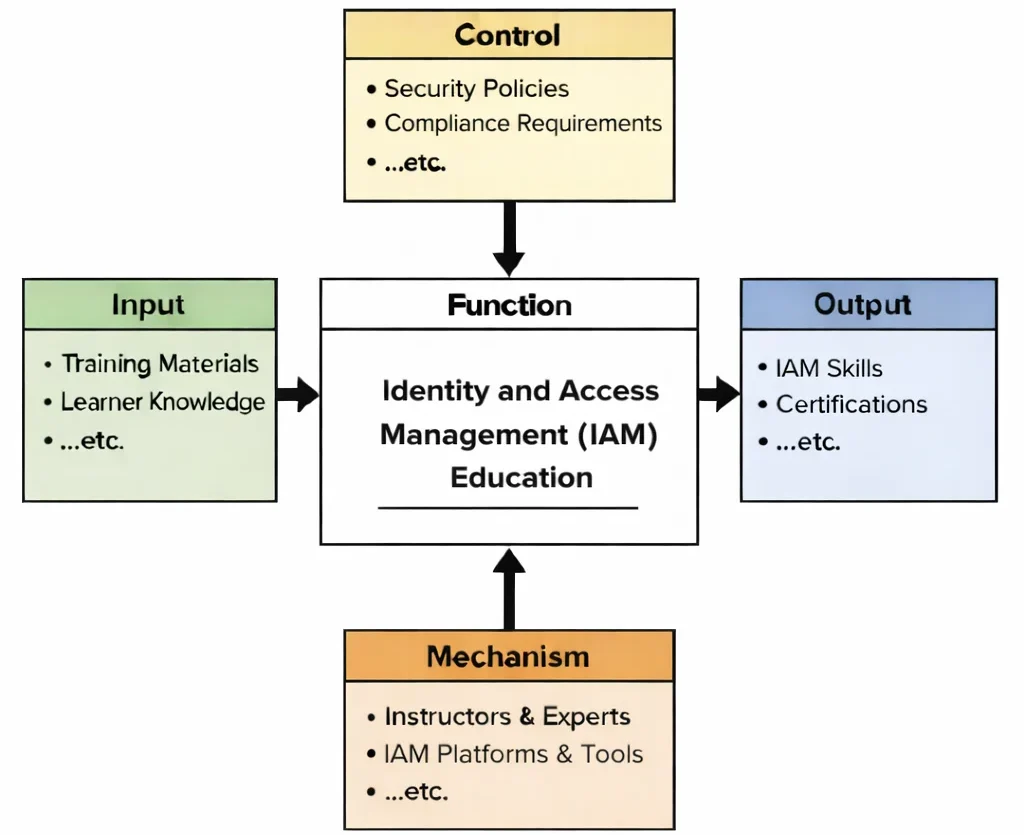
This IDEF0 (Input–Control–Output–Mechanism) diagram summarizes Identity and Access Management (IAM) Education as a structured transformation. Inputs include training materials and learner baseline knowledge of users, systems, and access concepts. Controls include security policies, compliance requirements, governance rules, and curriculum outcomes that define how access should be granted, reviewed, and revoked. Mechanisms include instructors, experts, IAM platforms and tools, and lab environments for practicing identity lifecycle management, authentication methods, role-based access, least privilege, and auditing. Outputs include learners who can design and operate IAM practices, interpret access risks, implement secure authentication and authorization patterns, and demonstrate competence through projects or certifications.
Interactive Check: Intro & System Concepts
Verify your understanding of how identity lifecycle management and governance rules establish modern security perimeters:
Introductory Concept Verification
1. Why is identity considered the “real perimeter” in modern cloud and hybrid architectures?
Answer: As workloads shift to multi-cloud platforms, remote workforces, and mobile devices, traditional physical network perimeters dissolve. Security boundaries now depend on verifying the identity (human user, API key, or service account) attempting to access a resource, making IAM the core security boundary.
2. What role do “Controls” play in the IDEF0 model for IAM Education?
Answer: Controls—including compliance standards, least-privilege policies, and access governance rules—define how permissions must be requested, approved, audited, and revoked to maintain strict accountability and prevent privilege creep.
Identity and Access Management (IAM) is a fundamental pillar of cybersecurity, focusing on defining and managing the roles, privileges, and access rights of users and systems within an organization. As digital transformation accelerates, IAM ensures that only authorized individuals can access sensitive resources, while preventing unauthorized access that could compromise application security and cloud environments. Effective IAM strategies not only mitigate risks but also streamline compliance with regulatory standards and internal policies.
With the increasing complexity of modern infrastructures, IAM is becoming even more critical in safeguarding hybrid and multi-cloud systems, where dynamic provisioning and automated scaling challenge traditional authentication models. Integration with AI and ML in cybersecurity allows IAM systems to detect behavioral anomalies and automate access decisions in real time. These enhancements play a crucial role in defending against advanced threats targeting endpoints, networks, and operational technology systems.
IAM intersects closely with disciplines such as cryptography, providing secure authentication protocols, identity tokens, and encryption mechanisms. It also underpins cybersecurity policies by establishing the rules for account creation, password policies, role-based access control, and deprovisioning. Ensuring strong awareness among employees about identity hygiene and phishing resilience further reinforces IAM effectiveness.
As digital identities extend beyond human users to include devices, APIs, and services, IAM plays a vital role in managing access across cyber-physical systems (CPS) and the Internet of Things. This complexity necessitates alignment with emerging areas in cybersecurity that emphasize zero-trust frameworks and least privilege principles. In response to incidents, IAM logs also provide forensic trails that enhance incident response and digital forensics.
IAM is a key component of network security, enforcing segmentation and limiting lateral movement within organizational networks. In threat landscapes where identity-based attacks are common, IAM helps analysts correlate identity anomalies with threat intelligence data for faster mitigation. Ethical security practices, including ethical hacking exercises, often test IAM policies by simulating privilege escalation or unauthorized data access.
Beyond access control, IAM contributes to data governance. Linking IAM frameworks with data collection policies ensures that access to personal and operational data is logged, monitored, and restricted appropriately. The insights gained from data analysis and big data analytics help organizations optimize permissions, spot outliers, and plan resource allocation more effectively.
Modern IAM platforms benefit from capabilities in tools and technologies in data science, especially for user behavior analytics and risk-based authentication. Preprocessing identity data with data cleaning techniques ensures accurate profiling and access decisions. Moreover, using data visualization, IAM professionals can uncover trends in login behavior, privilege usage, and policy violations.
IAM is also deeply tied to the ethical and social aspects of cybersecurity, particularly regarding user privacy, digital autonomy, and transparency. Domain-specific applications of IAM—whether in healthcare, finance, or education—are being explored through domain-specific analytics, ensuring that access control policies meet industry standards and social expectations.

This illustration represents IAM as the hub of modern cybersecurity, where digital identity sits at the center of many connected controls. The central panel labeled “Identity Access Management” is surrounded by user profile icons, symbolizing accounts, roles, and groups. Multiple padlocks and security emblems suggest authentication and authorization—verifying a user and then enforcing what resources they can reach. The radiating lines and node-like connections convey how IAM ties together many services across a network (applications, cloud platforms, data stores, and devices). Overall, the image communicates the main purpose of IAM: managing identities, granting appropriate access, and reducing risk by ensuring only the right people (and systems) can access sensitive resources.
Building Cyber Resilience: Identity & Access Management Navigation
Discover how Identity and Access Management governs user authentication, least-privilege authorization, and session security across the Cybersecurity cluster. Each card details Multi-Factor Authentication (MFA), Role-Based Access Control (RBAC), Single Sign-On (SSO), and identity governance.
Cybersecurity Overview
Presents the overarching macro-architecture, mapping how digital identity management functions as the foundational trust layer across all operational domains.
Network Security
Examines identity-driven network access control (802.1X), zero-trust network perimeter gating, and dynamic VPN token verification.
Application Security
Focuses on OAuth2 / OpenID Connect token verification, session cookie security flags (HttpOnly/Secure), and preventing authorization bypasses (IDOR).
Cloud Security
Details multi-cloud IAM role federation, short-lived STS session tokens, workloads identity federation (OIDC), and cloud access reviews.
Endpoint Security
Covers local device authentication, Local Administrator Password Solution (LAPS), Windows Hello for Business, and FIDO2 passkey integration.
Identity & Access Management
Focuses on Multi-Factor Authentication (MFA), Role-Based Access Control (RBAC/ABAC/ReBAC), Single Sign-On (SSO/SAML), Privileged Access Management (PAM), and identity governance.
Cryptography
Applies public-key infrastructure (PKI) for digital user certificates, cryptographic token signing (JWT RS256), and secure password hashing (Argon2).
Incident Response & Forensics
Orchestrates automated token revocation playbooks, analyzing authentication failure logs, and investigating credential stuffing attacks.
Threat Intelligence
Ingests dark web credential leak feeds and active password spraying IOCs to force automated password resets for compromised accounts.
Ethical Hacking & Pen Testing
Executes Kerberoasting simulations, privilege escalation testing, MFA push-fatigue bypass attempts, and Active Directory permission audits.
Cybersecurity Awareness
Educates users on avoiding MFA fatigue, adopting enterprise password managers, recognizing credential-harvesting phishing sites, and credential protection.
Policy & Governance
Codifies access control policies, least-privilege standards, mandatory quarterly permission reviews, and automated deprovisioning SLAs.
CPS Security
Protects physical access controllers, smart grid operator authentication, and device-level cryptographic certificates on cyber-physical hardware.
OT Security
Secures industrial SCADA and engineering workstation logins, enforcing jump-box authentication and vendor access logging.
AI & ML in Security
Leverages User and Entity Behavior Analytics (UEBA) to calculate continuous risk scores based on login times, location, and resource access anomalies.
Emerging Areas
Investigates Decentralized Identity (DID), zero-knowledge proof (ZKP) authentication, passwordless WebAuthn standards, and self-sovereign identity ledgers.
Key Topics in Identity and Access Management
Core mechanisms establishing authentication and authorization boundaries:
Multi-Factor Authentication (MFA)
- Authentication Factors: Combining something you know (password/PIN), something you have (hardware token, authenticator app, FIDO2 key), and something you are (biometrics).
- Benefits: Drastically reduces account compromise rates even if primary passwords are leaked or phished.
Access Control Models (RBAC, ABAC, ReBAC)
- Role-Based Access Control (RBAC): Assigning permissions based on organizational job roles (e.g., Developer, Auditor, Administrator).
- Attribute-Based Access Control (ABAC): Evaluating fine-grained user, resource, and environmental attributes (e.g., location, time of day, risk score).
- Relationship-Based Access Control (ReBAC): Evaluating permissions based on relationships between subjects and resources (Zanzibar model).
Single Sign-On (SSO) & Identity Federation
- Centralized Authentication: Allowing users to authenticate once using SAML 2.0 or OpenID Connect (OIDC) to access disparate enterprise applications.
Applications of Identity and Access Management
Operational execution of IAM controls in enterprise environments:
User Lifecycle Management (Provisioning & Deprovisioning)
- Automated Workflows: Granting role-appropriate access during onboarding and enforcing immediate account deprovisioning upon employee offboarding to prevent orphan accounts.
Privileged Access Management (PAM) & Monitoring
- Securing administrative credentials in vaults, enforcing Just-In-Time (JIT) access elevation, and capturing session recordings for compliance audits.
Emerging Trends in IAM
Advanced identity paradigms shaping modern digital security:
- Zero Trust IAM: Continuous risk-based evaluation requiring continuous authentication rather than implicit post-login trust.
- Passwordless Authentication: Utilizing FIDO2/WebAuthn standards, passkeys, and biometrics to eliminate password vulnerabilities entirely.
- User and Entity Behavior Analytics (UEBA): Applying machine learning to detect credential misuse based on anomalous login times, geolocations, or data access volumes.
Why Study Identity and Access Management
Mastering IAM prepares security professionals to control access boundaries effectively:
- Controlling Digital Access: Teaches how to enforce least privilege and segregation of duties across enterprise infrastructures.
- Mastering Modern Identity Protocols: Provides practical experience with OAuth2, OIDC, SAML, and cloud IAM platforms (Microsoft Entra ID, Okta, AWS IAM).
- Regulatory Compliance: Demonstrates how identity audit trails satisfy legal requirements (GDPR, HIPAA, ISO 27001).
Interactive Quick Review: IAM Concepts
Reinforce key concepts regarding authentication, authorization models, and identity lifecycle governance before reading the FAQ:
Quick Review Verification
1. What is the fundamental operational difference between Authentication and Authorization?
Answer: Authentication verifies *who* an entity is (validating credentials via password, MFA, or biometrics). Authorization determines *what* resources that authenticated identity is permitted to access (evaluating RBAC/ABAC policies and role permissions).
2. How does the Principle of Least Privilege mitigate insider threat risks?
Answer: Least privilege restricts user permissions strictly to the minimum access required to perform immediate job duties. If an account is compromised or an insider acts maliciously, the restricted permissions limit lateral movement and contain potential blast radius.
Identity and Access Management – Frequently Asked Questions
What is Identity and Access Management (IAM)?
IAM is the framework of policies, technologies, and processes ensuring the right identities receive appropriate access to digital resources at the right time for authorized reasons.
What are the core components of an IAM system?
Identity lifecycle management (provisioning/deprovisioning), authentication (MFA/SSO), authorization (RBAC/ABAC), and access governance auditing.
Why is Multi-Factor Authentication (MFA) critical?
MFA requires multiple independent identity verification factors, preventing unauthorized account access even if primary passwords are compromised through data leaks or phishing.
What is Single Sign-On (SSO)?
SSO allows users to authenticate once with a central identity provider (IdP) and gain seamless access to multiple applications without repeatedly entering credentials.
How does IAM support regulatory compliance?
IAM generates immutable access logs, enforces segregation of duties, automates quarterly access reviews, and proves due diligence for regulations like GDPR, HIPAA, and SOC 2.
What is Privileged Access Management (PAM)?
PAM is a specialized branch of IAM focused on securing, monitoring, and auditing administrative accounts (root/domain admin) with elevated system control rights.
Identity and Access Management: Conclusion
IAM is a cornerstone of modern cybersecurity, enabling organizations to protect their systems and data while providing secure, seamless access to authorized users. By adopting advanced IAM technologies and practices, organizations can strengthen their defenses and adapt to the evolving security landscape.
- Identity First: Establish identity as the primary Zero Trust security boundary.
- Least Privilege: Grant minimal necessary permissions and conduct regular access reviews.
- Automate Lifecycle: Automate provisioning and immediate offboarding deprovisioning to eliminate orphan accounts.
End-of-Page Exercises: Review, Reflections & Analytics
Review Questions and Answers
1. What is identity and access management (IAM) and why is it crucial for organizations?
Answer: IAM is a framework ensuring legitimate identities gain authorized access to digital assets. It is crucial because it prevents data breaches, enforces least privilege, and ensures regulatory compliance.
2. How do authentication and authorization differ within IAM systems?
Answer: Authentication verifies identity (“Who are you?”), while authorization evaluates policy permissions to grant or deny resource access (“What are you allowed to do?”).
3. What are the key components of an effective IAM strategy?
Answer: User lifecycle management, strong authentication (MFA/SSO), role-based authorization (RBAC), privileged access management (PAM), and continuous audit logging.
4. How does Multi-Factor Authentication (MFA) enhance IAM security?
Answer: By requiring two or more independent factors (knowledge, possession, inherence), neutralizing password-only credential theft and brute-force attacks.
5. What role does Role-Based Access Control (RBAC) play in IAM systems?
Answer: Assigns permissions to organizational roles rather than individual users, simplifying permission administration and preventing privilege creep.
6. How do IAM systems support regulatory compliance and audit requirements?
Answer: By supplying centralized audit trails documenting login timestamps, access decisions, permission grants, and automated user deprovisioning events.
7. What are the challenges associated with implementing IAM solutions in large organizations?
Answer: Integrating legacy systems, mapping complex job role hierarchies, managing orphan accounts, preventing MFA user fatigue, and scaling multi-cloud directory federation.
8. How does identity federation enhance user access across multiple domains?
Answer: By establishing trust relationships between identity providers (IdPs) and service providers (RPs) using standard protocols (SAML/OIDC), enabling single-credential login across domains.
9. What is the significance of user provisioning and de-provisioning in IAM?
Answer: Provisioning grants immediate, role-appropriate access to new hires; de-provisioning instantly revokes access upon departure, eliminating unmonitored orphan accounts.
10. How can continuous monitoring and analytics improve IAM effectiveness?
Answer: By analyzing behavioral telemetry (UEBA) to detect anomalous logins, trigger adaptive MFA challenges, or automatically isolate compromised accounts in real time.
Thought-Provoking Architectural Questions
1. How might emerging biometric technologies transform identity verification within IAM systems?
Answer: FIDO2 passkeys utilizing local device biometrics replace phishable passwords with cryptographic public-key challenge-responses, significantly reducing credential harvesting risks.
2. What are the implications of decentralized identity management for traditional IAM frameworks?
Answer: Decentralized Identity (DID) shifts credential ownership from centralized enterprise directories to user wallets via verifiable ledgers, eliminating single-point-of-failure directory databases.
3. In what ways can artificial intelligence enhance dynamic access control decisions in IAM systems?
Answer: AI calculates real-time contextual risk scores using location data, typing biometrics, and device posture, dynamically triggering step-up authentication or restricting sensitive access.
4. How can organizations balance user convenience and security in the implementation of IAM solutions?
Answer: By deploying frictionless passwordless Single Sign-On (SSO) alongside adaptive risk-based authentication that only prompts for MFA when anomalous behavior is detected.
5. What potential challenges and opportunities does cloud integration present for IAM systems?
Answer: Challenges include managing cross-cloud identity synchronization and permission sprawl; opportunities include leveraging centralized cloud Identity-as-a-Service (IDaaS) platforms.
6. How might emerging regulatory requirements impact the evolution of IAM strategies in global organizations?
Answer: Privacy mandates (GDPR, CCPA) require automated user consent tracking, fine-grained data access scoping, and demonstrable proof of automated account deprovisioning.
7. What are the potential benefits and risks of integrating identity federation into IAM architectures?
Answer: Benefits include centralized access control and reduced password fatigue; risks include single-point-of-failure vulnerabilities if the primary Identity Provider (IdP) is compromised.
8. How can continuous monitoring and analytics transform the way IAM systems respond to security threats?
Answer: Moves defense from static login verification to continuous session evaluation, automatically revoking access tokens mid-session if impossible travel or policy violations occur.
9. What role do user education and awareness play in strengthening IAM systems?
Answer: Prevents human social engineering compromise, teaching employees to recognize phishing sites designed to capture credentials or intercept MFA push notifications.
10. How might the convergence of IAM with endpoint and network security create a more unified defense strategy?
Answer: Enables Zero Trust architectures where access decisions dynamically combine user identity claims with endpoint health attestations and network location risk ratings.
11. What future trends could influence the evolution of IAM technologies?
Answer: AI autonomous identity governance, zero-knowledge proof authentication, machine/workload identity explosion, and post-quantum token signature algorithms.
12. How can organizations measure the ROI of their IAM investments?
Answer: By quantifying helpdesk cost reductions from self-service password resets, measuring decreased time-to-board new employees, and calculating avoided breach costs.
Numerical Engineering Problems & Solutions
Problem 1: Annual Unauthorized Access Attempts Prevented by MFA Enforcement
An organization manages 5,000 users. Implementing MFA reduces unauthorized access success rates from 5% (0.05) to 1% (0.01). Each user makes an average of 10 access attempts per day over 365 days. Calculate total annual access attempts, reduction in unauthorized rate, and total unauthorized access attempts prevented annually.
An organization manages 5,000 users. Implementing MFA reduces unauthorized access success rates from 5% (0.05) to 1% (0.01). Each user makes an average of 10 access attempts per day over 365 days. Calculate total annual access attempts, reduction in unauthorized rate, and total unauthorized access attempts prevented annually.
Solution:
- Daily access attempts = 5,000 users × 10 attempts/day = 50,000 attempts/day
- Total annual access attempts = 50,000 × 365 days = 18,250,000 attempts/year
- Unauthorized access rate reduction = 5% – 1% = 4% (0.04)
- Prevented attempts = 18,250,000 × 0.04 = 730,000 prevented attempts/year
Problem 2: Financial Payback Period for an IAM System Deployment
An IAM platform costs $200,000 in software implementation. The system reduces data breach risk by 60%. Baseline breach frequency was 20 incidents per year at $50,000 per breach ($1,000,000 annual loss). Calculate annual financial savings and payback period in years.
An IAM platform costs $200,000 in software implementation. The system reduces data breach risk by 60%. Baseline breach frequency was 20 incidents per year at $50,000 per breach ($1,000,000 annual loss). Calculate annual financial savings and payback period in years.
Solution:
- Baseline annual breach loss = 20 breaches × $50,000 = $1,000,000/year
- Annual gross savings (60% reduction) = $1,000,000 × 0.60 = $600,000/year
- Payback period = $200,000 / $600,000 = 0.333 years (approx. 4 months)
Problem 3: User Provisioning Error Reduction Metrics
An automated IAM provisioning engine cuts onboarding errors from 8% (0.08) to 2% (0.02) across 10,000 annual new user accounts. Calculate onboarding errors before and after automation, absolute error reduction, and percentage error reduction.
An automated IAM provisioning engine cuts onboarding errors from 8% (0.08) to 2% (0.02) across 10,000 annual new user accounts. Calculate onboarding errors before and after automation, absolute error reduction, and percentage error reduction.
Solution:
- Provisioning errors before = 10,000 × 0.08 = 800 errors/year
- Provisioning errors after = 10,000 × 0.02 = 200 errors/year
- Absolute error reduction = 800 – 200 = 600 errors eliminated
- Percentage reduction = (600 / 800) × 100 = 75.0%
Problem 4: Authentication Log Volume & Per-User Averages
An IAM cluster processes 1,200 authentication logs per minute 24/7. Calculate total logs processed daily, monthly (30 days), and average monthly logs per user across a user base of 20,000 users.
An IAM cluster processes 1,200 authentication logs per minute 24/7. Calculate total logs processed daily, monthly (30 days), and average monthly logs per user across a user base of 20,000 users.
Solution:
- Daily log volume = 1,200 logs/min × 60 min × 24 hours = 1,728,000 logs/day
- Monthly log volume (30 days) = 1,728,000 × 30 = 51,840,000 logs/month
- Average monthly logs per user = 51,840,000 / 20,000 users = 2,592 logs/user/month
Problem 5: Biometric Authentication Performance Calculation
A biometric authentication scanner processes 15,000 attempts with a 98% (0.98) genuine acceptance rate and a 2% (0.02) false rejection rate. Calculate successful authentications, false rejections, and overall error rate.
A biometric authentication scanner processes 15,000 attempts with a 98% (0.98) genuine acceptance rate and a 2% (0.02) false rejection rate. Calculate successful authentications, false rejections, and overall error rate.
Solution:
- Successful authentications = 15,000 × 0.98 = 14,700 attempts
- False rejections = 15,000 × 0.02 = 300 attempts
- Overall error rate = (300 / 15,000) × 100 = 2.0%
Problem 6: Incident Reduction from Role-Based Access Control (RBAC)
Implementing strict RBAC across 8,000 employees reduces unauthorized access incidents by 85% from a baseline of 400 incidents per year. Calculate expected incidents after implementation and absolute incident reduction.
Implementing strict RBAC across 8,000 employees reduces unauthorized access incidents by 85% from a baseline of 400 incidents per year. Calculate expected incidents after implementation and absolute incident reduction.
Solution:
- Absolute incident reduction = 400 × 0.85 = 340 incidents prevented
- Expected post-RBAC annual incidents = 400 – 340 = 60 incidents/year
Problem 7: Productivity Time Saved via Single Sign-On (SSO)
Implementing SSO cuts average user authentication login duration from 60 seconds to 15 seconds. For 10,000 daily logins, calculate total time saved daily in seconds, monthly (30 days) in seconds, and total annual hours saved (365 days).
Implementing SSO cuts average user authentication login duration from 60 seconds to 15 seconds. For 10,000 daily logins, calculate total time saved daily in seconds, monthly (30 days) in seconds, and total annual hours saved (365 days).
Solution:
- Time saved per login = 60 seconds – 15 seconds = 45 seconds saved
- Daily time saved = 10,000 logins × 45 seconds = 450,000 seconds/day
- Monthly time saved = 450,000 × 30 = 13,500,000 seconds/month
- Annual time saved in seconds = 450,000 × 365 = 164,250,000 seconds/year
- Convert annual seconds to hours = 164,250,000 / 3,600 ≈ 45,625 hours/year
Problem 8: Password Reset Request Reduction Metrics
Deploying self-service password reset and SSO reduces helpdesk password reset requests by 70% from an initial baseline of 5,000 requests per year. Calculate requests prevented and post-implementation annual requests.
Deploying self-service password reset and SSO reduces helpdesk password reset requests by 70% from an initial baseline of 5,000 requests per year. Calculate requests prevented and post-implementation annual requests.
Solution:
- Requests prevented = 5,000 × 0.70 = 3,500 requests prevented
- Post-implementation requests = 5,000 – 3,500 = 1,500 requests/year
Problem 9: Identity Provider Consolidation Overhead Reduction
An enterprise consolidates 12 disparate identity providers into a single centralized IDaaS directory. Each legacy provider required 200 administrative hours per year (2,400 baseline hours). Centralization cuts total administrative labor by 50%. Calculate pre-consolidation hours and annual labor hours saved.
An enterprise consolidates 12 disparate identity providers into a single centralized IDaaS directory. Each legacy provider required 200 administrative hours per year (2,400 baseline hours). Centralization cuts total administrative labor by 50%. Calculate pre-consolidation hours and annual labor hours saved.
Solution:
- Total pre-consolidation admin hours = 12 providers × 200 hours = 2,400 hours/year
- Annual hours saved (50% reduction) = 2,400 × 0.50 = 1,200 hours/year
Problem 10: Access Request Approval Processing Acceleration
An automated IAM access workflow reduces ticket approval processing duration from 10 minutes to 3 minutes per request. For 4,000 annual access requests, calculate total processing time before and after, and total annual hours saved.
An automated IAM access workflow reduces ticket approval processing duration from 10 minutes to 3 minutes per request. For 4,000 annual access requests, calculate total processing time before and after, and total annual hours saved.
Solution:
- Total processing time before = 4,000 × 10 minutes = 40,000 minutes
- Total processing time after = 4,000 × 3 minutes = 12,000 minutes
- Time saved in minutes = 40,000 – 12,000 = 28,000 minutes
- Convert saved time to hours = 28,000 / 60 ≈ 466.67 hours/year
Problem 11: Compromised Account Reduction via MFA Deployment
Deploying MFA across 25,000 users cuts account compromise probability by 90% from an initial baseline of 4% (1,000 compromised accounts). Calculate expected compromises before MFA, post-MFA compromise probability, post-MFA expected compromises, and accounts protected.
Deploying MFA across 25,000 users cuts account compromise probability by 90% from an initial baseline of 4% (1,000 compromised accounts). Calculate expected compromises before MFA, post-MFA compromise probability, post-MFA expected compromises, and accounts protected.
Solution:
- Baseline expected compromises = 25,000 × 0.04 = 1,000 accounts
- Post-MFA compromise probability = 4% × (1 – 0.90) = 0.4% (0.004)
- Post-MFA expected compromises = 25,000 × 0.004 = 100 accounts
- Accounts protected = 1,000 – 100 = 900 accounts saved
Problem 12: Daily Flagged Anomaly Reduction via UEBA Fine-Tuning
An IAM system logs 200,000 daily events where 0.25% (500 events) are flagged for security review. Deploying UEBA machine learning models reduces false positive flags by 60%. Calculate initial flagged events, new daily flagged events, and absolute reduction in daily alerts.
An IAM system logs 200,000 daily events where 0.25% (500 events) are flagged for security review. Deploying UEBA machine learning models reduces false positive flags by 60%. Calculate initial flagged events, new daily flagged events, and absolute reduction in daily alerts.
Solution:
- Initial daily flagged events = 200,000 × 0.0025 = 500 flagged events/day
- New flag rate = 0.0025 × (1 – 0.60) = 0.001 (0.1%)
- New daily flagged events = 200,000 × 0.001 = 200 flagged events/day
- Absolute reduction in flagged events = 500 – 200 = 300 events/day
Identity and Access Management — Summary & Wrap-Up
Identity and Access Management (IAM) establishes the foundational trust boundary for modern digital ecosystems. By combining multi-factor authentication, least-privilege authorization models (RBAC/ABAC), single sign-on federation, and automated user lifecycle governance, organizations secure applications, clouds, and endpoints while enabling seamless, compliant user access.