
AI and ML in Cybersecurity Education is where pattern-finding meets prudence. The diagram shows the discipline in four directions. Learners arrive with inputs—security basics, datasets, and conceptual tools—but their progress is guided by controls that matter as much as accuracy: governance rules, privacy boundaries, evaluation standards, and the simple reality that a model can be “clever” and still be wrong in dangerous ways. With mechanisms such as guided labs and expert coaching, students learn how to turn messy security signals into something a model can work with—logs into features, alerts into labels, and intuition into measurable tests. They also learn the hard lessons early: adversaries adapt, data shifts, false positives drain attention, and a model must be monitored like any other critical system. The output is not “AI magic,” but a grounded capability—learners who can build ML-assisted detection thoughtfully, explain what their models can and cannot claim, and weave AI into cybersecurity as a reliable partner rather than an unchecked oracle.
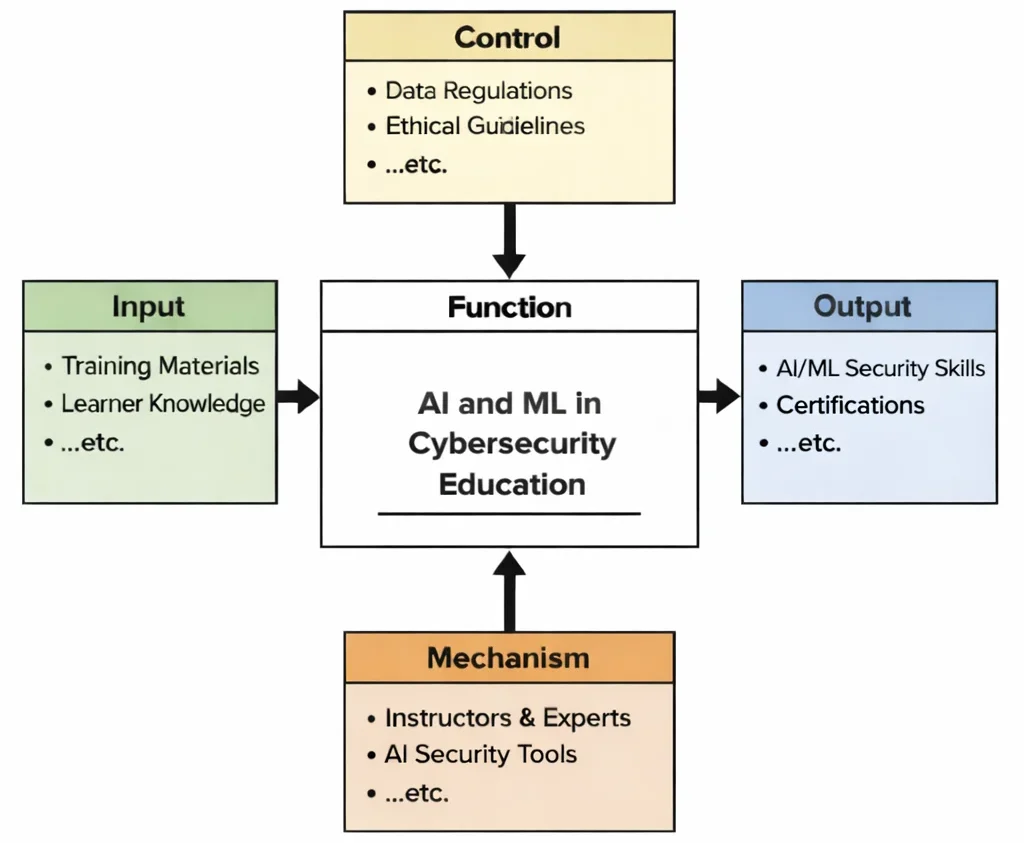
This IDEF0 (Input–Control–Output–Mechanism) diagram presents AI and ML in Cybersecurity Education as a structured transformation. Inputs include training materials and learner knowledge (such as basic security concepts, data literacy, and introductory ML ideas). Controls include security protocols, governance and compliance expectations, model risk considerations, and curriculum requirements that shape what is acceptable, testable, and ethical in security analytics. Mechanisms such as instructors, experts, lab environments, and ML/security tooling enable hands-on practice with data pipelines, feature engineering, anomaly detection, classification, evaluation metrics, and operational monitoring. Outputs include learners who can apply AI/ML methods to cybersecurity problems—building and assessing detection models, understanding limitations (false positives, drift, bias), and using ML responsibly within real security workflows.
Interactive Check: Intro & System Concepts
Verify your understanding of how AI/ML models transform raw security signals under real-world operational constraints:
Introductory Concept Verification
1. Why must machine learning models in cybersecurity be governed by strict controls rather than accuracy metrics alone?
Answer: High model accuracy alone does not guarantee security. Models can suffer from adversarial evasion, data drift, biased training datasets, or excessive false positives that overwhelm SOC analysts. Governance rules, privacy boundaries, and continuous monitoring controls ensure models perform reliably and ethically in production.
2. What role do “mechanisms” play in the IDEF0 framework for AI security education?
Answer: Mechanisms—such as lab environments, security analytics platforms (TensorFlow, Splunk), and expert instruction—provide the practical tools for students to transform raw logs into feature sets, build anomaly detection models, and evaluate detection trade-offs hands-on.
As cyber threats become increasingly complex and unpredictable, traditional defense mechanisms struggle to keep pace. This has accelerated the integration of data science and analytics and big data analytics with cybersecurity tools, enabling the use of artificial intelligence (AI) and machine learning (ML) to detect patterns, anomalies, and potential breaches in real time. These technologies play a crucial role in strengthening threat intelligence, helping organizations predict and prevent cyberattacks before they materialize.
Modern systems such as DevOps pipelines and serverless computing require dynamic security frameworks. AI models are trained to recognize normal versus suspicious behavior across cloud networks, making them critical for defending digital infrastructure. The integration of scalability and performance tuning practices also depends on secure automation, enabled by real-time analytics and predictive modeling.
In high-risk sectors such as operational technology (OT) and cyber-physical systems, AI-enhanced tools can help defend mission-critical assets through rapid adaptation to environmental changes. Meanwhile, sensitive information is safeguarded with adaptive identity and access management and AI-informed application security protocols.
In the broader ecosystem of cybersecurity, artificial intelligence enhances each layer, from automating patch management to improving incident response and forensics. It’s also pivotal in upholding compliance and governance standards, as intelligent monitoring tools ensure that systems meet regulatory and operational benchmarks.
Machine learning algorithms support the evolution of cryptographic methods, building stronger encryption techniques by analyzing vulnerabilities at scale. Furthermore, adaptive AI agents are increasingly employed in endpoint protection and network defense, drastically reducing response times against previously unseen threats.
In critical environments such as edge computing, where data is processed locally, AI ensures that decision-making occurs with minimal latency while retaining high-security standards. Similarly, modern containerized environments leverage ML tools for continuous monitoring, threat modeling, and policy enforcement.
As emerging areas in cybersecurity gain attention, AI and ML continue to shape how organizations approach vulnerabilities and prepare for future risks. They are also used to support cybersecurity awareness campaigns, tailoring education based on employee behavior, and are embedded in strategies to enforce security policies more effectively.
Advanced AI-driven systems can even simulate cyberattacks through ethical hacking, testing defenses and suggesting automated remediation paths. When implemented thoughtfully, these technologies bridge the gap between traditional defense mechanisms and the ever-evolving threat landscape, reshaping the practice of cybersecurity as a proactive, intelligent discipline.

A vivid, futuristic illustration shows a large, luminous brain formed from circuit traces, floating above a digital landscape that resembles a motherboard or network grid. Streams of light run from the brain down into the circuitry, suggesting machine-learning models feeding signals into real-time security systems. Surrounding the brain are dashboard-like panels with graphs, code-like textures, and glowing symbols—including a padlock and shield—representing encryption, protection, and monitoring. The overall scene conveys automated threat detection, pattern recognition, and data-driven defense, where AI analyzes vast streams of information to identify suspicious behavior and help secure systems, networks, and cloud services.
Building Cyber Resilience: AI & Machine Learning Navigation
Discover how artificial intelligence and machine learning models automate anomaly detection, predictive threat scoring, and zero-trust verification across the Cybersecurity cluster. Each card details model training pipelines, feature engineering, and automated response capabilities.
Cybersecurity Overview
Presents the high-level system framework, mapping how machine learning intelligence integrates with defensive controls, incident triage, and risk governance.
Network Security
Examines deep learning packet inspection, identifying stealthy encrypted C2 traffic streams, covert data exfiltration channels, and automated DDoS mitigation.
Application Security
Focuses on AI-assisted static code vulnerability scanning, transformer-based SAST models, automated API payload sanitization, and Web Application Firewall (WAF) tuning.
Cloud Security
Details ML-driven Cloud Security Posture Management (CSPM), detecting infrastructure configuration drift, abnormal multi-region S3 downloads, and unencrypted bucket creation.
Endpoint Security
Covers behavioral Endpoint Detection and Response (EDR) agents, running on-device ML classifiers to terminate signatureless ransomware executions in real time.
Identity & Access Management
Explores User and Entity Behavior Analytics (UEBA), calculating continuous risk scores based on login locations, typing biometrics, and unusual resource access.
Cryptography
Applies ML models to analyze cryptographic key entropy, evaluate lattice-based Post-Quantum Cryptography implementations, and detect side-channel timing leaks.
Incident Response & Forensics
Orchestrates automated SOAR playbooks, utilizing Natural Language Processing (NLP) to parse forensic disk images, correlate SIEM event logs, and isolate compromised hosts.
Threat Intelligence
Utilizes automated scraping and NLP text mining across dark web forums to extract Indicators of Compromise (IoCs) and categorize threat actor TTPs automatically.
Ethical Hacking & Pen Testing
Executes AI-powered automated penetration testing, utilizing reinforcement learning agents to discover multi-hop exploit paths inside staging environments.
Cybersecurity Awareness
Generates adaptive phishing simulation campaigns, analyzing employee click patterns to deliver personalized micro-learning security modules automatically.
Policy & Governance
Establishes AI Safety and Model Governance frameworks, enforcing audit standards for Explainable AI (XAI), training data privacy compliance, and model risk limits.
CPS Security
Protects cyber-physical systems using real-time sensor anomaly detection models, ensuring physical safety in autonomous transit, medical robotics, and smart grids.
OT Security
Applies unsupervised clustering models to industrial SCADA/PLC network traffic, identifying unauthorized register write commands without disrupting factory operations.
AI & Cybersecurity
Focuses on supervised/unsupervised anomaly detection, NLP phishing classification, zero-day threat prediction, adversarial robustness, and automated SOAR response.
Emerging Areas
Investigates frontier defensive paradigms, including Federated Learning for privacy-preserving threat sharing, homomorphic ML, and defenses against LLM prompt injection.
Core Architectural Topics in AI and ML for Cybersecurity
Modern AI-driven cyber defense relies on specialized algorithmic models trained on massive network, endpoint, and identity telemetry streams:
- Anomaly Detection via Machine Learning:
- Supervised Learning: Decision Trees, Random Forests, and Deep Neural Networks trained on labeled datasets of known benign vs. malicious executions.
- Unsupervised Learning: k-Means clustering, Isolation Forests, and Autoencoders identifying novel, previously unseen deviations without prior attack signatures.
- Primary Use Cases: Identifying lateral network movement, unusual database data exfiltration volumes, and compromised user account logins.
- AI-Powered Phishing & Messaging Defense:
- Natural Language Processing (NLP): Analyzing email text sentiment, urgency signals, and domain spoofing patterns to block spear-phishing attacks.
- Computer Vision & Link Analysis: Rendering target website login forms inside sandboxes to detect brand logo impersonation and credential-harvesting pages.
- Automated Incident Response & SOAR Integration:
- Security Orchestration, Automation, and Response (SOAR): AI engines correlate alerts across firewalls, EDR agents, and identity providers to execute instant containment playbooks (e.g., revoking JWT tokens or quarantining host IPs) in milliseconds.
- Defending Against Adversarial AI Attacks:
- Adversarial Evasion: Attackers craft subtle noise perturbations in malware binaries or network payloads to trick ML classifiers into predicting “benign”.
- Data Poisoning & Model Inversion: Injecting corrupt samples into training pipelines to create detection backdoors or extracting sensitive training data from open models.
Why Study AI and ML in Cybersecurity
Gaining expertise in machine learning security prepares technical specialists to tackle modern, high-speed attack vectors:
- High-Speed Threat Mitigation: Human analysts cannot manually evaluate billions of daily log events; AI acts as an essential force multiplier for Security Operations Centers (SOCs).
- Proactive Zero-Day Defense: Replaces static, easily bypassed anti-virus signatures with adaptive behavioral models that detect brand-new exploit methods instantly.
- Cutting-Edge Industry Relevance: AI security engineers, ML threat analysts, and SecOps automation specialists represent some of the highest-paid roles in the global technology sector.
Interactive Review & Problem Solving
Test your mastery of machine learning threat classification, anomaly detection algorithms, and performance calculations before exploring technical FAQs:
Review Questions & Answers
1. What is AI cybersecurity and why is it essential in modern digital defense?
Answer: AI cybersecurity applies machine learning algorithms to process massive security telemetry streams in real time. It is essential because human security teams cannot manually analyze billions of daily log events, and signature-based tools fail against novel zero-day attacks.
2. How does artificial intelligence enhance threat detection in cybersecurity systems?
Answer: AI enhances threat detection using behavioral analytics and feature extraction. By establishing baseline models of normal user, network, and system activity, AI detects subtle, multi-stage anomalous behaviors that bypass traditional static signature rules.
3. What role does machine learning play in modern cybersecurity strategies?
Answer: ML dynamically updates risk scores, classifies file binaries as malicious or benign, filters phishing content via Natural Language Processing (NLP), and prioritizes SIEM security alerts automatically to reduce analyst fatigue.
4. How can AI-driven systems automate incident response in cybersecurity?
Answer: Integrated with SOAR platforms, AI correlates alerts from multiple sources, confirms incident validity, and triggers automated playbooks—quarantining infected endpoint devices, blocking malicious IP addresses, or revoking compromised tokens in milliseconds.
5. What are the benefits of using AI for risk management in cybersecurity?
Answer: Benefits include predictive vulnerability prioritization (identifying which CVE patches are actively exploited in the wild), continuous real-time risk scoring, reduced breach discovery windows, and optimized resource allocation.
6. How does predictive analytics contribute to AI-driven cybersecurity measures?
Answer: Predictive analytics evaluates historical attack trends, dark web threat feeds, and system configurations to forecast likely attack vectors, enabling security teams to harden defenses proactively before exploits occur.
7. What challenges are associated with implementing AI in cybersecurity, and how can they be addressed?
Answer: Challenges include high false positive rates, adversarial evasion attacks, data bias, and lack of model explainability (black-box decisions). Addressed through human-in-the-loop validation, adversarial training, and Explainable AI (XAI) frameworks.
8. How do AI cybersecurity tools help mitigate Advanced Persistent Threats (APTs)?
Answer: APTs move slowly and stealthily over months. AI tools use sequence modeling and graph analytics to connect low-signal events across disparate system logs over time, exposing hidden lateral movement and data staging.
9. In what ways can AI improve the overall efficiency of cybersecurity operations?
Answer: By automatically triaging routine security alerts, grouping duplicate incidents, automating log parsing, and enriching threat alerts with context, allowing human analysts to focus on high-priority threat hunting.
10. What future trends in AI cybersecurity are expected to shape the digital defense landscape?
Answer: Key trends include Generative AI threat simulation, Federated Learning for privacy-safe threat intelligence sharing, autonomous AI incident response agents, and defenses against LLM prompt injection attacks.
Thought-Provoking Architectural Questions
1. How might the integration of AI with cybersecurity redefine traditional threat detection methods?
Answer: Shifts defense from reactive, signature-matching static rules to proactive, dynamic behavioral modeling. Systems continuously learn baseline behavior, identifying attacks based on malicious intent and operational impact rather than known file hashes.
2. What are the potential risks of over-reliance on AI in cybersecurity, and how can organizations mitigate them?
Answer: Over-reliance can lead to skill degradation in human teams, blind spots from model drift, and single-point-of-failure susceptibility to adversarial poisoning. Mitigate by enforcing “human-in-the-loop” oversight for high-impact actions and continuous model auditing.
3. How can AI-driven cybersecurity solutions adapt to the constantly evolving threat landscape?
Answer: Through continuous online learning pipelines, automated MLOps retraining loops fed by real-time threat intelligence feeds, and reinforcement learning environments that simulate adversary counter-tactics.
4. What ethical considerations must be addressed when implementing AI in cybersecurity operations?
Answer: Ethical concerns include invasive employee monitoring (privacy violations via UEBA), algorithmic bias falsely accusing users of insider threats, and lack of transparency when black-box AI algorithms terminate critical services automatically.
5. How might advancements in quantum computing impact AI-driven cybersecurity systems?
Answer: Quantum ML (QML) could accelerate high-dimensional threat pattern analysis by orders of magnitude. Conversely, quantum algorithms could break traditional encryption protecting training pipelines, making Post-Quantum Cryptography essential.
6. What role does continuous monitoring play in the success of AI-driven cybersecurity strategies?
Answer: Continuous telemetry collection feeds real-time inference engines. Without uninterrupted monitoring of network flows, endpoint processes, and user events, AI models lack the real-time context needed to catch fast-moving ransomware.
7. How can organizations measure the effectiveness of AI-driven cybersecurity initiatives over time?
Answer: By tracking key operational metrics: Mean Time to Detect (MTTD), Mean Time to Respond (MTTR), false positive reduction percentages, automated alert triage ratios, and cost per prevented security incident.
8. What potential challenges might arise from integrating AI with legacy cybersecurity systems?
Answer: Legacy tools often output unformatted, unstructured logs lacking API integration points. Overcome by deploying SIEM log normalization adapters and middleware abstraction layers to format data for ML pipelines.
9. How might the rise of remote work influence AI cybersecurity strategies?
Answer: Expands the network perimeter to home Wi-Fi and unmanaged endpoints. AI models shift focus toward zero-trust endpoint telemetry and behavioral risk profiling rather than relying on internal corporate network location.
10. What are the implications of increased cyber threats for AI-driven risk management?
Answer: Drives the adoption of dynamic risk-adaptive controls. Instead of static access policies, AI continuously recalculates user and device risk scores, dynamically triggering additional authentication or restricting permissions as threat activity rises.
11. How might international cybersecurity regulations shape the future development of AI-driven security solutions?
Answer: Laws like the EU AI Act enforce strict governance on high-risk AI models, requiring vendors to demonstrate algorithmic explainability, audit trail logging, and protection against training data privacy leaks.
12. What potential advancements in AI cybersecurity do you foresee transforming risk management?
Answer: Fully autonomous SOC defensive agents capable of dynamically patching zero-day code vulnerabilities, re-configuring network topologies during active attacks, and self-healing compromised infrastructure without human delay.
Numerical Engineering Problems & Solutions
Problem 1: Calculating Annual Financial Savings from AI Threat Detection
An enterprise experiences an average data breach cost of $500,000 per successful incident. Deploying an AI-driven threat detection platform prevents an average of 3 major data breaches per year. Calculate the total annual financial savings.
An enterprise experiences an average data breach cost of $500,000 per successful incident. Deploying an AI-driven threat detection platform prevents an average of 3 major data breaches per year. Calculate the total annual financial savings.
Solution:
- Breaches prevented = 3 incidents
- Cost per breach = $500,000
- Annual financial savings = 3 × $500,000 = $1,500,000/year
Problem 2: Estimating Cost Reduction from Automated Incident Response
Manual incident response processes cost a SOC $50,000 per security incident in engineering labor. Deploying an AI SOAR automation platform cuts manual response labor costs by 40%. Calculate labor savings per incident and total annual savings across 10 annual incidents.
Manual incident response processes cost a SOC $50,000 per security incident in engineering labor. Deploying an AI SOAR automation platform cuts manual response labor costs by 40%. Calculate labor savings per incident and total annual savings across 10 annual incidents.
Solution:
- Labor savings per incident = $50,000 × 0.40 = $20,000 saved/incident
- New cost per incident = $50,000 – $20,000 = $30,000
- Annual savings across 10 incidents = 10 × $20,000 = $200,000/year
Problem 3: Determining ROI for an AI Cybersecurity Software Investment
An enterprise invests $300,000 in an AI behavioral analytics platform. The system generates $150,000 in annual operational efficiency and breach mitigation savings. Calculate payback period in years and 4-year net Return on Investment (ROI) percentage.
An enterprise invests $300,000 in an AI behavioral analytics platform. The system generates $150,000 in annual operational efficiency and breach mitigation savings. Calculate payback period in years and 4-year net Return on Investment (ROI) percentage.
Solution:
- Payback period = $300,000 / $150,000 = 2.0 years
- 4-Year cumulative gross savings = $150,000 × 4 years = $600,000
- 4-Year net gain = $600,000 – $300,000 = $300,000
- 4-Year ROI = ($300,000 / $300,000) × 100 = 100.0%
Problem 4: Calculating Average Response Time Improvement
Before AI implementation, a SOC required an average response time of 45 minutes to contain a verified malware threat. Deploying AI endpoint agents lowers containment time to 30 minutes. Calculate time saved in minutes and percentage response time improvement.
Before AI implementation, a SOC required an average response time of 45 minutes to contain a verified malware threat. Deploying AI endpoint agents lowers containment time to 30 minutes. Calculate time saved in minutes and percentage response time improvement.
Solution:
- Time saved per incident = 45 minutes – 30 minutes = 15 minutes saved
- Percentage improvement = (15 / 45) × 100 = 33.33%
Problem 5: Estimating False Positive Alert Reduction
A legacy SIEM system exhibits a 20% false positive alert rate across daily notifications. Upgrading to an ML alert-filtering engine reduces the false positive rate down to 5%. Calculate absolute percentage point drop and relative false positive reduction percentage.
A legacy SIEM system exhibits a 20% false positive alert rate across daily notifications. Upgrading to an ML alert-filtering engine reduces the false positive rate down to 5%. Calculate absolute percentage point drop and relative false positive reduction percentage.
Solution:
- Absolute percentage point drop = 20% – 5% = 15 percentage points
- Relative false positive reduction = (15% / 20%) × 100 = 75.0%
Problem 6: Calculating Threat Detection Accuracy Increase
A rule-based intrusion detection system demonstrates a 80% baseline threat detection accuracy. Upgrading to a deep neural network model improves threat detection accuracy to 95%. Calculate absolute accuracy increase and relative percentage improvement.
A rule-based intrusion detection system demonstrates a 80% baseline threat detection accuracy. Upgrading to a deep neural network model improves threat detection accuracy to 95%. Calculate absolute accuracy increase and relative percentage improvement.
Solution:
- Absolute accuracy gain = 95% – 80% = 15 percentage points
- Relative accuracy improvement = (15% / 80%) × 100 = 18.75%
Problem 7: Determining Total Analyst Hours Saved by Automated Monitoring
Manual log triage requires 200 analyst hours per month. Deploying an AI log parser automates routine inspection, cutting manual labor hours by 60%. Calculate monthly analyst hours saved and total annual hours saved.
Manual log triage requires 200 analyst hours per month. Deploying an AI log parser automates routine inspection, cutting manual labor hours by 60%. Calculate monthly analyst hours saved and total annual hours saved.
Solution:
- Monthly hours saved = 200 hours × 0.60 = 120 hours saved/month
- Annual hours saved = 120 hours × 12 months = 1,440 hours/year
Problem 8: Estimating Cost Per Threat Prevented by AI
An AI threat hunting tool costs $100,000 in annual license fees and successfully isolates 25 significant zero-day threats per year before damage occurs. Calculate average tool cost incurred per threat prevented.
An AI threat hunting tool costs $100,000 in annual license fees and successfully isolates 25 significant zero-day threats per year before damage occurs. Calculate average tool cost incurred per threat prevented.
Solution:
- Cost per threat prevented = Total Annual Cost / Threat Count = $100,000 / 25 threats = $4,000 per threat
Problem 9: Calculating System Uptime Improvement and Downtime Hours Saved
An enterprise infrastructure maintains 99.0% availability without AI. Deploying AI predictive maintenance and threat mitigation raises availability to 99.9%. Calculate uptime percentage increase and annual downtime hours saved (out of 8,760 total annual hours).
An enterprise infrastructure maintains 99.0% availability without AI. Deploying AI predictive maintenance and threat mitigation raises availability to 99.9%. Calculate uptime percentage increase and annual downtime hours saved (out of 8,760 total annual hours).
Solution:
- Uptime improvement = 99.9% – 99.0% = 0.9% percentage point gain
- Original annual downtime = 8,760 hours × (1 – 0.990) = 87.6 hours downtime
- New annual downtime = 8,760 hours × (1 – 0.999) = 8.76 hours downtime
- Downtime hours saved = 87.6 – 8.76 = 78.84 hours saved/year
Problem 10: Estimating Cost Differential in Ransomware Breach Recovery
The baseline average recovery cost per ransomware breach is $500,000 without AI defenses. AI endpoint protection reduces breach damage severity, lowering recovery costs by 30%. Calculate recovery cost savings per breach and total annual savings across 4 incident attempts.
The baseline average recovery cost per ransomware breach is $500,000 without AI defenses. AI endpoint protection reduces breach damage severity, lowering recovery costs by 30%. Calculate recovery cost savings per breach and total annual savings across 4 incident attempts.
Solution:
- Cost reduction per breach = $500,000 × 0.30 = $150,000 saved/breach
- New recovery cost per breach = $500,000 – $150,000 = $350,000
- Annual cost reduction across 4 incidents = 4 × $150,000 = $600,000/year
Problem 11: Calculating Average Annual Savings per Employee from AI Phishing Training
Targeted AI phishing training costs $100 per employee annually. The personalized simulation reduces phishing vulnerability loss by $200 per employee per year. Calculate net savings per employee and net annual organizational savings for 1,000 employees.
Targeted AI phishing training costs $100 per employee annually. The personalized simulation reduces phishing vulnerability loss by $200 per employee per year. Calculate net savings per employee and net annual organizational savings for 1,000 employees.
Solution:
- Net savings per employee = $200 (loss reduction) – $100 (training cost) = $100/employee/year
- Total annual savings for 1,000 employees = 1,000 × $100 = $100,000/year
Problem 12: Break-Even Analysis for an AI Cybersecurity Upgrade Project
Upgrading a SOC to an AI-driven security suite requires a $250,000 initial software setup investment. The project generates $20,000 in monthly operational and breach-loss savings. Calculate break-even payback period in months and total net savings over 5 years (60 months).
Upgrading a SOC to an AI-driven security suite requires a $250,000 initial software setup investment. The project generates $20,000 in monthly operational and breach-loss savings. Calculate break-even payback period in months and total net savings over 5 years (60 months).
Solution:
- Payback break-even period = $250,000 / $20,000 = 12.5 months (rounded to 13th month)
- Total 60-month gross savings = 60 months × $20,000 = $1,200,000
- Net financial savings = $1,200,000 – $250,000 = $950,000
Engineering FAQs: AI & Machine Learning in Cybersecurity
How are Artificial Intelligence (AI) and Machine Learning (ML) used in cybersecurity?
AI and ML process high-volume network, system, and user telemetry streams to detect cyber threats faster than static rule-based tools. ML models establish baseline normal behaviors to flag anomalies, classify file binaries as malware, filter phishing emails via NLP, and prioritize security alerts automatically.
What is the difference between AI and ML in cybersecurity?
Artificial Intelligence is a broad concept describing software systems capable of autonomous decision-making. Machine Learning is a specific subset of AI where mathematical algorithms learn statistical detection patterns from historical data logs without requiring explicitly hardcoded rules.
What machine learning models are most commonly used for cyber threat detection?
Supervised learning models (Random Forests, Support Vector Machines, Deep Neural Networks) classify known malicious vs. benign payloads. Unsupervised models (Isolation Forests, k-Means clustering) group un-labeled telemetry to expose novel zero-day anomalies and insider threats.
How does AI improve upon traditional rule-based security systems?
Rule-based systems rely on static signatures that fail against mutated malware or zero-day exploits. AI continuously updates its understanding of normal system behavior, identifying subtle multi-step attack patterns and dramatically lowering false positive noise.
What are the primary risks and limitations of using AI in cybersecurity?
Limitations include susceptibility to adversarial evasion attacks (crafted inputs designed to trick classifiers), data poisoning in training pipelines, model drift over time, and black-box decision opacity requiring human analyst oversight.
How do AI-driven security tools assist human SOC analysts?
AI acts as a force multiplier: automatically triaging low-level alerts, enriching events with threat intelligence context, grouping related alerts into single incident timelines, and allowing human analysts to focus on complex investigation and strategic threat hunting.
What skills should students build to work with AI in cybersecurity?
Students should build foundational knowledge in operating systems, networking, and common attack vectors, paired with practical skills in Python programming, data analytics (Pandas, Scikit-learn), machine learning evaluation metrics (precision, recall), and SIEM log platforms.
What ethical and privacy considerations apply to AI cybersecurity monitoring?
AI monitoring evaluates continuous user behavior telemetry, raising privacy questions. Organizations must comply with data protection laws (GDPR), anonymize user data, enforce transparent policies, and ensure human oversight for high-stakes disciplinary or access termination actions.
AI and ML in Cybersecurity — Summary & Wrap-Up
AI and ML are revolutionizing cybersecurity by enabling faster, more accurate threat detection and response. As cyber threats continue to evolve, these technologies will play an increasingly important role in creating adaptive, resilient, and intelligent security solutions across digital enterprise ecosystems.