
History of Economic Thought
Examines the intellectual evolution of economic theories from early mercantilist doctrines and classical liberal economics to Marxist critiques, Keynesian stabilization, and modern neoliberal models. This subhub establishes the core theoretical paradigms that inform state policy and market organization across history.
Trade and Globalization
Explores the historical mechanics of international commerce, protectionist tariffs, colonial extraction, and global market integration. It connects early commercial expansion and imperial networks to contemporary multilateral institutions like the WTO and regional trade blocks.
Taxation and Fiscal Policy
Investigates how sovereign states extract revenue, manage public debt, and allocate government expenditures. This module analyzes the political struggles behind progressive income taxes, corporate taxation, tariffs, and fiscal state-building from early modern monarchies to contemporary welfare systems.
Labor and Social Policy
Focuses on the changing relationship between capital, organized labor, and state safety nets. It details industrial workplace transformation, trade union mobilization, minimum wage legislation, social security development, and state efforts to manage economic vulnerability.
Political Economy of Crises
Analyzes major structural disruptions including market panics, sovereign debt defaults, hyperinflation, and systemic downturns like the Great Depression and the 2008 Financial Crisis. It highlights how political choices shape emergency responses and structural reforms during systemic shocks.
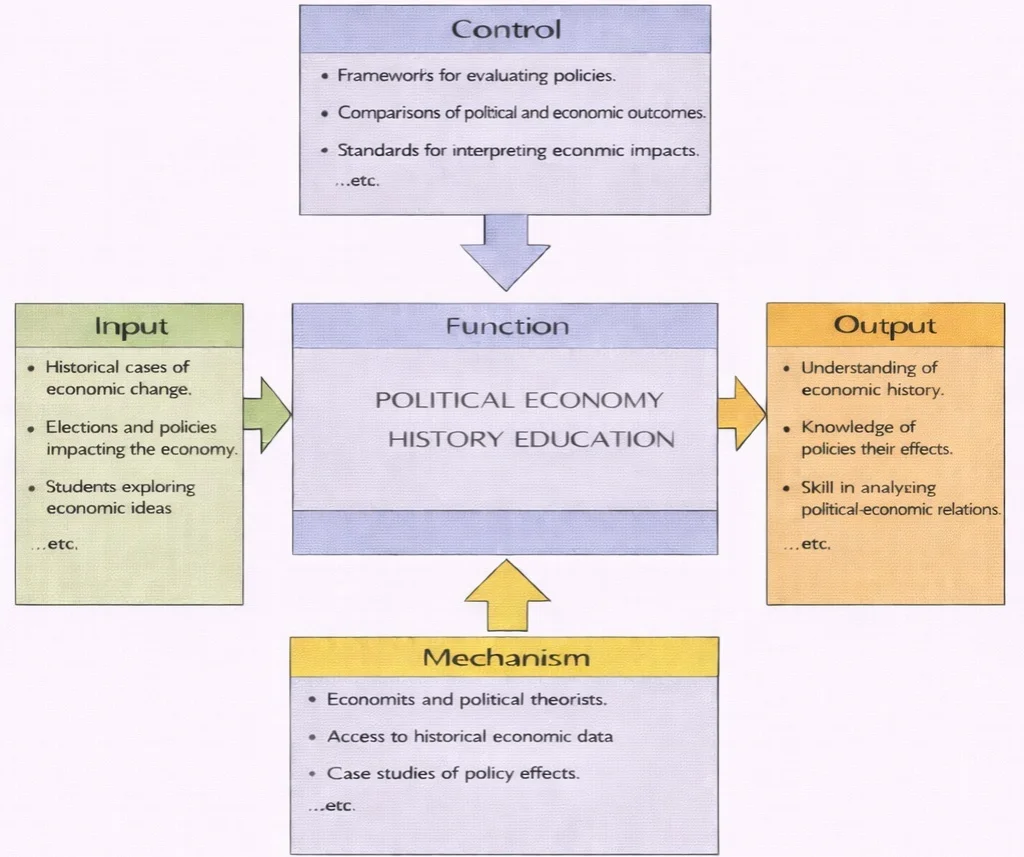
Central Research Streams in Historical Political Economy
Early Political Economy: Mercantilism
- Key Features:
- Accumulation of wealth through trade surpluses.
- Heavy government regulation of industries and markets.
- Colonial expansion to secure resources and markets.
- Examples:
- England’s Navigation Acts (1651): Restricted colonial trade to benefit the British economy.
- France under Jean-Baptiste Colbert: Promoted state-sponsored industries to enhance exports.
- Impact:
- Laid the foundation for modern nation-states and colonial empires.
- Sparked conflicts over trade routes and colonies.
Classical Political Economy
- Key Thinkers:
- Adam Smith (1723–1790):
- Writings: “The Wealth of Nations” (1776).
- Ideas: Advocated for free markets, the division of labor, and the “invisible hand” guiding economic efficiency.
- David Ricardo (1772–1823):
- Writings: “Principles of Political Economy and Taxation” (1817).
- Ideas: Introduced comparative advantage, justifying free trade.
- Adam Smith (1723–1790):
- Impact:
- Inspired policies promoting free trade, reduced tariffs, and limited government intervention.
- Shaped early industrial capitalism in Europe and North America.
Industrial Revolution and Political Economy
- Key Developments:
- Urbanization and industrialization led to significant wealth disparities.
- Labor movements emerged to advocate for workers’ rights and better wages.
- Governments debated policies to address social inequality.
- Examples:
- The Corn Laws in Britain (1815–1846): Controversial tariffs on grain imports, benefiting landowners at the expense of consumers.
- The rise of socialist thought: Thinkers like Karl Marx critiqued capitalism, highlighting exploitation and inequality.
Political Economy of the Great Depression (1930s)
- Causes:
- Stock market crash of 1929.
- Overproduction, declining demand, and financial instability.
- Lack of effective government intervention in many countries.
- Key Responses:
- The New Deal (1933–1939): U.S. President Franklin D. Roosevelt implemented public works programs, financial reforms, and social safety nets.
- Keynesian Economics: John Maynard Keynes advocated for active government intervention to stabilize the economy through fiscal and monetary policies.
- Impact:
- Increased acceptance of government responsibility in managing economic stability.
- Expansion of welfare states in many Western countries.
Post-World War II Political Economy
- Bretton Woods System (1944): Established international financial institutions like the International Monetary Fund (IMF) and the World Bank; fixed exchange rates tied to the U.S. dollar to promote global economic stability.
- Marshall Plan (1948–1952): U.S. aid program to rebuild European economies and prevent the spread of communism.
- Rise of Social Democracy: European countries implemented welfare policies, including universal healthcare and social security.
- Impact: Economic growth and improved living standards in the West alongside heightened Cold War tensions between capitalist and communist economic systems.
Neoliberal Reforms of the Late 20th Century
- Key Figures:
- Margaret Thatcher (UK): Privatized state-owned industries, reduced union power, and promoted free-market economics.
- Ronald Reagan (US): Reduced taxes, deregulated industries, and cut social spending.
- Impact: Increased economic efficiency and innovation in some sectors, though criticized for widening income inequality and weakening social safety nets.
Globalization and Political Economy
- Key Features: Growth of multinational corporations, expansion of free trade agreements (NAFTA, WTO), and rising concerns about economic inequality and environmental sustainability.
Translating Political Economy History into Today’s Strategies
- Policy Formulation: Provides historical context for crafting economic policies that balance growth, equity, and stability.
- Understanding Global Dynamics: Explains how economic and political forces shape international trade, finance, and relations.
- Addressing Inequality: Highlights the historical roots of economic disparities and informs strategies for redistribution.
Thematic Areas within Political Economy Research
- History of Economic Thought: Explores the evolution of economic theories and their political implications (e.g., Classical, Keynesian, Marxist economics).
- Taxation and Fiscal Policy: Examines the role of taxation in funding governments and influencing economic behavior.
- Trade and Globalization: Focuses on the history of trade policies, protectionism, and global markets (e.g., Mercantilism, WTO).
- Labor and Social Policy: Studies the intersection of labor markets, social policies, and economic systems (e.g., Labor unions, minimum wage laws, welfare state models).
- Political Economy of Crises: Investigates economic shocks and political policy responses (e.g., Great Depression, 2008 Financial Crisis).
Empirical Analyses of Political Economy in Practice
- The Great Depression (1930s): Highlighted the limitations of laissez-faire policies and inspired the expansion of Keynesian state intervention.
- Neoliberal Reforms in Latin America: Implementation of Washington Consensus policies in nations like Chile, balancing economic restructuring with widespread social impacts.
- Rise of China as an Economic Power: Transition from a centralized command economy to a state-led market system, restructuring modern global supply chains.
Complexities of Analyzing Political‑Economic Interactions
- Complex Interactions: Political and economic systems are deeply interconnected, making isolated causal analysis multifaceted.
- Global Perspectives: Accounting for diverse regional, institutional, and cultural contexts across different historical epochs.
- Dynamic Nature: Constant evolution of institutions requires updated analytical methodologies.
Charting New Horizons in Political Economic Thought
- Climate Economics: Exploring the intersection of environmental regulations, carbon pricing, and sustainable macroeconomics.
- Digital Transformation: Analyzing the political economy of platform monopolies, digital currencies, AI automation, and gig labor.
- Inclusive Growth: Developing fiscal and redistributive policies that target structural inequality while supporting economic productivity.
Why Examine the Historical Foundations of Political Economy?
Understanding the Origins of Economic and Political Thought
Exploring the Evolution of Economic Ideas in Historical Context
Analyzing the Relationship Between Markets, States, and Society
Recognizing the Intellectual Roots of Contemporary Policy Debates
Preparing for Advanced Study in the Social Sciences and Humanities
Closing Thoughts on the Legacy of Political Economy
Interactive Simulator: Political Economy Policy Trade-Offs
Adjust national trade tariff rates and public welfare spending to simulate historical policy choices and observe real-time impacts on national economic output and equity.
Frequently Asked Questions
What is meant by “history of political economy”?
The history of political economy studies how people in different times and places have understood the relationship between politics, markets, and society. It traces changing ideas about production, trade, money, taxation, and the role of the state, and asks how these ideas shaped laws, institutions, and everyday life.
How does the history of political economy differ from economics or economic history?
Economics often uses models to understand how markets work today, while economic history focuses on past patterns of production, trade, and growth. The history of political economy, in contrast, asks how people have thought about these issues: how economic ideas emerged, how they were debated, and how they influenced policies, institutions, and political struggles.
Why is the history of political economy important for understanding modern capitalism?
Modern capitalism did not appear suddenly. It evolved through long debates about property, labour, markets, and the state, and these debates still shape how we think today. Studying the history of political economy helps us see that ideas about competition, regulation, welfare, and inequality are historically specific and contested, not natural or inevitable.
Which thinkers are especially important in the history of political economy?
Key figures often include Adam Smith, David Ricardo, John Stuart Mill, Karl Marx, and later John Maynard Keynes, Friedrich Hayek, and Milton Friedman. Historians also pay attention to lesser-known thinkers, non-Western traditions, and policy practitioners whose ideas shaped institutions such as central banks, labour laws, and welfare systems.
How has the role of the state in the economy changed over time?
In early modern Europe, states regulated trade, granted monopolies, and raised revenue through tariffs and taxes. In the nineteenth century, liberal thinkers argued for freer markets and a smaller state, while others called for social protection. The twentieth century saw powerful welfare states and planning experiments, followed by waves of deregulation and market-oriented reforms. The history of political economy traces these shifting visions and the debates around them.
How does the history of political economy help us think about inequality?
Ideas about inequality have changed over time, from classical concerns with the distribution between wages, profits, and rents to modern debates about social justice and inclusive growth. Studying the history of political economy shows how societies have justified or challenged inequality, what policies they used to redistribute wealth, and how economic arguments were used both to defend privilege and to demand reform.
What is the connection between political economy and empire, trade, and globalization?
Many classic works of political economy were written in imperial and colonial contexts shaped by long-distance trade, slavery, and resource extraction. The history of political economy explores how thinkers understood tariffs, colonies, and global markets, and how their ideas were used to support, criticize, or reform imperial and global economic orders.
How did major crises, like the Great Depression or the 2008 financial crisis, reshape political-economic thinking?
Economic crises have often forced policymakers and thinkers to question established theories. The Great Depression helped push many countries toward stronger state intervention and welfare policies, while the crises of the 1970s fueled arguments for deregulation and market liberalization. The 2008 financial crisis revived interest in financial regulation, inequality, and systemic risk. Historians of political economy study how crises open and close windows of intellectual and policy change.
What kinds of sources and methods do historians use to study political economy?
Historians of political economy read classic texts in economics and political thought, but they also examine parliamentary debates, policy reports, business archives, newspapers, and personal correspondence. They place ideas in their social and political context, asking who produced them, whose interests they served, and how they interacted with institutions, statistics, and lived experiences.
How does the history of political economy connect with other areas of history and the social sciences?
The history of political economy overlaps with political history, labour history, social policy, legal history, and intellectual history. It also speaks to sociology, political science, and anthropology by providing deep context for concepts such as class, the state, markets, and institutions. This makes it a useful bridge between economic analysis and broader studies of power, culture, and society.
What skills do students develop by studying the history of political economy?
Students learn to read complex texts critically, compare arguments, and relate abstract theories to concrete historical cases. They practice evaluating evidence, tracing cause and effect across long periods, and understanding how ideas travel across borders and are translated into policy. These skills help them analyse contemporary debates with greater nuance and historical awareness.
How can knowledge of the history of political economy support future study and careers?
A grounding in the history of political economy is valuable for further study in history, economics, politics, public policy, and international relations. It can also support careers in government, journalism, think tanks, education, NGOs, and business, where understanding how economic ideas shape institutions, regulations, and public debates is a significant advantage.
Interactive Review Questions
Review Question 1: How does mercantilist monetary theory contrast with classical monetary concepts?
Review Question 2: What was the primary political-economic debate surrounding the repeal of the British Corn Laws in 1846?
Review Question 3: How did the Bretton Woods system structure international economic order after World War II?
History of Political Economy: Practice Module
Section 1: Foundational Review Questions
- What is the core definition of political economy, and how does its scope differ from modern neo-classical economics?
Answer: Political economy is the interdisciplinary study of how state governance, power structures, legal institutions, and political ideologies shape—and are shaped by—economic production, resource distribution, and market operations. Unlike neo-classical economics, which often treats markets as self-contained mathematical equilibrium systems driven by utility-maximizing individuals, political economy explicitly incorporates historical power dynamics, institutional rules, and social conflicts. - How did early sovereign states utilize trade policy during the mercantilist era?
Answer: Sovereign states utilized state-granted trade monopolies, strict tariffs, colonial extraction laws (e.g., Britain’s Navigation Acts), and subsidies to maximize domestic exports while minimizing imports, attempting to accumulate reserves of gold and silver bullion to fund state militaries and administration. - What was Adam Smith’s central argument regarding the “invisible hand” in The Wealth of Nations?
Answer: Smith argued that individuals pursuing their own self-interest in competitive market conditions unintentionally promote societal economic well-being through the efficient allocation of resources and division of labor, reducing the need for direct state regulation of commerce. - How did David Ricardo’s Theory of Comparative Advantage transform trade theory?
Answer: Ricardo demonstrated mathematically that nations benefit from international trade by specializing in producing goods where they possess the lowest opportunity cost—rather than absolute advantage—thereby expanding total global consumption and economic output. - What key economic vulnerability exposed by the Great Depression led to Keynesian macroeconomics?
Answer: The Great Depression exposed the failure of self-correcting market mechanisms under severe aggregate demand drops, demonstrating that economies could remain trapped in prolonged underemployment equilibria without active government counter-cyclical fiscal spending. - What role did the Marshall Plan play in post-WWII European political economy?
Answer: The Marshall Plan provided over $13 billion in U.S. economic assistance to rebuild war-torn European infrastructure, stabilize democratic institutions, foster trade integration, and stem the expansion of Soviet-aligned communist movements. - What were the structural objectives of the late 20th-century neoliberal economic policies?
Answer: Neoliberalism aimed to restore private capital profitability and market efficiency by privatizing state enterprises, deregulating financial and product markets, reducing income and corporate tax rates, cutting public social spending, and curbing labor union bargaining power. - How did the 1970s stagflation crisis challenge Keynesian economic consensus?
Answer: Stagflation (simultaneous high inflation and high unemployment) contradicted the standard Keynesian Phillips Curve model, creating policy paralysis and opening the path for monetarist and supply-side theories advocated by Milton Friedman and Friedrich Hayek. - What is the function of the World Trade Organization (WTO) in modern global political economy?
Answer: The WTO enforces multilateral trade agreements, provides a binding legal dispute settlement mechanism among sovereign states, and works to lower global tariffs and non-tariff barriers to commerce. - How does economic history define the “welfare state”?
Answer: A welfare state refers to a governance model wherein the democratic state assumes direct structural responsibility for the social and economic well-being of its citizens through universal healthcare, public education, unemployment insurance, and progressive pensions.
Section 2: Analytical & Thought-Provoking Questions
- Evaluate how the transition from mercantilism to classical liberalism reshaped global power structures during the 19th century.
Answer: The transition shifted power from absolute monarchies and monopolistic chartered companies (e.g., East India Company) toward industrial capitalists and financial elites. While classical free trade dismantled imperial trade blocks, it also enabled industrial powers like Great Britain to dominate global trade via “informal empire”—exporting manufactured goods while importing raw commodities from developing agrarian regions, creating structural global inequalities. - To what extent did Karl Marx’s critique of political economy identify structural contradictions within industrial capitalism?
Answer: Marx argued that industrial capitalism inherently contained contradictions, including the tendency of the rate of profit to fall, wealth concentration due to capital accumulation, and recurring crises of overproduction (where labor’s suppressed wages prevent them from consuming the total output produced). While capitalist systems adapted via state regulation and welfare buffers, Marx correctly identified long-term trends regarding capital concentration and financial volatility. - Analyze how the collapse of the gold standard during the interwar period reshaped domestic state sovereignty over monetary policy.
Answer: The strict gold standard prioritized external fixed exchange rate stability over internal economic health, forcing states to induce domestic deflation and high unemployment during downturns. Abandoning gold allowed central banks to print fiat money, lower interest rates, and engage in discretionary monetary interventions to stabilize domestic employment without being bound by physical gold reserves. - How do modern digital platforms and automation challenge 20th-century political economy frameworks regarding labor and capital?
Answer: Digital platforms convert market coordination into proprietary algorithmic infrastructure, fragmenting traditional employment into gig work without employer-funded welfare coverage. Monopoly profits accrue to intellectual property holders rather than physical manufacturing plants, weakening collective union leverage and creating regulatory challenges for traditional taxation and anti-trust laws. - Critique the Washington Consensus neoliberal policy packages applied to Latin American economies during the 1980s and 1990s.
Answer: While Washington Consensus policies (privatization, fiscal austerity, trade opening) successfully reduced hyperinflation and attracted foreign direct investment, they frequently resulted in severe public sector retrenchment, increased poverty, job losses in domestic industries, and heightened vulnerability to international financial panics, sparking popular political backlashes across the region. - In what ways does climate change present a classic “market failure” within historical political-economic frameworks?
Answer: Greenhouse gas emissions represent unpriced negative externalities where private market transactions ignore cumulative global environmental damage. Historical political economy struggled to address climate change because existing legal and property rights frameworks treat the atmosphere as an unowned global commons, requiring state tax interventions, green subsidies, and binding international regulatory cooperation. - How does China’s “socialist market economy” model challenge traditional Western theories of economic development?
Answer: Western development theory posited that market liberalization must inevitably lead to democratic governance and minimal state control. China’s state-led model demonstrated that rapid industrial growth, technological leapfrogging, and poverty reduction could occur under one-party political control paired with state-owned enterprises, strategic industrial planning, and controlled integration into global markets. - Evaluate how weaponized interdependence and economic sanctions alter contemporary international political economy.
Answer: Globalization created centralized financial and trade networks (e.g., SWIFT, semiconductor supply chains). Sovereign states now utilize control over these central nodes as geopolitical weapons. This incentivizes non-Western powers to build alternative trade clearance systems, accelerating currency de-dollarization and fragmenting global markets.
Section 3: Quantitative Political Economy Problems
- Ricardian Trade Advantage Calculation:
In a 19th-century trade model, Nation A requires 80 labor hours to produce 1 unit of Cloth and 120 labor hours to produce 1 unit of Wine. Nation B requires 100 labor hours for Cloth and 90 labor hours for Wine. Calculate the opportunity cost of Wine in both nations and state which nation holds the comparative advantage in Wine.
Solution:
For Nation A: Opportunity cost of 1 unit of Wine = 120 / 80 = 1.5 units of Cloth.
For Nation B: Opportunity cost of 1 unit of Wine = 90 / 100 = 0.9 units of Cloth.
Since Nation B surrenders fewer units of Cloth to produce a unit of Wine (0.9 < 1.5), Nation B holds the comparative advantage in Wine. - Keynesian Multiplier Analysis:
During a severe crisis, a government initiates a public works program of $50 billion. If the domestic Marginal Propensity to Consume (MPC) is 0.8, calculate the theoretical overall increase in Total National Income (ΔY).
Solution:
The Keynesian Fiscal Multiplier (k) is calculated as:k = 1 / (1 – MPC) = 1 / (1 – 0.8) = 1 / 0.2 = 5Total Economic Output Increase (ΔY) = k × ΔG = 5 × $50 billion = $250 billion. - Mercantilist Bullion Accumulation Net Trade Balance:
An 18th-century state exports 500,000 pounds of textiles valued at £4 per pound and imports 300,000 bushels of grain valued at £3 per bushel. Additionally, the crown pays £200,000 in foreign naval subsidies. Calculate the net bullion flow into the state treasury.
Solution:
Total Export Revenue = 500,000 × £4 = £2,000,000
Total Import Expenditure = 300,000 × £3 = £900,000
Net Trade Surplus = £2,000,000 – £900,000 = £1,100,000
Net Bullion Flow = Trade Surplus – Naval Subsidies = £1,100,000 – £200,000 = +£900,000 net influx of bullion. - Tariff Revenue vs. Consumer Deadweight Loss:
A state imports 1,000,000 steel units at a world price of $100 per unit. The state imposes a 20% protective tariff, raising the price to $120. Imports fall to 800,000 units. Domestic production increases to replace the rest. Calculate the state’s total tariff revenue collected.
Solution:
Tariff per unit = $100 × 0.20 = $20 per unit.
New Import Volume = 800,000 units.
Total Tariff Revenue = 800,000 × $20 = $16,000,000. - Gini Coefficient Structural Shift:
In a simplified nation of 100 residents, pre-tax income distributes $10,000 to the top 10 residents and $100 each to the remaining 90 residents. A progressive reform taxes the top 10 at 30% and redistributes the collected tax equally to the bottom 90 as social welfare grants. Calculate the new total income of a bottom-tier resident.
Solution:
Total Income of Top 10 = 10 × $10,000 = $100,000.
Total Tax Revenue Collected = $100,000 × 0.30 = $30,000.
Redistribution per bottom resident = $30,000 / 90 = $333.33.
New Total Income for a bottom resident = $100 + $333.33 = $433.33. - Seigniorage & Hyperinflation Valuation:
A government experiencing an economic shock doubles its money supply from $100 billion to $200 billion in a year while real output (Y) remains constant. Assuming velocity (V) is constant, use the Quantity Theory of Money (M × V = P × Y) to calculate the resulting percentage change in the price level (ΔP).
Solution:
Under Quantity Theory of Money:%ΔM + %ΔV = %ΔP + %ΔYGiven %ΔV = 0 and %ΔY = 0:
%ΔP = %ΔM = ($200B – $100B) / $100B = 1.00 = +100% increase in Price Level (Inflation). - Sovereign Debt Burden Index:
A country has a national debt of $500 billion and a GDP of $400 billion (Debt-to-GDP = 125%). If nominal GDP grows at 3% annually while national debt grows at 5% annually due to interest costs, calculate the Debt-to-GDP ratio after 1 year.
Solution:
New National Debt = $500 billion × 1.05 = $525 billion.
New Nominal GDP = $400 billion × 1.03 = $412 billion.
New Debt-to-GDP Ratio = ($525B / $412B) × 100 = 127.43%.