
Smart Manufacturing and Industry 4.0 represent a transformative leap in the way modern factories and industrial systems are designed, operated, and optimized. At the heart of this shift is the integration of advanced digital technologies into traditional industrial and manufacturing technologies, enabling a more agile, connected, and data-driven production environment. These advancements are not simply about automation—they signify a convergence of cyber-physical systems, cloud computing, and the Industrial Internet of Things (IIoT), reshaping how goods are produced and delivered globally.
Industry 4.0 education is an education in “aliveness.” A factory is no longer a silent line of machines; it becomes a living network—sensing, reporting, learning, and adjusting. The inputs—IoT technologies and data integration—supply the connective tissue: how signals are captured, transported, cleaned, and turned into information that can actually guide action. The controls—curriculum content and evaluative criteria—keep the journey steady, ensuring learners can explain not only why a smart system behaves the way it does, but how to prove it. Within the central function, students learn to read manufacturing like a language: devices become “words,” data streams become “sentences,” and analytics becomes the grammar that reveals meaning. The mechanisms—cyber-physical systems and analytics software—make the learning real, allowing students to build, test, and iterate on connected workflows where decisions are shaped by evidence rather than habit. The outputs are the quiet transformation that modern industry needs: digital competence that is practical, grounded, and responsible—and the ability to help shape factories that are not just automated, but intelligent, resilient, and continuously improving.
- Cyber-Physical Integration & Edge-to-Cloud Networks: Time-sensitive IIoT telemetry streaming, sub-millisecond edge processing vs. cloud latency trade-offs, and OPC-UA semantic communication.
- Overall Equipment Effectiveness & Reliability Engineering: Multi-parameter line decomposition (\(\text{OEE} = A \times P \times Q\)), Mean Time Between Failures (\(\text{MTBF}\)), and predictive remaining useful life (\(\text{RUL}\)) estimation.
- Modern AI & Digital Twin Paradigms: Physics-Informed Neural Networks (PINNs), neural operators for real-time thermal/vibrational inference, and dynamic closed-loop Model Predictive Control (MPC) in lights-out factories.
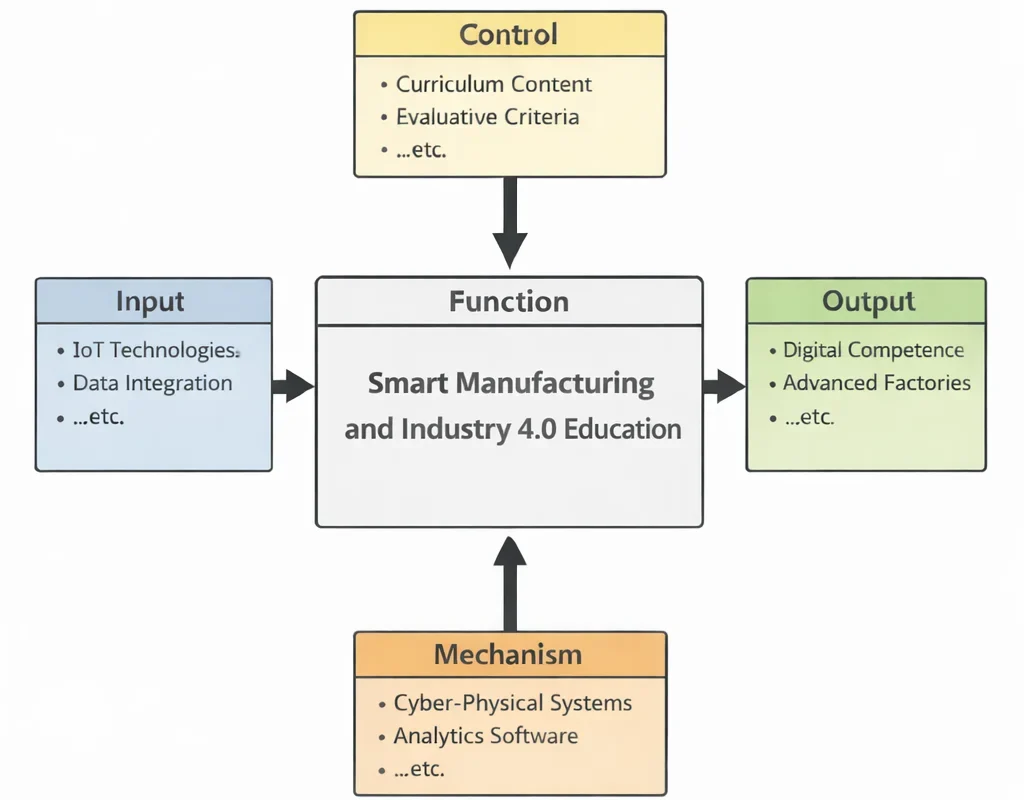
This IDEF0 (Input–Control–Output–Mechanism) diagram presents Smart Manufacturing and Industry 4.0 Education as a structured learning system. Inputs on the left—IoT technologies and data integration—represent the technical building blocks students must understand to connect machines, sensors, and information flows. Controls at the top—curriculum content and evaluative criteria—define what is taught and how competence is assessed, ensuring learning is purposeful and measurable. The central function, Smart Manufacturing and Industry 4.0 Education, transforms these inputs and controls into applied capability through structured instruction and practice. Outputs on the right—digital competence and advanced factories—capture the intended results: learners who can work confidently with connected production systems and contribute to modern industrial operations. Mechanisms at the bottom—cyber-physical systems and analytics software—provide the tools and environments that make Industry 4.0 concepts tangible through modeling, experimentation, and data-driven decision-making.
One of the core enablers of Industry 4.0 is Digital Twin Technology, which allows real-time simulation of processes, enabling manufacturers to predict failures, optimize performance, and improve product quality. When combined with Computer-Integrated Manufacturing (CIM), this approach ensures seamless interaction between design, fabrication, and feedback systems.
The transition to smart manufacturing also intersects with emerging techniques such as Additive Manufacturing (3D Printing) and the adoption of advanced materials and manufacturing technologies. These innovations support mass customization and decentralized production, two defining features of Industry 4.0.
Efficiency plays a central role. Enhancing energy and resource efficiency in manufacturing is a strategic priority, especially in light of global sustainability goals. Smart factories often incorporate sustainable manufacturing principles and environmental stewardship into their digital workflows.
The human component is also crucial. With the growing complexity of automated systems, attention to human factors and ergonomics in manufacturing ensures that systems are designed to support human decision-making and safety. Similarly, collaborative technologies in industrial automation and robotics allow machines and operators to work side-by-side efficiently.
Smart manufacturing extends beyond the shop floor. Strategies such as lean manufacturing and intelligent supply chain management link real-time production data with logistics, minimizing waste and aligning inventory with demand.
Core to these changes are robust design principles and predictive analytics. Fields such as manufacturing quality control and assurance and manufacturing process design and optimization are being enhanced through machine learning and AI-driven monitoring, reducing human error and improving overall system reliability.
Smart manufacturing ecosystems draw on a broad base of engineering disciplines. For example, mechanical engineering provides foundational insight into mechanical systems and materials, while specialties like robotics and automation in mechanical engineering expand into sensor integration and adaptive control. Simultaneously, disciplines such as control systems, thermodynamics and heat transfer, and solid mechanics remain essential for high-performance systems.
Applications of Industry 4.0 principles can already be seen in areas such as automotive engineering and biomechanical engineering, where real-time data, cloud platforms, and digital simulations improve both process and product. Tools such as mechanical design and CAD are now linked directly with smart production workflows.
Ultimately, Smart Manufacturing and Industry 4.0 define a vision for the future of production—intelligent, adaptive, and sustainable. Understanding this ecosystem prepares learners to lead in digital transformation and participate in a new era of industrial innovation.
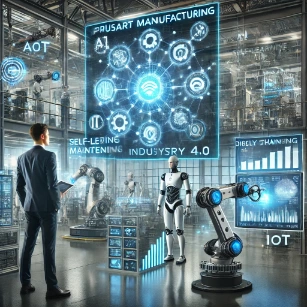
Smart Manufacturing Systems: Data, Connectivity, and Intelligent Production
Explore our comprehensive curriculum modules to see how core technologies integrate into cohesive, intelligent production workflows within the broader industrial engineering ecosystem:
Industrial & Manufacturing Technologies Overview
Frames digital transformation as a core driver of modern industrial production systems and serves as the umbrella portal for foundational concepts.
Smart Manufacturing & Industry 4.0 (Current Topic)
Integrates IoT, AI, and data analytics to create interconnected, adaptive, and intelligent production environments that respond autonomously to demand.
Digital Twin Technology
Simulates real-time operations to optimize performance, run risk-free scenarios, and predict system behavior before physical execution.
Industrial Automation & Robotics
Executes intelligent manufacturing processes with minimal human intervention, utilizing collaborative robots and automated guided vehicles.
Computer-Integrated Manufacturing (CIM)
Links physical production equipment, computer-aided design, and managerial databases into unified, enterprise-wide digital workflows.
Process Optimization
Uses real-time feedback loops and algorithmic tuning to dynamically eliminate bottlenecks and maximize resource efficiency.
Quality Control & Assurance
Applies computer vision and automated sensory inspection for high-speed defect detection and proactive defect prevention.
Supply Chain Management
Connects factory floor scheduling directly with upstream suppliers and downstream logistics networks for real-time demand coordination.
Lean Manufacturing
Enhances smart systems by establishing continuous flow principles and systematically eliminating non-value-added operations.
Additive Manufacturing
Enables flexible, tool-less 3D production driven directly by digital design files for mass customization and rapid prototyping.
Advanced Materials
Supports innovation in smart manufacturing through high-performance composites, smart alloys, and adaptive material processing.
Sustainable Manufacturing
Integrates circular economy metrics and environmental lifecycle stewardship directly into automated digital workflows.
Energy & Resource Efficiency
Optimizes utility loads and reduces carbon intensity using smart sensors and real-time operational analytics.
Human Factors & Ergonomics
Ensures seamless human-machine interaction, safer workplace environments, and cognitive support in complex automated plants.
Core Principles of Smart Manufacturing and Industry 4.0
Interconnectivity
Definition: Devices, machines, systems, and human interfaces are interconnected through the Internet of Things (IoT), allowing seamless communication and collaboration across all levels of production and operations.
- Smart sensors embedded in machines continuously monitor variables such as temperature, vibration, or load capacity and transmit this data to centralized cloud platforms, enabling predictive analytics and proactive maintenance scheduling.
- Industrial IoT networks connect supply chain partners, warehouse systems, and logistics providers to synchronize inventory levels and minimize lead times.
- Smart wearables on workers enhance situational awareness and safety by integrating with centralized dashboards that can alert supervisors in real time to potential hazards or performance metrics.
Real-Time Data Collection and Analysis
Definition: Real-time data collection uses sensors and intelligent devices to gather immediate data from machines, production lines, logistics systems, and even customer usage patterns, enabling rapid, data-driven decisions.
- Manufacturing Execution Systems (MES) collect data at each stage of production to optimize scheduling, resource allocation, and workflow efficiency.
- Advanced analytics platforms use real-time data to detect quality issues early, reducing waste and improving first-pass yield.
- Energy management systems analyze real-time consumption patterns, allowing manufacturers to shift loads or reduce power during peak periods.
Decentralized Decision-Making
Definition: Decentralized decision-making enables machines and subsystems to process data and make operational decisions locally, reducing dependency on centralized control systems and enhancing agility in dynamic environments.
- Autonomous mobile robots in warehouses detect traffic congestion and reroute themselves in real time to maintain optimal delivery speeds.
- Machine tools adapt their machining paths autonomously based on real-time feedback from embedded sensors, reducing error rates and improving precision.
- Distributed control systems allow individual modules of a production line to continue operating even if other parts are under maintenance or facing issues.
Cyber-Physical Systems
Definition: Cyber-physical systems are systems where physical components, such as machines and actuators, are tightly integrated with software, data networks, and computational models, allowing real-world operations to be dynamically controlled and optimized through digital intelligence.
- Cyber-physical systems in packaging lines use feedback loops to adjust fill levels and sealing parameters on the fly, ensuring consistent product quality despite fluctuations in input materials or environmental conditions.
- In CNC machining, cyber-physical systems monitor cutting forces and tool wear in real time, allowing automatic adjustments to feed rates and spindle speeds to prolong tool life and improve surface finish.
- Smart building systems in factories use cyber-physical systems to regulate lighting, HVAC, and air filtration based on occupancy and operational needs, improving energy efficiency and worker comfort.
Advanced Automation
Definition: Advanced automation harnesses robotics, artificial intelligence, and machine learning to perform tasks with greater speed, accuracy, and adaptability than traditional automation systems.
- Collaborative robots work safely alongside humans, assisting with repetitive, hazardous, or ergonomically challenging tasks without the need for physical barriers.
- AI-powered visual inspection systems use deep learning algorithms to detect defects on high-speed production lines with precision that can surpass manual inspection.
- Automated guided vehicles dynamically adjust routes based on facility traffic and delivery priority, reducing delays and optimizing material flow.
Digital Twins
Definition: Digital twins are virtual representations of real-world systems, processes, or products that continuously receive data from sensors and devices, allowing simulation, monitoring, and real-time optimization of physical operations.
- Before implementing layout changes in a production plant, digital twins can simulate how alterations affect throughput, energy use, and labor efficiency.
- Maintenance teams use digital twins to test repair scenarios on critical equipment, avoiding downtime by identifying the least disruptive strategy.
- In product development, engineers leverage digital twins to predict how new designs will perform under real-world conditions, accelerating innovation cycles.
- Digital twins are evolving from isolated tools into living models that continuously support better business and engineering outcomes.
Contemporary Computational Paradigms: Cyber-Physical AI & Neural Operators
Smart Manufacturing in the era of Industry 4.0 merges physical machine tool physics with advanced distributed computation. Moving beyond conventional supervisory setpoints, cyber-physical production leverages continuous neural fields, real-time edge filtering, and decentralized consensus algorithms to maintain peak line efficiency.
Physics-Informed Neural Networks (PINNs) & Digital Twin Edge State Estimation
In high-speed CNC machining and precision robotic assembly, thermal expansion and structural compliance induce tool deflection that classical lookup tables fail to track dynamically. Contemporary digital twins embed structural elastodynamics and heat conduction directly into Physics-Informed Neural Networks (PINNs):
$$\mathcal{L}_{\text{PINN}} = \|\mathbf{y}_{\text{sensor}} - \hat{\mathbf{y}}\|^2 + \lambda_{\text{thermal}} \left\| \rho c_p \frac{\partial T}{\partial t} - \nabla \cdot (k \nabla T) - \dot{q}_{\text{spindle}} \right\|^2 + \lambda_{\text{mech}} \|\nabla \cdot \boldsymbol{\sigma} + \mathbf{F}_{\text{cut}} - \rho \ddot{\mathbf{u}}\|^2$$
Where \(T\) is the transient temperature field, \(k\) is thermal conductivity, \(\boldsymbol{\sigma}\) is the Cauchy stress tensor, \(\mathbf{u}\) is mechanical displacement, and \(\dot{q}_{\text{spindle}}\) represents friction-generated heat at the bearings. For distributed sensor meshes across the shop floor, Fourier Neural Operators (FNOs) infer continuous spatial deformation profiles across multi-axis machine frames in sub-millisecond cycles, allowing edge PLCs to apply real-time kinematic tool center point (\(\text{TCP}\)) offsets before dimensional drift violates quality specifications.
Edge-to-Cloud Workload Allocation & Invariant State Estimation
Connected smart factories utilize a two-tier computation hierarchy. High-rate sensor telemetry (\(\ge 200\,\text{Hz}\)) is processed locally on edge acceleration nodes (TPU/FPGA) using Invariant Extended Kalman Filters (IEKF) to provide drift-free kinematic tracking and anomaly detection without relying on intermittent cloud connectivity:
$$\mathbf{x}_{k+1} = \mathbf{f}(\mathbf{x}_k, \mathbf{u}_k) + \mathbf{w}_k, \qquad \mathbf{z}_k = \mathbf{h}(\mathbf{x}_k) + \mathbf{v}_k$$
Meanwhile, long-term asset health prognostics, enterprise-level job scheduling, and Bayesian fleet-wide degradation models are aggregated asynchronously across cloud historians. This separation guarantees deterministic safety response times (\(\tau \le 2\,\text{ms}\)) on active machine tools while capturing macroscopic enterprise optimization insights.
Systems Engineering Trade-Off Matrix: Industry 4.0 Architectural Strategies
Implementing smart factory architectures requires navigating complex multi-variable compromises across computational latency, cybersecurity exposure, capital expense, and line flexibility:
| Architecture Approach | Primary Operational Advantage | Systemic Risk & Failure Mode | Design Mitigation Strategy |
|---|---|---|---|
| Edge AI Local Inference | Deterministic sub-millisecond execution (\(\tau \lt 15\,\text{ms}\)); immune to WAN outages; preserves localized data privacy. | Constrained local memory and thermal limits; hardware obsolescence on machine tool control panels. | Deploy containerized micro-models (Docker/K3s) with dynamic model pruning and over-the-air firmware updates. |
| Centralized Cloud Analytics | Massive scalable compute; cross-plant benchmarking; historical Big Data lake training across enterprise fleets. | High round-trip network latency (\(\ge 100\,\text{ms}\)); bandwidth bottlenecks; total line stoppage if internet connection drops. | Implement store-and-forward edge buffering and dual redundant SD-WAN links; restrict cloud to asynchronous analytics. |
| Autonomous Mobile Robots (AMRs) | Infrastructure-free flexible logistics; dynamically avoids human traffic; easily scalable fleet volume. | Localization loss in symmetric plant aisles; Wi-Fi handoff dropouts causing deadlock at narrow intersections. | Install industrial private 5G mesh networks; deploy ceiling visual fiducials (AprilTags) for absolute position recovery. |
| Integrated IT/OT Convergence | Unifies shop floor PLC telemetry directly with enterprise ERP scheduling; automated demand-driven pull flow. | Expanded attack surface; ransomware traversing from enterprise corporate email to physical machine safety networks. | Enforce the Purdue Enterprise Reference Architecture with industrial DMZ, hardware unidirectional data diodes, and TLS. |
Key Technologies Driving Smart Manufacturing and Industry 4.0
Internet of Things
The Internet of Things serves as the digital nervous system of smart factories by connecting sensors, devices, and industrial machines. These interconnected systems gather and share critical data in real time, enabling manufacturers to monitor performance, detect anomalies, and automate responses without constant human intervention.
- IoT-enabled production lines offer constant feedback on operating conditions such as temperature, vibration, and pressure, allowing predictive maintenance and reducing unexpected downtime.
- Smart inventory systems use RFID tags and IoT scanners to automatically update stock levels, issue replenishment alerts, and prevent material shortages or overstocking.
- IoT facilitates condition-based monitoring in equipment, triggering maintenance only when needed instead of on a fixed schedule, which lowers maintenance costs and extends equipment life.
Big Data and Advanced Analytics
Big data technologies process massive volumes of structured and unstructured data generated across a smart factory, from machine logs to environmental sensors and operator inputs. Advanced analytics tools then identify hidden patterns, correlations, and outliers to support data-informed decisions.
- Predictive maintenance models use historical machine data to forecast potential failures and alert technicians before breakdowns occur, reducing unplanned stoppages and improving asset reliability.
- Analytics platforms evaluate yield loss across production lines, pinpointing specific bottlenecks or inefficiencies and providing actionable insights to optimize processes.
- Customer demand trends can be analyzed in real time, enabling flexible production planning and inventory control that closely align with market fluctuations.
Artificial Intelligence and Machine Learning
Artificial intelligence and machine learning empower machines to learn from historical data, adapt to new conditions, and make autonomous decisions. These technologies improve the accuracy, speed, and efficiency of industrial processes while supporting innovation in design and quality control.
- AI algorithms detect defects in products by analyzing images or sensor data in milliseconds.
- Machine learning models are used to forecast customer orders, optimize inventory turnover, and minimize obsolescence.
- AI-driven systems autonomously adjust parameters in production equipment to compensate for input variability, maintaining consistent quality and reducing waste.
Robotics and Automation
Robotics and automation technologies take over tasks that are repetitive, dangerous, or require high precision. These systems enhance productivity, reduce operational risk, and improve overall safety.
- Collaborative robots, or cobots, work side by side with human operators, performing tasks such as screw tightening, welding, or component insertion while ensuring safety through built-in sensors.
- Automated guided vehicles transport materials autonomously across the factory floor, reducing human error and improving logistics efficiency.
- Pick-and-place robotic arms are used in high-speed packaging lines, ensuring uniformity and reducing physical strain on workers.
Cloud Computing
Cloud computing offers scalable data storage and computational resources, allowing manufacturers to scale operations, store historical data securely, and run powerful simulations without relying entirely on on-premises infrastructure.
- Cloud platforms host centralized dashboards that integrate data from multiple plants, enabling enterprise-wide performance visibility and benchmarking.
- Global manufacturers use cloud-based systems to coordinate supply chains across continents, sharing production schedules, inventory status, and quality data with partners in real time.
- Software-as-a-Service solutions provide remote access to enterprise applications for maintenance planning, ERP, and analytics, enhancing collaboration among distributed teams.
Blockchain
Blockchain introduces a secure and immutable ledger system for recording transactions across a distributed network. It supports trust and traceability in manufacturing ecosystems, especially where multiple suppliers or regulatory requirements are involved.
- Blockchain tracks the provenance of raw materials from source to final product, supporting ethical sourcing and reducing the risk of counterfeit components entering the supply chain.
- Smart contracts automate compliance and certification processes, ensuring suppliers meet quality and environmental standards before transactions are executed.
- As detailed by IBM Blockchain for Supply Chain, these technologies enhance transparency and resilience in manufacturing logistics.
Augmented Reality and Virtual Reality
Augmented reality and virtual reality bridge the physical and digital realms, enabling immersive training environments, real-time guidance, and enhanced visualization of manufacturing operations. They reduce errors, accelerate learning, and improve safety.
- Technicians use AR glasses that project assembly instructions directly onto machinery, minimizing the need for printed manuals and reducing setup time.
- VR simulators train workers in hazardous scenarios such as chemical spills or equipment failures without real-world risk.
- Product designers use VR environments to prototype factory layouts and ergonomics before construction or reconfiguration.
Edge Computing
Edge computing processes data near its source, on machines or devices, reducing reliance on centralized cloud servers. This local processing is critical for latency-sensitive applications such as real-time machine control or safety monitoring.
- Robotic arms executing precision welding require real-time decision-making enabled by edge processors to ensure accuracy and prevent quality issues.
- Condition monitoring systems detect vibrations or temperature spikes and trigger instant responses to prevent damage or halt dangerous operations.
- Edge-enabled cameras perform on-the-spot image analysis for defect detection, transmitting only relevant results to cloud databases.
5G Connectivity
5G technology offers high-speed, low-latency communication for time-sensitive and data-intensive industrial applications. It underpins the responsiveness and agility of connected manufacturing environments.
- Automated guided vehicles and mobile robots navigate dynamically across smart warehouses using 5G connectivity to receive updated routing data instantly.
- High-resolution video streams from production lines can be transmitted with very low delay for remote quality inspections or troubleshooting.
- 5G enables decentralized control of manufacturing equipment, allowing remote technicians to intervene in real time regardless of geographic distance.
Applications of Smart Manufacturing and Industry 4.0
About This Interactive Simulator:
This dynamic simulator models the operational trade-offs and throughput dynamics within a smart manufacturing cell under Industry 4.0 conditions. By adjusting key variables, users can explore how ingestion speed and latency affect overall line efficiency, buffer management, and defect rates.
- CAD/CAM Ingest Speed (parts/hr) [Solid Cyan Line]: Controls the rate at which digital design models are converted into operational G-code instructions for the machining cells. Higher speeds increase throughput capacity but require higher edge-processing bandwidth.
- Active CNC Machining Cells [Control Slider]: Determines the physical manufacturing capacity actively processing incoming jobs.
- Robotic Transfer Latency (sec) [Dashed Amber Line]: Represents the communication and mechanical lag time experienced by collaborative robots transferring parts between cells. Lower latency smooths the production flow and minimizes idle cell time.
Interactive Smart Manufacturing Cell Performance Simulator
Adjust the control sliders below to observe real-time impacts on cell throughput, buffer buildup, and transfer efficiency.
Predictive Maintenance
Definition: Predictive maintenance uses sensors, real-time monitoring, and machine learning algorithms to forecast potential equipment failures before they disrupt operations. By analyzing performance data such as vibration, temperature, and acoustics, predictive systems can identify anomalies that precede mechanical breakdowns.
Benefits: This approach reduces unplanned downtime, minimizes maintenance costs, and extends the lifespan of critical machinery. It enables companies to move from reactive or scheduled maintenance to condition-based strategies, ensuring that interventions are made only when necessary.
Example: In a high-speed bottling plant, vibration sensors installed on rotary filling machines can detect early signs of bearing wear. The system issues alerts to maintenance staff, who replace the components during planned downtime, avoiding costly line stoppages.
Quality Control
Definition: Smart quality control uses AI-powered machine vision systems and real-time analytics to inspect products continuously during manufacturing. These systems detect small defects that may be missed by manual inspection, improving product reliability and compliance with quality standards.
Benefits: Automated quality inspection reduces scrap rates, improves customer satisfaction, and lowers warranty claims. It enables immediate feedback for process adjustments, helping manufacturers maintain consistent quality throughout production.
Example: In electronics manufacturing, high-resolution cameras equipped with AI algorithms scan printed circuit boards for misaligned components and soldering issues. The system flags defective units in real time, allowing immediate removal from the line.
Flexible Manufacturing Systems
Definition: Flexible manufacturing systems use modular machines and reprogrammable automation to allow quick transitions between different products or variants. These systems are enabled by digital twins, advanced robotics, and software-defined control.
Benefits: Flexible manufacturing allows manufacturers to respond swiftly to changing market demands without requiring significant downtime or reconfiguration. It enhances product variety, shortens lead times, and increases resource utilization efficiency.
Example: In automotive manufacturing, smart factories can shift production from a sedan to an SUV model on the same assembly line. Robots adapt automatically through software updates, and tooling systems reconfigure themselves based on digital instructions.
Supply Chain Optimization
Definition: Smart manufacturing enables end-to-end visibility and coordination across supply chains by collecting and analyzing data from suppliers, logistics providers, and internal systems. Advanced analytics tools evaluate shipment locations, production schedules, inventory levels, and disruption risks in real time.
Benefits: This leads to reduced inventory carrying costs, fewer delays, and greater agility in responding to disruptions. Supply chain stakeholders can collaborate more effectively, adjusting procurement and logistics based on live data.
Example: IoT-enabled cargo containers can report their GPS location and internal temperature throughout transit. In case of temperature deviations in pharmaceutical shipments, alerts are sent to logistics teams for immediate intervention, reducing spoilage risk.
Energy Management
Definition: Energy management systems track energy consumption patterns across facilities and use AI to optimize energy distribution, load balancing, and scheduling. Smart grids and meters work with real-time energy analytics platforms.
Benefits: Companies can reduce energy waste, lower utility bills, and improve environmental sustainability. Integration with renewable sources such as solar and wind is supported through intelligent load control.
Example: A smart factory equipped with an energy management dashboard identifies peak consumption during the afternoon shift. The system automatically reschedules non-critical processes, such as equipment cleaning cycles, to off-peak hours, reducing overall energy cost.
Human-Machine Collaboration
Definition: Collaborative robots and augmented reality interfaces enable seamless cooperation between humans and machines. Smart interfaces adapt to human behavior, allowing operators to work more safely and intuitively alongside automation.
Benefits: Human-machine collaboration enhances productivity, reduces injury risks, and makes complex tasks more manageable for workers. It also supports inclusive design by accommodating operators of different skill levels and physical capabilities.
Example: In an aerospace facility, cobots assist workers by holding and aligning heavy turbine components while technicians perform precision fitting. The robot senses human presence and pauses when needed, ensuring a safe collaborative environment.
Mass Customization
Definition: Mass customization enables manufacturers to produce tailored products with the same efficiency as mass production. Technologies such as additive manufacturing, digital twins, and modular production lines support this shift.
Benefits: Mass customization delivers personalized products to customers, increases market competitiveness, and reduces waste from overproduction. It supports unique consumer needs without sacrificing scalability.
Example: Orthopedic clinics use 3D scanning and printing technologies to produce bespoke prosthetics and insoles that match each patient’s anatomy. Orders are sent digitally to manufacturing units, which automatically fabricate the required devices within hours.
Benefits of Smart Manufacturing and Industry 4.0
- Increased Productivity: Smart manufacturing enhances productivity by using real-time data, autonomous decision-making, and advanced automation. Traditional bottlenecks such as manual inspection or scheduled maintenance are replaced with intelligent systems that anticipate and resolve issues before they cause disruptions. Equipment efficiency is continuously optimized through AI-driven algorithms that adapt to workload variations and material properties. For instance, AI-integrated CNC machines can autonomously adjust cutting parameters based on feedback from vibration sensors, reducing cycle times and improving yield. Overall equipment effectiveness metrics improve as downtime and changeover delays are minimized.
- Enhanced Flexibility: One of the major advantages of Industry 4.0 is the ability to adapt quickly to shifting market demands. Smart factories can reprogram production lines remotely, enabling the manufacturing of different products or configurations with minimal manual intervention. This flexibility supports just-in-time production and customized manufacturing without lengthy retooling. For example, a packaging plant can switch between bottle sizes or labeling schemes using digital control panels and IoT-enabled equipment. This agility allows manufacturers to respond quickly to seasonal demand, new product launches, or customer-specific requirements.
- Improved Quality: Quality improvement is achieved through closed-loop systems where smart sensors and machine vision continuously inspect products and adjust process parameters. AI algorithms analyze defect patterns, identify root causes, and recommend process enhancements, thereby reducing error rates and enhancing product reliability. In pharmaceutical production, smart equipment can verify capsule fill levels and tablet coating thickness in real time, supporting compliance with strict quality standards. Such improvements reduce recalls and regulatory risks while supporting customer trust.
- Substantial Cost Savings: Operational cost reduction is achieved through automation, predictive analytics, and resource efficiency. Smart systems detect and eliminate waste, optimize energy usage, and streamline inventory management. Downtime caused by breakdowns or manual scheduling inefficiencies is substantially reduced. For example, automated warehouses use robotic picking and real-time inventory tracking to reduce labor costs and storage overhead. Manufacturers adopting Industrial IoT achieve significant savings across maintenance, logistics, and operations when implementation is well planned.
- Sustainability: Smart manufacturing supports environmentally responsible practices by reducing raw material consumption, lowering carbon emissions, and promoting circular economy models. Advanced monitoring tools track energy usage and waste production, allowing companies to implement targeted sustainability initiatives. Digital twins simulate eco-friendly alternatives in process design, while blockchain-enabled supply chains support ethical sourcing and traceability. These efforts contribute to corporate social responsibility goals and help meet international emissions standards.
- Enhanced Data-Driven Decision-Making: Data-driven decision-making is a cornerstone of Industry 4.0. With continuous access to accurate, real-time data, decision-makers can respond quickly to market changes, operational anomalies, and strategic opportunities. Dashboards powered by analytics platforms visualize key performance indicators across production, quality, supply chain, and maintenance domains. Machine learning models further aid decision-making by forecasting trends, identifying correlations, and recommending optimal actions. This level of insight enables proactive leadership, minimizes risks, and supports continuous improvement at all organizational levels.
Challenges & Technical Constraints in Implementation
- High Initial Capital Investment & ROI Lag: Transitioning to smart manufacturing demands substantial upfront capital outlays for industrial sensors, robotics, high-bandwidth 5G field networks, and enterprise cloud software licenses. For small and medium enterprises (SMEs), lengthy payback periods and the cost of commissioning downtime can pose significant financial barriers.
- Cyber-Physical Attack Vectors & Threat Proliferation: Bridging isolated Operational Technology (OT) fieldbuses with cloud enterprise networks exposes legacy PLCs to external malware, ransomware, and unauthorized command injection. Without hardware-enforced DMZs and Zero Trust access controls, cyber intrusions can compromise physical equipment safety.
- Telemetry Data Overload & Bandwidth Saturation: Thousands of IoT vibration and acoustic sensors streaming at high frequencies (\(\ge 200\,\text{Hz}\)) can rapidly saturate plant local-area networks. Without edge computing architectures to aggregate, filter, and extract features locally, network latency spikes undermine real-time control loops.
- Interoperability Across Heterogeneous Legacy Equipment: Plants typically house a complex mix of multi-generational equipment utilizing incompatible proprietary protocols (Modbus, Profibus, CC-Link). Establishing uniform communication across disparate vendors requires complex middleware gateways and standardized OPC-UA data modeling.
- Workforce Digital Competency Gaps: The shift from mechanical operation to cyber-physical supervision creates a severe skills mismatch on the factory floor. Operators require cross-disciplinary training in data interpretation, robotic hand-guiding, and digital troubleshooting to manage automated workstations effectively.
Emerging Trends in Smart Manufacturing and Industry 4.0
- Autonomous Manufacturing (Lights-Out Factories): Autonomous production environments operate 24/7 with zero on-site human presence. Self-guided robotic cells and closed-loop process controllers coordinate machining, inspection, and material transfer with minimal ambient lighting or heating requirements.
- Green Smart Manufacturing & Decarbonization: Smart factories embed energy telematics into digital twins, dynamically shifting heavy induction melting or heat-treating schedules to align with real-time renewable grid generation, adhering to the U.S. EPA Sustainable Manufacturing Program.
- AI-Driven Adaptive Process Control: Machine learning algorithms continuously analyze sensor streams to predict tool wear, recalculate feed rates on the fly, and prevent surface finish defects without halting machining cycles.
- Digital Thread Lifecycle Traceability: The digital thread links CAD design intent, CAM toolpaths, CMM inspection records, and in-service telemetry into a single continuous data chain, accelerating engineering changes and warranty audits.
- Hybrid Additive-Subtractive Robotic Cells: Multi-axis robotic arms equipped with laser directed energy deposition (DED) heads build near-net-shape geometries that are sequentially milled to final tolerances within the same automated workcell.
Future Directions for Smart Manufacturing and Industry 4.0
- Ubiquitous Hyperconnectivity & Private Industrial 5G: Ultra-reliable low-latency communication (URLLC) slices in private 5G networks will wirelessly synchronize dense fleets of AMRs, cobots, and wearable sensors with sub-millisecond determinism.
- Decentralized Collaborative Supply Ecosystems: Suppliers, contract manufacturers, and logistics carriers will operate over shared permissioned blockchain networks, using smart contracts to execute automated quality verification and inventory payments.
- Deep Reinforcement Learning & Autonomous Factory Agents: Multi-agent reinforcement learning models will autonomously manage enterprise line balancing, resolving complex dispatching bottlenecks across globally distributed facilities.
- Quantum-Enhanced Scheduling & Combinatorial Optimization: Quantum computing algorithms will solve high-dimensional job-shop scheduling and cutting-stock optimization problems instantaneously, eliminating production idle time.
- Seamless Edge-to-Cloud Continuum: Distributed computing fabrics will autonomously balance workloads between machine-mounted edge TPUs and central cloud clusters based on real-time network latency, cost, and safety criticality.
Why Study Smart Manufacturing and Industry 4.0
Digitizing and Automating Manufacturing
Smart manufacturing uses digital technologies to enhance production agility, quality, and visibility. Students learn how sensors, automation, and connectivity transform factories into intelligent systems. This supports real-time decision-making and productivity.
Cyber-Physical Systems and IoT
Students explore how physical machines are integrated with digital systems through the Internet of Things. These systems enable remote monitoring, control, and optimization. This creates smarter, safer, and more responsive operations.
Big Data and Advanced Analytics
The course introduces students to data collection, storage, and analytics in manufacturing. They learn how to extract insights from large datasets to improve processes and prevent issues. This supports predictive and prescriptive decision-making.
Cloud Platforms and Digital Integration
Students study how cloud computing enables collaboration, scalability, and remote access to data. They learn how digital platforms integrate systems from design to delivery. This enables seamless and transparent supply chains.
Shaping the Future of Manufacturing
Smart manufacturing empowers flexible, customized, and sustainable production. Students prepare to lead innovation in Industry 4.0 with interdisciplinary skills. This field offers exciting opportunities at the frontier of technology and industry.
Smart Manufacturing and Industry 4.0: Conclusion
Smart Manufacturing and Industry 4.0 represent a fundamental transformation in the way products are designed, produced, and distributed. Unlike previous industrial revolutions that focused on mechanization, electrification, and automation, this fourth wave integrates digital intelligence into every facet of manufacturing, enabling machines, systems, and humans to operate in an interconnected, data-driven environment. The result is a manufacturing paradigm that is not only more efficient but also more responsive, adaptive, and resilient in the face of changing market demands and global disruptions.
At the core of Smart Manufacturing are technologies such as the Internet of Things, artificial intelligence, robotics, and digital twins. These tools allow continuous data collection and real-time analytics, enabling predictive maintenance, automated quality control, and demand-driven production scheduling. Digital twins—virtual representations of physical processes—allow manufacturers to simulate operational changes before implementing them, reducing risk and downtime. AI-driven algorithms detect anomalies in product quality or energy usage patterns, supporting swift corrective actions.
Smart factories also prioritize sustainability and energy efficiency. Advanced monitoring systems track environmental metrics such as carbon emissions, water usage, and waste production. By optimizing operations with real-time data, manufacturers can reduce their ecological footprint while also improving profitability. Flexible production lines that incorporate robotics and modular automation enable rapid reconfiguration, allowing businesses to respond swiftly to market fluctuations, customized orders, or supply chain disruptions.
Another key element of Industry 4.0 is the democratization of manufacturing through decentralized and collaborative ecosystems. Edge computing and 5G connectivity facilitate low-latency decision-making at the source, while cloud platforms provide global scalability and oversight. This hybrid approach ensures that both local and enterprise-wide objectives are met efficiently. Workforce development is also central to the success of Smart Manufacturing. Employees increasingly work alongside collaborative robots and use AR/VR interfaces for training, troubleshooting, and real-time process adjustments. These advances support a safer, more skilled, and more empowered labor force.
As adoption accelerates globally, the competitive advantage of smart manufacturing becomes increasingly evident. Organizations that embrace these technologies can achieve lower production costs, shorter time-to-market, improved product quality, stronger innovation, and more sustainable operations. Governments and industry leaders are also investing in infrastructure and policy frameworks to support digital transformation.
In conclusion, Smart Manufacturing and Industry 4.0 are ushering in a new era of industrial excellence. By embedding intelligence, connectivity, and adaptability into manufacturing processes, these paradigms lay the foundation for sustainable growth, economic resilience, and technological leadership. As industries continue to evolve in response to digital pressures and environmental challenges, the principles of smart manufacturing will remain vital in shaping the factories of the future and ensuring global competitiveness in the years to come.
Frequently Asked Questions
1. What is Industry 4.0, and how does it revolutionize modern manufacturing?
2. How do IoT and connected devices contribute to Smart Manufacturing under Industry 4.0?
3. What role does artificial intelligence (AI) play in optimizing manufacturing processes in Industry 4.0?
4. How does additive manufacturing (3D printing) fit into the framework of Industry 4.0?
5. What is the significance of data analytics in Smart Manufacturing and Industry 4.0?
6. How do robotics and automation technologies enhance production efficiency in Industry 4.0?
7. What are the key challenges faced by manufacturers in implementing Smart Manufacturing and Industry 4.0 technologies, and how can they be addressed?
8. What is the role of Big Data and analytics in Industry 4.0, and how do they impact decision-making in manufacturing?
9. How do collaborative robots (cobots) differ from traditional industrial robots, and what advantages do they offer in Smart Manufacturing?
10. What are the environmental implications of adopting Smart Manufacturing and Industry 4.0 technologies, and how can they contribute to sustainability?
Smart Manufacturing and Industry 4.0: Comprehensive Student Exercises
Core Concept Review Modules
1. What is Industry 4.0, and how does it revolutionize modern manufacturing?
2. How do IoT and connected devices contribute to Smart Manufacturing?
3. What role does artificial intelligence (AI) play in process optimization?
4. How does additive manufacturing fit into Industry 4.0 workflows?
5. What is the operational significance of Big Data analytics?
6. How do modern robotics enhance flexible manufacturing efficiency?
7. What strategies mitigate Industry 4.0 implementation challenges?
8. How do collaborative robots (cobots) differ from traditional industrial robots?
Analytical & Strategic Thought Scenarios
1. Scenario: Cybersecurity Architecture in Interconnected Plants
2. Scenario: Digital Twin Fidelity vs. Computational Overhead
3. Scenario: Blockchain Implementation in Complex Automotive Supply Networks
4. Scenario: Edge Computing vs. Centralized Cloud Architecture Selection
5. Scenario: AI Demand Forecasting and Dynamic Production Scheduling Risks
6. Scenario: AR/VR Integration in Hazardous Maintenance Operations
7. Scenario: RPA and Human Workforce Transition Ethics
8. Scenario: Closed-Loop Quality Systems in High-Speed Precision Machining
9. Scenario: Interoperability Protocols in Heterogeneous Factory Floors
Quantitative & Mathematical Calculations
Work through these step-by-step mathematical problems to master quantitative engineering evaluation in smart factory design, Overall Equipment Effectiveness (\(\text{OEE}\)), network telemetry loads, edge latency compression, reliability modeling, and energy cost optimization.
Problem 1: Overall Equipment Effectiveness (OEE) Decomposition
Problem Statement: A smart CNC cell operates during an \(8\text{-hour}\) shift (\(480\,\text{min}\)) with \(30\,\text{min}\) of planned maintenance. Unplanned downtime due to a sensor fault equals \(20\,\text{min}\). The cell's target ideal cycle time is \(1.5\,\text{min/part}\). During the shift, the line produced \(260\,\text{total parts}\), of which \(13\) were flagged defective by the automated vision inspection system. Calculate Availability (\(A\)), Performance (\(P\)), Quality (\(Q\)), and total \(\text{OEE}\) percentage.
Step 1: Calculate Availability (\(A\))
$$\text{Planned Operating Time} = 480\,\text{min} - 30\,\text{min} = 450\,\text{min}$$
$$\text{Actual Operating Time} = 450\,\text{min} - 20\,\text{min} = 430\,\text{min}$$
$$A = \frac{\text{Actual Operating Time}}{\text{Planned Operating Time}} = \frac{430}{450} \approx \mathbf{0.9556} \quad (95.56\%)$$
Step 2: Calculate Performance (\(P\))
$$\text{Ideal Operating Time} = 260\,\text{parts} \times 1.5\,\frac{\text{min}}{\text{part}} = 390\,\text{min}$$
$$P = \frac{\text{Ideal Operating Time}}{\text{Actual Operating Time}} = \frac{390}{430} \approx \mathbf{0.9070} \quad (90.70\%)$$
Step 3: Calculate Quality (\(Q\))
$$\text{Good Parts} = 260 - 13 = 247\,\text{parts}$$
$$Q = \frac{\text{Good Parts}}{\text{Total Parts}} = \frac{247}{260} = \mathbf{0.9500} \quad (95.00\%)$$
Step 4: Calculate Total OEE
$$\text{OEE} = A \times P \times Q = 0.9556 \times 0.9070 \times 0.9500 \approx \mathbf{0.8234} \quad (\mathbf{82.34\%})$$
Engineering Interpretation: The cell operates at an \(\text{OEE}\) of \(82.34\%\). Speed loss (\(P = 90.70\%\)) accounts for the largest fraction of unrecovered capacity, indicating micro-stoppages and transfer lag as the primary focus for Kaizen improvement.
Problem 2: Network Bandwidth Estimation for IIoT Sensor Streaming
Problem Statement: An automated packaging facility deploys \(150\,\text{vibration and thermal sensors}\) across its production line. Each sensor samples data at \(200\,\text{Hz}\) (\(200\,\text{samples/second}\)). Each data packet contains a \(64\text{-bit}\) timestamp, three \(32\text{-bit}\) float channels (\(X, Y, Z\) axes), and \(32\,\text{bits}\) of sensor metadata. Calculate the raw data payload generated per second in Kilobytes per second (\(\text{KB/s}\)) and Megabits per second (\(\text{Mbps}\)) across the factory cell network.
Step 1: Calculate Bits per Sample Packet
$$\text{Packet Size} = 64 + (3 \times 32) + 32 = 64 + 96 + 32 = 192\,\text{bits} = \mathbf{24\,\text{bytes}}$$
Step 2: Calculate Data Generation per Sensor per Second
$$\text{Rate}_{\text{sensor}} = 200\,\frac{\text{samples}}{\text{s}} \times 192\,\frac{\text{bits}}{\text{sample}} = 38{,}400\,\text{bps} = \mathbf{4{,}800\,\text{bytes/s}} \quad (4.8\,\text{KB/s})$$
Step 3: Calculate Aggregate Network Load (150 Sensors)
$$\text{Total Throughput}_{\text{bytes}} = 150 \times 4{,}800\,\frac{\text{bytes}}{\text{s}} = 720{,}000\,\frac{\text{bytes}}{\text{s}} = \mathbf{720.0\,\text{KB/s}}$$
$$\text{Total Throughput}_{\text{bits}} = 150 \times 38{,}400\,\text{bps} = 5{,}760{,}000\,\text{bps} = \mathbf{5.76\,\text{Mbps}}$$
Engineering Interpretation: A sustained payload of \(5.76\,\text{Mbps}\) represents raw data only. With packet header overheads (TCP/IP, MQTT), dedicated industrial Ethernet or private 5G bandwidth must support at least \(10\text{--}15\,\text{Mbps}\) sustained throughput to prevent buffer drops.
Problem 3: Edge vs. Cloud Latency Comparison
Problem Statement: An edge controller evaluates vision inspection data locally with a processing delay of \(12\,\text{ms}\) and a local bus transmission latency of \(2\,\text{ms}\). Alternatively, sending raw images to a cloud platform involves a transmission network round-trip time (\(\text{RTT}\)) of \(85\,\text{ms}\), a cloud queuing delay of \(15\,\text{ms}\), and a server processing time of \(10\,\text{ms}\). Calculate the total latency for both edge and cloud processing modes, and determine the percentage latency reduction achieved by edge processing.
Step 1: Calculate Edge Processing Total Latency
$$\text{Latency}_{\text{Edge}} = 12\,\text{ms} + 2\,\text{ms} = \mathbf{14.0\,\text{ms}}$$
Step 2: Calculate Cloud Processing Total Latency
$$\text{Latency}_{\text{Cloud}} = 85\,\text{ms} + 15\,\text{ms} + 10\,\text{ms} = \mathbf{110.0\,\text{ms}}$$
Step 3: Calculate Percentage Latency Reduction
$$\text{Reduction}_{\%} = \left( \frac{110.0\,\text{ms} - 14.0\,\text{ms}}{110.0\,\text{ms}} \right) \times 100\% = \frac{96.0}{110.0} \times 100\% = \mathbf{87.27\%}$$
Engineering Interpretation: Edge computing provides an \(87.27\%\) latency reduction. On high-speed lines moving at \(10\,\text{parts/sec}\) (\(100\,\text{ms/part}\)), cloud latency exceeds the station takt time, making edge inference the only viable architecture for inline sorting.
Problem 4: Mean Time Between Failures (MTBF) and Availability Projection
Problem Statement: A group of \(8\,\text{robotic welding cells}\) operates continuously for \(30\,\text{days}\) (\(24\,\text{hours/day}\), \(720\,\text{hours}\) calendar time). Over this operational period, the robotic fleet experienced \(6\,\text{unexpected mechanical failures}\), resulting in a total combined downtime of \(18.0\,\text{hours}\). Calculate the fleet \(\text{MTBF}\), Mean Time to Repair (\(\text{MTTR}\)), and system operational availability.
Step 1: Calculate Total Fleet Operating Hours
$$\text{Total Fleet Operating Hours} = 8 \times (720\,\text{h} - 18\,\text{h}) = 8 \times 702 = \mathbf{5{,}616.0\,\text{robot-hours}}$$
Step 2: Calculate Mean Time Between Failures (\(\text{MTBF}\))
$$\text{MTBF} = \frac{\text{Total Operating Hours}}{N_{\text{failures}}} = \frac{5{,}616.0\,\text{h}}{6} = \mathbf{936.0\,\text{hours/failure}}$$
Step 3: Calculate Mean Time to Repair (\(\text{MTTR}\))
$$\text{MTTR} = \frac{\text{Total Downtime}}{N_{\text{failures}}} = \frac{18.0\,\text{h}}{6} = \mathbf{3.0\,\text{hours/repair}}$$
Step 4: Calculate Inherent Availability (\(A_o\))
$$A_o = \frac{\text{MTBF}}{\text{MTBF} + \text{MTTR}} = \frac{936.0}{936.0 + 3.0} = \frac{936.0}{939.0} \approx \mathbf{0.9968} \quad (\mathbf{99.68\%})$$
Engineering Interpretation: The system achieves an operational availability of \(99.68\%\). Predictive vibration monitoring deployed on robot wrist gearboxes can further increase \(\text{MTBF}\) by catching gear spalling prior to unexpected line halts.
Problem 5: Energy Efficiency Optimization and Peak Shaving ROI
Problem Statement: A smart factory facility uses an average power load of \(450\,\text{kW}\) during an \(8\text{-hour}\) daytime shift. Electricity rates are \(\$0.18/\text{kWh}\) during peak hours (12:00 PM – 4:00 PM, \(4\,\text{hours}\)) and \(\$0.08/\text{kWh}\) during off-peak hours. An AI energy management system shifts \(30\%\) of non-essential load from peak hours to off-peak night shifts. Calculate daily energy cost savings and annual savings assuming \(250\,\text{operating days/year}\).
Step 1: Calculate Shifted Energy Volume
$$\text{Energy}_{\text{peak window}} = 450\,\text{kW} \times 4\,\text{h} = 1{,}800\,\text{kWh}$$
$$\text{Energy}_{\text{shifted}} = 1{,}800\,\text{kWh} \times 0.30 = \mathbf{540.0\,\text{kWh/day}}$$
Step 2: Tariff Differential Evaluation
$$\Delta C = \$0.18 - \$0.08 = \mathbf{\$0.10/\text{kWh}}$$
Step 3: Daily and Annual Financial Savings
$$\text{Savings}_{\text{daily}} = 540.0\,\text{kWh} \times \$0.10/\text{kWh} = \mathbf{\$54.00/\text{day}}$$
$$\text{Savings}_{\text{annual}} = \$54.00/\text{day} \times 250\,\text{days} = \mathbf{\$13{,}500.00/\text{year}}$$
Engineering Interpretation: Without altering total energy consumption, peak load shaving generates \(\$13{,}500\) in annual utility savings while supporting grid decarbonization incentives.
Problem 6: Additive vs. Subtractive Crossover Production Volume
Problem Statement: A precision bracket component can be manufactured either via traditional CNC milling or metal laser powder bed fusion (3D printing). CNC milling requires tooling and fixturing setup costs of \(\$1{,}200\) and a variable unit machining cost of \(\$45.00/\text{part}\). Additive manufacturing requires zero setup cost and a unit printing cost of \(\$85.00/\text{part}\). Determine the crossover production volume \(N\) where CNC milling becomes more cost-effective.
Step 1: Cost Function Formulation
$$\text{Cost}_{\text{CNC}}(N) = 1{,}200 + 45.00 \cdot N$$
$$\text{Cost}_{\text{3D}}(N) = 0 + 85.00 \cdot N$$
Step 2: Algebraic Crossover Equivalence
$$1{,}200 + 45.00 \cdot N = 85.00 \cdot N$$
$$1{,}200 = 85.00 \cdot N - 45.00 \cdot N = 40.00 \cdot N$$
$$N = \frac{1{,}200}{40.00} = \mathbf{30\,\text{units}}$$
Engineering Interpretation: For batch volumes \(N \lt 30\,\text{units}\), Additive Manufacturing is economically superior due to zero tooling amortization. For volumes \(N \gt 30\,\text{units}\), traditional CNC machining offers a lower total manufacturing cost.
Problem 7: Spindle Vibration FFT Degradation & Remaining Useful Life (RUL)
Problem Statement: An accelerometer mounted on a high-speed CNC spindle measures root-mean-square (RMS) vibration velocity. Baseline RMS velocity is \(1.20\,\text{mm/s}\). Predictive maintenance failure models establish that severe bearing degradation occurs when vibration increases by \(150\%\) above baseline. If telemetry registers a steady linear degradation rate of \(0.05\,\text{mm/s}\) per \(100\,\text{operating hours}\), calculate the Remaining Useful Life (\(\text{RUL}\)) in operating hours before reaching the critical failure threshold.
Step 1: Calculate Critical Vibration Failure Threshold
$$V_{\text{limit}} = V_{\text{base}} + (1.50 \times V_{\text{base}}) = 1.20\,\frac{\text{mm}}{\text{s}} + (1.50 \times 1.20) = 1.20 + 1.80 = \mathbf{3.00\,\text{mm/s}}$$
Step 2: Allowable Vibration Velocity Delta
$$\Delta V = V_{\text{limit}} - V_{\text{base}} = 3.00 - 1.20 = 1.80\,\text{mm/s}$$
Step 3: Hourly Degradation Rate Evaluation
$$\text{Rate} = \frac{0.05\,\text{mm/s}}{100\,\text{hours}} = \mathbf{0.0005\,\text{mm/(s}\cdot\text{h)}}$$
Step 4: Remaining Useful Life Calculation
$$\text{RUL} = \frac{\Delta V}{\text{Rate}} = \frac{1.80\,\text{mm/s}}{0.0005\,\text{mm/(s}\cdot\text{h)}} = \mathbf{3{,}600\,\text{operating hours}}$$
Engineering Interpretation: The spindle has an estimated \(\text{RUL}\) of \(3{,}600\,\text{operating hours}\). Maintenance planners can schedule bearing replacement during planned overhaul windows without risking catastrophic in-cut spindle seizure.