
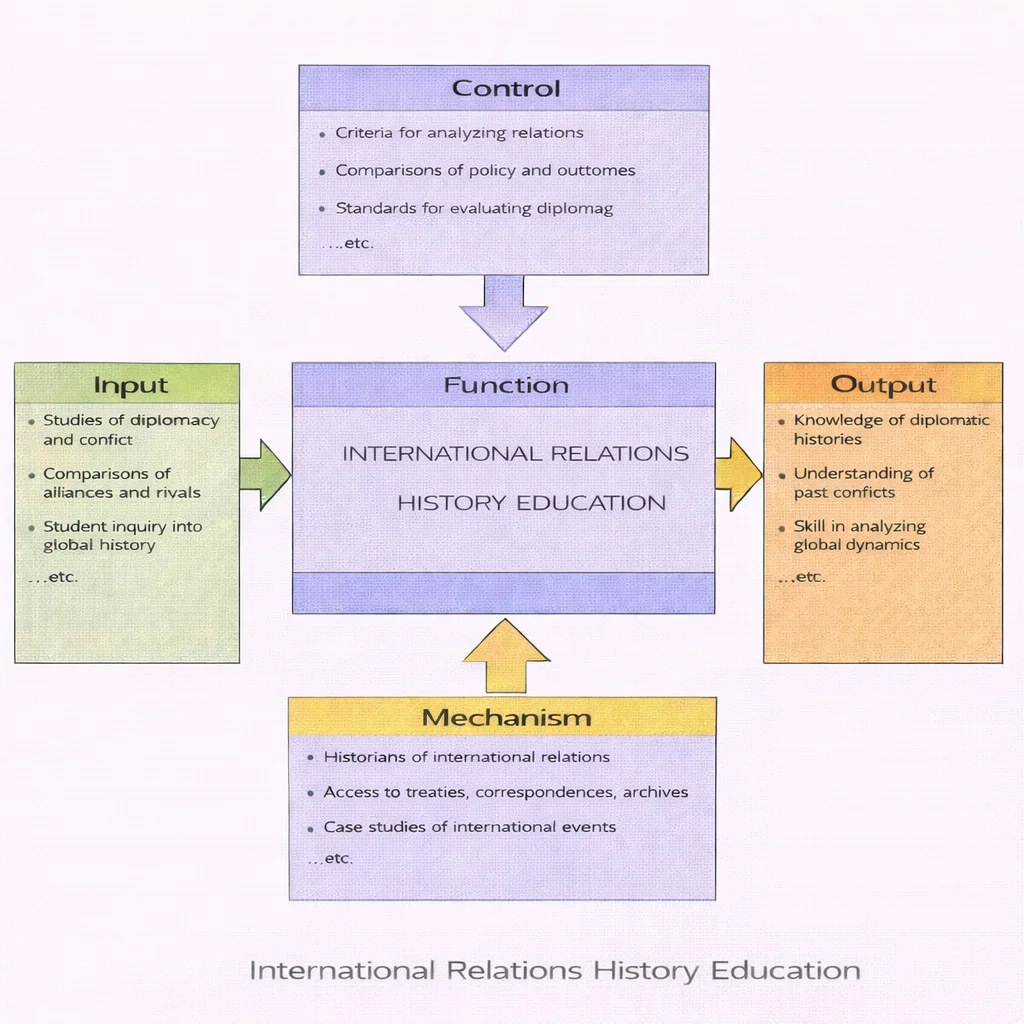
International Relations Education turns the record of diplomacy—treaties, rivalries, negotiations, and turning points—into a disciplined way of thinking about how the world changes. The inputs are the stories and documents of international life, along with students’ questions that test those stories. The controls provide the intellectual “rules of the road”: criteria for analysis, standards for judging diplomacy, and frameworks for comparing outcomes across different eras and regions. Supported by mechanisms such as expert historians, access to archives and correspondence, and carefully chosen case studies, the learning process produces outputs that matter beyond the classroom: a grounded knowledge of diplomatic histories, a clearer understanding of how conflicts emerge and end, and practical skill in analyzing global dynamics with evidence rather than slogans.
International Relations is the study of how nations interact, collaborate, and sometimes conflict with one another in an increasingly interdependent world. It draws from a wide range of disciplines within the humanities and social sciences, enabling students to analyze global affairs through political, economic, cultural, and technological lenses. By engaging with fields such as political science and philosophy, learners gain insight into governance, diplomacy, justice, and ethical decision-making across borders.
Understanding the human dimension of global dynamics is essential. Courses in sociology, psychology, and religious studies provide students with frameworks to examine how identity, belief systems, and collective behavior shape international outcomes. Meanwhile, literature offers a cultural lens through which to explore historical narratives and societal values across nations.
The technological and strategic landscape is a crucial part of global engagement today. The influence of emerging technologies, including information technology and robotics, plays a transformative role in shaping modern diplomacy, cyber conflict, and international security. Fields like cybersecurity and data science and analytics allow us to understand how digital infrastructure, surveillance, and disinformation impact geopolitical relations.
Connectivity across nations is further enabled and challenged by developments in internet and web technologies, as well as satellite technology. These tools not only enable real-time communication but also influence military strategy, economic planning, and humanitarian responses. Similarly, climate-related crises are shaping diplomatic agendas, necessitating familiarity with fields such as environmental engineering and renewable energy.
Statistical literacy and quantitative analysis are essential in evaluating trends, forecasting risks, and developing policy. Training in mathematics and statistics prepares students to interpret economic indicators, monitor international development, and assess the effectiveness of treaties and interventions. In crisis scenarios, knowledge from earthquake and disaster engineering becomes especially relevant in peacekeeping missions and cross-border relief efforts.
International cooperation is also tied to urbanization, trade routes, and infrastructure. Insights from urban and regional planning, green building and sustainable design, and smart manufacturing inform transnational development initiatives. These domains highlight how diplomacy is increasingly rooted not just in dialogue, but in collaborative innovation for a sustainable future.
Ultimately, International Relations is a gateway to understanding the complexity and urgency of global issues. It empowers students to think critically, engage empathetically, and act strategically in a world that demands cooperation, informed analysis, and ethical foresight.
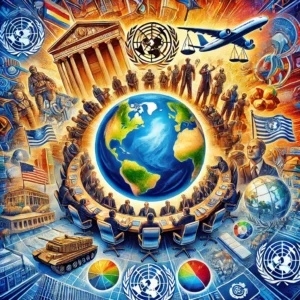
This image presents international relations as a complex system with the Earth at its center and human choices circling around it. A ring of delegates suggests negotiation and summit diplomacy, while repeated UN emblems and official architecture symbolize global institutions, treaties, and rules-based cooperation. Around the scene are visual cues of power and interdependence: flags and formal buildings for state authority, an aircraft for mobility and strategic reach, military elements for deterrence and security dilemmas, and colorful charts for trade, development, and competing national priorities. The layered composition captures the tension international relations studies often examines—collaboration versus rivalry, shared global problems versus national interests, and ideals versus real-world constraints. As an introduction, it invites students to explore how peace is maintained, how conflicts escalate or are prevented, how alliances form, and how economics, technology, and international law influence the decisions made on the world stage.
Connecting Nations: Power, Cooperation, and Global Relations
International Relations examines how countries interact through diplomacy, conflict, trade, and cooperation. It explores the balance between national interests and global responsibilities, revealing how power is negotiated on the world stage. Use the cluster roadmap below to navigate interdisciplinary links across the curriculum:
HSS Overview
Explore the broad study of human culture, social systems, governance, and institutional dynamics across interconnected disciplines.
Anthropology
Study human cultures, kinship structures, and social practices across time, offering ethnographic context for global conflicts.
Cultural Studies
Examine how soft power, ideological narratives, and global media channels construct transnational identities and public opinion.
History
Understand how past geopolitical treaties, imperial expansions, and wars construct modern diplomatic order and international law.
Literature
Explore cross-cultural narratives, exile testimonies, and diplomatic memoirs that reflect historical exchange and human perspectives.
Philosophy
Analyze ethical frameworks surrounding Just War theory, global justice, human rights regimes, and normative international law.
Political Science
Examine domestic state institutions, constitutional authority, public administration, and political theory within sovereign states.
Psychology
Understand leader decision-making cognitive biases, groupthink in security cabinets, and perception dynamics during international crises.
Religious Studies
Explore how transnational religious movements, sacred traditions, and belief systems influence diplomatic negotiations and regional stability.
Sociology
Analyze global social movements, transnational class structures, demographic migration flows, and systemic international inequalities.
Linguistics
Study language structure, translation, discourse framing, and rhetoric as essential tools for international treaty negotiation.
Historical Context of International Relations
Ancient and Classical Periods
- Early forms of international relations can be traced to alliances, treaties, and conflicts among ancient civilizations such as Mesopotamia, Greece, and Rome.
- Example: The Peace of Nicias between Athens and Sparta during the Peloponnesian War.
Westphalian System (1648)
- The Peace of Westphalia marked the emergence of the modern state system, establishing state sovereignty, territorial integrity, and non-interference principles.
World Wars and the Cold War
- The 20th century saw significant structural shifts in global governance:
- World War I and II: Led to multilateral bodies like the League of Nations and the United Nations (UN).
- Cold War Era: Bipolar ideological rivalry between the US (capitalism) and the Soviet Union (communism).
- The 20th century saw significant structural shifts in global governance:
Post-Cold War Globalization
- The end of the Cold War in 1991 ushered in a unipolar order, expanding economic globalization and regional trade blocs.
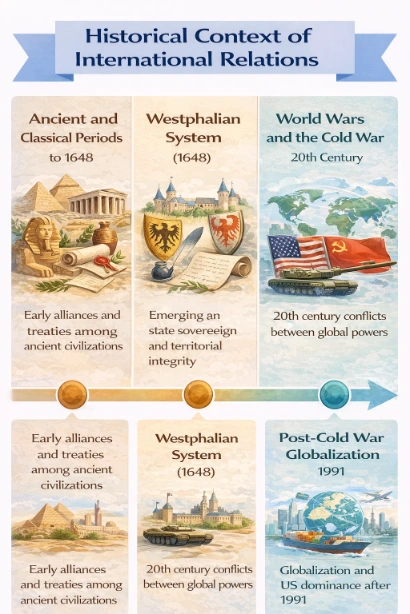
A clean educational infographic presenting the historical development of international relations across four major phases: early alliances and treaties among ancient civilizations; the Westphalian System (1648) establishing sovereignty and territorial integrity; the 20th century marked by world wars and Cold War rivalry; and the post–Cold War era (1991 onward) characterized by U.S.-led unipolarity, expanding globalization, and regional integration.
Key Theories of International Relations
Realism
- Overview: Emphasizes power, state sovereignty, and national interest in an anarchic international system.
- Key Figures: Hans Morgenthau, Niccolò Machiavelli, Thomas Hobbes, Kenneth Waltz.
- Key Ideas: States are rational, unitary actors seeking power to ensure survival. Conflict is an inherent feature of international anarchy.
Liberalism
- Overview: Focuses on institutional cooperation, international law, democracy, and economic interdependence.
- Key Figures: Immanuel Kant, John Locke, Woodrow Wilson, Robert Keohane.
- Key Ideas: Multilateral organizations (UN, WTO) facilitate cooperation; economic ties decrease war probability (Democratic Peace Theory).
Constructivism
- Overview: Argues that international politics is shaped by social constructs, shared norms, ideas, and identities rather than material power alone.
- Key Figures: Alexander Wendt, Martha Finnemore.
- Key Ideas: “Anarchy is what states make of it.” Social identities and norms evolve, actively constructing state behavior.
Marxism and Critical Theories
- Overview: Focuses on global economic structures, core-periphery exploitation, and capital accumulation dynamics.
- Key Figures: Karl Marx, Antonio Gramsci, Immanuel Wallerstein.
- Key Ideas: World-Systems Theory; capitalism generates global economic inequality and structural dependency.
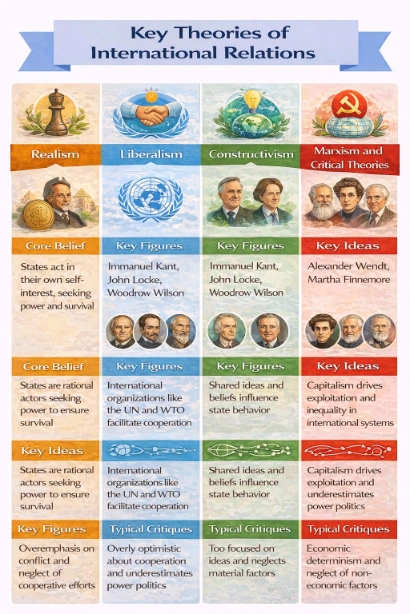
A comparative infographic that introduces four major International Relations theories in a consistent layout. Each column uses simple symbols and portraits to highlight what the theory emphasizes (power, cooperation, norms/identity, or economic structure), plus a short note on common critiques.
Key Areas of Study in International Relations
Diplomacy
- Overview: The practice of negotiation, dialogue, and summitry between sovereign states.
- Key Tools: Bilateral treaties, multilateral summits, embassy envoys, and back-channel communications.
Security Studies
- Overview: Examines deterrence, military strategy, counter-terrorism, arms control, and cybersecurity.
- Key Topics: Nuclear proliferation regimes and defense posture strategies.
Global Governance
- Overview: Focuses on how intergovernmental bodies manage global public goods and crises.
- Key Institutions: United Nations, World Trade Organization, International Monetary Fund.
Human Rights & Humanitarian Law
- Overview: Investigates human rights protections, refugee conventions, and international justice mechanisms (ICC).
International Political Economy (IPE)
- Overview: Examines trade agreements, foreign direct investment, currency markets, and development aid.
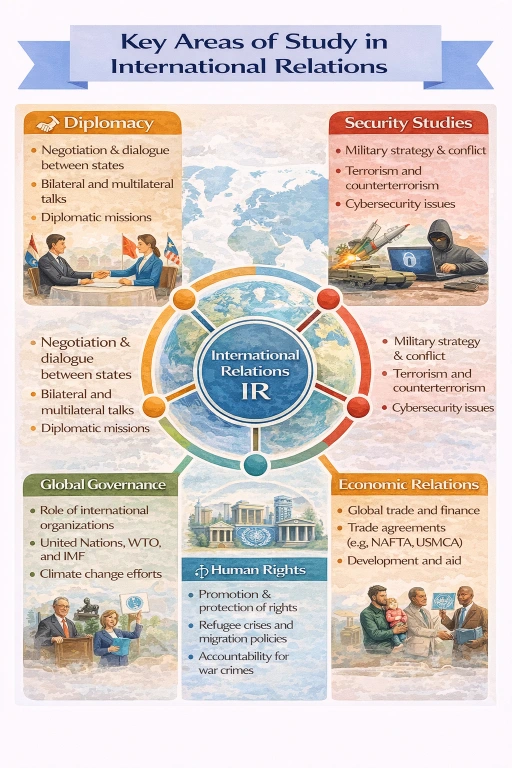
A clean, educational infographic with a world map background and a central circular globe marked “International Relations (IR).” Five color-coded sections surround the center: Diplomacy, Security Studies, Global Governance, Human Rights, and Economic Relations. Each section includes a simple icon-style illustration to reinforce the theme.
Methods in International Relations Research
Quantitative Analysis
- Utilizing statistical regression models to evaluate trade volume, conflict frequency, and treaty compliance data.
Qualitative Case Studies
- Conducting process-tracing and archival analysis on specific crisis events (e.g., Cuban Missile Crisis).
Comparative Analysis
- Evaluating similarities and differences between regional intergovernmental bodies (e.g., EU vs. ASEAN).
Historical & Archival Analysis
- Deconstructing diplomatic correspondence and declassified treaties to understand long-term strategic choices.
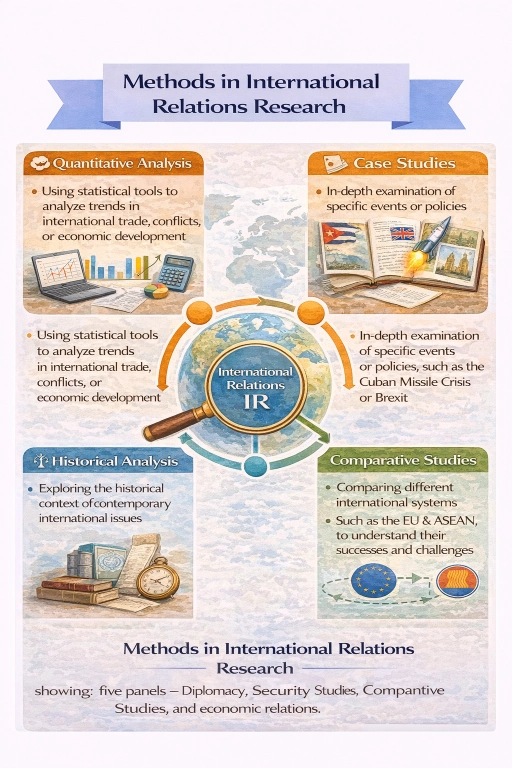
A classroom-style infographic that summarizes four common research methods used in International Relations. It highlights Quantitative Analysis, Case Studies, Comparative Studies, and Historical Analysis surrounding a central globe labeled “International Relations (IR),” visually emphasizing how different methods complement one another.
Contemporary Issues in International Relations
Globalization & Supply Chain Resilience
- Managing economic interdependence and strategic resource vulnerabilities across global trade routes.
Climate Diplomacy & Environmental Governance
- Coordinating multilateral climate action through international frameworks like the Paris Agreement.
Geopolitical Power Shifts & Multipolarity
- Navigating competition between major powers in the Indo-Pacific and Eastern Europe.
Cyber Security & Information Warfare
- Addressing state-sponsored cyberattacks, digital surveillance, and disinformation campaigns.
Humanitarian Response & Migration
- Formulating international policy responses to refugee movements caused by conflict and disaster.
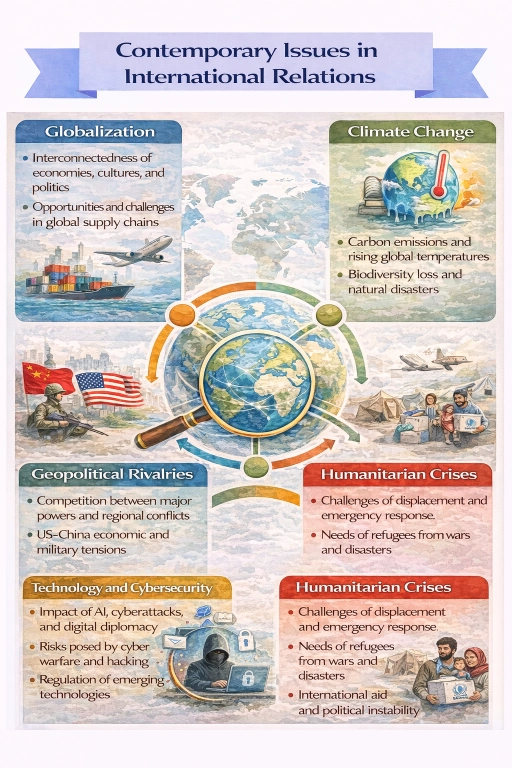
A modern educational infographic with a banner heading and five illustrated topic boxes. Globalization is represented by shipping containers and an aircraft; Climate Change by a warming, melting Earth and thermometer; Geopolitical Rivalries by competing flags and soldiers; Technology and Cybersecurity by digital icons, locks, and a hooded figure at a laptop; and Humanitarian Crises by refugees, tents, and aid supplies. A central globe under a magnifying glass links the panels, emphasizing how these issues intersect worldwide.
Applications of International Relations
- Foreign Policy Formulation: Assisting government state departments in drafting strategic diplomatic policies.
- Conflict Mediation: Facilitating formal peace talks and ceasefires in disputed territories.
- Multilateral Trade Negotiation: Structuring trade tariffs and economic agreements within the WTO framework.
- International Development: Designing sustainable poverty-reduction initiatives through non-governmental organizations.
Future Directions in International Relations
- Multipolar Power Architecture: Adapting international law to accommodate emerging global powers in Asia and Latin America.
- Green Diplomacy: Integrating carbon-tax policy and ecological protection into international trade agreements.
- Global Health Governance: Establishing pandemic response mechanisms under the World Health Organization.
- AI Governance Protocols: Developing international conventions regarding autonomous military systems and AI ethics.
Why Study International Relations
Understanding How the World Works Across Borders
International relations (IR) is the study of how states, organizations, and individuals interact on the global stage. For students preparing for university, IR offers a foundational understanding of the complex and interconnected world in which we live. It examines diplomacy, war, trade, human rights, and global cooperation, helping learners understand the forces that shape international policies, conflicts, and alliances.
Exploring Global Challenges and Geopolitical Dynamics
Students engage with pressing global issues such as climate change, terrorism, migration, nuclear proliferation, and pandemics. International relations provides the tools to analyze how states and non-state actors respond to these challenges, and how power, influence, and negotiation shape global outcomes. This prepares students to think critically about the balance between national interests and global responsibilities.
Analyzing Theories, Institutions, and Decision-Making
IR introduces students to major theories such as realism, liberalism, constructivism, and postcolonialism, each offering different perspectives on how international systems function. It also examines key global institutions—such as the United Nations, NATO, the World Bank, and the International Criminal Court—and how decisions are made in times of cooperation or crisis. This helps learners interpret global events with depth and nuance.
Recognizing Cultural Perspectives and Ethical Dimensions
International relations is not only about statecraft; it also involves culture, identity, and ethics. Students explore how different worldviews, historical experiences, and political ideologies influence diplomacy and conflict. This fosters intercultural understanding and encourages thoughtful engagement with issues like global justice, development, and humanitarian intervention.
Preparing for Global Careers and Informed Citizenship
A foundation in international relations supports academic paths in political science, law, economics, security studies, and global development. It also opens career opportunities in diplomacy, international organizations, journalism, non-profits, business, and academia. For university-bound learners, IR provides not only intellectual enrichment but also the knowledge and perspective needed to participate in shaping a more informed, peaceful, and cooperative world.
🎥 Related Video – Why Study Military History
Military history is essential for understanding the structure and dynamics of international relations. It reveals how wars shape alliances, shift power balances, and lead to the formation of international institutions. Studying conflict helps students grasp the causes of war, the challenges of peace, and the strategic behavior of states.
This video from our Why Study series explores how military history supports academic growth in international relations, and builds the analytical, ethical, and strategic skills needed to engage with global challenges.
Interactive Simulator: Multipolar Balance of Power & Stability Model
Adjust national defense expenditure, economic trade alignment, and alliance commitment parameters to observe real-time impacts on systemic international stability and war risk probability according to Realist and Liberal IR theories.
Interactive Topic Exploration & Self-Check
Click on the questions below to test your baseline knowledge of International Relations theories and historical frameworks:
What is the 'Security Dilemma' in Realist IR theory?
How does the Democratic Peace Theory operate in Liberal IR theory?
Why is the 1648 Peace of Westphalia considered the foundation of modern International Relations?
Is International Relations Right For You?
Explore career pathways, check your fit, and assess your skills — before you commit to a degree.
Conclusion
International Relations is a dynamic field that seeks to understand and influence the interactions among nations and global actors. By studying history, theory, and contemporary issues, IR provides essential tools for addressing the challenges of an interconnected world. As globalization deepens and new challenges emerge, the study of international relations will remain critical for promoting peace, cooperation, and sustainable development on a global scale.
Frequently Asked Questions
What is International Relations (IR)?
International Relations (IR) is the study of how states, international organisations, corporations, and other actors interact across borders. It explores diplomacy, conflict and cooperation, international law, global governance, foreign policy, and the ways global developments affect security, economies, and everyday life.
How is International Relations different from political science in general?
Political science examines power, institutions, and decision-making at many levels, including local, national, and international. International Relations focuses specifically on cross-border politics and global systems, analysing how states and non-state actors relate to one another, manage conflict, and build cooperation in an environment without a single world government.
Who are the main actors studied in International Relations?
Key actors in International Relations include sovereign states, intergovernmental organisations such as the United Nations, regional bodies, international financial institutions, multinational corporations, non-governmental organisations, transnational advocacy networks, and, increasingly, individuals and movements that operate across borders.
What are some major theoretical approaches in International Relations?
Major theoretical approaches include realism, which emphasises power and security in an anarchic international system; liberalism, which highlights cooperation, institutions, and interdependence; constructivism, which focuses on ideas, identities, and norms; and critical perspectives such as Marxist, feminist, postcolonial, and English School approaches that question whose interests and values shape world politics.
What topics can students expect to study in International Relations?
Students in International Relations may study foreign policy analysis, international security, war and peacebuilding, international political economy, international law and organisations, human rights, global health, environmental politics, development and humanitarian issues, regional studies, and the history of international order and diplomacy.
How do International Relations scholars use history and case studies?
International Relations scholars use historical episodes and case studies—such as wars, crises, treaties, and regional integrations—to test theories, trace decision-making processes, and understand how patterns of conflict and cooperation evolve. Historical analysis helps students see that today’s institutions and norms were created through specific choices and struggles.
What methods are used in International Relations research?
International Relations research uses a mix of qualitative and quantitative methods, including archival work, process tracing, interviews, discourse analysis, statistical modelling, network analysis, and simulations or scenario exercises. Students learn to evaluate evidence critically and to understand the strengths and limits of different methodological approaches.
How does International Relations relate to economics, law, and history?
International Relations is an interdisciplinary field. It draws on economics to understand trade, finance, and development; on international law to examine treaties, human rights regimes, and legal disputes; and on history to situate contemporary issues within longer-term patterns of empire, decolonisation, war, and institution-building.
Why is it useful to study International Relations today?
Studying International Relations helps students make sense of global challenges such as conflict, climate change, pandemics, economic crises, and technological disruption. It provides tools to analyse how decisions made in one part of the world affect others, and it encourages informed, critical engagement with news, policy debates, and international cooperation.
What skills do students gain from studying International Relations?
Students develop skills in critical reading, argumentation, and analytical writing; the ability to compare competing explanations; awareness of cultural and political diversity; and confidence in working with complex, often incomplete information. They also practice research design, data interpretation, and communication for both academic and policy audiences.
What kinds of careers can International Relations study prepare students for?
International Relations study can prepare students for careers in diplomacy and foreign service, international organisations, non-governmental organisations, policy analysis and think tanks, journalism, international business, risk and consultancy work, development and humanitarian agencies, and further academic research and teaching.
How can students prepare for university-level study in International Relations?
Students can prepare for university-level International Relations by following global news from diverse sources, reading introductory books on world politics, building a foundation in history, economics, and geography, practising critical discussion and debate, and engaging with different perspectives on current international issues in a careful and respectful way.
Comprehensive International Relations Assessment Module
Section 1: Foundational Theoretical Questions
- What defines International Relations (IR) as an academic discipline?
Answer: International Relations is the systematic study of interactions, diplomacy, conflicts, economic trade, and legal relations between sovereign states, intergovernmental organizations, non-governmental actors, and multinational corporations in an anarchic global system. - Explain the concept of 'anarchy' as understood in Realist IR theory.
Answer: In Realist theory, anarchy does not mean chaos, but rather the absence of a centralized global government above sovereign states, obligating states to rely on self-help strategies and balance of power dynamics to ensure survival. - How does Liberal Institutionalism argue that international cooperation is achievable despite anarchy?
Answer: Liberal Institutionalism posits that intergovernmental organizations (such as the UN or WTO) reduce transaction costs, increase information transparency, enforce reciprocity, and facilitate repeated interactions that allow states to cooperate for mutual gain. - What is the core premise of Constructivism in International Relations?
Answer: Constructivism asserts that state interests, power dynamics, and international structures are constructed through social interaction, shared norms, cultural identity, and historical ideas rather than fixed material capabilities. - What historical role did the 1648 Peace of Westphalia play in establishing the modern state system?
Answer: The Peace of Westphalia codified state sovereignty, territorial integrity, and the principle of non-interference in domestic affairs, creating the foundational legal framework for modern statehood. - How does World-Systems Theory explain global economic inequality?
Answer: Developed by Immanuel Wallerstein, World-Systems Theory divides the global political economy into Core (industrialized, capital-rich states) and Periphery (resource-exporting, exploited states), arguing that capitalist globalization perpetuates structural inequality. - What is the function of the International Court of Justice (ICJ) versus the International Criminal Court (ICC)?
Answer: The ICJ adjudicates legal disputes strictly between sovereign nation-states, whereas the ICC prosecutes individual persons accused of war crimes, genocide, crimes against humanity, and aggression. - What is deterrence theory in strategic security studies?
Answer: Deterrence theory posits that a state can prevent hostile military aggression by threatening a credible, devastating counterattack (such as nuclear retaliatory strike), convincing adversaries that costs outweigh potential gains. - How does soft power differ from hard power according to Joseph Nye?
Answer: Hard power relies on coercive force (military intervention, economic sanctions), while soft power relies on attraction, cultural diplomacy, political values, and legitimate foreign policy to persuade other states. - How does climate change function as a 'threat multiplier' in national security analysis?
Answer: Climate change exacerbates pre-existing social, economic, and political vulnerabilities by worsening resource scarcity (water, food), driving forced migration, and triggering regional border conflicts.
Section 2: Analytical & Scenario-Based Inquiry
- How might the global shift toward multipolarity alter traditional collective security alliances like NATO?
Answer: In a multipolar system, competing regional power centers weaken unipolar hegemony. Alliances must adapt by negotiating flexible coalition partnerships, balancing economic ties with rival states, and addressing non-traditional threats like cyber warfare. - Analyze how artificial intelligence and autonomous weapon systems impact strategic stability under classical deterrence models.
Answer: AI reduces decision-making reaction times and increases the risk of accidental escalation or miscalculation during automated crisis response, undermining human diplomatic signaling and mutual assured destruction protocols. - Evaluate how global supply chain dependencies (such as semiconductor manufacturing) create geopolitical leverage.
Answer: Concentration of critical technologies within specific geographic regions gives holding states strategic choke-point leverage, turning economic trade interdependencies into weapons of statecraft (weaponized interdependence). - Deconstruct the tension between state sovereignty and the Responsibility to Protect (R2P) doctrine in international law.
Answer: State sovereignty protects nations from foreign intervention, whereas R2P asserts that the international community has a moral obligation to intervene when a state fails to protect its population from genocide or war crimes, creating diplomatic conflict over Security Council authorization. - Analyze how digital diplomacy and social media alter traditional diplomatic secrecy and crisis negotiation.
Answer: Real-time digital communication accelerates public scrutiny and narrative warfare, forcing diplomats to respond instantly to unverified media, which can constrain back-channel negotiation flexibility during delicate crisis management. - How do non-state transnational networks challenge state control in international cybersecurity?
Answer: Decentralized hacker collectives and private tech infrastructure providers operate beyond territorial boundaries, creating attribution ambiguity that makes classical state-to-state international legal sanctions difficult to enforce. - Evaluate the effectiveness of economic sanctions as an alternative to military intervention.
Answer: Sanctions exert financial pressure without direct military casualties, but frequently cause humanitarian harm to civilian populations while failing to alter regime behavior if targets access shadow banking systems. - How does regional integration in the European Union test traditional Realist concepts of state sovereignty?
Answer: The EU pools legal, monetary, and border control authority into supranational bodies, proving that states can voluntarily cede traditional sovereign prerogatives to achieve economic and strategic stability. - In what ways do international trade organizations mediate trade wars between economic superpowers?
Answer: The WTO provides formal dispute settlement mechanisms to evaluate tariff legality, but relies on voluntary state compliance, leaving the system vulnerable when major powers block judicial appointments. - Analyze how refugee crises impact domestic political stability and foreign policy agendas in host nations.
Answer: Large refugee inflows test host state public infrastructure and can polarize domestic electorates, driving political shifts toward nationalist foreign policies and stricter border security. - How does weaponized interdependence allow core states to enforce sanctions through global financial clearinghouses?
Answer: States controlling central global financial infrastructure (such as SWIFT or USD clearing systems) can restrict adversary access to international banking, forcing third-party nations to comply with unilateral sanctions. - Evaluate how global health governance during pandemics exposes gaps in international health regulations.
Answer: Pandemics expose state tendencies to prioritize vaccine nationalism and unilateral border closures over WHO recommendations, proving that national security priorities often override global health protocols during acute crises.
Section 3: Applied Mathematical & Game Theory Exercises
- In a classic Prisoner's Dilemma nuclear disarmament model between State A and State B: If both Cooperate (Disarm), both receive a payoff of 3. If both Defect (Arm), both receive 1. If one Defects while the other Cooperates, the Defector receives 5 (Dominance) and the Cooperator receives 0 (Vulnerability). Identify the Nash Equilibrium payoff pair.
Answer:Payoff Matrix (State A, State B):
- Both Cooperate: (3, 3)
- State A Arms, State B Disarms: (5, 0)
- State A Disarms, State B Arms: (0, 5)
- Both Defect (Arm): (1, 1)
Analysis: If State B Cooperates, State A's best response is Defect (5 > 3). If State B Defects, State A's best response is Defect (1 > 0). Thus, Defecting is a dominant strategy for both states.
Nash Equilibrium: Both states Defect (Arm), yielding payoff pair (1, 1). - An international peacekeeping force deploys 12,000 troops across three sectors in a conflict zone: Border Security (B), Humanitarian Protection (H), and Urban Demilitarization (U) in a ratio of 5 : 4 : 3. Calculate the exact troop allocation in each sector.
Answer:Total Ratio Parts = 5 + 4 + 3 = 12 parts.
Troops per part = 12,000 / 12 = 1,000 troops.
Border Security (B) = 5 × 1,000 = 5,000 troops.
Humanitarian Protection (H) = 4 × 1,000 = 4,000 troops.
Urban Demilitarization (U) = 3 × 1,000 = 3,000 troops.
Troop Breakdown: Border = 5,000; Humanitarian = 4,000; Urban = 3,000. - A quantitative trade study measures bilateral export volume E (in billions of dollars) between two nations as a function of target GDP G ($B) and distance D (1,000 km): E = 2.5 × (G / D). If Target GDP G = 800 and Distance D = 4, calculate the predicted export volume.
Answer:E = 2.5 × (800 / 4)
E = 2.5 × 200 = 500
Predicted Export Volume: $500 billion. - An international climate treaty sets a carbon emission reduction target from 80 megatons (MT) down to 50 MT over 6 years. Calculate the required annual constant reduction rate in MT per year, and determine the emission level at Year 4.
Answer:Total Reduction required = 80 - 50 = 30 MT.
Annual Rate = 30 MT / 6 years = 5 MT per year.
Emission level at Year 4 = 80 - (4 × 5) = 80 - 20 = 60 MT.
Result: Annual reduction = 5 MT/yr; Year 4 level = 60 MT. - In an empirical security study tracking 1,000 international militarized crises, 250 crises escalated into armed conflict. Calculate the sample proportion (p) and compute the standard error (SE) of this proportion.
Answer:Sample Proportion (p) = 250 / 1000 = 0.25 (25%)
Standard Error (SE) = √[ p(1 - p) / N ] = √[ (0.25 × 0.75) / 1000 ] = √[ 0.1875 / 1000 ] = √[ 0.0001875 ] ≈ 0.01369
Result: Proportion = 25.0%; Standard Error = 1.37%. - A defense analysis model evaluates systemic war probability P(x) as a function of military expenditure disparity x: P(x) = 0.02x2 - 0.24x + 0.90. Find the disparity value x that minimizes war probability.
Answer:Quadratic function with a = 0.02, b = -0.24.
Minimum vertex occurs at x = -b / (2a):
x = -(-0.24) / [ 2 × 0.02 ] = 0.24 / 0.04 = 6.0 units.
Minimum Probability P(6) = 0.02(36) - 0.24(6) + 0.90 = 0.72 - 1.44 + 0.90 = 0.18 (18%).
Optimal Disparity: x = 6.0 yields a minimum war probability of 18%.