
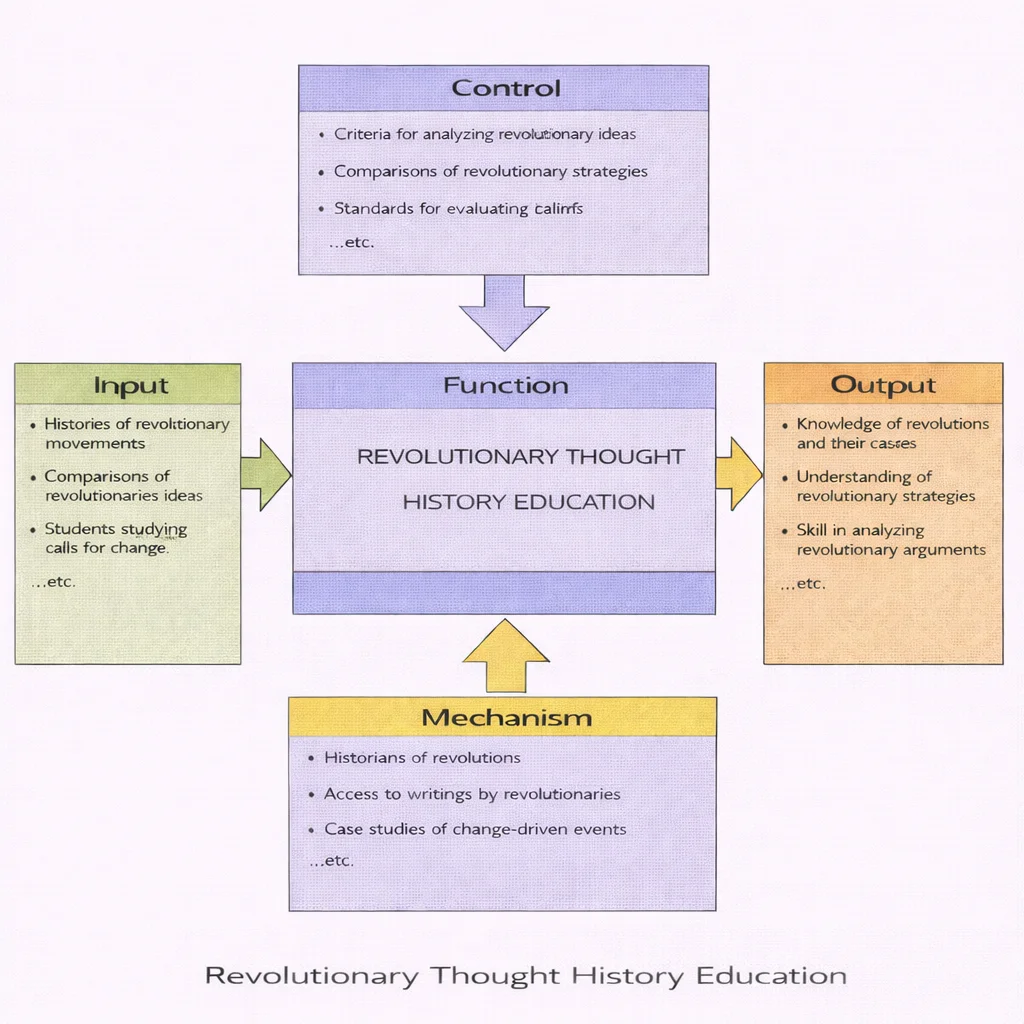
Revolutionary Thought History Education takes the raw materials of the past—manifestos, speeches, pamphlets, debates, and the lived experiences of upheaval—and turns them into structured understanding. With clear controls such as analysis criteria, comparative lenses, and evaluation standards, students learn to distinguish emotion from argument, ideals from tactics, and short-term victories from long-term consequences. Supported by mechanisms such as expert guidance, curated primary texts, and carefully chosen case studies, learners practice reading revolutionary claims in context: what problems were being named, what solutions were proposed, and what trade-offs were accepted or ignored. The intended outcome is not only historical knowledge of revolutions and their causes, but also a disciplined ability to assess revolutionary strategies and critique revolutionary arguments with fairness, evidence, and intellectual independence.
Revolutionary thought represents a fundamental challenge to established political orders, often emerging during moments of social unrest, economic dislocation, or cultural transformation. The roots of such movements can be traced through the evolution of political ideologies that provide the conceptual framework for reform, rebellion, and radical change. These ideas are never formed in isolation—they arise in conversation with the political history of their time, from ancient revolts to modern revolutions, and reflect the broader dynamics explored in the history of ideas.
Revolutionary action is not only an intellectual process but also a deeply social phenomenon. Widespread dissatisfaction expressed through movements like the suffrage and civil rights movements exemplifies how collective resistance gains momentum. The broader context of social history reveals the impact of economic inequality, class struggles, and marginalized voices, while the disruptions of migration and diaspora studies further fuel radical critique and reformist agendas.
The intellectual underpinning of revolutions frequently draws upon dissatisfaction with existing political systems, informed by economic grievances and the strategic role of political economy. Historical analyses such as political economy of crises and history of economic thought explain how collapsing financial systems often precipitate calls for revolutionary change.
Conflict, both ideological and military, often accompanies revolution. Military perspectives are crucial in this regard, explored through military history, military strategic studies, and the technological history of warfare. The personal experiences of revolutionaries are captured in political biography, while the evolving ethics of combat and diplomacy are addressed in studies like peace studies and conflict resolution and military diplomacy.
Revolutionary messaging has historically relied on both print and digital platforms. The way ideas spread—especially through propaganda, speeches, and manifestos—is analyzed in media and communication history. In the contemporary world, these channels are increasingly shaped by innovations studied in the role of technology in elections, which influence modern revolutionary campaigns and political organization.
Many revolutions grow out of grievances rooted in urban deprivation, land ownership, and industrial exploitation. These contexts are explored in urban and rural history, trade and commerce history, and the study of treaty analysis where colonial or repressive treaties sparked resistance. The shifting balances of military and political power during and after revolutions illuminate how old regimes fall and new orders take shape.
Ultimately, revolutionary thought reflects the friction between idealism and pragmatism, between the will for transformation and the institutions that resist it. Through the lens of political campaigns and the choices of individuals who risk everything for change, we gain insight into the dynamics of power and the enduring drive for freedom and justice.
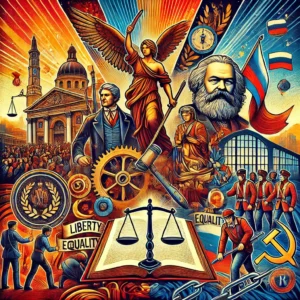
This dramatic illustration portrays revolutionary thought as a fusion of philosophy, public action, and competing visions of justice. A central open book and scales of justice suggest foundational principles and the demand for legitimacy. Around them, crowds, banners, and marching figures represent mass mobilization and political upheaval. Symbols and imagery associated with major revolutionary traditions appear throughout—liberty and equality slogans, worker movements, and a prominent portrait of Karl Marx—indicating debates about rights, class, and social transformation. Historic buildings and strong contrasting colors reinforce the intensity of revolutionary moments, when ideas move from texts and speeches into streets, institutions, and the reshaping of society.
Curriculum Cluster Navigation
Contextualize revolutionary thought within the broader curriculum roadmap of intellectual political history:
Intellectual Political History – Hub
Strategic Context: Parent Overview. Maps the complete continuum of political theory, illustrating how radical revolutionary movements disrupt and re-shape institutional history.
Ancient Political Philosophy
Strategic Context: Classical Foundations. Examines early classical critiques of tyranny, constitutional decay, and regime cycle changes (anacyclosis) that prefigured modern revolutionary theory.
Religious Political Thought
Strategic Context: Spiritual Legitimacy vs. Rebellion. Explores how sacred doctrines have been weaponized both to legitimize divine-right monarchies and to justify liberation theology or holy resistance.
Liberalism and Conservatism
Strategic Context: Modern Ideological Dialectic. Analyzes how conservative thought formulated its defense of tradition in direct opposition to the radical rupture of the French Revolution.
Global Political Thought
Strategic Context: Anti-Colonial Liberation. Connects Western revolutionary theories (Marxism/Rousseau) to 20th-century anti-colonial national liberation struggles across the Global South.
Ideas that Ignite Change: Revolutionary Thought and Political Transformation
Revolutionary thought challenges existing systems and imagines new political possibilities. From calls for liberty and equality to radical restructuring of society, these ideas have driven some of the most profound transformations in history. Studying revolutionary thought reveals how ideas can disrupt, reshape, and redefine power.
Core Concepts in Revolutionary Thought
The Right to Revolution
Revolutionary thought often posits that oppressed peoples have a moral or natural right to overthrow unjust systems of governance.
- Lockean Social Contract: John Locke argued in Two Treatises of Government (1689) that citizens hold an inalienable right to alter or abolish government when it systematically violates natural rights to life, liberty, and property.
Popular Sovereignty
Revolutions are frequently driven by the principle that ultimate political legitimacy resides in the collective citizen body rather than dynastic monarchs or divine mandate.
“Each of us puts his person and all his power in common under the supreme direction of the general will, and, in our corporate capacity, we receive each member as an indivisible part of the whole.” — Jean-Jacques Rousseau, The Social Contract
- Rousseauian General Will: Jean-Jacques Rousseau emphasized in The Social Contract (1762) that true sovereignty is indivisible and inalienable, belonging strictly to the general will of equal citizens.
Class Struggle and Economic Inequality
Revolutionary theories identify systemic economic exploitation and class division as the fundamental material drivers of social upheaval.
- Marxist Historical Materialism: Karl Marx and Friedrich Engels asserted in The Communist Manifesto (1848) that all history is the history of class struggles between oppressors (bourgeoisie) and oppressed (proletariat), culminating in a worker-led revolution.
Utopian Visions
Revolutionary thought frequently includes utopian frameworks, imagining a completely reconstructed society free from inequality, poverty, and state coercion.
- Thomas More’s Radical Blueprint: Utopia (1516) criticized private property and economic greed, providing early conceptual inspiration for later socialist, anarchist, and agrarian communist movements.
Historical Examples of Revolutionary Thought
Jean-Jacques Rousseau and the French Revolution
- Context: Rousseau’s critiques of feudal privilege and divine-right monarchy provided the ideological spark for the 1789 French Revolution.
- Key Contributions:
- General Will & Equality: Asserted that laws are valid only when expressing the collective moral will of equal citizens.
- Critique of Private Property: In Discourse on Inequality (1755), argued that institutional property created social corruption and bondage.
- Impact: Adopted by Jacobin leaders like Maximilien Robespierre to justify radical democratization and centralized revolutionary defense during the Reign of Terror.
Karl Marx and Communist Movements
- Context: Formulated in response to 19th-century industrial capitalism, shaping the 1917 Russian Revolution and 1949 Chinese Revolution.
- Key Contributions:
- Historical Materialism: Argued that economic modes of production dictate political legal superstructures.
- Proletarian Dictatorship: Formulated the necessity of a transitional worker state to seize the means of production and abolish private class ownership.
- Impact: Guided Vladimir Lenin’s Bolshevik Party in overthrowing the Tsarist empire and constructing the Soviet Union.
The American Revolution and Enlightenment Ideas
- Context: American colonists leveraged British Common Law traditions and Enlightenment philosophy to break from the British Empire (1775–1783).
- Key Contributions:
- Inalienable Rights: Adapted Lockean philosophy into Thomas Jefferson’s Declaration of Independence (“Life, Liberty and the pursuit of Happiness”).
- Anti-Monarchical Republicanism: Thomas Paine’s Common Sense (1776) popularized republican government and popular representation across the colonies.
- Impact: Established the first modern constitutional republic grounded in popular sovereignty and federal separation of powers.
Frantz Fanon and Decolonization
- Context: Authored during the Algerian War of Independence (1954–1962), guiding anti-colonial movements across Africa and Asia.
- Key Contributions:
- Psychological Subjugation: Analyzed in Black Skin, White Masks how colonial racism forces colonized peoples to internalize inferior status.
- Therapeutic Revolutionary Violence: Argued in The Wretched of the Earth (1961) that armed struggle is necessary to purge colonial trauma and restore subaltern dignity.
- Impact: Inspired liberation movements led by Che Guevara, Amílcar Cabral, and the Black Panther Party.
Themes in Revolutionary Thought
The Role of Intellectuals & Vanguard Parties
Revolutionary intellectuals formulate theoretical frameworks and organize vanguard movements to transform latent public discontent into structured political action.
The Ethics of Revolutionary Violence
Revolutionary thought grapples continuously with whether the use of violent force is morally permissible to overthrow systemic tyranny or whether violence inherently corrupts revolutionary outcomes.
The Tension Between Idealism and Statecraft
Revolutions frequently face a crisis when abstract utopian ideals must be translated into practical post-revolutionary state institutions, often resulting in bureaucratic centralization or authoritarian consolidation.
Interactive Revolutionary Mobilization & Dynamics Simulator
Use the interactive tool below to simulate how political oppression, economic inequality, and ideological mobilization interact to determine whether a polity experiences stability, reform, or revolutionary rupture.
Revolutionary Outbreak & Risk Simulator
Adjust the socio-economic indicators below to calculate the political pressure index and observe regime outcomes.
Interactive Review Questions
Toggle each box below to reveal detailed answers and analytical commentary on key concepts in revolutionary thought:
What is the fundamental difference between revolutionary thought and reformist political theory?
How did Lenin adapt orthodox Marxist theory to early 20th-century Russian conditions?
Why is Hannah Arendt's analysis of the French vs. American Revolutions significant?
Frequently Asked Questions
What is revolutionary thought in political history?
Revolutionary thought refers to political theories, manifestos, and philosophies that advocate for the radical overthrow or fundamental restructuring of existing political, social, or economic systems.
How does revolutionary thought differ from reformism?
Reformism seeks gradual change inside established legal channels. Revolutionary thought asserts that the system itself must be dismantled and replaced.
What social conditions spark revolutionary ideas?
Deep economic inequality, severe political disenfranchisement, fiscal crisis, military defeat, or colonial subjugation frequently trigger revolutionary movements.
Do all revolutionary theories advocate violence?
No. While some thinkers defend armed struggle against tyranny, others champion nonviolent mass mobilization, general strikes, and civil disobedience (e.g., Gandhian Satyagraha).
What role does propaganda play in revolutions?
Propaganda, manifestos, pamphlets, and speeches translate complex philosophy into accessible slogans, unifying disparate public grievances into mass collective action.
Why do some revolutions result in authoritarian regimes?
Revolutions create power vacuums, civil war, and economic disruption, which often lead vanguard parties or military leaders to centralize coercive power to preserve order.
How did anti-colonialism shape revolutionary thought?
Anti-colonial thinkers (such as Fanon, Cabral, and Mao) merged national liberation with anti-imperialist critiques, redefining sovereignty and human rights for the Global South.
Comprehensive Mastery & Exercise Module
Section 1: Foundational Review Questions
-
What is revolutionary thought in political history and what are its defining features?
Answer: Revolutionary thought consists of political theories, philosophies, and manifestos that challenge established authority and advocate for the radical transformation or complete overthrow of existing state and social structures. Its defining features include critiques of systemic oppression, popular sovereignty claims, and utopian visions of new order. -
How does revolutionary thought differ from reformist approaches?
Answer: Reformist approaches seek gradual policy improvements within established legal frameworks. Revolutionary thought asserts that existing legal and institutional structures are fundamentally corrupt or unreformable, requiring total dismantling and structural replacement. -
What historical factors contributed to the emergence of revolutionary thought?
Answer: Extreme wealth inequality, severe political disenfranchisement, rapid economic disruption (such as industrialization), state bankruptcy, foreign colonial exploitation, and the spread of critical Enlightenment ideas. -
Who are some influential thinkers associated with revolutionary thought?
Answer: Jean-Jacques Rousseau (Popular sovereignty), Karl Marx (Historical materialism/Class struggle), Vladimir Lenin (Vanguard party), Frantz Fanon (Anti-colonial liberation), and Thomas Paine (Democratic republicanism). -
How did revolutionary thought contribute to major political upheavals throughout history?
Answer: It provided cohesive theoretical arguments, unifying language, and moral justification that mobilized disparate social classes into organized mass revolts against ruling elites in France, America, Russia, China, and Algeria. -
What are the potential benefits and risks associated with revolutionary thought?
Answer: Benefits include dismantling autocratic oppression, expanding civil liberties, and restructuring economic wealth. Risks include civil war, economic collapse, mass violence, and the emergence of post-revolutionary authoritarianism. -
How has revolutionary thought influenced the development of modern political institutions?
Answer: It established foundational concepts like constitutionalism, secular republicanism, popular sovereignty, labor protections, universal suffrage, and international anti-colonial legal rights. -
In what ways does revolutionary thought inspire social and political mobilization?
Answer: It translates latent public discontent into structured collective action by providing ideological manifestos, framing oppression as unjust rather than inevitable, and offering visions of a liberated future. -
How do revolutionary ideas transform societal values and governance structures?
Answer: They replace dynastic or divine legitimacy with popular sovereignty, eliminate feudal privileges, redistribute land/capital, and re-engineer public legal systems to align with revolutionary doctrines. -
How does the legacy of revolutionary thought continue to influence contemporary political debates?
Answer: It informs modern movements for economic equality, anti-racism, climate justice, subaltern rights, and democratic resistance against authoritarian backsliding.
Section 2: Analytical & Scenario-Based Challenges
-
Analyze the tension between individual liberty and collective equality in Jacobin revolutionary ideology.
Answer: The Jacobins under Robespierre prioritized absolute social equality and public virtue (Rousseau's General Will) over individual liberal liberties. To preserve revolutionary equality against internal counter-revolutionaries, the Jacobin regime instituted centralized coercion and state surveillance (The Reign of Terror), demonstrating how radical demands for absolute collective equality can suppress individual negative liberty. -
How do digital communications platforms alter the spread of revolutionary ideas compared to 18th-century print culture?
Answer: 18th-century print culture relied on physical pamphlets (e.g., Paine's Common Sense) and salons, operating through slow, deliberative elite networks. Digital platforms enable instant, borderless, peer-to-peer mobilization, democratizing participation but accelerating ideological fragmentation, algorithmic echo chambers, and state digital surveillance. -
Contrast the Marxist-Leninist concept of the "Vanguard Party" with Anarchist theories of spontaneous mass revolution.
Answer: Marxism-Leninism argues that workers possess only "trade-union consciousness" and require a centralized, disciplined vanguard party of professional revolutionaries to direct the revolution and manage the post-revolutionary state. Anarchism (e.g., Bakunin, Kropotkin) rejects all state power and vanguard hierarchies, advocating for spontaneous worker uprisings and decentralized federations. -
Evaluate the ethical dilemma of using therapeutic violence in Frantz Fanon's anti-colonial framework.
Answer: Fanon argued that colonial rule is inherently violent and that revolutionary violence is psychologically necessary for colonized subjects to strip away internalized inferiority complexes. The ethical dilemma arises because invoking violence as a therapeutic agent risks institutionalizing brutal coercion within the post-colonial state, often leading to authoritarian military rule post-independence. -
How did the Haitian Revolution (1791–1804) challenge Enlightenment revolutionary thought?
Answer: The Haitian Revolution exposed the racial hypocrisy of the French and American Revolutions, which championed human liberty while maintaining chattel slavery. Enslaved Haitians under Toussaint Louverture took Enlightenment rights to their radical conclusion, establishing the first independent Black republic and abolishing slavery unconditionally. -
Examine how economic crises (e.g., hyperinflation, food shortages) act as catalysts for revolutionary tipping points.
Answer: Economic crises shatter the social contract by revealing state incapacity to guarantee basic subsistence. When food shortages or hyperinflation hit urban populations, the perceived cost of rebellion drops below the cost of compliance, transforming passive grievances into violent political mobilization. -
How can a post-revolutionary government avoid descending into authoritarian consolidation?
Answer: By swiftly establishing constitutional checks and balances, codifying judicial independence, protecting press freedoms, maintaining civilian control over military forces, and holding open competitive elections to decentralize executive power away from revolutionary vanguard bodies.
Section 3: Quantitative Political & Economic Calculations
-
During a pre-revolutionary economic crisis, food prices rise exponentially while real wages drop. If a staple food basket cost 40 francs in Year 1 and 180 francs in Year 3, while average monthly worker wages fell from 100 francs to 75 francs over the same period, calculate: (a) The percentage increase in the cost of the food basket, and (b) The percentage of monthly wages required to purchase the food basket in Year 1 versus Year 3.
Answer:
(a) Food basket price increase = ((180 - 40) / 40) × 100 = (140 / 40) × 100 = 350% increase.
(b) Year 1 wage share = (40 / 100) × 100 = 40% of wages.
Year 3 wage share = (180 / 75) × 100 = 240% of wages (causing starvation and revolt). -
In a pre-revolutionary assembly, land ownership determines voting blocks. Class 1 (Clergy/Nobility: 2% of population) controls 60% of legislative votes. Class 2 (Bourgeoisie/Peasants: 98% of population) controls 40% of votes. If a measure to levy taxes on noble land requires a simple majority (50% + 1 vote) in a 300-seat assembly, and 90% of Class 1 votes NO while 95% of Class 2 votes YES, compute the outcome.
Answer:
Class 1 seats = 0.60 × 300 = 180 seats. NO votes = 0.90 × 180 = 162 NO votes.
Class 2 seats = 0.40 × 300 = 120 seats. YES votes = 0.95 × 120 = 114 YES votes.
Class 1 YES votes = 180 - 162 = 18. Total YES votes = 114 + 18 = 132 votes.
Majority required = 151 votes.
Result: Defeated (132 YES votes falls short of 151 needed), illustrating structural voting paralysis. -
A revolutionary army mobilizes 80,000 insurgents across 4 military sectors: Sector A receives 35%, Sector B receives 30%, Sector C receives 20%, and Sector D receives the remainder. Calculate the exact troop allocation for each sector.
Answer:
- Sector A = 0.35 × 80,000 = 28,000 troops.
- Sector B = 0.30 × 80,000 = 24,000 troops.
- Sector C = 0.20 × 80,000 = 16,000 troops.
- Sector D percentage = 100% - (35 + 30 + 20)% = 15%. Allocation = 0.15 × 80,000 = 12,000 troops.
Total = 28,000 + 24,000 + 16,000 + 12,000 = 80,000 troops. -
Following a land reform decree, a post-revolutionary state expropriates 2,500,000 hectares of feudal estates and redistributes 70% to peasant cooperatives, 20% to state farms, and retains 10% as forest reserves. Compute the exact hectares allocated to each category.
Answer:
- Peasant Cooperatives = 0.70 × 2,500,000 = 1,750,000 hectares.
- State Farms = 0.20 × 2,500,000 = 500,000 hectares.
- Forest Reserves = 0.10 × 2,500,000 = 250,000 hectares. -
In a revolutionary referendum on a new constitution, 4,200,000 votes are cast. Option A (Radical Soviet Republic) receives 2,310,000 votes; Option B (Constitutional Monarchy) receives 1,260,000 votes; Option C (Invalid/Blank) receives 630,000 votes. Calculate the exact percentage share of valid votes won by Option A.
Answer:
Valid votes cast = 2,310,000 + 1,260,000 = 3,570,000 votes.
Option A valid percentage = (2,310,000 / 3,570,000) × 100 = 64.71%. -
A pre-revolutionary regime prints fiat currency to fund military defense, triggering hyperinflation. Currency in circulation grows from 500 million roubles to 8.5 billion roubles over 12 months. Calculate the percentage increase in the money supply.
Answer:
Increase = 8,500 million - 500 million = 8,000 million roubles.
Percentage Increase = (8,000 / 500) × 100 = 1,600% increase. -
Calculate the Gallagher Index of Disproportionality for a post-revolutionary provisional assembly election where Party A wins 40% of votes and 60% of seats, Party B wins 35% of votes and 30% of seats, and Party C wins 25% of votes and 10% of seats. Formula: sqrt(0.5 × ∑(Vi - Si)2).
Answer:
Party A diff = 40 - 60 = -20. Squared = 400.
Party B diff = 35 - 30 = +5. Squared = 25.
Party C diff = 25 - 10 = +15. Squared = 225.
Sum of squared diffs = 400 + 25 + 225 = 650.
Gallagher Index = sqrt(0.5 × 650) = sqrt(325) ≈ 18.03.