Prepare for University Studies & Career Advancement
Stimulated Emission and Laser Cavities
A laser is not simply a very bright lamp. It is a carefully organised system in which atoms, photons, mirrors, and energy input work together to produce light that is unusually coherent, narrow, directional, and controllable. This page explains the physical heart of Laser Optics: stimulated emission and the laser cavity.
The key idea is simple but powerful. Under the right conditions, one photon can encourage an excited atom to release a second photon that matches it. The new photon travels in the same direction, has the same frequency, and keeps a fixed phase relationship with the original photon. When this process is repeated many times inside a resonant cavity, ordinary microscopic quantum events become a macroscopic beam of organised light.
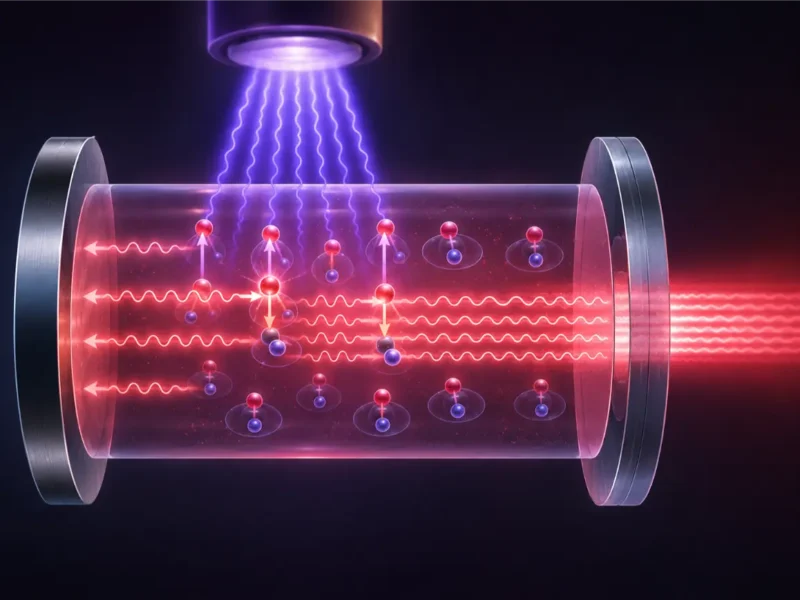
A laser produces organised light when excited atoms, matching photons, mirrors, and optical feedback work together inside a resonant cavity.
This artist’s impression illustrates the physical heart of laser optics. Inside a transparent laser cavity, energy input excites atoms in the gain medium. A photon stimulates an excited atom to release a matching photon, and the process repeats many times as light reflects between mirrors. The image shows how microscopic quantum events, guided by optical feedback, become a narrow, coherent, directional, and controllable laser beam.
What Stimulated Emission Really Is
Stimulated emission is the quantum process that makes laser light possible. An atom, ion, molecule, or semiconductor electron can exist in different energy states. When it is placed in a higher-energy state, it does not usually stay there forever. It may eventually fall to a lower-energy state and release energy as a photon.
In ordinary spontaneous emission, the atom releases a photon randomly. The direction, phase, and timing of the emitted photon are not tightly coordinated with photons from other atoms. This is why light from a normal lamp is usually spread out, mixed in wavelength, and not strongly coherent.
Stimulated emission is different. If a photon of the correct energy passes near an excited atom, it can trigger the atom to drop to a lower energy state and emit a second photon. This second photon has the same energy, frequency, direction, and phase as the stimulating photon. The result is not just more light, but more organised light.
The photon energy is related to the energy gap between two atomic or electronic states:
$$E_2 – E_1 = h\nu$$
Here, E2 is the higher energy state, E1 is the lower energy state, h is Planck’s constant, and ν is the frequency of the emitted photon. This equation links laser physics to the wider ideas of Quantum Physics, where light and matter exchange energy in discrete packets.
The Evolutionary Timeline: History, Scientific Hurdles, and Future Horizons
The development of stimulated emission shifted quantum optics from a theoretical set of equations into an essential driver of modern communications infrastructure.
The Historical Journey
The story of stimulated emission began in 1917 when Albert Einstein mathematically proved that spontaneous emission alone could not satisfy Planck’s radiation law in thermal equilibrium, introducing the concepts of A and B coefficients to establish the physics of stimulated light emission. For decades, this remained a theoretical curiosity. In 1954, Charles Townes and his team achieved population inversion using microwave wavelengths to construct the first MASER.
The breakthrough into visible light occurred on May 16, 1960, when Theodore Maiman utilized a synthetic ruby crystal paired with a high-intensity flashlamp to demonstrate the world’s first working optical laser, producing a pulse of coherent red light at a wavelength of 694.3 nm.
Contemporary Scientific Challenges
In modern optical systems engineering, the primary barrier is maintaining a stable population inversion without destroying the underlying gain medium. Pumping huge volumes of energy into a gas or crystal lattice generates immense localized heat. This heat warps the optical path, generating a disruptive phenomenon known as thermal lensing that alters the focal properties of the resonant cavity.
Furthermore, high-intensity photon fields circulating inside a cavity can exceed the structural breakdown thresholds of reflective coatings. This creates microscopic melt pits on the mirrors and limits the peak continuous-wave power levels achievable by conventional designs.
Future Horizons: Quantum Dot Microcavities and Single-Photon Lasers
The horizon of laser cavity design is shifting to ultra-small nanoscale architectures:
Single-Photon Quantum Dot Lasers: By trapping individual semiconductor quantum dots inside microscopic photonic crystal defects, engineers can construct lasers that initiate threshold amplification with only a handful of excited atoms. This approach minimizes power usage and enables optical computing circuits.
Topological Cavity Resonators: Utilizing advanced geometric designs inspired by quantum Hall effects, researchers are building laser cavities that guide circulating photons along specific edge states. These topological pathways prevent backscattering or phase disruptions even if the internal cavity walls contain structural defects or positioning layout mistakes.
Three Ways Light and Matter Interact
To understand stimulated emission clearly, it helps to compare it with two other processes: absorption and spontaneous emission. Lasers depend on the balance between all three.
Absorption
In absorption, an atom or electron takes in a photon and moves from a lower energy state to a higher energy state. The photon disappears as its energy is transferred to matter.
This process is important because a laser medium must first be supplied with energy before it can emit laser light. The energy input may come from electrical discharge, another light source, a chemical reaction, or electrical current in a semiconductor.
Spontaneous Emission
In spontaneous emission, an excited atom falls to a lower energy state without being triggered by a passing photon. It emits a photon, but the photon is released in a random direction and with a random phase.
Spontaneous emission is important because it often provides the first photons inside a laser cavity. However, by itself it does not produce a laser beam because the emitted photons are not sufficiently organised.
Stimulated Emission
In stimulated emission, a passing photon encourages an excited atom to emit a matching photon. The emitted photon becomes a companion to the original photon. Both continue travelling together, carrying the same frequency and phase relationship.
This matching behaviour is what allows lasers to build coherence. Instead of many atoms emitting light independently, stimulated emission causes photons to join a common pattern.
Why Population Inversion Is Needed
Stimulated emission alone is not enough to make a laser. In ordinary thermal conditions, more atoms usually occupy lower energy states than higher energy states. If many atoms are in the lower state, incoming photons are more likely to be absorbed than amplified.
A laser requires a special condition called population inversion. This means that more particles are placed in an excited state than in the lower state involved in the laser transition. In simple terms, the laser medium is prepared so that it is more ready to emit light than to absorb it.
Population inversion is unnatural in everyday thermal equilibrium. It must be created by pumping energy into the system. The pump may be optical, electrical, chemical, or semiconductor-based, depending on the type of laser.
Once population inversion is achieved, a photon passing through the medium is more likely to trigger stimulated emission than to be absorbed. This allows light amplification to begin.
The Role of the Laser Medium
The laser medium is the material in which stimulated emission takes place. It may be a gas, crystal, glass fibre, dye solution, or semiconductor. Different laser media produce different wavelengths because their energy levels are different.
For example, a helium-neon laser uses a gas mixture, while a ruby laser uses a crystal. Semiconductor diode lasers use electronic transitions in carefully designed materials. Fibre lasers use doped optical fibres as the gain medium. These differences are examined more fully in Types of Lasers.
The laser medium determines many practical properties of the laser, including its wavelength, efficiency, output power, pulse behaviour, and suitability for different applications.
What a Laser Cavity Does
A laser cavity is the optical structure that allows light to pass repeatedly through the laser medium. In its simplest form, it consists of two mirrors placed on opposite sides of the gain medium. One mirror is highly reflective, while the other is partially reflective. The partially reflective mirror allows some light to escape as the laser beam.
The cavity performs several important functions. It provides optical feedback, selects preferred directions of travel, strengthens certain frequencies, and helps organise the light into stable modes. Without the cavity, stimulated emission may amplify light, but it would not easily become a narrow, well-defined laser beam.
Inside the cavity, photons bounce back and forth through the gain medium. Each pass gives them another chance to stimulate more emission. Light travelling in directions that do not match the cavity geometry usually escapes or is lost. Light travelling along the cavity axis is reinforced.
Optical Feedback and Amplification
Optical feedback is the repeated return of light through the gain medium. The mirrors send photons back into the active material so they can trigger more stimulated emission. This feedback turns a single pass of amplification into a repeated process.
The process can be imagined as a conversation between photons and excited atoms. A photon enters the excited medium and encourages more photons to join it. The mirrors return the growing group of photons through the medium again and again. If the gain is large enough to overcome losses, the light field builds rapidly.
This is why the cavity is not merely a container. It is a selecting and organising system. It allows some light patterns to grow while suppressing others.
Laser Threshold: When Amplification Wins
A laser does not begin producing a strong beam the moment energy is supplied. The gain must first exceed the losses in the system. This condition is called the laser threshold.
Losses can occur when light is absorbed by the medium, scattered by imperfections, transmitted through mirrors, or diffracted out of the cavity. The pump must create enough population inversion so that stimulated emission compensates for these losses. For a resonant cavity of length L, bounded by mirrors with reflectivities R1 and R2, the threshold gain coefficient (gth) is calculated as:
Here, α matches the internal background scattering loss factor. Below threshold, the device may emit weak light, but it does not behave as a proper laser. Above threshold, the light field inside the cavity grows strongly, and a stable laser output can emerge through the partially reflective mirror.
Cavity Modes and Resonance
A laser cavity does not support every possible wave pattern equally. Only waves that fit the cavity conditions are strongly reinforced. These allowed patterns are called cavity modes.
For a simple cavity, a standing wave can form when an integer number of half-wavelengths fits between the mirrors:
$$L = \frac{m\lambda}{2}$$
Here, L is the cavity length, λ is the wavelength inside the cavity, and m is an integer. This condition explains why the cavity acts like a filter. It prefers light waves that fit its geometry and suppresses waves that do not, dictating the discrete resonant mode frequencies:
$$\nu_m = m \cdot \frac{c}{2nL}$$
This resonance behaviour connects laser optics to wider ideas in Wave Optics, where interference, phase, and wave superposition shape what is observed.
Why Laser Light Is Coherent
Coherence means that waves maintain a stable phase relationship. Laser light is highly coherent because stimulated emission produces photons that match the stimulating photons, and the cavity repeatedly reinforces selected wave patterns.
This does not mean every real laser is perfectly coherent. Real lasers have finite linewidths, imperfections, noise, and mode structure. However, compared with ordinary lamps, lasers are much more coherent, directional, and spectrally narrow.
Coherence is one of the reasons lasers are useful in interferometry, holography, communication, precision measurement, and scientific experiments. The wider behaviour of laser beams is developed further in Laser Beam Properties.
Why the Beam Comes Out in One Direction
A laser beam is directional because the cavity favours light that travels back and forth along its axis. Photons moving at large angles do not remain inside the cavity for long. They are lost through the sides or fail to receive enough amplification.
The partially reflective mirror allows part of the internally amplified light to leave the cavity. This escaping light forms the external laser beam. Because it comes from a selected cavity mode, it is usually much narrower and more directional than light from a lamp or LED.
Directionality is essential in many applications. It allows laser light to be focused into tiny spots, guided through optical systems, used in surgery, applied to cutting and welding, or transmitted over long distances with relatively small spreading.
Simple Learning Pathway
This page explains the physical starting point of laser action. The next pages in this cluster show how the beam behaves, how different lasers are built, and how laser systems are applied and used safely.
Recognise laser hazards, eye risks, laser classes, protective eyewear, controlled areas, and responsible procedures for safe laser use.
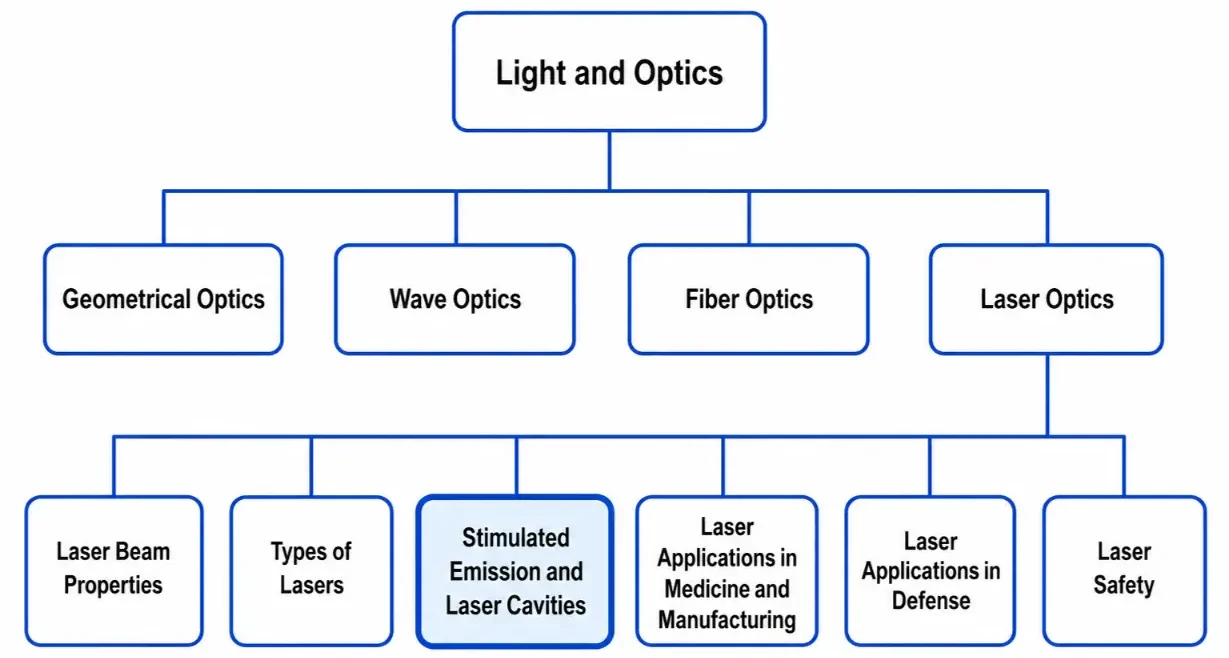
This tree chart shows Laser Optics within the wider Light and Optics cluster and highlights Stimulated Emission and Laser Cavities among the six Laser Optics terminal pages.
This simple educational tree chart presents the page hierarchy within the Light and Optics cluster. At the top is Light and Optics. The second layer contains four pages: Geometrical Optics, Wave Optics, Fiber Optics, and Laser Optics. Under Laser Optics, the third layer shows six terminal subpages: Laser Beam Properties, Types of Lasers, Stimulated Emission and Laser Cavities, Laser Applications in Medicine and Manufacturing, Laser Applications in Defense, and Laser Safety. The Stimulated Emission and Laser Cavities box is visually highlighted to indicate the current focus page.
Quick Check: Stimulated Emission and Cavities
Quick Check: How a Laser Begins
Q1. Why is stimulated emission more important to lasers than spontaneous emission?
Stimulated emission produces a new photon that matches the incoming photon in frequency, direction, and phase. This allows light to be amplified in an organised way. Spontaneous emission can start the process, but it is too random to produce a coherent laser beam by itself.
Q2. Why must a laser create population inversion?
Population inversion means more particles are in the excited state than in the lower laser state. This makes stimulated emission more likely than absorption, allowing light to be amplified instead of weakened.
Q3. What is the purpose of the laser cavity?
The laser cavity provides optical feedback. It sends light repeatedly through the gain medium, reinforces selected wave patterns, and allows a narrow beam to emerge through a partially reflective mirror.
Q4. What happens when a laser reaches threshold?
At threshold, the gain from stimulated emission becomes large enough to balance or exceed the optical losses in the cavity. Above this point, a strong laser beam can build up and leave through the output mirror.
Common Misunderstandings
Misunderstanding 1: A Laser Is Just Very Bright Light
A laser is not defined only by brightness. Its special value comes from coherence, directionality, narrow wavelength range, and controlled amplification. A powerful lamp may be bright, but its light is usually disorganised compared with laser light.
Misunderstanding 2: The Mirrors Create the Light
The mirrors do not create the light. The gain medium produces photons through stimulated emission. The mirrors provide feedback and selection, allowing the light to pass through the gain medium repeatedly and grow into a stable beam.
Misunderstanding 3: All Lasers Are Dangerous in the Same Way
Lasers vary greatly in power, wavelength, pulse duration, and hazard level. Some are used safely in everyday devices, while others require strict controls. Safety depends on the laser class, exposure conditions, beam path, and protective measures. This is why Laser Safety deserves its own page.
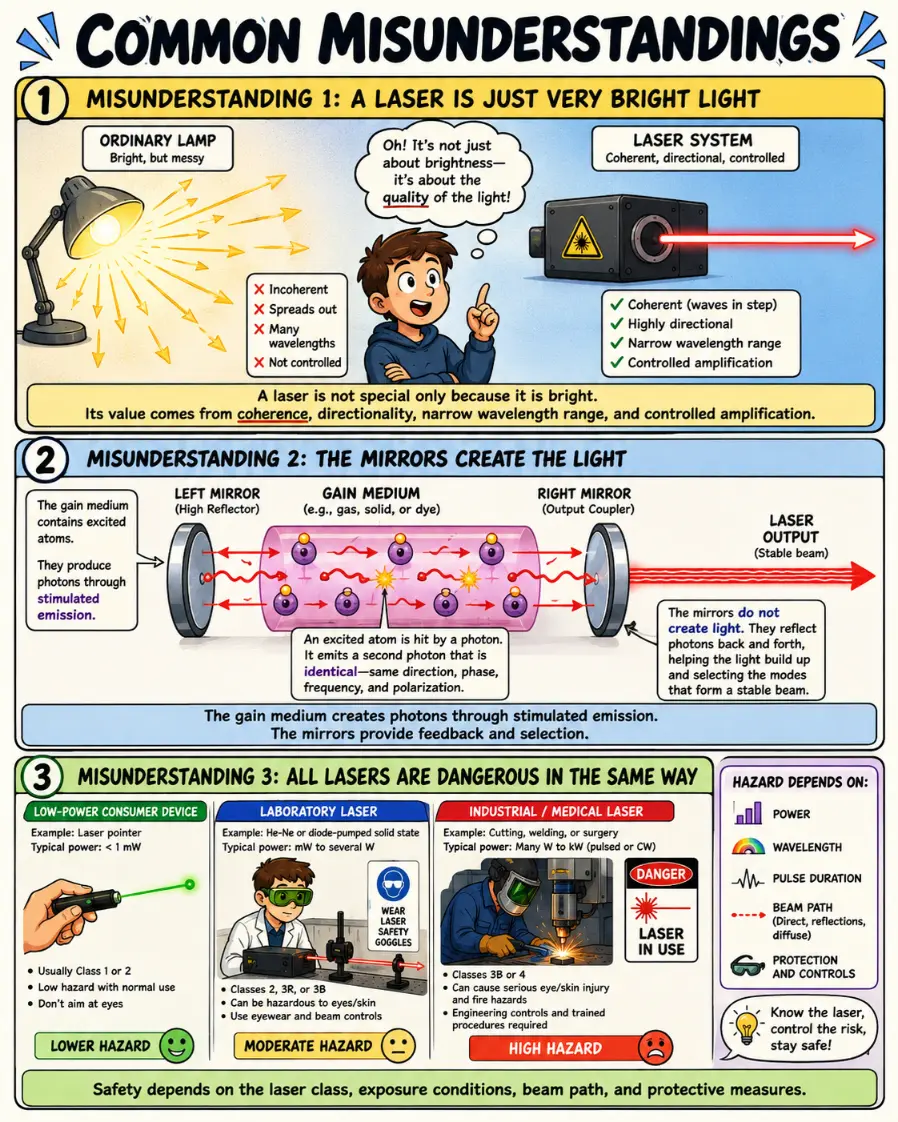
Lasers are often misunderstood: their value comes from organised light, their photons are produced in the gain medium, and their safety risks depend on power, wavelength, exposure, beam path, and protection.
This comic-style educational infographic explains three common misunderstandings about lasers. The first panel compares an ordinary bright lamp with a laser system, showing that a laser is special because its light is coherent, directional, narrow in wavelength, and controllably amplified. The second panel shows a laser cavity with mirrors and a gain medium, clarifying that the mirrors do not create the light; instead, the gain medium produces photons through stimulated emission while the mirrors provide optical feedback and selection. The third panel compares low-power consumer lasers, laboratory lasers, and industrial or medical lasers to show that not all lasers are dangerous in the same way. Laser safety depends on power, wavelength, pulse duration, beam path, exposure conditions, and protective controls.
Worked Conceptual Example
Why a Lamp Does Not Become a Laser
Imagine a hot lamp filament. Many atoms and electrons are excited and emit photons, but the emissions occur in many directions, at many times, and over a wide range of wavelengths. The photons do not generally share a fixed phase relationship.
Now compare this with a laser cavity containing a suitable gain medium. The pump creates population inversion. A photon of the correct energy passes through the medium and stimulates matching photons. The cavity mirrors send the growing light field back and forth, reinforcing photons travelling along the cavity axis. The result is not merely more light, but more disciplined light.
This example shows why laser action requires more than energy input. It requires the right quantum transition, the right population condition, and the right optical feedback structure.
Key Terms
Cavity mode
An allowed wave pattern that can be reinforced inside the laser cavity.
Coherence
The property of waves maintaining a stable phase relationship over time or distance.
Gain medium
The material inside a laser where stimulated emission and light amplification occur.
Laser cavity
An optical arrangement, usually involving mirrors, that provides feedback and selects the light patterns that are amplified.
Optical pumping
The use of light to supply energy to the gain medium and help create population inversion.
Population inversion
A condition in which more particles occupy a higher energy state than a lower energy state involved in the laser transition.
Spontaneous emission
A process in which an excited particle emits a photon without being triggered by another photon.
Stimulated emission
A process in which an incoming photon causes an excited particle to emit a second photon with the same frequency, direction, and phase relationship.
Threshold
The condition where optical gain becomes large enough to balance or exceed losses in the laser cavity.
Review Questions
What is stimulated emission?
Answer: Stimulated emission is the process in which an incoming photon causes an excited particle to emit a second photon that matches the incoming photon in frequency, direction, and phase.
Why is population inversion necessary for laser action?
Answer: Population inversion is necessary because it makes stimulated emission more likely than absorption. Without it, light passing through the medium would tend to be absorbed rather than amplified.
What is the function of the gain medium?
Answer: The gain medium provides the atoms, ions, molecules, or electronic transitions that produce stimulated emission and amplify light.
Why does a laser cavity usually contain two mirrors?
Answer: The mirrors provide optical feedback by reflecting light repeatedly through the gain medium. One mirror is often partially reflective so that some of the amplified light can leave as the laser beam.
What is laser threshold?
Answer: Laser threshold is the point at which the optical gain inside the cavity becomes large enough to overcome the losses. Above threshold, a strong laser output can develop.
Why is laser light usually more coherent than light from a lamp?
Answer: Laser light is more coherent because stimulated emission produces matching photons, and the cavity reinforces selected wave patterns. Lamp light is mostly produced by random spontaneous emission.
Thought-Provoking Questions
If stimulated emission creates matching photons, why do real lasers still have limits in coherence and linewidth?
Answer: Real lasers are affected by cavity imperfections, thermal effects, noise, multiple modes, mirror losses, and limitations of the gain medium. United emission creates strong order, but real physical systems are never perfectly ideal.
Why does a laser need both quantum physics and wave optics to be understood properly?
Answer: Quantum physics explains energy levels, photon emission, and population inversion. Wave optics explains resonance, interference, phase, cavity modes, and beam behaviour. A laser is both a quantum device and a wave-selecting optical system.
Why might two lasers with the same output power behave very differently in practical applications?
Answer: Output power alone does not determine laser behaviour. Wavelength, beam quality, pulse duration, focusing ability, coherence, divergence, and material interaction all affect how a laser performs.
Comprehensive Numerical Problems with Solutions
A laser transition has an energy gap of 3.14 × 10⁻¹⁹ J. Find the frequency of the emitted photon. Use h = 6.63 × 10⁻³⁴ J s.
Answer: The photon energy evaluates to approximately 3.98 × 10⁻¹⁹ J.
Why This Topic Matters
Stimulated emission and laser cavities show how deep physical principles can become precise technology. A laser begins with quantum transitions inside matter, but it becomes useful only when those transitions are organised by optical feedback, resonance, and careful engineering.
This is why laser optics sits at a crossroads of modern science. It connects Modern Physics, Light and Optics, materials science, electronics, medicine, manufacturing, communication, and measurement. The laser is a reminder that powerful technologies often begin with a subtle question: how can nature’s smallest events be guided into order?
Case Studies: Stimulated Emission and Cavities in Real Lasers
The ideas in this page become clearer when they are seen inside real laser systems. A laser is not only a theory of photons and energy levels. It is also a practical design problem: how to choose a gain medium, how to pump it, how to create feedback, how to control losses, and how to let a useful beam emerge.
Case Study 1: The First Working Ruby Laser
One of the most important moments in laser history came in 1960, when Theodore Maiman demonstrated the first working laser using a synthetic ruby crystal. The ruby acted as the gain medium. Energy was supplied by a flash lamp, which excited chromium ions in the crystal. The ends of the ruby were prepared to act as mirrors, creating the optical feedback needed for laser action.
This case study is useful because it shows that a laser needs more than a material that can emit light. The ruby crystal had to be pumped strongly enough to create population inversion. The cavity had to allow selected light waves to pass repeatedly through the gain medium. Losses had to be low enough for amplification to exceed threshold. Only when these conditions worked together could the laser produce a coherent beam.
The ruby laser also shows why early laser development was not obvious. A material may fluoresce, but fluorescence alone is not laser action. Fluorescence is mainly spontaneous emission. Laser action requires stimulated emission, feedback, and threshold behaviour. In other words, the first laser was not simply a glowing crystal. It was a carefully balanced optical system.
Case Study 2: Helium-Neon Lasers and Stable Visible Beams
The helium-neon laser became a classic teaching example because it produces a familiar red beam and demonstrates the importance of gas energy levels, electrical pumping, and mirror alignment. In this laser, an electrical discharge excites helium atoms. Energy is then transferred to neon atoms, which provide the main laser transition.
The cavity mirrors select and reinforce light travelling along the laser axis. The output mirror allows a small part of the circulating light to leave as the beam. This makes the helium-neon laser a useful example for understanding how stimulated emission becomes organised by a resonant cavity.
From a student’s point of view, the helium-neon laser is especially helpful because it separates the roles of different parts of the system. The gas mixture supplies the energy-level structure. The electrical discharge supplies the pump energy. The mirrors supply feedback. The cavity geometry shapes the beam. These roles appear again in many other laser types, even when the gain medium changes from gas to semiconductor, crystal, or optical fibre.
Case Study 3: Semiconductor Lasers in Everyday Technology
Semiconductor lasers are widely used in barcode scanners, optical communication, laser pointers, sensors, printers, and many electronic devices. Unlike ruby or helium-neon lasers, they are compact and can be driven directly by electric current. Their gain medium is a semiconductor structure rather than a gas or crystal rod.
The same core physics still appears. Electrons and holes recombine across energy levels in the semiconductor, producing photons. Under the right conditions, stimulated emission dominates. The laser cavity may be formed by the polished ends of the semiconductor chip or by more advanced waveguide structures.
This case study is valuable because it shows how the same principle can shrink from a laboratory-scale optical device to a tiny component inside modern technology. The idea of stimulated emission did not remain a special laboratory curiosity. It became a foundation for communication networks, sensing systems, data storage, and everyday optical electronics.
Connections Beyond the Laser Optics Cluster
Stimulated emission and laser cavities are part of the Laser Optics cluster, but they also connect naturally to wider Prep4Uni.online physics topics. These links help students see that lasers are not isolated devices. They sit at the meeting point of quantum physics, wave behaviour, electromagnetic radiation, materials, and optical engineering.
Laser wavelengths are linked to energy differences between atomic, ionic, molecular, or electronic states. This page helps students connect spectral lines with photon energy.
Laser light is a special form of electromagnetic wave. This page helps students place laser beams within the larger family of radio waves, microwaves, infrared, visible light, ultraviolet, X-rays, and gamma rays.
Many optical communication systems use lasers as light sources and optical fibres as guiding channels. This connection helps students see how laser beams become part of real communication infrastructure.
External References for Further Reading
The following external references provide useful background for students who want to read beyond this introductory page. They are included for conceptual reinforcement, historical context, and deeper technical extension.
TU Delft Interactive Optics: Lasers — A student-friendly explanation of stimulated emission, laser resonators, optical feedback, and the basic principles behind laser action.
RP Photonics Encyclopedia: Lasers — A more advanced reference explaining laser gain media, optical resonators, stimulated emission, laser operation, and related technical concepts.
Summary
Stimulated emission is the process that allows one photon to trigger the release of another matching photon from an excited particle. For this process to produce laser light, the gain medium must be placed in population inversion so that emission dominates absorption.
The laser cavity provides optical feedback, reinforces selected wave patterns, and allows a controlled beam to emerge. Together, stimulated emission, population inversion, gain, feedback, resonance, and threshold form the foundation of laser action.
Reflection Question
A laser works because many tiny quantum events are guided into a shared pattern. Where else in science or engineering do small individual actions become powerful only when they are organised collectively?