Prepare for University Studies & Career Advancement
Laser Applications in Medicine and Manufacturing
Lasers have become some of the most precise tools in modern medicine and manufacturing. In medicine, they can cut, reshape, seal, image, or treat tissue with carefully controlled light. In manufacturing, they can cut, weld, drill, mark, scan, measure, and build materials layer by layer. The same physical properties that make lasers scientifically interesting also make them technologically powerful.
This page explains laser applications in medicine and manufacturing in a student-friendly way. The aim is not to list every possible use, but to show how laser beam properties such as wavelength, coherence, focusability, pulse duration, power, and intensity allow lasers to interact with biological tissue and engineering materials in controlled ways. This page belongs to the wider Laser Optics cluster.
Lasers support medicine and manufacturing by focusing controlled light onto biological tissue and engineering materials with remarkable precision.
This artist’s impression shows how laser beam properties make lasers valuable in both medicine and manufacturing. On the medical side, controlled laser light is shown being used for precise treatment and imaging-related work. On the manufacturing side, multiple laser beams suggest cutting, welding, drilling, marking, scanning, and layer-by-layer production. The central optical pathway symbolises the shared physics behind these applications: wavelength selection, coherence, focusability, pulse control, power, intensity, and careful beam delivery. The image helps students see that lasers are not just bright light sources, but precision tools that connect optical physics with healthcare, engineering, materials processing, and modern production technology.
What Laser Applications Really Depend On
A laser is useful because it can deliver light in a highly organised form. The beam can be narrow, coherent, focused into a small spot, pulsed in time, and chosen at a specific wavelength. These features allow scientists, doctors, and engineers to control where energy goes and how matter responds.
In medicine, the target is usually biological tissue. The laser may interact with water, blood, pigment, skin, corneal tissue, blood vessels, or other structures. In manufacturing, the target may be metal, polymer, glass, ceramic, semiconductor material, or a powder bed. In both fields, the central question is similar: how does this material absorb, reflect, scatter, transmit, or respond to the laser light?
This is why laser applications cannot be understood by power alone. A low-power laser at the right wavelength may be excellent for imaging or communication. A high-power laser with poor beam control may be unsuitable for precision work. A pulsed laser may create effects that a continuous beam cannot. The best laser is the one whose beam properties match the material, purpose, and safety requirements.
Students should connect this page with Laser Beam Properties, where coherence, divergence, beam waist, focusing, intensity, linewidth, and pulse behaviour are explained more directly.
The Evolutionary Path: History, Core Hurdles, and Multi-Disciplinary Growth
The integration of laser optics into operating rooms and manufacturing plants highlights a clear path from fundamental quantum physics to industrial automation.
The Historical Journey
Shortly after Theodore Maiman demonstrated the first ruby laser in 1960, medical researchers began studying how coherent light fields interact with biology. In 1961, Leon Goldman pioneered dermatological laser treatment, using ruby laser pulses to selectively target melanin in skin cells. The manufacturing transition advanced rapidly in 1967 when Peter Houldcroft engineered the first industrial gas-assisted laser cutting system, using a continuous-wave carbon dioxide (CO2) laser beam to slice through a 1 mm thick steel sheet. By the 1980s, the invention of compact semiconductor diode lasers transformed biomedical imaging, while high-power Nd:YAG arrays established lasers as standard automotive assembly welding tools.
Contemporary Technical Hurdles
In both fields, the primary challenge remains managing heat dissipation within the target zone. When a laser beam illuminates material, localized heating can travel outwards beyond the target coordinate, creating an unintended heat-affected zone (HAZ). In manufacturing, an excessive HAZ introduces micro-cracks or structural weakness in metals. In surgery, it causes thermal collateral damage that scars neighboring healthy tissue.
To overcome these thermal limitations, modern systems use ultrafast pulsed lasers, such as picosecond (1 ps = 10−12 s) or femtosecond (1 fs = 10−15 s) laser configurations. Because the pulse duration is shorter than the thermal diffusion constant of the material, the target vaporizes instantly via cold ablation before heat has time to travel into the surrounding structure.
Future Paradigms: Photo-Medicine and Nanofabrication
The boundaries of laser processing are shifting toward sub-micron precision systems:
Targeted Photo-Dynamic Therapy: Modern medicine uses tunable dye lasers alongside specialized light-sensitive medications. The laser beam selectively activates the chemistry of the medication exclusively inside localized tumor coordinates, destroying malignant tissues while leaving surrounding healthy cells untouched.
Multiphoton Stereolithography: In 3D manufacturing, engineers utilize two-photon polymerization techniques to achieve sub-diffraction-limited printing resolution. This enables the additive fabrication of complex micro-structures, such as medical scaffolds or nanoscale metamaterials, directly inside liquid polymers.
Key Laser Properties Behind Medical and Manufacturing Applications
Different applications depend on different laser properties. The table below gives a simple overview.
Laser Property
Meaning
Why It Matters in Applications
Wavelength
The colour or spectral region of the laser light
Determines how strongly tissue or material absorbs the light.
Power
Energy delivered per second
Influences heating, cutting, welding, and treatment strength.
Pulse duration
How long each burst of light lasts
Controls whether energy is delivered gently, rapidly, or with high peak power.
Spot size
The area over which the beam is focused
A smaller spot gives higher intensity and finer precision.
Beam quality
How cleanly and tightly the beam can be focused
Important for surgery, microfabrication, cutting, and welding.
Coherence
Stable phase relationship among waves
Useful in imaging, measurement, interferometry, and some diagnostic systems.
Repetition rate
How frequently pulses are emitted
Affects processing speed, heat build-up, and treatment control.
Safety classification
Hazard category of the laser
Determines required protective controls, training, and supervision.
How Lasers Interact with Biological Tissue
In medicine, laser light may be absorbed, reflected, scattered, or transmitted by tissue. Absorption is especially important because absorbed light transfers energy to tissue. Depending on wavelength, intensity, pulse duration, and exposure time, this energy may produce heating, cutting, coagulation, vaporisation, stimulation, imaging contrast, or other controlled effects.
Different tissues absorb different wavelengths. Water-rich tissue, blood, melanin, and other biological components do not respond in exactly the same way. This is why medical lasers must be selected carefully for each purpose. A laser that is useful for one procedure may be unsuitable for another.
Medical laser use is not simply “light replacing a knife.” In some cases, a laser can cut. In other cases, it can seal blood vessels, reshape tissue, break down unwanted structures, activate imaging contrast, or support minimally invasive procedures. The medical value comes from control.
Medical Applications of Lasers
Lasers are used in many areas of medicine, including surgery, ophthalmology, dermatology, dentistry, imaging, diagnostics, therapy, and biomedical research. The following sections introduce the main ideas without turning the page into a medical manual.
Laser Surgery
In surgery, lasers may be used to cut, remove, seal, or reshape tissue. A focused beam can deliver energy to a small region, allowing precise interaction with the target area. Some lasers can also reduce bleeding by sealing small blood vessels as they interact with tissue.
The usefulness of a surgical laser depends on wavelength, power, pulse duration, spot size, delivery system, tissue absorption, and the skill of the trained medical team. The same laser energy that enables precision also requires strict control, suitable safety procedures, and proper patient protection.
Ophthalmology and Vision Correction
Eye-related laser applications are among the best-known medical uses. Lasers may be used in procedures involving the cornea, retina, or other eye structures. In some vision correction procedures, laser energy can reshape corneal tissue with high precision. In other cases, lasers may be used to treat retinal problems or support diagnostic imaging.
This field shows why wavelength and pulse control matter. The eye is optically sensitive, and different parts of the eye absorb different wavelengths. Medical laser procedures involving the eye must therefore be carefully designed, regulated, and performed by qualified professionals.
Dermatology and Skin Treatment
Lasers are used in dermatology for selected treatments involving pigmentation, hair, blood vessels, scars, tattoos, and skin resurfacing. These uses often depend on selective absorption, where one structure absorbs laser energy more strongly than surrounding tissue.
The principle is conceptually elegant: the laser is chosen so that the target absorbs enough energy while nearby tissue is protected as much as possible. However, the practical reality is complex. Skin type, wavelength, pulse duration, cooling, exposure, and medical judgement all matter.
Dentistry
In dentistry, lasers may be used for selected soft-tissue and hard-tissue procedures, depending on the system and clinical need. They may support cutting, reshaping, bacterial reduction, or treatment preparation in specific contexts.
Dental laser applications show that lasers are not one universal tool. Different dental tissues and treatment goals require different wavelengths and techniques. The laser must be matched to the material, whether the target is soft tissue, enamel, dentine, or another structure.
Medical Imaging and Diagnostics
Lasers also support medical imaging and diagnostics. In optical imaging, light interacts with tissue through absorption, scattering, reflection, fluorescence, or emission. These interactions can reveal structural or functional information about cells, tissues, blood flow, or biological processes.
Some imaging methods use laser light because it can be directed, focused, pulsed, or tuned. Examples include confocal microscopy, optical coherence tomography, fluorescence imaging, multiphoton microscopy, and photoacoustic imaging. These methods do not all work the same way, but they share a common idea: organised light can become a probe of living systems.
How Lasers Interact with Engineering Materials
In manufacturing, laser light is used to control material transformation. A laser may heat, melt, vaporise, mark, harden, join, or modify a material surface. The result depends on how the material absorbs the beam and how quickly heat moves away from the interaction zone.
For example, metals often require high power and careful focusing for cutting or welding. Polymers may melt, char, or ablate depending on wavelength and exposure. Glass and ceramics may need special wavelengths or pulsed systems. Semiconductors may be processed using precisely controlled laser energy at very small scales.
The key idea is energy localisation. Lasers can deliver energy to a chosen place, at a chosen time, with a chosen spot size. This localisation makes them powerful tools for modern manufacturing.
Manufacturing Applications of Lasers
Lasers are widely used in manufacturing because they can process materials without requiring a conventional cutting tool to touch the workpiece. This can improve precision, reduce mechanical wear, support automation, and allow processing of complex shapes or delicate materials.
Laser Cutting
Laser cutting uses a focused beam to remove material along a controlled path. The beam may melt, burn, vaporise, or otherwise separate the material, often with the help of assist gases in industrial systems. Laser cutting is used for metals, plastics, textiles, wood, ceramics, and many other materials, depending on the system.
The quality of the cut depends on beam power, wavelength, focus position, material thickness, scanning speed, gas flow, and thermal behaviour. For students, the most important concept is that cutting happens because energy is concentrated into a small region and moved along a planned path.
Laser Welding
Laser welding joins materials by using a concentrated beam to melt and fuse selected regions. It is useful when deep, narrow welds or precise heat control are needed. Laser welding is widely used in automotive manufacturing, electronics, medical devices, batteries, aerospace components, and precision assemblies.
Compared with some traditional welding methods, laser welding can reduce the heat-affected region when properly controlled. However, it also requires careful alignment, material preparation, process monitoring, and safety controls.
Laser Drilling and Micromachining
Laser drilling and micromachining use focused laser energy to create small holes, grooves, patterns, or surface features. These processes are valuable when conventional tools would be too large, too slow, or too damaging.
Micromachining often uses short-pulse or ultrafast lasers to limit unwanted heat spreading. This allows fine material removal with greater control. Such methods are important in electronics, photonics, medical devices, aerospace components, and precision engineering.
Laser Marking and Engraving
Laser marking changes the surface appearance of a material to create text, serial numbers, barcodes, logos, measurement marks, or identification codes. Laser engraving removes more material and creates a deeper mark.
These methods are useful because they can be fast, precise, automated, and durable. In manufacturing, marking is not only decorative. It supports traceability, quality control, product authentication, and safety labelling.
Laser Surface Treatment
Laser surface treatment modifies the surface of a material without necessarily cutting through it. It may harden, texture, clean, melt, alloy, or change the surface structure. Because the laser can be focused and scanned, treatment can be applied only where needed.
Surface treatment shows that lasers can be used not only to remove material, but also to improve material performance. A surface may be made more wear-resistant, more adhesive, more corrosion-resistant, or more suitable for later processing.
Laser Additive Manufacturing
Laser additive manufacturing uses laser energy to build parts layer by layer from powder, wire, or other feedstock. In laser powder bed fusion, for example, a laser scans across a bed of metal powder and fuses selected regions according to a digital design. After one layer is processed, another layer is added, and the process repeats.
This approach can create complex shapes that may be difficult or impossible to make with traditional subtractive machining. It also connects laser processing with digital design, materials science, process control, sensing, and quality assurance.
Laser additive manufacturing is a strong example of how optics and computation meet. The laser supplies localised energy, but the final part also depends on scanning strategy, material behaviour, thermal history, measurement, and digital control.
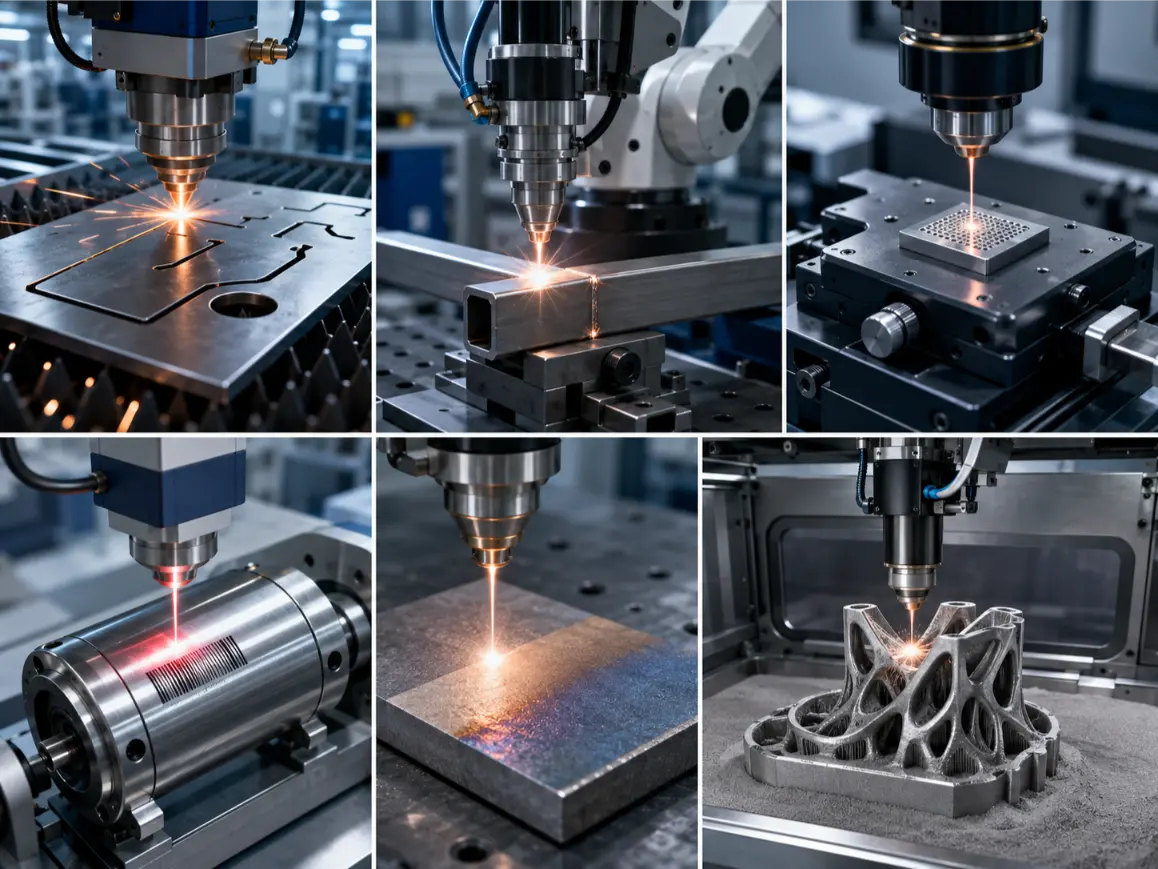
Lasers support modern manufacturing by cutting, welding, drilling, marking, treating surfaces, and building complex parts layer by layer with precise, contact-free energy delivery.
This artist’s impression presents major manufacturing applications of lasers in a high-tech production environment. It shows focused laser beams being used for cutting sheet metal, welding metal components, drilling and micromachining small features, marking a cylindrical part with barcode-like identification, modifying a surface, and building a complex metal structure through additive manufacturing. The image helps students understand that lasers can process materials without a conventional cutting tool touching the workpiece. By concentrating energy into a small, controlled region, laser systems can support precision, automation, reduced mechanical wear, complex geometry, surface modification, traceability, and digital manufacturing.
Medicine and Manufacturing Compared
At first, medicine and manufacturing may seem very different. One works with living tissue, the other with engineering materials. Yet laser applications in both fields depend on the same physical logic: deliver controlled light energy to a selected target.
Feature
Medicine
Manufacturing
Main target
Biological tissue
Metal, polymer, ceramic, glass, semiconductor, or powder
Main goal
Treatment, imaging, diagnosis, or tissue modification
Cutting, welding, drilling, marking, building, or surface modification
Key concern
Patient safety and biological response
Material quality, precision, repeatability, and operator safety
Machine control, sensors, robotics, and process monitoring
Safety emphasis
Patient, clinician, and eye protection
Beam enclosure, fumes, fire, reflections, and machine safety
This comparison helps students see the unity beneath the diversity. A laser is not a “medical tool” or an “industrial tool” by nature. It becomes one through design, control, wavelength selection, beam delivery, and purpose.
Case Studies: Lasers in Medicine and Manufacturing
The following case studies show how laser physics becomes practical technology. Each case highlights a different balance between wavelength, focusing, pulse control, material interaction, and safety.
Case Study 1: Laser Vision Correction
Laser vision correction is a well-known example of precision medical laser use. In selected procedures, laser energy is used to reshape corneal tissue so that light entering the eye focuses more effectively on the retina. The application depends on precise control of spot position, pulse delivery, tissue removal, and patient safety.
This case study illustrates why lasers can be valuable in medicine. The beam can be directed and controlled with high precision. However, it also illustrates why medical laser procedures require qualified professionals, regulated devices, careful screening, and strict safety practices.
Case Study 2: Lasers in Dermatology
Dermatology uses lasers for selected treatments involving skin appearance, unwanted hair, pigmentation, blood vessels, scars, and tattoos. Many of these uses depend on selective absorption. The target structure absorbs the laser energy more strongly than nearby tissue, allowing controlled treatment.
This case study is useful because it shows how wavelength choice becomes practical. A laser is not selected only because it is strong. It is selected because its wavelength, pulse duration, and energy delivery match the target tissue and treatment goal.
Case Study 3: Fibre Lasers in Metal Cutting
Fibre lasers are widely used in modern metal cutting. Their beams can be delivered efficiently, focused tightly, and controlled by computer-guided motion systems. The laser cuts by delivering intense energy along a planned path, often with assist gases and automated positioning.
This case study shows that modern laser manufacturing is not just about the beam. It involves optics, material science, motion control, sensors, software, and safety engineering. A high-quality cut depends on the whole system, not only the laser source.
Case Study 4: Laser Powder Bed Fusion
Laser powder bed fusion is an additive manufacturing process in which a laser selectively fuses regions of a powder layer to build a three-dimensional object. The laser spot size, power, scan path, timing, and material behaviour all affect the final part.
This case study is especially important for students because it connects laser optics with digital manufacturing. The part begins as a digital model, but its final quality depends on physical interactions: heat transfer, melting, solidification, material flow, defects, and measurement control.
Case Study 5: Medical Imaging with Laser-Based Optical Methods
Some medical imaging systems use laser light to probe tissue structure or function. In optical coherence tomography, confocal microscopy, fluorescence imaging, or photoacoustic imaging, light interacts with tissue and carries information back to detectors.
This case study shows that lasers are not only tools for cutting or heating. They can also be tools for seeing. A well-controlled beam can reveal structures and processes that are difficult to observe with ordinary illumination.
How Engineers and Clinicians Choose a Laser
Choosing a laser for medicine or manufacturing involves matching the beam to the task. The decision is not simply “which laser is strongest?” Instead, experts consider wavelength, power, pulse duration, beam quality, focusing, delivery method, material absorption, thermal effects, safety, cost, reliability, and regulatory requirements.
Question
Why It Matters
Example
What is the target material?
Different tissues and materials absorb different wavelengths.
Skin pigment, corneal tissue, steel, plastic, glass, or powder metal may require different lasers.
Is heating, cutting, imaging, or marking required?
The desired physical effect determines beam choice.
Imaging may need low energy and high sensitivity, while cutting needs stronger localised energy.
Should the beam be continuous or pulsed?
Pulse control affects heat flow, peak power, and precision.
Short pulses may support fine micromachining or selected tissue interaction.
How small must the spot be?
Spot size affects intensity and resolution.
Microfabrication and eye procedures require very fine control.
How will safety be managed?
Useful laser properties can also create hazards.
Eye protection, enclosure, ventilation, training, and controlled access may be needed.
How will quality be verified?
Medicine and manufacturing both require reliable outcomes.
Clinical monitoring, imaging, sensors, calibration, and inspection may be used.
Safety and Responsibility
Laser safety is especially important in medicine and manufacturing because a beam capable of targeting tissues or materials can present severe risks if uncontrolled. Hazards include direct beam path exposure, raw diffuse reflections, secondary toxic fumes or smoke, fire risk, and electrical shocks from power banks.
In medical settings, laser safety systems protect patients, clinicians, and support staff. In manufacturing nodes, safety barriers isolate lines to protect machine technicians, inspectors, and the workshop floor. Both ecosystems depend heavily on safety compliance training, proper anti-reflective safety eyewear, ventilation infrastructure, and strict authorization codes.
Students should read this page together with Laser Safety, where hazards, laser classes, eye risks, reflections, protective eyewear, and responsible use are explained more fully.
Connections with Wider Physics and Technology
Laser applications in medicine and manufacturing draw on many other areas of physics, engineering, and technology. These connections help students see lasers as part of a wider knowledge network.
Medical lasers connect optics with device design, clinical safety, imaging systems, treatment planning, and healthcare technology.
Learning Pathway Within Laser Optics
This page focuses on how lasers are used in medicine and manufacturing. Students can use the other Laser Optics pages to understand the underlying physics, beam behaviour, laser types, defence applications, and safety requirements.
Compare gas, solid-state, semiconductor, fibre, dye, excimer, and advanced lasers, and see why different applications need different laser sources.
Laser Applications in Medicine and Manufacturing
Current page. Understand how lasers support surgery, imaging, cutting, welding, marking, micromachining, surface treatment, and additive manufacturing.
Learn how laser classes, wavelength, power, exposure, reflections, protective eyewear, and safe procedures shape responsible laser use.
Quick Check: Medical and Manufacturing Laser Applications
Quick Check: Lasers in Real Applications
Q1. Why is wavelength important in medical laser applications?
Different tissues absorb different wavelengths differently. Choosing the right wavelength helps the laser interact with the intended target while reducing unnecessary effects on surrounding tissue.
2. Why can lasers cut or weld materials in manufacturing?
A focused laser beam can concentrate energy into a small area. If the material absorbs enough energy, it can heat, melt, vaporise, or fuse in a controlled way.
Q3. Why is laser additive manufacturing considered a digital manufacturing process?
The part is built from a digital design, layer by layer. The laser follows controlled scan paths to fuse selected material regions according to the digital model.
Q4. Why must laser applications always be connected with safety?
The same properties that make lasers useful, such as focusability, high intensity, directionality, and invisible wavelengths, can also create hazards if the beam is not properly controlled.
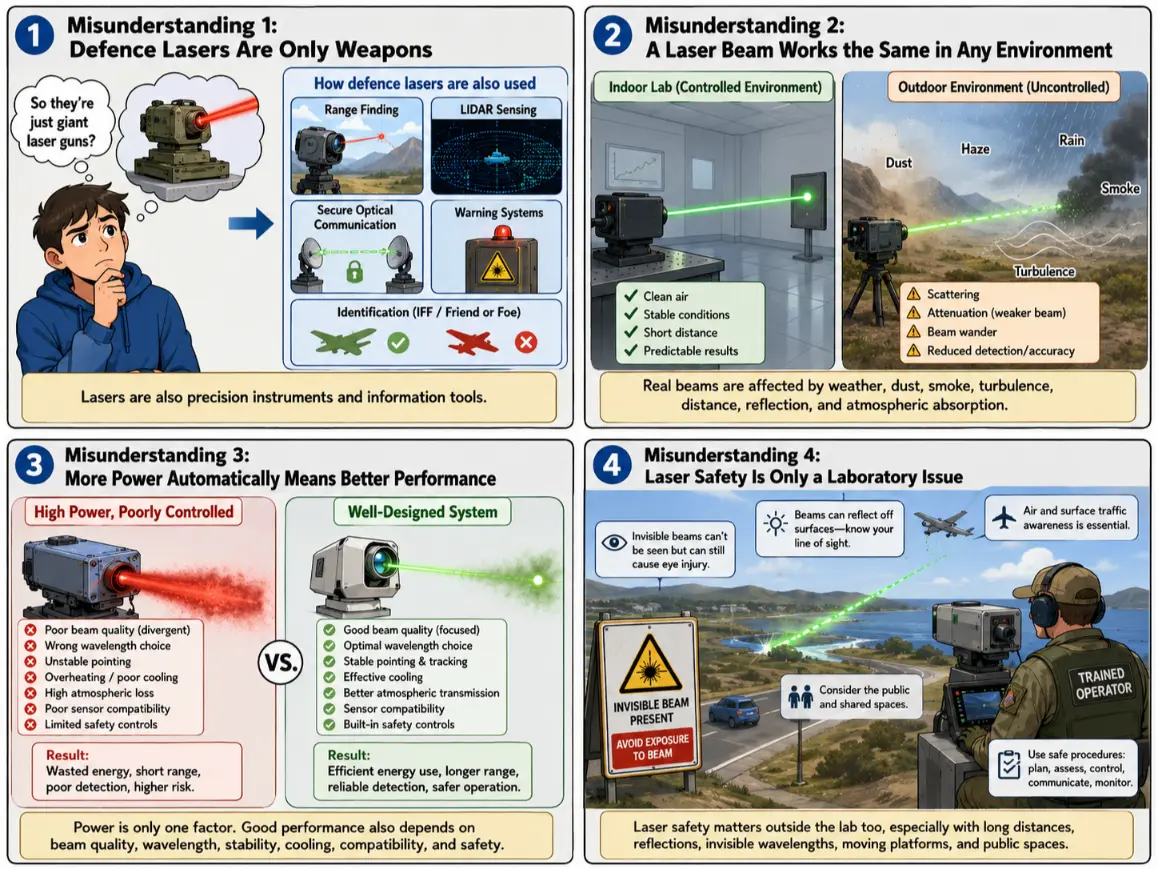
Common Misunderstandings About Laser Applications
Misunderstanding 1: A Laser Is Useful Only Because It Is Powerful
Power matters, but it is not the whole story. Wavelength, pulse duration, spot size, beam quality, delivery system, and material absorption may be just as important. A precise low-power laser can be more useful than a poorly controlled high-power laser in many applications.
Misunderstanding 2: Medical Lasers Simply Burn Tissue
Some medical lasers use heating, but laser-tissue interaction is more varied than simple burning. Lasers may cut, seal, reshape, image, stimulate, or selectively affect certain structures depending on wavelength and delivery conditions.
Misunderstanding 3: Laser Manufacturing Is Just High-Tech Cutting
Laser manufacturing includes cutting, welding, drilling, marking, engraving, surface treatment, cleaning, measurement, and additive manufacturing. It is a broad family of processes, not a single technique.
Misunderstanding 4: A Laser That Is Safe in One Context Is Safe in All Contexts
Safety depends on the laser, beam path, power, wavelength, reflections, exposure time, user training, and environment. A laser that is safe inside a properly enclosed machine may be hazardous if removed from that enclosure or used carelessly.
Key Terms
Absorption
The process by which tissue or material takes in laser energy. Absorption determines how strongly the laser affects the target.
Ablation
Removal of material from a surface by laser interaction. It may occur through vaporisation, photochemical effects, or other localised processes depending on wavelength and pulse duration.
Additive manufacturing
A manufacturing method that builds objects layer by layer from digital designs. Some additive processes use lasers to fuse powder or other feedstock.
Beam delivery system
The optical system that guides laser light from the source to the target. It may include mirrors, lenses, fibres, scanners, or articulated arms.
Coagulation
A process in which heat changes tissue properties and may help seal small blood vessels in some medical laser procedures.
Heat-affected zone
The region around a processed area where material properties change due to heat, even if the material is not directly removed or melted.
Laser cutting
A process in which a focused laser beam removes material along a controlled path.
Laser welding
A process in which laser energy melts and joins materials in a localised region.
Micromachining
Laser processing at very small scales, often used to create tiny holes, patterns, grooves, or surface features.
Optical imaging
Medical or scientific imaging that uses light interaction with tissue or samples to create visual or diagnostic information.
Photothermal effect
An effect in which absorbed laser energy becomes heat, producing controlled warming, melting, cutting, or tissue interaction.
Pulse duration
The length of time for which a laser pulse lasts. It strongly affects heat flow, peak power, and interaction with tissue or materials.
Selective absorption
A principle in which a target absorbs laser energy more strongly than surrounding material or tissue.
Spot size
The area over which the laser beam is focused on the target. Smaller spot sizes can produce higher intensity and finer precision.
Review Questions
Why are lasers useful in both medicine and manufacturing?
Answer: Lasers can deliver controlled light energy to small, selected regions. Their wavelength, focusability, pulse control, and beam quality allow precise interaction with tissue or engineering materials.
Why is wavelength important in laser applications?
Answer: Wavelength affects how strongly a target absorbs the laser light. Different tissues and materials respond differently to different wavelengths.
What is laser cutting?
Answer: Laser cutting is a manufacturing process in which a focused laser beam removes material along a controlled path by heating, melting, vaporising, or otherwise separating the material.
How can lasers support medical imaging?
Answer: Lasers can provide controlled light for imaging methods that use absorption, scattering, fluorescence, reflection, or other light-tissue interactions to reveal biological structure or function.
What is laser additive manufacturing?
Answer: Laser additive manufacturing uses laser energy to build parts layer by layer, often by fusing powder or feedstock according to a digital design.
Why is safety essential in laser applications?
Answer: Lasers can concentrate energy into small areas, produce invisible beams, reflect from surfaces, and create fumes, heat, or fire risks. Safety controls are needed to protect people and equipment.
Thought-Provoking Questions
Why might a laser be described as both a scientific instrument and an industrial tool?
Answer: A laser is based on deep physical principles such as stimulated emission and wave behaviour, but those principles can be engineered into tools for surgery, imaging, cutting, welding, communication, and manufacturing.
Why is precision sometimes more important than power in laser applications?
Answer: Many tasks require energy to be delivered only to a small target region. Too much power, or poorly controlled power, can damage surrounding tissue or material. Precision allows useful effects with fewer unwanted effects.
How does laser additive manufacturing change the relationship between design and production?
Answer: It allows digital designs to be translated directly into physical parts layer by layer. This can make complex geometries possible and connects manufacturing more closely with computation, modelling, and process monitoring.
Comprehensive Numerical Problems with Solutions
A medical laser delivers 0.50 J of energy in a pulse lasting 0.10 s. Find the average power during the pulse.
Answer: The beam spot travels exactly 1.0 m across the material surface interface.
External References for Further Reading
The following references provide reliable starting points for students who want to read beyond this introductory page. Medical laser use and industrial laser use should always follow official professional, institutional, and regulatory guidance.
U.S. FDA: Medical Lasers — An official overview of medical laser uses, benefits, risks, and safety considerations in surgical and therapeutic contexts.
Laser applications in medicine and manufacturing matter because they show how abstract physics becomes precise action. The same ideas that begin with photons, waves, energy levels, and optical cavities can become a surgical instrument, an imaging system, a welding tool, a micromachining process, or a digital manufacturing platform.
For students, this topic is valuable because it connects many fields: physics, engineering, medicine, biology, materials science, electronics, robotics, data systems, and safety management. It shows that modern technology often grows when different disciplines learn to speak to one another.
A laser is not powerful only because it carries energy. It is powerful because that energy can be shaped, focused, timed, guided, measured, and controlled. That is why lasers have become central tools in both healing and making.
Summary
Lasers are used in medicine for surgery, ophthalmology, dermatology, dentistry, imaging, diagnostics, and selected therapeutic procedures. Their usefulness comes from controlled interaction with biological tissue through wavelength selection, focusing, pulse control, and careful delivery.
Lasers are used in manufacturing for cutting, welding, drilling, marking, engraving, surface treatment, micromachining, and additive manufacturing. Their usefulness comes from localised energy delivery, precision, automation, and compatibility with digital control systems.
Medicine and manufacturing may seem very different, but they share the same laser logic: choose the right wavelength, shape the beam, control the energy, understand the target, monitor the result, and manage safety responsibly.
Reflection Question
Lasers can heal tissue, shape metal, read information, and build complex parts. What does this teach us about the power of controlling energy precisely rather than simply increasing energy?