Prepare for University Studies & Career Advancement
Laser Safety
Laser safety is the disciplined practice of using laser light without exposing people, equipment, or the surrounding environment to unnecessary risk. Lasers are valuable because they can concentrate light into narrow, intense, well-controlled beams. That same concentration is also why lasers require careful handling.
This page explains Laser Safety in a student-friendly way. It does not treat safety as a list of frightening warnings. Instead, it shows how laser hazards arise from the physics of light: wavelength, power, focusing, beam direction, exposure time, reflection, and the sensitivity of the human eye. It belongs to the wider Laser Optics cluster, where students can also study laser beam behaviour, laser types, and laser applications.
Laser safety means understanding how wavelength, power, focusing, beam direction, exposure time, reflection, and eye sensitivity shape the safe use of laser light.
What Laser Safety Really Is
Laser safety is not only about avoiding powerful beams. It is about understanding how an organised beam of light interacts with eyes, skin, materials, instruments, and surrounding surfaces. A laser beam can remain narrow over distance, reflect from shiny objects, pass through lenses, or become focused into a tiny spot. These properties make lasers useful, but they also make careless use risky.
Good laser safety begins with a simple question: where can the beam go? A safe laser setup controls the beam path, prevents accidental exposure, reduces unnecessary reflections, uses suitable protection, and ensures that people nearby understand the risk level.
Students should connect this page with Laser Beam Properties. Coherence, directionality, beam divergence, focusing, and intensity are not only useful optical features. They are also safety-relevant features.
Why Lasers Need Special Safety Rules
Ordinary lamps spread light in many directions. Lasers often send light in a narrow, concentrated beam. This means the energy may be delivered to a very small area. If the beam enters the eye or reaches skin at sufficient intensity, it may cause injury. The risk depends on wavelength, power, beam diameter, exposure duration, focusing, and whether the exposure is direct or reflected.
Laser safety is especially important because some hazardous laser beams are invisible. Infrared and ultraviolet beams cannot be judged by brightness. A beam may look weak, or may not be visible at all, while still being capable of causing harm. This is why safety must be based on laser class, specifications, labels, and proper procedures, not on appearance alone.
Another important point is that laser hazards are not limited to the beam itself. Some laser systems involve electrical supplies, cooling systems, fumes, smoke, hot surfaces, moving stages, or materials that change when irradiated. A responsible safety approach considers both beam hazards and non-beam hazards.
The Evolutionary Path of Laser Safety: History, Threshold Parameters, and Global Standards
The framework governing responsible laser use evolved rapidly as scientists discovered that narrow light fields interact profoundly with human biology.
The Historical Journey
In the early 1960s, the first operating ruby and Helium-Neon lasers were treated as simple laboratory novelties. However, accidental retinal burns among researchers quickly highlighted the critical need for standard safety controls. By 1973, the American National Standards Institute (ANSI) published the first structured Z136.1 Safe Use of Lasers document, establishing a rigorous math-based framework to analyze risk. This system was later expanded internationally by the International Electrotechnical Commission (IEC) under standard 60825, creating the universal laser classification guidelines used by engineers and technicians today.
Determining Safe Thresholds: MPE and AEL parameters
Modern optical protection is grounded in strict biological damage limits. The core benchmark is the Maximum Permissible Exposure (MPE), which calculates the absolute maximum intensity of laser radiation that a human eye or skin surface can receive without experiencing permanent structural damage. The MPE is highly dependent on both wavelength and exposure time. For instance, because the lens of the eye concentrates visible light by a factor of roughly 100,000 onto the retina, the retinal MPE limits are thousands of times tighter than the safety thresholds for skin.
Using these MPE constants, regulators calculate the Accessible Emission Limit (AEL) for manufacturers. The AEL is the maximum total power or energy that an enclosed laser product can structurally leak into accessible spaces, providing the quantitative boundary that dictates an instrument’s final safety label.
The Continuous Search for Balance
As technologies advance, safety engineers must constantly adapt rules to balance user safety with experimental capability. A primary example is the development of modern “eye-safe” laser windows for manufacturing spaces. These barriers are chemically formulated to fully absorb invisible processing wavelengths while remaining transparent to visible tracking light, allowing operators to monitor automated systems without risk of injury.
Main Factors That Affect Laser Risk
Laser risk is not determined by one number alone. A low-power visible laser, a high-power infrared laser, a pulsed ultraviolet laser, and an industrial cutting laser may all require different safety thinking. The following factors help explain why.
Safety Factor
Why It Matters
Student-Friendly Interpretation
Wavelength
Different wavelengths interact with the eye, skin, and materials differently.
Invisible infrared or ultraviolet light may be dangerous even when it does not look bright.
Power
Higher power can deliver more energy per second.
A stronger beam generally requires stricter controls.
Exposure time
Longer exposure can increase delivered energy.
Even a short exposure can matter if the beam is intense or focused.
Beam diameter
A narrow beam concentrates energy into a smaller area.
The same power can be more hazardous when tightly focused.
Focusing
Lenses can increase intensity at a focal point.
Optics can turn a beam into a much more concentrated spot.
Reflection
Specular reflections from shiny surfaces can redirect beams.
A reflected beam may still be hazardous, especially from mirrors or polished metal.
Pulse duration
Short pulses can deliver high peak power.
A pulsed laser may be more hazardous than its average power suggests.
Laser class
Classification indicates the level of hazard under defined conditions.
The label gives an important starting point for safety decisions.
Understanding Laser Classes
Laser classes are used to communicate the possible hazard level of a laser product. Exact labelling systems may vary by country or standard, but the general purpose is the same: to help users understand the level of care needed.
Students should not treat laser class as a decorative label. It is part of the safety information that tells the user whether normal use is expected to be low risk, whether viewing precautions are needed, or whether strict control measures are required.
General Class Idea
Meaning in Simple Terms
Typical Safety Message
Class 1
Low hazard during normal use because the beam is enclosed or below accessible limits.
Use as intended; do not defeat protective housing or interlocks.
Class 2
Visible low-power lasers where natural blink response may help limit accidental exposure.
Do not stare into the beam; avoid deliberate eye exposure.
Class 3R
Higher than Class 2 but usually lower risk than Class 3B when used carefully.
Avoid direct eye exposure; use only with proper awareness and control.
Class 3B
Can be hazardous to the eye from direct viewing and may also be risky through certain reflections.
Use controlled areas, suitable eyewear, beam stops, and trained supervision.
Class 4
Highest hazard category; may present eye, skin, fire, and diffuse reflection risks.
Requires strict controls, training, protective systems, and formal safety management.
This table is a learning guide, not a replacement for official product labels, institutional rules, or local regulations. In laboratories, workshops, clinics, and industrial settings, laser use should follow the official safety procedures for that environment.
Eye Hazards
The eye is usually the most sensitive part of the body in laser safety. This is because the eye contains transparent focusing structures that can concentrate light onto delicate tissue. A beam that enters the eye may be focused to a small spot, increasing the energy density at the retina or other eye structures.
Visible and near-infrared light are especially important because they can pass through the front of the eye and reach the retina. Ultraviolet and far-infrared radiation may be absorbed more strongly by the cornea or lens. The exact hazard depends on wavelength and exposure conditions.
A key student lesson is that eye safety cannot be judged by whether a beam looks bright. The eye may not respond naturally to invisible radiation, and a reflected beam can still be dangerous. Safe practice means avoiding direct viewing, controlling reflections, using appropriate eyewear when required, and never treating laser beams as toys.
Skin Hazards
Skin is generally less sensitive than the eye, but it can still be injured by sufficiently intense laser radiation. The effect may depend on wavelength, power, exposure time, beam size, and whether the beam is continuous or pulsed.
Some lasers can heat tissue, while others may cause photochemical effects or surface damage. In industrial and medical settings, controlled laser interaction with tissue or material may be the intended purpose. Outside controlled conditions, the same ability to concentrate energy can become a hazard.
Protective clothing, controlled beam paths, barriers, training, and proper procedures may be needed when higher-class lasers are used. Students should remember that skin protection is not only about avoiding burns. It is also about preventing unnecessary exposure to radiation and related by-products.
Reflection Hazards
Reflection is one of the most important practical laser safety issues. A beam does not always stop when it hits a surface. Smooth and shiny materials can reflect laser light in a predictable direction, like a mirror. This is called specular reflection. Rough surfaces scatter light more diffusely, but high-power lasers may still create hazards even from scattered radiation.
Common reflective risks include mirrors, glass, polished metal, jewellery, tools, watch faces, optical mounts, and glossy surfaces. In laboratories and workshops, unnecessary reflective objects should be kept away from the beam path.
This connects strongly with Geometrical Optics. Reflection is not only a ray-diagram idea. In laser safety, predicting where light travels can help prevent exposure.
Invisible Beam Hazards
Many lasers do not produce visible light. Infrared lasers are common in communication, sensing, range finding, manufacturing, and research. Ultraviolet lasers are used in microfabrication, medicine, and scientific instruments. Because invisible beams cannot be seen directly, they require special care.
The absence of visible brightness does not mean the absence of danger. A person may not blink, turn away, or realise that exposure has occurred. This is why invisible laser systems often require stricter controls, warning signs, beam enclosures, interlocks, and suitable detection tools used by trained personnel.
Students should connect this idea with Electromagnetic Waves, because visible light is only one part of the electromagnetic spectrum.
Non-Beam Hazards
Laser safety is not only about the beam. Many laser systems include other hazards that must be controlled. These are called non-beam hazards.
Non-Beam Hazard
Where It May Appear
Safety Meaning
Electrical hazard
Power supplies, capacitors, control units
Laser equipment may use dangerous voltages and should not be opened or modified by untrained users.
Supporting equipment may introduce environmental or workplace hazards.
A complete safety plan looks at the whole system, not just the beam leaving the laser aperture.
Protective Eyewear
Laser protective eyewear is not ordinary sunglasses. It must be selected for the specific laser wavelength and risk level. Suitable eyewear reduces the amount of laser radiation reaching the eye at the relevant wavelength range.
The important point for students is that eyewear must match the laser. Protection that works for one wavelength may not protect against another. Eyewear that looks dark may not be safe for an invisible infrared laser. Proper laser eyewear is chosen using technical information such as wavelength, optical density, power, exposure conditions, and applicable safety rules.
In schools, laboratories, workshops, and clinics, students should follow the eyewear instructions provided by trained supervisors. They should not improvise eye protection or assume that general-purpose glasses are enough.
Beam Control and Safe Setup
A safe laser setup controls the beam from its source to its endpoint. The safest beam is one that is enclosed, blocked, or kept below eye level where possible. Beam stops, barriers, housings, shutters, and warning labels help reduce accidental exposure.
The practical safety question is always: what happens if the beam continues, reflects, or misses its target? A responsible setup anticipates this possibility and prevents the beam from travelling into uncontrolled space.
Students should also understand the importance of alignment procedures. Many incidents occur not during ordinary operation, but during adjustment, testing, or maintenance. These are moments when beams may be exposed, covers may be opened, or normal protection may be reduced. Such work requires proper supervision and procedures.
Safe Behaviour Around Lasers
Safe behaviour is as important as safe equipment. Even a well-designed laser system can become risky if people act carelessly around it. The following principles are suitable for students and general educational settings.
Never deliberately look into a laser beam. This applies even when the laser seems weak.
Never aim a laser at another person. Eyes and faces must never be treated as targets.
Never point a laser at vehicles, aircraft, or public spaces. This can distract, endanger, or violate laws.
Do not use unknown or unlabelled lasers. If the class, wavelength, or power is unclear, the risk cannot be judged safely.
Remove unnecessary reflective objects near the beam path. Reflections can redirect the beam unexpectedly.
Use only under suitable supervision when the laser is not a simple low-risk classroom device. Higher-class lasers require trained control.
Do not bypass housings, interlocks, warning labels, or covers. These features are part of the safety design.
Stop and ask when unsure. Uncertainty is a safety signal, not an embarrassment.
Laser Safety in Schools and Student Projects
In education, lasers are often used to teach reflection, refraction, diffraction, interference, optical fibres, and beam properties. These demonstrations can be valuable, but they should be designed so that students learn safely.
A good classroom laser demonstration uses the lowest suitable power, keeps beams away from eye level, avoids unnecessary reflections, controls access, and explains safety before the activity begins. The goal is not to make lasers seem frightening, but to make students respectful and scientifically aware.
Student projects should be planned around safe observation rather than risky beam manipulation. For example, observing a beam path on a screen, studying reflection from controlled surfaces, or comparing beam spreading at low power can teach important optics without unnecessary exposure.
Laser Safety in Medicine and Manufacturing
Medical and manufacturing lasers show why safety and usefulness are closely linked. In medicine, lasers may be used for surgery, eye treatment, skin procedures, imaging, or tissue interaction. In manufacturing, lasers may cut, weld, drill, mark, engrave, or modify surfaces.
In both settings, the laser is useful because it can deliver controlled energy to a small region. The same feature requires strict controls: trained operators, suitable eyewear, controlled access, smoke or plume management, emergency procedures, and careful system design.
Lasers are also used in defence and security contexts for sensing, communication, range finding, guidance support, target designation, countermeasures, and directed-energy research at a broad level. These uses require especially careful safety, legal, and ethical control because they may involve long distances, invisible wavelengths, high powers, outdoor environments, or sensitive operational settings.
For students, the most important lesson is not technical operation. It is responsible understanding. Laser systems used in defence and security must be managed with strict attention to eye safety, public safety, aircraft safety, legal constraints, and ethical decision-making.
This page should be read alongside Laser Applications in Defense, which treats defence-related laser uses at a broad educational level.
Case Studies: Laser Safety in Real Contexts
The following case studies show how laser safety thinking changes with context. The physics may be similar, but the risk management differs greatly between a classroom pointer, a medical laser, an industrial laser, and an optical communication system.
Case Study 1: Classroom Laser Demonstration
A teacher uses a low-power visible laser to demonstrate reflection and refraction. The beam is directed onto a screen, and the demonstration is arranged so that the beam path stays below eye level. Reflective jewellery, shiny tools, and unnecessary mirrors are kept away from the setup.
The important safety principle is that even simple demonstrations should be planned. Students should know not to stare into the beam, not to redirect it casually, and not to treat the laser as a toy. The demonstration becomes more educational when safety is explained as part of the optics.
Case Study 2: Industrial Laser Cutting
An industrial laser cutter uses concentrated light to cut or engrave material. The main risks may include direct beam exposure, reflected beam exposure, fumes, fire, moving machinery, and electrical equipment. Safety depends on enclosure, ventilation, interlocks, trained operators, warning systems, and controlled access.
This case study shows why laser safety is a system problem. The beam is only one part of the hazard. A safe industrial setup also manages the material being processed, the air quality, the machine motion, and the people who might enter the work area.
Case Study 3: Medical Laser Procedure
In a medical setting, a laser may be used to treat tissue with high precision. The safety challenge is to protect the patient, healthcare workers, and surrounding equipment while still allowing the laser to do its intended job.
Safety measures may include wavelength-specific eyewear, controlled access, smoke or plume management, warning signs, trained operators, and careful communication. This case study shows that precision technology requires precise responsibility.
Connections with Wider Physics and Technology
Laser safety becomes easier to understand when students connect it to the physics of light, matter, waves, and optical systems. These related Prep4Uni.online pages provide useful background.
Laser radiation is part of the electromagnetic spectrum. Wavelength determines whether the beam is visible, infrared, ultraviolet, or in another region.
Laser sources are often used in optical fibre communication and sensing, where invisible infrared radiation and controlled beam coupling are important.
Learning Pathway Within Laser Optics
Laser safety should not be studied only at the end of the topic. It is connected to how lasers work, how beams behave, what types of lasers exist, and how lasers are used in real systems.
Consider broad educational applications of lasers in sensing, range finding, communication, and security, together with responsible safety and ethical awareness.
Laser Safety
Current page. Learn how laser class, wavelength, power, exposure, reflection, protective equipment, and safe behaviour shape responsible laser use.
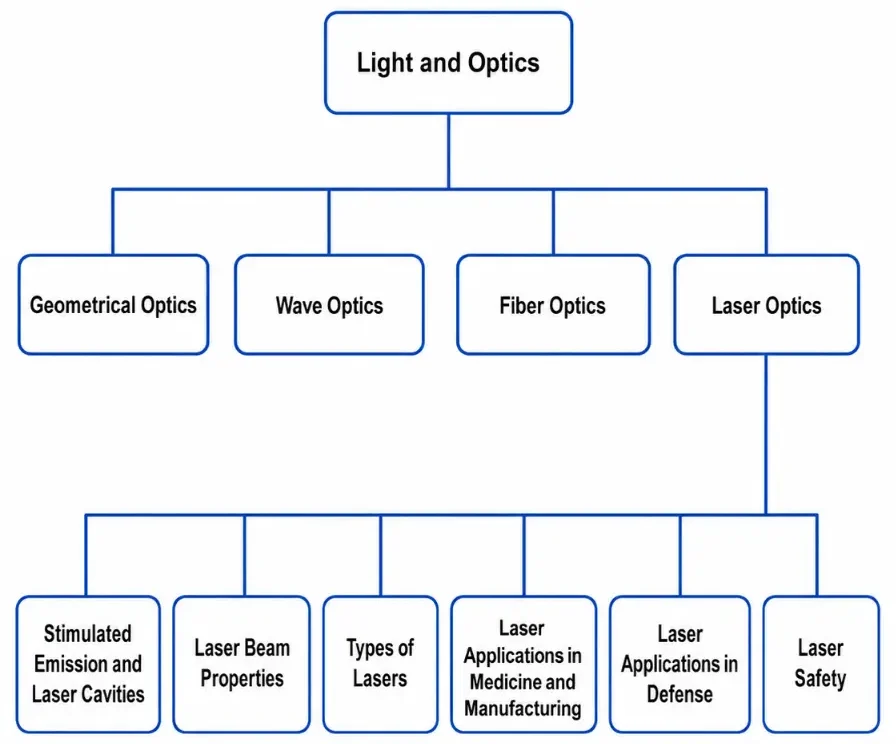
This tree chart places Laser Optics within the wider Light and Optics cluster and shows its six terminal subpages.This simple tree chart shows the page hierarchy for the Light and Optics cluster. At the top is Light and Optics. The second layer contains Geometrical Optics, Wave Optics, Fiber Optics, and Laser Optics. Under Laser Optics, the chart shows six terminal subpages: Stimulated Emission and Laser Cavities, Laser Beam Properties, Types of Lasers, Laser Applications in Medicine and Manufacturing, Laser Applications in Defense, and Laser Safety. The chart helps students understand that Laser Safety is part of a wider Laser Optics learning pathway rather than an isolated topic.
Quick Check: Laser Safety
Quick Check: Laser Safety
Q1. Why can an invisible laser beam still be dangerous?
An invisible beam may still carry enough energy to harm the eye or skin. Because it cannot be seen, a person may not blink, turn away, or realise that exposure is happening.
Q2. Why is the eye especially vulnerable to some laser beams?
The eye can focus certain wavelengths onto a small area of sensitive tissue. This concentration can increase the energy density and make the eye more vulnerable than skin in many laser exposure situations.
Q3. Why are shiny surfaces a safety concern in laser work?
Shiny surfaces can reflect the beam in a concentrated direction. A reflected beam may still be hazardous, especially when the laser is powerful or invisible.
Q4. Why are ordinary sunglasses not suitable laser safety eyewear?
Laser protective eyewear must be selected for the specific wavelength and hazard level. Ordinary sunglasses are not designed or rated to block specific laser wavelengths safely.
Common Misunderstandings About Laser Safety
Misunderstanding 1: A Laser Is Safe If It Does Not Look Bright
Brightness is not a reliable safety guide. Some hazardous lasers are invisible, and some visible beams may appear less intense than they really are. Safety must be based on wavelength, class, power, exposure conditions, and proper procedures.
Misunderstanding 2: Only Direct Beams Are Dangerous
Reflected beams can also be hazardous, especially when the reflection comes from a mirror-like surface. High-power lasers may also create risks from scattered light, fumes, fire, or material damage.
Misunderstanding 3: Low-Power Lasers Can Be Used Carelessly
Lower-power lasers may be safer than high-power systems, but careless behaviour is still unacceptable. Deliberate eye exposure, pointing at people, aiming at vehicles, or using unknown lasers is unsafe and irresponsible.
Misunderstanding 4: Safety Rules Are Separate from Physics
Laser safety is applied physics. Wavelength, focusing, reflection, absorption, beam divergence, and exposure time are all physics ideas. Understanding them makes safety rules more meaningful.
Key Terms
Beam hazard
A hazard caused directly by laser radiation reaching the eye, skin, or another exposed surface.
Beam stop
A device or surface designed to safely absorb or block a laser beam at the end of its intended path.
Controlled area
A space where access and conditions are managed to reduce laser exposure risk.
Diffuse reflection
Scattered reflection from a rough surface. It is usually less concentrated than specular reflection, but may still matter for high-power lasers.
Interlock
A safety feature designed to reduce risk by shutting down or limiting operation when covers, doors, or protective housings are opened.
Laser class
A hazard category used to describe the potential risk of a laser product under defined conditions.
Nominal hazard zone
The region where exposure to laser radiation may exceed safe limits. This concept is used in formal laser safety assessment.
Non-beam hazard
A hazard associated with laser equipment or laser use, such as electrical risk, fumes, fire, chemicals, or moving parts.
Optical density
A measure used for protective eyewear to indicate how strongly it reduces light transmission at specific wavelengths.
Protective eyewear
Eyewear selected for a specific laser wavelength and hazard level to reduce exposure to the eyes.
Specular reflection
Mirror-like reflection from a smooth surface. Specular reflections can redirect a laser beam in a concentrated direction.
Wavelength
The distance between repeating points of a wave. In laser safety, wavelength affects how radiation interacts with the eye, skin, and materials.
Review Questions
Why do lasers require special safety awareness compared with ordinary lamps?
Answer: Lasers can produce narrow, concentrated, directional beams. This allows energy to be delivered to small areas, which can create eye, skin, material, or reflection hazards.
Why is the eye often the most vulnerable organ in laser safety?
Answer: The eye can focus certain wavelengths onto sensitive tissue, increasing energy density and making injury possible even when the incoming beam is small.
Why is wavelength important in laser safety?
Answer: Wavelength affects whether laser radiation is visible or invisible, how deeply it enters the eye or skin, and how strongly it is absorbed by different materials.
What is a non-beam hazard?
Answer: A non-beam hazard is a risk associated with the laser system or its use, rather than direct laser radiation. Examples include electrical hazards, fumes, fire, chemicals, and moving parts.
Why should laser protective eyewear be matched to the laser?
Answer: Protective eyewear must reduce the specific wavelength used by the laser. Eyewear that protects against one wavelength may not protect against another.
Why are reflective objects risky near a laser beam?
Answer: Reflective objects can redirect the beam. A specular reflection can remain concentrated and may still be hazardous.
Thought-Provoking Questions
Why might a safety rule become easier to remember when students understand the physics behind it?
Answer: When students understand how beams reflect, focus, and interact with the eye, safety rules no longer feel arbitrary. They become logical consequences of physical behaviour.
Why should laser safety be considered part of scientific literacy rather than only a laboratory rule?
Answer: Lasers appear in communication, medicine, manufacturing, research, entertainment, and consumer devices. Understanding safe and responsible use helps students connect physics with real-world responsibility.
Why is it dangerous to judge a laser by appearance alone?
Answer: Appearance may not reveal wavelength, power, pulse behaviour, or invisibility. A beam that looks weak, or cannot be seen at all, may still be hazardous under the wrong conditions.
Comprehensive Numerical Problems with Solutions
A laser emits 5.0 mW of power continuously for 20 s. How much energy is emitted during this time?
Solution:
Using the structural equation linking power and energy:
$$E = P \cdot t$$
Convert the metric power parameter into standard base units:
Answer: The concentrated beam intensity evaluates to exactly 2.5 × 10⁵ W/m2. This calculation shows why focusing light into a small area can greatly increase intensity.
A pulsed laser emits 0.010 J in a single localized pulse lasting 5.0 ns. Find the average power during this transient pulse interval.
Answer: The average power during the pulse is exactly 2.0 × 10⁶ W (or 2.0 MW). The result shows why short pulses can have very high peak power even when the energy seems modest.
External References for Further Reading
The following references give students and educators reliable starting points for reading beyond this introductory page. Safety requirements may vary by country, institution, and application, so official local guidance should always be followed in real laser work.
OSHA: Laser Hazards Overview — An official overview of laser hazards, including biological effects, hazard classifications, control measures, and safety programs.
Laser safety matters because laser technology is becoming more common, not less. Lasers appear in classrooms, workshops, hospitals, factories, research laboratories, communication networks, entertainment systems, and consumer devices. Students who understand laser safety are better prepared to use technology responsibly.
The deeper lesson is that powerful science always carries responsibility. A laser beam is useful because it is organised, concentrated, and controllable. Those same qualities require careful judgement. Safety is not the opposite of discovery. It is what allows discovery and technology to continue without unnecessary harm.
Summary
Laser safety is the responsible control of laser radiation and related system hazards. The main risks depend on wavelength, power, exposure time, beam diameter, focusing, reflection, pulse duration, and laser class. The eye is often especially vulnerable because it can focus certain wavelengths onto sensitive tissue.
Safe laser use requires awareness of direct beams, reflected beams, invisible beams, protective eyewear, beam stops, controlled areas, warning signs, non-beam hazards, and responsible behaviour. A laser should never be judged by brightness alone, and safety procedures should always follow official labels, institutional rules, and local regulations.
For students, laser safety is not merely a list of restrictions. It is applied optics, applied physics, and applied responsibility.
Reflection Question
How does understanding the physics of laser beams make safety rules feel less like arbitrary warnings and more like intelligent design choices?