Prepare for University Studies & Career Advancement
Laser Applications in Defense
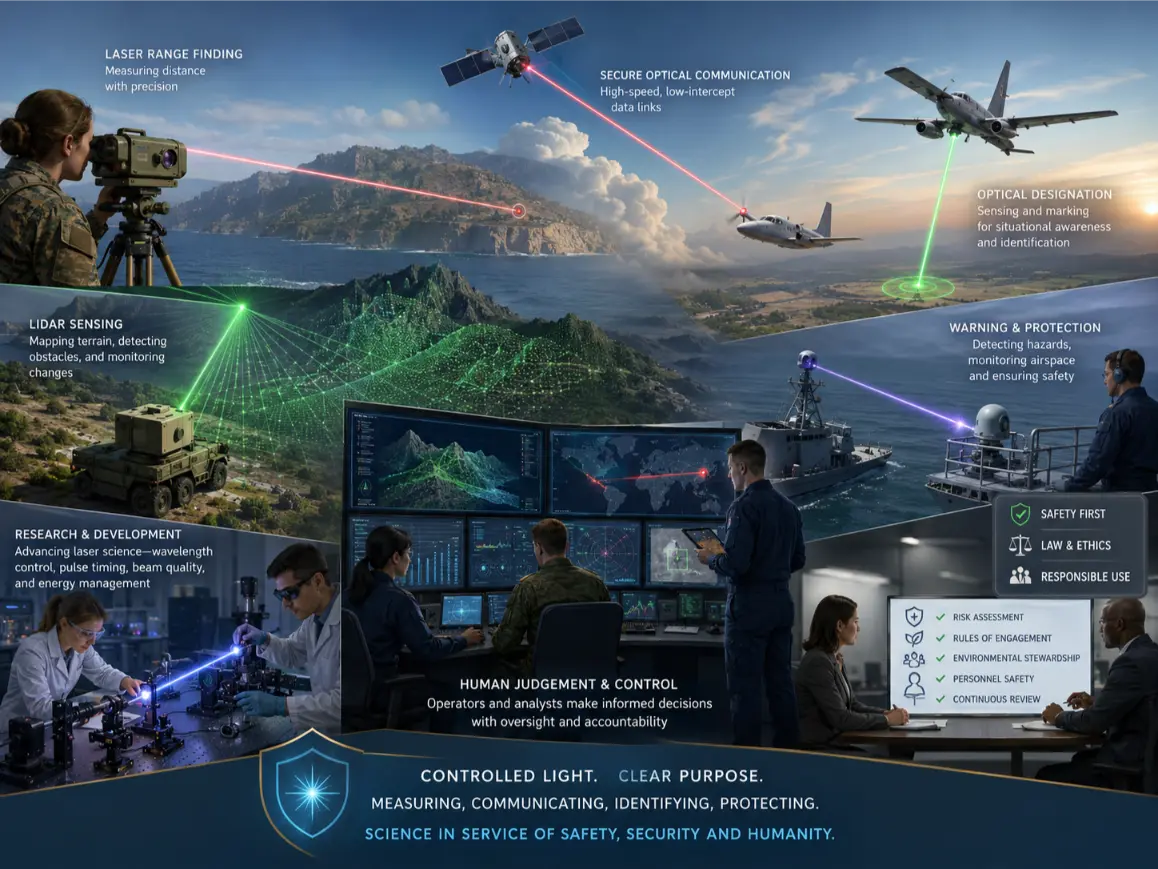
Lasers have important roles in defence and security because they can send, shape, focus, and measure light with unusual precision. In defence settings, lasers may support range finding, sensing, secure optical communication, target designation, warning systems, countermeasure concepts, and research into directed-energy technologies. These applications depend on the same laser properties studied across the wider Laser Optics cluster: wavelength, coherence, directionality, focusing, pulse timing, beam quality, and controlled interaction with matter.
This page explains Laser Applications in Defense in a student-friendly and responsible way. The aim is not to teach operational use or weapon design. Instead, the page shows how laser physics supports broad defence functions such as measuring distance, transmitting information, identifying objects, improving situational awareness, protecting personnel, and managing risk. Because defence laser systems can involve high power, invisible wavelengths, long distances, and sensitive contexts, safety, law, ethics, and human judgement must remain central.
Laser applications in defense use controlled light for measuring, sensing, communication, protection, and research, while safety, law, ethics, and human judgement remain central.
What Laser Applications in Defense Really Mean
In defence and security, a laser is best understood as a tool for controlled light. That controlled light can carry information, measure time of flight, illuminate a distant point, scan an environment, interact with sensors, or deliver concentrated energy under carefully regulated conditions. The usefulness of the laser comes not from brightness alone, but from organisation.
A laser beam can be narrow, precisely timed, directed over long distances, matched to optical sensors, and selected at a wavelength suited to the task. These properties allow defence systems to use lasers in ways that ordinary light sources cannot. However, the same properties also create risks. A narrow beam may travel far. An invisible beam may not trigger a natural warning response. A reflected beam may still be hazardous. A powerful beam may require strict control.
Students should therefore study defence laser applications as a combination of physics, engineering, systems thinking, and responsibility. The science explains what lasers can do; safety and ethics explain how society should control powerful tools.
The Chronology of Defense Lasers: History, Technical Hurdles, and Ethical Controls
The integration of laser optics into security systems represents a clear transition from laboratory experiments to precision long-range engineering.
The Historical Journey
Shortly after Theodore Maiman demonstrated the first ruby laser in 1960, engineering laboratories recognized that a highly directional, brief optical pulse could revolutionize distance tracking. By the mid-1960s, the first ruby-based laser range finders were built, replacing inaccurate optical line-of-sight estimations with precise time-of-flight measurements.
The field advanced in the 1970s with the introduction of Nd:YAG solid-state lasers operating at an infrared wavelength of 1064 nm. These lasers became the standard baseline for laser target designation and remote sensing systems. The late 20th century saw the development of semiconductor diode lasers and compact fiber optics, moving defense laser technology toward secure free-space communication channels and multi-spectral LiDAR terrain-mapping arrays.
Contemporary Scientific Challenges
Unlike laboratory configurations that operate in clean, temperature-controlled settings, outdoor laser beams face unpredictable environmental factors. As a beam travels over long distances, it undergoes **atmospheric attenuation**, where dust particles, rain, and water vapor scatter and absorb light energy.
Furthermore, localized air temperature differences create shifting thermal variations known as **atmospheric turbulence**. This turbulence distorts the coherence of the wavefront, causing the laser beam to bounce, wander, and spread unproductively—a phenomenon known as beam scintillation. To mitigate these environmental distortions, modern systems must incorporate complex adaptive optics, utilizing deformable mirrors managed by computer sensors to adjust the beam profile instantly during transit.
Legal and Ethical Frameworks
Because high-intensity optical systems pose unique risks, international law strictly governs their development and deployment. The most important regulatory milestone is the **1995 United Nations Protocol on Blinding Laser Weapons** (Protocol IV of the Convention on Certain Conventional Weapons). This legal framework explicitly prohibits the deployment of laser systems specifically designed to cause permanent blindness to human vision.
Consequently, modern technical research focuses heavily on developing “eye-safe” wavelengths—such as erbium-doped fiber arrays operating past 1500 nm—where the light is absorbed by the front structures of the eye (the cornea and lens) before it can focus onto and permanently damage the sensitive retina.
Key Laser Properties Behind Defence Applications
Defence applications depend on matching laser beam properties to the purpose. The same laser is not suitable for every role. A system used for optical communication may require stability and modulation. A system used for range finding may require accurate timing. A system used for sensing may require wavelength selection and detector compatibility.
Laser Property
Meaning
Why It Matters in Defence Contexts
Directionality
The beam travels in a narrow path.
Useful for range finding, communication, pointing, and controlled sensing.
Wavelength
The spectral region of the laser light.
Affects atmospheric transmission, sensor response, visibility, and safety.
Pulse timing
The ability to emit short, timed bursts of light.
Important in distance measurement, lidar, and time-of-flight sensing.
Coherence
Stable phase relationship among waves.
Useful in precision measurement, interferometry, coherent sensing, and some communication systems.
Beam quality
How cleanly the beam propagates and focuses.
Affects long-distance propagation, focusing, and optical coupling.
Power and intensity
Energy delivery rate and concentration.
Must be matched to the task and carefully controlled for safety.
Mechanics of Modulation
Controlled variation of the beam signal parameters.
Allows information to be encoded in optical communication and signalling systems.
Eye safety
Risk of injury from exposure.
Critical because defence systems may involve long ranges, invisible beams, or reflective environments.
Laser Range Finding
Laser range finding is one of the clearest defence-related applications of laser physics. A laser pulse is sent toward a distant object, and the system measures how long it takes for reflected light to return. Since light travels at a known speed, the time delay can be used to estimate distance.
The basic idea is similar to echo timing, but with light instead of sound. The fundamental time-of-flight relationship is written as:
$$d = \frac{c \cdot t}{2n}$$
Here, d is the linear distance to the object, c is the speed of light in vacuum, t is the measured round-trip travel time, and n is the refractive index of the atmosphere (typically taken as 1.00 for standard air computations). The factor of 2 appears because the laser light must travel to the object and back again.
In defence and security contexts, range information can support navigation, mapping, surveying, targeting support, search operations, and situational awareness. The educational point is that laser range finding turns precise timing into distance information.
Lidar and Remote Sensing
Lidar stands for light detection and ranging. It uses laser light to scan surfaces, objects, terrain, air, or other environments. By measuring returned light, a lidar system can build information about distance, shape, motion, or material response.
In defence-related contexts, lidar and laser-based sensing may support terrain mapping, obstacle detection, object recognition, atmospheric sensing, perimeter awareness, or navigation. Similar principles also appear in civilian fields such as autonomous vehicles, environmental monitoring, archaeology, robotics, and Earth observation.
The important student lesson is that a laser can act as a measuring probe. It does not merely illuminate a scene. It sends controlled light and reads the returning signal.
Laser Target Designation and Pointing Support
Lasers may be used in broad defence systems to indicate or mark a location for compatible optical sensors. In this role, the laser beam acts as a precise optical reference. The physics depends on directionality, wavelength selection, beam control, and sensor detection.
This topic should be treated carefully. At an educational level, students only need to understand that laser designation is a form of optical coordination between a beam and a sensor. It is not necessary or appropriate to study tactical procedures, operational methods, or detailed system use on this page.
The useful learning point is that a laser can provide spatial information. By sending a beam toward a chosen region, a system can help compatible sensors identify where to look or what signal to detect.
Secure Optical Communication
Lasers can be used to carry information through free space or through optical fibres. In defence and security settings, optical communication can be attractive because laser beams can be narrow, directional, and capable of high data rates. A tightly directed optical link may reduce unwanted signal spread compared with some broader forms of transmission.
The beam can be modulated so that information is encoded in changes of intensity, phase, frequency, or timing. This connects defence applications with the wider study of Fiber Optics and Photonics.
The key idea is that a laser beam can be both a physical beam of light and a carrier of information. In modern systems, light is not only something we see; it is something we use to communicate.
Laser-Based Sensing and Identification
Laser-based sensing can help systems gather information about distance, motion, vibration, surface shape, material properties, or atmospheric conditions. Different sensing methods use different features of light: time delay, reflection, scattering, absorption, Doppler shift, interference, or spectral response.
In broad defence contexts, sensing may support surveillance, navigation, mapping, vehicle awareness, environmental monitoring, or equipment diagnostics. The same physical ideas also appear in civilian science, including spectroscopy, industrial inspection, environmental sensing, and medical imaging.
This shows why defence laser technology should not be studied in isolation. Many underlying ideas belong to general optics and measurement science. The context changes, but the physics remains connected.
Countermeasure Concepts
Some defence systems use lasers or laser-related sensing to detect, confuse, warn, or protect against optical or infrared threats. These broad countermeasure concepts may involve sensors, warning receivers, optical tracking, beam control, or signal management.
At this educational level, students should focus on the physics of why optical systems can be affected by light. Sensors respond to wavelengths, intensities, timing patterns, and signal structures. If a system depends on detecting light, then controlled light may also be used to test, protect, or manage that system.
This page does not provide operational countermeasure methods. The goal is to understand the general idea that lasers can be part of defensive sensing and protection systems, while recognising that real-world use is governed by strict technical, legal, and ethical controls.
Directed-Energy Research at a Broad Level
High-energy laser systems are sometimes discussed under the wider category of directed-energy technology. The basic idea is that energy is delivered at a distance through a directed beam rather than through a physical projectile. Such systems are complex and involve not only lasers, but also power supply, cooling, beam control, tracking, atmospheric effects, safety systems, and command decisions.
For students, the most important point is conceptual: a laser beam can carry energy as well as information. If the beam is powerful enough and controlled carefully, it may interact strongly with a target surface. However, turning this idea into a real system involves major engineering challenges and serious responsibility.
This page treats directed-energy technology only as a broad educational topic. It does not cover design details, operational use, or tactical deployment. The proper emphasis for students is on physics, system complexity, safety, and ethical control.
Why Atmosphere and Environment Matter
Laser beams do not travel through empty mathematical space in real defence applications. They pass through air, dust, haze, rain, turbulence, heat gradients, smoke, or other environmental conditions. These conditions can scatter, absorb, distort, or weaken the beam.
This is why atmospheric effects matter. A laser beam that behaves well in a laboratory may behave differently outdoors. The wavelength, beam quality, propagation distance, weather, and target surface all affect performance.
Laser safety is especially important in defence contexts because systems may involve invisible wavelengths, long beam paths, high power, moving platforms, reflective surfaces, outdoor environments, or multiple people in the operating area. Safety must protect personnel, the public, equipment, infrastructure, and the environment.
Responsible defence use also involves legal and ethical questions. Who controls the system? How is accidental exposure prevented? How are non-combatants protected? How are aircraft, vehicles, and public spaces safeguarded? How are operators trained? How are risks reviewed before deployment?
Students should understand that technological capability does not automatically justify use. A responsible society asks not only “Can this be done?” but also “Should it be done, under what rules, with what safeguards, and with whose accountability?”
For a fuller physics-based safety discussion, continue to Laser Safety.
Medicine, Manufacturing, and Defense Compared
Laser applications in defence may look very different from medical or manufacturing applications, but all three depend on controlled interaction between light and matter. The difference lies in the target, purpose, environment, and safety framework.
Context
Main Purpose
Typical Laser Role
Main Responsibility
Medicine
Treat, image, reshape, or diagnose tissue.
Controlled interaction with biological structures.
Protect the patient, medical team, and surrounding tissue.
Manufacturing
Cut, weld, mark, scan, drill, or build materials.
Localised energy delivery and process control.
Protect workers, ensure quality, manage fumes, fire, and machine risk.
Defense
Sense, communicate, measure, designate, warn, protect, or research directed-energy systems.
Long-range optical control, sensing, timing, and energy delivery.
Protect personnel, public safety, legal boundaries, and ethical accountability.
Case Studies: Lasers in Defense and Security Contexts
The following case studies are broad educational examples. They focus on physics ideas and system thinking, not operational procedures.
Case Study 1: Laser Range Finding for Distance Measurement
A laser range finder sends out a short pulse of light and measures the time taken for the reflected signal to return. This allows the system to estimate distance using the speed of light. The essential physics is simple: timing becomes distance.
This case study shows why lasers are valuable for measurement. Their directionality allows the beam to be aimed at a narrow region, while their pulse timing allows distance to be calculated. The same basic idea appears in surveying, robotics, autonomous vehicles, and scientific mapping.
Case Study 2: Lidar for Mapping and Situational Awareness
A lidar system sends laser pulses across a scene and builds information from returning signals. In a defence or security setting, this may help map terrain, detect obstacles, support navigation, or create environmental awareness. In civilian settings, similar lidar principles support self-driving vehicle sensors, archaeology, geology, and atmospheric science.
This case study shows that lasers can be used as measuring instruments rather than only as energy tools. A carefully controlled light signal can become a way of seeing structure, distance, and movement.
Case Study 3: Free-Space Optical Communication
A narrow laser beam can carry information between two optical terminals. Such communication may be useful where a directional, high-data-rate optical link is desired. The system depends on beam pointing, atmospheric conditions, modulation, receiver sensitivity, and alignment.
This case study links laser optics with communication technology. The laser beam becomes a carrier of information, while optics and electronics work together to encode, transmit, receive, and interpret the signal.
Case Study 4: Directed-Energy Research and System Complexity
High-energy laser research illustrates how difficult it is to turn physical possibility into practical systems. A directed-energy concept must manage power, cooling, beam quality, tracking, atmospheric propagation, safety, and decision control. The laser source alone is not the whole system.
This case study is valuable because it prevents oversimplification. Students may imagine that a powerful beam is enough. In reality, system integration, safety, reliability, rules of use, and ethical oversight are just as important as laser power.
Connections with Wider Physics and Technology
Laser applications in defence connect strongly with other areas of physics, engineering, communication, sensing, and technology. These related pages help students place the topic within a broader learning pathway.
Laser-based sensors often produce data that must be interpreted by algorithms, including pattern recognition, tracking, mapping, and decision-support systems.
Learning Pathway Within Laser Optics
This page focuses on broad defence and security applications. Students should connect it with the other pages in the Laser Optics cluster to understand the full pathway from physical laser action to responsible use.
Learn how lasers begin through energy levels, population inversion, gain media, stimulated emission, optical feedback, resonant cavities, and threshold behaviour.
See how lasers are used for surgery, imaging, cutting, welding, marking, scanning, micromachining, surface treatment, and additive manufacturing.
Laser Applications in Defense
Current page. Understand broad defence uses of lasers in range finding, sensing, communication, designation support, countermeasure concepts, directed-energy research, and responsible control.
Learn how laser class, wavelength, power, exposure time, reflection, protective eyewear, beam control, and safe procedures shape responsible use.
Quick Check: Laser Applications in Defense
Quick Check: Defence and Security Uses
Q1. Why are lasers useful for range finding?
Lasers can send short, narrow pulses of light toward an object. By measuring the time for the reflected light to return, a system can estimate distance using the speed of light.
Q2. Why can a laser beam carry information?
A laser beam can be modulated, meaning its intensity, phase, frequency, or timing can be varied to encode information for optical communication.
Q3. Why is atmospheric propagation important in defence laser systems?
Outdoor laser beams pass through air, dust, haze, rain, turbulence, and heat gradients. These conditions can scatter, absorb, distort, or weaken the beam.
Q4. Why must defence laser applications be discussed with safety and ethics?
Defence lasers may involve long distances, invisible wavelengths, high power, public safety risks, and sensitive decisions. Responsible use requires safety controls, legal boundaries, ethical judgement, and accountability.
Common Misunderstandings About Defence Lasers
Misunderstanding 1: Defence Lasers Are Only Weapons
Many defence laser applications involve sensing, measuring, communicating, warning, or identifying. Directed-energy research is only one part of the wider field. Lasers are also precision instruments and information tools.
Misunderstanding 2: A Laser Beam Works the Same in Any Environment
Real beams are affected by weather, dust, smoke, turbulence, distance, surface reflection, and atmospheric absorption. Outdoor operation is very different from a clean laboratory demonstration.
Misunderstanding 3: More Power Automatically Means Better Performance
Power is only one factor. Beam quality, wavelength, pointing stability, cooling, atmospheric transmission, sensor compatibility, and safety controls may be just as important.
Misunderstanding 4: Laser Safety Is Only a Laboratory Issue
Laser safety is especially important outside the laboratory because beams may travel long distances, reflect unpredictably, operate at invisible wavelengths, or involve moving platforms and public spaces.
Defence lasers are not only weapons; they also support sensing, measuring, communication, warning, identification, and safety-critical decision-making.
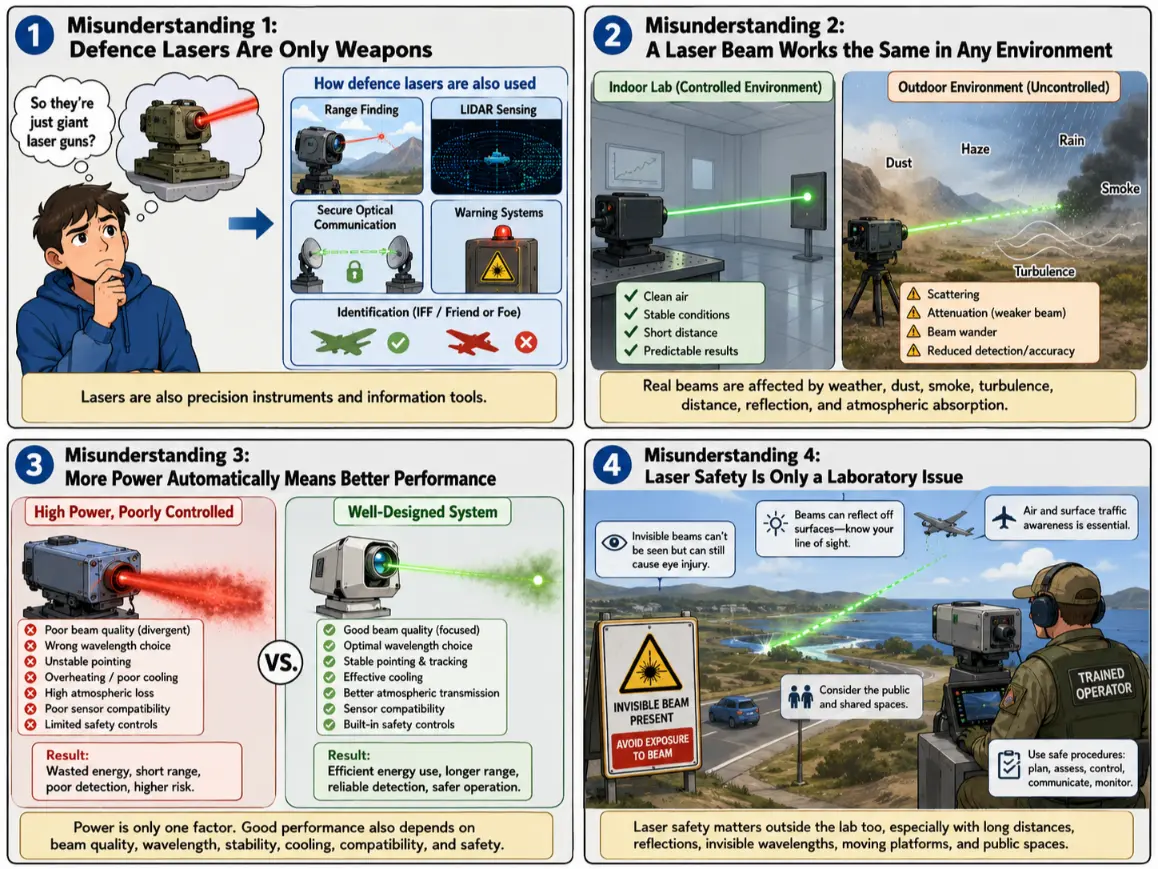
This comic-style educational infographic explains common misunderstandings about defence lasers. It shows that defence laser systems are not limited to weapons, but may also support range finding, lidar sensing, secure optical communication, warning systems, and identification. The comic also illustrates how outdoor conditions such as dust, haze, rain, smoke, turbulence, distance, reflection, and atmospheric absorption can affect real laser beams. Another panel compares raw power with well-designed system performance, emphasising beam quality, wavelength choice, pointing stability, cooling, sensor compatibility, and built-in safety controls. The final panel reminds students that laser safety is not only a laboratory issue, because defence-related laser systems may involve long distances, invisible wavelengths, reflections, moving platforms, public spaces, and trained operational responsibility.
Key Terms
Atmospheric attenuation
Reduction of beam strength as light travels through the atmosphere due to absorption, scattering, turbulence, or weather conditions.
Beam propagation
The way a beam travels through space or a medium, including spreading, distortion, absorption, and scattering.
Countermeasure
A protective method intended to detect, reduce, confuse, or manage a threat. Laser-related countermeasures may involve sensing or optical signal control.
Directed energy
Technology that directs electromagnetic energy, such as laser light, toward a target or region. This page discusses it only as a broad educational concept.
Eye-safe wavelength
A wavelength region (typically past 1500 nm) associated with reduced retinal hazard under specific design conditions because the light cannot reach the back of the eye.
Free-space optical communication
Communication that sends information through air or space using a directed optical beam rather than a physical glass cable.
Laser range finding
A method of estimating distance by sending a laser pulse toward an object and measuring the time taken for reflected light to return.
Laser safety officer
A trained person responsible for overseeing laser safety procedures in environments where lasers present significant hazards.
Lidar
Light detection and ranging. A sensing method that uses laser light to measure distance, shape, motion, or environmental properties.
Modulation
The controlled variation of a signal parameter, such as intensity, phase, frequency, or timing, to encode information.
Rules of engagement
Formal operational rules that govern when and how military systems may be used, highlighting that capability is always bounded by legal constraints.
Target designation
A broad term for using an optical signal to indicate or mark a location for compatible sensors discussed on this page only at a conceptual level.
Review Questions
Why are lasers useful in defence and security applications?
Answer: Lasers are useful because they can produce narrow, directional, precisely timed, and controllable beams of light. These properties support range finding, sensing, communication, designation support, and research into directed-energy systems.
How does laser range finding estimate distance?
Answer: It sends a laser pulse toward an object and measures the round-trip time for reflected light to return. The distance can be estimated using the time-of-flight formulation $d = c \cdot t / 2$.
What is lidar?
Answer: Lidar is a sensing method that uses laser light to measure distance, map surfaces, detect objects, or gather environmental information.
Why is wavelength important in defence laser systems?
Answer: Wavelength affects atmospheric transmission, detector response, visibility, material interaction, and safety. A wavelength suitable for one application may not be suitable for another.
Why is atmospheric propagation important?
Answer: Laser beams travelling outdoors can be affected by dust, rain, haze, smoke, turbulence, and heat gradients. These conditions can reduce or distort the beam.
Why should directed-energy technology be studied responsibly?
Answer: Directed-energy systems raise safety, legal, ethical, and public-risk issues. Students should understand the physics and system complexity without treating the topic as a guide to operational use.
Thought-Provoking Questions
Why might a laser be more valuable as a sensor than as an energy-delivery device?
Answer: A sensor can help people understand distance, movement, terrain, atmosphere, or object properties without necessarily delivering large amounts of energy. Information can be just as valuable as force in modern systems.
Why does the environment matter more for outdoor defence lasers than for many classroom laser demonstrations?
Answer: Classroom demonstrations usually occur over short distances in controlled air. Defence and security systems may operate over long distances through variable atmosphere, weather, heat gradients, and reflective surfaces.
Why is it dangerous to think of advanced technology only in terms of capability?
Answer: Capability tells us what a technology might do, but not whether it should be used, who controls it, what safeguards are needed, or what risks it creates. Responsible technology requires ethical and legal judgement.
How does laser optics show the connection between physics and policy?
Answer: Physics explains beam propagation, sensing, energy transfer, and safety risks. Policy determines acceptable use, training requirements, safety boundaries, accountability, and protection of people.
Comprehensive Numerical Problems with Solutions
A laser range finder sends a pulse that returns after 4.0 μs. Estimate the distance to the object. Use c = 3.0 × 10⁸ m/s.
A laser communication beam carries pulses at a rate of 2.0 × 10⁶ pulses per second. If each pulse represents one bit in a simple model, what is the data rate?
Solution:
1. Establish the linear pulse-to-data relationship:
Answer: The localized beam intensity is exactly 2.0 × 10³ W/m2.
A laser beam travels through clear air over a distance of 1.5 km. If its beam radius increases by 0.30 m during transit, estimate the beam divergence angle.
Solution:
1. Convert the system propagation length into meters:
$$1.5\text{ km} = 1500\text{ m}$$
2. Apply the paraxial divergence angle approximation:
Laser applications in defence matter because they show how precise control of light can affect security, sensing, communication, and technological responsibility. A laser can measure distance, carry information, scan an environment, support compatible sensors, or serve as part of advanced research systems.
For students, this topic is valuable because it connects physics with real-world decision-making. It shows that beam properties such as wavelength, directionality, coherence, pulse timing, and focusing are not abstract details. They influence what a system can measure, how it performs outdoors, what risks it creates, and what safeguards are needed.
The deeper lesson is that powerful technology must be governed by more than technical possibility. Defence laser systems require physics knowledge, engineering skill, safety discipline, legal control, and ethical awareness.
Summary
Lasers are used in defence and security contexts for range finding, lidar, sensing, optical communication, designation support, countermeasure concepts, and broad directed-energy research. These applications depend on directionality, wavelength selection, pulse timing, beam quality, coherence, modulation, and controlled propagation.
Defence laser systems also raise major safety and responsibility questions. Long-distance beams, invisible wavelengths, atmospheric effects, reflections, high power, public safety, and legal constraints all matter. A student-friendly understanding of this topic should therefore combine physics with ethics and responsible control.
Laser applications in defence show that light can be more than illumination. It can be a measuring tool, communication channel, sensor probe, warning system, and carefully governed technology.
Reflection Question
If a laser can measure, communicate, sense, and deliver energy, how should society decide which uses are responsible and which require strict limits?