Prepare for University Studies & Career Advancement
Laser Beam Properties
A laser beam is not special simply because it is bright. Its real power comes from how the light is organised. Laser beams can be highly directional, coherent, narrow in wavelength, focusable, and intense over a small area. These properties explain why lasers are useful in communication, surgery, manufacturing, measurement, sensing, research, and many other technologies.
This page explains the main laser beam properties that students need to understand: coherence, monochromaticity, directionality, divergence, beam waist, focusing, intensity, linewidth, polarisation, and beam quality. It belongs to the wider Laser Optics cluster, where students can also study how lasers are produced, how different laser types work, how lasers are applied, and how they are used safely.
What Laser Beam Properties Really Mean
A laser beam is a stream of light whose photons are produced and organised through stimulated emission and optical feedback. This gives laser light several features that are often very different from ordinary light sources such as lamps, flames, or sunlight reflected from a surface.
Ordinary light usually spreads in many directions, contains many wavelengths, and has waves that are not strongly coordinated in phase. Laser light can be much more ordered. It may travel in a narrow beam, contain a very small range of wavelengths, and maintain a stable phase relationship over distance or time.
These properties are not magical. They come from the physical design of the laser: the gain medium, the pumping method, the cavity, the mirrors, and the beam-shaping optics. Students who understand these properties can better understand why one laser is suitable for surgery, another for fibre communication, another for cutting metal, and another for laboratory measurement.
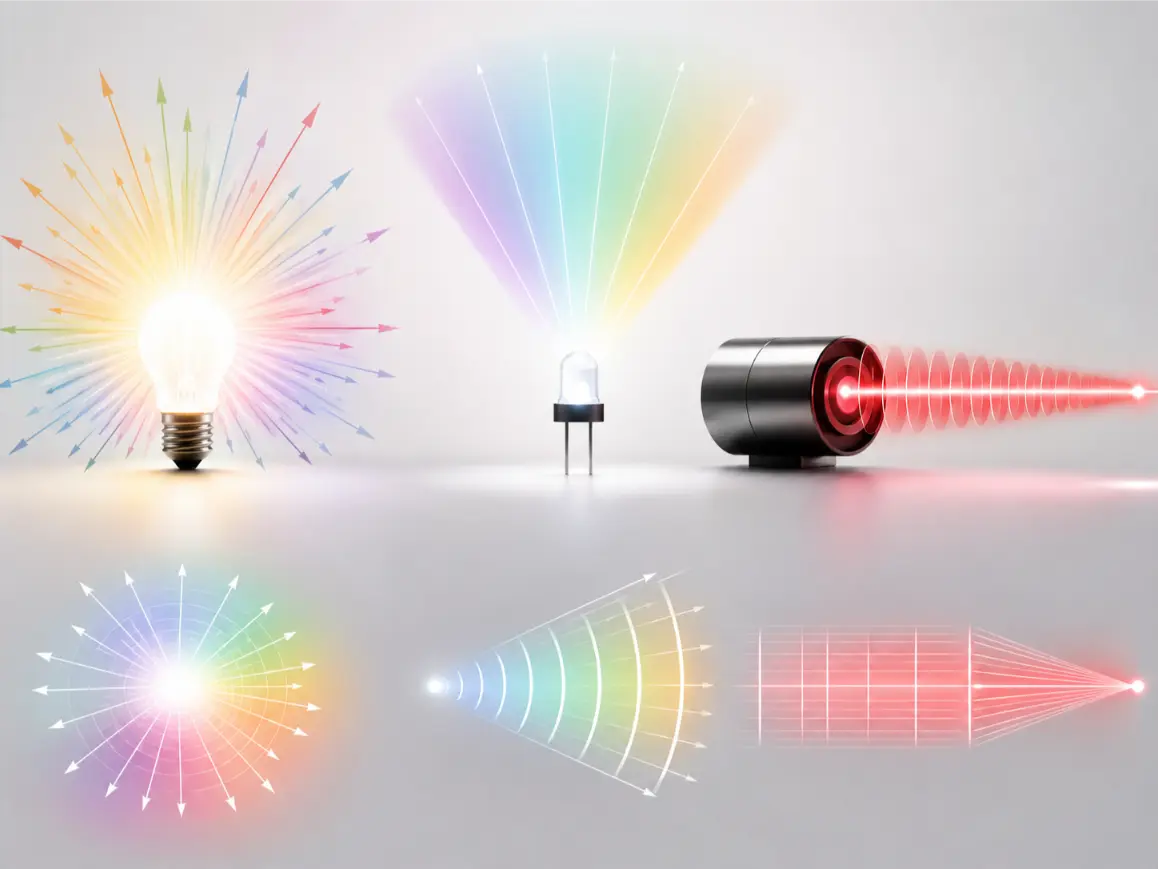
This illustration compares ordinary light, LED light, and laser light to show that a laser is special not simply because it is bright, but because its light is more organised, directional, and easier to focus.This artist’s impression helps students understand the central idea behind laser beam properties. It visually compares three kinds of light behaviour: an ordinary light source that spreads light widely in many directions, an LED that produces a more limited but still spreading beam, and a laser that emits a narrow, highly organised beam. The lower visual elements reinforce the contrast by showing how ordinary light spreads broadly, how intermediate light can form a wider cone, and how laser light remains tightly directed with a more ordered wave structure. The image supports the Laser Beam Properties page by introducing the idea that the usefulness of lasers comes not only from brightness, but from coherence, directionality, narrow wavelength range, focusability, and controlled beam behaviour.
Main Properties of Laser Beams
Laser beams are usually described using several related properties. No single property defines all lasers perfectly, because real lasers differ in wavelength, power, beam quality, pulse behaviour, and design. However, the following properties form the core vocabulary of laser beam behaviour.
Beam Property
Meaning
Why It Matters
Coherence
Waves maintain a stable phase relationship.
Important for interference, holography, measurement, and precision optics.
Monochromaticity
The beam has a narrow range of wavelengths.
Useful in spectroscopy, communication, sensing, and material interaction.
Directionality
The beam travels mostly in one direction.
Allows energy or information to be sent accurately over distance.
Low divergence
The beam spreads slowly as it travels.
Helps maintain a small beam size over long distances.
Focusability
The beam can be concentrated into a small spot.
Important for cutting, surgery, microscopy, and data reading.
Intensity
Power per unit area.
Determines how strongly the beam interacts with matter.
Polarisation
Direction of electric field oscillation.
Important in optics, communication, measurement, and material processing.
Beam quality
How close the beam is to an ideal beam shape.
Affects focusing, propagation, and precision applications.
The Evolutionary Timeline: History, Scientific Hurdles, and Future Horizons
The classification of controlled light parameters has driven modern physics forward, turning light beams into highly calibrated measurement tools.
The Historical Journey
Before the laser was invented, physicists like Max Born and Emil Wolf laid the mathematical groundwork for light coherence in the 1950s. When Theodore Maiman demonstrated the first ruby laser in 1960, researchers immediately noticed its extreme spatial coherence and low divergence compared to continuous gas lamps.
By the late 1960s, separate metrics like the beam parameter product were developed to quantify laser profiles. In 1988, Anthony Siegman introduced the formal M2 beam quality factor, giving optical engineers a universal benchmark to gauge how closely a real laser profile matches a perfect Gaussian wave.
Contemporary Scientific Challenges
In high-precision optical engineering, the ultimate limitation is preserving beam quality over real distances or through dense optics. High-power laser lines alter the index of refraction of surrounding air or glass due to thermal expansion. This alters the phase front, causing the beam waist to wander or experience unwanted self-focusing blurs.
Additionally, narrowing a laser’s linewidth to enhance temporal coherence makes the system highly sensitive to external structural vibrations and micro-seismic noise. This requires the use of multi-layered vibration isolation tables and active optoelectronic feedback loops.
Future Horizons: Quantum Linewidths and Structured Light Fields
The frontier of beam development is moving beyond traditional Gaussian parameters:
Structured and Vortex Light Fields: Modern researchers are designing lasers that generate beams with custom shapes, such as hollow doughnut rings or helical wavefronts. These beams carry orbital angular momentum, allowing them to optically trap and spin tiny biological cells or encode multiple data streams onto a single wavelength channel.
Sub-Hertz Spectral Linewidths: Utilizing ultra-stable monocrystalline silicon cavities cooled to cryogenic thresholds, quantum engineers can now narrow a laser’s linewidth to less than 1 Hz. This extreme spectral purity enables the synchronization of next-generation optical atomic clocks, which lose less than one second over billions of years.
Coherence: Light Waves Keeping in Step
Coherence describes how well light waves maintain a stable phase relationship. If two waves rise and fall together in a predictable way, they are coherent. If their peaks and troughs occur randomly relative to one another, they are incoherent or only weakly coherent.
Laser light is often highly coherent because stimulated emission produces photons that match the stimulating photons. The laser cavity then reinforces selected wave patterns. This is very different from ordinary spontaneous emission, where atoms emit photons randomly in direction and phase.
Temporal Coherence
Temporal coherence describes how long a wave maintains a predictable phase relationship over time. It is closely related to the narrowness of the laser’s frequency range. A laser with a very narrow linewidth usually has stronger temporal coherence than a broad-spectrum light source.
Temporal coherence matters in interferometry, spectroscopy, precision measurement, and systems where the phase of light must remain predictable.
Spatial Coherence
Spatial coherence describes how well different points across the beam maintain a stable phase relationship. A beam with strong spatial coherence can be focused well and can produce clear interference patterns.
Spatial coherence helps explain why laser beams can remain narrow and why they are useful in holography, diffraction experiments, fibre coupling, and precision optical alignment.
Monochromaticity: A Narrow Range of Wavelengths
Monochromatic light means light of a single colour or wavelength. Real lasers are not perfectly single-wavelength, but many lasers have a much narrower wavelength range than ordinary lamps.
This narrow wavelength range is valuable because different wavelengths interact differently with materials. In medicine, manufacturing, sensing, and communication, choosing the right wavelength can be more important than simply choosing the strongest beam.
The relationship between wavelength, frequency, and photon energy is given by:
$$c = f\lambda$$
and
$$E = hf = \frac{hc}{\lambda}$$
Here, c is the speed of light, f is frequency, λ is wavelength, E is photon energy, and h is Planck’s constant. Shorter wavelengths have higher photon energies, which is one reason ultraviolet lasers interact with materials differently from infrared lasers.
Directionality and Beam Divergence
A laser beam is usually highly directional. This means most of its energy travels along a narrow path instead of spreading in all directions. Directionality is one of the most visible differences between a laser and an ordinary lamp.
However, no real beam stays perfectly parallel forever. Even a very good laser beam spreads gradually as it travels. This spreading is called beam divergence. A beam with low divergence spreads slowly; a beam with high divergence spreads more quickly.
For small divergence angles, a simple approximate relationship is:
$$\theta \approx \frac{r}{L}$$
Here, θ is the divergence angle in radians, r is the increase in beam radius, and L is the distance travelled. This simplified relationship helps students estimate how quickly a beam expands over distance.
Beam divergence matters in laser pointers, surveying, fibre coupling, communication, range finding, and any application where the beam must remain small after travelling some distance.
Gaussian Beams: The Common Shape of Laser Light
Many laser beams are approximately Gaussian. This means their intensity is strongest at the centre and gradually decreases toward the edges. A Gaussian beam does not have a sharp boundary. Instead, it fades smoothly outward from the centre.
Gaussian beams are useful because they provide a simple and powerful model for understanding laser focusing and propagation. Real beams may not be perfectly Gaussian, but the Gaussian model gives students a strong first picture of beam behaviour.
Beam Waist
The beam waist is the narrowest part of a focused laser beam. It is where the beam radius is smallest and the intensity is often highest. In many applications, the beam waist is placed at the work surface, sample, fibre entrance, or target region.
A smaller beam waist can produce higher intensity, but it also usually increases divergence after the focus. This is an important trade-off: a beam that is focused very tightly tends to spread more rapidly after the focal point.
Rayleigh Range
The Rayleigh range is a measure of how far a Gaussian beam remains close to its narrowest size. It describes the distance from the beam waist over which the beam radius increases by a specific factor.
For an ideal Gaussian beam, the Rayleigh range is:
$$z_R = \frac{\pi w_0^2}{\lambda}$$
Here, zR is the Rayleigh range, w0 is the beam waist radius, and λ is the wavelength. This equation shows an important idea: a larger beam waist gives a longer Rayleigh range, while a shorter wavelength can also help maintain a tighter beam over distance.
Beam Radius During Propagation
A simplified Gaussian beam model describes how the beam radius changes with distance from the waist:
Here, w(z) is the beam radius at distance z from the waist. This equation shows that the beam is narrowest at z = 0 and gradually expands as it moves away from the waist.
Focusability and Spot Size
One of the most useful properties of a laser beam is that it can often be focused into a very small spot. A small spot concentrates energy into a small area, increasing intensity. This is why lasers can cut, weld, engrave, perform surgery, read data, or probe tiny structures.
The final spot size depends on wavelength, beam diameter, lens quality, focusing geometry, and beam quality. Shorter wavelengths and better beam quality often allow tighter focusing, although real systems are limited by diffraction and optical imperfections.
A student-friendly way to think about focusing is this: focusing does not create energy from nothing. It redistributes the beam’s power into a smaller area. When the same power is squeezed into a smaller spot, the intensity increases.
Intensity and Power Density
Laser intensity is the power delivered per unit area. It is often written as:
$$I = \frac{P}{A}$$
Here, I is intensity, P is power, and A is the beam area. This equation explains why a modest-power laser can become very effective when focused tightly.
For example, a laser with the same power may produce very different effects depending on whether it is spread over a large spot or focused into a tiny point. In one case it may gently illuminate a surface. In another case it may heat, cut, mark, or damage the material.
This is also why intensity is important in Laser Safety. The danger is not only the total power of the laser, but how concentrated that power is and where it goes.
Continuous-Wave and Pulsed Laser Beams
Some lasers emit light continuously. These are called continuous-wave lasers. Others emit light in pulses. Pulsed lasers may release energy in short bursts, sometimes with very high peak power even when the average power is moderate.
Beam Operation
What It Means
Common Uses
Continuous-wave
Light is emitted continuously over time.
Alignment, communication, sensing, steady illumination, some cutting and heating tasks.
Pulsed
Light is emitted in short bursts.
Range finding, medical procedures, precision machining, spectroscopy, ultrafast research.
Ultrafast pulsed
Pulses are extremely short, often femtoseconds or picoseconds.
The distinction between average power and peak power is important. Average power describes energy delivered over a longer time interval. Peak power describes how intense the beam is during a short pulse.
For a pulse, a simple average power during the pulse can be estimated using:
$$P = \frac{E}{t}$$
Here, E is pulse energy and t is pulse duration. If t is very small, the power during the pulse can become very large.
Linewidth and Spectral Purity
A laser’s linewidth describes the range of frequencies or wavelengths present in the beam. A narrow linewidth means the laser output is concentrated into a very small frequency range. This is useful in spectroscopy, interferometry, atomic physics, optical clocks, communication, and precision measurement.
Linewidth is related to temporal coherence. A narrower linewidth usually means the light can maintain a stable phase relationship for a longer time. However, real lasers are affected by noise, temperature changes, cavity design, gain medium behaviour, and mechanical stability.
This is why some lasers are designed for high power, while others are designed for extremely narrow linewidth. The best beam depends on the purpose.
Polarisation
Light is an electromagnetic wave. Its electric field oscillates in a direction perpendicular to the direction of travel. Polarisation describes the orientation of this electric field.
Some laser beams are strongly polarised, while others are weakly polarised or have changing polarisation states. Polarisation matters in optical communication, microscopy, reflection control, material processing, stress analysis, and many scientific instruments.
Polarisation connects laser optics with the wider study of Wave Optics, where light is understood through wave behaviour, interference, diffraction, and field orientation.
Beam Quality and the M2 Factor
Beam quality describes how close a real laser beam is to an ideal beam. A common measure is the M2 factor. An ideal Gaussian beam has M2 = 1. Real beams usually have M2 greater than 1.
A beam with lower M2 can usually be focused more tightly and propagate more cleanly. A beam with higher M2 may spread more, focus less well, or have a less regular intensity profile.
Beam quality is especially important in precision manufacturing, fibre coupling, microscopy, medical systems, and scientific measurement. A high-power beam is not automatically a high-quality beam. In many applications, beam shape and focusability are just as important as power.
How Beam Properties Affect Applications
Different applications require different beam properties. A laser used for fibre communication does not need to behave exactly like a laser used for metal cutting. A surgical laser does not need the same properties as a classroom alignment laser. The best beam is the one whose properties match the task.
The beam must travel outward and return useful timing information.
Microscopy
Focusability, wavelength, power stability, beam profile
The beam must illuminate or excite small regions accurately.
Case Studies: Beam Properties in Real Systems
The following case studies show why laser beam properties are practical design choices, not just vocabulary terms.
Case Study 1: Fibre-Optic Communication
In fibre-optic communication, laser light carries information through optical fibres. The beam must be coupled efficiently into the fibre core, operate at a suitable wavelength, and remain stable enough for reliable transmission. A laser with poor beam quality or unsuitable wavelength may waste power or transmit data poorly.
This case study shows that laser communication is not only about turning light on and off. It depends on matching the laser beam to the fibre, detector, modulation system, and transmission distance. The related physics is developed further in Fiber Optics.
Case Study 2: Precision Laser Cutting
In precision manufacturing, a laser may be focused onto metal, plastic, ceramic, or other materials. The beam must deliver enough intensity to the workpiece, but the spot size and motion must be carefully controlled. A beam that cannot be focused well may produce wider cuts, poorer edges, or less efficient processing.
This case study shows why beam quality matters. A laser with excellent beam quality can often be focused into a smaller, cleaner spot. That can improve precision and reduce waste. The application side is explored further in Laser Applications in Medicine and Manufacturing.
Case Study 3: Interferometry and Precision Measurement
Interferometry uses the wave nature of light to measure small distances, surface shapes, vibrations, or changes in optical path. For this to work well, the laser must have strong coherence and stable wavelength. If the phase relationship changes unpredictably, the interference pattern becomes less useful.
This case study shows that laser light is valuable not only because it can be intense, but because it can be orderly. A stable beam can act like a precise ruler made of waves.
Case Study 4: Laser Safety and Beam Concentration
A low-divergence beam that can be focused into a small spot is useful for technology, but it also creates safety concerns. The same beam property that helps a laser cut, measure, or transmit information can also create risk if the beam enters the eye or reflects from a shiny surface.
This case study reinforces an important principle: useful beam properties and safety hazards often come from the same physics. This is why every study of laser beam behaviour should be connected to responsible use.
Connections with Wider Physics and Technology
Laser beam properties connect naturally with several wider areas of physics and engineering. These related pages help students see that laser beams are part of a larger story about waves, energy, matter, and optical systems.
Laser beam properties such as wavelength, divergence, and coupling efficiency are central to transmitting light through optical fibres.
Learning Pathway Within Laser Optics
This page focuses on what laser beams are like after they are produced. Students can connect it with the other pages in the Laser Optics cluster to understand the full pathway from laser generation to applications and safety.
Learn how beam properties affect hazards, eye protection, reflections, laser classes, and responsible laser use.
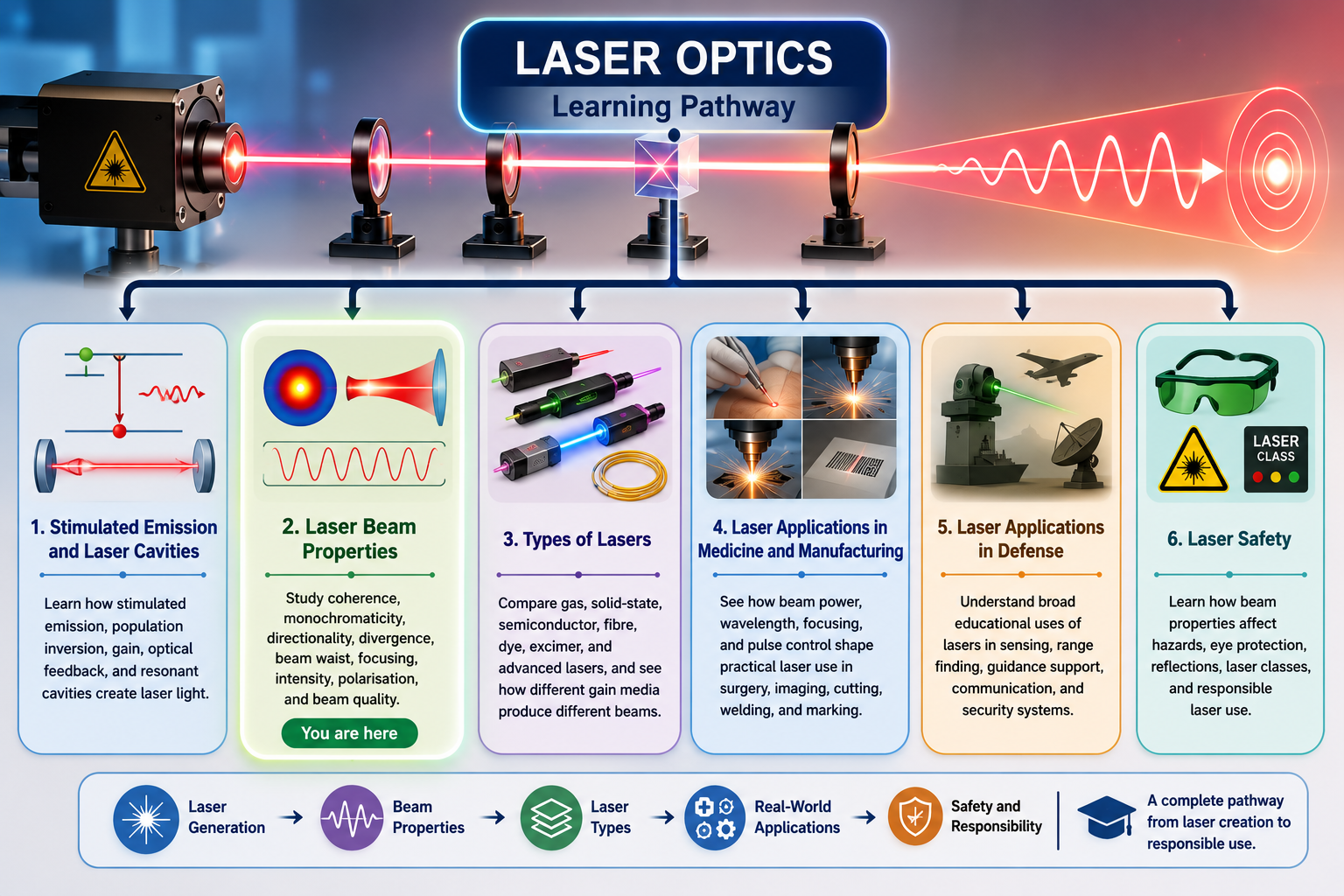
The Laser Optics pathway helps students connect laser generation, beam properties, laser types, real-world applications, and responsible safety practices.
This educational tree chart presents Laser Optics as a hub connected to six related subpages. It shows the learning pathway from Stimulated Emission and Laser Cavities, where students learn how laser light is created, to Laser Beam Properties, where coherence, divergence, focusing, intensity, polarisation, and beam quality are studied. The chart then connects to Types of Lasers, Laser Applications in Medicine and Manufacturing, Laser Applications in Defense, and Laser Safety. The highlighted Laser Beam Properties panel indicates the current page, helping students understand where they are within the wider Laser Optics cluster.
Quick Check: Laser Beam Properties
Quick Check: Beam Behaviour
Q1. Why is a laser beam usually more directional than light from a lamp?
A laser cavity reinforces light travelling in selected directions, especially along the cavity axis. Ordinary lamps emit light in many directions through mostly random spontaneous emission.
Q2. What does beam divergence mean?
Beam divergence is the gradual spreading of a beam as it travels. Even a good laser beam spreads slightly because real beams are limited by diffraction and optical design.
Q3. Why can focusing a laser beam increase its effect on a material?
Focusing concentrates the same power into a smaller area. Since intensity is power per unit area, a smaller spot produces higher intensity.
Q4. Why is beam quality important?
Beam quality affects how well a laser can be focused and how cleanly it propagates. A high-quality beam can often produce a smaller, more controlled spot than a poor-quality beam of the same power.
Common Misunderstandings About Laser Beam Properties
Misunderstanding 1: A Laser Beam Never Spreads
A laser beam may spread very slowly, but it does not remain perfectly parallel forever. Beam divergence is unavoidable in real optical systems. A good laser beam has low divergence, not zero divergence.
Misunderstanding 2: Laser Brightness Is the Same as Laser Power
Brightness as seen by the eye depends on wavelength, visibility, beam direction, and eye sensitivity. Power is a physical quantity measured in watts. An invisible infrared laser may not look bright at all but may still carry significant power.
Misunderstanding 3: More Power Always Means a Better Laser
Power is only one beam property. A lower-power laser with excellent beam quality, narrow linewidth, and stable wavelength may be better for precision measurement than a high-power laser with poor stability.
Misunderstanding 4: A Laser Beam Has a Sharp Edge
Many laser beams, especially Gaussian beams, do not have a sharp edge. Their intensity is highest at the centre and gradually decreases toward the outside. The “diameter” of a laser beam therefore depends on how it is defined and measured.
Key Terms
Beam divergence
The gradual spreading of a laser beam as it travels away from its narrowest region or source.
Beam waist
The narrowest part of a focused beam, where the beam radius is smallest.
Coherence
The property of waves maintaining a stable phase relationship over time or across space.
Directionality
The tendency of a laser beam to travel mainly in one direction rather than spreading widely.
Focusability
The ability of a beam to be concentrated into a small spot using optical elements such as lenses or mirrors.
Gaussian beam
A beam whose intensity is strongest at the centre and decreases smoothly toward the edges in a Gaussian-like profile.
Intensity
Power per unit area, often written as I = P / A.
Linewidth
The range of frequencies or wavelengths present in a laser beam.
M2 factor
A measure of beam quality that compares a real beam with an ideal Gaussian beam. An ideal Gaussian beam has M2 = 1.
Monochromaticity
The property of having a narrow range of wavelengths or frequencies.
Polarisation
The orientation of the electric field oscillation in a light wave.
Rayleigh range
The distance from the beam waist over which a Gaussian beam remains relatively close to its minimum size.
Spatial coherence
Coherence across different points in the beam cross-section.
Temporal coherence
Coherence over time, often related to the narrowness of the laser’s frequency range.
Review Questions
What does coherence mean in laser light?
Answer: Coherence means that light waves maintain a stable phase relationship. Laser light is often highly coherent because stimulated emission and cavity feedback help organise the emitted photons.
Why is laser light often described as monochromatic?
Answer: Laser light is often described as monochromatic because it usually contains a much narrower range of wavelengths than ordinary light sources. Real lasers are not perfectly single-wavelength, but many are spectrally narrow.
What is beam divergence?
Answer: Beam divergence is the spreading of a beam as it travels. A laser usually has low divergence, meaning it spreads slowly compared with many other light sources.
What is a beam waist?
Answer: The beam waist is the narrowest part of a focused beam. It is where the beam radius is smallest and the intensity is often highest.
Why does focusing increase laser intensity?
Answer: Focusing reduces the area over which the beam power is spread. Since intensity is I = P / A, a smaller area gives a higher intensity for the same power.
Why is beam quality important?
Answer: Beam quality affects how well a beam can be focused and how cleanly it propagates. A high-quality beam is often more useful for precision applications than a poor-quality beam of the same power.
Thought-Provoking Questions
Why might a laser with lower power be more useful than a higher-power laser in a precision experiment?
Answer: A lower-power laser may have better coherence, narrower linewidth, greater stability, or better beam quality. In precision experiments, order and stability may matter more than raw power.
Why does the same beam property sometimes create both usefulness and danger?
Answer: A beam that is narrow, coherent, and focusable can perform precise tasks, but it can also concentrate energy into sensitive tissue or reflective paths. The same concentration that makes it useful can make it hazardous.
Why is it misleading to describe a laser only by its colour?
Answer: Colour tells us about visible wavelength, but it does not reveal power, beam quality, divergence, pulse duration, linewidth, or safety risk. Many important lasers are also invisible.
Comprehensive Numerical Problems with Solutions
A laser has power 0.20 W and is focused onto a circular spot of area 4.0 × 10⁻⁶ m2. Find the intensity.
Answer: The average power during the pulse is exactly 5.0 × 10⁵ W (or 500 kW).
External References for Further Reading
The following external references provide useful background for students who want to read beyond this introductory page. They support the basic physics of laser light, Gaussian beam propagation, beam divergence, and beam quality.
OpenStax University Physics: Lasers — A student-level explanation of laser light, coherence, monochromaticity, stimulated emission, and the basic physical structure of lasers.
RP Photonics Encyclopedia: Beam Quality — A deeper reference on laser beam quality, the M2 factor, beam parameter product, and the comparison between real and ideal beams.
Why This Topic Matters
Laser beam properties matter because they explain why lasers are so useful across many fields. A beam that is narrow, coherent, focusable, and stable can become a communication signal, a surgical tool, a measuring ruler, a manufacturing instrument, or a scientific probe.
The study of beam properties also teaches a deeper lesson about technology. A device is not powerful only because it contains energy. It becomes powerful when energy is organised. A laser beam is useful because its light is arranged in ways that can be directed, focused, timed, measured, and controlled.
For students preparing for university, this topic connects physics with engineering judgement. It encourages them to ask not only “How much power does the laser have?” but also “What wavelength is it? How does it spread? How well can it focus? How stable is it? How does it interact with matter? How can it be used safely?”
Summary
Laser beam properties describe how laser light behaves after it is produced. Important properties include coherence, monochromaticity, directionality, divergence, beam waist, Rayleigh range, focusability, intensity, linewidth, polarisation, and beam quality.
A laser beam is usually more organised than light from ordinary sources. It may travel in a narrow direction, maintain phase relationships, contain a narrow wavelength range, and focus into a small spot. These features make lasers useful in communication, medicine, manufacturing, measurement, research, and sensing.
The same properties that make laser beams useful also make them safety-relevant. A narrow, focusable beam can deliver energy precisely, but it must be controlled responsibly.
Reflection Question
A laser beam is powerful not only because of how much energy it carries, but because of how carefully that energy is organised. Where else in science or engineering does organisation matter as much as quantity?