Prepare for University Studies & Career Advancement
Types of Lasers
Lasers are not all the same. Some use gases, some use crystals, some use semiconductors, some use optical fibres, and some use special chemical or molecular systems. Yet all of them depend on the same core idea: light can be amplified through stimulated emission when a suitable gain medium, pumping method, and optical cavity work together.
This page introduces the main types of lasers in a student-friendly way. Instead of treating laser names as a list to memorise, it explains how each type is built, what makes it useful, and why different lasers are chosen for different tasks. It belongs to the wider Laser Optics cluster, where students can also study laser beam behaviour, laser applications, and laser safety.
What “Types of Lasers” Really Means
When scientists and engineers classify lasers, they are usually asking one central question: what material provides the light amplification? This material is called the gain medium. It is where particles are excited to higher energy states and then release photons through stimulated emission.
Different gain media produce different wavelengths, powers, efficiencies, beam qualities, and operating styles. A gas laser, a semiconductor laser, and a fibre laser may all produce laser light, but they do so using very different physical structures. This is why laser classification is not just a naming exercise. It tells us how the laser works and what it is likely to be good at.
A simple way to understand laser types is to imagine that each laser is built from three main choices:
Gain medium: What material produces stimulated emission?
Pumping method: How is energy supplied to create population inversion?
Cavity design: How is light fed back, selected, and allowed to emerge as a beam?
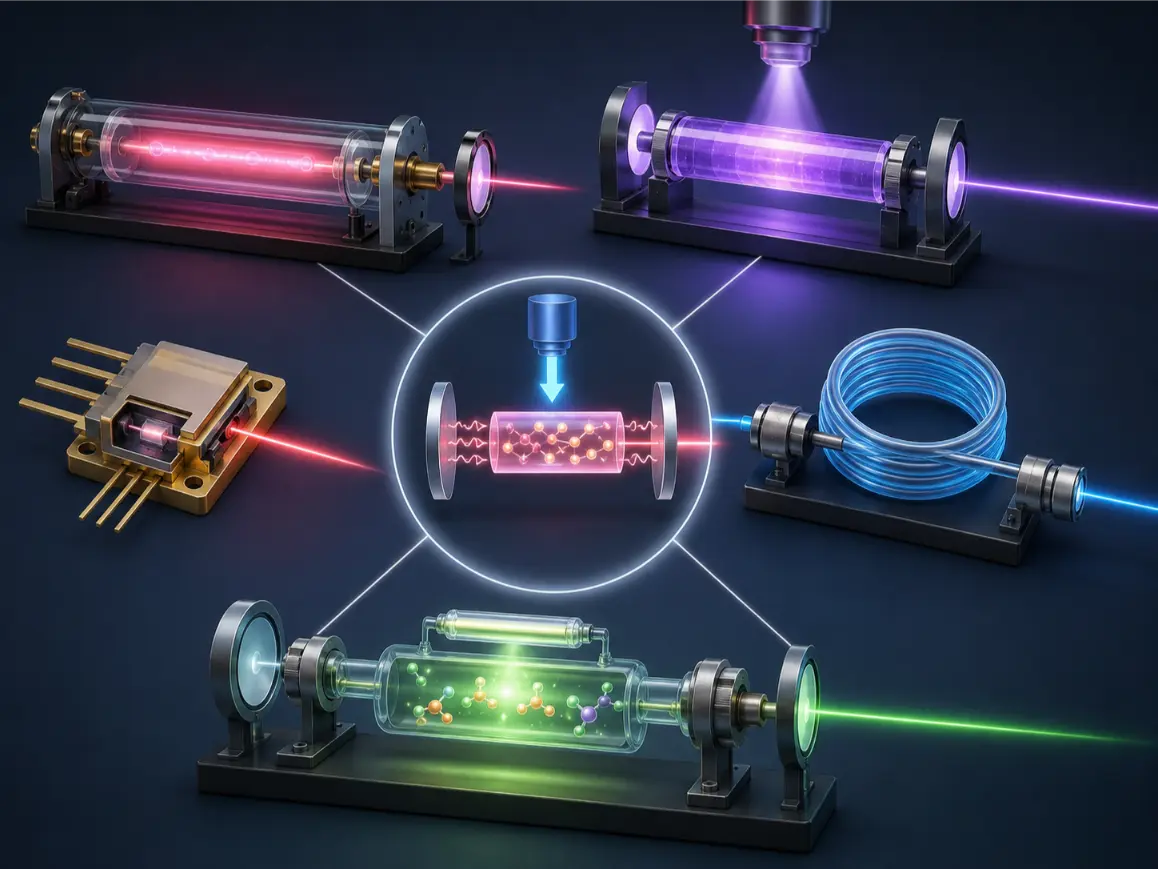
Different lasers use different gain media, but all depend on stimulated emission, energy input, and optical feedback to produce controlled laser light.
This artist’s impression introduces the main idea behind different types of lasers. It shows several laser systems based on different gain media, including gases, crystals, semiconductors, optical fibres, and special molecular or chemical systems. At the centre, a simplified laser cavity represents the shared principle behind all these devices: a suitable gain medium receives energy from a pumping method, particles are excited, stimulated emission amplifies light, and optical feedback allows a controlled beam to emerge. The image helps students understand that laser classification is not just a list of names, but a way of seeing how the material, pumping method, and cavity design shape the behaviour and usefulness of each laser type.
A Simple Classification of Lasers
Lasers can be classified in many ways, but students usually meet them first according to the gain medium. The main categories include gas lasers, solid-state lasers, semiconductor lasers, fibre lasers, dye lasers, excimer lasers, and specialised advanced lasers.
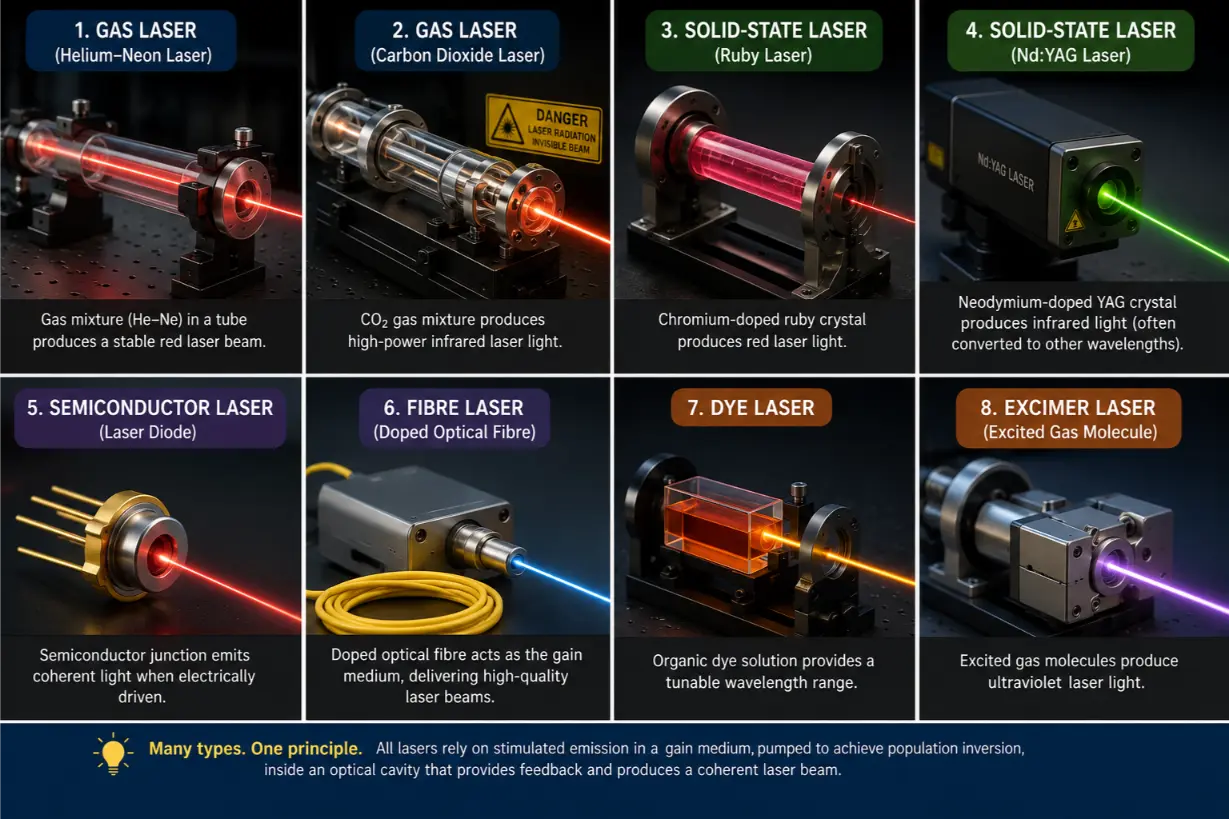
Lasers can be classified by their gain medium, including gases, crystals, semiconductors, optical fibres, dye solutions, and excited gas molecules.
This infographic-style illustration introduces the main types of lasers commonly studied in laser optics. It shows gas lasers such as helium-neon and carbon dioxide lasers, solid-state lasers such as ruby and Nd:YAG lasers, semiconductor laser diodes, fibre lasers, dye lasers, and excimer lasers. Each type uses a different gain medium, but all depend on the same core principle: stimulated emission in an excited medium, supported by pumping and optical feedback. The image helps students understand that laser classification is not just a list of names, but a way of seeing how different materials and structures produce different wavelengths, powers, efficiencies, beam qualities, and practical uses.
The Chronology of Laser Development: From Helium-Neon to Quantum Cascades
The history of laser engineering shows a constant effort to find new materials capable of sustaining a stable population inversion.
The Historical Journey
Following Theodore Maiman’s milestone 1960 ruby laser, Ali Javan designed the Helium-Neon (He-Ne) gas laser in December of that same year, producing the first continuous-wave laser light framework. The field expanded into high-power processing options in 1964 with Kumar Patel’s development of the molecular Carbon Dioxide (CO2) laser line, and J.E. Geusic’s implementation of the solid-state Nd:YAG crystal array.
Semiconductor diode lasers matured throughout the 1970s, paving the way for the invention of erbium-doped fiber lasers in the late 1980s, which directly enabled long-distance telecommunications networks. In 1994, Jerome Faist and Federico Capasso invented the Quantum Cascade Laser (QCL), utilizing quantum well sub-bands to generate tunable infrared emissions.
Contemporary Scientific Challenges
Modern laser manufacturing faces limits due to material-specific properties. Solid-state crystal blocks suffer from intense thermal gradients under continuous high-power operation, generating localized phase front warp errors known as thermal lensing.
Gas lasers require bulky transmissive glass framing or gas refill systems that can suffer from electrode decay over time. Meanwhile, semiconductor laser diodes face intense current density challenges within thin p-n junctions. This can lead to sudden degradation of the crystal facets if light power levels spike too high.
Future Horizons: Random Lasers and Metamaterial Mediums
The boundaries of gain medium design are moving beyond conventional geometries:
Random Laser Mediums: Instead of using precise opposing alignment mirrors, modern researchers are exploring random lasers. These systems build up threshold gain using chaotic multiple-scattering paths inside disordered powder structures or zinc oxide paint layers, paving the way for low-coherence, speckle-free medical imaging probes.
Metamaterial Waveguide Arrays: Quantum engineers are designing artificial sub-wavelength structural crystal networks that exhibit a zero or negative index of refraction. Integrating gain loops directly inside these metamaterial configurations allows for ultra-compact micro-diodes that emit clean directional fields with minimal back-reflection losses.
Gas Lasers
Gas lasers use a gas or gas mixture as the gain medium. The gas is usually placed inside a tube, and energy is supplied through an electrical discharge or another pumping method. When the gas atoms, ions, or molecules are excited, they can produce laser light at specific wavelengths.
Gas lasers are historically important because many early and widely used lasers belonged to this category. They are also educationally useful because their working principles are relatively easy to connect with atomic energy levels, emission lines, and optical cavities.
Helium-Neon Lasers
The helium-neon laser is one of the most familiar gas lasers in education. It often produces a red beam and has been widely used in laboratory demonstrations, alignment systems, and optical experiments. In a helium-neon laser, helium helps transfer energy to neon atoms, and neon provides the main laser transition.
This type of laser is useful for students because it shows how energy transfer, population inversion, and mirror feedback can work together in a clear physical system. The beam is usually stable and easy to see, making it helpful for demonstrations of reflection, refraction, interference, and diffraction.
Carbon Dioxide Lasers
Carbon dioxide lasers use molecular transitions and often produce infrared light. They can reach high power levels and are widely used in cutting, engraving, welding, and some medical procedures. Because their wavelength is strongly absorbed by many materials, they are useful when controlled heating or material removal is needed.
A carbon dioxide laser reminds students that not all important lasers operate in the visible range. Many practical lasers produce infrared or ultraviolet radiation that cannot be seen directly by the human eye. This is one reason why laser safety depends on wavelength as well as power.
Solid-State Lasers
Solid-state lasers use a solid material as the gain medium. The material is often a crystal or glass doped with specific ions. These ions provide the energy levels needed for laser action. The solid host supports the active ions and helps determine the laser’s optical and thermal behaviour.
Solid-state lasers are important because they can produce powerful, high-quality beams and short pulses. They are used in research laboratories, industrial processing, medical systems, surveying, range finding, and scientific instrumentation.
Ruby Lasers
The ruby laser is historically famous because it was the first working laser. It uses a synthetic ruby crystal containing chromium ions. When the crystal is optically pumped, the chromium ions can produce red laser light.
For students, the ruby laser is a strong example of how a material that can fluoresce becomes a laser only when population inversion and cavity feedback are achieved. A glowing crystal is not automatically a laser. A laser requires organised amplification.
Nd:YAG Lasers
Nd:YAG lasers use neodymium ions in a yttrium aluminium garnet crystal. They are widely used because they can produce strong beams and pulses. Their output is often in the infrared, but frequency conversion can produce visible or ultraviolet light for certain applications.
Nd:YAG lasers show how one laser system can be adapted for many purposes. Depending on power, pulse duration, focusing, and beam delivery, they may be used in medicine, manufacturing, research, and measurement.
Semiconductor Lasers
Semiconductor lasers are among the most common lasers in modern life. They are also called laser diodes. Instead of using a gas tube or a large crystal, they use semiconductor materials where electrons and holes recombine to produce photons.
The great strength of semiconductor lasers is compactness. They can be very small, efficient, and directly driven by electric current. This makes them suitable for optical communication, barcode readers, laser pointers, printers, sensors, data storage, and many electronic devices.
Semiconductor lasers connect strongly with Electrical and Electronic Engineering because they combine optics, materials science, electronics, and device design. They are also central to many systems in Fiber Optics, where laser light is guided through optical fibres for communication and sensing.
Why Semiconductor Lasers Matter
A large laboratory laser may look more impressive, but semiconductor lasers changed the world by making coherent light small, affordable, and easy to integrate into devices. They helped move lasers from special instruments into everyday technology.
This is a useful lesson for students: scientific impact does not always come from the largest or most powerful system. Sometimes the most transformative technology is the one that can be manufactured reliably, miniaturised, and placed inside millions of devices.
Fibre Lasers
Fibre lasers use an optical fibre as the gain medium. The fibre is usually doped with rare-earth ions such as ytterbium, erbium, or neodymium. Pump light is guided into the fibre, and laser light is amplified along the fibre length.
Fibre lasers are important because the gain medium is also a waveguide. This means the light is naturally confined and guided as it is amplified. The result can be high efficiency, good beam quality, compact design, and convenient beam delivery.
Fibre lasers are widely used in industrial cutting, welding, marking, precision manufacturing, telecommunications, sensing, and research. They connect naturally with Fiber Optics, because both fields depend on guiding light through carefully designed optical fibres.
Fibre Lasers as a Bridge Between Optics and Engineering
A fibre laser is not just a laser placed inside a fibre. It is a system where the fibre itself helps shape the beam, control the interaction, and deliver the output. This makes fibre lasers especially attractive in engineering environments, where reliability, compactness, and beam control matter.
For students, fibre lasers are a good example of how a physical idea becomes more powerful when it is combined with clever geometry. By guiding light through a long, narrow medium, engineers can create efficient amplification without needing a bulky cavity in the traditional sense.
Dye Lasers
Dye lasers use organic dye molecules, usually dissolved in a liquid solvent, as the gain medium. Their most important feature is tunability. Instead of being restricted to one fixed wavelength, many dye lasers can be adjusted across a range of wavelengths.
This tunability makes dye lasers useful in spectroscopy and research, where scientists may need to scan across wavelengths to study atoms, molecules, materials, or chemical processes. However, dye lasers can be less convenient than solid-state or semiconductor lasers because they may involve liquid handling, dye degradation, and more complex maintenance.
Dye lasers show that “better” depends on purpose. A tunable laser may be excellent for a scientific experiment but unsuitable for a compact consumer device. Classification helps students understand not only what a laser is, but why a particular laser is chosen.
Excimer Lasers
Excimer lasers use excited molecular states, often involving noble gases and halogens, to produce ultraviolet light. The word “excimer” originally refers to an excited dimer, a molecule-like state that exists only when excited. When the excited state decays, ultraviolet photons are emitted.
Excimer lasers are important because ultraviolet light can interact strongly with materials at very small scales. This makes them useful in eye surgery, microfabrication, and semiconductor manufacturing. Their short wavelength allows fine patterns and precise material processing.
For students, excimer lasers provide an important reminder: wavelength matters. A visible red laser pointer and an ultraviolet excimer laser are both lasers, but they interact with matter in very different ways. The photon energy, absorption depth, and material response can completely change the application.
Specialised and Advanced Laser Types
Some lasers do not fit neatly into the introductory categories above, or they are best studied after students understand the basic types. These include chemical lasers, free-electron lasers, quantum cascade lasers, ultrafast lasers, and high-power research lasers.
Chemical Lasers
Chemical lasers use energy from chemical reactions to create population inversion. They are less common in everyday educational settings but are important historically and in specialised research or defence-related contexts. At this level, the main idea is that pumping energy does not always need to come from electricity or light; it can also come from chemical energy.
Quantum Cascade Lasers
Quantum cascade lasers are semiconductor lasers that operate through engineered electronic transitions inside layered structures. They are especially important in parts of the infrared spectrum and are used in sensing, spectroscopy, and environmental monitoring.
Free-Electron Lasers
Free-electron lasers do not use ordinary bound atomic transitions in the same way as conventional lasers. Instead, they use high-speed electrons moving through special magnetic structures. They can produce intense and tunable radiation, often for advanced research facilities.
These advanced lasers show how the idea of coherent radiation can be extended beyond the simplest gain media. They are not usually the first lasers students need to master, but they reveal the depth and flexibility of laser physics.
How Engineers Choose a Laser Type
Choosing a laser is not simply a matter of choosing the most powerful one. Engineers and scientists consider the wavelength, power, pulse duration, beam quality, efficiency, size, cost, cooling requirements, maintenance needs, and safety risks.
Need
Likely Laser Choice
Reason
Compact light source for electronics
Semiconductor laser
Small, efficient, and electrically driven
High-power cutting or welding
Fibre laser or carbon dioxide laser
Can deliver strong beams for material processing
Tunable wavelength for spectroscopy
Dye laser or specialised tunable laser
Can be adjusted across selected wavelength ranges
Ultraviolet microfabrication
Excimer laser
Short wavelength supports fine-scale processing
Stable laboratory alignment beam
Helium-neon laser or diode laser
Convenient visible beam for optical setup and teaching
Optical fibre communication
Semiconductor laser
Can be modulated and coupled into optical fibre systems
This decision-making process connects directly to Laser Beam Properties, because the usefulness of a laser depends not only on its type but also on coherence, divergence, focusing ability, linewidth, intensity, and beam stability.
Case Studies: Laser Types in Real Contexts
The following case studies show how different laser types are chosen for different real-world tasks. The aim is not to memorise many laser names, but to understand the reasoning behind the choice.
Case Study 1: Semiconductor Lasers in Fibre-Optic Communication
In fibre-optic communication, information is sent as pulses or modulated signals of light through optical fibres. Semiconductor lasers are often used because they are compact, efficient, and can be modulated rapidly by electronic circuits.
This is a powerful example of physics becoming infrastructure. A tiny semiconductor device can generate light that carries data across cities, countries, and oceans. The laser must produce a suitable wavelength, couple efficiently into the fibre, and switch or modulate fast enough to encode information.
The student lesson is that laser type matters because the whole system matters. The best laser for optical communication is not necessarily the brightest laser. It is the one that works well with fibres, electronics, detectors, and communication protocols.
Case Study 2: Precision Laser Cutting
Modern manufacturing often requires accurate cutting, welding, drilling, engraving, or surface treatment. Fibre lasers are widely used because they can provide high beam quality, efficient operation, and convenient beam delivery through optical fibres.
A fibre laser can focus energy into a small region, allowing controlled interaction with metals and other materials. In automated production, this supports repeatability and precision. The laser is not merely a heat source; it is part of a controlled manufacturing system involving optics, motion control, sensors, and software.
This case study shows why laser optics connects with engineering design. The choice of laser affects speed, accuracy, cost, safety, and the quality of the final product.
Case Study 3: Excimer Lasers in Eye Surgery and Microfabrication
Excimer lasers produce ultraviolet light that can interact with surfaces very precisely. In eye surgery, carefully controlled ultraviolet pulses can reshape corneal tissue. In microfabrication, similar short-wavelength light can support fine patterning and material processing.
The important concept is that ultraviolet light has higher photon energy than visible or infrared light. This changes how it interacts with matter. Instead of simply heating a large region, it can support more localised material modification when used in a controlled system.
This case study also reminds students that powerful lasers require careful safety design. The same properties that make a laser useful can also make it hazardous if used without proper controls. Students should connect this page with Laser Safety.
Connections with Wider Physics
Different laser types are easier to understand when students connect them to wider physics ideas. Laser classification is not isolated from the rest of optics and modern physics. It grows out of energy levels, electromagnetic waves, waveguides, interference, materials, and electronic structure.
Laser action depends on energy levels, photons, and transitions between quantum states. This wider page helps students understand why light is emitted in discrete packets.
Many laser wavelengths are linked to specific energy transitions. This page helps students connect spectral lines with photon energy and material identity.
Laser cavities, coherence, interference, and beam shaping all depend on wave behaviour. Wave optics provides the language for understanding resonance and phase.
Laser light is a special form of electromagnetic radiation. This page places laser beams within the wider spectrum of radio waves, infrared, visible light, ultraviolet, X-rays, and gamma rays.
Semiconductor and fibre lasers are closely connected with optical communication and fibre-based sensing. This page explains how light can be guided through optical fibres.
Learning Pathway Within Laser Optics
This page sits in the middle of the Laser Optics learning pathway. Students should first understand how laser action begins, then compare laser types, and finally study beam behaviour, applications, and safety.
Learn how wavelength, power, exposure time, beam path, reflection, and laser class affect safe use and responsible handling.
Quick Check: Comparing Laser Types
Quick Check: Types of Lasers
Q1. What is the main feature used to classify most laser types?
Most lasers are classified by their gain medium. The gain medium is the material where stimulated emission and light amplification occur.
Q2. Why are semiconductor lasers so common in modern technology?
They are small, efficient, electrically driven, and easy to integrate into electronic devices. This makes them useful in communication, sensing, scanning, printing, and consumer technology.
Q3. Why are fibre lasers useful in manufacturing?
Fibre lasers can provide efficient amplification, good beam quality, and convenient beam delivery. These features make them useful for precision cutting, welding, marking, and automated production.
Q4. Why does wavelength matter when choosing a laser?
Different wavelengths interact with materials differently. Infrared, visible, and ultraviolet lasers may be absorbed, transmitted, reflected, or focused in different ways. This affects applications and safety.
Common Misunderstandings About Laser Types
Misunderstanding 1: The Most Powerful Laser Is Always the Best Laser
Power is only one factor. A low-power semiconductor laser may be ideal for optical communication, while a high-power cutting laser would be unsuitable. The best laser depends on wavelength, beam quality, pulse behaviour, efficiency, size, safety, and system requirements.
Misunderstanding 2: All Lasers Produce Visible Light
Many lasers produce infrared or ultraviolet light, which cannot be seen directly. Invisible laser beams can still be hazardous. This is one reason students should never judge laser safety by brightness alone.
Misunderstanding 3: Laser Colour Alone Tells You the Laser Type
Colour gives information about wavelength, but it does not fully identify the laser type. Different laser systems may produce similar visible colours, and the same type of laser may be modified to produce different wavelengths through frequency conversion or design changes.
Misunderstanding 4: A Laser Diode Is Less “Real” Than a Large Laboratory Laser
A laser diode is a real laser. It still depends on stimulated emission and optical feedback. Its small size does not make it less important. In fact, semiconductor lasers are among the most widely used lasers in the modern world.
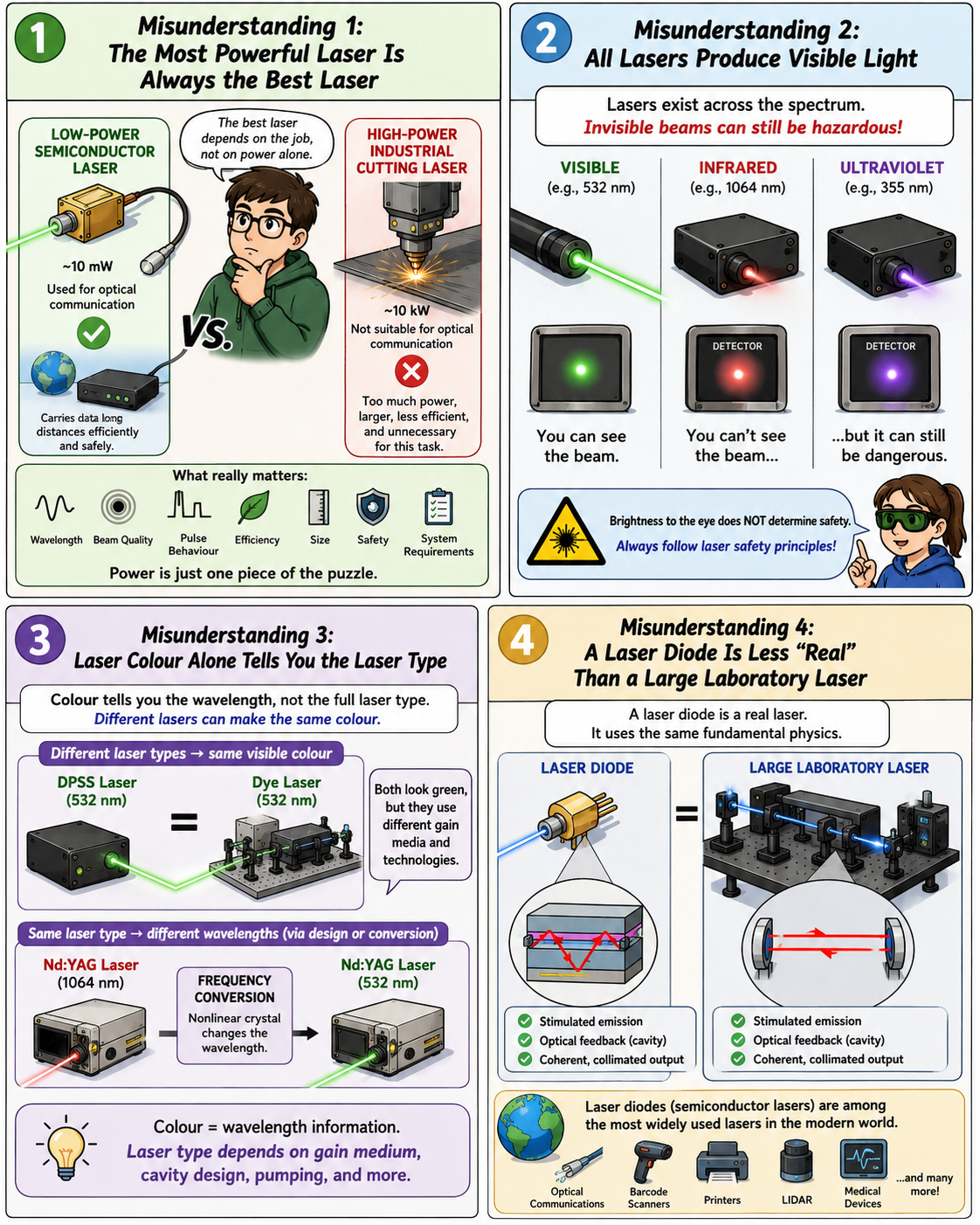
This comic explains that the best laser depends on the job, many lasers are invisible, colour alone does not identify the laser type, and laser diodes are fully real lasers.
This comic-style illustration explains four common misunderstandings about laser types. The first panel shows that the most powerful laser is not always the best one, because wavelength, beam quality, pulse behaviour, efficiency, size, safety, and system needs all matter. The second panel shows that not all lasers produce visible light, since many operate in the infrared or ultraviolet and can still be hazardous even when the beam cannot be seen. The third panel explains that laser colour alone does not identify the laser type, because different laser systems can produce similar visible colours and the same laser type can be modified to produce different wavelengths. The fourth panel shows that a laser diode is a real laser, based on stimulated emission and optical feedback, and highlights its importance in modern communication, scanning, sensing, and everyday technology.
Key Terms
Gas laser
A laser that uses a gas or gas mixture as the gain medium. Examples include helium-neon and carbon dioxide lasers.
Solid-state laser
A laser that uses a solid crystal or glass as the gain medium, often doped with active ions.
Semiconductor laser
A compact laser, also called a laser diode, that uses electronic transitions in semiconductor materials to produce laser light.
Fibre laser
A laser that uses a doped optical fibre as the gain medium. The fibre both guides and amplifies the light.
Dye laser
A laser that uses organic dye molecules, usually in a liquid solution, as the gain medium. Many dye lasers are tunable.
Excimer laser
A laser that uses excited molecular states to produce ultraviolet light. It is often used where short-wavelength precision is needed.
Gain medium
The material in which stimulated emission occurs and light is amplified.
Pumping
The process of supplying energy to the gain medium so that population inversion can be created.
Population inversion
A condition in which more particles occupy an excited state than a lower state involved in the laser transition.
Laser diode
A semiconductor laser that is driven by electric current and commonly used in electronic and communication devices.
Tunable laser
A laser whose output wavelength can be adjusted across a range.
Ultrafast laser
A laser system that produces extremely short pulses, often used in research, precision processing, and high-speed measurement.
Review Questions
What is the gain medium of a laser?
Answer: The gain medium is the material where stimulated emission occurs and light is amplified. It may be a gas, crystal, semiconductor, dye, or doped optical fibre.
How does a gas laser differ from a solid-state laser?
Answer: A gas laser uses a gas or gas mixture as the gain medium, while a solid-state laser uses a solid crystal or glass, often doped with active ions.
Why are semiconductor lasers useful in everyday devices?
Answer: They are compact, efficient, electrically driven, and easy to integrate into electronic systems.
What makes fibre lasers different from many other lasers?
Answer: In a fibre laser, the gain medium is an optical fibre. The fibre guides the light while also amplifying it.
Why are dye lasers useful in spectroscopy?
Answer: Many dye lasers are tunable, meaning their wavelength can be adjusted across a range. This helps scientists study different atomic, molecular, or material transitions.
Why are excimer lasers important in microfabrication?
Answer: Excimer lasers produce ultraviolet light with short wavelength. This allows fine-scale interaction with materials, which is useful in microfabrication and lithography.
Thought-Provoking Questions
Why might a small semiconductor laser have greater social impact than a large high-power laboratory laser?
Answer: A small semiconductor laser can be mass-produced and integrated into communication systems, sensors, scanners, and consumer devices. Its impact comes from widespread use, not from size or power alone.
Why does the same physical principle produce so many different laser technologies?
Answer: Stimulated emission is the shared principle, but different materials, energy levels, pumping methods, cavity designs, and wavelengths lead to very different laser systems.
Why should laser classification include applications and safety, not only physics?
Answer: A laser’s type affects how it interacts with matter, how it is used, and what hazards it may create. Understanding the physics helps students understand both usefulness and risk.
Comprehensive Numerical Problems with Solutions
A semiconductor laser emits light of wavelength 850 nm. Find the photon energy using the quantum parameter formulation, where h = 6.63 × 10⁻³⁴ J s and c = 3.00 × 10⁸ m/s.
Solution:
Convert wavelength to meters: 850 nm = 850 × 10−9 m. Apply the formula:
Answer: The average power during the pulse is exactly 2.0 × 10⁷ W (or 20 MW). This value exists only during the very short pulse duration.
External References for Further Reading
The following references provide useful background for students who want to read beyond this introductory page. They support the basic principles of laser operation, common laser categories, and more advanced photonics vocabulary.
OpenStax University Physics: Lasers — A student-level explanation of stimulated emission, population inversion, and the basic physics behind laser action.
RP Photonics Encyclopedia: Lasers — A detailed reference explaining laser operation, gain media, resonators, and common laser categories.
The study of laser types helps students see how one physical principle can become many different technologies. Stimulated emission is the shared foundation, but the choice of gain medium, pumping method, wavelength, and cavity design creates lasers with very different abilities.
This matters because lasers are not chosen by name alone. A medical laser, an industrial cutting laser, a fibre communication laser, a laboratory spectroscopy laser, and a microfabrication laser must satisfy different physical and engineering requirements. Understanding laser types helps students ask better questions: What wavelength is needed? How much power is required? How should the beam be delivered? What material will absorb the light? What safety controls are necessary?
In this way, laser classification becomes more than a catalogue. It becomes a way of thinking about how physics, materials, design, and purpose meet in real technology.
Summary
Lasers can be classified by their gain medium, including gas, solid-state, semiconductor, fibre, dye, excimer, and specialised advanced systems. Each type uses stimulated emission, but each does so through a different material structure and pumping method.
Gas lasers are useful for stable wavelengths and laboratory demonstrations. Solid-state lasers can produce strong beams and pulses. Semiconductor lasers are compact and central to modern electronics. Fibre lasers are efficient and valuable in manufacturing and communication. Dye lasers are useful when tunability is needed. Excimer lasers provide ultraviolet light for fine-scale applications.
The best laser is not always the most powerful one. It is the laser whose wavelength, beam quality, power, pulse behaviour, size, efficiency, and safety profile match the task.
Reflection Question
If many laser types depend on the same basic principle of stimulated emission, what does this teach us about the relationship between scientific discovery and technological design?