

Reading Between the Lines: Understanding Treaties and Agreements
Diplomatic History – Overview
Establishes the macro-foundations of international relations. Examines how states interact over centuries through negotiation, formal alliances, strategic signaling, and systemic balance-of-power arrangements.
Diplomatic Personalities
Focuses on the human element of statecraft. Explores how individual negotiators, envoys, and leaders shape the specific phrasing, timing, and strategic concessions of treaty drafts.
Military Diplomacy
Investigates the intersection of force and negotiation. Directs analysis toward demilitarized zones, security guarantees, troop caps, and mutual defense clauses embedded in peace accords.
History of Alliances
Traces how formal treaties structure long-term coalition politics, defining binding assistance commitments, deterrence frameworks, and institutionalized security pacts.
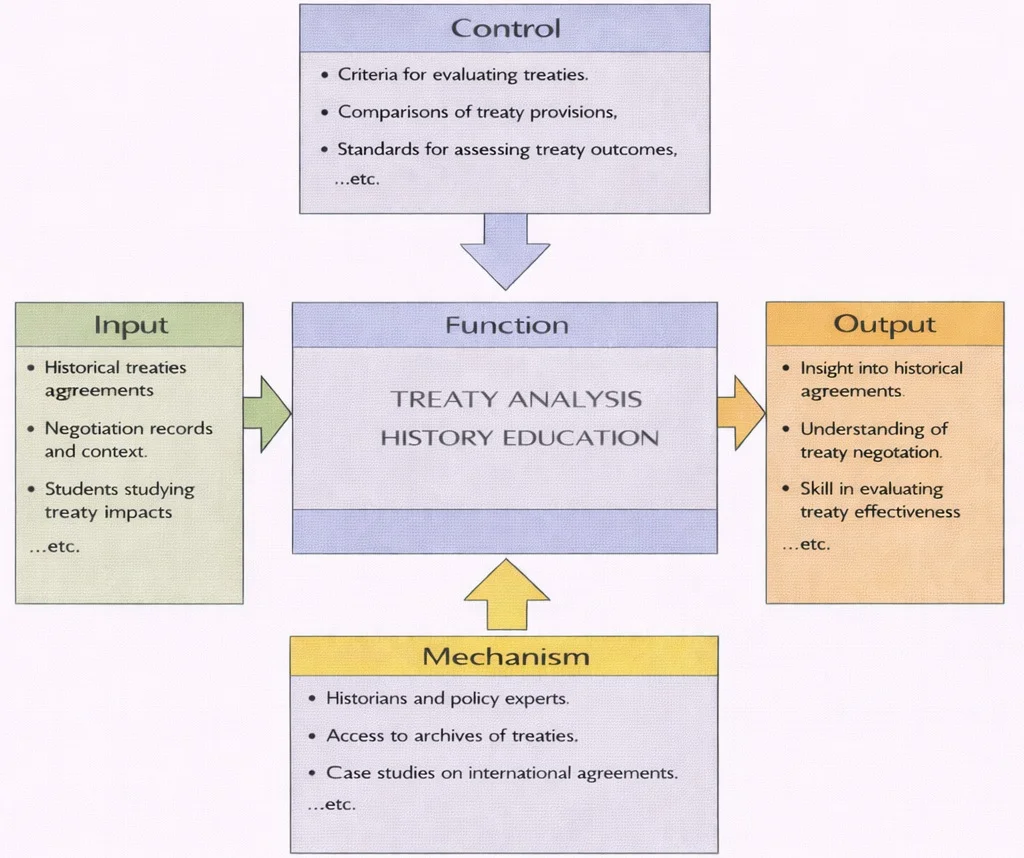
Treaty Analysis (Current Module)
Serves as the core methodical workshop. Provides tools to deconstruct treaties as legal instruments, strategic political bargains, and structural compromises—evaluating text, intent, and enforcement.
Cultural Diplomacy
Examines soft power and norm-building. Details how shared values, cultural exchange, and ideological alignment facilitate goodwill during treaty drafting and ratification.
Economic Diplomacy
Analyzes the material levers of treaty-making. Evaluates commercial pacts, tariff structures, sanctions regimes, and financial reparation clauses within international agreements.
Fundamental Principles Behind Treaty Language and Logic
Definition and Purpose of Treaties
Core Objectives
- Conflict Resolution: Treaties often mark the end of wars and establish terms for peace. For example, the Treaty of Versailles (1919) formally ended World War I.
- Territorial Agreements: Treaties define boundaries and resolve territorial disputes. For example, the Treaty of Tordesillas divided the New World between Spain and Portugal.
- International Cooperation: Treaties facilitate collaboration on global challenges such as trade, environmental protection, and human rights. For example, the Paris Agreement (2015) addresses climate change.
Phases of Treaty Analysis
Negotiation
- Diplomatic Engagement: Negotiations often involve multiple parties balancing their interests. For example, the negotiations leading to the Treaty of Paris (1783) involved the United States, Great Britain, France, and Spain.
- Mediation and Arbitration: Neutral third parties may assist in resolving disputes. For example, the Treaty of Portsmouth (1905) ending the Russo-Japanese War was mediated by U.S. President Theodore Roosevelt.
Drafting and Signing
- Legal Language: Treaties must use precise and unambiguous language to prevent misinterpretation.
- Signatories: Parties involved officially sign the treaty, committing to its terms.
Ratification
- Domestic Approval: Many treaties require legislative or parliamentary approval before they take effect. For example, in the United States, treaties must be ratified by a two-thirds majority in the Senate.
Implementation
- Domestic and International Enforcement: States must incorporate treaty obligations into their legal and administrative systems.
- Monitoring Mechanisms: International organizations or joint commissions often oversee treaty compliance.
Consequences and Revisions
- Long-Term Impact: Treaties can reshape international relations and domestic policies. For example, the Treaty of Tordesillas influenced European colonization patterns for centuries.
Pacts That Shaped the World: Defining Treaty Moments
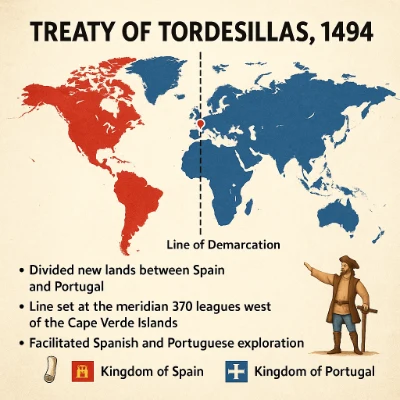
- Treaty of Tordesillas (1494): Iberian powers partition the non-European world—cartography meets canon law, with enduring legacies from Brazil to the Moluccas.
- Peace of Westphalia (1648): Ends the Thirty Years’ War, foregrounding state sovereignty and non-interference—often framed as the birth of the modern international system.
- Treaty of Paris (1783): Confirms U.S. independence and redraws Atlantic power balances, with major implications for Indigenous nations and imperial economies.
- Congress of Vienna – Final Act (1815): Post-Napoleonic settlement that institutionalizes great-power concert, river commissions, and balance-of-power diplomacy.
- General Act of the Berlin Conference (1885): Codifies colonial “effective occupation” in Africa—legalizing partition and setting rules for imperial competition.
- Treaty of Versailles (1919): War-ending terms, mandates, reparations, and the League of Nations—punitive peace or necessary containment?
- Treaty on the Non-Proliferation of Nuclear Weapons – NPT (1968): Bargain among nuclear restraint, peaceful use, and disarmament—verification and equity in tension.
- Paris Agreement (2015): Flexible, “bottom-up” climate treaty—ratcheting ambition, transparency frameworks, and the geopolitics of decarbonization.
Treaty of Tordesillas (1494)
- Context: Signed between Spain and Portugal to divide newly discovered lands outside Europe.
- Terms: Established a demarcation line, granting Spain territories west of the line and Portugal those to the east.
- Impact: Influenced colonial expansion, with Portugal gaining control over Brazil while Spain dominated much of the Americas.
- Critique: Ignored the sovereignty of indigenous peoples, contributing to the exploitation and colonization of non-European societies.
Historical Context & Preludes
- Iberian rivalry: Late-15th-century maritime competition followed Portuguese advances along the African coast and Columbus’s 1492 voyage under the Spanish crown.
- Papal bulls (1493): Alexander VI’s Inter caetera and related decrees attempted to settle claims by drawing an initial line west of the Azores and Cape Verde. Spain favored the arrangement; Portugal protested.
- Diplomatic need: The treaty sought to avoid intra-Catholic war, lock in exclusive spheres for spice, gold, and conversion, and translate papal moral authority into bilateral, enforceable terms.
Parties, Interests & Bargaining Leverage
- Crown of Castile/Aragon (Spain): Validate Columbus’s route, claim western lands, and secure rights before rivals learned of the Atlantic crossing.
- Kingdom of Portugal: Protect the Africa–Indian Ocean strategy, ensure eastern hemisphere priority, and obtain room in the western Atlantic for navigation and landfall.
- Hidden players: The papacy provided moral-legal framing, cartographers and pilots shaped practical measurement, and Indigenous polities—unconsulted but central to the outcomes—bore the consequences.
Key Terms & Legal Mechanics
- The Line: A meridian set 370 leagues west of the Cape Verde Islands. Because a “league” varied, longitude placement was ambiguous in practice.
- West/East allocation: Spain received claims to the west, covering most of the Americas; Portugal received claims to the east, covering Africa, the Indian Ocean, and an Atlantic slice touching future Brazil.
- Jurisdiction: The agreement aimed at newly discovered lands and did not alter European borders.
- Enforcement: Royal licenses, captaincies, patrols, and later treaties helped enforce the arrangement; the Church’s authority gave initial legitimacy, but practical power came from ships, forts, and courts.
Cartography, Science & the “Longitude Problem”
- Instruments & error: Latitude was measurable by stars; longitude at sea was imprecise until much later. Small measurement errors could produce large territorial consequences.
- Map disputes: Competing Iberian “secret” cartography produced overlapping claims; the line’s exact meridian was contested on many voyage tracks.
- Follow-on settlement: The Treaty of Zaragoza (1529) extended a dividing line in the eastern hemisphere to address the Spice Islands, or Moluccas, dispute.
Implementation & Compliance
- Portuguese Brazil: Landfalls along the South American bulge fell on Portugal’s side of the line, enabling sugar, later gold, and plantation economies.
- Spanish America: Vast western claims underpinned viceroyalties such as New Spain, Peru, New Granada, and Río de la Plata, as well as the encomienda system.
- Third-party powers: England, France, and the Dutch Republic rejected papal-bilateral partition; privateering and settlement eroded the Iberian duopoly over the 16th and 17th centuries.
Distributional Effects & Global Impact
- Economic: Iberian monopoly rents on spices, gold, and silver; global bullion flows from places such as Potosí destabilized European prices; the Atlantic slave trade expanded with plantation complexes.
- Cultural–linguistic: Portuguese in Brazil and Spanish across much of the rest of Latin America created a linguistic frontier traceable to the treaty line.
- Geopolitical: The treaty set a precedent for great-power spheres of influence and normalized treaty-based claims to lands without Indigenous consent.
Indigenous Peoples & Ethical Critiques
- Sovereignty erased: The treaty treated inhabited territories as legally “available.” No Indigenous delegation participated, and no existing Indigenous legal order was recognized.
- Labor & land expropriation: Encomienda, bandeirante slaving raids, missionization, epidemics, and demographic collapse followed in different regions.
- Debates then & now: The 16th-century Valladolid debate, involving figures such as Las Casas and Sepúlveda, raised questions about conquest morality; modern scholarship criticizes the papal “doctrines of discovery.”
Design Analysis: Why Did It “Work” for a While?
- Clarity plus power: A simple rule—one meridian—combined with two capable navies created enforceability until other naval powers rose.
- Legitimation: Papal blessing eased domestic acceptance and deterred immediate contestation by Catholic rivals.
- Brittleness: Technical ambiguity over longitude and the exclusion of other powers and peoples generated long-term instability.
Counterfactuals & Alternatives
- If the line was set further west or east: Brazil’s shape—and the language map of the Americas—could have been radically different.
- Multilateralization in 1494: Had England or France been included, piratical erosion and later wars might have been reduced, but Iberian dominance would likely have been diluted sooner.
- Indigenous consent frameworks: A hypothetical recognition regime would have dramatically altered colonization’s speed, scale, and violence.
Primary Sources & Maps
- Papal bull Inter caetera (1493) and the 1494 treaty text in Latin, Portuguese, and Spanish versions.
- Early world maps, including the Cantino planisphere (1502) and Caverio map (1505), illustrating evolving understandings of the line.
- The Treaty of Zaragoza (1529), which addressed the eastern hemisphere counterpart.
Study Prompts & Exam-Style Questions
- Explain how technological limits in measuring longitude shaped the legal effectiveness of Tordesillas. Use one early map to support your answer.
- Compare Tordesillas with a later “spheres” treaty such as Berlin 1885. What similar legal techniques and moral blind spots persist?
- Assess the treaty’s role in producing today’s Portuguese–Spanish linguistic boundary in the Americas. What non-treaty factors reinforced it?
Key Terms
Peace of Westphalia (1648)
- Context: Ended the Thirty Years’ War in the Holy Roman Empire and the Eighty Years’ War between Spain and the Dutch Republic. It was concluded through parallel negotiations at Münster and Osnabrück.
Historical Context & War Drivers
- Religious fragmentation after the Reformation combined with dynastic and territorial rivalries, especially between Habsburg and Bourbon interests, producing devastation across German lands.
- Mercenary warfare, famine, and disease generated catastrophic demographic and economic losses.
Main Parties & Interests
- Holy Roman Emperor and Imperial Estates: Reassert order while conceding local privileges.
- France and Sweden: Weaken Habsburg encirclement and gain territory and guarantor status.
- Spain and Dutch Republic: Settle independence and commerce, with Spain recognizing Dutch independence.
- German princes and cities: Secure legal recognition of autonomy, religious rights, and restitution of properties.
Treaty Set & Legal Mechanics
- Two core instruments: Treaty of Münster and Treaty of Osnabrück/Münster arrangements involving the Empire, France, Sweden, and the Estates.
- Confessional settlement: Confirmed and updated the Peace of Augsburg, recognizing Calvinism alongside Lutheranism and Catholicism.
- Territorial adjustments: Sweden gained Pomeranian territories; France gained Alsace/Lorraine rights; Swiss and Dutch independence received legal recognition.
- Imperial constitution: Estates secured significant rights, including treaty-making with caveats, embedding a negotiated federal order.
- Guarantee clauses: France and Sweden became guarantors, offering an early form of collective enforcement on paper.
Sovereignty & Non-Interference
- The settlement normalized the principle that rulers could settle confessional questions internally, subject to constraints, and that external powers should avoid coercive interference.
- It became an important precedent for diplomatic congresses and multilateral peace architecture in Europe.
Implementation & Compliance
- Restitution of secularized church properties and mixed confessional jurisdictions required local compromises.
- Guarantor enforcement was irregular, and power politics remained decisive, as seen in later wars involving Louis XIV.
Distributional Effects & Impact
- The treaties ended large-scale religious war in central Europe, empowered estates, and confirmed a multipolar structure that encouraged balance-of-power diplomacy.
- They also supported commercial revival in the Dutch Republic and shifted imperial trade and finance networks.
Caveats & Critiques
- “Westphalian sovereignty” is often overstated, since interference and dynastic wars persisted and colonial domains were largely ignored.
- Religious minorities remained vulnerable within local majorities, and peasants saw limited immediate relief.
Counterfactuals
- A harsher imperial victory might have centralized the Empire, while a French or Swedish collapse could have prolonged confessional warfare.
Primary Sources & Study Aids
- Treaty texts from Münster and Osnabrück, Imperial Diet records, and confessional settlement provisions.
Prompts
- How did the treaty’s constitutional changes in the Empire shape later German fragmentation and unification timelines?
- Compare Westphalia’s guarantor model to later collective security arrangements.
Key Terms


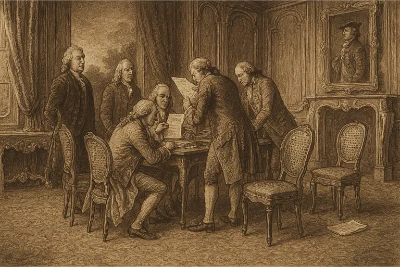
Treaty of Paris (1783)
- Context: Ended the American Revolutionary War and secured British recognition of the independence of the United States.
Geopolitical Setting
- The war had become global, involving North America, the Caribbean, and the Atlantic, with France and Spain seeking to check British power and the Netherlands drawn in.
- British war-weariness and fiscal strain fostered willingness to settle with the American peace commission.
Main Parties & Interests
- United States: Secure independence, generous borders, fishing rights, and debt recognition to reassure European creditors.
- Great Britain: Limit U.S. gains, preserve imperial trade, manage Loyalist claims, and maintain strategic posts.
- France and Spain: Pursue territorial aims, naval prestige, and financial compensation through related treaties.
- Indigenous nations: Excluded from talks despite their central role in the conflict and frontier future.
Key Terms & Legal Mechanics
- Recognition and borders: U.S. borders extended to the Mississippi River, with access to the Great Lakes. Florida returned to Spain in a separate treaty with Britain.
- Fisheries: The United States received rights on the Grand Banks, off Newfoundland, and in the Gulf of St. Lawrence.
- Debts and property: Private debts were to be payable; restoration of Loyalist property was recommended rather than imposed, creating later disputes.
- Prisoners and evacuation: British evacuation of posts was required, though implementation lagged, especially in the Northwest Territory.
Implementation & Compliance
- Boundary commissions mapped complex river systems, while British retention of frontier forts fueled tension until the Jay Treaty (1794).
- Loyalist claims were only partially addressed; many Loyalists emigrated to Canada or Britain, and compensation was uneven.
- Indigenous land cessions accelerated through separate treaties, absent from the Paris text but deeply consequential.
Distributional Effects & Impact
- U.S. sovereignty: International recognition enabled commercial treaties and access to credit.
- Imperial rebalancing: Britain retained naval and commercial strength; France gained prestige but deepened fiscal crisis; Spain expanded in Florida but faced frontier strains.
- Indigenous dispossession: Expansionary borders set the stage for rapid westward settlement and conflict.
Caveats & Critiques
- Ambiguities in the northwestern boundary, weak enforcement on Loyalist property, and omission of Indigenous bargaining rights created persistent instability.
- Peace on paper preceded a decade of frontier violence and diplomatic friction.
Counterfactuals
- A stricter British stance on the Mississippi boundary could have constrained early U.S. expansion and altered Louisiana dynamics.
- Binding Loyalist restitution might have changed domestic U.S. politics and the pace of Anglo-American reconciliation.
Primary Sources & Study Aids
- Treaty text, boundary commission maps, the Jay Treaty (1794), and Loyalist claims records.
Prompts
- Assess how the fisheries clauses reflect mercantilist logics and future maritime disputes.
- Explain the treaty’s indirect role in the fiscal unraveling of Bourbon France.
Key Terms
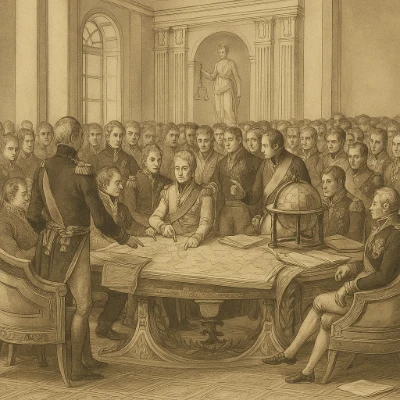
Congress of Vienna – Final Act (1815)
- Context: Post-Napoleonic settlement reordering Europe; sought durable peace through balance of power and great-power concert.
Strategic Aims & Setting
- Undo Napoleonic conquests, contain France, prevent another hegemon, stabilize borders, and manage revolutionary contagion.
- Congresses and informal diplomacy involving figures such as Talleyrand, Metternich, Castlereagh, Hardenberg, and Nesselrode crafted compromises.
Main Parties & Interests
- Austria and Metternich: Conservative order and buffer zones in Italy and the Balkans.
- Britain and Castlereagh: Maritime supremacy, trade routes, colonial gains, and continental balance.
- Russia: Influence in Poland and Finland, status as liberator, and Holy Alliance ideology later.
- Prussia: Territorial consolidation in the Rhineland and a path toward German power.
- France and Talleyrand: Re-entry into great-power diplomacy through the principle of legitimacy.
Key Terms & Institutional Devices
- Territorial settlement: Dutch–Belgian union, Swiss neutrality, replacement of the Holy Roman Empire with the German Confederation, and reconfiguration of Italian states.
- Concert of Europe: Periodic conferences and great-power consultations created a form of collective management.
- Functional regimes: River commissions, especially for the Rhine, addressed navigation; rules on diplomatic precedence shaped protocol.
- France: The Bourbon monarchy was restored, and containment remained relatively moderate despite the Hundred Days.
Implementation & Compliance
- The Concert managed crises such as Greek independence and the Belgian revolution with mixed success; conservative interventionism remained contested.
- River commissions endured as early examples of functional international organization.
Distributional Effects & Long-Run Impact
- The settlement supported relative stability in Europe for roughly 40 years, encouraging diplomatic crisis management rather than general war.
- It unintentionally laid groundwork for later German and Italian unifications through territorial consolidations.
Caveats & Critiques
- The principle of legitimacy privileged dynastic rulers, suppressed popular sovereignty, and largely ignored colonial spheres.
- The Concert struggled with nationalist revolts and liberal movements, and repression generated later upheavals.
Counterfactuals
- A harsher settlement on France might have provoked revanchism sooner, while softer terms might have risked immediate instability.
Primary Sources & Aids
- Final Act, protocols, river commission statutes, and diplomatic correspondence of major plenipotentiaries.
Prompts
- Evaluate the Concert as a governance innovation. What made it durable, and why did it ultimately falter?
- Compare Vienna’s river commissions to modern functional agencies.
Key Terms
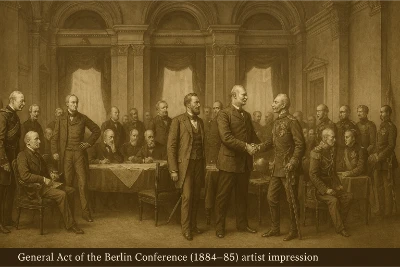
General Act of the Berlin Conference (1885)
- Context: European powers codified rules for African colonization amid the Scramble for Africa.
Setting & Motives
- Commercial access, raw materials, strategic competition, and control of rivers and coasts shaped the conference.
- Humanitarian rhetoric stood alongside imperial practice, as Belgian, French, British, and German ambitions intersected along the Congo and West African coasts.
Main Parties & Interests
- Germany, under Bismarck, acted as convenor; Britain and France were major naval powers; Portugal, Belgium, Italy, Spain, and others attended.
- Notably absent: African polities had no seat at the table.
Key Terms & Doctrines
- Effective occupation: Claims required administrative presence to be recognized, providing legal cover for rapid partition.
- Free trade and navigation: Congo and Niger river basins were declared open for commerce on paper.
- Humanitarian clauses: Pledges against the slave trade were often instrumentalized to justify imperial control.
- Congo Free State: Leopold II’s personal domain was internationally recognized, becoming a site of extreme exploitation.
Implementation & Compliance
- Effective occupation spurred military conquest and boundary-drawing with scant knowledge of local societies.
- River free trade was constrained by de facto monopolies, while humanitarian pledges were routinely violated.
- Boundary commissions drew straight lines that ignored ethnic and linguistic realities, planting seeds for later conflicts.
Distributional Effects & Global Impact
- The act consolidated European imperial rule, extraction economies, forced labor, and demographic and social upheaval.
- Many long-run state borders in Africa trace to colonial demarcations with lasting consequences for governance and conflict.
Caveats & Ethical Critiques
- The agreement legalized dispossession, erased African sovereignty, and used “civilizing” rhetoric to mask commercial coercion and violence.
- Congo atrocities catalyzed early international human rights advocacy, but only after immense harm.
Counterfactuals
- Multilateral protectorates with African representation might have moderated exploitation, though such a path was unlikely given the era’s power asymmetries.
- Without the act, partition likely would have proceeded through bilateral wars, perhaps even more violently.
Primary Sources & Aids
- General Act text, boundary protocols, consular reports, missionary accounts, and later Congo reform movement documents.
Prompts
- Analyze effective occupation as a legal technology. How did it reshape incentives at the frontier?
- Trace a contemporary border dispute to Berlin’s lines. What institutional fixes might mitigate the legacy?
Key Terms
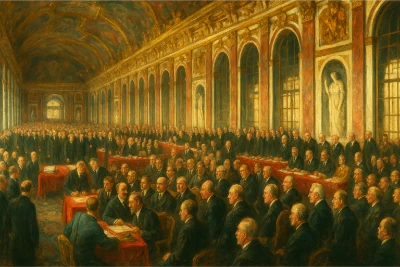
Treaty of Versailles (1919)
- Context: Formally ended World War I with Germany, created the League of Nations, redrew borders, and imposed reparations and disarmament.
Negotiating Environment
- Allied objectives varied: France prioritized security and compensation, Britain sought balance and economic recovery, and the United States promoted Wilsonian principles such as self-determination and the League.
- The German delegation was excluded from early drafting; the gap between armistice expectations and treaty realities fueled resentment.
Key Terms & Architecture
- Territory: Alsace-Lorraine returned to France; the Polish Corridor and Danzig Free City were created; the Saar came under League administration; colonies became mandates.
- Military limits: Germany’s army was capped, and tanks, air force, and militarization of the Rhineland were prohibited.
- Reparations: Liability was established, but sums and schedules remained contentious under the Reparations Commission.
- League of Nations: A collective security framework was created, though U.S. Senate rejection undermined universality.
- War guilt clause: Provided a legal basis for reparations and became symbolically explosive in German politics.
Implementation & Compliance
- Inter-Allied control commissions enforced disarmament, while reparations were repeatedly modified through arrangements such as the Dawes Plan and Young Plan.
- Locarno (1925) eased tensions on western frontiers, but the Great Depression destabilized compliance and politics.
Distributional Effects & Impact
- Short-term effects included border changes, minority issues, economic volatility, and the mandate system, which entrenched imperial oversight under an international veneer.
- Long-term effects included grievances exploited by extremists and failures of collective security, both of which contributed to the road toward World War II.
Caveats & Historiography
- Historians debate whether the terms were punitive or comparatively moderate in relation to alternative demands.
- The structure of enforcement and the absence of the United States from the League arguably mattered more than clause severity alone.
Counterfactuals
- U.S. League membership plus a stable reparations regime might have sustained Weimar moderation longer.
- Earlier revision of eastern borders might have reduced interwar minority crises, though this remains speculative.
Primary Sources & Aids
- Treaty text, Reparations Commission records, League Covenant, Locarno Treaties, and Weimar political debates.
Prompts
- Which mattered more for instability: reparations design or security architecture? Argue with evidence.
- Compare the mandate system to earlier colonial legalities, such as Berlin 1885, in rhetoric and practice.
Key Terms
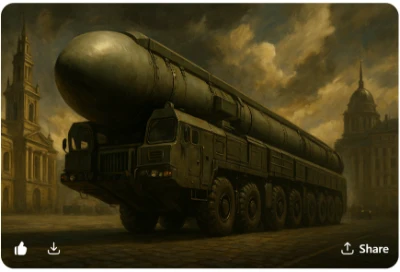
Treaty on the Non-Proliferation of Nuclear Weapons (1968)
- Context: The Cold War arms race spurred a multilateral effort to limit nuclear spread, promote peaceful use, and pursue disarmament.
Bargain Structure: Three Pillars
- Non-proliferation: Non-nuclear-weapon states renounce weapons, while nuclear-weapon states agree not to assist proliferation.
- Peaceful use: States retain access to nuclear technology for energy and medicine under safeguards.
- Disarmament: Article VI commits parties to negotiations toward cessation of the arms race and nuclear disarmament.
Key Terms & Enforcement
- Definitions: Nuclear-weapon states are those that tested before 1 January 1967: the United States, Soviet Union/Russia, United Kingdom, France, and China. Other parties are non-nuclear-weapon states.
- IAEA safeguards: Verification occurs through inspections and material accountancy; later Additional Protocol arrangements expanded access.
- Export controls: Supplier groups coordinate restrictions on technology transfer.
- Withdrawal clause: Article X provides a right of withdrawal with notice, a rare but consequential provision.
Implementation & Compliance
- Extensive accession made the treaty broad, while cases of non-compliance spurred sanctions and diplomacy.
- Nuclear-weapon-state disarmament progress has been uneven, and bilateral arms control outside the NPT architecture has remained pivotal.
- Non-parties and withdrawals challenge universality and regional security dynamics.
Efficacy & Distributional Effects
- The NPT limited the number of nuclear-armed states relative to feared projections in the 1960s.
- It created technology access pathways but also intensified debates about equity between nuclear haves and have-nots.
- Regional security complexes in the Middle East, South Asia, and Northeast Asia remain fragile.
Caveats & Critiques
- Perceived slow disarmament under Article VI undermines legitimacy.
- The peaceful-use pillar creates tension because enrichment and reprocessing can shorten breakout timelines.
- Export control disparities and technology-denial concerns remain important for developing states.
Counterfactuals
- A world without the NPT likely would have seen many more nuclear-armed states and much worse crisis stability.
- A stronger verification regime from the start might have prevented violations, but may also have discouraged early accessions.
Primary Sources & Aids
- Treaty text, IAEA safeguards agreements, Review Conference outcome documents, and export control guidelines.
Prompts
- Is the NPT’s inequitable structure a necessary bargain or a design flaw? Propose politically realistic reforms.
- Assess the role of verification innovations versus security guarantees in preventing proliferation.
Key Terms
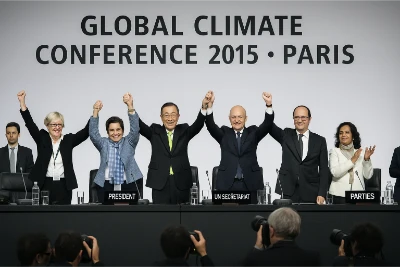
Paris Agreement (2015)
- Context: Landmark climate treaty under the UNFCCC aiming to limit global temperature rise to well below 2°C while pursuing efforts toward 1.5°C.
Design Philosophy: Bottom-Up with Common Rules
- Nationally Determined Contributions: Each party submits its own targets and policies, providing flexibility to secure universal participation.
- Ratcheting mechanism: Five-year cycles are used to enhance ambition, with the global stocktake informing updates.
- Transparency framework: Common reporting and verification rules, with flexibility for capacity, aim to build trust and comparability.
Key Provisions
- Mitigation: Long-term low-greenhouse-gas strategies, peaking emissions as soon as possible, and balancing sources and sinks in the second half of the century.
- Adaptation: National adaptation plans, resilience building, and adaptation communications.
- Finance: Developed countries are expected to provide and support finance flows, with broader mobilization goals connected to the agreement.
- Loss & Damage: Recognition through the Warsaw International Mechanism, though liability and compensation remain politically sensitive.
- Cooperative approaches: Article 6 provides for carbon markets and non-market cooperation with accounting safeguards to prevent double counting.
Implementation & Compliance
- The Enhanced Transparency Framework uses common tables and expert review, while global stocktakes occur at five-year intervals.
- A non-punitive compliance committee focuses on facilitation and capacity rather than sanctions, reflecting a consensus choice to keep parties engaged.
- Sub-national and private actors, including cities and companies, play pivotal roles in polycentric climate governance beyond states.
Efficacy, Equity & Politics
- Aggregate national pledges remain insufficient for 1.5°C, and ratchet success depends on finance, technology diffusion, and domestic politics.
- Equity disputes involve historical responsibility, current and future emissions, and just transitions for workers and regions.
- Clean technology, critical minerals, supply chains, and border adjustments have become part of climate-related trade diplomacy.
Caveats & Critiques
- Voluntary ambition risks free-riding; transparency helps but cannot compel stronger targets.
- Finance credibility gaps undermine trust, and offset accounting under Article 6 remains vulnerable to integrity problems.
Counterfactuals
- A top-down Kyoto-style binding target for all parties likely would have failed politically; Paris trades legal bite for breadth and durability.
- Stronger Article 6 safeguards from the start might have improved integrity but slowed consensus.
Primary Sources & Aids
- Paris Agreement text, NDC registry, global stocktake outcomes, and IPCC assessments as scientific underpinning.
Prompts
- Design a credible ratchet pathway for a major emitter that aligns with 1.5°C and domestic political constraints.
- Evaluate Article 6 risks and propose guardrails to prevent greenwashing while enabling cooperation.
Key Terms
Themes in Treaty Analysis
Power Dynamics
- Treaties often reflect the power imbalance between negotiating parties.
- Example: The Treaty of Nanking (1842) imposed unequal terms on China after its defeat in the First Opium War.
Sovereignty and Autonomy
- Treaties can strengthen or undermine state sovereignty.
- Example: The Treaty of Waitangi (1840) between Britain and Māori chiefs in New Zealand remains contentious, with debates over its interpretation and implementation.
Regional and Global Impacts
- Treaties often have far-reaching consequences beyond their immediate terms.
- Example: The North American Free Trade Agreement reshaped trade dynamics across North America.
Challenges in Treaty Negotiation and Implementation
Complexity of Multilateral Agreements
- Multilateral treaties often involve diverse interests, making consensus difficult.
- Example: The Kyoto Protocol faced challenges due to varying commitments among developed and developing nations.
Non-Compliance
- States may fail to fulfill treaty obligations due to domestic or external pressures.
- Example: Some signatories of the Nuclear Non-Proliferation Treaty have been accused of violating its terms.
Lack of Enforcement Mechanisms
- Many treaties rely on voluntary compliance, limiting their effectiveness.
- Example: The League of Nations failed to prevent aggression by Axis powers before World War II.
Reading Between the Lines: Practical Uses of Treaty Interpretation
Conflict Resolution
- Treaties are essential tools for ending conflicts and establishing frameworks for peace.
- Example: The Good Friday Agreement (1998) brought peace to Northern Ireland after decades of conflict.
Environmental Protection
- International treaties address global challenges such as climate change and biodiversity loss.
- Example: The Montreal Protocol (1987) successfully reduced ozone-depleting substances.
Trade and Economic Development
- Trade agreements facilitate economic integration and growth.
- Example: The European Union’s foundational treaties established a single market and customs union.
Why Treaties Matter: Decoding the Frameworks of Peace and Power
Understanding the Legal Foundations of International Relations
Exploring the Structure, Language, and Interpretation of Treaties
Analyzing Historic and Contemporary Agreements
Recognizing the Role of Treaties in Conflict Prevention and Cooperation
Preparing for Academic and Professional Paths in Law, Diplomacy, and Policy
Beyond the Agreement: Last Reflections on Treaty Function
Interactive Case Studies & Legal Toggles
Click on each scenario below to expand the legal analysis and historical rationale.
Case Study 1: Why did the Treaty of Tordesillas fail to exclude non-Iberian powers long-term?
Case Study 2: How did the Peace of Westphalia re-conceptualize international law?
Case Study 3: What made the Paris Agreement’s structure different from the Kyoto Protocol?
Frequently Asked Questions
What is treaty analysis?
Treaty analysis is the systematic study of international agreements to understand their language, context, negotiation history, implementation, and impact. It combines legal interpretation with historical and political analysis to see how treaties are made, how they function, and how they reshape relations between states and other actors.
Why is treaty analysis important in diplomatic history?
Treaties are key products of diplomacy, often marking turning points such as the end of wars, the creation of alliances, or the establishment of international organisations. Treaty analysis helps explain why agreements took the form they did, whose interests they served, and how they influenced later conflicts, cooperation, and legal norms.
What are the main elements examined in treaty analysis?
Treaty analysis usually considers the treaty text, the historical context of negotiation, the parties involved, their relative power, the drafting process, reservations and protocols, mechanisms for enforcement or dispute settlement, and how the agreement has been interpreted and applied over time by courts, governments, and international bodies.
How do power relations shape the content of treaties?
Powerful states often have more leverage in setting agendas, drafting clauses, and enforcing compliance, which can tilt treaties in their favour. However, weaker states, coalitions, and non-state actors can still influence outcomes through bargaining, norm-based arguments, issue linkage, and strategic use of international institutions in the negotiation process.
How is analysing a bilateral treaty different from analysing a multilateral treaty?
Bilateral treaties primarily reflect the interests and compromises of two parties, making their dynamics more focused but sometimes more asymmetrical. Multilateral treaties involve many actors with diverse preferences, require complex drafting, and often create general rules or institutions. Treaty analysis compares how bargaining, coalition-building, and enforcement differ across these formats.
Why does treaty analysis pay attention to implementation and compliance?
A treaty’s significance depends not just on what is written, but on how far its provisions are implemented in practice. Treaty analysis asks whether parties change laws, policies, and behaviour, what monitoring and enforcement mechanisms exist, and how disputes over non-compliance are handled, revealing gaps between formal commitments and real outcomes.
What kinds of sources are used to study treaties historically?
Historians examine treaty texts, preparatory works and draft versions, diplomatic correspondence, minutes of conferences, legal opinions, parliamentary debates, memoirs of negotiators, and court decisions. These sources help reconstruct negotiation strategies, hidden trade-offs, contested meanings, and the evolving interpretation of treaty obligations.
How do legal interpretation and historical context work together in treaty analysis?
Legal interpretation focuses on the wording, structure, and agreed rules for reading treaties, while historical context explains why certain phrases were chosen and how contemporaries understood them. Combining both approaches helps avoid reading today’s assumptions into past texts and clarifies how meaning may have shifted over time.
What challenges commonly arise when interpreting treaties?
Common challenges include vague or ambiguous language, conflicting provisions, translation issues, secret clauses, and changing circumstances not anticipated by drafters. Treaty analysis must also consider that different parties may have had divergent expectations, leading to later disputes about the true meaning of key terms.
How does treaty analysis connect to broader themes in diplomatic and international history?
Treaty analysis connects legal texts with larger themes such as empire, decolonisation, human rights, economic globalisation, alliance politics, and institutional design. It shows how treaties both reflect and reshape power structures, ideologies, and economic interests across different periods of international history.
What skills can students gain from learning how to analyse treaties?
Students develop skills in close reading, legal reasoning, historical contextualisation, and critical evaluation of sources. They learn to dissect complex documents, trace negotiations, and assess the real-world effects of international agreements, preparing them for advanced study in history, law, international relations, and policy work.
How can this Treaty Analysis page be used with other Prep4Uni resources?
Learners can link this Treaty Analysis page with materials on diplomatic history, the history of alliances, economic diplomacy, international law, and specific regional or thematic case studies. Exploring these resources together helps students see how detailed treaty work fits into wider narratives of conflict, cooperation, and institutional change.
Treaty Mastery & Analytical Practice Module
Section 1: Foundational Concept Checks
-
What is treaty analysis and why is it important in diplomatic history?
Answer: Treaty analysis is the systematic study of the formation, content, and impact of international agreements, which are central to diplomatic history. It examines the negotiation processes, language, and implementation of treaties, shedding light on how states articulate and secure their interests. This analytical approach reveals the underlying power dynamics and legal principles that guide international relations. Understanding treaty analysis is crucial as it helps explain the evolution of global diplomacy and the development of international law. -
How do treaties serve as tools for conflict resolution in international relations?
Answer: Treaties serve as essential tools for conflict resolution by formalizing agreements that resolve disputes between nations through peaceful means. They establish clear rules and mechanisms for cooperation and conflict management, reducing the potential for misunderstandings and hostilities. Through treaties, states can commit to mutual security arrangements and economic partnerships that promote stability and prevent future conflicts. This process of negotiated compromise and legally binding commitments plays a pivotal role in maintaining global peace and fostering international cooperation. -
What factors influence the negotiation and formulation of treaties?
Answer: The negotiation and formulation of treaties are influenced by political interests, economic conditions, cultural differences, and power asymmetries between nations. Diplomatic negotiations often reflect the strategic priorities of the parties involved, with each side seeking to maximize its benefits while mitigating risks. Historical context and external pressures, such as regional conflicts or global economic trends, also shape the substance and tone of treaty negotiations. These factors collectively determine the effectiveness and longevity of the resulting agreements. -
How do historians use treaty analysis to understand shifts in international power?
Answer: Historians use treaty analysis to understand shifts in international power by examining how the terms and enforcement of treaties reflect changes in geopolitical dynamics over time. Analyzing treaties allows scholars to track the rise and fall of empires, the emergence of new alliances, and the rebalancing of global power structures. Treaties often serve as markers of political transitions, revealing how diplomatic strategies have evolved to address changing economic, military, and cultural circumstances. -
In what ways can treaty language reveal the intentions and priorities of negotiating parties?
Answer: Treaty language is a key indicator of the intentions and priorities of negotiating parties, as the precise wording reflects the compromises and strategic interests underlying the agreement. Diplomatic negotiators carefully craft language to balance conflicting objectives, signal commitment, and manage future disputes. Specific terms, clauses, and exceptions often reveal the relative bargaining power of each side and the issues deemed most critical to their national interests. -
How does treaty analysis contribute to our understanding of international legal frameworks?
Answer: Treaty analysis contributes to our understanding of international legal frameworks by showing how binding agreements shape the norms and rules that govern state behavior. Treaties form the backbone of international law, setting standards for trade, human rights, environmental protection, and security. Through detailed analysis of treaty provisions and implementation, scholars can see how international legal principles evolve and influence global governance. -
What challenges do scholars face when interpreting historical treaties?
Answer: Scholars face challenges such as language ambiguities, incomplete archival records, and differing cultural contexts that influence the meaning of treaty provisions. Variations in legal terminology over time can complicate efforts to understand original intent. Treaties are also products of their historical and political context, requiring careful analysis to separate symbolic language from legally binding commitments. -
How can treaty analysis reveal the evolution of diplomatic negotiation techniques?
Answer: Treaty analysis reveals the evolution of diplomatic negotiation techniques by tracing changes in the methods, language, and strategies used in international agreements over time. Comparing treaties from different historical periods helps scholars identify shifts from informal personal diplomacy to formal, institutionalized negotiations. This evolution reflects broader changes in international relations, including the development of multilateral institutions and the increasing complexity of global challenges. -
How do economic considerations manifest in the language and content of treaties?
Answer: Economic considerations appear in treaty provisions related to trade, investment, resource allocation, and financial cooperation. Treaty language may address tariffs, quotas, regulatory measures, or dispute resolution mechanisms designed to protect economic interests. Analyzing these clauses shows how economic power influences international relations and how states seek mutual benefits through diplomatic negotiation. -
How might the study of treaty analysis inform contemporary diplomatic strategies and international policymaking?
Answer: Treaty analysis informs contemporary diplomacy by offering lessons on effective negotiation, compromise, clarity, transparency, and implementation. By understanding the successes and failures of historical treaties, diplomats can design agreements that better address current global challenges such as trade disputes, environmental issues, and security concerns. The insights gained from treaty analysis help shape policies that promote stability, cooperation, and durable international commitments.
Section 2: Analytical & Scenario-Based Inquiries
-
How might emerging digital technologies revolutionize the way treaties are negotiated and implemented in international diplomacy?
Answer: Emerging digital technologies, such as blockchain and artificial intelligence, could transform treaty negotiation and implementation by enhancing transparency, efficiency, and trust. Blockchain could provide a secure, decentralized ledger for recording negotiations, amendments, and commitments, reducing disputes over interpretation. Artificial intelligence could analyze large datasets, identify areas of compromise, and model likely outcomes under different negotiation strategies. Digital tools can also support real-time collaboration among diplomats, allowing faster decision-making and more agile responses to changing geopolitical dynamics. -
How can comparative treaty analysis help in understanding the evolution of international legal norms?
Answer: Comparative treaty analysis helps students trace how different agreements across periods and regions have addressed similar issues. By comparing treaties, scholars can observe the development of principles such as sovereignty, non-intervention, human rights, and environmental responsibility. These comparisons reveal that international law is not fixed; it changes through negotiation, crisis, and adaptation. This approach also highlights the relationship between domestic legal traditions and international norms. -
How might the historical context of treaty negotiations influence contemporary diplomatic practices?
Answer: Historical context provides lessons about timing, compromise, power dynamics, mediation, and conflict resolution. Past treaty negotiations often occurred under intense geopolitical pressure, requiring diplomats to balance immediate needs with long-term stability. Studying these contexts helps modern negotiators understand how earlier diplomats overcame deadlock or failed to prevent future conflict. Contemporary diplomats can adapt historical lessons to modern trade, environmental, or security negotiations. -
How can treaty analysis be used to evaluate the effectiveness of international conflict resolution mechanisms?
Answer: Treaty analysis evaluates conflict resolution by examining the terms, implementation, and long-term impacts of agreements intended to end disputes. It asks whether a treaty addressed the causes of conflict, created workable enforcement mechanisms, and provided procedures for handling future disagreements. This reveals whether the agreement produced genuine peace or merely paused conflict. Comparing different treaties can identify best practices and recurring weaknesses. -
How might economic incentives be used as a diplomatic tool in treaty negotiations?
Answer: Economic incentives can encourage cooperation by offering tangible benefits such as favorable trade terms, investment access, financial aid, or development support. These incentives can reduce the perceived costs of agreement and create mutually beneficial outcomes. In treaty design, economic clauses may link benefits to compliance, aligning diplomatic goals with material interests. Historical examples show that economic diplomacy can transform contentious negotiations into durable partnerships. -
How can interdisciplinary research enhance our understanding of the negotiation processes behind major treaties?
Answer: Interdisciplinary research combines history, political science, economics, psychology, and law to examine treaty negotiation from multiple angles. This approach captures not only formal legal clauses but also economic interests, political pressures, negotiation behavior, institutional constraints, and public opinion. It provides a richer picture of why certain compromises became possible and guides future diplomacy by identifying conditions that support successful bargaining. -
How might emerging global issues, such as cybersecurity and climate change, influence the content and focus of future treaties?
Answer: Emerging global issues such as cybersecurity and climate change require new legal frameworks because they cross borders and cannot be solved by one state alone. Cybersecurity treaties need to establish norms for state behavior in cyberspace, information sharing, and cyber defense. Climate treaties must address emissions, renewable energy, adaptation, and finance. Future treaty-making will require stronger monitoring systems and greater technical cooperation. -
How can the study of treaty language help us understand the priorities and power dynamics among negotiating nations?
Answer: Treaty language reveals priorities through specific wording, exceptions, definitions, and enforcement clauses. What is included, softened, omitted, or left ambiguous often reflects bargaining power and strategic compromise. Stronger states may shape obligations in their favor, while weaker states may seek protection through precise language or coalition-building. Comparing treaty language across time traces shifts in international norms. -
How might cultural differences among nations influence the negotiation and drafting of treaties?
Answer: Cultural differences shape communication styles, negotiation expectations, legal assumptions, and the meaning attached to formal commitments. Some diplomatic cultures value consensus and long-term relationship-building, while others emphasize explicit safeguards and narrow legal precision. Cultural awareness helps prevent misunderstanding and supports more durable agreements. -
How can economic considerations be effectively integrated into treaty negotiations to ensure mutual benefits for all parties?
Answer: Economic considerations can be integrated through clauses on trade, investment, intellectual property, development finance, and dispute settlement. Negotiators can use economic data and impact assessments to design terms that distribute benefits fairly and reduce risks. Effective integration requires technical expertise and transparent, measurable enforcement.
Section 3: Numerical Problems & Quantitative Treaty Modeling
-
Problem 1 (Longitude Boundary Offset): Under the Treaty of Tordesillas (1494), the demarcation line was established at 370 leagues west of the Cape Verde Islands. Assuming 1 maritime league ≈ 5.556 km, calculate the total distance in kilometers of the meridian west of Cape Verde. If a cartographer mistakenly used the older Papal Bull baseline of 100 leagues, calculate the territorial gap (in km) introduced by the negotiation shift.
Solution:
Step 1: Calculate distance for 370 leagues: D1494 = 370 × 5.556 km = 2,055.72 km.
Step 2: Calculate distance for 100 leagues: D1493 = 100 × 5.556 km = 555.60 km.
Step 3: Calculate the shift gap: ΔD = 2,055.72 km – 555.60 km = 1,500.12 km.
Result: The 1494 treaty shifted the line 1,500.12 km further west, granting Portugal rights to the eastern bulge of South America (Brazil). -
Problem 2 (Reparations Depreciation Model): Under a hypothetical postwar treaty, State A is assessed a total reparation bill of R0 = 132 billion gold marks. The treaty mandates an annual payment of 2 billion gold marks with a fixed interest rate of r = 3% per annum on the remaining balance. Calculate the interest accrued in Year 1 and the principal remaining after the first annual payment.
Solution:
Step 1: Calculate Year 1 interest: I1 = R0 × r = 132 × 0.03 = 3.96 billion gold marks.
Step 2: Add interest to balance: Rtotal = 132 + 3.96 = 135.96 billion gold marks.
Step 3: Subtract annual payment of 2 billion: Rend = 135.96 – 2.00 = 133.96 billion gold marks.
Result: Because the payment (2B) is less than accrued interest (3.96B), the debt balance increases to 133.96 billion gold marks, demonstrating how unsustainable debt structures lead to economic default. -
Problem 3 (Climate Ratchet Ambition Model): State B submits an initial Nationally Determined Contribution (NDC) under the Paris Agreement to emit E0 = 500 million metric tons (Mt) of CO2 per year. The treaty requires a 5-year ratchet cycle with a target reduction of 12% per cycle. Calculate the projected emissions limit for State B at Cycle 1 (5 years) and Cycle 2 (10 years).
Solution:
Step 1: Calculate Cycle 1 emissions (Year 5): E1 = E0 × (1 – 0.12) = 500 × 0.88 = 440 Mt CO2.
Step 2: Calculate Cycle 2 emissions (Year 10): E2 = E1 × (1 – 0.12) = 440 × 0.88 = 387.2 Mt CO2.
Result: State B’s emission target drops to 440 Mt CO2 at Year 5 and 387.2 Mt CO2 at Year 10. -
Problem 4 (Nuclear Breakout Time Calculation): A non-nuclear state operates N = 1,500 centrifuges. Converting low-enriched uranium (LEU) to weapons-grade highly enriched uranium (HEU) requires 5,000 Separative Work Units (SWU). If each centrifuge produces 2.5 SWU per year, calculate the total SWU produced per year and the estimated breakout time in months.
Solution:
Step 1: Total annual SWU capacity = N × 2.5 = 1,500 × 2.5 = 3,750 SWU/year.
Step 2: Time in years to reach 5,000 SWU = 5,000 / 3,750 = 1.333 years.
Step 3: Convert to months = 1.333 × 12 ≈ 16 months.
Result: The theoretical breakout time to produce sufficient HEU for one weapon is 16 months. -
Problem 5 (Treaty Voting Thresholds): In a 193-member multilateral assembly, ratifying an amendment requires a supermajority of two-thirds of all member states. If 180 states attend the session and 125 vote in favor, determine if the amendment passes the legal threshold. Calculate the exact minimum number of affirmative votes needed among all 193 members.
Solution:
Step 1: Calculate required votes from total membership: Vreq = (2/3) × 193 = 128.67 → ceiling = 129 votes.
Step 2: Compare actual votes (125) to required threshold (129).
Result: With 125 votes in favor, the amendment fails by 4 votes, as 129 affirmative votes are required for ratification under the two-thirds total membership rule. -
Problem 6 (Tariff Reduction Formula in Trade Treaties): A commercial treaty mandates a linear tariff reduction from an initial rate of T0 = 25% down to Tfinal = 5% over a period of t = 8 years. Calculate the annual percentage point reduction and the tariff rate at Year 5.
Solution:
Step 1: Total reduction needed = 25% – 5% = 20 percentage points.
Step 2: Annual reduction rate = 20% / 8 years = 2.5 percentage points per year.
Step 3: Tariff rate at Year 5 = T0 – (5 × 2.5%) = 25% – 12.5% = 12.5%.
Result: The tariff decreases by 2.5% annually, reaching 12.5% at Year 5. -
Problem 7 (Territorial Partition Ratio): Under a bilateral boundary agreement, a disputed border region of 45,000 square kilometers is divided between Nation X and Nation Y in a ratio of 3:2 based on historical garrison control. Calculate the land area allocated to each nation.
Solution:
Step 1: Total ratio parts = 3 + 2 = 5 parts.
Step 2: Value per part = 45,000 / 5 = 9,000 km2.
Step 3: Nation X allocation = 3 × 9,000 = 27,000 km2.
Step 4: Nation Y allocation = 2 × 9,000 = 18,000 km2.
Result: Nation X receives 27,000 km2 and Nation Y receives 18,000 km2.