
Laser optics is the study of how light can be generated, organised, shaped, directed, focused, and used with unusual precision. A laser is not merely a bright light source. It is a carefully designed optical system that produces light with special properties such as coherence, narrow wavelength range, low divergence, and strong focusability.
This hub introduces the main ideas behind lasers and guides students toward deeper pages on laser generation, beam behaviour, laser types, real-world applications, defence-related uses, and safety. It sits within the wider study of Light and Optics, while also drawing on ideas from Electromagnetic Waves, Wave Optics, and Quantum Physics.
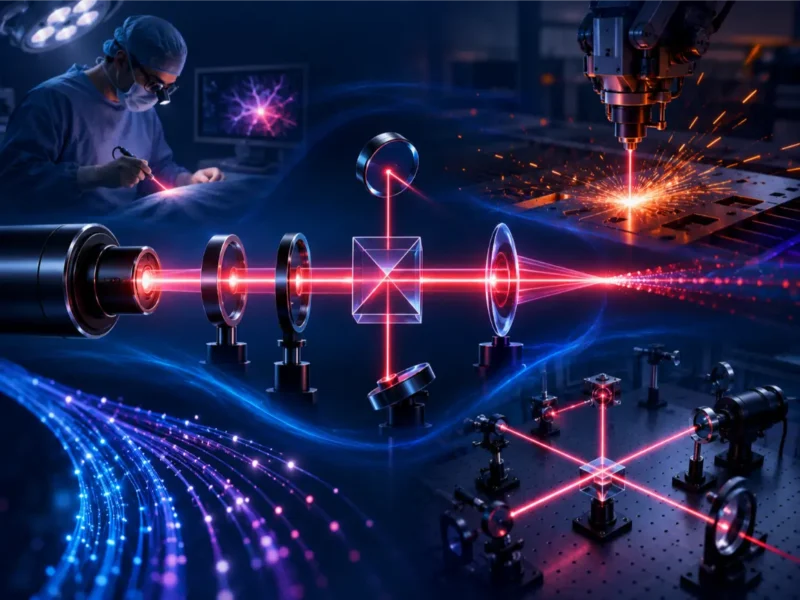
This artist’s impression presents laser optics as the science of controlled light. A bright coherent beam passes through lenses, mirrors, and beam-splitting optics, suggesting how lasers can be shaped and directed with precision. Around the central optical pathway, the image evokes several major applications: medical laser use, industrial laser processing, fibre-optic communication, and laboratory-based optical research. The scene helps students see laser optics not as a single device, but as a field connecting quantum physics, wave optics, engineering design, safety, and real-world technology.
What Laser Optics Really Is
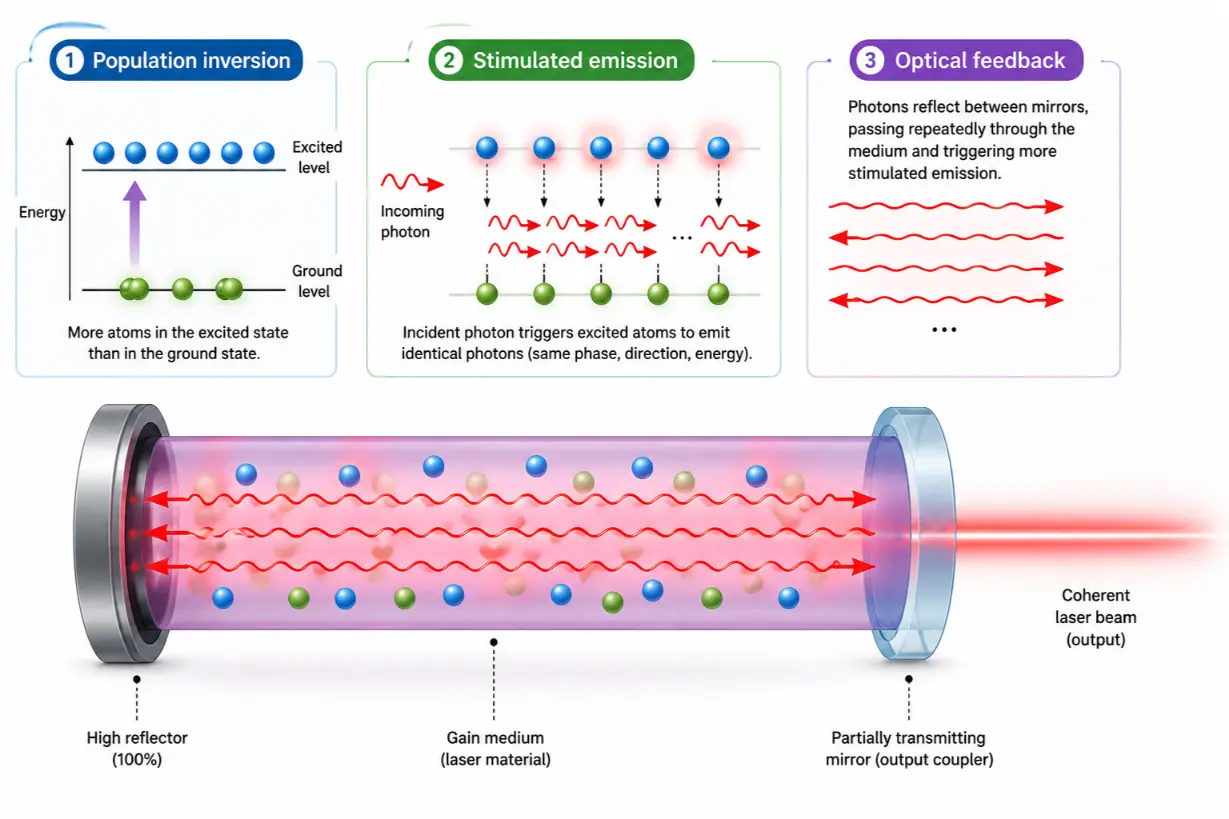
At its heart, laser optics is about controlled light. Ordinary light sources usually emit waves in many directions, with many wavelengths, and with little coordination between one wave and another. A laser, by contrast, uses stimulated emission, population inversion, and optical feedback to produce light that is far more organised.
This organisation is what makes lasers so valuable. A laser beam can be sent through an optical fibre, focused onto a tiny surgical region, used to cut metal, measure distance, scan a surface, read information, or probe the structure of matter. The same beam can be gentle enough for communication or intense enough for industrial processing, depending on its wavelength, power, pulse duration, and focusing conditions.
Students should therefore avoid thinking of lasers as a single device. Laser optics is a family of ideas connecting quantum transitions, optical cavities, wave behaviour, beam control, materials, electronics, safety, and applications. It is one of the clearest examples of how abstract physics becomes practical technology.
The Chronology of Lasers: History, Core Hurdles, and Future Frontiers
The journey of laser optics illustrates how theoretical quantum mechanics evolved into an indispensable foundation of modern industrial engineering.
The Historical Journey
The foundational physics of laser light was born in 1917 when Albert Einstein proposed the concept of stimulated emission in his paper On the Quantum Theory of Radiation. Decades passed before this concept moved from paper to reality. In 1954, Charles Townes and his colleagues developed the MASER (Microwave Amplification by Stimulated Emission of Radiation).
The optical transition occurred in May 1960 when Theodore Maiman constructed the first operational optical laser at Hughes Research Laboratories, using a flashlamp-pumped synthetic ruby crystal to emit a brief flash of red light at a wavelength of exactly 694.3 nm. Shortly after, the Helium-Neon (He-Ne) gas laser was invented, producing the continuous-wave red beam at 632.8 nm that became a staple of physics classrooms worldwide.
Contemporary Scientific Challenges
Modern laser design faces severe performance constraints when scaling to ultra-high powers or ultra-short pulse durations. As a laser beam travels through its own gain medium or out-coupling mirrors, small absorption fractions generate thermal gradients. These temperature differences distort the material’s index of refraction, creating a phenomenon known as thermal lensing that warps the beam path and degrades focus.
Furthermore, in high-intensity systems, the electric field of the light alters the properties of the transmissive optics. This triggers non-linear self-focusing effects that can cause optical coatings to split or crack, requiring specialized vacuum transport and complex cooling networks.
Future Frontiers: Attosecond Physics and Metamaterial Cavities
The frontier of laser science is expanding along two cutting-edge paths:
- Attosecond Pulse Generation: By utilizing high-harmonic generation in gases, scientists can compress laser bursts into durations measured in attoseconds (1 as = 10−18 s). This capability allows researchers to capture real-time, freeze-frame images of electrons shifting inside chemical bonds.
- Photonic Crystal and Topological Cavities: Engineers are fabricating microscopic, sub-wavelength optical cavities that lock photons into robust topological pathways. These structures eliminate scattering losses from material defects, opening the door for ultra-low-threshold micro-lasers directly integrated onto silicon computer architectures.
How the Main Ideas Connect
Laser optics begins with the question of how light is produced. In a laser medium, atoms, ions, molecules, or semiconductor electrons are placed in excited energy states. Under the right conditions, incoming photons stimulate these excited particles to emit matching photons. This process, called stimulated emission, is the foundation of laser action.
The next question is how this light becomes a beam. Optical cavities, mirrors, gain media, and feedback structures select and amplify particular wave patterns. These choices affect the beam’s coherence, directionality, divergence, wavelength, and focusability. The resulting beam properties determine whether a laser is suitable for communication, medicine, manufacturing, defence, sensing, research, or teaching demonstrations.
Laser optics also connects naturally to Geometrical Optics, because lenses and mirrors shape laser beams; to Fiber Optics, because many communication systems use lasers as light sources; and to Photonics, where light becomes a tool for information, sensing, imaging, and advanced technology.
The Mathematical Backbone of Laser Cavities
For a laser to operate continuously, the gain medium must amplify the light enough to overcome all internal losses, such as absorption, scattering, and output transmission. This requirement is defined by the Laser Threshold Condition. For a resonant cavity of physical length L, bounded by mirrors with reflectivities R1 and R2, the minimum threshold gain coefficient (gth) per unit length is formulated as:
$$g_{\text{th}} = \alpha + \frac{1}{2L} \ln\left(\frac{1}{R_1 R_2}\right)$$
Here, α represents the internal distributed loss coefficient due to material scattering and background absorption. Furthermore, to form a stable standing wave pattern inside the cavity, the round-trip distance must equal an integer multiple of the laser wavelength, dictating the discrete resonant longitudinal cavity modes:
$$\nu_m = m \cdot \frac{c}{2nL}$$
Here, νm is the mode frequency, m is a large integer, c is the speed of light in vacuum, and n is the refractive index of the medium.
Rigorous Technical Worked Example
Problem: A solid-state Nd:YAG laser cavity has a physical length of 10 cm (L = 0.1 m) and an internal distributed loss coefficient (α) of 0.02 m−1. The back reflector mirror has a reflectivity R1 = 1.00 (100%), while the front output coupler mirror has a reflectivity R2 = 0.90 (90%). Calculate the minimum threshold gain coefficient (gth) required to initiate laser action.
Solution:1. Write out the laser threshold equation:$$g_{\text{th}} = \alpha + \frac{1}{2L} \ln\left(\frac{1}{R_1 R_2}\right)$$2. Substitute the known parameters into the equation:$$g_{\text{th}} = 0.02 + \frac{1}{2(0.1)} \ln\left(\frac{1}{1.00 \times 0.90}\right)$$3. Evaluate the natural logarithm term:$$\ln\left(\frac{1}{0.90}\right) = \ln(1.1111) \approx 0.1054$$4. Complete the calculation:$$g_{\text{th}} = 0.02 + \frac{1}{0.2} \times 0.1054 = 0.02 + (5 \times 0.1054) = 0.02 + 0.5270 = 0.5470\text{ m}^{-1}$$Answer: The minimum threshold gain coefficient required to achieve laser action is exactly 0.5470 m−1 (or 5.47 × 10⁻³ cm−1). This value demonstrates that the medium must provide enough amplification to counter both internal losses and the light extracted as the output beam.
Learning Pathway: From Laser Action to Real Applications
This hub is designed as a guide. Students can begin with the physical origin of laser light, then move toward beam behaviour, laser types, applications, and safety. The pages below form a logical learning pathway through the Laser Optics cluster.
Stimulated Emission and Laser Cavities
Understand how lasers begin: energy levels, photon emission, population inversion, gain media, optical feedback, resonant cavities, and laser threshold.Laser Beam Properties
Study the features that make laser beams useful, including coherence, monochromaticity, divergence, beam waist, focusability, intensity, linewidth, and beam quality.Types of Lasers
Compare gas, solid-state, semiconductor, fibre, dye, excimer, and advanced lasers, and learn why different gain media produce different laser behaviours.Laser Applications in Medicine and Manufacturing
See how laser beams are used in surgery, imaging, cutting, welding, marking, micromachining, surface treatment, and additive manufacturing.Laser Applications in Defense
Explore broad educational uses of lasers in defence and security, including sensing, range finding, communication, guidance support, countermeasures, and responsible control.Laser Safety
Learn why wavelength, power, exposure time, reflection, beam focusing, laser class, protective eyewear, and safe procedures matter in responsible laser use.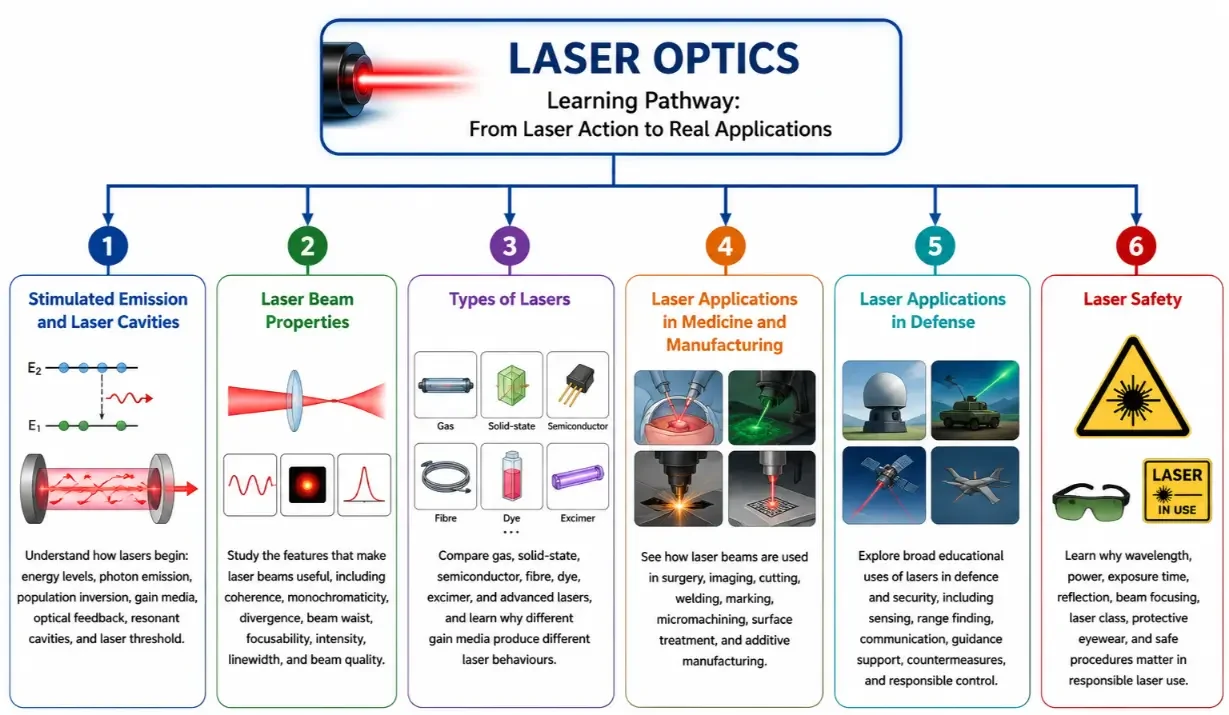
This infographic presents the Laser Optics hub as a two-level learning pathway. The top section introduces Laser Optics as the central hub, while the six connected panels below represent the main subpages in the cluster: Stimulated Emission and Laser Cavities, Laser Beam Properties, Types of Lasers, Laser Applications in Medicine and Manufacturing, Laser Applications in Defense, and Laser Safety. The chart helps students see the cluster as a complete pathway, moving from the origin of laser light toward real-world applications and responsible use.
Why Laser Optics Matters
Laser optics matters because lasers are now part of everyday technology and advanced science. They carry data through optical fibres, scan products in shops, support medical procedures, cut and weld materials, measure tiny distances, guide scientific instruments, and help researchers study matter at extremely small scales.
For students, laser optics is valuable because it connects many areas of physics. It shows how Modern Physics explains photon emission, how wave optics explains coherence and interference, how electromagnetic theory explains light as a field, and how engineering turns these ideas into useful systems.
The deeper lesson is that precision often matters more than raw strength. A laser is powerful not only because it can carry energy, but because that energy can be organised, focused, timed, guided, and controlled.

Key Ideas Students Should Recognise
Laser optics is built from a small number of powerful ideas. Once students understand these ideas, the many different laser types and applications become easier to organise. The aim is not to memorise laser devices one by one, but to see how controlled light can be produced, shaped, delivered, and used.
Stimulated Emission
Laser light begins when an incoming photon triggers an excited particle to emit a second photon with the same energy, direction, and phase relationship. This is the quantum process that separates laser light from ordinary spontaneous emission.Population Inversion
A laser medium must be prepared so that more particles occupy an excited state than a lower state involved in the laser transition. This unusual condition allows light amplification to dominate absorption.Optical Feedback
Mirrors, cavities, waveguides, or resonant structures send light repeatedly through the gain medium. This feedback allows selected light waves to grow while other directions and patterns are suppressed.Beam Control
Laser beams can be shaped by lenses, mirrors, fibres, scanners, apertures, and optical coatings. This control determines how the beam spreads, focuses, reflects, enters materials, and performs useful work.Material Interaction
A laser becomes useful only when its wavelength, power, pulse duration, and spot size are matched to the material or tissue being illuminated. Different targets absorb and respond to laser light differently.Safety and Responsibility
The same properties that make lasers useful can also make them hazardous. Directionality, focusing, invisible wavelengths, reflections, and high intensity all require informed and responsible use.How Laser Optics Connects to Other Areas of Physics
Laser optics is not an isolated topic. It brings together quantum ideas, wave behaviour, electromagnetic theory, optical design, materials science, electronics, and engineering control. This makes it one of the best topics for seeing how different branches of physics cooperate in real technology.
Quantum Physics
Quantum physics explains energy levels, photons, stimulated emission, and the microscopic transitions that make laser action possible.Wave Optics
Wave optics explains coherence, interference, diffraction, phase, and the wave behaviour that gives laser light its special character.Geometrical Optics
Geometrical optics helps students understand lenses, mirrors, ray paths, focusing systems, beam delivery, and optical alignment.Electromagnetic Waves
Laser light is a highly organised electromagnetic wave. Understanding wavelength, frequency, energy, and the electromagnetic spectrum helps explain laser behaviour.Fiber Optics
Many communication systems use lasers as light sources and optical fibres as guiding channels. This connection shows how laser optics supports modern data transmission.Photonics
Photonics extends the study of light into information technology, sensing, imaging, communication, and optical devices.Where Laser Optics Appears in the Real World
Lasers are used wherever light must be controlled with unusual precision. The same physical principles appear in medicine, manufacturing, communication, defence, scientific research, and environmental sensing. The examples below act as a map, not a detailed applications catalogue.
Medicine and Biomedical Technology
Medical lasers are used in selected forms of surgery, vision correction, dermatology, dentistry, imaging, diagnostics, and biomedical research. Their value comes from controlled interaction with tissue: the right wavelength, focused at the right place, for the right duration, under strict safety conditions. Common examples include using carbon dioxide (10.6 μm) lasers for tissue vaporization and excimer (193 nm) lasers for precision corneal reshaping.

Manufacturing and Materials Processing
Industrial lasers are used for cutting, welding, drilling, marking, engraving, surface treatment, micromachining, and additive manufacturing. They are valuable because they can deliver energy to a small region with high precision and can be integrated with automated machines. High-power fiber lasers and CO2 lasers operating at continuous outputs of several kilowatts (10 kW) are capable of slicing cleanly through thick industrial steel plate.

Communication and Information Systems
Laser light is central to many fibre-optic communication systems. Semiconductor diode lasers can be modulated rapidly at frequencies exceeding 10 GHz and coupled directly into glass optical fibres, allowing massive bandwidth channels to cross oceanic distances at infrared wavelengths near 1550 nm with minimal signal decay.

Defence, Security, and Remote Sensing
Lasers are used in broad defence and security contexts for range finding, sensing, communication, target designation, countermeasures, and directed-energy research. These uses require careful attention to safety, law, ethics, and responsible control. Multi-spectral LiDAR systems transmit nanosecond laser pulses to map topographic structures with centimeter accuracy.

Scientific Research and Precision Measurement
Lasers are essential tools in spectroscopy, interferometry, holography, microscopy, atomic physics, plasma research, optical clocks, and high-precision measurement. In research, a laser often acts like a ruler, probe, trigger, energy source, or timing reference made from organised light. Precision optical interferometers rely on stabilized laser baselines to detect subtle gravitational waves.
 Scientific applications of lasers, including high-precision measurement, laser spectroscopy, and holography.[/caption>
Why Study Laser Optics?
Laser optics is worth studying because it shows how a deep physical idea can become a practical tool. The laser began from questions about light, matter, energy levels, and photons. Today it is used in hospitals, factories, laboratories, communication networks, shops, defence systems, and research facilities.
It Connects Quantum Ideas to Real Devices
Stimulated emission, photon energy, and population inversion may seem abstract at first, but laser optics shows how these ideas become working instruments.It Builds Strong Optical Intuition
Laser beams help students understand coherence, focusing, divergence, interference, wavelength, intensity, and beam quality in concrete ways.It Links Physics with Engineering
A laser system is not only a physical effect. It is also an engineered device involving materials, electronics, cooling, optics, alignment, control, and safety.It Opens Doors to Modern Technology
Lasers support communication, manufacturing, medicine, sensing, imaging, environmental monitoring, scientific research, and advanced photonics.It Teaches Responsible Use of Powerful Tools
Laser safety reminds students that scientific power must be paired with judgement, care, ethical awareness, and respect for risk.It Prepares Students for Future Fields
Laser optics leads naturally into photonics, quantum technologies, biomedical engineering, semiconductor devices, optical communication, and advanced manufacturing.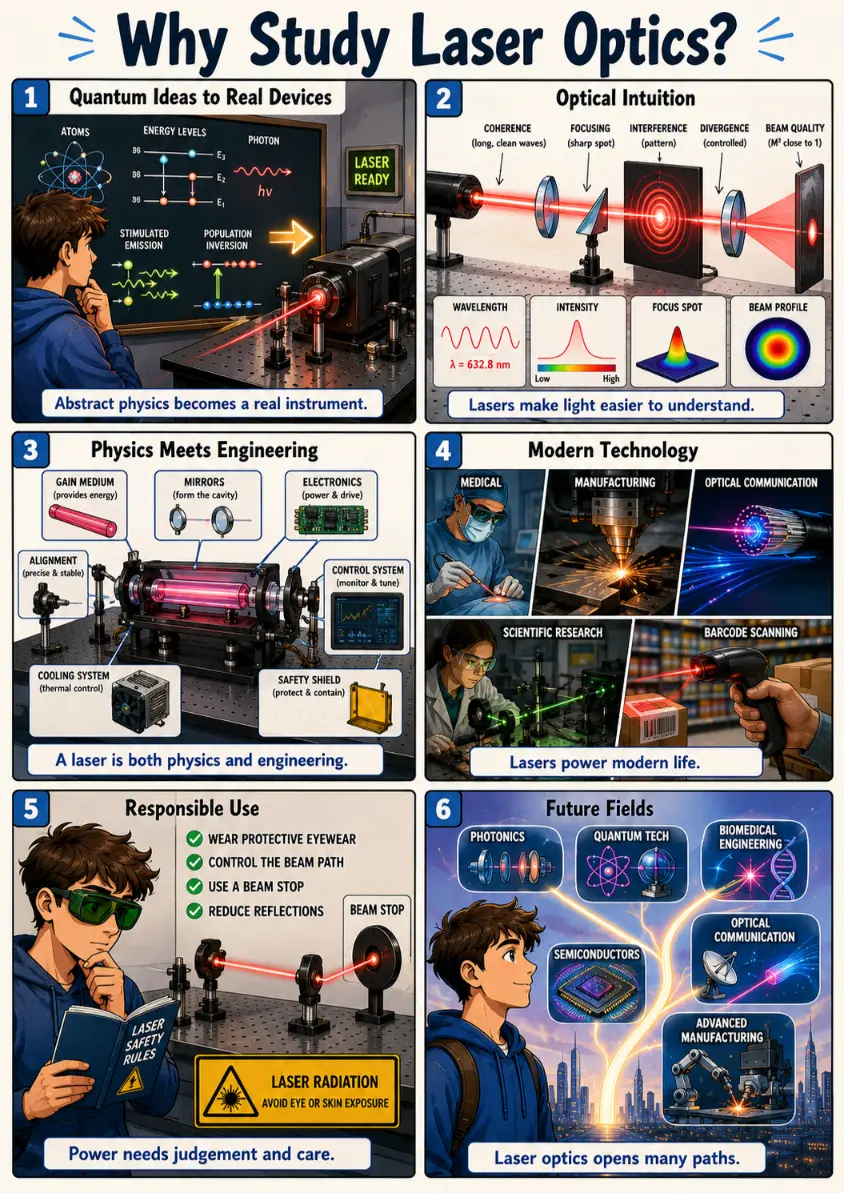 This comic shows why laser optics is worth studying: it connects abstract physics ideas with real devices, practical engineering, modern technology, responsible use, and future fields of study.
Quick Check: Laser Optics as a Hub Topic
Quick Check: Understanding the Big Picture
Q1. Why should a laser not be described simply as a bright light source?
A laser is special not only because of brightness, but because its light can be coherent, narrow in wavelength, directional, focusable, and carefully controlled.
Q2. What is the central physical process behind laser action?
The central process is stimulated emission, where an incoming photon causes an excited particle to emit another photon with matching energy, direction, and phase relationship.
Q3. Why do laser applications depend strongly on wavelength?
Different materials and tissues absorb, reflect, scatter, or transmit different wavelengths differently. Choosing the right wavelength helps the laser interact with the intended target.
Q4. Why does laser safety belong inside a physics learning pathway?
Laser safety is applied physics. Beam direction, focusing, wavelength, reflection, power, and exposure time all affect risk, so understanding the science helps students understand responsible use.
What Comes Next?
Students who are new to the topic should begin with Stimulated Emission and Laser Cavities, then continue to Laser Beam Properties. After that, they can compare Types of Lasers and study applications in medicine, manufacturing, defence, and safety.
Students who already understand the basic mechanism may go directly to the application pages. Students who want a stronger physics foundation should also review wave optics, electromagnetic waves, quantum physics, and fibre optics.
Summary
Laser optics studies how coherent and controllable light is produced, shaped, guided, focused, and applied. It connects stimulated emission, optical cavities, beam properties, laser types, material interaction, applications, and safety into one powerful learning pathway.
For students, laser optics is more than a specialist topic. It is a bridge between modern physics and modern technology. It shows how abstract ideas about photons and waves can become tools for communication, medicine, manufacturing, research, defence, and measurement.
Reflection Question
A laser is powerful because it organises light, not merely because it produces light. Where else in science or technology does organisation matter as much as energy or quantity?