
In Waste Management Engineering Education, students don’t just “wire things up”—they learn to make machines behave on purpose. This IDEF0 view makes the purpose of Waste Management Engineering Education immediately clear: it trains learners to take messy, mixed, and uncertain waste realities and convert them into disciplined decisions—how to reduce waste at the source, recover value through reuse and recycling, select appropriate treatment technologies, and manage residuals responsibly. Guided by policy constraints and public-health priorities, students learn to weigh trade-offs (cost, emissions, safety, land use, community impact) and to design systems that actually work outside the classroom—where contamination, human behavior, and operational limits are always part of the problem.
Waste Management Engineering plays a critical role in sustainable development, bridging the gap between technological innovation and environmental protection. As populations grow and consumption increases, effective strategies are needed to handle the waste generated from residential, commercial, and industrial sources. This field is deeply interconnected with broader disciplines like Environmental Engineering, ensuring that waste disposal methods align with ecological health and regulatory frameworks.
- Sanitary Landfill Geotechnics & Hydraulics: Model leachate head via the water balance method, calculate advective contaminant seepage through composite HDPE/compacted clay liners using Darcy's Law, and size methane gas extraction wellfields.
- Thermochemical & Biological Transformation: Analyze mass and volume reduction in Waste-to-Energy (WTE) incineration, evaluate anaerobic digestion kinetics and volatile solids destruction, and optimize carbon-to-nitrogen (C:N) composting thermodynamics.
- Automated Resource Recovery Logistics: Characterize Material Recovery Facility (MRF) separation efficiencies (optical NIR, eddy current, ballistic separators) and model dynamic reverse logistics using IoT fill telemetry.
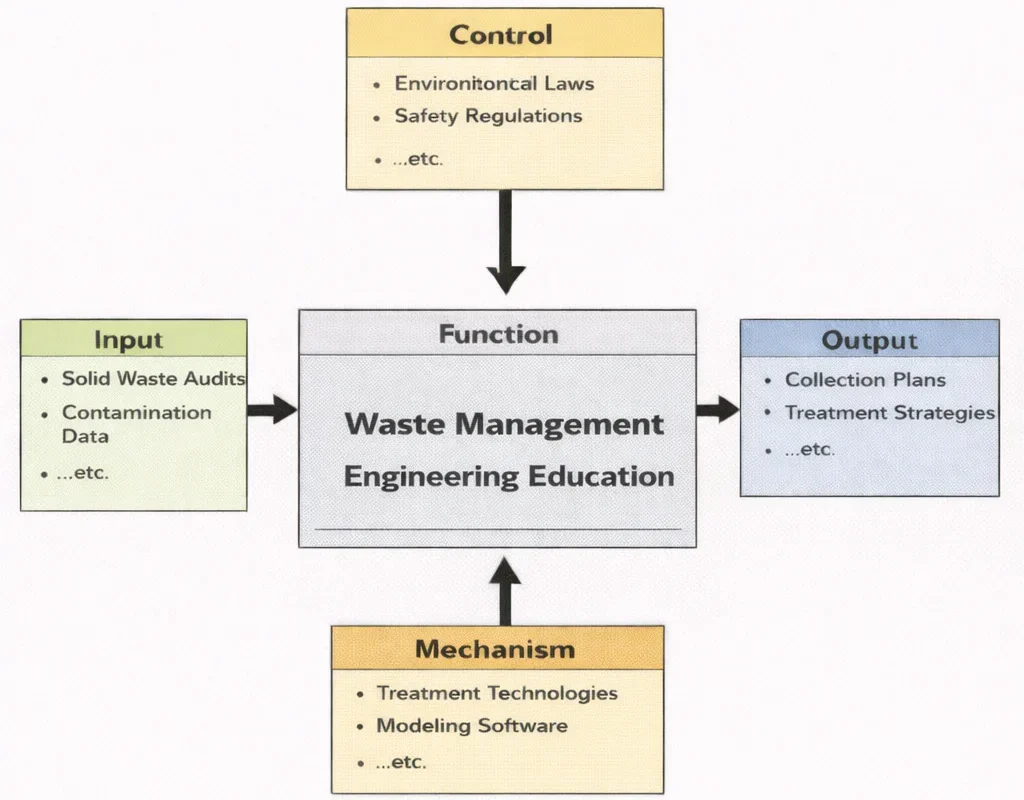
This IDEF0 diagram summarizes how Waste Management Engineering Education transforms real-world waste challenges into engineered solutions. Inputs (waste stream information, site context, material data) enter the learning process, while Controls (regulations, safety and environmental standards, performance targets) shape what “good” looks like. The central Function develops the knowledge and judgment needed to plan, design, and evaluate waste systems. Outputs include practical deliverables such as treatment and recycling strategies, waste audits and system designs, and risk-aware recommendations. The work is enabled by Mechanisms—labs, field facilities, software tools, case studies, and industry mentors—that turn concepts into tested practice.
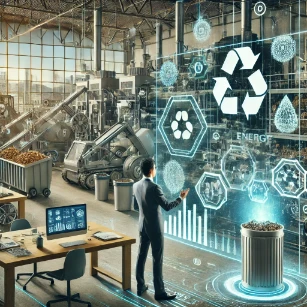
This image represents waste management engineering in a modern industrial setting. It shows recycling operations, material processing systems, and waste sorting within a facility, enhanced by digital overlays displaying environmental data, resource flows, and sustainability indicators. The illustration highlights how engineering integrates physical infrastructure with data-driven technologies to improve waste reduction, recycling efficiency, energy recovery, and environmental protection. It reflects the growing role of smart systems and automation in achieving sustainable waste management solutions.
Modern waste engineering is increasingly data-driven, relying on technologies from Environmental Monitoring and Data Analysis to track pollutant levels and optimize recycling operations. By integrating insights from Air Quality Engineering, systems are designed to minimize harmful emissions from landfills and incineration facilities. Furthermore, the principles of Industrial Ecology and Circular Economy promote closed-loop systems where waste is seen as a resource.
Policy and governance are equally essential, and practitioners must understand frameworks from Environmental Policy and Management. Regulations influence landfill design, recycling targets, hazardous waste control, and stakeholder coordination. In tandem, urban planners apply principles from Green Building and Sustainable Design to incorporate waste reduction at the architectural level.
Waste management also plays a vital role in combatting climate change. Engineers collaborate with professionals working in Climate Change Mitigation and Adaptation to reduce methane emissions from organic waste and design energy recovery systems. These link to Renewable Energy Systems Engineering, where waste-to-energy technologies transform refuse into usable power.
In complex ecosystems, waste handling strategies must consider biodiversity and hydrology. Collaboration with experts in Ecological Engineering helps minimize ecological disruption, while alignment with Water Resources Engineering ensures that leachates do not contaminate surface or groundwater.
The industrial sector also demands innovation in material flows. Concepts from Energy and Resource Efficiency in Manufacturing guide the design of byproduct reuse systems. These approaches are supported by advancements in Additive Manufacturing and Advanced Materials, which reduce waste at the source.
Automation and digital tools are revolutionizing the field. From robotic sorters driven by Robotics and Automation to smart facilities modeled using Digital Twin Technology, operational efficiency has improved significantly. Signal analysis techniques from Signal Processing also support sensor networks that monitor toxic emissions and operational safety.
As systems grow more sophisticated, integration with Computer-Integrated Manufacturing and Smart Manufacturing ensures seamless flow of information across supply chains. Engineers must also prioritize user interaction and safety, drawing from Human Factors and Ergonomics and best practices in Quality Control.
Ultimately, Waste Management Engineering stands at the intersection of technology, policy, and sustainability. Whether implementing lean strategies from Lean Manufacturing or leveraging industrial knowledge from Industrial and Manufacturing Technologies, engineers in this field have a transformative role in shaping a cleaner, more efficient future.
Interactive System Dynamics: Municipal Waste Diversion & Landfill Lifecycle Simulator
Simulate long-term municipal solid waste (MSW) generation, material diversion, and cumulative landfill airspace consumption over a 20-year horizon. Adjust population, recycling efficiency, and waste-to-energy (WTE) capacity to evaluate diversion metrics in real time.
Municipal Parameters
Waste Management Engineering: Curriculum Roadmap & Cluster Navigation
Explore where Waste Management Engineering fits within the broader Environmental Engineering curriculum framework. Each card outlines strategic relationships and learning objectives across related disciplines:
Environmental Engineering – Overview
Serves as the foundational hub connecting physical, biological, and chemical engineering principles across air, water, land, and urban systems.
Air Quality Engineering
Focuses on monitoring, modeling, and controlling atmospheric emissions, flue gas pollutants, and particulate matter from incinerators and industrial processing.
Water Resources Engineering
Provides hydrologic modeling, leachate containment strategies, and aquifer protection protocols critical for engineered landfill design.
Waste Management Engineering (Current Page)
Integrates solid waste logistics, hazardous waste neutralization, material recovery facilities (MRFs), waste-to-energy conversion, and sanitary landfill engineering.
Renewable Energy Systems Engineering
Develops biogas recovery, anaerobic digestion systems, thermochemical gasification, and refused-derived fuel (RDF) power generation technologies.
Industrial Ecology & Circular Economy
Establishes closed-loop material flows, product life-cycle assessments (LCA), and industrial symbiosis networks that minimize initial waste generation.
Green Building & Sustainable Design
Incorporates deconstruction planning, construction debris salvage, and architectural material recovery into civil infrastructure lifecycles.
Environmental Policy & Management
Enforces extended producer responsibility (EPR), municipal compliance frameworks, international accords (Basel Convention), and permitting standards.
Environmental Monitoring & Data Analysis
Applies sensor networks, IoT fill-level tracking, and GIS spatial mapping to optimize collection routes and monitor fugitive site emissions.
Ecological Engineering
Utilizes engineered wetlands, phytoremediation, and bio-filtration systems for passive leachate and organic sludge treatment.
Climate Change Mitigation & Adaptation
Targets fugitive landfill methane abatement and builds climate-resilient flood protection around regional waste treatment infrastructure.
Core Areas of Waste Management Engineering
Solid Waste Management
Solid waste management encompasses non-hazardous refuse from municipal, industrial, commercial, and agricultural sectors. Engineering designs evaluate waste generation rates, physical composition, moisture fractions, and bulk compaction densities to plan collection logistics and treatment infrastructure.
- Municipal Solid Waste (MSW): Household discards, packaging, paper, and food waste segregated for material recovery, composting, or sanitary disposal.
- Construction & Demolition (C&D) Waste: Concrete rubble, masonry, and metals crushed and screened into secondary civil construction aggregates.
Hazardous Waste Management
Hazardous wastes exhibit toxic, ignitable, corrosive, or reactive characteristics defined by statutory criteria (e.g., US EPA RCRA). Specialized stabilization/solidification (S/S), high-temperature rotary kiln incineration (>1,100°C), and double-lined containment cells prevent bioaccumulation and aquifer contamination.
Waste-to-Energy (WTE) Systems
Mass-burn incineration and refused-derived fuel (RDF) gasification convert non-recyclable solid residues into high-pressure steam, driving turbogenerators to supply municipal electricity and district heat while reducing waste mass by 75% and volume by over 90%.
Recycling and Material Recovery Facilities (MRFs)
Modern MRFs employ mechanical screen trommels, magnetic belts, eddy current non-ferrous separators, and automated Near-Infrared (NIR) optical sorters to achieve high commodity purity across plastics, paper, and metal streams.
Problem Formulation: Composite Compacted Clay Liner Leachate Flux & EPA LandGEM Methane Yield
An environmental engineer is designing a composite sanitary landfill cell with an area \(A = 50,000.0\text{ m}^2\). The bottom barrier consists of a compacted clay liner (CCL) of thickness \(d_L = 0.90\text{ m}\) with hydraulic conductivity \(k = 1.0 \times 10^{-9}\text{ m/s}\), underlying an HDPE geomembrane with a maximum allowable leachate hydraulic head \(h_w = 0.30\text{ m}\). Calculate the 1-D advective Darcy leachate seepage flux (\(Q_L\)) through the clay layer. Additionally, estimate the annual methane production (\(Q_{\text{CH}_4}\)) from \(M = 150,000\text{ metric tons}\) of MSW deposited in Year 1 after \(t = 5\text{ years}\) using the EPA LandGEM first-order decomposition equation.
- Cell footprint area: \(A = 50,000.0\text{ m}^2\)
- Compacted clay liner thickness: \(d_L = 0.90\text{ m}\); Saturated hydraulic conductivity: \(k = 1.0 \times 10^{-9}\text{ m/s}\)
- Leachate collection head above liner: \(h_w = 0.30\text{ m}\)
- Waste mass placed in Year 1: \(M = 150,000.0\text{ metric tons}\)
- LandGEM methane generation potential: \(L_0 = 100.0\text{ m}^3\text{ CH}_4\text{ / metric ton MSW}\)
- First-order methane generation rate constant: \(k_m = 0.050\text{ year}^{-1}\); Elapsed decomposition time: \(t = 5.0\text{ years}\)
- First-order rate equation: \(Q_{\text{CH}_4} = k_m \cdot M \cdot L_0 \cdot e^{-k_m \cdot t}\)
Step 1: Calculate Total Hydraulic Head & Darcy Hydraulic Gradient (\(i\))
Total head driving fluid through the liner includes the leachate pooling depth plus liner thickness (\(\Delta h = h_w + d_L\)):
$$\Delta h = 0.30\text{ m} + 0.90\text{ m} = 1.20\text{ m}$$ $$i = \frac{\Delta h}{d_L} = \frac{1.20\text{ m}}{0.90\text{ m}} = 1.3333$$Step 2: Compute Advective Darcy Leachate Seepage Discharge (\(Q_L\))
Apply Darcy’s Law across the saturated cell footprint:
$$q = k \cdot i = (1.0 \times 10^{-9}\text{ m/s}) \times 1.3333 = 1.3333 \times 10^{-9}\text{ m/s}$$ $$Q_L = q \cdot A = (1.3333 \times 10^{-9}\text{ m/s}) \times 50,000.0\text{ m}^2 = 6.6667 \times 10^{-5}\text{ m}^3\text{/s}$$Convert seepage to cubic meters per year (\(1\text{ year} = 31,536,000\text{ seconds}\)):
$$Q_L = 6.6667 \times 10^{-5}\text{ m}^3\text{/s} \times 31,536,000\text{ s/yr} = \mathbf{2,102.40\text{ m}^3\text{/year}}\quad (\mathbf{5.76\text{ m}^3\text{/day}})$$Step 3: First-Order Methane Generation Kinetics (LandGEM Model)
Evaluate microbial methane generation at Year 5:
$$Q_{\text{CH}_4}(5) = k_m \cdot M \cdot L_0 \cdot e^{-k_m \cdot t}$$ $$Q_{\text{CH}_4}(5) = 0.050\text{ yr}^{-1} \times 150,000\text{ tons} \times 100.0\text{ m}^3\text{/ton} \times e^{-(0.050 \times 5.0)}$$ $$Q_{\text{CH}_4}(5) = 750,000.0 \times e^{-0.250} = 750,000.0 \times 0.7788 = \mathbf{584,100.0\text{ m}^3\text{ CH}_4\text{/year}}$$Step 4: Landfill Gas (LFG) Energy Recovery Power Capacity
Given methane lower heating value \(\text{LHV} = 37.0\text{ MJ/m}^3\) and a gas engine efficiency \(\eta = 0.35\):
$$E_{\text{elec}} = 584,100.0\text{ m}^3 \times 37.0\text{ MJ/m}^3 \times 0.35 = 7,564,095\text{ MJ/year}$$ $$P_{\text{avg}} = \frac{7,564,095\text{ MJ}}{31,536,000\text{ s}} = \mathbf{0.2398\text{ MW}}\quad (\mathbf{239.8\text{ kW continuous electrical capacity}})$$Systems Engineering Trade-Off Matrix: Waste Treatment & Disposal Technologies
Selecting waste management infrastructure requires balancing volume reduction factors, capital expenditures, fugitive atmospheric emissions, groundwater risks, and circular resource recovery.
| Treatment Technology | Primary Process | Mass & Volume Reduction | CAPEX vs. OPEX Balance | Environmental & Residual Risks | Resource & Energy Yield |
|---|---|---|---|---|---|
| Sanitary Landfill (Engineered) | Anaerobic containment, daily capping, leachate extraction | Zero mass reduction; compaction density \(850\text{ kg/m}^3\) | Low initial CAPEX; long-term 30-year post-closure liability | Fugitive methane leakage; liner rupture aquifer contamination | LFG methane extraction (\(50 - 55\%\text{ CH}_4\)) |
| Waste-to-Energy (Mass-Burn Incineration) | Controlled thermal combustion (\(> 850 - 1,100^\circ\text{C}\)), steam turbines | Mass reduced by \(75\%\); volume reduced by \(90 - 93\%\) | Very High CAPEX (\(\$150 - \$250\text{M}\)); high flue-gas OPEX | Toxic fly ash (heavy metals, dioxins); public siting opposition | Electricity (\(500 - 650\text{ kWh/t}\)) + district heating |
| Material Recovery Facility (MRF) | Optical NIR, eddy current, ballistic, and magnetic sorting | Diverts \(60 - 85\%\) of recyclable incoming commodities | Moderate CAPEX; sensitive to commodity market prices | Stream cross-contamination; worker dust & ergonomic strain | High; reclaims clean secondary paper, metals, polymers |
| Anaerobic Digestion (Organics) | Mesophilic/thermophilic biomethanation of wet slurries | Volatile solids destroyed by \(60 - 70\%\); digestate liquid | Moderate-to-High CAPEX; requires pure organic feedstock | Odor control; volatile fatty acid souring failure | Biomethane (\(0.4 - 0.6\text{ m}^3\text{/kg VS}\)) + biofertilizer |
| Aerobic Windrow Composting | Thermophilic aerobic biological oxidation (\(55 - 65^\circ\text{C}\)) | Mass reduced by \(40 - 50\%\) via water and \(\text{CO}_2\) loss | Low CAPEX; moderate turning and aerating OPEX | Leachate runoff during rain; bio-aerosols and odors | Nutrient-rich soil humus amendment; carbon sequestration |
Applications of Waste Management Engineering
- Municipal Solid Waste Logistics: IoT bin telemetry pairs with routing algorithms to dynamically dispatch collection fleets, reducing citywide fuel consumption by 25%.
- Hazardous Industrial Remediation: Chemical neutralization, stabilization, and vitrification treat toxic industrial sludges before secure containment.
- Construction & Demolition Salvage: On-site crushing plants process concrete rubble into recycled road base, reducing quarry extraction.
- Agricultural Organics & Composting: Anaerobic digesters convert animal manure and crop residues into biogas and pasteurized organic fertilizer.
- E-Waste Hydrometallurgical Extraction: Acid leaching and electrowinning recover gold, copper, and palladium from printed circuit boards with minimal emissions.
Why Study Waste Management Engineering
Protecting Public Health and Ecosystems
Students design systems that prevent contaminated leachate from reaching drinking aquifers, neutralize toxic industrial wastes, and eradicate disease vectors.
Thermal and Biochemical Resource Recovery
Engineers master the thermochemical kinetics of waste-to-energy incineration, anaerobic biomethanation, and aerobic composting to generate clean grid power and nutrients.
Advanced Mechanical & Optical Sorting
Coursework covers the automation of Material Recovery Facilities (MRFs) using computer-vision robotic pickers, NIR spectroscopy, and ballistic separation.
Environmental Policy & Regulatory Compliance
Students examine regulatory standards (e.g., US EPA Subtitle D, EU Landfill Directive, Basel Convention), Extended Producer Responsibility (EPR), and life-cycle costing.
Waste Management Engineering: Conclusion
Waste Management Engineering bridges civic sanitation, mechanical automation, and ecological protection. By transforming discarded consumer and industrial products from environmental liabilities into secondary resources, engineers close material loops, abate fugitive greenhouse gases, and protect groundwater assets. As urbanization and consumption expand globally, the discipline is shifting away from simple landfill disposal toward high-efficiency automated recovery, waste-to-energy conversion, and circular zero-waste systems.
Frequently Asked Questions
What are the primary categories of waste and how do their management approaches differ?
Municipal solid waste requires automated mechanical and biological sorting; hazardous industrial waste demands chemical stabilization, thermal destruction, or secure double-lined cells; biomedical waste requires autoclave sterilization or high-temperature incineration; and construction waste is crushed for secondary aggregate reuse.
What is the waste hierarchy and how does it guide engineering decisions?
The waste hierarchy prioritizes Prevention first, followed by Reuse, Recycling, Energy Recovery (WTE), and lastly Disposal. Engineers use this framework to design products for disassembly, maximize material purity in recycling, and treat landfilling strictly as a last resort.
How do modern engineered landfills mitigate groundwater contamination risks?
Sanitary landfills incorporate composite liner systems consisting of a low-permeability compacted clay liner (CCL) overlaid by a high-density polyethylene (HDPE) geomembrane, a geotextile cushion, and gravel collection pipes that maintain leachate hydraulic head below 30 cm.
End-of-Page Practice & Assessment Modules
Section 1: Interactive Foundational Concepts Review
Question 1: Waste Categories and Handling Protocols
Question 2: Mechanical vs. Chemical Plastics Recycling
Question 3: Landfill Gas (LFG) Generation and Energy Recovery
Question 4: Role of Life Cycle Assessment (LCA) in Waste Policy
Section 2: Analytical & Scenario-Based Inquiry
Question 1: Designing for Circularity in Municipal MRFs
Question 2: Waste-to-Energy Flue-Gas Emission Mitigation
Question 3: Climate Resilience in Landfill Design
Section 3: Applied Engineering Quantitative Calculations
Problem 1: Landfill Airspace Volumetric Capacity and Lifespan
Question: A municipality produces \(120,000.0\text{ metric tons}\) of MSW annually and achieves a \(30.0\%\) diversion rate through recycling and composting. Residual waste is compacted in a landfill to a density of \(850.0\text{ kg/m}^3\). If daily soil cover consumes \(20.0\%\) of the total cell volume, calculate the required annual landfill volume in \(\text{m}^3\) and the operational lifespan of a \(2,000,000.0\text{ m}^3\) cell.
Solution:
1. Annual landfilled waste mass: \(120,000.0 \times (1 - 0.30) = 84,000.0\text{ tons/yr} = 84,000,000.0\text{ kg/yr}\)
2. Compacted waste volume: \(\frac{84,000,000.0\text{ kg}}{850.0\text{ kg/m}^3} = 98,823.53\text{ m}^3\text{/year}\)
3. Total required cell volume (accounting for cover soil):
$$V_{\text{total}} = \frac{98,823.53\text{ m}^3}{1 - 0.20} = \mathbf{123,529.41\text{ m}^3\text{/year}}$$4. Projected landfill cell lifespan:
$$\text{Lifespan} = \frac{2,000,000.0\text{ m}^3}{123,529.41\text{ m}^3\text{/year}} = \mathbf{16.19\text{ years}}$$Problem 2: Landfill Methane Thermal Energy and Electrical Power Output
Question: An active landfill extracts \(12,000,000.0\text{ m}^3\) of landfill gas (LFG) annually with a \(55.0\%\) methane concentration. Pure methane has a lower heating value (\(\text{LHV}\)) of \(37.0\text{ MJ/m}^3\). The gas fuels an engine-generator operating at a \(35.0\%\) electrical efficiency. Determine total annual thermal energy input in \(\text{GJ}\) and net electrical power generation in \(\text{MWh/year}\).
Solution:
1. Volume of pure methane: \(12,000,000.0\text{ m}^3 \times 0.55 = 6,600,000.0\text{ m}^3\text{ CH}_4\text{/year}\)
2. Total thermal energy input:
$$E_{\text{thermal}} = 6,600,000.0\text{ m}^3 \times 37.0\text{ MJ/m}^3 = 244,200,000.0\text{ MJ} = \mathbf{244,200.0\text{ GJ/year}}$$3. Electrical generation in Megawatt-hours (\(1\text{ MWh} = 3,600\text{ MJ}\)):
$$E_{\text{elec}} = \frac{244,200,000.0\text{ MJ} \times 0.35}{3,600.0\text{ MJ/MWh}} = \mathbf{23,741.67\text{ MWh/year}}$$Problem 3: Landfill Leachate Generation via Water Balance Model
Question: An open landfill cell has an operating footprint \(A = 45,000.0\text{ m}^2\). The site records rainfall \(P = 950.0\text{ mm/yr}\), evapotranspiration \(ET = 400.0\text{ mm/yr}\), and surface runoff \(R = 250.0\text{ mm/yr}\). Assuming waste moisture storage capacity is fully saturated, calculate the annual leachate volume in \(\text{m}^3\) and daily generation rate in \(\text{L/day}\).
Solution:
1. Net infiltration percolation depth:
$$L_{\text{depth}} = P - ET - R = 950.0 - 400.0 - 250.0 = 300.0\text{ mm/year} = 0.30\text{ m/year}$$2. Total annual leachate volume:
$$V_{\text{leachate}} = 45,000.0\text{ m}^2 \times 0.30\text{ m/year} = \mathbf{13,500.0\text{ m}^3\text{/year}}$$3. Daily leachate generation rate:
$$Q_{\text{daily}} = \frac{13,500.0\text{ m}^3 \times 1,000.0\text{ L/m}^3}{365\text{ days}} = \mathbf{36,986.30\text{ Liters/day}}$$Problem 4: Material Recovery Facility (MRF) Sorting Yield
Question: A MRF processes \(450.0\text{ metric tons/day}\) of commingled recyclables containing \(40.0\%\) paper, \(25.0\%\) plastics, \(10.0\%\) metals, and residual glass/contamination. Automated lines recover \(88.0\%\) of paper, \(82.0\%\) of plastics, and \(95.0\%\) of metals. Calculate total daily recovered commodity mass and overall sorting efficiency.
Solution:
1. Recovered paper: \(450.0 \times 0.40 \times 0.88 = 158.40\text{ tons/day}\)
2. Recovered plastics: \(450.0 \times 0.25 \times 0.82 = 92.25\text{ tons/day}\)
3. Recovered metals: \(450.0 \times 0.10 \times 0.95 = 42.75\text{ tons/day}\)
4. Total mass of recovered commodities: \(158.40 + 92.25 + 42.75 = \mathbf{293.40\text{ metric tons/day}}\)
5. Overall recovery efficiency: \(\left(\frac{293.40}{450.0}\right) \times 100\% = \mathbf{65.20\%}\)
Problem 5: Waste-to-Energy Mass and Volume Reduction
Question: A WTE plant incinerates \(500.0\text{ metric tons/day}\) of unsegregated MSW. Combustion reduces mass by \(75.0\%\), leaving \(20.0\%\) bottom ash and \(5.0\%\) fly ash residue. Raw waste density is \(300.0\text{ kg/m}^3\) and combined ash density is \(1,100.0\text{ kg/m}^3\). Calculate total daily ash mass and the percentage volume reduction achieved.
Solution:
1. Initial raw waste volume: \(\frac{500,000.0\text{ kg}}{300.0\text{ kg/m}^3} = 1,666.67\text{ m}^3\text{/day}\)
2. Total ash mass: \(500.0\text{ tons} \times 0.25 = \mathbf{125.0\text{ metric tons/day}}\quad (125,000.0\text{ kg/day})\)
3. Ash residue volume: \(\frac{125,000.0\text{ kg}}{1,100.0\text{ kg/m}^3} = 113.64\text{ m}^3\text{/day}\)
4. Volume reduction percentage:
$$\text{Volume Reduction} = \left(\frac{1,666.67 - 113.64}{1,666.67}\right) \times 100\% = \mathbf{93.18\%}$$Problem 6: Anaerobic Digestion Food Waste Biogas Generation
Question: An anaerobic digester processes \(60.0\text{ metric tons/day}\) of food waste containing \(22.0\%\) Total Solids (TS), of which \(85.0\%\) are Volatile Solids (VS). The system achieves a \(65.0\%\) VS destruction rate with a specific biogas yield of \(0.60\text{ m}^3\text{/kg VS destroyed}\). Compute daily volatile solids input and total daily biogas production in \(\text{m}^3\).
Solution:
1. Daily Total Solids: \(60,000.0\text{ kg} \times 0.22 = 13,200.0\text{ kg TS/day}\)
2. Daily Volatile Solids input: \(13,200.0 \times 0.85 = \mathbf{11,220.0\text{ kg VS/day}}\)
3. Volatile Solids destroyed: \(11,220.0 \times 0.65 = 7,293.0\text{ kg VS/day}\)
4. Daily biogas generation:
$$Q_{\text{biogas}} = 7,293.0\text{ kg VS} \times 0.60\text{ m}^3\text{/kg VS} = \mathbf{4,375.80\text{ m}^3\text{/day}}$$Problem 7: Composting Carbon-to-Nitrogen (C:N) Ratio Optimization
Question: A composting facility mixes \(10.0\text{ tons}\) of food waste (dry mass = \(3.0\text{ tons}\), containing \(1.40\text{ tons}\) Carbon and \(0.0933\text{ tons}\) Nitrogen) with dry wood chips (containing \(50.0\%\) Carbon and \(0.50\%\) Nitrogen) to reach an optimum blend \(\text{C:N}\) ratio of \(30:1\). Determine the required dry mass of wood chips \(W\) in metric tons.
Solution:
1. Formulate the mass balance ratio:
$$\frac{C_{\text{total}}}{N_{\text{total}}} = \frac{1.40 + 0.50W}{0.0933 + 0.005W} = 30$$2. Solve the linear algebraic equation:
$$1.40 + 0.50W = 30 \times (0.0933 + 0.005W) = 2.799 + 0.150W$$ $$0.350W = 1.399 \quad \Rightarrow \quad W = \frac{1.399}{0.350} = \mathbf{3.997\text{ metric tons of dry wood chips}}$$