
Ecological Engineering Education, as illustrated by the diagram below, teaches students to treat ecosystems as living systems with measurable signals, limits, and feedback—not as scenery to be “fixed” by guesswork. Students start by reading the world carefully: collecting observations, measurements, and indicators that reveal how water, soil, species, and human activity interact. They then learn to work under clear guardrails—ecological laws, such as carrying capacity and resilience, and the real-world rules written into environmental policy. With modelling and bioengineering tools in hand, they practice turning evidence into designs: choosing interventions that restore habitats, reduce harm, and keep benefits lasting over time. The end result is a kind of disciplined creativity—engineers who can justify why a solution should work, how it will be evaluated, and what counts as success in a landscape that is always changing.
- Living Systems Biogeochemistry: Formulate reactor kinetics for constructed wetlands, rhizosphere microbial transformations, enzymatic nutrient immobilization, and first-order plug-flow decay equations (\(k\text{-}C^*\) model).
- Biotechnical Stabilization & Living Defense: Quantify mechanical root-reinforcement shear strength (Wu-Waldron model), wave attenuation through porous vegetation canopies, and living shoreline morphodynamics.
- AI & Computational Ecology: Bridge classical ecological field metrics to Physics-Informed Neural Networks (PINNs), Fourier Neural Operators (FNOs), and drone multispectral edge telemetry for continuous ecohydrological state estimation.
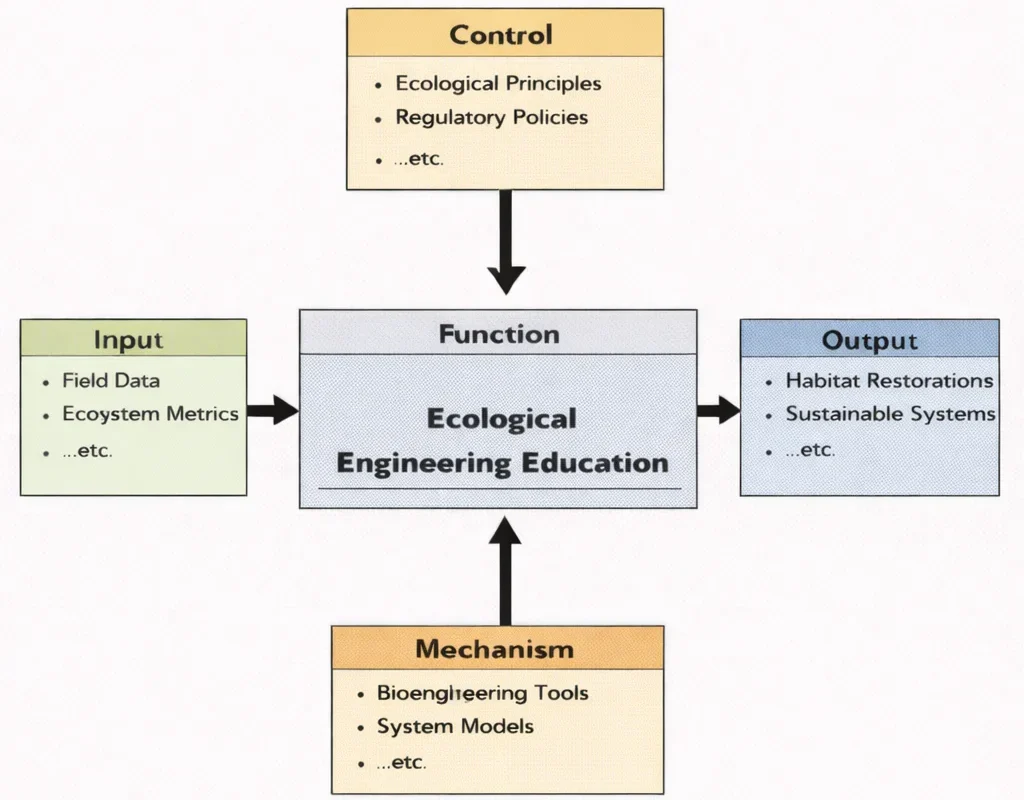
This IDEF0 (Input–Control–Output–Mechanism) diagram frames Ecological Engineering Education as a structured learning “engine.” On the left, Inputs such as field data and ecosystem metrics enter the process. From above, Controls—ecological principles and regulatory policies—set the boundaries of what is acceptable, safe, and scientifically sound. From below, Mechanisms—bioengineering tools and system models—represent the practical capabilities and platforms students use to design, test, and refine solutions. The right side shows Outputs: learners produce the ability to plan and justify habitat restorations and build sustainable systems that work with nature rather than against it.
Ecological Engineering represents a vital synthesis between ecological understanding and engineering practice, focusing on the design of sustainable systems that integrate human society with the natural environment. Unlike traditional approaches that may work against nature, this field emphasizes collaboration with ecosystems to address pressing issues such as pollution, resource scarcity, and habitat loss. It aligns closely with broader Environmental Engineering efforts, particularly in restoring ecological balance while meeting human needs.
By leveraging insights from Air Quality Engineering and Climate Change Mitigation and Adaptation, ecological engineering contributes to improving air and climate conditions. Systems design in this field depends on precise data gathering and interpretation, which draws upon methods found in Environmental Monitoring and Data Analysis. These insights guide sustainable strategies outlined within Environmental Policy and Management.
Interactive System Dynamics: Constructed Wetland Pollutant Removal & Biodiversity Simulator
Simulate dissolved nitrate (\(\text{NO}_3\text{-N}\)) attenuation and Shannon Biodiversity Index (\(H'\)) trajectories across an engineered subsurface flow wetland using first-order plug-flow kinetics. Adjust hydraulic retention time (HRT), native macrophyte cover, and inflow loading to observe bio-reactor performance in real time.
Design Parameters
Ecological engineering is essential in developing solutions for urban ecosystems, including innovations such as Green Building and Sustainable Design. It also supports transitions to a circular economy by rethinking waste, energy, and material cycles. These systems are increasingly intertwined with Renewable Energy Systems Engineering, forming a backbone for sustainable infrastructure.
Water and waste are critical domains where ecological engineering principles thrive. Integrated water management solutions like those found in Water Resources Engineering aim to mimic natural hydrological cycles, while innovations in Waste Management Engineering help turn waste into usable resources. These applications are increasingly supported by developments in Industrial and Manufacturing Technologies, fostering more sustainable production ecosystems.
Advances in technology offer powerful tools for ecological engineers. Practices like Additive Manufacturing (3D Printing) and Advanced Materials and Manufacturing Technologies help develop eco-friendly prototypes. Furthermore, the simulation capabilities of Computer-Integrated Manufacturing (CIM) and Digital Twin Technology allow researchers to model ecological systems and test interventions before implementation.
Industrial transformation through Energy and Resource Efficiency in Manufacturing supports the ecological goals of reducing emissions and conserving biodiversity. Human-focused design, informed by Human Factors and Ergonomics in Manufacturing, ensures that interventions are both sustainable and accessible. Robotics applications, such as those explored in Industrial Automation and Robotics and Robotics and Automation in E&E, enhance precision in habitat restoration and ecological monitoring.
Foundations in Lean Manufacturing and process improvement principles contribute to streamlined ecological solutions. Quality assurance practices like Manufacturing Quality Control and Assurance ensure environmental technologies meet sustainability standards. Finally, the integration of smart systems through Smart Manufacturing and Industry 4.0 allows for dynamic adaptation in both natural and engineered ecosystems, completing a holistic ecological engineering approach.

The image depicts a future-oriented ecological control hub overlooking an urban-edge wetland system filled with ponds, channels, and lush vegetation. A seated analyst studies curved digital displays showing graphs and indicators, while floating symbols and a luminous globe represent ecosystem processes such as biodiversity, nutrient cycles, and water purification. In the background, city towers frame a large green corridor—suggesting that ecological engineering links infrastructure with living systems through habitat restoration, constructed wetlands, and nature-based stormwater management. The overall mood emphasizes data-informed stewardship: using science, monitoring, and thoughtful design to help ecosystems function well while supporting healthy, livable cities.
Curriculum Navigation & Cluster Links
Environmental Engineering – Overview
Serves as the foundational hub anchor, connecting ecological design to environmental chemistry, hydrology, and civil infrastructure planning.
Air Quality Engineering
Focuses on urban forest microclimates, particulate capture via vegetative buffers, and biological emission control systems.
Water Resources Engineering
Integrates stream restoration, floodplain reconnection, and watershed hydrology to mimic natural water cycles in engineered catchments.
Waste Management Engineering
Covers organic waste composting, vermiculture, anaerobic digestion, and land reclamation using biological capping layers.
Renewable Energy Systems Engineering
Explores bioenergy generation, micro-hydro power, and agrivoltaic dual-use systems that align clean energy with land conservation.
Industrial Ecology & Circular Economy
Applies metabolic ecosystem principles to closed-loop industrial manufacturing parks and resource recycling networks.
Green Building & Sustainable Design
Details living walls, green roofs, biophilic architecture, and bioswales integrated directly into urban site planning.
Environmental Policy & Management
Links nature-based solutions to biodiversity offsetting frameworks, wetland protection laws, and regional governance.
Environmental Monitoring & Data Analysis
Leverages satellite remote sensing, bio-indicators, and GIS mapping to track long-term habitat restoration trajectories.
Ecological Engineering
Focuses on designing living systems, bioengineering, phytoremediation, and constructed wetlands to restore ecosystem health.
Climate Change Mitigation & Adaptation
Applies Ecosystem-Based Adaptation (EbA), mangrove coastal defenses, and soil carbon sequestration to build climate resilience.
Challenges in Ecological Engineering
- Uncertainty and Biological Latency
Unlike gray infrastructure which delivers immediate full capacity, living systems require years to mature, establish root systems, and achieve steady-state biofiltration performance.
- Regulatory Acceptance and Standardization
Building codes often prioritize rigid civil engineering formulas. Certifying the reliability of living systems under extreme weather events requires extensive empirical demonstration.
Why Study Ecological Engineering
Ecological Engineering: Conclusion
Ecological engineering has emerged as a transformative discipline that integrates ecological principles with engineering design to address some of the most pressing environmental challenges of the 21st century. Unlike traditional engineering fields that often focus on infrastructure independent of ecological systems, ecological engineering seeks to work with nature rather than against it, leveraging natural processes to create solutions that are not only effective but also regenerative and self-sustaining over time.
By embracing the complexity of natural ecosystems, ecological engineers design systems that mimic ecological functions, enhance biodiversity, and provide multiple ecosystem services—such as flood regulation, water purification, carbon sequestration, and habitat restoration. This multidisciplinary approach draws upon insights from biology, hydrology, soil science, and landscape architecture, fostering holistic solutions that are resilient to both environmental variability and human pressures.
One of the defining features of ecological engineering is its commitment to sustainability and long-term functionality. For example, constructed wetlands are not just waste treatment systems; they also offer habitat for wildlife, recreational spaces for communities, and serve as carbon sinks. Similarly, green infrastructure projects like bioswales, rain gardens, and living shorelines not only manage stormwater effectively but also reconnect urban populations with natural processes and aesthetics.
Community engagement plays a critical role in ecological engineering, as the success of many projects depends on local stewardship, cultural relevance, and participatory planning. Engineers increasingly collaborate with stakeholders, including indigenous communities, municipalities, and non-governmental organizations, to co-create systems that align ecological functions with social values and needs.
As climate change accelerates and environmental degradation continues, the need for scalable and adaptive ecological interventions becomes more urgent. Ecological engineering offers innovative responses to these challenges, from rewilding degraded landscapes to restoring urban rivers, stabilizing coastlines, and regenerating agricultural lands through techniques like agroecology and silvopasture. These interventions not only mitigate climate impacts but also help communities adapt to emerging risks.
In academic and professional spheres, ecological engineering is gaining recognition as a foundational element of sustainable development. Educational institutions worldwide are incorporating ecological design into engineering curricula, while research initiatives are producing evidence-based frameworks to evaluate and optimize ecosystem-based technologies. This momentum is helping to redefine what it means to engineer responsibly in an era of environmental limits.
Moreover, policy frameworks at local, national, and international levels are beginning to reflect the importance of ecological engineering. Governments are funding ecosystem restoration programs, incentivizing green infrastructure, and integrating nature-based solutions into climate resilience planning. Such policy support is vital to expanding the implementation of ecological strategies and achieving widespread environmental benefits.
In sum, ecological engineering is not just a technical discipline—it is a paradigm shift in how humanity interacts with the natural world. By blending scientific rigor with ecological wisdom and social inclusion, it charts a path toward regenerative development where human progress enhances rather than compromises planetary health. As ecological knowledge continues to grow, so too will the scope and impact of ecological engineering in shaping a future that is resilient, equitable, and deeply connected to the ecosystems that sustain life on Earth.
Frequently Asked Questions
What is ecological engineering?
Ecological engineering is the design, construction, and management of ecosystems using both engineering principles and ecological science. The aim is to solve practical problems such as wastewater treatment, flood control, and habitat loss in ways that are sustainable, self-maintaining, and compatible with natural processes.
How do constructed wetlands fit into ecological engineering?
Constructed wetlands are engineered ecosystems that treat wastewater by guiding it through shallow, vegetated basins. As water moves through soils, plant roots, and biofilms, pollutants are removed by sedimentation, filtration, chemical reactions, and microbial degradation. Compared with conventional plants, they typically use less energy and can also provide habitat and amenity value.
What are the main components of an ecological engineering project?
Most projects follow a loop: detailed site assessment, integrated design and planning, on-the-ground implementation, and long-term monitoring and maintenance. Community engagement and education run alongside these steps so that local stakeholders understand, support, and help care for the system over time.
How does ecological engineering help conserve biodiversity?
By restoring wetlands, rivers, forests, riparian buffers, green roofs, corridors, and other habitats, ecological engineering creates space for many species to live and move. Cleaner water, more complex habitat structures, and better connectivity all support richer, more resilient ecosystems.
What makes ecological engineering different from traditional engineering?
Ecological engineering emphasises systems thinking, ecosystem services, and biomimicry. Rather than forcing the environment to fit a rigid design, it tries to align human needs with the self-organising patterns of natural systems. This often leads to solutions that evolve over time rather than remaining fixed.
Why are native plants so important in ecological projects?
Native species are adapted to local soils, climate, and hydrology, and they co-evolved with local wildlife and pollinators. Using natives improves survival rates, reduces maintenance, stabilises soils, filters water, and provides food and habitat that non-native ornamental plants often cannot match.
How can ecological engineering reduce the impacts of urbanisation?
In cities, ecological engineering appears as green roofs and walls, bioswales, rain gardens, constructed wetlands, urban forests, and habitat corridors. These measures manage stormwater, lower temperatures, improve air and water quality, and carve out space for biodiversity within dense urban fabrics.
What ethical questions does ecological engineering raise?
Manipulating ecosystems raises concerns about ecological integrity, unintended side effects, social justice, and who gets to decide what is “improved.” Responsible practice requires impact assessments, inclusive stakeholder processes, transparency, and adaptive management so projects can be corrected if problems emerge.
How can ecological engineering help cities deal with water scarcity?
Ecological approaches include rainwater harvesting, infiltration-based green infrastructure, constructed wetlands for water quality improvement, and decentralised water reuse systems. Combined with demand management and, where appropriate, renewable-powered desalination, these measures help cities stretch limited water supplies while improving urban ecosystems.
Which emerging technologies are reshaping ecological engineering?
Remote sensing, drones, and GIS support precise mapping and monitoring. IoT sensors and smart controls provide real-time data for adaptive management. AI tools support modelling and optimisation, while 3D printing and advanced materials enable new habitat and erosion-control structures. Together they make ecological projects more targeted, efficient, and scalable.
Practice Exercises & Self-Assessment Modules
Section 1: Interactive Foundational Concept Reviews
Question 1: Definition and Systems-Thinking Principles
Question 2: Constructed Wetland Functional Mechanics
Question 3: Key Phases in Ecological Project Workflows
Question 4: Biodiversity Enhancement Mechanisms
Question 5: Ecological vs. Traditional Civil Engineering
Question 6: Native Plant Selection and Soil Stabilization
Question 7: Urban Runoff Mitigation via Green Infrastructure
Question 8: Ethical Considerations in Ecosystem Manipulation
Section 2: Analytical & Scenario-Based Inquiry
Question 1: Living Shorelines vs. Concrete Seawalls
Question 2: Biotechnical Slope Stabilization Mechanics
Question 3: Heavy Metal Soil Phytoremediation Strategies
Question 4: Hybrid Gray-Green Infrastructure Design
Question 5: Ecosystem Services Valuation in Project Financing
Question 6: Urban Heat Island Mitigation via Green Roofs
Question 7: IoT and Remote Sensing in Adaptive Restoration
Section 3: Quantitative Environmental Calculations
Problem 1: Constructed Wetland Sizing First-Order Kinetics
Question: A subsurface constructed wetland treats wastewater with inflow nitrate \(C_0 = 40.0\text{ mg/L}\) at flow rate \(Q = 500.0\text{ m}^3\text{/day}\). Target effluent \(C = 5.0\text{ mg/L}\). Given first-order reaction rate \(k = 0.350\text{ day}^{-1}\) and water depth \(h = 0.60\text{ m}\) with porosity \(n = 0.35\), calculate required surface area \(A\) in \(\text{m}^2\) using \(C = C_0 \exp(-k \cdot \text{HRT})\).
Solution:
1. HRT calculation:
$$\frac{C}{C_0} = \frac{5.0}{40.0} = 0.125 = \exp(-0.350 \cdot \text{HRT})$$ $$\ln(0.125) = -2.07944 = -0.350 \cdot \text{HRT} \quad \Rightarrow \quad \text{HRT} = \frac{2.07944}{0.350} = 5.9413\text{ days}$$2. Active liquid volume: \(V = Q \times \text{HRT} = 500.0\text{ m}^3\text{/day} \times 5.9413\text{ days} = 2,970.63\text{ m}^3\)
3. Total bed bulk volume: \(V_{\text{bed}} = \frac{V}{n} = \frac{2,970.63\text{ m}^3}{0.35} = 8,487.52\text{ m}^3\)
4. Required surface area:
$$A = \frac{V_{\text{bed}}}{h} = \frac{8,487.52\text{ m}^3}{0.60\text{ m}} = \mathbf{14,145.87\text{ m}^2}$$Problem 2: Mangrove Coastal Wave Energy Attenuation
Question: Incident storm wave height \(H_0 = 2.00\text{ m}\) enters a restored mangrove forest with attenuation coefficient \(k_w = 0.015\text{ m}^{-1}\). Calculate wave height \(H\) at distance \(x = 80.0\text{ m}\) using \(H = H_0 \exp(-k_w \cdot x)\) and percentage wave energy reduction (\(\text{Energy} \propto H^2\)).
Solution:
1. Transmitted wave height:
$$H = 2.00 \times \exp(-0.015 \times 80.0) = 2.00 \times \exp(-1.20) = 2.00 \times 0.30119 = \mathbf{0.602\text{ m}}$$2. Fractional energy remaining:
$$\frac{E}{E_0} = \left(\frac{H}{H_0}\right)^2 = (0.30119)^2 = 0.09072\quad (9.072\%)$$3. Percentage energy attenuated:
$$\Delta E = (1.0 - 0.09072) \times 100\% = \mathbf{90.93\%}$$Problem 3: Bioswale Stormwater Runoff Peak Reduction
Question: A \(2.0\text{-hectare}\) (\(20,000\text{ m}^2\)) impervious catchment experiences a design rainfall intensity \(I = 50.0\text{ mm/h}\). Pre-project runoff coefficient \(C_{\text{pre}} = 0.90\). An engineered bioswale network reduces the effective runoff coefficient to \(C_{\text{post}} = 0.35\). Calculate the peak discharge reduction in \(\text{L/s}\) using the Rational Method \(Q = \frac{C \cdot I \cdot A}{3.6}\).
Solution:
1. Pre-project peak discharge (\(Q_{\text{pre}}\)):
$$Q_{\text{pre}} = \frac{0.90 \times 50.0\text{ mm/h} \times 2.0\text{ ha}}{3.6} = \frac{90.0}{3.6} = 25.0\text{ m}^3\text{/s} = 25,000.0\text{ L/s}$$2. Post-project peak discharge (\(Q_{\text{post}}\)):
$$Q_{\text{post}} = \frac{0.35 \times 50.0\text{ mm/h} \times 2.0\text{ ha}}{3.6} = \frac{35.0}{3.6} = 9.722\text{ m}^3\text{/s} = 9,722.2\text{ L/s}$$3. Net peak flow attenuation:
$$\Delta Q = 25,000.0 - 9,722.2 = \mathbf{15,277.8\text{ L/s}}\quad (15.28\text{ m}^3\text{/s})$$Problem 4: Soil Phytoremediation Heavy Metal Extraction Time
Question: A \(1,000.0\text{ m}^2\) brownfield site (soil depth = \(0.30\text{ m}\), soil bulk density = \(1,400.0\text{ kg/m}^3\)) is contaminated with Cadmium at \(12.0\text{ mg/kg}\). Target regulatory cleanup level is \(2.0\text{ mg/kg}\). Hyperaccumulating brassica yields \(8.0\text{ metric tonnes of dry biomass/hectare/year}\) and bioaccumulates \(250.0\text{ mg Cd per kg biomass}\). Calculate the required phytoremediation duration in years.
Solution:
1. Total dry soil mass:
$$M_{\text{soil}} = 1,000.0\text{ m}^2 \times 0.30\text{ m} \times 1,400.0\text{ kg/m}^3 = 420,000.0\text{ kg}$$2. Mass of Cadmium to extract:
$$\Delta M_{\text{Cd}} = (12.0 - 2.0)\text{ mg/kg} \times 420,000.0\text{ kg} = 4,200,000.0\text{ mg} = 4.20\text{ kg Cd}$$3. Annual harvestable biomass from \(0.10\text{ ha}\) (\(1,000\text{ m}^2\)):
$$Y_{\text{biomass}} = 8.0\text{ tonnes/ha} \times 0.10\text{ ha} = 0.80\text{ tonnes} = 800.0\text{ kg dry biomass/yr}$$4. Annual Cadmium removal rate:
$$\dot{m}_{\text{Cd}} = 800.0\text{ kg/yr} \times 250.0\text{ mg/kg} = 200,000.0\text{ mg/yr} = 0.20\text{ kg Cd/year}$$5. Time required for remediation:
$$t = \frac{4.20\text{ kg}}{0.20\text{ kg/yr}} = \mathbf{21.0\text{ years}}$$Problem 5: Blue Carbon Wetland Sequestration Valuation
Question: A \(150.0\text{-hectare}\) restored coastal salt marsh sequesters carbon at a rate of \(2.40\text{ metric tonnes C/hectare/year}\). Convert elemental carbon mass to equivalent \(\text{CO}_2\) using the stoichiometric mass ratio (\(44.01 / 12.01\)). If carbon credits trade at \(\$35.00\text{ per metric tonne }\text{CO}_2\text{e}\), calculate total annual carbon credit valuation.
Solution:
1. Elemental carbon sequestered: \(M_{\text{C}} = 150.0\text{ ha} \times 2.40\text{ tonnes C/(ha}\cdot\text{yr)} = 360.0\text{ metric tonnes C/yr}\)
2. Conversion to \(\text{CO}_2\) equivalent:
$$M_{\text{CO}_2} = 360.0\text{ tonnes C} \times \left(\frac{44.01}{12.01}\right) = 360.0 \times 3.6644 = 1,319.20\text{ metric tonnes }\text{CO}_2\text{e/yr}$$3. Annual carbon revenue:
$$\text{Valuation} = 1,319.20\text{ tonnes} \times \$35.00\text{/tonne} = \mathbf{\$46,172.00\text{ / year}}$$Problem 6: Riparian Forest Buffer Sediment Trapping Efficiency
Question: Agricultural overland runoff carries \(45.0\text{ metric tonnes of sediment/year}\) toward an active river channel. A \(15.0\text{-meter}\) wide native multi-strata riparian forest buffer achieves an \(82.0\%\) sediment trapping efficiency. Calculate the annual sediment mass arrested by the buffer and the net residual load entering the river.
Solution:
1. Sediment load trapped by vegetation:
$$M_{\text{trapped}} = 45.0\text{ tonnes/yr} \times 0.820 = \mathbf{36.90\text{ metric tonnes sediment/year}}$$2. Residual sediment discharge entering the river:
$$M_{\text{stream}} = 45.0 - 36.90 = \mathbf{8.10\text{ metric tonnes sediment/year}}$$Problem 7: Green Roof Urban Heat Energy Savings
Question: A \(2,500.0\text{ m}^2\) extensive green roof reduces the building summer thermal cooling demand by \(18.0\text{ W/m}^2\) across a \(1,000\text{-hour}\) operational cooling season. Calculate total electricity saved in \(\text{kWh}\) and financial savings if electricity costs \(\$0.15\text{ / kWh}\).
Solution:
1. Total thermal power flux reduction:
$$P_{\text{thermal}} = 2,500.0\text{ m}^2 \times 18.0\text{ W/m}^2 = 45,000.0\text{ W} = 45.0\text{ kW}$$2. Cumulative electrical energy saved:
$$E = 45.0\text{ kW} \times 1,000\text{ h} = \mathbf{45,000.0\text{ kWh/year}}$$3. Direct operating cost savings:
$$\text{Financial Savings} = 45,000.0\text{ kWh} \times \$0.15\text{/kWh} = \mathbf{\$6,750.00\text{ / year}}$$