
Emerging Networking and Telecommunications Technologies Education is a way of teaching students to build in a landscape that refuses to stay still. The inputs in the diagram—curiosity and trend signals—remind us that “emerging” does not arrive as a neat syllabus; it arrives as headlines, new standards, unfamiliar architectures, and prototypes that sometimes work brilliantly and sometimes fail for subtle reasons. Education’s job is to turn that raw motion into something students can grasp, test, and eventually extend.
The controls matter because novelty can be seductive. Curriculum standards and academic policies act as a stabilising force: they keep learning anchored to fundamentals, including signals, protocols, performance, reliability, and security, while still leaving space for exploration. They also insist on evidence—measuring latency, throughput, coverage, resilience, and risk—so students learn to separate engineering truth from marketing excitement.
Mechanisms provide the workshop where ideas become tangible. With advanced tools and strong learning resources, students can simulate, prototype, instrument, and validate—building small systems that reveal how new concepts behave under real constraints. The outputs are therefore not just “awareness” of new technologies, but readiness to contribute: learners who can reason about unfamiliar networking problems, and prototype projects that prove they can design, test, explain, and improve emerging solutions.
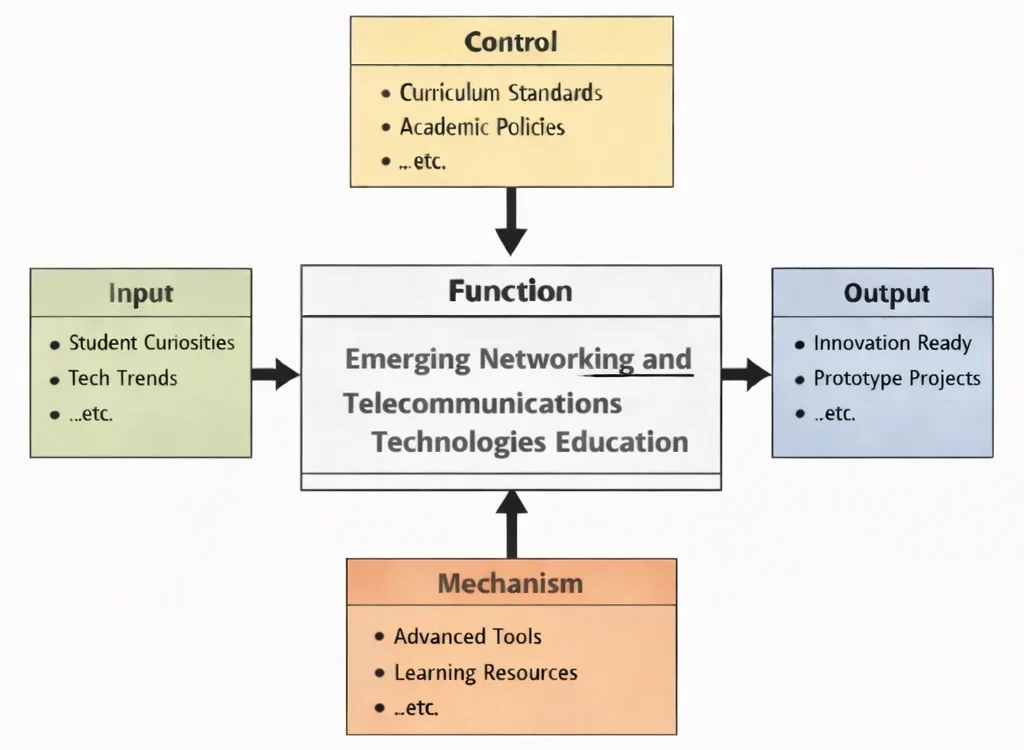
This IDEF0 diagram presents “Emerging Networking and Telecommunications Technologies Education” as a structured learning function. On the left, inputs such as student curiosities and current tech trends feed the educational process. From above, controls—curriculum standards and academic policies—shape what is taught, how learning is paced, and how competence is assessed. The function produces outputs on the right, including innovation-ready learners and prototype projects that demonstrate practical application. From below, mechanisms such as advanced tools and learning resources enable experimentation, rapid prototyping, measurement, troubleshooting, and iterative refinement.
Interactive Check: Intro & System Concepts
Verify your understanding of how curriculum controls, technical evidence, and prototyping mechanisms govern emerging telecom education:
Introductory Concept Verification
1. Why must educational standards anchor emerging technologies to fundamentals like signals, protocols, and performance metrics?
Answer: Novelty can be seductive; anchoring instruction in rigorous metrics (latency, throughput, resilience) prevents students from confusing marketing excitement with engineering truth.
2. What constitutes the primary operational outputs of Emerging Networking and Telecommunications Education?
Answer: Innovation-ready learners and prototype projects that prove students can design, test, instrument, and improve emerging solutions under real-world constraints.
Emerging technologies in networking and telecommunications are redefining how we connect, communicate, and share information in a digitally transformed world. These innovations are not just enhancing bandwidth and latency—they’re reshaping industries, enabling new applications, and addressing longstanding challenges in connectivity, efficiency, and security. From smart cities and 5G infrastructure to satellite internet and network virtualization, the evolution of networking technologies is a cornerstone of global digital transformation.
One of the critical enablers of next-generation networks is the integration of intelligent cybersecurity measures. The implementation of robust network security is fundamental to protecting complex communication infrastructures from attacks and disruptions. As devices proliferate across the Internet of Things (IoT), securing endpoints becomes increasingly crucial. These developments are supported by comprehensive cybersecurity policies and proactive techniques such as ethical hacking, which identify vulnerabilities before they can be exploited.
In tandem, the use of cryptography ensures that sensitive data remains secure during transmission across networks. Broader considerations of identity and access management are increasingly automated using cloud-native and AI-driven tools. When incidents do occur, timely incident response and forensics enable rapid mitigation and learning from breaches.
The digital ecosystem also depends on cutting-edge data practices. Data science and analytics underpin the optimization of network infrastructure, while big data analytics helps manage the massive datasets generated by connected devices. To harness these insights effectively, processes like data cleaning and preprocessing and efficient data collection and storage are essential. Visual tools provided by data visualization assist in interpreting trends and bottlenecks across networks.
Emerging network architectures are also being shaped by intelligence-driven insights. Domain-specific analytics inform how sectors like healthcare, finance, and manufacturing adopt networking innovations, while tools and technologies in data science power predictive maintenance, resource allocation, and adaptive quality of service. With increased adoption, ethical considerations grow more prominent, requiring awareness of ethical and social aspects such as digital equity, data sovereignty, and environmental impact.
Innovation continues at the intersection of security and emerging systems. Emerging areas in cyber security reflect how AI, quantum computing, and zero-trust models are being incorporated into networking infrastructure. In highly specialized fields, such as OT security for industrial networks or CPS security for smart grids, innovations address unique risk landscapes. These approaches are strengthened by real-time threat intelligence and enhanced system resilience.
Networking technology also plays a vital role in immersive and interactive environments. The development of connected entertainment platforms benefits from advances in game development and related areas like game engine development. Meanwhile, adaptive gameplay and non-player behavior are improved through artificial intelligence in games. Story-driven digital experiences are enriched by narrative design, supported by real-time updates enabled by advanced networking.
Finally, emerging networking technologies enable immersive experiences in virtual reality and augmented reality. These platforms demand ultra-low latency, high data throughput, and seamless synchronization, which push the boundaries of today’s networks and drive innovation toward tomorrow’s intelligent, ubiquitous, and adaptive communication systems.

This vibrant illustration presents a near-future telecommunications landscape where the city itself becomes a living network. Tall radio towers and rooftop antennas represent next-generation wireless infrastructure (such as 5G and beyond), while bright connection lines and floating interface icons suggest dense, always-on connectivity. Symbols for IoT devices and smart services appear across buildings and streets, hinting at sensor-rich environments, autonomous systems, and machine-to-machine communication. “Edge” cues imply computing and data processing moving closer to users and devices, reducing latency for real-time applications. The padlock icons woven into the scene emphasize that modern networks increasingly embed security, encryption, and identity protection as core design features rather than add-ons. Overall, the image captures the idea of networking and telecommunications evolving into a high-speed, distributed, intelligent ecosystem—linking people, devices, and services through fast wireless links, edge computing, and security-aware infrastructure.
Discover how Emerging Networking and Telecommunication Technologies drive 5G/6G infrastructures, quantum key distribution, edge computing, and AI-driven automation across the Networking and Telecommunication cluster.
Overview Hub
Presents foundational networking principles, packet routing, and the global telecommunication ecosystem.
Cloud Networking
Explores software-defined networking, hybrid multi-cloud fabrics, and edge data center interconnects.
Wireless & Mobile Communications
Covers cellular spectrum allocation, Wi-Fi evolution, and mobile device communications.
Telecommunication Systems & Standards
Covers global telecommunication infrastructure, regulatory standardization bodies, and carrier-grade switching networks.
Network Security
Details safeguarding next-generation distributed networks against sophisticated cyber threats and routing attacks.
Network Management & Administration
Focuses on network monitoring, configuration management, automated provisioning tools, and troubleshooting workflows.
Emerging Technologies
Focuses on 5G and 6G ultra-low latency wireless, quantum networking (QKD), edge computing distribution, and AI self-healing network management.
Internet & Web Technologies
Comprehensive guide on open web stacks, browser client-side execution, PWA service workers, and modern API integration patterns.
Network Architecture & Protocols
Explores OSI/TCP-IP reference models, OSPF and BGP routing algorithms, circuit vs. packet switching, and wireless protocols.
Data Transmission Technologies
Covers fiber optic light transmission, modulation techniques (AM/FM/PSK/QAM), and error detection coding (CRC, Hamming, Reed-Solomon).
Key Topics in Emerging Networking and Telecommunications Technologies
5G and 6G Networks: High-Speed, Low-Latency Wireless Communication
- 5G Networks:
- Represent the current pinnacle of wireless communication technology, offering speeds up to 100 times faster than 4G LTE.
- Features include ultra-low latency, enhanced capacity to connect billions of IoT devices, and support for high-bandwidth applications like 4K video streaming and augmented reality (AR).
- Applications:
- Smart cities: Real-time traffic monitoring and energy management.
- Autonomous vehicles: Seamless vehicle-to-vehicle (V2V) and vehicle-to-infrastructure (V2I) communication.
- Telemedicine: High-definition video consultations and remote robotic surgeries.
- 6G Networks:
- Expected to surpass 5G with speeds in the terabits-per-second range and latency reduced to milliseconds.
- Incorporates technologies like AI for adaptive network management and terahertz frequencies for greater data capacity.
- Applications:
- Holographic communication for remote collaboration.
- Real-time VR/AR experiences for education and entertainment.
- Integration with quantum computing and AI for advanced communication systems.
Quantum Networking: Utilizing Quantum Mechanics for Ultra-Secure Communication
- Overview: Quantum networking leverages quantum mechanics principles, such as entanglement and superposition, to enable ultra-secure data transmission.
- Quantum Key Distribution (QKD): Ensures secure encryption by generating keys using quantum properties.
- Quantum teleportation: Transmits quantum states over long distances for secure communication.
- Advantages:
- Immune to traditional eavesdropping techniques, as any interception of quantum keys disrupts their state and alerts the sender and receiver.
- Potential for unhackable communication networks.
- Applications:
- Finance: Securing financial transactions and sensitive communications.
- Government and Defense: Protecting classified information and infrastructure.
- Healthcare: Safeguarding patient data and medical records.
- Future Potential: Integration of quantum networks with classical communication systems to create hybrid secure networks for global applications.
Edge Computing: Reducing Latency by Processing Data Closer to Users
- Overview: Edge computing processes data at or near the source of data generation, reducing latency and bandwidth usage. By offloading data processing from centralized servers to edge devices, this technology ensures faster response times and localized decision-making.
- Advantages:
- Enhanced performance for latency-sensitive applications like autonomous vehicles and industrial automation.
- Reduced strain on centralized cloud infrastructure.
- Improved reliability in remote or bandwidth-constrained environments.
- Applications:
- Smart Cities: Real-time monitoring of traffic, energy usage, and public safety systems.
- Industrial IoT: Optimizing manufacturing processes and predictive maintenance of machinery.
- Healthcare: Supporting wearable devices for remote patient monitoring and real-time diagnostics.
- Future Trends: Edge computing is expected to converge with 5G and AI to create highly efficient and intelligent distributed networks.
AI and Machine Learning in Networking: Optimizing Network Management and Threat Detection
- Overview: AI and machine learning are revolutionizing networking by enabling intelligent decision-making and automation in network operations.
- AI algorithms analyze vast amounts of network data to detect anomalies, predict issues, and optimize performance.
- Machine learning models improve over time, adapting to changing network conditions and threats.
- Applications:
- Network Management: AI-driven tools automate tasks such as traffic routing, fault detection, and load balancing.
- Cybersecurity: Advanced threat detection systems identify and mitigate cyberattacks in real time.
- Optimization: AI-powered SDN ensures efficient bandwidth allocation and reduces latency.
- Future Potential:
- Self-healing networks capable of autonomously diagnosing and resolving issues.
- Integration of AI with edge computing for smarter, localized decision-making.
Applications of Emerging Technologies in Networking and Telecommunications
Smart Cities
- Emerging technologies enable interconnected systems that enhance urban living.
- Examples:
- Intelligent traffic management systems using 5G and edge computing to optimize traffic flow.
- IoT-powered waste management and energy-efficient street lighting.
- AI-based public safety systems for monitoring and responding to emergencies.
Autonomous Vehicles
- 5G and edge computing facilitate real-time communication between vehicles and infrastructure.
- Examples:
- Vehicle-to-Everything (V2X) communication ensures seamless navigation and safety.
- AI-based systems process massive amounts of sensor data for decision-making in self-driving cars.
Advanced Healthcare Systems
- Telemedicine and remote patient monitoring benefit from low-latency networks and edge computing.
- Examples:
- Wearable devices that monitor vital signs and transmit real-time data to healthcare providers.
- AI-powered diagnostic tools for early detection of diseases.
- Quantum-secure networks to protect sensitive patient information.
History, Challenges, and Future of Emerging Telecommunication Technologies
History and Evolution of Next-Generation Connectivity
The trajectory of emerging communication technologies evolved from experimental packet radio networks (ALOHAnet) and cellular voice standards (1G/2G) into high-speed mobile data packet architectures (3G/4G LTE). Over the past decade, the rollout of 5G introduced massive machine-type communications and ultra-reliable low-latency links (URLLC). Concurrently, academic and corporate research pioneered quantum key distribution and edge micro-datacenters to decentralize computational load away from legacy cloud hubs.
Current Technical & Operational Challenges
Deploying emerging wireless, quantum, and edge architectures introduces intricate engineering obstacles:
- Millimeter-Wave Propagation Constraints: High-frequency 5G and future 6G signals suffer severe path loss, attenuation from building foliage and rain, and require dense small-cell base station deployments.
- Quantum Decoherence and Distance Limits: Entangled photons degrade over long optical fiber transmission distances, necessitating quantum repeaters that remain technically challenging to manufacture at scale.
- Edge Resource Heterogeneity: Managing ephemeral, resource-constrained edge computing nodes distributed across diverse geographical hardware presents significant orchestration friction.
- AI Model Drift and Adversarial Evasion: Self-healing AI network controllers can experience catastrophic performance collapse or drift when subjected to novel, unforeseen traffic anomaly patterns.
Future Potentials & Emerging Paradigms
The horizon of emerging networking points toward pervasive ambient connectivity and unhackable physics:
- Ambient IoT & Energy-Harvesting Sensors: Billions of batteryless IoT sensors powered entirely by ambient radio frequency (RF) signals, light, or vibration.
- Global Quantum Satellite Mesh: Low-earth-orbit quantum satellite constellations establishing secure global quantum key distribution without terrestrial fiber distance limits.
- Cognitive Terahertz Sensing & Communication: Dual-purpose 6G networks that simultaneously stream multi-terabit data and perform high-resolution radar imaging of physical environments.
Why Study Emerging Network and Transmission Technologies
Staying Ahead of the Curve
Emerging technologies such as 5G, Li-Fi, and quantum communication are reshaping connectivity. Studying them prepares students to anticipate and lead the next wave of advancements.
Innovation Through Research
Students learn to evaluate novel systems and explore their implications on bandwidth, latency, and security—key to future-proofing infrastructure in smart cities and industrial automation.
Opportunities in Cutting-Edge Sectors
Expertise in these technologies is in demand in defense, autonomous systems, and future internet development projects.
Interactive Quick Review: Next-Gen Architectures
Reinforce key concepts regarding 5G/6G speeds, quantum key distribution, and edge computing before reviewing the FAQ:
Quick Review Verification
1. How does Quantum Key Distribution (QKD) provide absolute eavesdropping protection?
Answer: QKD uses quantum mechanics (such as photon polarization states). According to the Heisenberg uncertainty principle, any attempt by an eavesdropper to measure or intercept the photons alters their quantum state, immediately exposing the intrusion.
2. What is the primary operational advantage of Edge Computing over centralized cloud architecture?
Answer: Edge computing processes data locally at or near the generation source, dramatically reducing backhaul propagation latency and conserving central cloud bandwidth for time-sensitive applications like autonomous driving.
Future Outlook of Emerging Technologies in Networking and Telecommunications
Emerging technologies in networking and telecommunications are not just reshaping existing systems but also creating entirely new paradigms of connectivity. The convergence of 5G, 6G, quantum networking, edge computing, and AI will enable networks to be faster, smarter, and more secure than ever before. These innovations will continue to drive progress in diverse fields, from creating more sustainable and efficient cities to ensuring safer and more connected transportation systems and revolutionizing global healthcare. As these technologies mature, they will lay the foundation for the next era of communication and connectivity.
End-of-Page Exercises: Review, Thought-Provoking & Engineering Problems
Review Questions and Answers
1. What are emerging network and transmission technologies and why are they significant?
Answer: Advanced solutions like 5G/6G, IoT, SDN, quantum communication, and edge computing that enhance speed, capacity, and security to support massive data flows and digital transformation.
2. How does 5G technology improve data transmission in modern networks?
Answer: By offering higher bandwidth, ultra-low latency, and massive device density capacity, enabling real-time IoT, autonomous vehicles, and remote telemedicine.
3. What is Software-Defined Networking (SDN) and how does it transform network management?
Answer: SDN decouples the control plane from the data plane, enabling centralized, programmable software management that automates routing configuration and speeds up service deployment.
4. How do IoT and edge computing enhance global network connectivity?
Answer: Decentralizing data processing to the edge minimizes backhaul traffic and reduces response latency, enabling instant local decision-making for smart city sensors.
5. What is quantum communication and what role does it play in enhancing network security?
Answer: Uses quantum mechanics (like QKD) to generate unhackable encryption keys, instantly alerting parties if eavesdroppers attempt interception.
6. How do cloud-based infrastructures contribute to the efficiency and scalability of modern networks?
Answer: By supplying flexible, on-demand compute and storage resources that eliminate upfront hardware costs and support instant global scaling.
7. What challenges do emerging transmission technologies face in real-world deployments?
Answer: Legacy system interoperability, high infrastructure upgrade costs, environmental signal attenuation, and strict regulatory hurdles.
8. How does latency affect overall network performance and user experience?
Answer: High latency causes sluggish application responsiveness, video call buffering, and gaming input lag, undermining real-time interactive experiences.
9. What role do emerging communication protocols play in advancing data transmission technologies?
Answer: Standardizing methods for high-speed, secure data exchange, improving error correction, optimizing bandwidth, and ensuring multi-vendor system interoperability.
10. How will the convergence of traditional and emerging networking technologies shape the future of global communication?
Answer: Creating robust hybrid networks that blend established infrastructure reliability with 5G, SDN, and quantum security to meet expanding digital demands.
Thought-Provoking Questions and Answers
1. How will the integration of 5G and edge computing redefine data transmission and network efficiency?
Answer: By bringing processing nodes to the network perimeter, data is analyzed locally without traversing central cloud backhauls, maximizing real-time efficiency for IoT and autonomous systems.
2. What potential ethical issues might arise from the widespread adoption of quantum communication in telecommunication networks?
Answer: Unprecedented encryption capabilities could widen the global digital divide if monopolized by wealthy states, while raising deep wiretapping and state surveillance privacy debates.
3. How can network virtualization technologies such as SDN and NFV drive innovation in global telecommunication infrastructures?
Answer: Decoupling network services from physical hardware allows telecom operators to provision virtual routers and firewalls via software APIs instantly, lowering barriers to service innovation.
4. What are the key challenges in implementing cloud networking solutions for global communication, and how can they be overcome?
Answer: Latency across geography and data security risks. Overcome via advanced encryption protocols, optimized routing algorithms, and strategically placed CDNs.
5. How can emerging IoT technologies be integrated into cloud networking to improve data transmission and connectivity?
Answer: Aggregating sensor streams at edge gateways before transmitting filtered summaries to centralized cloud repositories, conserving WAN bandwidth.
6. What impact do you foresee from the convergence of satellite and terrestrial networks on global data transmission?
Answer: LEO satellite constellations acting as seamless wireless backhauls will eradicate remote dead zones, unifying global broadband coverage.
7. How might advancements in encryption and security protocols reshape data transmission in high-speed networks?
Answer: Ensuring that gigabit data pipes remain secure against modern interception without introducing hardware processing bottlenecks.
8. What future innovations in network hardware could further boost data transmission capabilities?
Answer: Silicon photonics integration on computer motherboards, multi-core spatial division fibers, and terahertz wireless transceivers.
9. How can network analytics tools be used to predict and mitigate potential issues in data transmission?
Answer: Machine learning models analyze historical telemetry to forecast hardware degradation and traffic surges, enabling automated preventive traffic rerouting.
10. What impact will emerging communication protocols have on the evolution of data transmission technologies?
Answer: Streamlining header overhead and improving congestion control algorithms to extract maximum throughput from optical and wireless links.
11. How might regulatory changes in telecommunications impact the deployment of emerging network technologies?
Answer: Evolving compliance mandates dictate strict spectrum licensing rules and mandatory data localization, shaping how cross-border cloud and telecom architectures are engineered.
12. How can the evolution of cloud networking and edge computing shape the future of global data transmission?
Answer: Creating a unified, intelligent distributed fabric where applications execute seamlessly across edge nodes and hyperscale data centers without regard to physical distance.
Numerical Engineering Problems & Solutions
Problem 1: Cloud Network Hourly & Daily Transmission Volume
A cloud network transmits data at 100 Mbps. Calculate total data transmitted in one hour in gigabytes (GB), total in 24 hours, and average data transmitted per minute.
Solution:
- Data per second = 100 Mbps = 100 × 106 bits/sec
- Data per hour = 100 × 106 × 3,600 = 360 × 109 bits
- Convert to GB: 360 × 109 ÷ (8 × 10⁹) = 45 GB
- Data per day = 45 GB × 24 = 1,080 GB
- Average per minute = 1,080 GB ÷ 1,440 min = 0.75 GB/min
Problem 2: High-Frequency Router Packet Processing Load
A router processes 2,000 packets per second. Calculate the number of packets processed per minute, per hour, and per day (24 hours).
Solution:
- Packets per minute = 2,000 × 60 = 120,000 packets/min
- Packets per hour = 120,000 × 60 = 7,200,000 packets/hour
- Packets per day = 7,200,000 × 24 = 172,800,000 packets/day
Problem 3: Telecommunication Link Total Data & Rate
A telecommunication link operates at 75 Mbps. For an 8-hour period, calculate total data transmitted in gigabytes (GB) and average data rate in MB per minute.
Solution:
- Data per second = 75 Mbps = 75 × 106 bits/sec
- Total bits in 8 hours = 75 × 106 × 8 × 3,600 = 2.16 × 1012 bits
- Convert to GB: 2.16 × 10¹² ÷ (8 × 10⁹) = 270 GB
- Average per minute = (270 GB × 1,000 MB/GB) ÷ 480 min = 270,000 MB ÷ 480 = 562.5 MB/min
Problem 4: Fiber Optic Distance Latency Comparison
A fiber optic cable has a latency of 4 ms per 100 km. Calculate latency for 800 km, for 1,500 km, and determine the difference between these two latencies.
Solution:
- Latency rate = 4 ms ÷ 100 km = 0.04 ms/km
- Latency for 800 km = 800 × 0.04 = 32.0 ms
- Latency for 1,500 km = 1,500 × 0.04 = 60.0 ms
- Difference = 60.0 ms – 32.0 ms = 28.0 ms
Problem 5: Packet Loss Rate & Successful Transmission
A network experiences a packet loss rate of 0.2% (0.002). If 5,000,000 packets are transmitted, calculate lost packets, successful packet transmissions, and overall success percentage.
Solution:
- Lost packets = 5,000,000 × 0.002 = 10,000 packets
- Successful packets = 5,000,000 – 10,000 = 4,990,000 packets
- Success percentage = (4,990,000 ÷ 5,000,000) × 100 = 99.8%
Problem 6: Wireless Access Point Transfer Volume
A wireless access point transmits at 250 Mbps. Calculate total data transmitted in 15 minutes (900 seconds) in megabytes (MB). (Note: 1 MB = 8 Megabits).
Solution:
- Data rate per second = 250 Megabits/sec
- Total bits in 15 minutes = 250 Mb/sec × 900 sec = 225,000 Megabits
- Convert Megabits to Megabytes: 225,000 Mb ÷ 8 bits/Byte = 28,125 MB
Problem 7: Network Monitoring Tool Log Accumulation
A network monitoring tool logs 500,000 events per hour. Calculate total events logged in one day, in one week (7 days), and average events per minute over the week.
Solution:
- Events per day = 500,000 × 24 = 12,000,000 events/day
- Events per week = 12,000,000 × 7 = 84,000,000 events/week
- Average per minute = 84,000,000 events ÷ (7 × 24 × 60 min) = 84,000,000 ÷ 10,080 = 8,333.33 events/min
Problem 8: Bandwidth Upgrade Additional Transfer Volume
A network upgrade increases bandwidth from 120 Mbps to 180 Mbps. Calculate percentage bandwidth increase, additional throughput in Mbps, and additional data transmitted in 1 hour in GB.
Solution:
- Percentage increase = ((180 – 120) ÷ 120) × 100 = 50.0%
- Additional bandwidth rate = 180 – 120 = 60 Mbps = 60 × 106 bits/sec
- Additional data in 1 hour = 60 × 106 bits/sec × 3,600 sec = 216 × 109 bits
- Convert to GB: 216 × 109 ÷ (8 × 10⁹) = 27 GB
Problem 9: Latency Reduction Percentage & Absolute Savings
A network’s average latency is measured at 20 ms. An optimization reduces latency by 30% (0.30). Calculate new average latency, absolute reduction in milliseconds, and percentage decrease.
Solution:
- New average latency = 20 ms × (1 – 0.30) = 20 × 0.70 = 14.0 ms
- Absolute reduction = 20 – 14 = 6.0 ms
- Percentage decrease = (6 ÷ 20) × 100 = 30.0%
Problem 10: High-Frequency Router Packet Accumulation
A router transmits 2,500 packets per second. Calculate total packets transmitted per minute, per hour, and per day (24 hours).
Solution:
- Packets per minute = 2,500 × 60 = 150,000 packets/min
- Packets per hour = 150,000 × 60 = 9,000,000 packets/hour
- Packets per day = 9,000,000 × 24 = 216,000,000 packets/day
Problem 11: Telecom Subscriber Monthly & Annual Usage
A telecom provider serves 18,000 subscribers, each consuming 2 GB of data per month. Calculate total monthly data usage, annual usage, and average annual data usage per subscriber.
Solution:
- Total monthly usage = 18,000 subscribers × 2 GB = 36,000 GB/month
- Total annual usage = 36,000 GB × 12 months = 432,000 GB/year
- Average annual usage per subscriber = 432,000 GB ÷ 18,000 = 24.0 GB/subscriber/year
Problem 12: Monitoring System Critical Anomaly Metrics
A network monitoring system processes 800,000 logs per day. If 0.1% (0.001) of these logs indicate critical issues, calculate critical logs per day, per 30-day month, and critical log percentage.
Solution:
- Critical logs per day = 800,000 × 0.001 = 800 logs/day
- Critical logs per month (30 days) = 800 × 30 = 24,000 logs/month
- Critical log percentage = (800 ÷ 800,000) × 100 = 0.1%
Network & Transmission Emerging Technologies — Summary & Wrap-Up
Emerging Networking and Telecommunications Technologies represent the cutting edge of digital connectivity. By harnessing 5G/6G ultra-low latency air interfaces, quantum key distribution (QKD) physics, localized edge computing architectures, and self-healing AI network management, communications engineers build intelligent, highly secure, and ultra-fast networks that fuel the future of smart cities, autonomous vehicles, and global digital transformation.