Prepare for University Studies & Career Advancement
Artificial Intelligence in Games
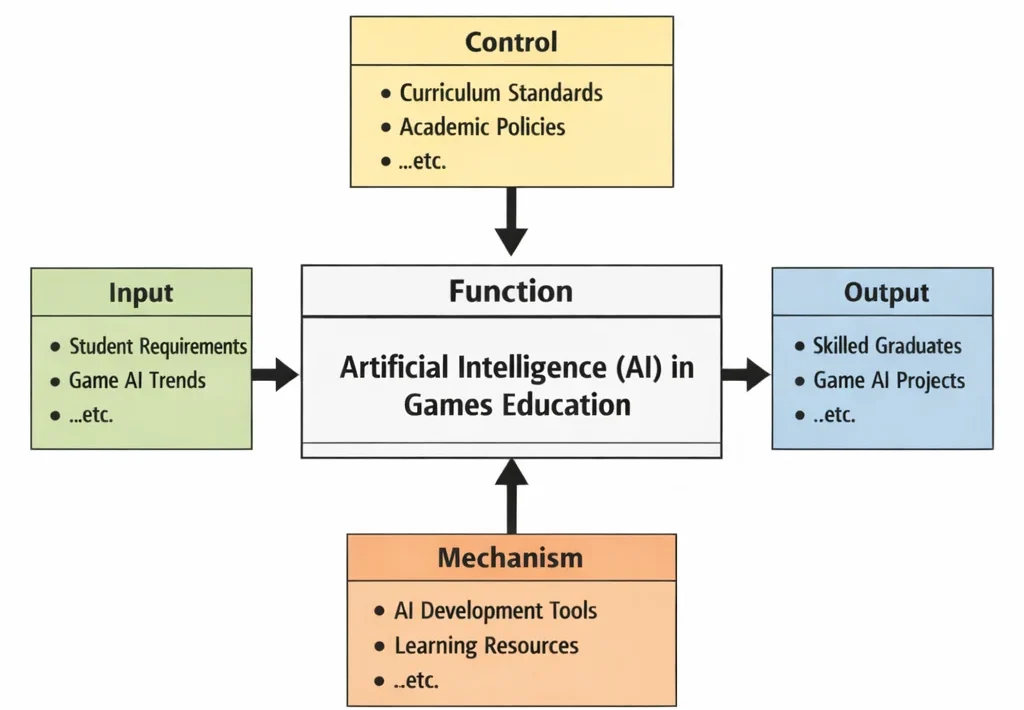
Artificial Intelligence (AI) in Games Education sits at a fascinating crossroads: it teaches students how to make games feel alive, while also teaching them to think carefully about what “intelligence” should mean inside a designed world. The diagram makes the logic visible. Learners bring needs, backgrounds, and aspirations; the industry brings moving targets—new AI techniques, new player expectations, new debates about automation and creativity. These inputs keep the curriculum grounded in reality rather than in theory alone.
But games are not just technology—they are experiences, and experiences can be shaped responsibly or carelessly. That is why controls matter. Standards and policies act like a quiet referee: they keep the learning journey coherent, prevent the work from becoming “random clever demos,” and insist on clarity—fair evaluation, safe experimentation, and ethical design choices, for example, how AI influences player behavior, difficulty, or in-game economies.
The mechanisms are where the classroom becomes a workshop. With the right tools, frameworks, datasets, and guided resources, students can build agents, tune behaviors, test outcomes, and learn the essential habit of iteration: observe, adjust, and refine. When the function succeeds, the outputs are concrete and persuasive—graduates who understand both the engineering and the design intent of game AI, and portfolio projects that show not only what they built, but why it works for players.
IDEF0 snapshot of AI in Games Education—guided by standards, powered by tools, and measured by projects and graduate capability.
This IDEF0 diagram frames “Artificial Intelligence (AI) in Games Education” as a disciplined learning process. Inputs such as student requirements and current game AI trends enter from the left, while controls—curriculum standards and academic policies—arrive from above to steer scope, sequencing, ethics, and assessment. The function produces outputs on the right, including skilled graduates and completed game AI projects. Underneath, mechanisms such as AI development tools and learning resources enable hands-on experimentation, implementation, testing, and iteration within practical development environments.
Interactive Check: Intro & System Concepts
Verify your understanding of how game AI balances algorithmic logic with player experience design:
Introductory Concept Verification
1. Why is Game AI defined as balancing engineering capability with “design intent”?
Answer: Unlike academic AI that seeks absolute mathematical optimality or perfect play, game AI is designed to create fun, believable, and manageable challenges for human players within strict real-time frame budgets.
2. What function do curriculum standards and academic policies serve as “Controls” in AI Game Education?
Answer: Controls prevent learning from turning into disconnected code demos by enforcing clear pedagogical sequencing, fair assessment rules, and ethical considerations surrounding difficulty balancing and player manipulation.
Artificial Intelligence (AI) in games plays a pivotal role in crafting dynamic and responsive gameplay experiences. From adaptive enemies to procedural storytelling, AI enhances the realism and challenge of virtual worlds. Game developers combine principles from data science and analytics with domain-specific design to create believable non-player characters (NPCs), intelligent behavior trees, and real-time decision-making engines. These systems are tightly interwoven with game engine development, enabling smoother integration and more efficient processing of AI tasks within game environments.
One major application of AI is in designing context-aware agents that respond intelligently to players’ actions. This requires substantial work in data analysis and domain-specific analytics to track player decisions and adjust difficulty or narrative progression accordingly. Story-driven titles especially benefit from the integration of narrative design and AI, enabling personalized plotlines or emotional responses from characters.
AI in games does not just stay in the digital world—it increasingly interacts with virtual reality and augmented reality, enabling immersive simulations that react in real time to user gestures and speech. These advanced systems are secured through best practices in cybersecurity, particularly when games connect across devices and cloud platforms.
Understanding the foundations of security—like cryptography and identity and access management—is critical when AI-powered games store player data or use machine learning algorithms trained on user-generated content. AI systems must also be evaluated through the lens of ethical and social aspects, ensuring fair and inclusive design practices.
To protect gaming environments from exploitation, developers incorporate techniques from ethical hacking and threat intelligence. For example, AI bots may be used in both offense and defense during cyber exercises. In industrial gaming environments or smart consoles, operational technology (OT) security and CPS security help safeguard embedded AI modules.
Game studios must also anticipate post-release threats. AI modules may be subject to abuse or tampering, requiring preparedness in incident response and forensics. In multiplayer settings, endpoint security and network security maintain fair play and protect against automated cheating systems.
AI in games is also informed by wider developments in emerging areas in cybersecurity, where predictive algorithms, adversarial learning, and anomaly detection techniques are adapted from enterprise security to gaming use cases. To ensure responsible deployment, studios must align with cybersecurity policy and compliance standards.
Ultimately, integrating AI into games requires collaboration across specialties—combining game development and secure infrastructure with intelligent systems. The result is gameplay that is not only more immersive but also continually evolving to meet the expectations of today’s players.
Artificial Intelligence in Games: teaching virtual worlds to react, adapt, and feel alive.
This image visualizes how artificial intelligence powers behavior inside modern games. In the foreground, two creators work at computers, suggesting the “behind-the-scenes” building and tuning of AI systems—coding logic, training models, testing behaviors, and adjusting difficulty or balance. The center stage is a game-like arena where multiple characters move and interact around a luminous sphere labeled with AI, symbolizing the decision-making engine that drives NPC actions such as chasing, hiding, cooperating, or navigating obstacles. Floating network patterns and glowing orbs evoke machine learning, perception, and pattern recognition, while the layered interface graphics hint at data, parameters, and real-time analytics used during development. The golden “intelligence” motif in the background suggests higher-level planning—strategies, goals, and adaptive tactics that make gameplay unpredictable yet fair. Overall, the artwork conveys AI in games as a blend of programming, simulation, and learning systems that create believable opponents, helpful companions, and dynamic worlds that respond to player choices.
Building Cyber Resilience: AI in Games Navigation
Discover how Artificial Intelligence powers decision-making, pathfinding, procedural generation, and adaptive difficulty across the Game Development cluster. Each card details finite state machines, behavior trees, machine learning models, and automated playtesting frameworks.
Presents the overarching game architecture, mapping how real-time AI decision loops integrate with physics engines, rendering pipelines, and input handling.
Covers spatial AI agent perception, 3D audio-visual sensing cones, and reactive virtual characters within immersive XR spaces.
Definition of AI in Games
Artificial Intelligence in games refers to the use of computational systems to simulate human-like behaviors, decision-making, and responses in NPCs and game mechanics.
Core Objectives of AI in Games
Enhance Immersion:
Create believable NPCs and dynamic environments.
Challenge Players:
Adapt gameplay difficulty to individual skill levels.
Increase Replayability:
Generate procedurally varied content for unique experiences.
Streamline Development:
Automate complex systems like level generation and testing.
Key Components of AI in Games
NPC Behavior
Definition: AI-driven NPCs simulate human-like decision-making, interaction, and movement within the game world.
Key Techniques:
Finite State Machines (FSMs): Define NPC behaviors based on states (e.g., idle, attack, flee).
Behavior Trees: Hierarchical structures that organize NPC actions logically.
Pathfinding Algorithms: Enable NPCs to navigate environments efficiently using techniques like A*.
Applications:
NPCs that dynamically react to player actions in combat scenarios.
Intelligent companions that assist players in achieving objectives.
Examples:
The Last of Us NPCs adapting their strategies based on the player’s behavior.
Guards in Metal Gear Solid using pathfinding and vision cones for stealth detection.
Adaptive Gameplay
Definition: Systems that adjust game difficulty, mechanics, or narrative elements based on player actions and performance.
Key Techniques:
Dynamic Difficulty Adjustment (DDA): Modifying gameplay parameters to match player skill levels.
Procedural Storytelling: Altering narratives based on player choices.
Reinforcement Learning: AI learns optimal strategies during gameplay.
Applications:
Games that become more challenging as players improve.
Personalized story outcomes based on in-game decisions.
Examples:
Resident Evil 4 dynamically adjusting enemy behavior based on player performance.
Mass Effect offering branching narratives influenced by player actions.
Procedural Content Generation (PCG)
Definition: AI generates game content such as levels, maps, and quests in real-time or during development.
Key Techniques:
Algorithmic World Building: Creating expansive worlds with randomized elements.
Quest Generation Systems: Designing unique objectives based on gameplay context.
Infinite levels or worlds for exploration-based games.
Reducing development time by automating repetitive tasks.
Examples:
The procedurally generated universe of No Man’s Sky.
Randomized dungeons in Diablo III.
AI in Game Testing
Definition: Automating the quality assurance (QA) process to identify bugs, balance gameplay, and stress-test systems.
Key Techniques:
Bot Players: AI bots simulate human players to test game mechanics.
Automated Playthroughs: Identifying edge cases and errors in level design.
Analytics-Driven Testing: Using AI to analyze player behavior and feedback.
Applications:
Identifying game-breaking bugs before release.
Testing multiplayer balance and matchmaking systems.
Examples:
AI testing tools used in Ubisoft’s large-scale game launches.
Automated bot testing in mobile games to evaluate difficulty curves.
Technologies Driving AI in Games
Machine Learning
AI learns and adapts to improve game mechanics, NPC behavior, and procedural content generation.
Examples: Reinforcement learning algorithms creating adaptive enemies in StarCraft II.
Neural Networks
Used for pattern recognition and decision-making in AI systems.
Examples: Neural networks powering dynamic lighting and animations in Unreal Engine games.
Natural Language Processing (NLP)
Enables realistic conversations and interactions between players and NPCs.
Examples: Dialogue systems in Detroit: Become Human using NLP to enhance storytelling.
Physics-Based AI
AI that integrates real-world physics for realistic movement and interactions.
Examples: Realistic ball trajectories in sports games like FIFA.
Applications of AI in Games
Storytelling and Narrative Design
AI creates dynamic, branching narratives that respond to player decisions.
Examples: Red Dead Redemption 2’s NPCs reacting to the player’s actions and reputation.
Combat Systems
Intelligent enemies adapt strategies, flank players, and utilize the environment during battles.
Examples: Enemies in Halo games using coordinated tactics against players.
Open World Exploration
AI populates worlds with NPCs exhibiting varied routines and interactions.
Examples: Grand Theft Auto V’s realistic pedestrian and traffic behaviors.
Multiplayer and Co-op Experiences
AI bots enhance multiplayer modes by simulating human-like teammates or opponents.
Examples: AI companions in Left 4 Dead assisting players during missions.
History and Evolution of Game AI
Game AI began as simple deterministic rule sets in early arcade games (such as ghost movement patterns in Pac-Man and basic paddle tracking in Pong). As arcade and console hardware advanced in the 1990s, developers introduced Finite State Machines (FSMs) and rule-based decision trees to simulate patrol, chase, and attack behaviors in titles like Doom and Half-Life. The 2000s saw the widespread adoption of A* Pathfinding over baked navigation meshes (NavMesh) and Goal-Oriented Action Planning (GOAP) (pioneered in F.E.A.R.), allowing NPCs to dynamically select actions to achieve tactical goals. Over the past decade, industry standards shifted toward Behavior Trees and Utility AI to construct scalable, modular decision systems across expansive open worlds.
Challenges in AI Development for Games
Balancing Realism and Performance:
Complex AI systems can strain processing power, impacting gameplay performance.
Unpredictable Player Behavior:
Designing AI to handle unexpected player actions while maintaining immersion.
Development Costs:
Creating sophisticated AI systems can be resource-intensive and time-consuming.
Avoiding Overcomplication:
Ensuring AI remains engaging without frustrating players by being too difficult or overly simplistic.
Emerging Trends in Game AI
Emotionally Intelligent NPCs
AI that simulates emotions to deepen player-NPC interactions.
Examples: NPCs in The Sims reacting dynamically to player actions and game events.
AI-Driven Game Design
AI assists developers by generating game prototypes, levels, and mechanics.
Examples: Procedural quest design tools in The Elder Scrolls series.
Ethical AI in Games
Addressing representation, fairness, and moral choices in AI-driven narratives.
Examples: Games like Papers, Please challenging players with ethical dilemmas.
AI in Immersive Technologies
Integrating AI with VR/AR to create interactive and adaptive experiences.
Examples: AI-driven NPCs in VR games like Half-Life: Alyx.
Why Study Artificial Intelligence in Games
Creating Smarter and More Immersive Game Experiences
Artificial Intelligence (AI) plays a central role in making games more interactive, realistic, and challenging. For students preparing for university, studying AI in games introduces them to how non-player characters (NPCs) behave intelligently, adapt to player actions, and respond to dynamic environments. This knowledge enhances both storytelling and gameplay, making it a vital skill in modern game development.
Understanding Core AI Concepts Through Interactive Systems
Game AI provides a practical, hands-on way to learn foundational AI techniques such as pathfinding, decision trees, finite state machines, behavior trees, and machine learning. By implementing these algorithms in game settings, students gain a clearer understanding of abstract concepts and how they apply to real-time, resource-constrained environments. This bridges the gap between theoretical AI and its practical applications.
Enhancing Problem-Solving and System Design Skills
Designing AI for games challenges students to think strategically about systems design, resource efficiency, and player psychology. Whether crafting believable enemies or developing adaptive opponents, learners must balance complexity with playability. This process sharpens their logic, creativity, and debugging skills—abilities that are transferable to a wide range of technology and design disciplines.
Exploring the Intersection of AI, Human Behavior, and Creativity
AI in games isn’t just about mechanics—it’s also about emotion, strategy, and storytelling. Students study how to simulate human-like behavior, create engaging interactions, and build narratives shaped by player choices. This blend of technical skill and human insight prepares students to design experiences that feel meaningful and personalized, expanding their capacity for creative innovation.
Preparing for Careers in Gaming and Intelligent Systems
Knowledge of game AI supports roles in game programming, AI development, simulation design, and robotics. It also lays the foundation for advanced study in computer science, cognitive science, and machine learning. For university-bound learners, studying AI in games offers a compelling and enjoyable pathway into one of the most rapidly evolving areas of technology and entertainment.
Reinforce key concepts regarding A* pathfinding, behavior trees, and dynamic difficulty adjustment before reading the FAQ:
Quick Review Verification
1. How does A* Pathfinding determine the optimal path across a NavMesh or grid map?
Answer: A* calculates node costs using the evaluation formula f(n) = g(n) + h(n), where g(n) represents the exact movement cost from the start node to current node n, and h(n) represents the estimated heuristic distance from n to the goal.
2. What advantage do Behavior Trees offer over traditional Finite State Machines (FSMs)?
Answer: Behavior Trees provide a hierarchical, modular structure composed of Composites, Decorators, and Leaf actions. Unlike FSMs (which suffer from state-explosion as transitions scale quadraticly), Behavior Trees allow modular reuse and easier expansion of complex NPC logic.
Frequently Asked Questions about Artificial Intelligence in Games
What does artificial intelligence in games actually mean?
Artificial intelligence in games refers to techniques used to simulate responsiveness and intelligent behavior in NPCs and game mechanics. In commercial games, the goal is creating believable, challenging, and fun interactions rather than real-world general intelligence.
How is AI in games different from academic AI or data science?
Game AI operates under strict real-time frame budgets (milliseconds), prioritizing predictable, tunable player experiences over mathematical optimality or large-scale data modeling.
Do I need strong mathematics and programming skills to study AI in games?
Yes, foundations in linear algebra, graph theory, logic, and languages like C++ or C# are essential for coding pathfinding algorithms, NavMesh traversal, and decision trees.
What are some classic AI techniques used in games?
Finite State Machines (FSMs), Behavior Trees, Utility AI, Goal-Oriented Action Planning (GOAP), and A* Pathfinding.
How are machine learning and data-driven methods used in modern games?
Machine learning is applied in player behavioral modeling, anti-cheat detection, automated playtesting QA, procedural content generation, and matchmaking balance.
What tools and engines can I use to start experimenting with AI in games?
How can I build a portfolio that highlights my interest in AI for games?
Develop focused prototypes showcasing specific techniques: a stealth enemy vision-cone patrol system, an A* maze solver, or a tactical squad combat bot.
What university majors and careers can AI in games lead to?
Majors in Computer Science, Game Engineering, and AI. Careers include AI Gameplay Programmer, Systems Designer, Tools Developer, and Simulation Engineer.
AI in Games: Conclusion
Artificial Intelligence has become a cornerstone of modern game development, driving innovations in NPC behaviors, adaptive gameplay, and procedural content generation. From creating lifelike characters to tailoring experiences to individual players, AI enhances immersion, challenge, and replayability. As technology continues to evolve, AI’s role in gaming will expand further, reshaping how developers create games and how players experience them. Through advancements in machine learning, neural networks, and procedural systems, the potential of AI in games is limitless, promising an exciting future for interactive entertainment.
1. What is artificial intelligence in games and why is it important?
Answer: Artificial intelligence in games refers to algorithms used to simulate responsive behavior in non-player characters and dynamic environments. It is vital because it creates immersion, adaptive challenge, and replayability for players.
2. How does AI improve non-player character (NPC) behavior in video games?
Answer: By enabling NPCs to evaluate game state variables, track sound/visual perception cones, navigate complex geometry via A*, and execute tactical actions using Behavior Trees or Utility rules.
3. What are the common AI techniques used in game development?
Answer: Finite State Machines (FSMs), Behavior Trees, A* Pathfinding, Utility AI, Goal-Oriented Action Planning (GOAP), and Reinforcement Learning.
4. How does procedural content generation (PCG) benefit game development through AI?
Answer: PCG automates the creation of expansive levels, maps, dungeons, and item layouts using mathematical rules, drastically expanding replayability while cutting manual art asset costs.
5. How can machine learning techniques be applied to improve gameplay experiences?
Answer: Machine learning analyzes telemetry to adjust Dynamic Difficulty Adjustment (DDA) parameters in real time, balancing opponent challenge against player skill level.
6. What role does AI play in enhancing adaptive gameplay and dynamic game environments?
Answer: AI monitors player performance metrics (accuracy, health loss rates) and dynamically modulates enemy spawning, item drops, and encounter aggressiveness.
7. How do pathfinding algorithms contribute to game AI, and what are their key benefits?
Answer: Pathfinding algorithms (like A*) compute efficient movement routes across 3D NavMeshes, allowing agents to navigate complex terrain and bypass obstacles without getting stuck.
8. How can AI be used to generate intelligent decision-making processes for in-game scenarios?
Answer: By weighting multiple environmental utility factors (health, ammunition, proximity to cover), allowing AI squadmates or enemies to choose tactical maneuvers dynamically.
9. What are some challenges developers face when implementing AI in games?
Answer: Managing frame-budget CPU limits, debugging non-deterministic behaviors, preventing AI from being unbeatable, and handling edge cases in open worlds.
10. How does the use of AI in game development influence the overall player experience?
Answer: It turns static visual worlds into responsive, organic spaces where characters react realistically to choices, maintaining player engagement and emotional investment.
Thought-Provoking Architectural Questions
1. How will the integration of advanced AI algorithms transform the future of game development?
Answer: Generative AI and deep reinforcement learning will automate level design, enable unscripted natural voice conversations with NPCs, and allow dynamic game world generation tailored to individual player choices.
2. What are the potential ethical implications of using AI in game development concerning player data?
Answer: Continuous telemetry harvesting for AI training can infringe on privacy if personal user data or behavioral profiles are exploited for predatory monetization or psychological manipulation without explicit consent.
3. In what ways can AI-driven game development foster creativity and innovation in game design?
Answer: Automating tedious QA bug-hunting and routine asset creation frees human designers to experiment with novel mechanics, complex narrative branching, and creative world-building.
4. How might emerging technologies like VR and AR work in tandem with AI in game development?
Answer: AI processes spatial gaze tracking, physical hand gesture inputs, and real-time environment mapping, enabling virtual agents in VR/AR to react naturally to human physical body language.
5. How can game developers ensure that AI-driven features contribute positively to UX without overshadowing core gameplay?
Answer: By designing AI as a supporting pillar that creates agency and readable telegraphing rather than automating player interactions or creating frustrating, unpredictable obstacles.
6. What are the key challenges in integrating AI systems into game development pipelines?
Answer: Cross-platform CPU thread allocation, maintaining deterministic logic across multiplayer netcode, and ensuring AI state machines integrate smoothly with animation trees.
7. How can data collected from player interactions be used to improve AI in game development?
Answer: Heatmaps and telemetry logs reveal where players get stuck or exploit AI pathfinding flaws, allowing designers to tune decision tree weights and NavMesh node density.
8. What impact could the development of ethical guidelines for AI in games have on the industry?
Answer: Standards will prevent manipulative Dynamic Difficulty Adjustment (DDA) designed to push microtransactions, enforcing transparency in matchmaking algorithms and content safety.
9. How might the convergence of AI and procedural content generation revolutionize game design?
Answer: Enables infinite, unique game worlds where terrain, ecosystem behavior, side-quests, and character dialogues are synthesized dynamically based on player playstyles.
10. How can game developers balance technical innovation with user experience in AI-driven game features?
Answer: By prioritizing player readability—ensuring complex AI tactical shifts are clearly telegraphed to the player through visual cues and audio callouts.
11. What strategies ensure that AI in game development remains unbiased and fair to all players?
Answer: Auditing training datasets for diverse demographics, testing AI difficulty curves across broad skill buckets, and preventing “input-reading” cheat mechanics in enemy AI logic.
12. How might future advancements in AI change the ethical and social considerations in game development?
Answer: As NPCs acquire hyper-realistic LLM voice and emotional capabilities, developers must establish safeguards against digital addiction, parasocial attachment, and abusive user interactions.
Numerical Engineering Problems & Solutions
Problem 1: Monthly & Annual AI Training Dataset Volume A game development studio collects 8,000,000 user interaction records per month. If 4% (0.04) of these records are used for AI training, calculate monthly training records, annual training volume (12 months), and confirm average monthly usage.
Solution:
Monthly training records = 8,000,000 × 0.04 = 320,000 records/month
Annual training volume = 320,000 × 12 = 3,840,000 records/year
Average monthly usage = 3,840,000 ÷ 12 = 320,000 records/month
Answer: Studio processes 320,000 AI training records monthly, totaling 3,840,000 records annually.
Problem 2: Machine Learning Prediction Accuracy & Error Rate A machine learning model for NPC behavior classification is trained on a dataset of 500,000 samples and achieves an accuracy rate of 90% (0.90). Calculate correctly predicted samples, misclassified samples, and misclassification percentage.
Answer: Model predicts 450,000 samples correctly, leaving 50,000 misclassified samples (a 10% error rate).
Problem 3: Engine Frame-Processing Rate Optimization A game engine processes 250,000 graphics frames per minute. An AI scheduling optimization improves frame processing throughput by 20%. Calculate new frame rate per minute, additional frames processed, and percentage increase.
Answer: Engine throughput increases to 300,000 frames per minute (a 50,000 frame / 20% gain).
Problem 4: Asset Processing Pipeline Duration Calculation A game build pipeline takes 0.005 seconds to process one 3D asset file. For a AAA game containing 10,000,000 assets, calculate total processing time in seconds, convert to minutes, and then to hours.
Solution:
Total processing time = 10,000,000 × 0.005 seconds = 50,000 seconds
Convert to minutes = 50,000 ÷ 60 ≈ 833.33 minutes
Convert to hours = 833.33 ÷ 60 ≈ 13.89 hours
Answer: Total build time is 50,000 seconds, equal to 833.33 minutes (approx. 13.89 hours).
Problem 5: Security Event Logging Volume Metrics An online game AI anti-cheat system logs 1,000,000 player events per day. Telemetry flags 0.5% (0.005) as potential threat anomalies. Calculate daily flagged events, weekly flagged events (7 days), and monthly flagged events (30 days).
Answer: System flags 5,000 events daily, totaling 35,000 weekly and 150,000 monthly.
Problem 6: Asset Loading Time Reduction Savings An AI streaming optimization reduces asset loading time from 0.8 seconds down to 0.5 seconds per asset. For a world loading 2,000,000 assets, calculate time saved per asset, total time saved in seconds, and convert to minutes and hours.
Solution:
Time saved per asset = 0.8 – 0.5 = 0.3 seconds saved/asset
Total time saved in seconds = 2,000,000 × 0.3 = 600,000 seconds
Convert to minutes = 600,000 ÷ 60 = 10,000 minutes
Problem 7: Real-Time NPC Decision Inference Time A predictive AI model for NPC tactical decisions takes 0.004 seconds per prediction call. For a complex game session requiring 2,500,000 prediction calls, calculate total processing time in seconds, minutes, and hours.
Solution:
Total processing time = 2,500,000 × 0.004 = 10,000 seconds
Problem 8: Cloud Server Game Event Capacity Scaling A cloud server cluster processes 5,000,000 game events per day. Server-side optimization increases throughput by 30%. Calculate new daily processing capacity, additional daily events processed, and percentage increase.
Answer: Capacity scales to 6,500,000 events per day (an additional 1,500,000 events).
Problem 9: Neural Network Parameter Training Duration A game engine uses a neural network with 256 hidden units, where total parameters equal 2562. Calculate parameter count. If each parameter update takes 0.000001 seconds during 1,000 training iterations, calculate total training time in seconds.
Total training time = 65,536,000 × 0.000001 seconds = 65.536 seconds
Answer: The network has 65,536 parameters and requires 65.536 seconds to complete 1,000 iterations.
Problem 10: Frame-Time Rendering Optimization Savings A game framework improves frame rendering speed from 16 ms down to 12 ms per frame. For a game target running at 60 frames per second (3,600 frames per minute), calculate total rendering time per minute before and after optimization, and calculate time saved in seconds per minute.
Original rendering time = 3,600 × 16 ms = 57,600 ms = 57.6 seconds
New rendering time = 3,600 × 12 ms = 43,200 ms = 43.2 seconds
Time saved per minute = 57.6 – 43.2 = 14.4 seconds saved/minute
Answer: Rendering time drops from 57.6s to 43.2s per minute, saving 14.4 seconds of GPU/CPU time every minute.
Problem 11: Analytics Data Point Ingestion Volumes A game analytics platform gathers 50,000 data points per hour. Operating continuously for 24 hours, calculate total daily data points, total monthly data points (30 days), and confirm average daily points.
Solution:
Daily data points = 50,000 × 24 hours = 1,200,000 data points/day
Monthly data points = 1,200,000 × 30 days = 36,000,000 data points/month
Average daily data points = 36,000,000 ÷ 30 = 1,200,000 data points/day
Answer: Ingestion totals 1,200,000 data points daily and 36,000,000 data points monthly.
Problem 12: Pipeline Time Optimization & Annual Time Saved An AI asset loading workflow optimization reduces daily pipeline processing duration by 25% from a baseline of 800 minutes per day. Calculate new daily processing time, daily time saved, and total annual hours saved (365 days).
Solution:
New processing time = 800 × (1 – 0.25) = 800 × 0.75 = 600 minutes/day
Annual time saved in minutes = 200 × 365 = 73,000 minutes/year
Convert to hours = 73,000 ÷ 60 ≈ 1,216.67 hours/year
Answer: Pipeline time drops to 600 minutes/day, saving 200 minutes daily (approx. 1,216.67 hours annually).
Artificial Intelligence in Games — Summary & Wrap-Up
Artificial Intelligence in Games bridges interactive system engineering and human play psychology. By mastering Finite State Machines, Behavior Trees, A* Pathfinding, Procedural Content Generation, and Machine Learning, game developers construct dynamic, adaptive virtual environments that challenge players, deepen immersion, and create living digital worlds.