
Network Architecture and Protocols Education is an education in invisible agreements. When devices communicate, they do so through layered rules—naming, addressing, routing, reliability, congestion control, security handshakes—most of which the user never sees. The diagram clarifies how those rules become teachable skill. Inputs bring purpose and relevance: learners arrive with goals (connect systems, secure traffic, improve performance), while industry requirements bring constraints (scale, uptime, compliance, cost, interoperability). Controls keep the subject disciplined, ensuring students don’t just memorise acronyms but learn to justify design choices, validate behaviour, and document decisions with care. Mechanisms then supply the workshop: tools to simulate and measure, labs to build and break safely, and resources that guide students from simple topologies to robust architectures. The outputs—capable practitioners and real projects—signal the end goal: not merely knowing what a protocol is, but knowing how and why it behaves, and how to design networks that remain trustworthy under stress.
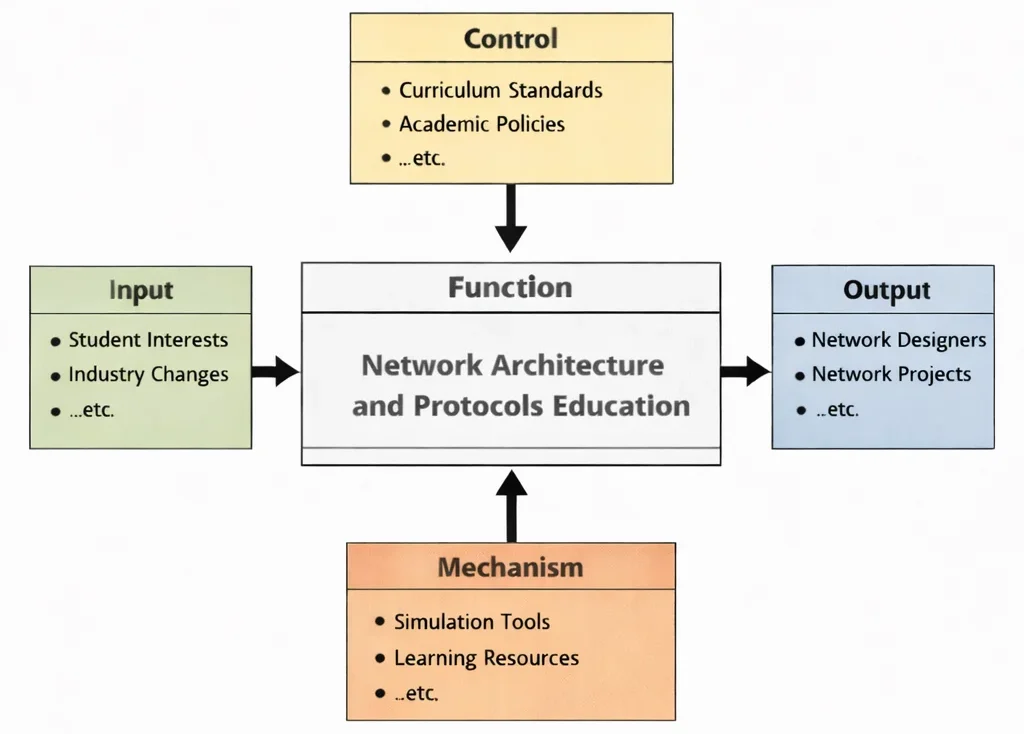
This IDEF0 diagram presents “Network Architecture and Protocols Education” as a structured transformation. From the left, inputs such as student needs and industry requirements enter the learning function. From above, controls—curriculum standards and academic policies—shape the scope, sequencing, rigor, and assessment of what is taught. On the right, outputs emerge as skilled practitioners and completed network projects that demonstrate applied understanding. From below, mechanisms such as networking tools, lab environments, and learning resources provide the practical means for building, testing, tracing, troubleshooting, and refining protocol-driven systems.
Interactive Check: Intro & System Concepts
Verify your understanding of how layered agreements, protocol rules, and verification mechanisms function in network design:
Introductory Concept Verification
1. Why are network protocols described as “invisible agreements” in communication systems?
Answer: Devices communicate through strictly standardized, layered rules (naming, addressing, routing, congestion control, security handshakes) that execute automatically in the background without requiring user intervention.
2. What function do curriculum standards and academic policies serve as “Controls” in Network Architecture Education?
Answer: They ensure students go beyond memorizing acronyms by enforcing rigorous discipline—requiring them to justify architectural design choices, validate protocol behavior, and document deployment decisions systematically.
Understanding network architecture and protocols is fundamental to the design, operation, and evolution of modern digital infrastructure. At its core, network architecture defines the structure and organization of how data is communicated across systems, while protocols specify the rules and standards that govern these interactions. These concepts underpin nearly every aspect of STEM fields, particularly within Information Technology, where they support everything from small-scale applications to large-scale cloud and enterprise systems.
The role of network management and administration is vital in maintaining efficient operations, ensuring network uptime, and resolving performance bottlenecks. Meanwhile, concerns around security are addressed through layered network security protocols that detect, prevent, and respond to cyber threats. Protocols such as TCP/IP, HTTP, and DNS form the backbone of the internet, but these are increasingly complemented by newer models tailored for dynamic environments.
In global communications, telecommunication systems and standards ensure interoperability across devices and networks. The rise of wireless and mobile communications has transformed user expectations for seamless connectivity, placing new demands on protocol efficiency and reliability in 4G, 5G, and beyond.
These architectural and protocol foundations intersect significantly with software development. Developers must understand protocol behavior when designing distributed systems, APIs, and cloud-native applications. Similarly, the growth of the Internet of Things (IoT) is fueled by innovations in embedded systems and IoT development, which rely on lightweight communication protocols for sensor data transmission and device coordination.
Effective digital systems also prioritize usability, as addressed in HCI and UX design. These interfaces, while seemingly unrelated to low-level protocols, depend on the speed and accuracy of underlying network services. For developers targeting smartphones, an understanding of mobile application development requires proficiency with mobile protocols and backend integrations.
Languages like Python, Java, and C++—explored in programming languages and paradigms—are employed in developing software that interacts with networking layers. This process is guided by principles discussed in software architecture and design and refined through software engineering practices. These efforts continue through stages of maintenance and evolution, where protocol updates and architectural changes must be managed carefully.
System robustness is validated through software testing and QA, which often involve simulating network loads and examining how protocols behave under stress. These testing insights are especially relevant for developers working in web development and design, where real-time interactivity depends on efficient client-server communication.
In modern web applications, back-end development handles the server-side logic and databases, often interacting directly with network protocols to deliver content and services. Content Management Systems (CMS) streamline web deployment but still rely on HTTP, HTTPS, and DNS protocols. Platforms focusing on e-commerce development require secure protocols such as SSL/TLS to ensure safe transactions.
Meanwhile, front-end development ensures the user-facing interface communicates efficiently with the back-end via AJAX, REST, and WebSocket protocols. Developers pursuing full-stack development must grasp the full spectrum of protocol use across the application stack. This includes optimizing web visibility through SEO and monitoring user behavior using web analytics tools.
Finally, good web design ensures that networked applications are not only functional but also responsive and accessible—qualities that rely on low-latency, protocol-efficient delivery. For learners and developers alike, mastering network architecture and protocols provides the technical foundation for building secure, scalable, and user-centric digital solutions.

This image presents computer networking as a luminous “city grid” of interconnected blocks, where each glowing tower suggests a major node such as a server cluster, router, or switch. Bright pathways run between components like multilane highways, symbolizing data packets traveling through a network. Floating labels such as TCP/IP and HTTP point to the protocol layers that make communication possible—from addressing and routing, to transport reliability, to application-level messaging. The stacked, modular look of the components evokes layered architecture: physical links and devices at the bottom, logical routing and transport in the middle, and higher-level services on top. Overall, the illustration captures the idea that network performance, security, and scalability come from both good architecture (how systems are arranged) and well-defined protocols (the shared rules that keep data flowing correctly).
Building Cyber Resilience: Network Architecture & Protocols Navigation
Discover how Network Architecture and Protocols structures multi-layer communication models, routing algorithms, and switching mechanisms across the Networking and Telecommunication cluster.
Overview Hub
Presents core routing principles, packet transport, and the overarching telecommunication ecosystem.
Network Architecture & Protocols
Focuses on OSI/TCP-IP reference models, OSPF and BGP routing algorithms, circuit vs. packet switching, and wireless protocols.
Cloud Networking
Explores software-defined networking, hybrid cloud VPCs, and scalable data center routing topologies.
Network Security
Details secure transport protocols, IPSec VPNs, TLS handshakes, and perimeter defense architectures.
Network Management & Administration
Covers monitoring network traffic, configuring VLAN segmentation, and managing routing table states.
Key Topics in Network Architecture and Protocols
OSI and TCP/IP Models:
- These layered frameworks simplify the complexities of networking by dividing communication tasks into discrete layers, each responsible for specific functions.
- OSI Model: Comprises seven layers, from the physical to the application layer, offering a universal reference for understanding network processes.
- TCP/IP Model: Focuses on four layers and forms the foundation of internet communication.
Routing Protocols:
- Enable data packets to find the most efficient paths across networks.
- Examples include:
- OSPF (Open Shortest Path First): Determines optimal paths based on link-state information.
- BGP (Border Gateway Protocol): Manages routing between large networks, such as ISPs.
- RIP (Routing Information Protocol): A simpler protocol suitable for smaller networks.
Switching Techniques:
- Facilitate the transfer of data within networks.
- Circuit Switching: Establishes a dedicated communication path (e.g., telephone networks).
- Packet Switching: Breaks data into packets sent independently across the network (e.g., the internet).
- Virtual Circuits: Combine features of circuit and packet switching for reliable communication.
Wireless Protocols:
- Govern wireless communication between devices.
- Examples include:
- Wi-Fi (802.11): Enables high-speed wireless internet connectivity.
- Bluetooth: Facilitates short-range communication between devices.
- 5G: Supports ultra-fast speeds and low latency for modern mobile networks.
Applications of Network Architecture and Protocols
Enterprise Networks:
- Designing scalable and secure infrastructures for businesses, supporting collaboration and productivity.
- Example: Implementing VLANs and VPNs for secure communication.
Service Providers:
- Building robust backbones to support high traffic demands, such as in ISPs and cloud services.
- Example: Deploying BGP to manage internet traffic across global networks.
Emerging Technologies:
- Supporting IoT, 5G, and cloud applications by optimizing network performance and interoperability.
Sub-Areas in the Study of Network Architecture and Protocols
Network Topologies:
- Study of physical and logical arrangements of network components.
- Types: Star, ring, bus, mesh, and hybrid topologies.
- Applications: Determining optimal setups for specific environments, such as data centers or smart grids.
Network Virtualization:
- Abstraction of physical network resources into virtual networks.
- Tools: VMware NSX, Cisco ACI, and SD-WAN solutions.
- Applications: Enhancing flexibility, reducing costs, and enabling dynamic network reconfiguration.
Protocol Design and Analysis:
- Developing and evaluating new communication protocols.
- Tools: Wireshark for analyzing existing protocols and ns-3 for simulation.
- Applications: Ensuring efficient and secure communication in cutting-edge technologies.
Network Security Protocols:
- Specialized protocols designed to secure data transmission.
- Examples: SSL/TLS for secure web communication, IPSec for VPNs.
- Applications: Protecting sensitive information in financial transactions and healthcare systems.
Quality of Service (QoS):
- Mechanisms to prioritize certain types of network traffic.
- Techniques: Traffic shaping, bandwidth management, and resource reservation.
- Applications: Ensuring smooth video streaming, VoIP calls, and real-time gaming.
Wireless and Mobile Networks:
- Advanced study of wireless communication technologies and protocols.
- Focus Areas: LTE, 5G, and satellite networks.
- Applications: Supporting mobile connectivity, remote access, and IoT ecosystems.
History, Challenges, and Future of Network Architecture
History and Evolution of Protocol Hierarchies
Network architecture originated in proprietary vendor mainframe systems (such as IBM’s SNA) in the 1970s, which locked organizations into single-vendor hardware. To solve interoperability barriers, the International Organization for Standardization (ISO) formulated the theoretical 7-layer OSI Model. Concurrently, the Department of Defense funded ARPANET research that yielded the pragmatic 4-layer TCP/IP Suite, which ultimately won broad global adoption due to its open design. The 1990s introduced VLAN switching and multi-protocol label switching (MPLS) for enterprise routing, while the 2010s sparked the transition toward Software-Defined Networking (SDN) and programmable network function virtualization.
Current Technical & Operational Challenges
Architecting robust network protocols and topologies involves complex engineering hurdles:
- Routing Convergence and BGP Table Bloat: As the global internet expands, the global BGP routing table exceeds hundreds of thousands of prefixes, increasing router memory overhead and convergence times during link flapping.
- Stateful Firewall and NAT Scalability Bottlenecks: Maintaining state tables for millions of concurrent TCP sessions across high-throughput enterprise perimeter firewalls strains memory and CPU throughput.
- Protocol Rigidity and Legacy Entrenchment: The deep entrenchment of IPv4 and TCP makes deploying modern transport protocols (like QUIC or IPv6) structurally slow across global enterprise networks.
- Suboptimal Path Selection in Complex Topologies: Distance-vector and link-state routing metrics often fail to reflect real-time link congestion or jitter variations, leading to suboptimal traffic steering.
Future Potentials & Emerging Paradigms
Network architecture is advancing toward programmable data planes and autonomous traffic control:
- P4-Programmable Data Planes: Writing custom packet-forwarding logic directly onto network switch ASICs at line rate, enabling real-time telemetry and custom protocol encapsulation.
- Intent-Based Networking (IBN): Translating high-level business goals (e.g., “secure payment traffic”) into automated protocol configurations and dynamic routing policies across the enterprise.
- AI-Optimized Dynamic Routing: Reinforcement learning algorithms replacing static OSPF cost metrics to predict network congestion and optimize path selection dynamically.
Why Study Network Architecture and Protocols
Designing the Blueprint of Connectivity
Network architecture defines how systems are structured and connected, while protocols determine how data flows. Mastering this equips students to build efficient and scalable networks.
Foundational to Systems Engineering
Students learn about OSI and TCP/IP models, routing algorithms, IP addressing, and protocol design—vital for configuring complex networks.
Gateway to Advanced Networking Roles
This knowledge is essential for network architects, protocol engineers, and infrastructure planners in large organizations.
Interactive Quick Review: Layered Architecture & Routing
Reinforce key concepts regarding OSI layers, OSPF vs. BGP routing, and packet switching before reviewing the FAQ:
Quick Review Verification
1. What is the fundamental difference between Interior Gateway Protocols (like OSPF) and Exterior Gateway Protocols (like BGP)?
Answer: Interior Gateway Protocols (IGPs like OSPF) route packets within a single Autonomous System (AS) using link-state cost metrics. Exterior Gateway Protocols (EGPs like BGP) route packets between distinct Autonomous Systems across the global internet using path-vector policies.
2. How does Packet Switching differ from Circuit Switching in network data transfer?
Answer: Circuit switching reserves a dedicated physical communication path for the entire duration of a session (like traditional telephony). Packet switching breaks data into independent addressed packets that dynamically share network links, optimizing bandwidth utilization.
Network Architecture and Protocols Summary
By delving into network architecture and protocols, students and professionals gain a comprehensive understanding of the frameworks that underpin global communication systems. This knowledge is instrumental in building and managing networks that are secure, scalable, and optimized for modern technological demands.
End-of-Page Exercises: Review, Thought-Provoking & Engineering Problems
Network Architecture: Review Questions and Answers
1. What is network architecture and why is it critical in modern telecommunication systems?
Answer: Network architecture is the structural design of hardware, software, protocols, and connectivity. It is critical because it ensures high performance, reliability, and scalability for data-intensive applications.
2. How do communication protocols facilitate effective data transmission in networks?
Answer: Protocols provide standardized formatting, addressing, and handshaking rules, ensuring interoperability and reliable data packet exchange across heterogeneous devices.
3. What are the key layers of the OSI model and their functions in network communication?
Answer: Physical, Data Link, Network, Transport, Session, Presentation, and Application layers. They abstract hardware transmission from logical routing and user presentation.
4. How do routing protocols contribute to network efficiency and reliability?
Answer: By dynamically computing optimal packet paths based on link-state metrics and providing automatic failover rerouting during network link disruptions.
5. What role does network security play in the design of network architectures and protocols?
Answer: Security embeds encryption, firewalls, and authentication directly into protocol handshakes, protecting confidentiality and defending against unauthorized access.
6. How do cloud networking solutions integrate with traditional network architectures?
Answer: Through virtual private networks (VPNs), direct cloud peering links, and software-defined WAN (SD-WAN) extensions that bridge on-premises subnets to cloud VPCs.
7. What is the importance of network protocols such as TCP/IP in global communications?
Answer: TCP/IP standardizes internet packet encapsulation, error recovery, and logical addressing, allowing universal global interoperability.
8. How do emerging technologies like SDN and NFV impact network architecture and data transmission?
Answer: SDN centralizes control plane logic for programmable traffic routing, while NFV replaces dedicated hardware boxes with scalable virtual software instances.
9. What challenges do traditional networking technologies face that emerging transmission technologies aim to solve?
Answer: Bandwidth saturation, rigid hardware provisioning, high latency, and lack of dynamic adaptability to real-time traffic surges.
10. How do web technologies and internet protocols contribute to the seamless integration of various network systems?
Answer: By providing universal application-layer interfaces (HTTP/HTTPS, REST, DNS) that abstract underlying network routing complexities from end-user software.
Thought-Provoking Questions and Answers
1. How will the evolution of 6G technology impact the future of network architecture and data transmission?
Answer: Terabit speeds and sub-millisecond latencies will require optical-wireless core convergence and AI-driven automated packet switching architectures.
2. What ethical implications arise from increased data transmission speeds, and how should they be addressed?
Answer: Massive real-time telemetry harvesting increases state surveillance risks. Addressed via strict data minimization policies and end-to-end cryptographic privacy.
3. How can artificial intelligence be leveraged to optimize network protocols and improve data transmission efficiency?
Answer: Reinforcement learning agents can dynamically tune TCP congestion window parameters and OSPF link weights based on microburst traffic predictions.
4. What impact will quantum communication have on the security of data transmission in global networks?
Answer: Quantum Key Distribution (QKD) will eliminate mathematical decryption vulnerabilities, making optical backbone transport immune to brute-force cyberattacks.
5. How might the convergence of cloud networking and edge computing improve data transmission in remote areas?
Answer: Local edge nodes cache and process regional traffic, preventing high-latency transcontinental backhaul hops for rural users.
6. What are the potential challenges in integrating traditional networking systems with emerging communication technologies?
Answer: Protocol mismatch, software-defined controller friction with legacy ASICs, and potential security blind spots during transitional dual-stack operation.
7. How do modern web technologies contribute to the evolution of internet communication infrastructures?
Answer: Demands for zero-latency web apps push transport layers toward HTTP/3 QUIC and push CDN edge execution closer to consumers.
8. What is the significance of protocol standardization in global network communication, and how does it impact interoperability?
Answer: Standardization (IETF, IEEE) guarantees that equipment from competing vendors can interoperate seamlessly without proprietary protocol lock-in.
9. How might advancements in software-defined networking (SDN) and network virtualization influence future internet architectures?
Answer: Transforming static physical hardware topologies into fully programmable, elastic software circuits capable of reconfiguring in milliseconds.
10. How can the integration of IoT devices enhance data transmission in modern networks, and what challenges does this integration pose?
Answer: Enhances environmental monitoring insights; poses severe challenges in spectrum congestion, battery conservation, and unpatched IoT botnet security vulnerabilities.
11. What role do content delivery networks (CDNs) play in optimizing data transmission for web technologies?
Answer: CDNs replicate static assets across global points of presence, minimizing propagation delay and protecting origin servers from traffic overloads.
12. How might the continuous evolution of internet protocols shape the future of global digital communication?
Answer: Continuous protocol refinement (like QUIC and encrypted SNI) will make internet communication faster, more private, and resilient against censorship or interception.
Numerical Engineering Problems & Solutions
Problem 1: Cloud Network Hourly & Daily Transmission Volume
A cloud network transmits data at 120 Mbps. Calculate total data transmitted in one hour in gigabytes (GB), total in 24 hours, and average data transmitted per minute.
A cloud network transmits data at 120 Mbps. Calculate total data transmitted in one hour in gigabytes (GB), total in 24 hours, and average data transmitted per minute.
Solution:
- Data per second = 120 Mbps = 120 × 106 bits/sec
- Data per hour = 120 × 106 × 3,600 = 432 × 109 bits
- Convert to GB: 432 × 109 ÷ (8 × 10⁹) = 54 GB
- Data per day = 54 GB × 24 = 1,296 GB
- Average per minute = 1,296 GB ÷ 1,440 min = 0.9 GB/min
Problem 2: High-Frequency Router Packet Processing Load
A router processes 2,500 packets per second. Calculate the number of packets processed per minute, per hour, and per day (24 hours).
A router processes 2,500 packets per second. Calculate the number of packets processed per minute, per hour, and per day (24 hours).
Solution:
- Packets per minute = 2,500 × 60 = 150,000 packets/min
- Packets per hour = 150,000 × 60 = 9,000,000 packets/hour
- Packets per day = 9,000,000 × 24 = 216,000,000 packets/day
Problem 3: Telecommunication Link Total Data & Rate
A telecommunication link operates at 80 Mbps. For a 2-hour period, calculate total data transmitted in gigabytes (GB) and average data rate in MB per minute.
A telecommunication link operates at 80 Mbps. For a 2-hour period, calculate total data transmitted in gigabytes (GB) and average data rate in MB per minute.
Solution:
- Data per second = 80 Mbps = 80 × 106 bits/sec
- Total bits in 2 hours = 80 × 106 × 2 × 3,600 = 576 × 109 bits
- Convert to GB: 576 × 109 ÷ (8 × 10⁹) = 72 GB
- Average per minute = (72 GB × 1,000 MB/GB) ÷ 120 min = 72,000 MB ÷ 120 = 600 MB/min
Problem 4: Fiber Optic Distance Latency Comparison
A fiber optic cable has a latency of 3 ms per 100 km. Calculate latency for 700 km, for 1,200 km, and determine the difference between these two latencies.
A fiber optic cable has a latency of 3 ms per 100 km. Calculate latency for 700 km, for 1,200 km, and determine the difference between these two latencies.
Solution:
- Latency rate = 3 ms ÷ 100 km = 0.03 ms/km
- Latency for 700 km = 700 × 0.03 = 21.0 ms
- Latency for 1,200 km = 1,200 × 0.03 = 36.0 ms
- Difference = 36.0 ms – 21.0 ms = 15.0 ms
Problem 5: Packet Loss Rate & Successful Transmission
A network experiences a packet loss rate of 0.15% (0.0015). If 5,000,000 packets are transmitted, calculate lost packets, successful packet transmissions, and overall success percentage.
A network experiences a packet loss rate of 0.15% (0.0015). If 5,000,000 packets are transmitted, calculate lost packets, successful packet transmissions, and overall success percentage.
Solution:
- Lost packets = 5,000,000 × 0.0015 = 7,500 packets
- Successful packets = 5,000,000 – 7,500 = 4,992,500 packets
- Success percentage = (4,992,500 ÷ 5,000,000) × 100 = 99.85%
Problem 6: Wireless Access Point Transfer Volume
A wireless access point transmits at 300 Mbps. Calculate total data transmitted in 15 minutes (900 seconds) in megabytes (MB). (Note: 1 MB = 8 Megabits).
A wireless access point transmits at 300 Mbps. Calculate total data transmitted in 15 minutes (900 seconds) in megabytes (MB). (Note: 1 MB = 8 Megabits).
Solution:
- Data rate per second = 300 Megabits/sec
- Total bits in 15 minutes = 300 Mb/sec × 900 sec = 270,000 Megabits
- Convert Megabits to Megabytes: 270,000 Mb ÷ 8 bits/Byte = 33,750 MB
Problem 7: Network Monitoring Tool Log Accumulation
A network monitoring tool logs 500,000 events per hour. Calculate total events logged in one day, in one week (7 days), and average events per minute over the week.
A network monitoring tool logs 500,000 events per hour. Calculate total events logged in one day, in one week (7 days), and average events per minute over the week.
Solution:
- Events per day = 500,000 × 24 = 12,000,000 events/day
- Events per week = 12,000,000 × 7 = 84,000,000 events/week
- Average per minute = 84,000,000 events ÷ (7 × 24 × 60 min) = 84,000,000 ÷ 10,080 = 8,333.33 events/min
Problem 8: Bandwidth Upgrade Additional Transfer Volume
A network upgrade increases bandwidth from 90 Mbps to 135 Mbps. Calculate percentage bandwidth increase, additional throughput in Mbps, and additional data transmitted in 1 hour in GB.
A network upgrade increases bandwidth from 90 Mbps to 135 Mbps. Calculate percentage bandwidth increase, additional throughput in Mbps, and additional data transmitted in 1 hour in GB.
Solution:
- Percentage increase = ((135 – 90) ÷ 90) × 100 = 50.0%
- Additional bandwidth rate = 135 – 90 = 45 Mbps = 45 × 106 bits/sec
- Additional data in 1 hour = 45 × 106 bits/sec × 3,600 sec = 162 × 109 bits
- Convert to GB: 162 × 109 ÷ (8 × 10⁹) = 20.25 GB
Problem 9: Latency Reduction Percentage & Absolute Savings
A network’s average latency is measured at 18 ms. An optimization reduces latency by 20% (0.20). Calculate new average latency, absolute reduction in milliseconds, and percentage decrease.
A network’s average latency is measured at 18 ms. An optimization reduces latency by 20% (0.20). Calculate new average latency, absolute reduction in milliseconds, and percentage decrease.
Solution:
- New average latency = 18 ms × (1 – 0.20) = 18 × 0.80 = 14.4 ms
- Absolute reduction = 18 – 14.4 = 3.6 ms
- Percentage decrease = (3.6 ÷ 18) × 100 = 20.0%
Problem 10: High-Frequency Router Packet Accumulation
A router transmits 3,000 packets per second. Calculate total packets transmitted per minute, per hour, and per day (24 hours).
A router transmits 3,000 packets per second. Calculate total packets transmitted per minute, per hour, and per day (24 hours).
Solution:
- Packets per minute = 3,000 × 60 = 180,000 packets/min
- Packets per hour = 180,000 × 60 = 10,800,000 packets/hour
- Packets per day = 10,800,000 × 24 = 259,200,000 packets/day
Problem 11: Telecom Subscriber Monthly & Annual Usage
A telecom provider serves 20,000 subscribers, each using 2.5 GB of data per month. Calculate total monthly data usage, annual usage, and average annual data usage per subscriber.
A telecom provider serves 20,000 subscribers, each using 2.5 GB of data per month. Calculate total monthly data usage, annual usage, and average annual data usage per subscriber.
Solution:
- Total monthly usage = 20,000 subscribers × 2.5 GB = 50,000 GB/month
- Total annual usage = 50,000 GB × 12 months = 600,000 GB/year
- Average annual usage per subscriber = 600,000 GB ÷ 20,000 = 30.0 GB/subscriber/year
Problem 12: Monitoring System Critical Anomaly Metrics
A network monitoring system processes 800,000 logs per day. If 0.1% (0.001) of these logs indicate critical issues, calculate critical logs per day, per 30-day month, and critical log percentage.
A network monitoring system processes 800,000 logs per day. If 0.1% (0.001) of these logs indicate critical issues, calculate critical logs per day, per 30-day month, and critical log percentage.
Solution:
- Critical logs per day = 800,000 × 0.001 = 800 logs/day
- Critical logs per month (30 days) = 800 × 30 = 24,000 logs/month
- Critical log percentage = (800 ÷ 800,000) × 100 = 0.1%
Network Architecture and Protocols — Summary & Wrap-Up
Network Architecture and Protocols establish the logical blueprints and standardized rules governing global digital communication. By mastering OSI and TCP/IP reference layers, OSPF and BGP routing algorithms, packet switching, and protocol design, network engineers build secure, interoperable, and scalable communication systems that sustain modern information technology.