
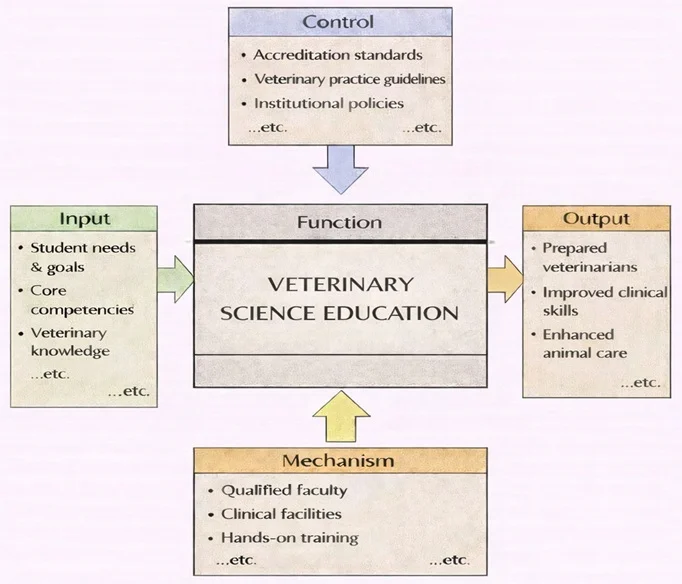
Veterinary Science Education transforms learner needs and professional expectations into competent veterinary graduates who can protect animal health and support public well-being. As the diagram suggests, the process begins with clear inputs—student goals, foundational science understanding, and the competencies needed to diagnose, treat, and prevent disease across different species. These inputs are shaped by strong controls such as accreditation requirements, veterinary clinical standards, ethical obligations, and institutional policies that ensure the training is safe, evidence-based, and aligned with real practice.
The work is made possible by mechanisms—qualified faculty, laboratories and simulation resources, clinical placements, teaching hospitals or partner clinics, and supervised hands-on training. Together, these mechanisms turn theory into skilled practice: careful observation, clinical reasoning, responsible prescribing, surgical and procedural competence, and effective communication with animal owners and care teams. The outputs are not only “prepared veterinarians,” but also stronger clinical skills and better animal care outcomes—graduates who can serve livestock systems, companion animal clinics, wildlife conservation, and emerging One Health challenges with professionalism and compassion.
Veterinary science is the medical discipline dedicated to the health and welfare of animals, encompassing the diagnosis, treatment, and prevention of diseases in pets, livestock, and wildlife. It plays a critical role not only in ensuring the well-being of animals but also in protecting human health through the control of zoonotic diseases—those that are transmissible between animals and humans. The field integrates medical knowledge, biology, and public health to address diverse challenges ranging from pet care to global health threats like pandemics.
Veterinarians work in various settings, including clinics, farms, research facilities, and conservation projects, contributing to animal health, food security, and ecological balance. Veterinary science combines advanced medical technologies with a compassionate approach to care, reflecting its dual commitment to animal welfare and public health.
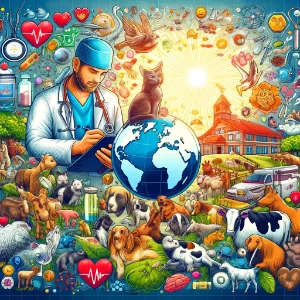
A bright collage illustrates the scope of veterinary medicine. At left, a veterinarian records notes beside a globe, highlighting global animal and public-health links. Around them are pets and farm animals—dogs, cats, cattle, horses, sheep, birds—set before a clinic and ambulance. Medical symbols (stethoscopes, heart monitors, vaccines, microscopes) orbit the scene, while a warm sun suggests wellbeing and care. The compact image conveys prevention, diagnosis, treatment, and the One Health idea that human, animal, and environmental health intersect.
Focus of Veterinary Science
Veterinary science is focused on improving the health and well-being of animals while addressing broader societal goals such as food safety, environmental sustainability, and zoonotic disease prevention. It integrates clinical care, preventive medicine, research, and education to ensure animals live healthy, productive lives. The field also highlights the interconnectedness of animal health, human health, and the environment, often referred to as the “One Health” approach.
Veterinary professionals work across a spectrum of activities, from treating household pets and managing livestock health to rehabilitating injured wildlife and conducting biomedical research. By ensuring the health of animals, veterinary science directly impacts human livelihoods, ecosystems, and public health.
Key Areas in Veterinary Science
Animal Surgery
- Definition: The branch of veterinary science that focuses on surgical interventions to treat injuries, congenital defects, and diseases in animals.
- Key Procedures:
- Soft Tissue Surgery: Includes spaying, neutering, and tumor removal.
- Orthopedic Surgery: Treats bone fractures, joint disorders, and spinal conditions.
- Emergency Surgery: Life-saving procedures for trauma, such as accidents or ingestion of foreign objects.
- Applications:
- Enhancing the quality of life for pets with mobility issues.
- Correcting life-threatening conditions like gastric torsion in dogs.
- Examples:
- Performing hip dysplasia surgery in dogs.
- Repairing fractures in racehorses to restore athletic performance.
Preventive Care
- Definition: Measures taken to prevent diseases and maintain overall health in animals.
- Key Aspects:
- Vaccinations: Protecting against common diseases like rabies, distemper, and parvovirus.
- Parasite Control: Managing ticks, fleas, and intestinal worms.
- Nutrition Counseling: Ensuring balanced diets tailored to species, age, and activity levels.
- Applications:
- Reducing the prevalence of infectious diseases in pet populations.
- Enhancing livestock productivity through herd health programs.
- Examples:
- Annual wellness exams for pets.
- Vaccination drives for livestock to prevent outbreaks like foot-and-mouth disease.
Research in Veterinary Science
- Definition: The study of animal diseases, genetics, and physiology to advance animal and human health.
- Focus Areas:
- Zoonotic Diseases: Investigating diseases like rabies, avian influenza, and leptospirosis.
- Animal Welfare: Researching pain management and humane treatment practices.
- Genetic Studies: Exploring animal breeding and genetic disorders.
- Applications:
- Developing vaccines and treatments for emerging diseases.
- Improving breeding practices for healthier livestock.
- Examples:
- Studying the transmission dynamics of zoonotic diseases to prevent pandemics.
- Researching genetic markers for resistance to diseases in cattle.
Applications of Veterinary Science
Ensuring the Health of Companion Animals
- Overview: Veterinary science provides medical care to pets, ensuring their longevity and quality of life.
- Examples:
- Treating chronic conditions like diabetes or arthritis in aging pets.
- Managing behavioral issues through veterinary psychiatry.
Supporting Livestock Health and Food Security
- Overview: Healthy livestock are critical for food production, economic stability, and public health.
- Examples:
- Managing herd health programs to improve milk production in dairy cattle.
- Controlling infectious diseases in poultry to prevent economic losses.
Protecting Public Health
- Overview: Veterinary science plays a key role in identifying and controlling diseases that can spread from animals to humans.
- Examples:
- Monitoring and controlling rabies outbreaks.
- Preventing foodborne illnesses by ensuring the safety of animal products like meat and milk.
Wildlife Conservation and Ecosystem Health
- Overview: Veterinarians contribute to biodiversity preservation by treating injured wildlife and managing conservation programs.
- Examples:
- Rehabilitating injured sea turtles and releasing them back into the wild.
- Monitoring the health of endangered species like rhinos and tigers.
Emerging Trends in Veterinary Science
One Health Approach
- Emphasizing the interconnectedness of animal, human, and environmental health to tackle global health challenges.
Telemedicine in Veterinary Care
- Providing remote consultations and follow-ups through digital platforms, improving accessibility for pet owners and farmers.
Genomic Medicine
- Utilizing genetic technologies to develop targeted treatments and enhance breeding practices.
Advanced Imaging and Diagnostics
- Employing technologies like MRI, CT scans, and AI-based diagnostic tools for early disease detection.
Personalized Veterinary Medicine
- Tailoring treatments based on individual animals’ genetic profiles and medical histories.
Challenges in Veterinary Science
Zoonotic Disease Prevention
- Managing the rising threat of diseases transmitted from animals to humans, especially in densely populated areas.
Access to Veterinary Care
- Ensuring that rural and underserved communities have access to quality veterinary services.
Workforce Shortages
- Addressing the growing demand for veterinary professionals, particularly in specialized fields.
Ethical Considerations
- Balancing economic interests and animal welfare in industries like farming and research.
Climate Change
- Addressing the impact of environmental changes on animal health and disease patterns.
Future Directions in Veterinary Science
Sustainability in Animal Agriculture
- Developing eco-friendly practices to reduce the environmental impact of livestock farming.
Vaccination and Disease Eradication
- Advancing vaccine technologies to eliminate diseases like brucellosis and foot-and-mouth disease.
Wildlife Health and Conservation
- Enhancing global efforts to protect endangered species and restore ecosystems.
Collaboration with Human Medicine
- Strengthening partnerships between veterinary and human healthcare professionals to combat global health challenges.
Technological Innovations
Why Study Veterinary Science
Understanding Animal Health and Welfare
Protecting Public Health and Food Safety
Combining Science, Problem-Solving, and Compassion
Exploring a Range of Animal Species and Career Paths
Preparing for a Meaningful and Respected Profession
Interactive Zoonotic Disease Transmission & Herd Immunity Simulator
Simulate pathogen spillover from animal reservoirs to human populations. Adjust vaccination coverage and biosecurity stringency to observe infection rates.
Veterinary Science: Conclusion
Veterinary science is a dynamic and essential field that contributes to the health and well-being of animals, humans, and ecosystems. By integrating clinical care, preventive medicine, and research, veterinarians address a wide range of challenges, from pet health to global pandemics. As the field continues to evolve with advancements in technology and interdisciplinary approaches, veterinary science will play an even greater role in shaping a healthier and more sustainable world. Through its commitment to compassion, innovation, and collaboration, veterinary science ensures the welfare of all living beings and the environments they inhabit.
Is Veterinary Science Right For You?
Explore career pathways, check your fit, and assess your skills — before you commit to a degree.
Veterinary Science – Frequently Asked Questions
What is veterinary science, and how is it different from human medicine?
Veterinary science is the study of animal health, disease, welfare, and production. It covers pets, farm animals, wildlife, and laboratory animals. Like human medicine, it focuses on diagnosing, treating, and preventing disease, but it must do so across many species with different anatomies, behaviours, and environments. Veterinary science also deals with herd and population health, food safety, and human–animal–environment interactions.
How does the Veterinary Science page on Prep4Uni.online help me prepare for university studies?
The Veterinary Science page introduces core ideas such as animal anatomy and physiology, infectious disease, biosecurity, animal welfare, and clinical decision-making. These topics mirror the foundations of early veterinary and animal science courses. By exploring definitions, examples, and questions on the page, you build vocabulary, conceptual understanding, and habits of careful observation that will support you in lectures, labs, and case-based learning at university.
What school subjects are most helpful if I want to study veterinary science?
Biology and chemistry are usually the most important subjects because they underpin anatomy, physiology, microbiology, pharmacology, and pathology. Mathematics helps with data analysis, drug dosage calculations, and epidemiology. Physics can be useful for understanding imaging and biomechanics. Communication skills, critical reading, and basic statistics are also valuable, because veterinary work involves explaining complex information to owners and interpreting evidence from studies.
What kinds of animals and areas can I specialise in as a veterinarian?
Veterinarians can specialise in companion animals such as dogs and cats, equine practice for horses, farm and production animals, wildlife and conservation, zoo medicine, laboratory animals, and exotic pets. There are also clinical specialties such as surgery, internal medicine, dermatology, ophthalmology, emergency and critical care, and animal behaviour. Beyond clinical practice, some graduates focus on public health, food safety, research, or policy.
What is the difference between a veterinarian, a veterinary nurse or technician, and an animal scientist?
A veterinarian is a medically trained professional who diagnoses disease, prescribes medication, performs surgery, and is legally responsible for clinical decisions. Veterinary nurses and technicians work closely with veterinarians to monitor patients, assist in procedures, perform laboratory tests, and support owners. Animal scientists typically focus on animal nutrition, breeding, welfare, and production systems, often working in research, industry, or policy rather than direct clinical practice.
What does a typical day for a veterinary student look like?
In the early years, a typical day may involve lectures on anatomy, physiology, microbiology, and pathology, followed by practical classes in dissection labs, microscopy, or basic clinical skills. In later years, students spend more time in clinics, observing consultations, assisting with examinations, collecting samples, and helping with surgeries under supervision. Evenings often involve revising notes, working on case reports, and preparing for practical assessments.
What role do evidence-based practice and research play in veterinary science?
Evidence-based practice means that veterinarians make decisions using the best available scientific data, clinical experience, and owner values. Research in veterinary science generates this evidence, from vaccine studies and epidemiology to nutrition trials and welfare assessments. The Veterinary Science page encourages you to see treatments not as fixed rules but as hypotheses tested and refined through data, linking naturally to biology, statistics, and research methods.
What ethical issues arise in veterinary science and animal care?
Veterinarians must balance animal welfare, owner expectations, financial constraints, and public health responsibilities. Ethical questions include when to recommend euthanasia, how much suffering is acceptable in treatment, how to manage animals used for food or research, and how to deal with neglected or dangerous animals. University study invites you to think carefully about consent, welfare frameworks, professional codes, and how to communicate difficult decisions with compassion.
How do veterinarians contribute to public health and food safety?
Veterinarians play a key role in preventing and controlling zoonotic diseases that can pass between animals and humans, such as influenza or rabies. They also work in food safety, inspecting farms, transport, and abattoirs, and helping design systems that reduce contamination and antibiotic resistance. Some veterinarians work in government, international agencies, or industry to design surveillance programmes and biosecurity policies that protect both animals and people.
What if I am sensitive to blood, injury, or strong emotions around animals?
Many people feel uneasy at first when they encounter surgery, blood, or very sick animals. Training is gradual, and you are supported as you develop coping strategies and professional distance while still caring deeply. It can help to gain controlled exposure through shadowing experiences and to reflect honestly on how you respond. Veterinary science is emotionally demanding, so self-care, peer support, and realistic expectations are important.
How can I gain experience before applying to veterinary or animal-related courses?
You can look for supervised opportunities such as observing at local veterinary clinics, volunteering at animal shelters, helping on farms or stables, or joining school-based animal and science clubs. Keep a record of what you did, what you learned, and how it shaped your view of animal care. Admissions teams often value reflective experience more than the sheer number of hours.
How does veterinary science connect to other subjects on Prep4Uni.online?
Veterinary science connects to biology, microbiology, genetics, ecology, and physiology; to public health and environmental health; and to ethics, law, and communication. On Prep4Uni.online, you can explore related pages on health sciences, biology, public health, environmental sustainability, and data analysis to build a broad foundation. Seeing these links early helps you understand why veterinary curricula include both scientific depth and broader professional skills.
How can I use this Veterinary Science page effectively as part of my study routine?
Start by reading through the overview sections to get a big-picture view of veterinary science. Then pick one subtopic, such as animal welfare, infectious disease, or clinical reasoning, and answer the guiding questions in your own words. You can summarise key points, create simple diagrams, or link ideas to recent news stories about animals. Returning to the page regularly will help you build a layered understanding rather than memorising facts only once.
Veterinary Science: Interactive Review Questions
1. What is veterinary science and why is it important?
2. How do veterinarians contribute to public health?
3. What role does clinical research play in veterinary science?
4. How does preventive care benefit animal health?
5. How do veterinarians address the challenges of managing zoonotic diseases?
6. What is the significance of animal welfare in veterinary science?
7. How can advances in technology improve diagnostic accuracy in veterinary medicine?
8. What are the key challenges faced by veterinary professionals today?
9. How does interdisciplinary collaboration enhance veterinary care?
10. How can continuing education benefit veterinary professionals?
Comprehensive Practice Modules
Section 1: Core Concept Mastery (Foundational Questions)
-
Define veterinary science and identify its core professional scope across animal and human health domains.
Answer: Veterinary science is the medical discipline dedicated to diagnosing, treating, and preventing diseases in animals while safeguarding public health through the control of zoonotic pathogens and food safety assurance. -
What is meant by the "One Health" approach in veterinary medicine?
Answer: The One Health approach is a collaborative, multisectoral framework recognizing that human health, animal health, and ecosystem resilience are deeply interconnected and mutually dependent. -
Define zoonotic diseases and provide two classic clinical examples.
Answer: Zoonotic diseases are infectious illnesses that transmit naturally between vertebrate animals and humans; two classic examples are rabies and avian influenza. -
What is the primary objective of preventive veterinary care in herd management?
Answer: The primary objective is to maintain population-level health, prevent infectious disease outbreaks, optimize animal productivity, and ensure food safety through vaccinations and biosecurity. -
Differentiate between soft tissue and orthopedic surgery in veterinary practice.
Answer: Soft tissue surgery involves procedures on non-bony structures (such as spaying, neutering, and tumor removal), whereas orthopedic surgery addresses skeletal and joint conditions (such as fracture repairs and cruciate ligament stabilization). -
What role do diagnostic imaging technologies (such as CT and MRI) play in modern veterinary clinics?
Answer: Diagnostic imaging provides high-resolution cross-sectional visualization of internal organs, soft tissues, and skeletal structures, enabling early and precise detection of complex pathologies. -
Define biosecurity in the context of livestock agriculture.
Answer: Biosecurity encompasses management practices and protocols designed to prevent the introduction and spread of infectious agents into animal facilities, farms, or national borders. -
What is the significance of animal welfare ethical frameworks in veterinary medicine?
Answer: Ethical frameworks guide veterinarians in balancing clinical treatments, pain management, and humane euthanasia while upholding professional obligations to minimize animal suffering.
Section 2: Clinical Scenarios & Analytical Thinking
-
A rural dairy farm experiences an unexplained drop in milk yield and sudden respiratory distress in cattle. Formulate an investigative veterinary response plan.
Answer: The response plan includes isolating affected animals, conducting clinical examinations and diagnostic swabbing, testing feed and water sources for toxins or pathogens, implementing strict biosecurity movement controls, and notifying agricultural health authorities if a contagious foreign animal disease is suspected. -
Evaluate the ethical and clinical considerations a veterinarian faces when managing chronic osteoarthritis in an elderly canine patient with failing renal function.
Answer: The veterinarian must balance pain relief and mobility enhancement against the nephrotoxic risks of standard non-steroidal anti-inflammatory drugs (NSAIDs). Treatment requires multimodal management (physical therapy, joint supplements, opioid analgesics or alternative anti-inflammatories) and compassionate discussions regarding quality-of-life assessment with the owner. -
Analyze the role of wildlife veterinarians in monitoring and mitigating emerging zoonotic spillover events at human-animal interfaces.
Answer: Wildlife veterinarians conduct active surveillance by sampling free-ranging animal populations for novel pathogens (e.g., coronaviruses or avian viruses), tracking habitat fragmentation drivers, and collaborating with epidemiologists to establish early-warning systems before spillover into domestic livestock or humans occurs. -
A shelter veterinarian confronts an outbreak of canine parvovirus. Propose immediate infection control and containment protocols.
Answer: Protocols include immediate quarantine of symptomatic animals, strict barrier nursing (gloves, gowns, dedicated footwear), isolation ward setup, rigorous disinfection using virucidal agents active against non-enveloped parvovirus, and emergency vaccination/serological screening of exposed shelter dogs. -
Discuss how climate change impacts vector-borne parasite distributions (such as ticks and heartworm vectors) in veterinary practice.
Answer: Warming temperatures and altered rainfall patterns expand the geographical range and active seasons of disease vectors like ticks and mosquitoes, exposing previously unaffected regions to canine heartworm, Lyme disease, and anaplasmosis, and necessitating year-round preventive parasite control. -
Evaluate the economic versus welfare trade-offs in intensive livestock production systems and the veterinarian's advocacy role.
Answer: Intensive systems maximize feed efficiency and economic output but can compromise stocking density, natural behaviors, and immune function. Veterinarians act as ethical stewards by auditing welfare standards, recommending environmental enrichment, optimizing ventilation, and championing judicious antimicrobial stewardship. -
Propose a telehealth triage protocol for an equine practice handling colic emergencies in remote rural areas.
Answer: The protocol involves a secure video consultation where the owner assesses vital signs (heart rate, mucous membrane color, gut sounds) under veterinary direction, allowing the vet to grade pain severity, administer initial oral analgesics safely if appropriate, and determine whether immediate surgical referral or farm visit is mandatory. -
Analyze the implications of antimicrobial resistance (AMR) in veterinary medicine on human clinical healthcare.
Answer: Overuse or misuse of antibiotics in veterinary agriculture can select for resistant bacterial strains (e.g., methicillin-resistant Staphylococcus aureus or resistant E. coli) that transfer to humans through the food chain or direct contact, rendering human infections difficult to treat and necessitating strict prescription oversight and alternative therapies.
Section 3: Veterinary Calculations & Quantitative Diagnostics
-
A canine patient weighing 20 kg requires an intravenous fluid CRI (Constant Rate Infusion) of a drug prescribed at 2 mg/kg/hour. If the stock solution concentration is 10 mg/mL, calculate the required drug volume per hour in mL/hr.
Answer:Total hourly dose = 2 mg/kg × 20 kg = 40 mg/hrThe infusion rate is 4.0 mL/hr.
Volume per hour = Total hourly dose / Stock concentration = 40 mg/hr / 10 mg/mL = 4.0 mL/hr -
Calculate the maintenance fluid rate for a 15 kg dog using the standard veterinary formula (60 mL/kg/24 hours). Express the rate in mL/hour.
Answer:Total daily volume = 60 mL/kg × 15 kg = 900 mL/dayThe maintenance fluid rate is 37.5 mL/hr.
Hourly rate = 900 mL / 24 hours = 37.5 mL/hr -
An antibiotic suspension has a concentration of 50 mg/mL. A feline patient weighing 4.5 kg requires a dose of 10 mg/kg administered twice daily. Calculate the volume of suspension (in mL) needed for a single dose.
Answer:Dose in mg = 10 mg/kg × 4.5 kg = 45 mgThe single dose volume is 0.9 mL.
Volume in mL = 45 mg / 50 mg/mL = 0.9 mL -
In a herd health screening of 500 cattle for bovine viral diarrhea (BVD), 25 animals test positive. Calculate the herd prevalence percentage.
Answer:Prevalence = (Number of positive cases / Total herd size) × 100%The herd prevalence is 5.0%.
Prevalence = (25 / 500) × 100% = 0.05 × 100% = 5.0% -
A veterinary diagnostic test for feline leukemia virus (FeLV) has a sensitivity of 95% and a specificity of 98%. If tested on a population where 100 cats truly have FeLV, how many true positive results are expected?
Answer:Expected True Positives = Total Diseased Animals × SensitivityThere are 95 expected true positive results.
Expected True Positives = 100 × 0.95 = 95 true positives -
An equine surgeon needs to administer a general anesthetic induction drug at 0.05 mg/kg to a 500 kg horse. If the drug vial concentration is 5 mg/mL, calculate the total volume to inject in mL.
Answer:Total dose in mg = 0.05 mg/kg × 500 kg = 25 mgThe required injection volume is 5.0 mL.
Volume in mL = 25 mg / 5 mg/mL = 5.0 mL -
A dog's packed cell volume (PCV) is measured at 24% (normal reference range: 37% - 55%). Calculate the percentage deficit below the lower limit of the normal reference range.
Answer:Deficit = Lower normal limit - Measured PCV = 37% - 24% = 13%The PCV is 35.14% below the lower normal limit (indicating regenerative or non-regenerative anemia).
Percentage deficit = (13 / 37) × 100% = 35.14% -
A veterinary clinic purchases 200 vaccine doses at a wholesale cost of $8.50 per dose and administers them with a 40% markup on wholesale cost. Calculate the retail price per vaccine dose.
Answer:Markup amount = $8.50 × 0.40 = $3.40The retail price per vaccine dose is $11.90.
Retail price = Wholesale cost + Markup = $8.50 + $3.40 = $11.90