
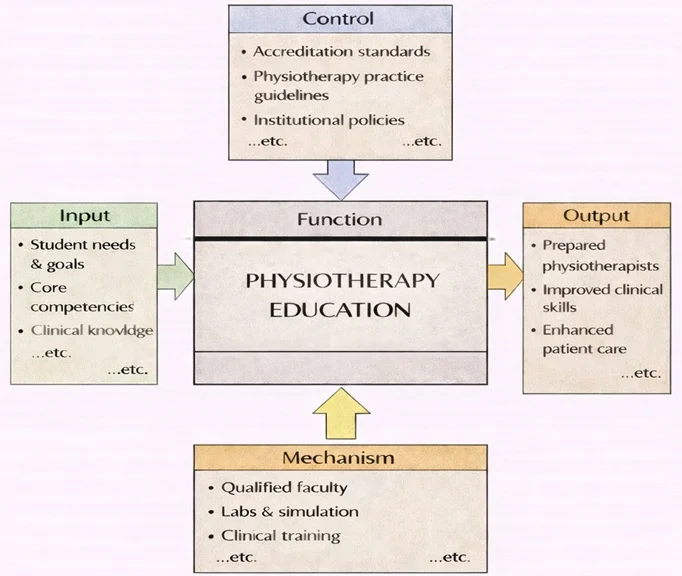
Physiotherapy Education can be understood as a structured “transformation” process. From the left, it begins with student needs and goals, along with the core competencies and clinical knowledge that the profession expects new practitioners to master. From the top, the process is guided by accreditation requirements, physiotherapy practice guidelines, and institutional policies, which define what must be covered, how learning should be assessed, and what safe practice looks like.
From the bottom, the function is enabled by the mechanisms that make training possible—qualified faculty, labs and simulation facilities, and clinical training placements where students learn in real healthcare settings. When these inputs, controls, and mechanisms work together, the output is a pipeline of prepared physiotherapists with strong clinical skills and the capacity to deliver better patient care, supporting healthier individuals and communities.
Physiotherapy, also known as physical therapy, is a healthcare profession dedicated to restoring, maintaining, and improving physical function and mobility in individuals of all ages. It employs a range of therapeutic exercises, manual techniques, and advanced technologies to alleviate pain, promote healing, and enhance overall well-being. Physiotherapists work closely with patients to develop personalized treatment plans that address specific needs, whether recovering from surgery, managing chronic conditions, or improving physical performance.
Physiotherapy plays a critical role in healthcare systems worldwide, bridging the gap between acute medical care and long-term recovery. Its applications extend beyond rehabilitation, encompassing preventive care, health education, and performance optimization. As lifestyles become more sedentary and chronic conditions more prevalent, the importance of physiotherapy in promoting active and independent living continues to grow.

This bright illustration shows a rehabilitation clinic where physiotherapists work with several patients at once. In the foreground, a therapist supports a person practicing walking with a cane, emphasizing balance training and functional mobility. Nearby, patients do guided exercises with therapy balls, resistance equipment, and light weights, while others receive hands-on treatment on therapy tables. The background displays muscle and skeleton diagrams, reinforcing the role of anatomy and biomechanics in treatment planning. The overall scene highlights physiotherapy as practical, goal-focused care that combines assessment, exercise, manual techniques, and patient coaching to improve everyday movement and quality of life.
Focus of Physiotherapy
The focus of physiotherapy is to restore and enhance physical mobility, reduce pain, and improve the quality of life for individuals affected by injuries, illnesses, or disabilities. It aims to empower patients by teaching them how to manage their conditions through exercises, lifestyle modifications, and preventive measures. Physiotherapists use evidence-based practices to ensure effective and safe treatments tailored to the unique needs of each patient.
Physiotherapy emphasizes a holistic approach, addressing not only the physical aspects of health but also the psychological and social factors that influence recovery. By fostering independence and promoting self-care, physiotherapy enhances overall well-being and reduces reliance on long-term medical interventions.
Key Areas in Physiotherapy
1. Orthopedic Physiotherapy
- Definition: Focuses on the assessment and treatment of musculoskeletal injuries and conditions affecting bones, joints, muscles, and ligaments.
- Key Conditions Treated:
- Fractures, sprains, and dislocations.
- Post-surgical rehabilitation (e.g., after joint replacements).
- Chronic conditions like arthritis and tendinitis.
- Therapeutic Techniques:
- Strengthening and stretching exercises.
- Manual therapy for joint mobilization.
- Posture correction and gait training.
- Examples:
- Assisting athletes in recovering from ACL injuries.
- Designing exercise programs for patients with lower back pain.
2. Neurological Physiotherapy
- Definition: Specializes in managing conditions that affect the nervous system, such as strokes, Parkinson’s disease, and multiple sclerosis.
- Key Goals:
- Restoring motor function and coordination.
- Reducing muscle spasticity and improving balance.
- Enhancing independence in daily activities.
- Therapeutic Techniques:
- Balance and coordination exercises.
- Electrical stimulation to activate muscles.
- Functional movement training.
- Examples:
- Helping stroke survivors regain mobility and strength.
- Teaching Parkinson’s patients exercises to improve gait and reduce tremors.
3. Pediatric Physiotherapy
- Definition: Focuses on children with developmental, neurological, or musculoskeletal conditions.
- Key Conditions Treated:
- Cerebral palsy, muscular dystrophy, and spina bifida.
- Developmental delays in motor skills.
- Congenital deformities like clubfoot.
- Therapeutic Techniques:
- Play-based therapy to engage children in movement.
- Strengthening and flexibility exercises tailored to developmental needs.
- Parental education and guidance.
- Examples:
- Helping children with cerebral palsy improve mobility using assistive devices.
- Encouraging motor skill development in infants with delayed milestones.
Applications of Physiotherapy
1. Recovery from Surgeries and Injuries
- Overview: Physiotherapy aids in the recovery process following surgeries, accidents, or sports-related injuries.
- Examples:
- Post-operative rehabilitation for knee or hip replacements.
- Strengthening and mobilization exercises after a fracture.
- Impact: Speeds up recovery time and prevents complications such as stiffness or muscle atrophy.
2. Managing Chronic Conditions
- Overview: Physiotherapy helps individuals manage long-term health conditions to maintain functionality and reduce pain.
- Examples:
- Tailoring exercise programs for individuals with arthritis or osteoporosis.
- Using aquatic therapy to alleviate pain in fibromyalgia patients.
- Impact: Improves quality of life and reduces reliance on medication.
3. Enhancing Physical Performance
- Overview: Physiotherapists work with athletes and active individuals to optimize physical performance and prevent injuries.
- Examples:
- Developing conditioning programs for runners or swimmers.
- Analyzing movement patterns to reduce injury risks.
- Impact: Enhances strength, endurance, and flexibility, leading to better performance.
4. Preventive Care and Health Promotion
- Overview: Physiotherapy emphasizes prevention by addressing risk factors for injuries and chronic diseases.
- Examples:
- Educating desk workers on ergonomic setups to avoid posture-related issues.
- Conducting fall prevention programs for elderly individuals.
- Impact: Reduces healthcare costs and improves overall health outcomes.
Emerging Trends in Physiotherapy
Tele-Physiotherapy
- Providing virtual consultations and guided exercises for remote patients.
Integration with Technology
- Using wearable devices, AI tools, and VR systems to monitor progress and enhance therapy outcomes.
Focus on Mental Health
- Addressing the psychological impact of injuries and chronic conditions through holistic approaches.
Regenerative Therapies
- Incorporating stem cell research and regenerative medicine into rehabilitation practices.
Community-Based Programs
- Expanding physiotherapy services to underserved populations through outreach and community health initiatives.
Challenges in Physiotherapy
Access to Care
- Limited availability of physiotherapy services in rural and low-income areas.
Adherence to Treatment
- Ensuring patients follow through with prescribed exercises and therapies.
Evolving Needs
- Adapting to the growing demand for physiotherapy due to aging populations and lifestyle-related conditions.
Workforce Shortages
- Addressing the shortage of trained physiotherapists globally.
Future Directions in Physiotherapy
Personalized Therapy Plans
- Leveraging data and technology to design individualized treatment programs.
Collaborative Healthcare Models
- Integrating physiotherapy with other disciplines like occupational therapy and mental health services.
Focus on Preventive Care
- Expanding physiotherapy’s role in preventing injuries and managing risk factors.
Research and Innovation
- Advancing understanding of musculoskeletal and neurological recovery through research.
Global Health Initiatives
- Strengthening the role of physiotherapy in addressing global health challenges like aging and chronic diseases.
Why Study Physiotherapy
Understanding the Science of Movement and Rehabilitation
Helping People Recover and Improve Their Quality of Life
Combining Clinical Skills with Compassionate Care
Exploring Diverse Areas of Practice and Specialization
Preparing for a Fulfilling and In-Demand Health Career
Interactive Biomechanical Strain & Joint Load Simulator
Adjust the knee flexion angle and external lifting load to compute compressive joint force and patellofemoral strain in real-time.
Physiotherapy: Conclusion
Physiotherapy is a vital healthcare discipline that enhances mobility, alleviates pain, and promotes overall well-being. By addressing a wide range of conditions, from acute injuries to chronic diseases, physiotherapy empowers individuals to lead active and fulfilling lives. Its applications in recovery, prevention, and performance optimization make it indispensable in modern healthcare. As technology and research continue to advance, physiotherapy will expand its reach and impact, ensuring better health outcomes and improved quality of life for diverse populations worldwide.
Is Physiotherapy Right For You?
Explore career pathways, check your fit, and assess your skills — before you commit to a degree.
Frequently Asked Questions – Physiotherapy
What is physiotherapy in simple terms?
Physiotherapy is a health profession that uses movement, exercise, manual therapy, education, and advice to help people restore, maintain, or improve their physical function and quality of life. Physiotherapists work with people who have pain, injury, disability, or long-term health conditions, as well as those who want to prevent problems and stay active.
How is physiotherapy different from general medicine or surgery?
Medicine and surgery focus on diagnosing diseases, prescribing drugs, and performing operations, while physiotherapy focuses on how people move and function in daily life. Physiotherapists use assessment, movement-based treatment, and education to reduce pain, improve mobility and strength, and support recovery before or after medical or surgical treatment.
What kinds of problems do physiotherapists treat?
Physiotherapists treat a wide range of conditions, including back and neck pain, sports injuries, joint and muscle problems, stroke and neurological conditions, heart and lung conditions, balance and mobility issues in older adults, and physical difficulties related to long-term illnesses or disability.
What is the difference between physiotherapy and occupational therapy?
Physiotherapy focuses mainly on movement, physical function, and the body’s systems that support activity, such as muscles, joints, heart, and lungs. Occupational therapy focuses more on enabling people to carry out meaningful daily activities at home, school, work, or in the community, often by adapting tasks or environments in addition to working on movement and strength.
Which school subjects are helpful if I want to study physiotherapy at university?
Biology is especially important for understanding human anatomy, physiology, and how the body responds to injury and exercise. Chemistry, physics, and mathematics can also be useful, especially for biomechanics and evidence-based practice. Subjects that build communication and writing skills help with patient interaction and professional documentation.
What personal qualities are important for future physiotherapists?
Future physiotherapists need strong communication skills, empathy, patience, and the ability to motivate people who may be in pain or discouraged. They also need good observational skills, problem-solving ability, physical stamina, and a willingness to keep learning as evidence and practice change over time.
What do students typically study in a physiotherapy degree?
Physiotherapy degrees usually include anatomy and physiology, biomechanics, neuroscience, pathology, exercise science, and rehabilitation science. Students learn assessment techniques, therapeutic exercises, manual therapy, electrotherapy, respiratory and cardiovascular physiotherapy, and how to plan and progress treatment programmes. Professional practice, ethics, and research skills are also core components.
What kind of clinical placements do physiotherapy students complete?
Physiotherapy students complete supervised placements in settings such as hospitals, outpatient clinics, rehabilitation centres, community health services, sports and orthopaedic clinics, aged-care facilities, and sometimes schools or industrial workplaces. These placements allow them to apply theory, practise clinical reasoning, and work as part of multidisciplinary teams.
What are some main areas or specialisations within physiotherapy?
Major areas of physiotherapy include musculoskeletal and sports physiotherapy, cardiorespiratory physiotherapy, neurological physiotherapy, paediatric physiotherapy, geriatric physiotherapy, women’s and men’s health, community and public health physiotherapy, and occupational or industrial rehabilitation. With experience and further study, physiotherapists can specialise in one or more of these fields.
How does physiotherapy contribute to prevention and long-term health, not just recovery?
Physiotherapy is not only for injury or illness. Physiotherapists design exercise and movement programmes to improve strength, flexibility, balance, and cardiovascular fitness, helping to prevent falls, manage chronic conditions, and reduce the risk of future injuries. They also educate people about posture, workplace ergonomics, and healthy activity habits.
What kinds of workplaces and careers are available to physiotherapy graduates?
Physiotherapy graduates can work in public and private hospitals, outpatient and specialist clinics, sports medicine and performance centres, community health services, rehabilitation and aged-care facilities, schools, and workplace or occupational health settings. Some move into research, teaching, health management, or roles with sports teams and international health organisations.
How does the Physiotherapy page on Prep4Uni.online support my study and career planning?
The Physiotherapy page on Prep4Uni.online introduces key ideas about human movement, injury, and rehabilitation, and links school subjects to university-level expectations. It helps you understand what physiotherapy study involves, what skills and qualities are important, and how physiotherapy connects to wider health, sport, and rehabilitation careers.
Physiotherapy: Interactive Review Questions
1. What is physiotherapy and what are its primary goals?
2. How do physiotherapy treatments contribute to patient rehabilitation?
3. What are the common techniques used in physiotherapy?
4. How does physiotherapy help in managing chronic pain?
5. What role does patient education play in physiotherapy?
6. How can physiotherapy be adapted for different age groups and conditions?
7. What is the importance of interdisciplinary collaboration in physiotherapy?
8. How does technology influence modern physiotherapy practices?
9. What challenges do physiotherapists face in their practice, and how can they overcome them?
10. How do physiotherapy interventions contribute to the prevention of injuries and promotion of long-term wellness?
Comprehensive Practice Modules
Section 1: Core Concept Mastery (Foundational Questions)
-
Define neuromuscular re-education and its goal in stroke rehabilitation.
Answer: Neuromuscular re-education is a therapeutic technique aimed at retraining the brain and spinal cord to restore proper motor patterns, movement control, and balance following neurological damage such as a stroke. -
What is the primary physiological distinction between passive range of motion (PROM) and active-assisted range of motion (AAROM)?
Answer: PROM involves movement of a joint entirely by an external force (therapist or device) without muscle contraction from the patient, whereas AAROM requires voluntary muscle contraction from the patient supplemented by external assistance. -
State the main purpose of utilizing the Borg Rating of Perceived Exertion (RPE) scale during cardiorespiratory rehabilitation.
Answer: The Borg RPE scale measures a patient’s subjective feeling of exertion and effort during exercise, providing a safe and reliable method to monitor exercise intensity when physiological metrics like heart rate may be altered by medications. -
Explain how therapeutic ultrasound promotes soft tissue healing at a cellular level.
Answer: Therapeutic ultrasound uses high-frequency acoustic sound waves to induce micro-vibrations (cavitation and acoustic streaming) that increase cellular membrane permeability, enhance collagen synthesis, and boost localized blood circulation. -
What role do proprioceptors play in joint stability and fall prevention?
Answer: Proprioceptors (such as muscle spindles and Golgi tendon organs) detect joint position, muscle length, and tension, sending rapid feedback to the central nervous system to make automatic muscular adjustments that maintain balance. -
Differentiate between concentric and eccentric muscle contractions in resistance therapy.
Answer: Concentric contractions occur when a muscle shortens while generating tension (e.g., lifting a weight during a bicep curl), whereas eccentric contractions occur when a muscle lengthens under tension (e.g., controlled lowering of a weight). -
Identify two common clinical indications for chest physiotherapy in pediatric patients.
Answer: Common indications include cystic fibrosis (to clear viscous airway secretions) and atelectasis or pneumonia (to improve lung expansion and ventilation-perfusion matching). -
What is the function of an orthosis in orthopedic gait rehabilitation?
Answer: An orthosis supports, aligns, prevents, or corrects deformities, or improves the functional movement of a compromised limb during walking.
Section 2: Clinical Scenarios & Analytical Thinking
-
A 68-year-old post-hip replacement patient exhibits severe Trendelenburg gait. Analyze the anatomical weakness responsible and propose a targeted exercise intervention.
Answer: Trendelenburg gait is caused by weakness of the gluteus medius muscle on the stance side, causing the contralateral pelvis to drop. A targeted exercise intervention includes side-lying hip abduction, progressive clamshell exercises, and single-leg standing balance drills. -
Compare the rehabilitation priorities for an acute grade II ankle sprain versus a chronic osteoarthritic knee.
Answer: Acute ankle sprains prioritize ice/compression, ligament protection, swelling reduction, and early joint mobilization. Chronic knee osteoarthritis prioritizes long-term periarticular muscle strengthening (quadriceps/hamstrings), weight management, joint-sparing low-impact exercises (aquatics), and pain modulation. -
Evaluate why early mobilization is critical following abdominal surgery, considering both respiratory and vascular systems.
Answer: Early mobilization prevents postoperative pulmonary complications (like atelectasis and pneumonia) by expanding basal lung volumes and stimulates deep vein blood flow in the lower limbs, drastically reducing the risk of Deep Vein Thrombosis (DVT) and pulmonary embolism. -
An adolescent athlete presents with anterior knee pain attributed to patellofemoral pain syndrome (PFPS). Discuss biomechanical factors that may contribute to this condition.
Answer: Contributing factors include abnormal patellar tracking due to weak vastus medialis obliquus (VMO) muscles, excessive dynamic knee valgus driven by weak hip external rotators/abductors, tight iliotibial (IT) bands, or excessive foot pronation. -
A Parkinson’s disease patient experiences frequent motor “freezing” episodes while walking. Formulate two compensation strategies utilizing external cues.
Answer: Strategies include visual cues (stepping over bright lines or laser lines projected on the floor) and auditory cues (marching in cadence with a metronome or rhythmic counting out loud) to bypass damaged basal ganglia circuits. -
Why must a therapist exercise caution when prescribing high-intensity aerobic training to a patient with multiple sclerosis (MS)?
Answer: Patients with MS often experience Uhthoff’s phenomenon, where a minor increase in core body temperature temporarily worsens neurological deficits due to heat-induced conduction block in demyelinated nerves. Cooling strategies and moderate-intensity intervals are essential. -
Contrast the mechanical goals of continuous passive motion (CPM) devices versus active functional weight-bearing in post-surgical knee rehab.
Answer: CPM aims to maintain soft tissue elasticity, promote synovial fluid circulation, and prevent intra-articular adhesions passively without muscle effort. Active functional weight-bearing targets neuromuscular firing, bone density retention, muscular hypertrophy, and functional joint stabilization. -
Propose an ergonomic workstation redesign for a client presenting with chronic cervical radiculopathy and upper trapezius strain.
Answer: Position the top of the computer monitor at eye level directly ahead, position elbows at 90° supported by adjustable armrests, place feet flat on the floor or on a footrest, and introduce a document holder to prevent sustained cervical flexion/rotation.
Section 3: Biomechanical Calculations & Quantitative Diagnostics
-
A physiotherapist measures a patient’s knee joint angle using a goniometer. In full extension, the reading is 0°, and in full flexion, it is 125°. If a functional task requires 90° of flexion, calculate the percentage of total range of motion (ROM) utilized.
Answer:Total ROM = 125° – 0° = 125°The functional task utilizes 72% of the patient’s available range of motion.
Percentage utilized = (90° / 125°) × 100% = 0.72 × 100% = 72% -
During a biceps force assessment, a forearm holds a 50 N dumbbell held horizontally at a distance of 0.35 m from the elbow joint center. Calculate the muscle torque required by the biceps to hold the arm motionless, ignoring forearm weight.
Answer:Torque (τ) = Force (F) × Distance (d)The biceps must generate a static flexion torque of 17.5 N·m.
τ = 50 N × 0.35 m = 17.5 N·m -
If the biceps tendon inserts at a distance of 0.05 m from the elbow joint axis, calculate the required muscle force (Fbiceps) to balance the 17.5 N·m external resistance torque.
Answer:Internal Torque = External TorqueThe biceps muscle contraction force required is 350 N.
Fbiceps × 0.05 m = 17.5 N·m
Fbiceps = 17.5 N·m / 0.05 m = 350 N -
A stroke patient walks 15 meters in 20 seconds. During this walk, they take 30 steps. Calculate: (a) Gait speed in m/s, and (b) Cadence in steps per minute (steps/min).
Answer:(a) Gait speed = Distance / Time = 15 m / 20 s = 0.75 m/sThe gait speed is 0.75 m/s and cadence is 90 steps per minute.
(b) Cadence = (Total Steps / Time in seconds) × 60 seconds
Cadence = (30 steps / 20 s) × 60 = 1.5 × 60 = 90 steps/min -
An individual with a mass of 70 kg is standing upright on a force plate. Calculate the ground reaction force (GRF) acting on the individual in static equilibrium (take g = 9.81 m/s2).
Answer:Weight Force (W) = Mass (m) × Acceleration due to gravity (g)The vertical ground reaction force is 686.7 N.
W = 70 kg × 9.81 m/s2 = 686.7 N
In static equilibrium: GRF = Weight Force = 686.7 N upwards -
During a vertical jump assessment, a ground reaction force of 1373.4 N is measured for the same 70 kg person. Calculate the net vertical acceleration experienced by the individual.
Answer:Net Force (Fnet) = GRF – Body WeightThe net upward acceleration is 9.81 m/s2.
Fnet = 1373.4 N – 686.7 N = 686.7 N
Acceleration (a) = Fnet / Mass = 686.7 N / 70 kg = 9.81 m/s2 -
A patient in cardiac rehab performs step aerotherapy. The mechanical work performed is calculated at 4200 Joules over a 60-second exercise bout. Calculate the mechanical power output in Watts.
Answer:Power (P) = Work (W) / Time (t)The mechanical power output is 70 Watts.
P = 4200 Joules / 60 seconds = 70 Watts -
During ankle plantarflexion, the Achilles tendon acts at a moment arm distance of 0.04 m from the ankle joint center. If the ground reaction force creates an external dorsiflexion moment of 120 N·m, calculate the required tensile force in the Achilles tendon.
Answer:Tendon Force × Moment Arm = External MomentThe required tensile force in the Achilles tendon is 3000 N (3.0 kN).
FAchilles × 0.04 m = 120 N·m
FAchilles = 120 N·m / 0.04 m = 3000 N