
Fine arts often begins with an uncomfortable moment: the blank page, the empty canvas, the unshaped clay. There is no “correct answer” waiting at the back. Instead, you build a voice through repetition, risk, and critique. The work teaches you to see—then to decide what deserves attention.
Studying fine arts is not only learning techniques. It is learning how meaning survives materials. A drawing is not just lines; it is a decision about what matters. A sculpture is not just form; it is a relationship between space, weight, and viewer. A painting is not just colour; it is an argument about mood and memory.
Because of that, progress in fine arts has a distinctive rhythm. You make work. You reflect. You receive critique. You revise. You collect evidence of growth. Over time, your portfolio becomes a narrative of your thinking—not just a gallery of outcomes.
This page is structured as a studio pathway. It will help students practice observation, experiment with mediums, document process, and build a small portfolio with intention rather than random variety.
Fine arts express what words often cannot—feelings, dreams, struggles, and beauty. Through paint, stone, sound, or digital tools, artists invite us to see the world in new ways. These works mirror personal emotions while reaching for something universal. At the heart of Arts, Design, and Media, fine arts also connect deeply with fields like graphic design, film and media studies, and performing arts—each offering unique ways to tell stories through images, sound, and movement.
Today’s fine arts world blends the old and the new. Classic forms like painting and sculpture stand alongside cutting-edge formats like performance, installation, and interactive digital work. The tools have changed, but the aim remains: to provoke thought and stir emotion. As fine arts embrace digital communication, they are not just keeping pace—they are reshaping what art can be. Artists now collaborate with advertising, public relations, and journalism to craft messages that inform, persuade, and move audiences.
Fine arts also live within the world of business and law. Artists today must balance vision with survival—handling budgets, managing time, and promoting their work. Skills in economics, marketing, and operations management help them stay afloat and thrive. Legal awareness, especially in intellectual property protection, ensures their creations are safe. In studios or teams, artists also benefit from understanding human resource management. The image of the lone artist gives way to a new model: thoughtful, skilled, and strategic.
The line between art and architecture continues to blur. As buildings tell stories and public spaces become stages, artists and architects join forces. Their collaborations turn cities into living galleries. Sculptures, murals, and installations become part of daily life, inviting reflection and shaping identity. Whether housed in museums or integrated into digital worlds, fine arts remain powerful tools for change and connection. They remind us that creativity is not just for show—it shapes how we live, how we feel, and how we see one another.

How Fine Arts Quietly Powers Everything Around It
Fine arts is often treated as a world of galleries and personal expression. But if you look closely, it is also a training ground for attention: learning to see what most people overlook, learning to stay with a question longer than feels comfortable, and learning to make choices without needing instant approval. Those habits travel well—especially into Graphic Design, where the challenge is to turn an idea into a visual structure that reads clearly in seconds.
Fine arts also nourishes storytelling, even when no words are used. Composition, colour temperature, rhythm, and symbolism all teach you how meaning can be carried by images alone. That is why many students who love painting, drawing, or sculpture eventually feel curious about Film and Media Studies, where those same visual decisions unfold over time—frame by frame.
Journalism & PR
Exploring Journalism sharpens your sense of language, evidence, and framing, while Public Relations shows how institutions communicate values and build community trust.
Performing Arts & Architecture
Bridge into Performing Arts to explore spatial presence, or discover how paintings behave like spatial experiences through Architecture.
Digital Communication & Advertising
Master portfolio presentation with Digital Communication Strategies, and analyze persuasive visual mechanics through Advertising.
Interactive Tool: Studio Palette & Value Scale Mixer
Adjust pigment ratios using the Zorn Limited Palette (Ochre, Vermilion, Black, White) to test chroma control and evaluate real-time tonal value step output.
Studio Mindset: Process Over Perfection
Fine arts rewards people who can stay in the room with unfinished work. In a studio, “good” is rarely a single moment of brilliance. It is the visible trace of a process: trying, failing, adjusting, and trying again with sharper eyes. If you wait for confidence before you begin, you will produce very little. If you begin first, confidence arrives later—quietly—because you have evidence.
A practical mindset is to treat each piece as a study, not a verdict on your talent. Studies exist to answer one question at a time: Can I control value? Can I simplify a complex form? Can I make edges behave? Can I build depth without overworking? When you define the question clearly, “imperfect” work becomes useful work.
- Measure progress by repetition: do the same small exercise five times and compare the 1st to the 5th.
- Separate “making” from “judging”: produce first, review later.
- Keep a visible trail: date your studies, keep failed attempts, and note what changed.
- Use constraints on purpose: one tool, one subject, one hour.
Learning to See: Observation and Visual Thinking
Before style comes eyesight—the practice of active attention. Fine arts trains you to notice what most people glide past: the exact tilt of a jaw, the way light fades across a cylinder, the difference between an edge that turns and an edge that stops.
A useful way to think about drawing is this: you are not “drawing objects.” You are drawing relationships—angles, distances, proportions, negative spaces, and value shapes.
Three Observation Habits That Compound
- See the big shapes first: Start with the largest value masses, light versus dark, before refining details.
- Use negative space: Draw the shapes around objects to eliminate cognitive bias.
- Compare, don’t guess: Compare widths to heights and shadow sizes to highlight sizes continuously.
Mediums as Languages: What Each Material “Says”
A medium is a set of natural tendencies. Charcoal wants atmosphere. Ink wants decisions. Paint holds time in layers. Clay makes you think with your hands. When you choose a medium, you choose what kind of meanings come easily.
- Graphite pencil: Quiet precision for proportion and subtle value control.
- Charcoal: Bold value shapes and dramatic lighting.
- Ink: Unforgiving clarity, rhythm, and confident line weight.
- Watercolour: Transparency, restraint, and timing.
- Oil paint: Slow blending, deep colour, and complex layering logic.
- Clay: Direct volume, spatial balance, and structural form.
First-Year Fine Arts Studio: Core Skills and Projects
Lesson 2 — Value & Light Control
Goal: Group the subject into two value groups (lights vs. shadows) before introducing midtones.
- Construct a 7-step value scale with even transitions.
- Block out big shadow masses cleanly.
- Place core shadows, reflected light, and cast shadows relative to light direction.
- Maintain sharp edges on cast shadows and soft transitions on turning forms.
Value & Light: Two-Group Control
Reflected Light < Light Mass
Lesson 8 — Human Figure Basics
Goal: Capture gesture, proportion, and simple light on form.


What Fine Arts Seek to Express and Explore
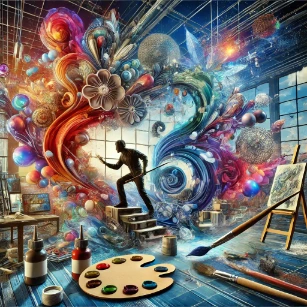

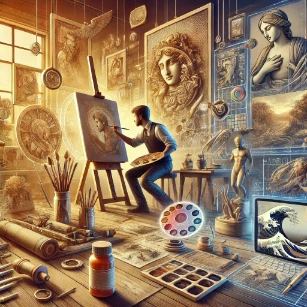
The Many Forms of Artistic Expression

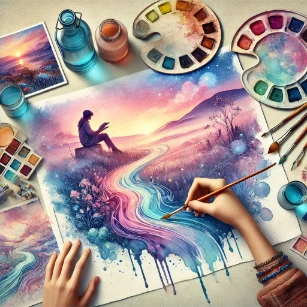
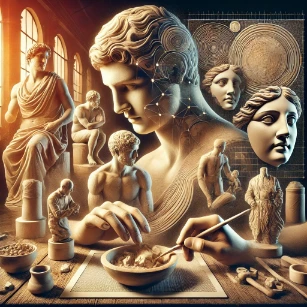
Emerging Art in the Digital Age







Is Fine Arts Right For You?
Explore career pathways, check your fit, and assess your skills — before you commit to a degree.
Fine Arts – Frequently Asked Questions
- What is Fine Arts as a university subject?
Fine Arts is the practice of creative visual expression paired with critical theory, art history, and personal studio exploration. - How is Fine Arts different from design or illustration?
Design solves applied client briefs, whereas Fine Arts focuses on self-directed inquiry and experimental form. - What does a Fine Arts portfolio include?
A curated selection showing recent finished work, sketchbook process, value studies, and material experimentation. - What careers can Fine Arts graduates pursue?
Studio artists, illustrators, gallery curators, arts educators, community facilitators, and creative directors.
Fill-in-the-Blank Practice (Fine Arts)
- In Fine Arts, a strong portfolio often shows your process (how ideas change through trials), not only final outcomes.
- In critique, starting with description (what is literally present) helps reduce defensive arguments and keeps feedback useful.
- A portfolio becomes more coherent when pieces are connected by a repeating question rather than a repeating style.
- In studio practice, “iteration” means making multiple versions to test and refine choices.
- Art history can function like a toolbox of strategies you can borrow, remix, or resist in your own work.
- Good documentation includes clear photos plus short notes about intent, methods, and what you changed next.
Multiple Choice Questions (Fine Arts)
- Which option best describes how many Fine Arts programmes are structured?
Answer: D) Studio projects with critique, documentation, and reflective writing - What is most likely to make a portfolio feel “serious” to admissions reviewers?
Answer: A) Clear development: studies → experiments → revisions → resolved work - In critique, what is usually the most helpful first step?
Answer: D) Describe what you see before evaluating - Which example best fits a “portfolio narrative” idea?
Answer: C) A series that shows a question explored across variations and materials - Which statement about art history in Fine Arts study is most accurate?
Answer: D) It offers references and methods that can shape your choices and arguments - What does “self-directed” typically mean in Fine Arts?
Answer: B) You choose questions, test ideas, and justify decisions through work - Which habit most directly improves long-term studio growth?
Answer: C) Regular practice with small studies and reflection - Which option is a realistic way many graduates build stability?
Answer: D) A mixed “portfolio career” (teaching, commissions, projects, creative roles)