
What Vision Correction Really Means
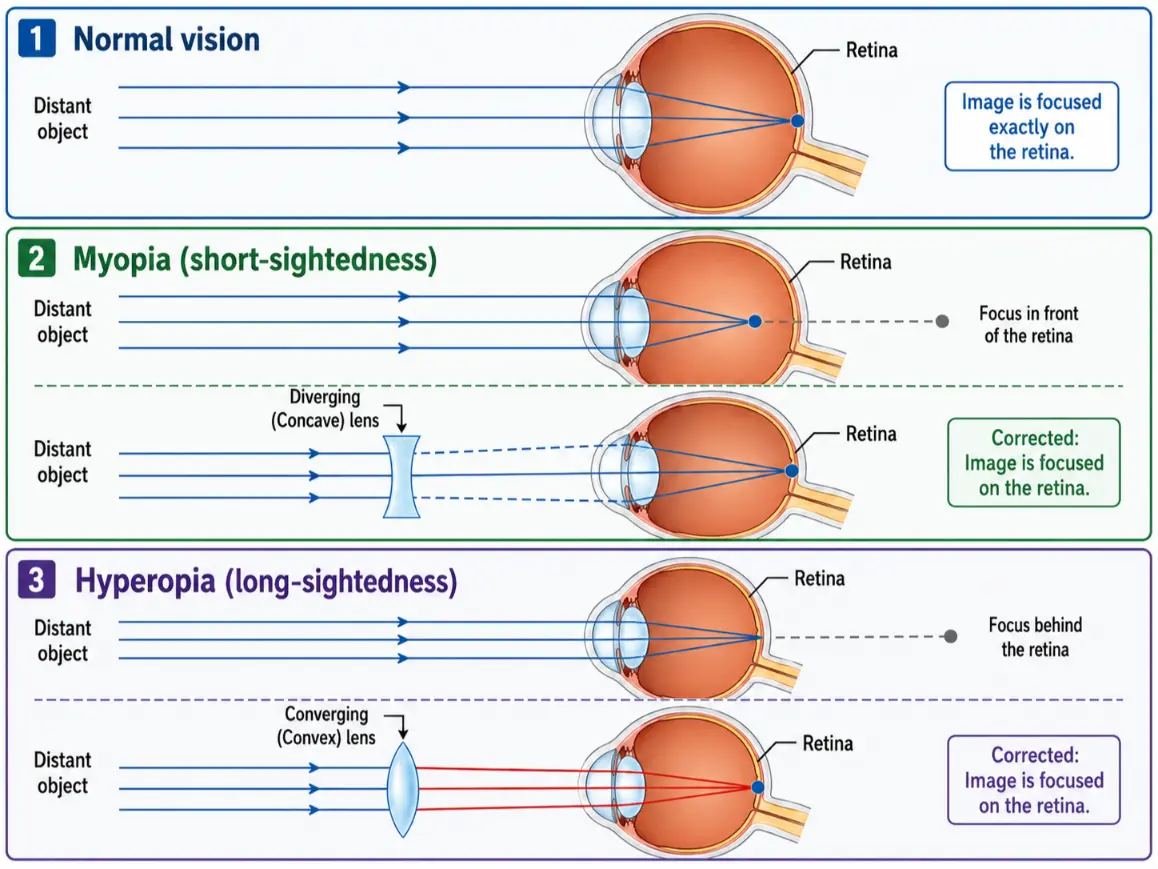
This educational illustration explains the optical idea behind corrective lenses using three side-by-side ray diagrams. The first panel shows normal vision, where parallel rays from a distant object are focused directly on the retina. The second panel shows myopia, or short-sightedness, where the eye focuses light in front of the retina; a diverging concave lens spreads the rays slightly before they enter the eye, shifting the focus back onto the retina. The third panel shows hyperopia, or long-sightedness, where the eye would focus light behind the retina; a converging convex lens bends the rays inward before they enter the eye, helping the focus form on the retina. The image helps students see that glasses work by pre-bending light before the eye completes the focusing process.
The Evolutionary Path: History, System Barriers, and Foundry Paradigms
The Historical Journey
Contemporary Technical Hurdles
Future Paradigms: Active Solid-State Lenses and Electro-Optics
- Liquid Crystal Tunable Smart Prescriptions: To completely eliminate the side distortion channels common in old progressive lenses, industrial labs are embedding micro-thin layers of nematic liquid crystals inside light spectacle lenses. Combined with tiny distance sensors on the frame, an micro-current loop alters the fluid orientation matrix instantly, changing the local refractive index to provide clear focus as a patient shifts gaze from scenery to computer screens.
- On-Chip Contact Telemetry Foundations: Advanced contact lens foundries are printing transparent micro-electronics, ring micro-displays, and biosensors straight onto biocompatible hydrogel bases. These intelligent lenses track pupil adjustments and adapt local diopter boundaries in real-time, preparing the baseline layers for seamless, glass-free augmented reality links.
Refractive Errors: The Optical Problem
| Refractive Error | Basic Optical Problem | Common Visual Effect | Typical Lens Strategy |
|---|---|---|---|
| Myopia | Distant light focuses in front of the retina | Distant objects look blurred | Diverging lens |
| Hyperopia | Light tends to focus behind the retina | Near vision may be difficult; sometimes distance vision also strains | Converging lens |
| Astigmatism | Different meridians focus differently | Blur or distortion at different orientations | Cylindrical or toric lens component |
| Presbyopia | Age-related loss of accommodation | Near focusing becomes harder | Reading addition, bifocal, progressive, or multifocal correction |
The Thin-Lens Model
Lens Power and Diopters
| Lens Type | Power Sign | Effect on Light | Common Use |
|---|---|---|---|
| Converging lens | Positive power | Brings light rays together | Hyperopia, presbyopia, some near tasks |
| Diverging lens | Negative power | Spreads light rays apart | Myopia |
| Cylindrical lens component | Can be positive or negative | Corrects focusing differently in one direction | Astigmatism |
Myopia: Correcting Nearsightedness
| Myopia Feature | Optical Meaning |
|---|---|
| Distant blur | Distant rays focus too early |
| Image forms | In front of the retina |
| Corrective lens | Diverging lens |
| Lens power sign | Negative |
Hyperopia: Correcting Farsightedness
| Hyperopia Feature | Optical Meaning |
|---|---|
| Near blur or strain | Near objects require extra focusing effort |
| Image tends to form | Behind the retina |
| Corrective lens | Converging lens |
| Lens power sign | Positive |
Astigmatism: Correcting Unequal Curvature
| Prescription Term | Meaning |
|---|---|
| Sphere | Overall myopic or hyperopic correction |
| Cylinder | Amount of astigmatism correction |
| Axis | Orientation of the cylindrical correction |
Presbyopia: Correcting Reduced Accommodation
| Correction Type | Purpose |
|---|---|
| Reading glasses | Add positive power for near tasks |
| Bifocals | Provide separate distance and near zones |
| Progressive lenses | Provide a gradual change in power from distance to near |
| Multifocal contact lenses | Provide multiple focusing zones or optical strategies in contact-lens form |
Glasses: Correcting Light Before It Reaches the Eye
Contact Lenses: Correcting Light at the Eye Surface
| Lens Type | Typical Use |
|---|---|
| Soft contact lens | Common correction for many prescriptions |
| Toric contact lens | Astigmatism correction |
| Multifocal contact lens | Presbyopia correction |
| Rigid gas-permeable lens | Selected prescriptions and corneal-shape needs |
Reading Glasses and Near Addition
Bifocal, Trifocal, and Progressive Lenses
| Lens Design | How It Works | Common Purpose |
|---|---|---|
| Bifocal | Two main zones: distance and near | Distance viewing plus reading |
| Trifocal | Three zones: distance, intermediate, and near | Distance, computer-range, and reading tasks |
| Progressive | Gradual change in power across the lens | Continuous range from distance to near |
Understanding a Simple Glasses Prescription
| Prescription Term | Meaning | Example |
|---|---|---|
| OD | Right eye | Used to label the right-eye prescription |
| OS | Left eye | Used to label the left-eye prescription |
| SPH | Spherical power for myopia or hyperopia | \(-2.00\,\text{D}\) or \(+1.50\,\text{D}\) |
| CYL | Cylindrical correction for astigmatism | \(-0.75\,\text{D}\) |
| Axis | Orientation of astigmatism correction | \(180^\circ\), \(90^\circ\), or another angle |
| Add | Extra near power | \(+2.00\,\text{D}\) for reading support |
| PD | Pupillary distance | Distance between pupils for lens alignment |
Why Lens Position Matters
Lens Materials and Design Choices
| Feature | Why It Matters |
|---|---|
| Refractive index | Higher-index materials can make strong lenses thinner |
| Abbe value | Relates to colour dispersion and chromatic effects |
| Lens thickness | Affects weight, appearance, and comfort |
| Anti-reflection coating | Reduces reflections and glare |
| Scratch resistance | Improves durability |
| UV protection | Helps block ultraviolet light when built into the lens or coating |
Aberrations and Distortions in Corrective Lenses
| Effect | Possible Cause | Student-Friendly Meaning |
|---|---|---|
| Magnification difference | Positive or negative lens power | Objects may appear slightly larger or smaller |
| Peripheral distortion | Lens shape and viewing away from optical centre | Edges may look warped |
| Chromatic effects | Dispersion in lens material | Colours may separate slightly at high contrast edges |
| Prism effect | Looking through off-centre parts of a lens | Image position may shift |
Vision Correction and the Brain
Corrective Lenses and Display Use
Vision Correction Compared with Eye Treatment
Applications of Vision Correction
Glasses
Spectacle lenses correct light before it enters the eye and can be designed for distance, near, intermediate, or multiple viewing ranges.
Contact Lenses
Contact lenses sit on the eye surface and correct refractive errors while moving with the eye.
Reading Support
Positive near addition helps compensate for reduced accommodation in presbyopia.
Astigmatism Correction
Cylindrical or toric designs correct different focusing powers in different directions.
Digital Learning and Work
Corrected vision supports reading, screen use, classroom learning, and detailed visual tasks.
Sports and Movement
Lens choice affects field of view, stability, safety, depth judgement, and comfort during activity.
Accessibility
Vision correction helps many people participate more fully in education, work, communication, and daily life.
Optical Design
Lens correction connects physics with product design, materials, ergonomics, and human-centred technology.
Connections with Wider Physics and Technology
Light and Optics
Vision correction uses refraction, image formation, focal length, aperture, and lens power.
Geometrical Optics
Ray diagrams explain why converging and diverging lenses correct different refractive errors.
Wave Optics
Diffraction, resolution, and chromatic effects set limits on optical clarity and lens performance.
The Eye as an Optical System
The eye’s cornea, lens, pupil, and retina provide the biological optical system that corrective lenses support.
Bio-Optics
Vision correction connects optics with living tissue, eye function, imaging, and biological interpretation.
Atmospheric and Environmental Optics
Haze, environmental scattering, and environmental light fluctuations alter structural contrast profiles before rays strike a corrective tracking lens layer.
Data Science and Analytics
Automated optometric mapping nodes sort massive wavefront telemetry fields to generate optimized prescription profiles.
Human-Computer Interaction and UX
Readable screens, visual comfort, glare reduction, and interface accessibility depend on corrected and comfortable vision.
Materials Engineering
Lens materials, coatings, refractive index, durability, and comfort connect vision correction with materials science.
Learning Pathway Within Visual Optics
The Eye as an Optical System
Learn how the cornea, pupil, lens, retina, and optic nerve work together to form images and begin visual perception.
Vision Correction with Lenses
Current page. Understand how glasses, contact lenses, lens power, and optical design correct myopia, hyperopia, astigmatism, and presbyopia.
Colour Vision and Visual Perception
Explore how cones, wavelengths, colour mixing, contrast, adaptation, and the brain shape human colour vision and perception.
Displays, AR, and Human Vision
Discover how screens, pixels, refresh rates, contrast, AR optics, eye comfort, and human vision shape modern display design.
Quick Check: Vision Correction with Lenses
Quick Check: Corrective Lens Basics
Common Misunderstandings About Vision Correction
Misunderstanding 1: Glasses Make the Eye Stronger or Weaker
Misunderstanding 2: Myopia and Hyperopia Are Opposite in Every Way
Misunderstanding 3: A Higher Prescription Always Means Worse Overall Eye Health
Misunderstanding 4: Astigmatism Means the Eye Cannot Be Corrected
Misunderstanding 5: Reading Glasses Are Only Magnifiers
Key Terms
- Add
- Additional positive power used for near tasks, commonly in presbyopia correction.
- Astigmatism
- A refractive error in which the eye focuses light differently in different directions.
- Axis
- The orientation of cylindrical correction for astigmatism, measured in degrees.
- Converging lens
- A positive-power lens that brings light rays together.
- Cylinder
- The part of a prescription describing astigmatism correction.
- Diopter
- A unit of lens power equal to the reciprocal of focal length in metres.
- Diverging lens
- A negative-power lens that spreads light rays apart.
- Hyperopia
- Farsightedness, where light tends to focus behind the retina without enough accommodation or correction.
- Myopia
- Nearsightedness, where distant objects appear blurred because distant light tends to focus in front of the retina.
- Presbyopia
- Age-related reduction in accommodation, making near focusing more difficult.
- Pupillary distance
- The distance between the pupils, used to align lenses correctly with the eyes.
- Refractive error
- An optical mismatch in which the eye does not focus light sharply on the retina without correction.
- Sphere
- The part of a prescription describing overall myopic or hyperopic correction.
- Vision correction
- The use of lenses or other methods to help light focus more accurately on the retina.
Review Questions
- What is vision correction with lenses?Answer: It is the use of optical lenses to change the path of light so that the eye can focus a clearer image on the retina.
- What is a refractive error?Answer: A refractive error occurs when the eye’s optical system does not focus light sharply on the retina without correction.
- Why does myopia need a diverging lens?Answer: In myopia, distant light focuses in front of the retina. A diverging lens spreads the rays slightly so the eye focuses them farther back.
- Why does hyperopia need a converging lens?Answer: In hyperopia, light tends to focus behind the retina. A converging lens helps bring the focus forward toward the retina.
- What is lens power measured in?Answer: Lens power is measured in diopters, written as D.
- What does negative lens power mean?Answer: Negative lens power means the lens is diverging.
- What does positive lens power mean?Answer: Positive lens power means the lens is converging.
- What is presbyopia?Answer: Presbyopia is the age-related reduction in the eye’s ability to accommodate, making near focusing more difficult.
Thought-Provoking Questions
- Why is vision correction a good example of physics serving daily life?Answer: It applies refraction, focal length, lens power, and image formation to a common human need: seeing clearly.
- Why is a prescription not just a number?Answer: A prescription must be interpreted through lens design, fitting, optical centre, pupillary distance, material, comfort, and the wearer’s visual tasks.
- Why might someone need different corrections for reading and distance vision?Answer: Near objects require greater focusing power than distant objects. If accommodation is reduced, extra near correction may be needed.
- How does vision correction show that technology must fit the human body?Answer: A lens may be optically correct in theory, but it must also match eye position, head movement, comfort, brain adaptation, and daily use.
- Why should blurred vision not always be assumed to be only a lens problem?Answer: Blur can come from refractive error, but also from eye disease, injury, retinal problems, nerve problems, dry eye, cataract, or other causes that need professional assessment.
Comprehensive Numerical Problems with Solutions
- A corrective lens has a focal length parameter value of 0.50 m. Calculate its power in diopters.Solution:Ocular lens power is defined as the reciprocal of its measured focal length in meters:$$P = \frac{1}{f}$$$$P = \frac{1}{0.50\,\text{m}} = +2.0\,\text{D}$$Answer: The lens power value measures exactly +2.0 D.
- A diverging thin lens designed for myopia exhibits a focal length of −0.25 m. Find its refractive power.Solution:Apply the standard reciprocal focal tracking layout:$$P = \frac{1}{f}$$$$P = \frac{1}{-0.25\,\text{m}} = -4.0\,\text{D}$$Answer: The net refractive power of the lens is exactly −4.0 D.
- An ophthalmic lens has a power rating of +1.25 D. Find its exact focal length.Solution:Isolate the inverse focal variable from the lens power definition:$$f = \frac{1}{P}$$$$f = \frac{1}{1.25\,\text{D}} = 0.80\,\text{m}$$Answer: The absolute focal length of the lens measures precisely 0.80 m (or 80 cm).
- A myopic eye has an uncorrected far point of 0.50 m. A simplified corrective lens must project parallel light from infinity to form a comfortable virtual image at this exact far point. Estimate the required lens power.Solution:1. For a distant target object, incoming light rays are nearly parallel (\(d_o \approx \infty\)).2. The thin lens approximation dictates that parallel incoming rays resolve their image directly at the lens focal plane. To match the patient’s far point, the lens must project a virtual image at \(d_i = -0.50\,\text{m}\), which sets the focal distance parameter to \(f = -0.50\,\text{m}\).3. Compute the diopter value:$$P = \frac{1}{f} = \frac{1}{-0.50\,\text{m}} = -2.0\,\text{D}$$Answer: The approximate calculated corrective lens power is precisely −2.0 D.
- A presbyopic patient requires a near reading addition of +2.00 D. What focal tracking length does this added refractive power parameter correspond to?Solution:Calculate the reciprocal value of the localized near addition factor:$$f = \frac{1}{P_{\text{add}}}$$$$f = \frac{1}{2.00\,\text{D}} = 0.50\,\text{m}$$Answer: The reading addition corresponds to a focal length of exactly 0.50 m (or 50 cm).
- An optometric glasses prescription includes a sphere power of −2.50 D, a cylinder value of −0.75 D, and an orienting axis of 180°. Evaluate what the negative sign on the spherical coordinate indicates.Solution:In geometrical visual optics, a negative spherical power coordinate parameter explicitly states that the lens structure is diverging. Diverging lens metrics are deployed to shift focus points backward to resolve myopic errors.Answer: The negative sign indicates a myopic vision correction requiring a diverging lens layer.
- A patient wears an un-toric lens featuring a power reading of −3.00 D. State its optical divergence behavior and calculate its structural focal length.Solution:1. Because the refractive power sign parameter is negative, the optical matrix behaves as a diverging lens.2. Compute the precise focal length variable:$$f = \frac{1}{P} = \frac{1}{-3.00\,\text{D}} \approx -0.3333\,\text{m}$$Convert standard meters into centimeters:$$-0.3333\,\text{m} \times 100\,\text{cm/m} \approx -33.3\,\text{cm}$$Answer: The lens is diverging with an absolute focal length measuring approximately −33.3 cm.
- A progressive glasses lens features a baseline distance zone power of −1.00 D combined with an absolute near addition factor of +2.00 D. Find the net effective near power inside the active lower reading zone.Solution:The total localized power inside the reading zone equals the sum of the baseline distance prescription and the near addition factor:$$P_{\text{near}} = P_{\text{distance}} + P_{\text{add}}$$$$P_{\text{near}} = -1.00\,\text{D} + (+2.00\,\text{D}) = +1.00\,\text{D}$$Answer: The effective near power inside the lower reading zone measures exactly +1.00 D.
External References for Further Reading
- National Eye Institute: Refractive Errors — A public-facing explanation of myopia, hyperopia, astigmatism, presbyopia, and correction options.
- OpenStax College Physics: Vision Correction — A physics-based explanation of corrective lenses for common vision defects.
- OpenStax University Physics: The Eye — A more advanced discussion of image formation and optical correction in the eye.
- American Academy of Ophthalmology Preferred Practice Pattern: Refractive Errors — A professional reference on refractive errors and correction options.
- Refractive Errors: Epidemiology, Effects and Treatment Options — A peer-reviewed review on refractive errors and their correction.
- NCBI Bookshelf: Hyperopia — A clinical reference on hyperopia and its optical basis.