
Prepare for University Studies & Career Advancement

Photonics in Communication and Computing

Photonics in communication and computing is about using light to move, organise, and sometimes process information. In communication systems, photons carry data through optical fibres, waveguides, and free-space links. In computing systems, photonics can help move data between chips, servers, processors, memory, and specialised hardware.
This page introduces Photonics in Communication and Computing in a student-friendly way. It belongs to the wider Light and Optics sector, exploring how custom light streams serve as the hidden, high-speed backbone for modern technological grids.

What Photonics in Communication and Computing Really Means
Communication and computing both depend on information movement. A message, image, video, search request, cloud file, sensor reading, or artificial intelligence model output must move from one place to another. Electronics is excellent for logic, memory, switching, and control. Photonics is powerful when information must travel quickly, over distance, or through many parallel channels.
In communication, photonics often means using light to carry data through optical fibres. A transmitter converts electrical data into light. The light travels through a fibre or waveguide. A receiver converts the light back into an electrical signal. This simple pattern supports internet backbones, undersea cables, data-centre links, telecommunications networks, and many high-speed optical systems.
In computing, photonics often means using light to move data between parts of a computing system. This may include optical interconnects between servers, links inside data centres, chip-to-chip communication, optical input/output, or specialised photonic processors. The deeper idea is that modern computing is not limited only by calculation. It is also limited by how efficiently data can move.
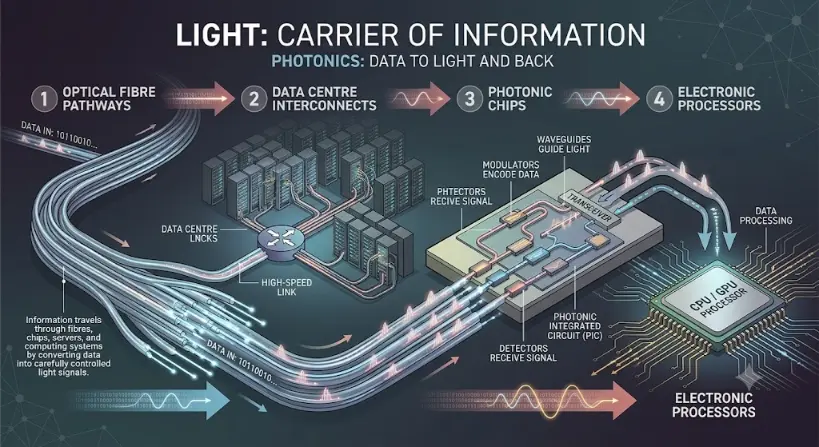
A detailed conceptual infographic illustration titled "LIGHT: CARRIER OF INFORMATION" and "PHOTONICS: DATA TO LIGHT AND BACK" on a modern dark gradient background, mapping the conversion of data into light for transport. A dense bundle of multiple translucent optical fibres on the left is labelled 'DATA IN: 10110010...' with small binary digits embedded in glowing light pulses. Directional arrows trace the paths: Stage 1 shows 'OPTICAL FIBRE PATHWAYS' glowingly guiding data-embedded light pulses. A side callout notes, "Information travels through fibres, chips, servers, and computing systems by converting data into carefully controlled light signals." The path leads to Stage 2, a large 'DATA CENTRE INTERCONNECTS', where glowing light paths integrate into rows of server racks via a high-speed link. The path continues to Stage 3, 'PHOTONIC CHIPS', showing a magnified Photonic Integrated Circuit (PIC) on a substrate guiding pulses with clear callouts like 'WAVEGUIDES GUIDE LIGHT', 'MODULATORS ENCODE DATA', and 'DETECTORS RECEIVE SIGNAL'. Light is shown converting near a transceiver section before moving to Stage 4, 'ELECTRONIC PROCESSORS', connecting to conventional CPU pins for 'DATA PROCESSING' and 'ELECTRONIC INTERFACES', with a callout on the right. A side panel shows 'TRANSCEIVER' conversion and 'CPU / GPU PROCESSOR' with conventional data streams. Binary code streams and waves reinforce the concept. Clear, sans-serif labels are integrated throughout the design, with a subtle network node pattern background.
This conceptual infographic visualizes the role of photonics in modern communication systems, showing how information is converted from data into carefully controlled light signals to travel through optical fibres, integrate into data center interconnects, be processed within photonic chips, and finally connect to electronic processors for computing.

The image is a detailed conceptual infographic illustration titled “LIGHT: CARRIER OF INFORMATION” and “PHOTONICS: DATA TO LIGHT AND BACK” on a modern dark gradient background with network node patterns. The illustration is structured across four distinct, connected stages, using glowing light paths and robust, directional arrows with integrated binary code streams and glowing wave patterns to emphasize light as a precise tool for information transport. Clear, sans-serif text labels are integrated into the design.

  • Stage 1 (Left): “OPTICAL FIBRE PATHWAYS.” A dense bundle of multiple translucent optical fibres glows as streams of light pulses move through them, labelled ‘DATA IN: 10110010…’ with small binary digits embedded in the pulses. A side callout says, “Information travels through fibres, chips, servers, and computing systems by converting data into carefully controlled light signals.” The fibres form long, branching highways.

  • Stage 2 (Center-Left): “DATA CENTRE INTERCONNECTS.” A massive, modern data centre filled with rows of glowing server racks branches from a central router structure. Light paths from the fibres integrate directly into these racks, labeled ‘HIGH-SPEED LINK’. Inside server blocks, light paths are visible, merging with traditional cables.

  • Stage 3 (Center-Right): “PHOTONIC CHIPS.” A magnified view of a complex photonic integrated circuit (PIC) on a substrate, with waveguides, modulators, and detectors. Light pulses are carefully guided within the chip structure, labelled ‘PHOTONIC INTEGRATED CIRCUIT (PIC)’. Text callouts indicate ‘WAVEGUIDES GUIDE LIGHT’, ‘MODULATORS ENCODE DATA’, and ‘DETECTORS RECEIVE SIGNAL’. Streams of light pulses from the fibre highway are routed through the chip. Arrows show conversion from light to electrical signals near a ‘TRANSCEIVER’ section.

  • Stage 4 (Right): “ELECTRONIC PROCESSORS.” A close-up view of a high-performance CPU (labelled ‘CPU / GPU PROCESSOR’) on a motherboard. Modulated light paths terminate here, converting into conventional electronic traces, with callouts saying ‘ELECTRONIC INTERFACES’ and ‘DATA PROCESSING’. Streams of conventional electrical data are shown flowing through the processor pins.

The Evolutionary Path: History, Communication Bottlenecks, and Foundational Milestones

The systematic adoption of light waves as the primary carrier for massive datasets represents the key infrastructure transition that enabled our modern hyper-connected digital society.

The Historical Journey

The integration of photonics into information tracking was sparked in 1970 when researchers at Corning Glass Works fabricated a silica optical fiber with an attenuation level below 20 dB/km, proving that light could route complex data across long paths without degrading. Concurrently, the development of continuous-wave semiconductor injection lasers operating at room temperature enabled stable, high-speed data encoding.
By the late 1990s, the introduction of Wavelength-Division Multiplexing (WDM) scaled link networks by combining dozens of data streams inside single fiber tracks. In recent years, this technology migrated from long-distance subsea links into localized data center clusters, addressing the severe information demands of modern cloud architectures.

Contemporary Technical Challenges

The dominant hurdle in scaling modern cloud and artificial intelligence clusters is known as the interconnect bottleneck. While internal microprocessor calculation rates have increased dramatically, old copper wires generate massive heat, electrical resistance, and latency when forced to carry these high-speed datasets between server blocks.
Unfortunately, replacing these metallic lines requires multiple conversions between electrons and photons via transceiver modules. This conversion step introduces insertion losses and consumes precious energy budgets, forcing foundries to engineer co-packaged optics architectures that place light guides directly onto processor substrates.

Future Paradigms: Optical AI Matrix Engines and Space-Division Multiplexing

Next-generation data infrastructure relies on utilizing the physical wave properties of light to compute and scale:
  • Monolithic Co-Packaged Silicon Optics: Hardware developers are bypassing transceiver conversion loss by integrating microcomb ring modulators directly onto conventional CPU and GPU silicon dies. This approach uses light streams to perform high-bandwidth input/output operations, routing massive memory arrays to processing cores with minimal latency.
  • Neuromorphic Optical Matrix Processors: To speed up artificial intelligence model calculations, research teams are constructing processors built entirely out of phase modulators and waveguides. By leveraging optical interference loops to calculate matrix multiplication at the speed of light, these photonic accelerators execute AI training workloads with a fraction of the power used by traditional electronics.

Why Light Is Useful for Information

Light is useful in communication and computing because it can carry information at high speed, travel through low-loss optical fibres, support many wavelength channels, and connect systems without the same electrical limitations as long copper links. This does not mean light is better for every task. It means light has special strengths when movement of information becomes the main challenge.
Strength of PhotonicsWhy It HelpsExample
High bandwidthOptical signals can carry large amounts of dataFibre-optic internet and data-centre links
Low loss over distanceLight can travel far through well-designed fibresLong-distance communication networks
Wavelength multiplexingDifferent wavelengths can carry different channelsMany data streams through one fibre
Electrical isolationOptical links can avoid some electrical interference problemsMedical, industrial, and high-speed systems
Compact chip integrationWaveguides and modulators can be placed on photonic chipsSilicon photonics and photonic integrated circuits
Fast signal transmissionOptical signals can move information rapidly between systemsOptical interconnects in computing infrastructure

The Basic Optical Communication Chain

A simple optical communication system contains a few essential stages. Each stage turns information into a form that the next stage can use.
StageMain ComponentWhat HappensRelated Photonics Idea
Electrical data inputElectronic circuitDigital information begins as an electrical signalElectronics and signal processing
Light generationLED or laser diodeElectrical energy is converted into photonsEmission and photon energy
ModulationOptical modulatorInformation is written onto lightIntensity, phase, wavelength, or timing control
GuidingOptical fibre or waveguideLight travels through a controlled pathTotal internal reflection and guided modes
ReceptionPhotodetectorLight is converted back into an electrical signalPhoton absorption and detection
Data recoveryReceiver electronicsThe signal is processed and interpretedDigital communication and computing

Optical Fibres: Long-Distance Roads for Photons

Optical fibres are among the most important technologies in modern communication. They guide light through long, thin strands of glass or plastic. In long-distance networks, carefully chosen wavelengths can travel through fibre with low loss, allowing information to move across cities, countries, and oceans.
A fibre does not simply carry “brightness.” It carries controlled optical signals. Those signals may be pulses, modulated waves, or multiple wavelength channels. The receiving system must detect and interpret the light accurately.

Wavelength-Division Multiplexing

One of the most powerful ideas in optical communication is wavelength-division multiplexing. Instead of sending only one data stream through one fibre, engineers can send many channels using different wavelengths of light. Each wavelength acts like a separate information lane.
This does not mean the wavelengths are physically separated into different fibres. They can travel together through the same fibre and then be separated by optical filters, gratings, or photonic devices at the receiver.
FeatureMeaningWhy It Matters
One fibreA single optical path carries many channelsUses infrastructure efficiently
Many wavelengthsEach wavelength can carry a different data streamIncreases total capacity
Optical filtersSeparate or combine wavelength channelsAllows routing and channel management
Stable lasersProvide controlled wavelength sourcesHelps channels remain distinct
Photonic chipsCan integrate filters, modulators, and detectorsSupports compact systems

Modulation: Writing Data onto Light

A steady light beam does not automatically carry useful digital information. To carry data, the light must be changed in a controlled way. This process is called modulation.
Simple systems may use intensity modulation, where high and low light levels represent information. More advanced systems may use phase, amplitude, polarisation, or combinations of properties. These methods allow more efficient use of optical signals and higher data rates.
In many high-speed systems, a laser provides a stable optical carrier and a modulator writes data onto it. This separation can allow better control than simply turning a light source on and off at very high speed.

Photodetection: Reading the Light Signal

At the receiving end, a photodetector converts incoming photons into an electrical signal. The detector must respond to the wavelength used, operate at the required speed, and produce a signal strong enough for the receiver electronics to process.
Detection is not a passive afterthought. A poor detector, weak signal, noisy receiver, or badly matched wavelength can limit the entire communication system. This is why photodetector design matters as much as source and fibre design.
Once light becomes an electrical signal again, the information can be processed by digital circuits, stored in memory, analysed by software, or sent onward through another system.

Photonics in Data Centres

Data centres are among the most important places where communication and computing meet. They contain servers, storage systems, switches, processors, accelerators, and networking equipment. Enormous amounts of data must move between these parts continuously.
As data rates increase, electrical links can face challenges involving power consumption, heat, signal loss, and bandwidth. Optical links can help move data efficiently across racks, between switches, and between computing modules.
This is why photonics is strongly connected with Cloud Computing. Cloud services depend not only on software but also on fast physical networks that move data between machines.

Optical Interconnects in Computing

An interconnect is a connection that moves data between parts of a computing system. Traditional interconnects use electrical signals. Optical interconnects use light. Photonic interconnects become attractive when large amounts of data must move quickly and efficiently.
Optical interconnects may connect servers, boards, chip packages, processors, memory units, accelerators, or network switches. They can help reduce bottlenecks when computing systems need high-bandwidth communication between many components.
The key idea is simple but important: faster processors alone do not guarantee faster computing. If data cannot move efficiently, the whole system slows down. Photonics addresses the movement of information.

Silicon Photonics in Communication and Computing

Silicon photonics is especially important for communication and computing because it offers a way to build compact optical devices using silicon-based chip platforms. Silicon photonic chips can include waveguides, modulators, filters, couplers, and detectors that help manage optical data links.
A silicon photonic transceiver may convert electrical data into optical signals, send those signals through fibre, and then receive optical signals from another system. This makes silicon photonics highly relevant to data centres, high-performance computing, and optical networking.

Photonic Integrated Circuits in System Design

Photonic integrated circuits help bring many optical functions onto chips. Instead of building systems from many separate optical components, engineers can place waveguides, splitters, modulators, resonators, filters, and detectors into compact circuits.
This matters for communication and computing because systems must be manufacturable, reliable, small enough for modules, and able to connect with electronics. Photonic integrated circuits help make optical systems more practical.

Photonics and Computing: A Balanced View

Photonics is sometimes described as the future of computing, but students should understand this carefully. Photonics is not a simple replacement for electronics. Electronic circuits remain extremely powerful for logic, memory, control, switching, and general-purpose computation.
Photonics is especially strong where light has natural advantages: high-speed data movement, wavelength parallelism, optical interconnects, sensing, signal transmission, and some specialised forms of analogue or quantum information processing.
A realistic future is likely to involve cooperation. Electronics may continue to handle logic and memory, while photonics helps move information, connect systems, support specialised accelerators, or process selected types of signals.

Forms of Photonics in Computing

Photonics can support computing in several ways. Some are already common in communication infrastructure, while others are still developing as research or specialised technology.
AreaWhat Photonics DoesStage of UseStudent-Friendly Meaning
Optical interconnectsMoves data between computing componentsWidely important and growingLight helps computers talk to each other
Data-centre opticsConnects servers, switches, racks, and networksAlready central to modern infrastructureCloud systems depend on fast optical links
Photonic acceleratorsUses optical effects for selected computationsDeveloping and specialisedLight may help with certain high-speed operations
Optical signal processingProcesses signals using interference, filtering, or wavelength controlUsed in specialised systemsSome signal tasks can be shaped directly in light
Quantum photonicsUses photons in quantum information systemsResearch and emerging technologyIndividual photons can carry quantum states
Optical neural networksUses optical components for selected machine-learning operationsResearch and early developmentPhotonic systems may support specialised AI hardware

Communication Versus Computing Applications

Communication and computing applications overlap, but they are not identical. Communication focuses on moving information between locations. Computing focuses on storing, processing, and using information. Photonics is important in both because moving data has become a central technical challenge.
QuestionCommunication FocusComputing Focus
What is the main goal?Send information from one point to anotherMove and process information inside a computing system
Typical optical pathOptical fibres across networksLinks between servers, boards, chips, or processors
Important devicesLasers, modulators, fibres, amplifiers, detectorsTransceivers, optical interconnects, photonic chips, electronic interfaces
Main challengeDistance, loss, bandwidth, noise, channel capacityBandwidth, energy, heat, latency, packaging, integration
Student-friendly pictureLight carries messages across a networkLight helps parts of a computer exchange data

Bandwidth, Latency, Energy, and Heat

Photonics becomes important in computing because data movement has physical costs. Moving electrical signals at high speed can require power and generate heat. Long or dense electrical interconnects can become difficult as data rates rise.
Optical links can help by carrying high data rates efficiently, especially over distances where electrical links become less attractive. However, optical systems also have costs. Lasers, modulators, detectors, drivers, packaging, coupling, and thermal control all require careful engineering.
A good engineering decision does not ask, “Is light always better?” It asks, “Where does light solve the most important system problem?”

Photonics and Artificial Intelligence Infrastructure

Artificial intelligence systems often require large amounts of data movement. Training and using large models may involve processors, memory, accelerators, storage systems, and networked computing clusters. These systems depend heavily on fast communication between components.
Photonics can support this infrastructure by improving data movement in networks and interconnects. In some research directions, photonics may also support specialised machine-learning hardware. However, students should distinguish between two ideas: photonics already matters for the communication infrastructure around AI, while photonic AI computation itself remains a specialised and developing field.
This topic connects naturally with Artificial Intelligence, Data Science and Analytics, and Cloud Computing.

Photonics and Quantum Information

Photons are also important in quantum information science. Individual photons can carry quantum states, travel through optical channels, interfere, and be detected by specialised devices. Photonic chips may help guide, split, recombine, and measure quantum light.
Quantum photonics is different from ordinary optical communication. It depends on quantum states, measurement, probability, and coherence at very small scales. Students do not need to master these details here, but they should recognise that photons can carry both classical and quantum forms of information.
This connects photonics with Modern Physics.

Applications of Photonics in Communication and Computing

Photonics supports many systems where information must be transmitted, received, routed, or moved efficiently.

Fibre-Optic Internet

Light carries digital information through optical fibres, supporting high-speed communication across homes, cities, countries, and continents.

Undersea Cables

Long optical fibre cables carry internet traffic between continents, making global communication possible.

Data Centres

Optical links move data between servers, switches, racks, and storage systems inside cloud infrastructure.

Optical Transceivers

Transceivers convert electrical signals into optical signals and optical signals back into electrical signals.

Optical Interconnects

Light can connect computing components where high bandwidth and efficient data movement are needed.

Photonic Chips

Photonic integrated circuits and silicon photonics help route, modulate, filter, and detect light on compact platforms.

High-Performance Computing

Photonics may help large computing systems move data between processors, accelerators, memory, and network hardware.

Quantum Communication

Photons can carry quantum states in specialised communication and research systems.

Case Studies: Photonics in Real Information Systems

Case Study 1: Fibre-Optic Internet Access

A fibre-optic internet connection uses light to carry information between the network and the user. Data from digital electronics is converted into optical signals, sent through fibre, and detected at the other end. The same physical idea supports much larger backbone networks.
This case study shows that photonics is not remote from everyday life. A video call, online lesson, cloud document, or streamed lecture may travel part of its journey as pulses or modulated waves of light.

Case Study 2: Data-Centre Optical Links

Inside a data centre, servers and switches exchange enormous amounts of information. Optical transceivers and fibre links help move data between machines. Silicon photonic modules may help make these links more compact and scalable.
This case study shows that cloud computing is also a physical engineering achievement. Software services depend on optical links, power systems, cooling, chips, and networks.

Case Study 3: Wavelength Channels in One Fibre

A single fibre can carry many wavelength channels at the same time. Each wavelength may carry a separate data stream. Optical filters and multiplexers combine and separate these channels.
This case study shows why photonics is powerful for communication. Light offers parallelism through wavelength. Instead of building a separate path for every data stream, engineers can use different optical wavelengths as separate channels.

Case Study 4: Optical I/O for Advanced Computing

Advanced computing systems may need very fast input and output between processors, memory, accelerators, and external networks. Optical I/O uses light to move data into and out of computing packages or modules.
This case study shows that computing performance depends not only on arithmetic operations. It also depends on how quickly data can enter, leave, and circulate through the system.

Case Study 5: Photonic Chips for Sensing and Signal Processing

Some photonic chips are designed to process signals directly through optical interference, filtering, resonance, or wavelength selection. Others are used as compact sensing platforms where the optical signal changes when the environment changes.
This case study shows that photonics is not limited to carrying internet data. It can also help systems sense, measure, filter, analyse, and respond to physical information.

Connections with Wider Physics and Technology

Photonics in communication and computing connects physics, electronics, networks, cloud infrastructure, computer engineering, and data systems. These related pages help students see the wider map.

Light and Optics

Photonics depends on the wider physics of light, including reflection, refraction, interference, diffraction, polarisation, and interaction with matter.

Fiber Optics

Fibre optics provides the long-distance pathways that allow photons to carry information through communication networks.

Laser Optics

Lasers provide the organised light sources used in many optical communication, sensing, and measurement systems.

Chemical Material Engineering

Ultra-fast modulation crystals rely on specialized chemical lattice deposits that exhibit high electro-optic properties under tight electrical boundaries.

Learning Pathway Within Photonics

This page completes the introductory photonics cluster by showing how photon energy, devices, modulators, waveguides, integrated circuits, and silicon platforms come together in real information systems.

Photons and Photon Energy

Understand photons, wavelength, frequency, photon energy, absorption, emission, and energy matching in photonic materials.

Photonic Integrated Circuits

Discover how waveguides, modulators, detectors, filters, resonators, and optical components can be combined on compact chips.

Silicon Photonics

Explore how silicon-based platforms guide, manipulate, detect, and process light for communication, sensing, and optical interconnects.

Photonics in Communication and Computing

Current page. Understand how photons carry information in fibre networks, data centres, optical interconnects, photonic chips, and future computing systems.

Quick Check: Photonics in Communication and Computing

Quick Check: Light and Information

Q1. Why is light useful for communication?
Light is useful because it can carry high-speed information through optical fibres and waveguides, often with high bandwidth and low loss over suitable distances.
Q2. What does an optical modulator do in a communication system?
An optical modulator writes information onto light by changing a property such as intensity, phase, polarisation, frequency, or timing.
Q3. What is wavelength-division multiplexing?
Wavelength-division multiplexing sends multiple data channels through the same optical path by using different wavelengths of light.
Q4. Why does photonics matter in computing?
Photonics matters because computing systems often need to move huge amounts of data. Optical links can help with high-bandwidth data movement between servers, chips, processors, memory, and network equipment.

Common Misunderstandings About Photonics in Communication and Computing

Misunderstanding 1: Photonics Is Only About Faster Internet

Faster internet is one important application, but photonics also supports data centres, optical interconnects, sensing, imaging, high-performance computing, photonic chips, and quantum information systems.

Misunderstanding 2: Light Automatically Replaces Electricity

Light and electricity have different strengths. Electronics remains excellent for logic, memory, switching, and control. Photonics is especially useful for high-speed transmission, wavelength multiplexing, optical interconnects, and some specialised signal-processing tasks.

Misunderstanding 3: Optical Communication Is Just Sending Bright Light Through Fibre

Optical communication uses carefully controlled signals. The light may be modulated in intensity, phase, wavelength, polarisation, or timing. Sources, fibres, modulators, amplifiers, filters, detectors, and electronics all affect performance.

Misunderstanding 4: Computing Speed Depends Only on Processor Speed

Processor speed is important, but data movement can also limit performance. A system may slow down if processors, memory, accelerators, storage, and networks cannot exchange information efficiently.

Misunderstanding 5: Photonic Computing Is Already a Simple Replacement for Digital Electronics

Photonic computing is promising in selected areas, but it is not a universal replacement for electronic computing. Many useful systems will combine electronics and photonics rather than choosing only one.

Key Terms

Bandwidth
The information-carrying capacity of a communication link or system.
Data-centre optics
Optical links and modules used to move data within or between data centres.
Latency
The time delay between sending information and receiving or using it.
Modulation
The controlled changing of a light signal so that it carries information.
Optical communication
The transmission of information using light signals through fibres, waveguides, or free-space optical paths.
Optical fibre
A thin waveguide, usually made of glass or plastic, that carries light over short or long distances.
Optical I/O
Optical input and output used to move data into and out of computing systems.
Optical interconnect
A connection that uses light to move data between systems, boards, chips, processors, servers, or network devices.
Optical transceiver
A device or module that converts electrical signals into optical signals and optical signals back into electrical signals.
Photonics accelerator
A specialised system that uses optical effects for selected computing or signal-processing tasks.
Photonic integrated circuit
A chip that combines multiple optical components to guide, control, process, and detect light.
Quantum photonics
The use of photons and photonic devices in quantum information, communication, sensing, or computing research.
Silicon photonics
A technology platform that uses silicon-based chips to guide, modulate, detect, and process light.
Wavelength-division multiplexing
A method of sending multiple optical channels through the same path using different wavelengths of light.

Review Questions

  1. What is the main role of photonics in communication?
    Answer: Photonics allows information to be carried by light through optical fibres, waveguides, and optical links.
  2. What is the basic function of an optical transceiver?
    Answer: An optical transceiver converts electrical signals into optical signals for transmission and converts received optical signals back into electrical signals.
  3. Why is modulation needed in optical communication?
    Answer: Modulation writes information onto light by changing a property such as intensity, phase, frequency, polarisation, or timing.
  4. What is wavelength-division multiplexing?
    Answer: It is a method of sending multiple data channels through one optical path by using different wavelengths of light.
  5. Why does photonics matter in data centres?
    Answer: Data centres must move huge amounts of information between servers, switches, processors, and storage systems. Photonics helps provide high-bandwidth optical links for this data movement.
  6. Why does photonics not simply replace electronics?
    Answer: Electronics remains excellent for logic, memory, control, and switching. Photonics is especially useful for transmission, interconnection, wavelength parallelism, and selected signal-processing tasks.
  7. How does silicon photonics support communication and computing?
    Answer: Silicon photonics can integrate waveguides, modulators, filters, couplers, and detectors on compact chips, supporting optical transceivers, data-centre links, and optical interconnects.
  8. Why can data movement limit computing performance?
    Answer: Even if processors are fast, systems may slow down if data cannot move quickly and efficiently between processors, memory, accelerators, storage, and networks.

Thought-Provoking Questions

  1. Why is the internet partly a physics achievement, not only a software achievement?
    Answer: The internet depends on physical systems that move information, including optical fibres, lasers, photodetectors, modulators, amplifiers, routers, data centres, and power infrastructure. Software depends on this physical foundation.
  2. Why might future computing systems need both electrons and photons?
    Answer: Electrons are highly effective for logic, memory, and control. Photons are powerful for high-speed transmission, low-loss links, wavelength parallelism, and some specialised processing tasks. Combining both may produce stronger systems.
  3. Why is moving data sometimes as difficult as processing data?
    Answer: Large systems may contain many processors, memory units, storage systems, and accelerators. If data movement consumes too much time or energy, overall performance suffers even when the processors are powerful.
  4. How does wavelength-division multiplexing show the special value of light?
    Answer: Different wavelengths can carry separate data channels through the same optical path. This gives light a natural form of parallelism that is extremely useful in communication systems.
  5. Why should students be careful about claims that photonic computing will replace electronic computing?
    Answer: Photonics has major strengths, but digital electronics is deeply developed and highly effective for many tasks. The most realistic view is that photonics will complement electronics in areas where light offers clear advantages.

Comprehensive Numerical Problems with Solutions

  1. A fibre link carries 4 wavelength channels. Each channel carries 25 Gbit s−1. What is the total data rate?
    Solution:
    Total data rate is the product of parallel channel allocations and discrete throughput rates:
    $$\text{Total Data Rate} = \text{Channels} \times \text{Data Rate per Channel}$$
    $$\text{Total Data Rate} = 4 \times 25\text{ Gbit s}^{-1} = 100\text{ Gbit s}^{-1}$$
    Answer: The total aggregate data rate is exactly 100 Gbit s−1.
  2. An optical signal travels through 10 km of fibre at 2.0 × 10⁸ m/s. Estimate the travel time.
    Solution:
    Convert the structural route parameter into metric meters base units: 10 km = 1.0 × 10⁴ m. Use the tracking transit equation:
    $$t = \frac{d}{v}$$
    $$\text{t} = \frac{1.0 \times 10^4\text{ m}}{2.0 × 10^8\text{ m/s}} = 5.0 \times 10^{-5}\text{ s}$$
    Convert raw time metrics into microseconds (μs), where 1 μs = 10−6 s:
    $$t = 5.0 \times 10^{-5}\text{ s} = 50\mu\text{s}$$
    Answer: The structural travel time is exactly 5.0 × 10⁻⁵ s (or 50 μs).
  3. A data-centre optical link uses 8 channels, each carrying 50 Gbit s−1. What is the total data rate?
    Solution:
    Multiply the parallel core channels across the line rates:
    $$\text{Total Data Rate} = 8 \times 50\text{ Gbit s}^{-1} = 400\text{ Gbit s}^{-1}$$
    Answer: The total data rate capacity evaluates to exactly 400 Gbit s−1.
  4. An optical receiver receives 2.0 mW of optical power. If the photodetector responsivity is 0.80 A/W, estimate the photocurrent.
    Solution:
    Convert power levels into base scientific formatting: 2.0 mW = 2.0 × 10⁻³ W. Use the responsivity equation:
    $$I = R \cdot P$$
    $$I = (0.80\text{ A/W}) \times (2.0 \times 10^{-3}\text{ W}) = 0.0016\text{ A}$$
    Convert current values into milliamperes (mA), where 1 mA = 10−3 A:
    $$I = 0.0016\text{ A} = 1.6\text{ mA}$$
    Answer: The generated photocurrent response is exactly 1.6 mA.
  5. A modulated optical signal sends 2.5 × 10⁹ symbols per second. If each symbol represents 2 bits, estimate the bit rate.
    Solution:
    Calculate capacity based on symbol density parameters:
    $$\text{Bit Rate} = \text{Symbol Rate} \times \text{Bits per Symbol}$$
    $$\text{Bit Rate} = (2.5 \times 10^9\text{ symbols/s}) \times 2\text{ bits/symbol} = 5.0 \times 10^9\text{ bits/s}$$
    Scale using standard system prefixes (1 Gbit/s = 109 bit/s):
    $$\text{Bit Rate} = 5.0\text{ Gbit s}^{-1}$$
    Answer: The line link data bit rate evaluates to exactly 5.0 Gbit s−1.
  6. A fibre link has input optical power 10 mW. At the receiver, the optical power is 4 mW. What percentage of the input power remains?
    Solution:
    Find the ratio parameter of terminal power over launching power:
    $$\text{Percentage Remaining} = \frac{P_{\text{out}}}{P_{\text{in}}} \times 100\%$$
    $$\text{Percentage Remaining} = \frac{4\text{ mW}}{10\text{ mW}} \times 100\% = 40\%$$
    Answer: Exactly 40% of the initial launched input optical power is preserved.

External References for Further Reading

The following references provide useful background for students who want to read beyond this introductory page.
  1. RP Photonics Encyclopedia: Optical Fiber Communications — A useful technical reference on fibre-optic communication systems, components, and signal transmission.
  2. RP Photonics Encyclopedia: Wavelength Division Multiplexing — A reference explaining how multiple optical wavelength channels can share the same fibre.
  3. MIT OpenCourseWare: Fundamentals of Photonics Lecture Notes — Lecture materials covering waveguides, optical fibres, resonators, photonic devices, and related foundations.
  4. Intel: Silicon Photonics — A technology overview showing how silicon photonics is used in high-speed optical connectivity.

Why This Topic Matters

Photonics in communication and computing matters because modern society depends on moving information quickly and reliably. Online learning, cloud storage, video calls, search engines, artificial intelligence, financial systems, research networks, and global communication all depend on physical channels that carry data.
For students, this topic is important because it shows how physics becomes infrastructure. Photons, fibres, lasers, modulators, detectors, waveguides, and photonic chips are not isolated textbook ideas. They support the hidden light-based networks behind modern digital life.
The deeper lesson is that the future of computing may not depend only on faster calculation. It may also depend on wiser ways of moving information.

Summary

Photonics uses light to carry, guide, modulate, detect, and sometimes process information. In communication systems, photons travel through optical fibres and waveguides to transmit data. In computing systems, photonics can help move data between servers, chips, processors, memory, and network equipment.
Key ideas include optical transceivers, modulation, wavelength-division multiplexing, optical interconnects, data-centre optics, photonic integrated circuits, and silicon photonics. Photonics does not simply replace electronics; it works with electronics where light offers useful advantages.
Students who understand photonics in communication and computing can better understand the physical foundation of internet infrastructure, data centres, cloud computing, artificial intelligence systems, and future light-based technologies.

Reflection Question

If future computing systems are limited not only by how fast they calculate but also by how fast they move information, what new role might photons play in the next generation of digital technology?
Last updated: 14 Jul 2026