
Modern photonics depends on three essential device families: LEDs, lasers, and photodetectors. LEDs and lasers convert electrical or optical energy into light, while photodetectors convert light back into electrical signals. Together, they form the basic input and output devices of many light-based technologies.
This page explains how LEDs emit light, how lasers produce organised light, and how photodetectors sense incoming photons. It belongs to the wider Photonics cluster, where students can also study photon energy, optical modulators, waveguides, photonic integrated circuits, silicon photonics, and photonics in communication and computing.
What LEDs, Lasers, and Photodetectors Really Are
An LED, a laser, and a photodetector may look like different devices, but they are closely connected by one central idea: light and electrons can exchange energy. Inside an LED, electrons release energy as photons. In a laser, excited particles release photons in an organised and amplified way. In a photodetector, incoming photons transfer energy to electrons and create an electrical response.
This means photonics is not only about light travelling through space. It is also about conversion. Photonic systems often need to convert electrical signals into light, guide or process that light, and then convert it back into electrical signals. LEDs, lasers, and photodetectors make this possible.
Students should first connect this topic with Photons and Photon Energy, because all three devices depend on whether photon energy matches the energy structure of the material.
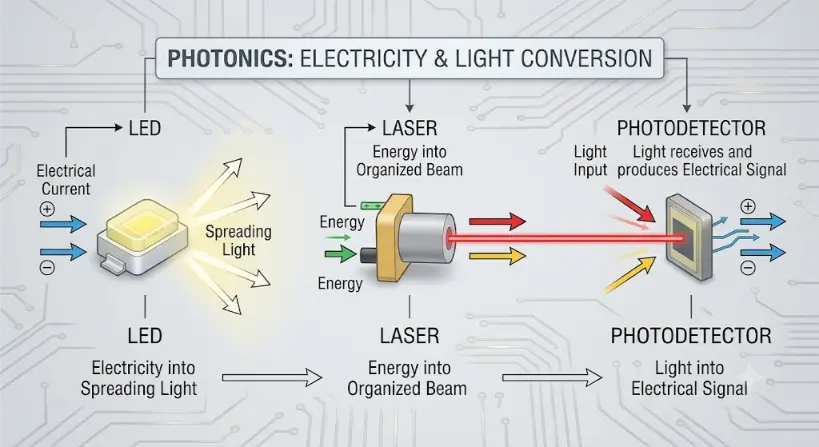
The image is a clean, minimalist three-panel infographic set against a dark blue, stylized electronic circuit board background. It traces the flow of energy between electrical and optical states across three discrete components arranged from left to right:
Left Panel (LED): An electrical current wire leads into a bright blue light-emitting diode (LED). The device converts the incoming electrical current into a wide, expanding cone of incoherent blue light, illustrating electricity-to-light conversion.
Center Panel (Laser): Positioned in the middle, a metallic laser diode module receives energy and transforms it into a highly organised, perfectly parallel, and narrow red laser beam that shoots toward the right.
Right Panel (Photodetector): On the far right, a photodetector component acts as the receiver. The narrow red laser beam hits its active sensor area, which immediately triggers an outgoing electrical current pulse labeled as an "ELECTRICAL SIGNAL."
The visual layout relies on clear, glowing arrow indicators to map the energy pipeline, showing a complete conceptual loop of light in, light out, and signal back.
The Evolutionary Path: History, Materials Science Challenges, and Next-Gen Paradigms
The integration of electrical carriers with discrete quantum transitions transformed materials physics into the active discipline of optoelectronic systems engineering.
The Historical Journey
The journey of optoelectronic energy conversion began in 1907 when Henry Joseph Round noticed a faint asymmetrical yellow light leaking from a silicon carbide crystal, documenting the first discovery of solid-state electroluminescence. This effect remained a physics curiosity until Nick Holonyak developed the first practical visible-spectrum GaAsP LED in 1962.
Concurrently, Robert Hall demonstrated the world’s first semiconductor injection laser diode using gallium arsenide. Detection capabilities matured rapidly in 1970 when Willard Boyle and George Smith invented the Charge-Coupled Device (CCD) image sensor, completing the fundamental technological toolkit needed to dynamically translate electrical signals into light waves and back.
Contemporary Scientific Challenges
The central challenge in configuring highly efficient optoelectronic pairs is managing localized heat inside a crystalline structure. Forcing dense carrier currents through a tiny p-n junction generates immense thermal stress. This lowers **internal quantum efficiency** (IQE) and causes the output wavelength to drift due to thermal bandgap narrowing.
Furthermore, standard Silicon substrate chips present an indirect electronic bandgap. This prevents electrons and holes from recombining directly to generate photons efficiently, forcing engineers to grow or bond complex direct-bandgap III-V compound semiconductor crystals (such as Indium Phosphide or Gallium Nitride) onto silicon wafers.
Future Paradigms: Quantum Dot Micro-Emitters and Single-Photon Avalanche Diodes
The horizon of active device layout moves past traditional bulk material junctions:
- Colloidal Quantum Dot Micro-LEDs: By manipulating the geometric size of nanoscale semiconductor crystals, engineers can color-tune light emissions through quantum confinement. This approach provides incredibly high color purity and pixel densities for next-generation displays and intra-chip communication wave networks.
- Single-Photon Avalanche Diodes (SPADs): In deep-space routing and advanced quantum key networks, tracking incredibly weak signals is essential. Modern foundries are refining SPAD arrays that run above their reverse breakdown threshold in a self-sustaining Geiger mode. This configuration allows a single incoming photon to trigger a measurable electrical cascade with sub-nanosecond timing precision.
A Simple Comparison
LEDs, lasers, and photodetectors are often introduced separately, but students understand them better when they are compared together.
| Device | Main Function | Basic Energy Conversion | Typical Uses |
|---|---|---|---|
| LED | Emits light | Electrical energy to photons | Displays, lighting, indicators, sensors, optical links |
| Laser | Emits organised light | Energy input to coherent photon emission | Communication, surgery, manufacturing, sensing, research |
| Photodetector | Detects light | Photon energy to electrical signal | Cameras, optical receivers, sensors, lidar, scientific instruments |
The simplest way to remember the difference is this: LEDs glow, lasers beam, and photodetectors listen to light.
LEDs: Converting Electricity into Light
An LED, or light-emitting diode, is a semiconductor device that emits light when electric current flows through it in the correct direction. Inside the semiconductor, electrons and holes recombine. When they recombine, energy can be released as photons.
The colour or wavelength of the emitted light depends strongly on the semiconductor material. Different materials have different energy gaps, so they release photons with different energies. This is why red, green, blue, infrared, and ultraviolet LEDs require different material designs.
Why LEDs Are Useful
LEDs are useful because they are compact, efficient, robust, and easy to control electronically. They are found in indicator lights, traffic signals, display screens, remote controls, optical sensors, vehicle lighting, medical devices, and communication systems.
Compared with lasers, LEDs usually emit light over a wider range of directions and wavelengths. Their light is not usually highly coherent. This makes LEDs excellent for illumination and display, but less suitable when a very narrow, coherent beam is needed.
LEDs as Photonic Devices
An LED is not just a small lamp. It is a semiconductor photonic device. Its behaviour depends on electron energy levels, material band gaps, current flow, recombination, photon emission, heat management, and optical packaging.
For students, LEDs are a friendly entry point into photonics because they show how quantum energy transitions become everyday technology. A tiny semiconductor chip can turn electrical energy into visible or invisible light.
Lasers: Producing Organised Light
A laser also emits light, but it does so in a more organised way than an LED. Laser light is often more coherent, more directional, narrower in wavelength, and easier to focus into a small spot.
Laser action depends on stimulated emission, population inversion, gain, and optical feedback. When a suitable gain medium is excited, incoming photons can stimulate the emission of matching photons. Mirrors or cavity structures then help selected light waves grow into a stable beam.
Students can study this mechanism more deeply in Stimulated Emission and Laser Cavities.
Why Lasers Are Useful
Lasers are useful because organised light can be controlled with great precision. A laser beam can be sent through an optical fibre, focused onto a small surgical region, used to cut or weld materials, used in barcode scanners, or used in scientific measurement.
Lasers are especially important in photonics because they provide controlled light sources for communication, sensing, imaging, measurement, manufacturing, and research. Their beam properties are explored in Laser Beam Properties.
Laser Diodes
Many modern lasers are semiconductor lasers, also called laser diodes. A laser diode is small, electrically driven, and highly useful in optical communication, sensors, barcode readers, printers, lidar systems, and compact instruments.
Laser diodes show why photonics and electronics are closely connected. The device begins as a semiconductor component, but its output is a beam of light that can carry information, measure distance, or interact with materials.
Photodetectors: Converting Light into Electrical Signals
A photodetector is a device that senses light and converts it into an electrical response. When photons enter the detector, their energy may excite electrons inside the material. This can produce a current, voltage, charge pattern, or measurable change in electrical behaviour.
Photodetectors are essential because photonic systems need receivers. A communication link needs a detector to read optical signals. A camera needs a sensor to convert images into electronic data. A scientific instrument needs detectors to measure faint light. A lidar system needs detectors to receive reflected pulses.
Why Photon Energy Matters in Detection
A detector cannot respond equally well to every wavelength. The photon energy must be suitable for the detector material. If the photon energy is too low, it may not create a useful electronic response. If it is too high, the light may be absorbed too strongly or produce unwanted effects.
This is why visible-light cameras, infrared sensors, ultraviolet detectors, and fibre-optic receivers often use different materials or device structures. The detector must be matched to the photons it is meant to detect.
Common Types of Photodetectors
Students may meet several types of photodetectors as they advance. Photodiodes are widely used in optical receivers and sensors. Avalanche photodiodes can provide internal gain for weak signals. Image sensors convert patterns of light into digital images. Photomultiplier tubes are used when extremely weak light must be detected in specialised instruments.
The details differ, but the central idea remains the same: photon energy is converted into measurable electrical information.
How the Three Devices Work Together
Many photonic systems use light sources and detectors together. One device emits light, the system guides or modifies the light, and another device detects it. This pattern appears again and again in modern technology.
| System | Light Source | Light Path or Process | Detector Role |
|---|---|---|---|
| Fibre-optic link | Laser diode or LED | Light travels through optical fibre | Photodetector converts optical signal into electrical data |
| Barcode scanner | Laser or LED | Light reflects from printed code | Detector reads intensity pattern |
| Camera | External light source or scene illumination | Light forms an image through a lens | Image sensor records the photon pattern |
| Lidar | Pulsed laser | Light travels to object and returns | Detector measures returned signal and timing |
| Medical imaging | LED, laser, or broadband source | Light interacts with tissue | Detector measures reflected, scattered, or emitted light |
| Photonic chip | Integrated or external light source | Light travels through waveguides and modulators | On-chip or off-chip detector reads the signal |
This is why LEDs, lasers, and photodetectors should not be seen as isolated devices. They are often parts of a larger optical information system.
LEDs Versus Lasers
LEDs and lasers both emit light, but their light is organised differently. The distinction matters because different applications require different light behaviour.
| Feature | LED | Laser |
|---|---|---|
| Emission process | Mostly spontaneous emission | Stimulated emission with optical feedback |
| Directionality | Light spreads more widely | Beam is usually narrow and directional |
| Coherence | Usually low | Often high |
| Wavelength range | Usually broader | Usually narrower |
| Focusing | Less easily focused into a tiny spot | Often highly focusable |
| Best suited for | Lighting, displays, indicators, short links | Communication, cutting, sensing, precise measurement, imaging |
Neither device is automatically better. The best choice depends on the task. A display needs many efficient LEDs. A fibre communication link may need a stable laser diode. A simple indicator light does not need a coherent beam.
Photodetectors as the “Eyes” of Photonics
If LEDs and lasers are light sources, photodetectors are the receiving eyes of photonic systems. They do not merely “see” light in the human sense. They convert optical energy into measurable electrical data.
This conversion is central to digital technology. A camera sensor turns a scene into image data. A fibre receiver turns light pulses into digital information. A scientific detector turns faint optical signals into measurements. A sensor network turns environmental light changes into useful signals.
This is why the Photodetectors page connects strongly with Data Science and Analytics. Once light is converted into electrical or digital form, it can be stored, analysed, transmitted, and interpreted.
Materials Matter
LEDs, lasers, and photodetectors depend strongly on materials. The material determines energy gaps, emission wavelength, detection range, efficiency, heat behaviour, and device performance.
Semiconductor materials are especially important. By choosing and engineering materials, designers can create devices that emit red, green, blue, infrared, or ultraviolet light, or detect different parts of the spectrum.
This material-device relationship prepares students for later pages on Photonic Integrated Circuits and Silicon Photonics.
Case Studies: LEDs, Lasers, and Photodetectors in Real Systems
Case Study 1: Fibre-Optic Communication
A fibre-optic communication system uses a light source, an optical fibre, and a detector. A laser diode or LED converts an electrical data signal into light. The light travels through the fibre. At the far end, a photodetector converts the light back into an electrical signal.
This case study shows the complete photonic cycle: electrical signal to photons, photons through a guided path, and photons back to electrical signal. It connects naturally with Fiber Optics.
Case Study 2: Smartphone Cameras
A smartphone camera uses a lens system and an image sensor. Photons from the scene enter the camera and are focused onto millions of tiny detector pixels. Each pixel converts incoming light into an electrical signal. Software then processes the signals into an image.
This case study shows that a modern camera is not only an optical device. It is also a photonic, electronic, and computational system.
Case Study 3: LED Displays
LED displays use many tiny light-emitting elements. By controlling the brightness of red, green, and blue emitters, a display can create colours and images. Each small light source is part of a larger visual system.
This case study helps students see how simple photon emission becomes a complex information display. The screen is made of controlled light.
Case Study 4: Lidar Sensing
A lidar system often uses a pulsed laser to send light toward an object or environment. A detector receives the reflected signal. By analysing timing and intensity, the system can estimate distance, shape, or motion.
This case study shows how lasers and photodetectors work together to turn light into spatial information.
Connections with Wider Physics and Technology
LEDs, lasers, and photodetectors connect photonics with wider physics, electronics, communication, imaging, and data systems.
Light and Optics
These devices belong to the wider study of how light is produced, guided, focused, reflected, absorbed, emitted, and detected.Photons and Photon Energy
Photon energy explains why materials emit and detect only certain wavelength ranges effectively.Laser Optics
Laser optics explains stimulated emission, optical feedback, laser cavities, beam properties, laser types, applications, and laser safety.Electrical and Electronic Engineering
LEDs, laser diodes, and photodetectors are optoelectronic devices that connect light signals with electronic circuits.Chemical Material Engineering
Advanced solid-state architectures rely on specialized atomic crystal lattices engineered for exact bandgap and transparency limits.Learning Pathway Within Photonics
This page introduces the basic devices that emit, amplify, and detect light. Students can then continue to guiding, modulation, chip integration, silicon photonics, and optical communication or computing systems.
Photons and Photon Energy
Understand photons, wavelength, frequency, photon energy, absorption, emission, and the energy matching needed in photonic materials.LEDs, Lasers, and Photodetectors
Current page. Learn how photonic devices emit, amplify, detect, and convert light signals.Optical Modulators and Waveguides
See how light is controlled, switched, shaped, and guided through optical fibres, chips, and waveguide structures.Photonic Integrated Circuits
Discover how light sources, waveguides, modulators, detectors, and other optical functions can be combined on compact chips.Silicon Photonics
Explore how semiconductor platforms can support optical communication, sensing, and signal processing using light.Photonics in Communication and Computing
Understand how photonic devices support fibre networks, data centres, optical interconnects, and future computing systems.Quick Check: LEDs, Lasers, and Photodetectors
Quick Check: Basic Photonic Devices
Q1. What does an LED do?
An LED converts electrical energy into light when electrons and holes recombine inside a semiconductor material.
Q2. How is laser light different from LED light?
Laser light is usually more coherent, directional, narrow in wavelength, and focusable than LED light. LED light usually spreads more widely and has lower coherence.
Q3. What does a photodetector do?
A photodetector converts incoming light into an electrical signal by using photon energy to produce a measurable electronic response.
Q4. Why must a detector be matched to the wavelength it detects?
Different materials respond to different photon energies. A detector must be made from a material that can respond effectively to the wavelength range of the incoming light.
Common Misunderstandings About Photonic Devices
Misunderstanding 1: An LED Is Just a Tiny Bulb
An LED is not a miniature version of an old filament lamp. It is a semiconductor device that emits photons through electron-hole recombination. Its colour and efficiency depend on material physics, not on heating a wire until it glows.
Misunderstanding 2: A Laser Is Better Than an LED for Every Use
A laser is better only when its special properties are needed. LEDs are often better for lighting, displays, indicators, and some short-distance optical systems because they are simple, efficient, safe, and inexpensive.
Misunderstanding 3: A Photodetector Simply “Sees” Light Like an Eye
A photodetector is not a biological eye. It converts photon energy into electrical signals. Its response depends on material choice, wavelength range, sensitivity, noise, speed, and circuit design.
Misunderstanding 4: All Light Sources Produce the Same Kind of Light
Different sources produce different light. An LED, a laser diode, a fluorescent lamp, and sunlight may differ in spectrum, coherence, directionality, intensity, modulation speed, and focusability.
Key Terms
- Band gap
- An energy gap in a semiconductor that strongly influences which photons can be emitted or absorbed.
- Electron-hole recombination
- A process in which an electron and a hole recombine, often releasing energy as a photon in an LED or semiconductor laser.
- Laser
- A device that produces organised light through stimulated emission, gain, and optical feedback.
- Laser diode
- A compact semiconductor laser driven by electric current.
- LED
- A light-emitting diode that converts electrical energy into photons through recombination in a semiconductor.
- Optoelectronics
- The field of devices that connect optical signals with electronic signals.
- Photodetector
- A device that converts incoming light into an electrical signal.
- Photodiode
- A semiconductor photodetector commonly used to sense light and produce a current or voltage response.
- Quantum efficiency
- A measure of how effectively a device converts carriers into photons or photons into electrical signals.
- Responsivity
- A measure of how much electrical output a detector produces for a given amount of incoming optical power.
- Spontaneous emission
- Emission of a photon without being triggered by a matching incoming photon. LEDs mainly rely on this process.
- Stimulated emission
- Emission of a photon triggered by an incoming photon, producing a matching photon. Lasers rely on this process.
Review Questions
- What is the main function of an LED?Answer: An LED converts electrical energy into light through electron-hole recombination in a semiconductor material.
- What is the main function of a laser?Answer: A laser produces organised light that is often coherent, directional, narrow in wavelength, and focusable.
- What is the main function of a photodetector?Answer: A photodetector converts incoming light into an electrical signal.
- Why are semiconductor materials important in LEDs and photodetectors?Answer: Semiconductor materials have energy gaps that determine which wavelengths they can emit or detect effectively.
- Why is laser light usually more directional than LED light?Answer: Laser light is produced through stimulated emission and optical feedback, which select and amplify organised light waves. LED light usually comes mainly from spontaneous emission and spreads more widely.
- How do LEDs, lasers, and photodetectors work together in optical communication?Answer: A light source converts electrical data into light, the optical channel carries the signal, and a photodetector converts the received light back into electrical data.
Thought-Provoking Questions
- Why is conversion between electricity and light so important in modern technology?Answer: Electronic systems are good at storing, processing, and controlling information, while optical systems are excellent for high-speed transmission, sensing, and imaging. Conversion allows the strengths of both to be combined.
- Why might a simple LED display still depend on deep quantum physics?Answer: The display may look simple, but each LED emits photons because electrons move between energy states inside a semiconductor. The colour and efficiency depend on quantum energy structure.
- Why is a detector as important as a light source in photonics?Answer: A light signal is useful only if it can be read. Detectors turn optical information into electrical information that can be stored, processed, transmitted, or acted upon.
- How do LEDs, lasers, and photodetectors show the partnership between physics and engineering?Answer: Physics explains photon emission, absorption, and energy gaps. Engineering turns these principles into reliable devices, circuits, packages, sensors, displays, and communication systems.
Comprehensive Numerical Problems with Solutions
- An LED emits light of wavelength 620 nm. Estimate the photon energy in electron volts.Solution:Using the quick optoelectronic wavelength approximation formula:$$E(\text{eV}) \approx \frac{1240}{\lambda(\text{nm})}$$Substitute $\lambda$ = 620 nm directly into the relationship:$$E \approx \frac{1240}{620} = 2.0\text{ eV}$$Answer: The energy value of the emitted photon equals exactly 2.0 eV.
- A laser diode emits 3.0 × 10¹⁷ photons per second. If each individual photon has an energy of 2.0 × 10⁻¹⁹ J, estimate the continuous optical power.Solution:Optical power represents the aggregate energy released per unit time:$$P = N \cdot E_{\text{photon}}$$Substitute the values:$$P = (3.0 \times 10^{17}\text{ s}^{-1}) \times (2.0 \times 10^{-19}\text{ J}) = 0.060\text{ W}$$Answer: The operational optical power evaluates to exactly 6.0 × 10⁻² W (or 60 mW).
- A photodetector receives a continuous optical power of 2.0 mW and presents a responsive parameter factor R = 0.50 A/W. Find the resulting photocurrent.Solution:Convert the power parameter into standard base units: 2.0 mW = 2.0 × 10⁻³ W. Use the responsivity equation:$$I = R \cdot P$$$$I = (0.50\text{ A/W}) \times (2.0 \times 10^{-3}\text{ W}) = 0.001\text{ A}$$Answer: The generated photocurrent is exactly 1.0 mA.
- A photodiode sensor receives 1.0 × 10¹⁵ incoming photons per second, with each single photon holding an energy value of 1.6 × 10⁻¹⁹ J. Calculate the total incoming optical power.Solution:Using the structural energy flux equation:$$P = N \cdot E$$$$P = (1.0 \times 10^{15}\text{ s}^{-1}) \times (1.6 \times 10^{-19}\text{ J}) = 1.6 \times 10^{-4}\text{ W}$$Answer: The incoming optical power calculates precisely to 1.6 × 10⁻⁴ W (or 0.16 mW).
- A localized optical link uses a micro-emitter that transmits 5.0 × 10⁶ independent light pulses per second. If each distinct pulse represents a single digital bit within a basic binary framework, evaluate the link data rate capacity.Solution:Since a 1:1 ratio links single pulse units to bit metrics:$$\text{Data Rate} = 5.0 \times 10^6\text{ bits/s}$$Scale using standard base prefixes:$$\text{Data Rate} = \frac{5.0 \times 10^6}{10^6} = 5.0\text{ Mbit s}^{-1}$$Answer: The data link throughput equals exactly 5.0 Mbit s−1.
External References for Further Reading
The following references provide useful background for students who want to read beyond this introductory page.
- OpenStax University Physics: Photoelectric Effect — A useful introduction to photon energy and light interacting with electrons.
- RP Photonics Encyclopedia: Light-Emitting Diodes — A technical but accessible reference on LED operation, materials, and applications.
- RP Photonics Encyclopedia: Photodetectors — A detailed reference on photodetector types, responsivity, noise, and optical detection.
Why This Topic Matters
LEDs, lasers, and photodetectors matter because they are the basic active devices of photonics. They allow technology to create light, organise light, detect light, and convert between optical and electrical information.
For students, this topic connects physics with everyday devices and advanced systems. The same principles help explain display screens, fibre networks, barcode scanners, cameras, optical sensors, medical imaging, lidar, laboratory instruments, and photonic chips.
The deeper lesson is that light becomes useful when it can be generated, controlled, guided, and detected. LEDs, lasers, and photodetectors form the starting toolkit for that light-based world.
Summary
LEDs convert electrical energy into light through semiconductor recombination. Lasers produce organised light through stimulated emission and optical feedback. Photodetectors convert incoming light into electrical signals.
Together, these devices allow photonic systems to emit, transmit, process, receive, and interpret optical information. They form the foundation for optical communication, imaging, sensing, displays, fibre networks, and photonic integrated circuits.
Students who understand LEDs, lasers, and photodetectors are ready to study optical modulators, waveguides, photonic chips, silicon photonics, and communication or computing systems based on light.
Reflection Question
If LEDs, lasers, and photodetectors can convert between electricity and light, how might this shape the future of communication, computing, sensing, and intelligent machines?