
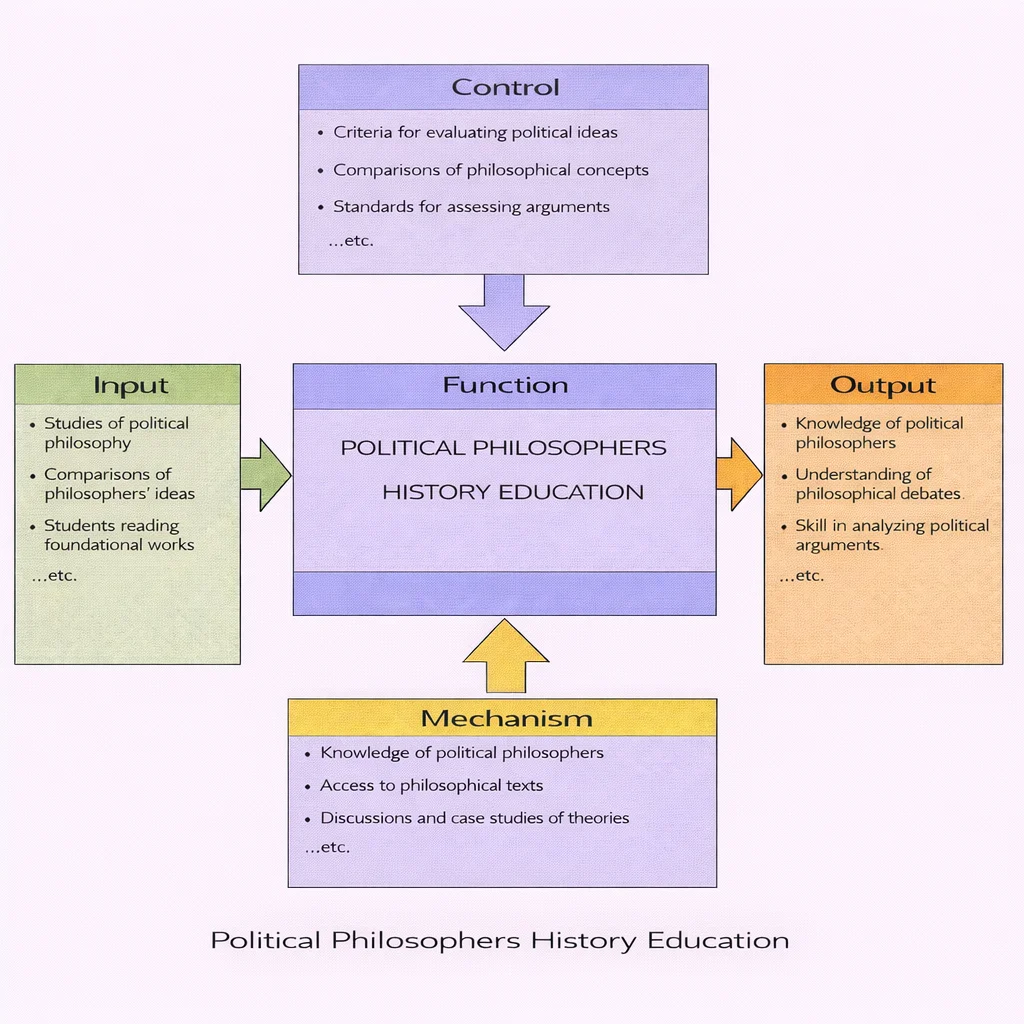
Political Philosophers History Education turns reading and comparative study of major thinkers into a disciplined way of reasoning about politics. The Inputs in the diagram emphasize exposure to foundational texts and the practice of setting philosophers side by side—so students learn not only “who said what,” but why certain ideas emerged in particular historical contexts. The Controls remind learners that interpretation needs standards: criteria for judging political claims, careful comparison of concepts (justice, authority, freedom, rights), and shared expectations for what counts as a sound argument. With these guides in place, the learning process produces Outputs that matter for university study: a clearer grasp of key political philosophers, a more structured understanding of enduring debates, and stronger analytical skill in evaluating political arguments. The Mechanisms show what makes this learning possible in practice—reliable access to texts, informed guidance, and seminar-style discussion or case studies that connect abstract theories to real historical dilemmas.
Political philosophers have profoundly shaped the frameworks through which we understand power, governance, and justice. From ancient treatises on civic virtue to contemporary debates on rights and global ethics, their insights transcend time and geography. These thinkers have played a central role in the development of political ideologies, offering foundational concepts such as liberty, authority, democracy, and sovereignty. Their ideas remain embedded in the structures of modern political systems and continue to inspire critical inquiry into how societies are organized and governed.
The influence of political philosophers often intersects with the lived realities of history, including social history and major historical upheavals. Revolutionary eras, such as those marked by civil rights movements, or dramatic reconfigurations of political economy, often reflect the practical realization—or rejection—of philosophical ideals. These moments also invite deeper reflection on the role of ideology and leadership, particularly when evaluated through political biography and political campaigns.
The rise and fall of empires, explored in military history and military strategic studies, also invite philosophical inquiry into war, peace, and moral responsibility. Many political philosophers have engaged deeply with the ethical questions of violence, authority, and governance, topics now echoed in peace studies and conflict resolution. Additionally, their perspectives enrich the study of social and cultural history of warfare, and how ideas of honor, duty, or resistance are constructed and contested.
Political thought cannot be divorced from economic realities. Philosophers like Locke, Marx, and Hayek have profoundly influenced how we think about markets, property, labor, and inequality. These legacies are central to the political economy of crises, trade and commerce history, and the history of economic thought. Moreover, ideas about progress, justice, and equality inform debates on urban development, migration, and identity, as seen in urban and rural history and migration and diaspora studies.
The intellectual lineage of political philosophy also runs parallel to cultural transformations. The history of ideas reveals a dynamic interplay between political theory and broader shifts in literature, art, religion, and science. These dialogues are mediated through media and communication history and sometimes forged through strategic diplomatic efforts, like those explored in treaty analysis and military diplomacy. As new challenges arise—be it the digital age, populist politics, or climate governance—philosophical reflections remain vital to shaping future political directions. Whether influencing military and political power or redefining the parameters of democracy, the contributions of political philosophers remain essential for students and citizens alike.
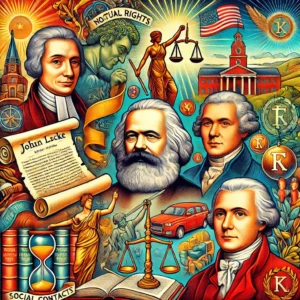
Ideas that Govern: Thought, Theory, and Political Vision
Political philosophers shape the foundations of governance through ideas about justice, authority, rights, and the ideal state. Their work influences how societies organize power, resolve conflict, and pursue collective goals. Studying these thinkers reveals how abstract ideas translate into real political systems and enduring debates.
Political Biography – Overview
Explore how individual lives, leadership styles, and personal philosophies shape political movements, institutional structures, and historical change across human history.
Women in Politics
Examine leadership journeys, struggles for suffrage, and pioneering political thinkers who expanded democratic representation and redefined political participation globally.
Revolutionary Leaders
Study historical figures who dismantled existing regimes and transformed socio-political systems through direct action inspired by radical philosophical ideologies.
Political Philosophers (Current Focus)
Analyze foundational thinkers whose theoretical frameworks and social contract concepts established modern ideas of governance, civil rights, and state legitimacy.
Democratic Statesmen
Explore leaders who operationalized democratic theory within constitutional, parliamentary, and legal frameworks to balance liberty, stability, and public interest.
Authoritarian Leaders
Analyze autocratic regimes, centralized power dynamics, and the ideological justifications used by authoritarian figures to restrict freedoms and control state apparatuses.
Key Concepts in Political Philosophy
Governance and Authority
Political philosophers examine the origins and legitimacy of authority, questioning how and why governments exist and what role they should play in society.
- Core Principle: The justification of political coercion and state power.
- John Locke argued that governments derive their authority from the consent of the governed, advocating for a system based on natural rights and social equality.
Justice and Rights
A central theme in political philosophy is defining justice and understanding the moral and legal rights individuals possess in relation to the state.
- Core Principle: Distributive vs. corrective justice and civil liberty.
- Karl Marx critiqued capitalist systems for perpetuating economic inequality, advocating for a classless society where productive resources are distributed equitably according to need.
Individual and Collective Interests
Philosophers explore the tension between personal autonomy and societal welfare, addressing questions of liberty, security, and public responsibility.
- Core Principle: Balancing private freedom with collective civic duty.
- Thomas Jefferson emphasized individual liberty, decentralization, and civic republicanism as essential components of a stable and self-governing society.
Historical Examples of Political Philosophers
John Locke (1632–1704)
- Context: English philosopher during the Enlightenment, widely recognized as the “Father of Liberalism.”
- Key Contributions:
- Natural Rights: Advocated that life, liberty, and estate (property) are fundamental pre-political rights that every state must preserve.
- Social Contract Theory: Proposed that governance is a fiduciary trust based on civil consent; if a government fails to uphold rights, citizens hold a moral duty to overthrow it.
- Influence on Democracy: Locke’s treatises directly fueled the intellectual foundations of the American and French Revolutions and shaped constitutionalism.
- Legacy: Locke’s work remains central to contemporary debates on civil liberties, constitutional checks and balances, and democratic legitimacy.
Karl Marx (1818–1883)
- Context: German philosopher, political theorist, and economist whose writings analyzed the social impact of the Industrial Revolution.
- Key Contributions:
- Critique of Capitalism: Detailed the structural exploitation inherent in capitalist production, specifically the economic friction between the bourgeoisie (owners) and the proletariat (workers).
- Historical Materialism: Posited that human history is fundamentally driven by material economic conditions and structural class struggles.
- Scientific Socialism: Called for the abolition of private ownership of production in favor of collective ownership and a stateless, classless society.
- Legacy: Marx’s socio-economic critiques transformed 20th-century geopolitical alignments, inspiring labor movements, political revolutions, and ongoing critical theory.
Thomas Jefferson (1743–1826)
- Context: American Founding Father, diplomat, primary draftsman of the Declaration of Independence, and third President of the United States.
- Key Contributions:
- Declaration of Independence: Formulated fundamental statements of human equality, unalienable rights, and popular sovereignty in constitutional thought.
- Religious Freedom: Authored the Virginia Statute for Religious Freedom, championing a strict wall of separation between church and state.
- Agrarian Republicanism: Championed local self-reliance, public education, and limited federal control to prevent oligarchic tyranny.
- Legacy: Jefferson’s political philosophy continues to anchor democratic ideals, civil liberty discourse, and constitutional rights movements globally.
Interactive Political Spectrum & Policy Projection Simulator
Select a political philosophy framework below to project system authority, social inequality, and civil liberty metrics over a 10-year timeline.
Themes in the Study of Political Philosophers
The Evolution of Political Ideologies
Political philosophers have contributed directly to the development of major political ideologies, including liberalism, socialism, conservatism, and anarchism.
- Comparison: Locke’s liberalism emphasized individual freedom and private property protection, while Marx’s socialism critiqued the structural inequalities generated by unrestrained private accumulation.
The Role of Morality in Politics
Many philosophers explore the ethical foundations of governance, debating whether civic virtue, justice, or utilitarian outcomes should dictate state policy.
- Application: Jefferson’s writings explicitly linked personal civic virtue and moral education with the long-term preservation of democratic self-governance.
The Interplay of Theory and Practice
While some philosophers focused on abstract speculative ideals, others directly shaped real-world revolutionary movements, legislation, and state constitutions.
- Impact: Marx’s political manifestos catalyzed international working-class revolutions, whereas Locke’s social contract treatises directly guided the framing of constitutional rights.
Impact of Political Philosophers
Shaping Democratic Institutions
Theories regarding governance, natural rights, and judicial independence directly informed the architecture of modern representative democracies.
- Historical Example: Locke’s division of executive and legislative authority was integrated into the U.S. Constitution and Bill of Rights.
Influencing Social Movements
Philosophical critiques provide the vocabulary and moral framework for civil rights activists, labor unions, and anti-colonial movements.
- Historical Example: Marx’s critiques of capital labor exploitation fueled international union movements and 20th-century welfare legislation.
Defining Political Discourse
The conceptual models of classical philosophers remain active touchstones in present-day debates on freedom of speech, taxation, authority, and public interest.
Modern Relevance of Political Philosophy
Addressing Inequality
Philosophers like Marx, Rousseau, and John Rawls remain vital in contemporary discussions regarding wealth gaps, wage stagnation, labor rights, and progressive taxation.
Navigating Global Challenges
The fundamental principles articulated by Enlightenment and classical thinkers are regularly applied to emerging debates surrounding digital privacy, AI ethics, climate policy, and international sovereignty.
Promoting Civic Engagement
Studying political theory fosters critical thinking, enabling citizens to evaluate electoral arguments, detect authoritarian overreach, and participate meaningfully in democratic governance.
Why Study Political Philosophers
Understanding the Origins of Political Concepts and Ideals
Exploring Diverse Thinkers and Intellectual Traditions
Analyzing Arguments, Ideologies, and Political Worldviews
Recognizing the Enduring Relevance of Political Thought
Preparing for Rigorous Inquiry and Responsible Citizenship
Political Philosophers: Conclusion
Political philosophers such as John Locke, Karl Marx, and Thomas Jefferson have profoundly shaped political systems and ideologies, leaving legacies that continue to influence societies worldwide. Their ideas about governance, rights, and justice provide timeless frameworks for understanding power, addressing inequality, and building inclusive societies. By studying their works, we gain valuable insights into the foundations of modern political thought and the enduring quest for a just and equitable world. As contemporary challenges evolve, the teachings of these thinkers remain essential in guiding political discourse and action.
Frequently Asked Questions
Who are political philosophers in the context of political history?
Political philosophers are thinkers who develop systematic reflections on power, authority, justice, rights, and the organisation of political communities. Through books, essays, and lectures, they analyse how societies should be governed, what makes laws legitimate, and what citizens owe to one another and to the state.
How is a political philosopher different from an everyday political commentator?
Everyday political commentators respond to current events, often within short news cycles. Political philosophers work at a different level of abstraction and time scale: they ask deeper questions about the principles behind institutions, propose conceptual frameworks, and test arguments for consistency and fairness across many situations.
What kinds of questions do political philosophers typically ask?
Political philosophers ask questions such as: What is justice? When is the use of force legitimate? What counts as a right? Who should have a say in collective decisions? How should benefits and burdens be distributed? They also explore how to balance freedom and equality, security and liberty, and individual and collective interests.
How does political biography help us understand political philosophers?
Political biography places philosophical ideas in the lives and times of their authors. It shows how personal experiences, intellectual networks, political crises, and social structures shaped the questions political philosophers asked, the examples they used, and the reforms or revolutions they hoped their ideas might inspire.
Do political philosophers only write abstract theory, or do they influence real politics?
Many political philosophers have combined abstract theory with direct engagement in politics, law, or education. Their ideas have influenced constitutions, declarations of rights, party programmes, legal doctrines, and social movements. Even when they do not hold office, their concepts can shape how citizens and leaders understand what is politically possible or desirable.
What kinds of sources are used in the biography of political philosophers?
Biographers of political philosophers use published works, drafts and notes, correspondence, diaries, teaching materials, reviews, and records of public debates. They also draw on institutional archives, contemporaries’ memoirs, and intellectual histories to reconstruct the conversations and conflicts in which a philosopher participated.
Are political philosophers always detached observers, or are they shaped by their own context and biases?
Political philosophers are deeply shaped by their historical context, education, and social position. Their theories often reflect assumptions about class, gender, race, empire, or religion that may not be immediately visible in their texts. Political biography helps readers recognise these influences and evaluate both the insights and limits of particular theories.
How do political philosophers relate to other intellectual fields such as law, economics, and theology?
Political philosophers frequently engage with law, economics, theology, sociology, and history. They borrow concepts, challenge assumptions, and offer normative critiques of how other fields model society. Biographical study often shows how training in law, religious thought, or economics shaped a philosopher’s approach to power, rights, and institutions.
Do political philosophers agree with one another about basic concepts like justice and rights?
No. Political philosophy is marked by deep disagreement. Different thinkers define justice, rights, freedom, democracy, and equality in conflicting ways and argue for competing principles of distribution or authority. Political biography traces how these disagreements emerged from particular debates and why they continue to matter.
How have political philosophers responded to major historical events such as revolutions, wars, or economic crises?
Major events often prompt political philosophers to rethink assumptions or develop new frameworks. Revolutions raise questions about sovereignty and legitimacy; wars and mass violence challenge ideas about morality and law; economic crises provoke debates about property, markets, and social justice. Biographies show how individual thinkers reinterpreted their theories in response to such shocks.
What skills do students develop by studying the lives and works of political philosophers together?
Students learn to read complex arguments carefully, situate ideas in context, and compare different answers to the same political questions. They practice reconstructing an author’s reasoning before criticising it, and develop the ability to connect abstract principles to concrete institutions, policies, and historical experiences.
How can the study of political philosophers help students reflect on contemporary politics and their own commitments?
Studying political philosophers invites students to examine the values that underpin their own political views and those circulating in public debate. It helps them see alternative ways of organising power and justice, recognise the historical origins of familiar ideas, and think more deliberately about what they consider fair, legitimate, and worth defending in present-day politics.
Interactive Concept Review
Click on any question below to reveal detailed answers and explanations regarding political philosophy.
What is the focus of a political biography dedicated to political philosophers?
Political biographies of political philosophers focus on the lives, ideas, and intellectual contributions of individuals who have profoundly shaped political thought. These biographies delve into the personal experiences, educational backgrounds, and historical contexts that influenced their theoretical work. They explore how these thinkers developed concepts such as justice, democracy, and power, which continue to inform modern political discourse.
How do political biographies help illuminate the evolution of political ideas?
Political biographies illuminate the evolution of political ideas by tracing the development of thought from early influences to later reforms. They reveal the ways in which personal experiences, historical events, and cultural contexts contributed to the formation of influential theories, showing how key philosophical debates emerged and evolved over time.
What role does personal character play in the political philosophies of influential thinkers?
Personal character plays a significant role in political philosophy, as individual virtues, moral struggles, and personal ambitions often shape a thinker’s theoretical perspective. Hardship, triumph, and ethical dilemmas influence ideas about leadership, justice, and the common good.
How have political philosophers contributed to the development of modern political theory?
Political philosophers introduced groundbreaking concepts that challenge traditional notions of power and governance. Their foundational frameworks regarding democracy, liberty, equality, and the state serve as building blocks for modern institutional design and constitutional law.
How do political biographies address the influence of historical context on a philosopher’s work?
Biographies address historical context by situating a philosopher’s work within the social, economic, and political environment of their era. Major historical shocks—such as civil wars, colonial expansion, or industrial development—directly prompt thinkers to construct new models of authority and rights.
Comprehensive Practice & Assessment Module
Section 1: Foundational Review Questions
- What is the primary difference between Locke’s view of natural rights and Hobbes’s view of human rights in the state of nature?
Answer: Thomas Hobbes believed that in the natural state, life was “solitary, poor, nasty, brutish, and short,” where individuals possessed complete freedom but no security, making absolute state authority necessary. John Locke argued that individuals possess natural rights to life, liberty, and property even in the state of nature, and that government exists merely as a fiduciary trust to protect those pre-existing rights. - How does Karl Marx define the term “bourgeoisie” in his critique of political economy?
Answer: Marx defines the bourgeoisie as the capitalist class who owns the means of social production (factories, machinery, capital) and employs wage labor, profiting from the surplus value generated by workers. - What core democratic principle did Thomas Jefferson articulate in the U.S. Declaration of Independence?
Answer: Jefferson articulated popular sovereignty and unalienable natural rights, asserting that all individuals are created equal with inherent rights to life, liberty, and the pursuit of happiness, and that governments derive their just powers from the consent of the governed. - What is meant by the concept of “Historical Materialism”?
Answer: Historical Materialism is the theoretical framework formulated by Karl Marx which posits that economic conditions, production methods, and class relationships form the fundamental basis of societal development, driving history through class struggle. - What is the core premise of Social Contract Theory?
Answer: Social Contract Theory posits that political authority and state legitimacy arise from an implicit or explicit agreement (contract) among individuals who surrender certain freedoms to a governing authority in exchange for protection of rights, security, and social order. - How do political biographies bridge the gap between abstract political philosophy and historical reality?
Answer: Political biographies ground abstract ideas in concrete context, illustrating how personal struggles, education, networks, and contemporary political crises directly influenced how thinkers formulated their theoretical models. - What was John Locke’s justification for popular revolution against a ruling government?
Answer: Locke argued that if a government consistently violates natural rights or exceeds its constitutional authority, it breaches its social contract trust, restoring the moral right and obligation to citizens to resist and replace the tyrannical government. - Why is the separation of church and state a pivotal milestone in Jeffersonian philosophy?
Answer: Jefferson argued that religious belief is a matter of private conscience beyond civil jurisdiction. Separating state power from religious doctrine prevents state tyranny and guarantees freedom of belief for all citizens.
Section 2: Analytical & Scenario-Based Questions
- Scenario: A modern democratic state passes a law restricting digital communication during national emergencies. How would Locke and Marx evaluate this action differently?
Answer: Locke would evaluate whether the restriction strictly preserves property and life without infringing on fundamental liberty; if deemed arbitrary overreach, he would consider it a breach of consent. Marx would analyze whether the law is being utilized by the ruling capitalist elite to suppress working-class organizing and protect corporate state dominance. - Analytical Question: How can the tension between personal liberty and state-enforced economic equality be resolved in modern welfare policy?
Answer: Resolving this tension requires synthesizing John Rawls’s principle of justice (maximizing liberty for all while structuring inequality to benefit the least advantaged) with classical checks on state power, ensuring social safety nets do not erode civil liberties or individual autonomy. - Scenario: A developing nation faces rapid urbanization and extreme wealth concentration. Which philosophical framework offers better utility for agrarian land reform?
Answer: A Jeffersonian framework supports widespread land ownership to foster independent, self-reliant citizens, whereas a Marxist framework advocates complete nationalization and collective control of agricultural land to eliminate private capital accumulation. - Analytical Question: In what ways does digital surveillance challenge the Enlightenment concepts of privacy and the social contract?
Answer: Enlightenment social contract theory assumes citizens trade limited freedoms for visible state security. Digital surveillance creates asymmetrical power where states monitor private lives without explicit citizen consent, altering the contractual equilibrium and threatening personal liberty. - Scenario: A political leader uses executive orders to bypass legislative gridlock during an economic crisis. Is this legitimate under Lockean principles?
Answer: Locke recognized “Prerogative Power”—the executive’s freedom to act for the public good without prescription of law during emergencies—provided it is demonstrably used for the public interest and subsequently ratified by popular consent. - Analytical Question: Why do revolutionary leaders who cite liberation philosophies often end up constructing autocratic state apparatuses?
Answer: The consolidation of revolutionary power often relies on centralized authority to suppress counter-revolutions. Without strong institutional checks, civic culture, and constitutional safeguards, centralized authority quickly degenerates into autocratic power structures. - Scenario: A international treaty limits carbon emissions, impacting national industrial output. How do sovereignty theories apply here?
Answer: Treaties reflect shared global contract theory: sovereign states voluntarily limit local autonomy via international compacts to prevent mutual ecological destruction, balancing national sovereignty with collective survival. - Analytical Question: How does studying political biography prevent students from viewing political theories as ahistorical dogma?
Answer: Biography reveals that theories were written to solve specific historical dilemmas (e.g., Locke responding to the Glorious Revolution), allowing students to appreciate their historical context while evaluating their universal applicability.
Section 3: Mathematical & Quantified Political Policy Problems
-
Problem 1: Surplus Value Calculation (Marxist Political Economy)
A factory worker works an 8-hour shift. The worker produces $240 worth of commodities per day. The employer pays the worker a daily wage of $80 and incurs $60 in constant capital costs (raw materials/machinery depreciation). Calculate the Surplus Value (S) and the Rate of Surplus Value (s’ = S / V, where V is variable capital/wages).
Step-by-Step Solution:
Total Product Value (W) = Constant Capital (C) + Variable Capital (V) + Surplus Value (S)
Given: W = $240, C = $60, V = $80
1. Solve for Surplus Value (S):
S = W – C – V
S = $240 – $60 – $80 = $100
2. Calculate Rate of Surplus Value (Rate of Exploitation):
s’ = (S / V) × 100
s’ = ($100 / $80) × 100 = 125%
Answer: The Surplus Value created is $100, and the Rate of Surplus Value is 125%. -
Problem 2: Proportional Representation Seat Allocation (Jefferson/Hamilton Method)
A parliament has 20 seats to allocate among 3 political parties based on popular vote counts: Party A (45,000 votes), Party B (35,000 votes), Party C (20,000 votes). Total votes = 100,000. Calculate the exact seat quota and final seats allocated using Hamilton’s Largest Remainder Method.
Step-by-Step Solution:
1. Calculate the Hare Quota (Total Votes / Total Seats):
Quota = 100,000 / 20 = 5,000 votes per seat.
2. Calculate Quota Allocations:
– Party A: 45,000 / 5,000 = 9.0 seats (Remainder: 0.0)
– Party B: 35,000 / 5,000 = 7.0 seats (Remainder: 0.0)
– Party C: 20,000 / 5,000 = 4.0 seats (Remainder: 0.0)
3. Total Automatic Allocated Seats = 9 + 7 + 4 = 20 seats.
Answer: Party A receives 9 seats, Party B receives 7 seats, and Party C receives 4 seats. -
Problem 3: Gini Coefficient & Wealth Inequality Index
In a small community of 5 citizens, personal wealth values are $10k, $20k, $30k, $40k, and $100k (Total wealth = $200k). Calculate the proportion of wealth held by the top 20% of the population versus the bottom 40%.
Step-by-Step Solution:
Population = 5 citizens (each citizen represents 20% of the population).
1. Top 20% Population = 1 citizen with $100k wealth.
Wealth Share (Top 20%) = ($100,000 / $200,000) × 100 = 50% of total wealth.
2. Bottom 40% Population = 2 citizens with lowest wealth ($10k + $20k = $30k).
Wealth Share (Bottom 40%) = ($30,000 / $200,000) × 100 = 15% of total wealth.
Answer: The top 20% holds 50% of total wealth, while the bottom 40% holds only 15% of total wealth. -
Problem 4: Electoral Majority Quota (Absolute vs Simple Majority)
A assembly contains 450 voting representatives. A constitutional amendment requires a 2/3 absolute majority of all representatives to pass. On voting day, 420 members are present. 275 members vote “Yes”. Does the amendment pass?
Step-by-Step Solution:
1. Calculate Required 2/3 Absolute Majority Threshold of ALL members:
Threshold = (2 / 3) × 450 = 300 votes.
2. Compare Actual Votes with Absolute Threshold:
Votes received = 275.
Shortfall = 300 – 275 = 25 votes.
Answer: The amendment FAILS because 275 votes is less than the required 300-vote absolute majority threshold (despite receiving 65.5% of present votes). -
Problem 5: Public Good Tax Distribution Index
A public park costs $500,000 to construct. The state taxes two income groups: Group 1 (1,000 low-income households earning $30,000 average) and Group 2 (200 high-income households earning $150,000 average). Total community income = $60,000,000. If a flat tax percentage is levied to fund the park, calculate the tax rate percentage and payment per household in each group.
Step-by-Step Solution:
1. Calculate Total Community Income:
Group 1 Income = 1,000 × $30,000 = $30,000,000
Group 2 Income = 200 × $150,000 = $30,000,000
Total Income = $60,000,000
2. Calculate Required Flat Tax Rate (η):
η = ($500,000 / $60,000,000) × 100 ≈ 0.8333%
3. Payment per Household:
– Group 1 Household = $30,000 × 0.008333 = $250.00
– Group 2 Household = $150,000 × 0.008333 = $1,250.00
Answer: Flat tax rate is 0.8333%. Low-income households pay $250.00, and high-income households pay $1,250.00. -
Problem 6: Voter Turnout Margin Analysis
In an election with 120,000 registered voters, candidate X wins with 35,000 votes, while candidate Y receives 25,000 votes. 10,000 ballots were spoiled/blank, and the remainder did not vote. Calculate voter turnout percentage and candidate X’s victory margin relative to total registered voters.
Step-by-Step Solution:
1. Total Ballots Cast = Candidate X (35,000) + Candidate Y (25,000) + Spoiled (10,000) = 70,000 votes.
2. Voter Turnout Percentage = (70,000 / 120,000) × 100 = 58.33%
3. Candidate X Victory Margin (Votes) = 35,000 – 25,000 = 10,000 votes.
4. Victory Margin as % of Registered Voters = (10,000 / 120,000) × 100 = 8.33%
Answer: Voter turnout was 58.33%, and Candidate X won with an absolute victory margin representing 8.33% of registered voters. -
Problem 7: Legislative Power Index (Banzhaf Power Calculation)
A coalition council has 3 members with voting weights: Member A (4 votes), Member B (3 votes), Member C (2 votes). Passing quota is 6 votes out of 9 total votes. List all winning coalitions and calculate the number of times Member C is critical (a swing voter).
Step-by-Step Solution:
Winning Coalitions (Sum ≥ 6):
1. {A, B} -> Votes = 4 + 3 = 7 (Winning)
– Swing members: If A leaves, sum = 3 (Lose). If B leaves, sum = 4 (Lose). Both A and B are swings.
2. {A, C} -> Votes = 4 + 2 = 6 (Winning)
– Swing members: If A leaves, sum = 2 (Lose). If C leaves, sum = 4 (Lose). Both A and C are swings.
3. {A, B, C} -> Votes = 4 + 3 + 2 = 9 (Winning)
– Swing members: If A leaves, sum = 5 (Lose). A is a swing. (Leaving B or C leaves sum ≥ 6, so B and C are not swings).
Member C critical swings count = 1 time (in coalition {A, C}).
Answer: Member C is a critical swing voter in 1 winning coalition ({A, C}).