
Diplomatic history is often where the quiet work of power becomes visible. Diplomatic History Education trains students to read treaties, negotiations, and foreign-policy choices not as dusty paperwork, but as carefully shaped responses to fear, ambition, trade, security, and the limits of what nations can openly say. Using historical records and case studies as inputs, the learning process is guided by analytical controls—such as comparing policy across countries and applying criteria for judging agreements—so students can move beyond memorizing events toward interpreting why decisions were made. Supported by knowledgeable educators and access to archival sources, this education produces durable outputs: clearer understanding of treaty histories, deeper insight into how diplomacy is practiced, and the ability to analyze negotiation outcomes with both empathy and rigor.

Diplomatic history provides a vital lens through which we understand how states have interacted, negotiated, and contested their positions across centuries. Beyond war and treaties, it reveals the underlying ideologies, cultural contexts, and strategic calculations that shape international relations. Rooted in the evolution of global political thought, diplomacy has often reflected the moral visions and pragmatic interests of empires, nation-states, and revolutionary movements alike.
The foundations of diplomatic engagement are deeply intertwined with the structures of power and governance. Understanding the history of political systems helps explain why certain diplomatic arrangements arise and endure. Similarly, the shifting nature of electoral legitimacy—as seen in the electoral history of states—has influenced how governments represent themselves on the world stage. Failures in legitimacy, such as electoral fraud and integrity issues, often strain foreign relations or precipitate external intervention.
Diplomatic history is inseparable from the study of economic history, as economic interests have consistently driven alliances, rivalries, and colonial expansion. Trade negotiations, financial agreements, and resource diplomacy intersect with deeper analyses found in financial history and economic thought and theory. These themes also inform the specialized field of economic diplomacy, where nations deploy financial leverage and soft power instead of military force.
Cultural factors play a pivotal role in diplomacy, from ceremonial rituals to shared values. A study of gender and cultural history helps uncover how perceptions of identity and difference have affected diplomatic protocols and outcomes. The influence of key individuals is captured in the study of diplomatic personalities, whose actions have sometimes altered the course of history more than any formal institution. Meanwhile, ideas that shaped diplomatic norms often trace back to the history of ideas, where concepts like sovereignty, neutrality, and peace were developed.
Diplomatic alignments also shift according to security needs and shared ideological outlooks. The history of alliances offers insight into how coalitions are formed, maintained, and dissolved, often reflecting changing priorities in the geopolitical landscape. In more volatile contexts, diplomacy may give way to asymmetrical tactics like those explored in guerrilla warfare and insurgency studies, where non-state actors challenge traditional diplomatic conventions.
Diplomacy does not occur in isolation from intellectual trends or domestic upheavals. The history of social movements often influences diplomatic priorities, especially when internal protest leads to external concern. During the Enlightenment and modern constitutions era, ideas of universal rights began to enter diplomatic discourse. Similarly, the complexities of colonial and post-colonial governance can be understood through both political economy and environmental economic history, which reveal how global environmental concerns have become diplomatic imperatives.
Educational institutions also serve as cultural bridges in diplomacy, making education history a relevant backdrop to international engagement. Moreover, the broader discipline of history provides the essential context needed to interpret treaties, power shifts, and diplomatic norms over time. As international politics evolve, students equipped with a deep understanding of diplomatic history will better grasp the strategic, ethical, and cultural dimensions that define global affairs.
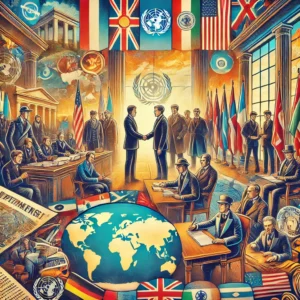
This image depicts a formal meeting hall filled with delegates seated at tables, suggesting negotiations, bargaining, and careful protocol. At the center, a handshake symbolizes agreement-making—treaties, alliances, and peace settlements—while the large globe in the foreground highlights diplomacy’s global reach. Surrounding national flags and international emblems evoke both rivalries and cooperation across borders, and the staged setting resembles a summit or conference where agendas are set, statements are crafted, and compromises are forged. Overall, the scene captures diplomatic history as the study of how international relationships are built and tested through dialogue, strategy, and institutions.
Influence Without War: Strategy, Signals, and Statecraft
Diplomacy shapes international outcomes through negotiation, persuasion, and calculated signalling. The cluster module grid below offers specialized pathways to explore how states manage security, leverage trade, forge treaties, and deploy soft power across the global curriculum.
History of Alliances
Explores how formal partnerships form, adapt, and dissolve across balance-of-power shifts.
Explore Module →
Military Diplomacy
Analyses how defense capabilities, deterrence posture, and strategic signalling reinforce negotiations.
Explore Module →
Economic Diplomacy
Investigates trade sanctions, financial leverage, energy flows, and statecraft in global markets.
Explore Module →
Treaty Analysis
Deconstructs legal accord structures, compromise formulas, enforcement loopholes, and statecraft.
Explore Module →
Cultural Diplomacy
Examines soft power, intellectual exchange, public advocacy, and ideological alignment strategies.
Explore Module →
Diplomatic Personalities
Evaluates key negotiators, foreign ministers, and leaders whose strategic choices redirected world history.
Explore Module →
Statecraft in Motion: Central Themes in Diplomatic History
Formation of Alliances
- Alliances have been a cornerstone of international relations, often formed to balance power or counter threats.
- Examples:
- Triple Alliance (1882): Germany, Austria-Hungary, and Italy formed a military alliance to counterbalance the Triple Entente.
- NATO (1949): A post-World War II alliance formed to provide collective security against the Soviet Union.
Treaty Negotiations
- Diplomatic history is rich with examples of treaties that reshaped nations and continents. Treaties often signal the end of wars or conflicts and lay the groundwork for new political or territorial arrangements.
- Examples:
- Treaty of Westphalia (1648): Ended the Thirty Years’ War and established the concept of sovereign states.
- Treaty of Versailles (1919): Ended World War I and imposed reparations and territorial adjustments on Germany.
Causes and Resolutions of Conflicts
- Diplomatic history seeks to uncover the political and social dynamics that lead to conflicts and the negotiations that resolve them.
- Examples:
- World War I Causes: Examines the failure of diplomacy, secret treaties, and alliances that escalated tensions.
- Cuban Missile Crisis (1962): A pivotal moment in Cold War diplomacy where negotiations averted nuclear war.
Diplomacy in Economic Relations
- Trade agreements and economic pacts play a significant role in diplomacy, influencing global markets and political alliances.
- Examples:
- Bretton Woods Conference (1944): Established the International Monetary Fund and World Bank to regulate global finance.
- NAFTA (1994): A trade agreement between the United States, Canada, and Mexico, promoting economic integration.
The Role of Diplomats and Statesmen
- Diplomatic history often highlights the contributions of individuals who shaped international relations.
- Examples:
- Otto von Bismarck: Known for his realpolitik approach and unification of Germany through strategic alliances.
- Henry Kissinger: Played a key role in United States foreign policy during the Cold War, including détente with the Soviet Union and the opening of relations with China.
Pivotal Moments in Diplomatic History
The Congress of Vienna (1815)
- Context: Convened after the Napoleonic Wars to restore European stability.
- Key Outcomes:
- Redrew the map of Europe to balance power among major states.
- Established a framework for international diplomacy, known as the Concert of Europe.
- Promoted the principle of legitimacy, restoring monarchies overthrown by Napoleon.
- Impact: The Congress maintained relative peace in Europe for nearly a century until World War I.
The Paris Peace Conference (1919)
- Context: Held after World War I to determine the post-war order and prevent future conflicts.
- Key Treaties:
- Treaty of Versailles: Imposed reparations and territorial losses on Germany.
- Treaty of Saint-Germain: Dismantled the Austro-Hungarian Empire.
- Challenges:
- The harsh terms of the Treaty of Versailles are often cited as a cause of World War II.
- Failure to include significant global powers like Russia and limited participation from colonized nations.
- Impact: Established the League of Nations, a precursor to the United Nations.
Modern Conflicts, Modern Resolutions: Evolving Diplomatic Playbooks
Cold War Diplomacy (1947–1991)
- Features: Ideological rivalry between the United States and the Soviet Union, marked by proxy wars and arms races.
- Key Events:
- Marshall Plan (1948): A United States initiative to rebuild Europe economically and counter Soviet influence.
- Strategic Arms Limitation Talks (SALT): Negotiations to limit nuclear weapons development.
- Impact: Shaped global geopolitics and alliances, with effects lasting beyond the Cold War.
Post-Cold War Diplomacy
- Features: Shift from ideological conflicts to issues like globalization, terrorism, and climate change.
- Key Events:
- Kyoto Protocol (1997): A landmark treaty on reducing greenhouse gas emissions.
- Iran Nuclear Deal (2015): An agreement to limit Iran’s nuclear capabilities in exchange for lifting sanctions.
Contemporary Diplomacy
- Contemporary diplomacy focuses on multilateral cooperation through international organizations like the United Nations and the World Trade Organization.
- Key Issues:
- Climate change negotiations, such as the Paris Agreement.
- Trade conflicts and economic sanctions.
- Cybersecurity and digital diplomacy.
Diplomatic Echoes: Leveraging History in Global Decision-Making
Informing Foreign Policy
- Historical diplomatic strategies provide lessons for contemporary international relations, such as the importance of balancing power and fostering alliances.
Conflict Resolution
- Understanding past diplomatic failures and successes aids in resolving current disputes, such as territorial conflicts or trade wars.
Promoting Global Cooperation
- Insights from diplomatic history guide the establishment of international agreements on pressing issues like climate change and public health.
Interactive Simulation: Diplomatic Bargaining & Crisis Simulator
Analyze how power dynamics, threat perception, and diplomatic concessions impact bargaining outcomes in international crisis negotiations. Adjust the statecraft parameters below to simulate crisis resolution, arms control negotiations, or strategic escalation.
Bargaining Space & Peace Probability Calculator
Modelling state bargaining using expected payoff functions: UState = p·V – C + ΔD, where p is probability of military victory, V is issue valuation, C represents military costs, and ΔD represents diplomatic negotiation leverage.
Strategic Bargaining Output
Unearthing the Unspoken: Difficulties in Tracing Diplomatic Motives
- Bias in Sources: Diplomatic records often reflect the perspectives of dominant nations or leaders.
- Complexity of Modern Issues: Contemporary diplomacy involves multifaceted issues like cybersecurity and global health.
- Evolving Norms: The traditional focus on state-to-state relations must now account for non-state actors like NGOs and multinational corporations.
Where Is Diplomatic History Headed Next?
Digital Diplomacy
- Studying the role of technology and social media in shaping modern international relations.
Global South Perspectives
- Expanding research to include the diplomatic histories of Africa, Asia, and Latin America.
Intersectional Approaches
- Examining how culture, economics, and technology intersect with diplomacy.
Decoding Peace: The Value of Diplomatic Storylines
Understanding How Nations Interact, Negotiate, and Compete
Diplomatic history examines the strategies, negotiations, and relationships that shape interactions between states. For students preparing for university, this field offers essential insights into how international order is created and contested. It explains how treaties are made, how alliances shift, and how diplomacy is used to prevent or provoke conflict, manage crises, and pursue national interests through peaceful means.
Exploring the Causes and Consequences of War and Peace
Students learn how diplomacy can both fail and succeed in moments of tension—before, during, and after wars. Diplomatic history reveals the human and institutional efforts behind peace conferences, ceasefires, and post-war settlements. Understanding these negotiations, from the Congress of Vienna to the United Nations, helps students grasp how the international community responds to global challenges and redefines the rules of engagement over time.
Analyzing Power, Influence, and Strategy in Global Affairs
Diplomacy is not only about negotiation—it is also about influence, reputation, and leverage. Students explore how states have historically used embassies, intelligence, trade, coercion, and cultural diplomacy to advance their objectives. This encourages a deeper understanding of international relations and the nuanced strategies states use to shape outcomes without direct confrontation.
Recognizing the Role of Individuals and Institutions in Shaping History
Diplomatic history places emphasis on the actions of diplomats, leaders, and state actors as well as the protocols and institutions that guide their work. Students examine key figures—from Metternich to Kissinger—and study the evolution of institutions like foreign ministries, embassies, and multilateral organizations. This focus humanizes diplomacy and reveals the importance of skill, character, and context in shaping global events.
Preparing for Careers in International Affairs, Law, and Public Service
A foundation in diplomatic history supports further study in history, international relations, political science, and global governance. It also prepares students for careers in diplomacy, foreign service, international law, journalism, and policy analysis. For university-bound learners, this field offers a vital and intellectually rewarding path to understanding how the world’s nations have historically communicated, collaborated, and competed.
🎥 Related Video – Why Study Military History
Diplomatic history and military history are deeply connected. Wars often result from failed diplomacy—and in turn, shape treaties, alliances, and new world orders. Understanding how conflicts arise and are resolved helps students grasp the strategic calculations behind major diplomatic decisions.
This video from our Why Study series highlights how studying military history builds skills in strategic thinking, ethical reasoning, and historical analysis—all of which are essential for students of diplomacy and international relations.
What Diplomatic History Teaches About Peace and Power
Diplomatic history provides a rich understanding of how nations interact, negotiate, and resolve conflicts. By examining alliances, treaties, and diplomatic events, it highlights the importance of cooperation and strategic decision-making in shaping global order. With its relevance to modern foreign policy and international relations, diplomatic history remains a vital field for navigating the complexities of our interconnected world. As new challenges and opportunities emerge, the lessons of diplomatic history will continue to inform and inspire efforts toward global peace and collaboration.
Interactive Concept Review
Click on each topic question below to expand the detailed analytical answer and test your understanding of core diplomatic concepts:
How does the principle of sovereign equality established at Westphalia differ from the Concert of Europe balance-of-power model?
What is the core distinction between bilateral trade negotiations and multilateral economic institutions like Bretton Woods?
Why are secret treaties viewed by diplomatic historians as both an instrument of stability and a catalyst for conflict?
Frequently Asked Questions – Diplomatic History
What is diplomatic history?
Diplomatic history studies how states and other political entities interact with each other over time through diplomacy, treaties, negotiations, alliances, and international institutions. It explores how foreign relations, power balances, and international norms shape global developments and domestic politics.
Why is diplomatic history important for understanding modern world history?
Diplomatic history helps explain the causes and consequences of wars, colonialism, decolonisation, trade networks, and international cooperation. It reveals how ideas of sovereignty, empire, international law, and global order changed over time, influencing economic, social, and political transformations worldwide.
What kinds of sources do historians use for diplomatic history?
Historians use treaties, diplomatic correspondence, state archives, memoirs of diplomats and leaders, consular reports, international organisation records, newspapers, and private letters. By analysing these sources, they reconstruct negotiations, alliances, conflicts, and the shifting interests of states over time.
How did diplomacy evolve from ancient to modern times?
Diplomacy evolved from ad hoc envoys and tribal negotiations in ancient and medieval times to permanent embassies, professional diplomatic corps, international conferences, and modern institutions. Changes in communication, travel, international law, and state formation have shaped how states manage relations and negotiate issues such as trade, war, and alliances.
What role did alliances and treaties play in shaping diplomatic history?
Alliances and treaties have determined how wars start and end, how empires expand or contract, how territories are divided, and how powers check each other. They institutionalise cooperation or conflict, and often reflect shifting balances of interest, power, and diplomacy skills rather than purely military strength.
How have ideas and ideology influenced diplomatic relations historically?
Ideas such as nationalism, religious identity, imperial ambition, economic interests, and human rights have often shaped diplomatic decisions. Ideological alignment or divergence has determined alliances, colonial policies, peace negotiations, and even the formulation of international law and global institutions.
How does diplomatic history intersect with imperialism and colonialism?
Diplomatic history often overlaps with the history of empire and colonial expansion, since treaties, protectorates, trade agreements, and diplomatic pressure were key tools of imperial control. Studying diplomacy reveals how colonial powers negotiated with local rulers, set boundaries, and managed dependencies across vast territories.
What impact did international institutions have on diplomatic history?
International institutions—such as leagues, confederations, and modern organisations—provided platforms for states to negotiate issues like war, trade, human rights, and diplomacy. They contributed to norm-making, conflict resolution, cooperation frameworks, and the idea of global governance beyond bilateral treaties.
How does diplomatic history help us understand global conflicts and peace processes?
By tracing alliances, negotiations, and treaties, diplomatic history shows how conflicts escalate, are managed, or resolved. It helps explain why wars spread, why peace treaties succeed or fail, and how power dynamics influence peace processes. It also demonstrates how diplomacy can shape postwar order and reconstruction.
What skills can students gain from studying diplomatic history?
Students gain skills in reading primary documents, understanding international contexts, thinking comparatively across time and space, and evaluating how interests, norms, and power influence decisions. They learn to connect global events with local consequences and to analyse how states’ choices affect both domestic and international politics.
How can this Diplomatic History page be used with other Prep4Uni resources?
Learners can combine this Diplomatic History page with resources on political history, colonial and post-colonial history, war and military history, economic and trade history, and international relations. Such integration helps students see how diplomacy is woven through broader historical processes including conflict, empire, decolonisation, and global cooperation.
Comprehensive Practice & Assessment Module
Section 1: Foundational Review Assessment
- What is diplomatic history, and why is it essential for political analysis?
Answer: Diplomatic history is the study of statecraft, international negotiations, foreign policy decisions, and treaties. It provides the empirical background necessary to understand how international order is constructed, how state behavior is governed, and how peace or war is engineered. - How did the 1648 Treaty of Westphalia transform international relations?
Answer: It ended the Thirty Years’ War and established state sovereignty and territorial integrity as fundamental tenets of international law, moving Europe away from feudal/religious hierarchies toward a system of independent nation-states. - What were the primary objectives of the Congress of Vienna in 1815?
Answer: To restore European balance of power following the Napoleonic Wars, reinstate monarchical legitimacy, and establish the Concert of Europe to prevent large-scale continental wars. - How do secret treaties affect diplomatic stability?
Answer: While providing short-term tactical advantages to signatory states, secret treaties breed systemic paranoia, cause miscalculations regarding opposing force strength, and exacerbate escalation during crises. - What key multilateral monetary institutions were created at the 1944 Bretton Woods Conference?
Answer: The International Monetary Fund (IMF) and the International Bank for Reconstruction and Development (World Bank). - What is the core strategic principle underlying NATO’s collective defense framework?
Answer: Article 5, which states that an armed attack against one member state is considered an attack against all member states. - How did the Cuban Missile Crisis alter Cold War diplomatic channels?
Answer: It demonstrated the danger of miscommunication during nuclear standoffs, leading directly to the installation of the Moscow-Washington hotline and the Nuclear Test Ban Treaty. - What role did Otto von Bismarck play in 19th-century European diplomatic balance?
Answer: He utilized realpolitik and a complex web of secret alliances (e.g., the Reinsurance Treaty) to isolate adversaries and secure German unification without triggering a general European war. - What is the main distinction between bilateral and multilateral diplomacy?
Answer: Bilateral diplomacy takes place directly between two sovereign nations, whereas multilateral diplomacy involves three or more states negotiating within shared frameworks or international bodies like the UN. - How did the Treaty of Versailles impact post-WWI Germany?
Answer: It imposed heavy financial reparations, severe territorial losses, and military restrictions, contributing to economic instability and political revanchism in Germany. “`