
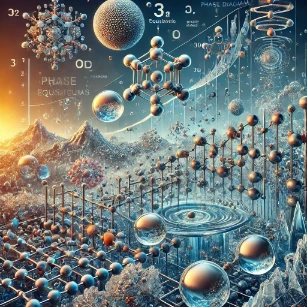
An illustration of Phase Equilibria and Phase Transitions, depicting ice melting, water boiling, and metal transitions, alongside molecular interactions and a subtle phase diagram in the background.
Thermodynamics Learning Pathway
Thermodynamics – Overview
Master the foundational principles governing energy, work, heat, and equilibrium across physical systems.Classical Thermodynamics
Explore macroscopic state functions, pressure-volume behavior, and ideal/real gas relationships.Laws of Thermodynamics
Study the Zeroth, First, Second, and Third laws shaping energy conservation and directionality.Statistical Thermodynamics
Bridge quantum microstates and bulk thermodynamic properties using partition functions.Engineering Thermodynamics
Apply thermal laws to power plants, refrigeration cycles, and real-world mechanical engines.Heat Transfer
Understand the core mechanisms of thermal energy movement: conduction, convection, and radiation.Thermodynamic Cycles
Analyze closed and open processes including Carnot, Rankine, Brayton, Otto, and Diesel cycles.Non-Equilibrium Thermodynamics
Analyze dynamic systems governed by gradients, fluxes, and entropy production.Phase Equilibria & Phase Transitions
Current page. Study Clausius-Clapeyron relations, triple points, latent heat, and phase stability.Chemical Thermodynamics
Examine reaction spontaneity, Gibbs free energy, and equilibrium constants in chemical systems.Thermodynamics of Materials
Explore phase diagrams, alloy solidification, defects, and thermal stability in material structures.Renewable & Sustainable Energy Thermodynamics
Apply exergy analysis to solar, wind, geothermal, and bioenergy system optimization.Computational Thermodynamics
Utilize CALPHAD methods and numerical simulations to model multi-component phase behavior.Core Concepts in Phase Equilibria and Phase Transitions
1. Thermodynamic Potentials and Equilibrium Conditions
2. Phase Diagrams
3. Classification of Phase Transitions
4. Kinetics of Phase Transitions
Focus in Phase Equilibria and Phase Transitions
How the Study of Phase Equilibria and Phase Transitions Helps Prepare Students for University Studies
Core Topics Covered to Help Prepare for University Studies in Phase Equilibria and Phase Transitions
Common Challenges Faced in the Study of Phase Equilibria and Phase Transitions
Examples of Current Applications of Phase Equilibria and Phase Transitions in Society
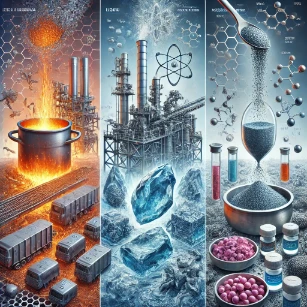
An illustration of current industrial applications of Phase Equilibria and Phase Transitions, depicting metallurgical solidification, food preservation through freezing and dehydration, and pharmaceutical crystallization processes.
Examples of Emerging Applications of Phase Equilibria and Phase Transitions in Society

An illustration of emerging applications of Phase Equilibria and Phase Transitions, depicting shape-memory alloys, magnetocaloric materials, phase-change memory devices, and biomimetic materials with self-healing and responsive properties.
Why Study Phase Equilibria and Phase Transitions
Understanding Material Behavior Across Phases
Phase Diagrams and Material Design
Thermodynamic Criteria for Phase Stability
Critical Points and Supercritical Fluids
Relevance in Advanced Manufacturing and Nature
Phase Equilibria and Phase Transitions Conclusion
Frequently Asked Questions: Phase Equilibria and Phase Transitions
1. What are phase equilibria in thermodynamics?
Phase equilibria describe the conditions of temperature, pressure, and composition at which two or more phases of a substance (such as solid, liquid, and gas) can coexist in stable equilibrium without net change over time.
2. What is a phase diagram?
A phase diagram is a graphical map that shows which phase or phases of a substance are stable under different combinations of temperature, pressure, and sometimes composition. It summarises where solids, liquids, gases, and mixed regions exist and how phase transitions occur.
3. What is meant by a phase transition?
A phase transition is a change of state, such as melting, freezing, boiling, condensation, sublimation, or deposition, where a substance moves from one phase to another when conditions like temperature or pressure cross certain thresholds.
4. What is the triple point of a substance?
The triple point is the unique combination of temperature and pressure at which solid, liquid, and gas phases of a pure substance coexist in equilibrium. At this point all three phases can be present and interconvert reversibly.
5. What is the critical point and supercritical fluid?
The critical point is the end of the liquid–gas coexistence curve. Above the critical temperature and critical pressure, a substance forms a supercritical fluid in which liquid- and gas-like properties merge and there is no distinct phase boundary.
6. What is the Gibbs phase rule?
The Gibbs phase rule, F = C − P + 2, relates the number of degrees of freedom F (independent variables), the number of components C, and the number of phases P in a system at equilibrium. It tells us how many intensive variables can be changed without altering the number of phases present.
7. How does pressure affect phase equilibria and boiling point?
Increasing pressure generally raises the boiling point of a liquid because the system needs a higher temperature for vapour pressure to match the external pressure. This is why water boils at a lower temperature at high altitudes and at a higher temperature in a pressure cooker.
8. What is latent heat in a phase transition?
Latent heat is the amount of energy absorbed or released by a substance during a phase change at constant temperature and pressure. For example, the latent heat of fusion refers to melting or freezing, and the latent heat of vaporisation refers to boiling or condensation.
9. What is a binary phase diagram?
A binary phase diagram shows phase equilibria for mixtures of two components. It typically plots temperature (or pressure) versus composition and reveals regions where different phases or phase mixtures are stable, guiding alloy design and material processing.
10. How are phase equilibria used in materials science and engineering?
Engineers use phase equilibria to predict which phases will form in alloys or ceramic systems under given conditions, choose heat-treatment paths, avoid unwanted phases, and design microstructures with desired mechanical, electrical, or thermal properties.
11. How is chemical potential related to phase equilibrium?
At phase equilibrium, the chemical potential of each component is the same in all coexisting phases. This equality of chemical potentials determines how components distribute between phases and sets the conditions for coexistence and phase boundaries.
12. Why should students learn about phase equilibria and phase transitions before university?
Understanding phase equilibria and phase transitions helps students connect abstract thermodynamic ideas with real phenomena like boiling, freezing, casting metals, and designing new materials. It prepares them for advanced courses in thermodynamics, materials science, chemical engineering, and physical chemistry.
Phase Equilibria and Phase Transitions: Review Questions and Answers
- What is phase equilibria in thermodynamics?Answer: Phase equilibria refers to the state in which multiple phases, such as solid, liquid, and gas, coexist in balance, with no net change in the amount of each phase over time.
- How do phase transitions differ from phase equilibria?Answer: Phase transitions are the processes in which a substance changes from one state to another, such as melting or boiling, while phase equilibria describe the conditions where different phases coexist stably.
- What is a phase diagram and what information does it provide?Answer: A phase diagram is a graphical representation showing the equilibrium conditions between different phases of a substance as a function of variables such as temperature and pressure.
- How does the concept of a critical point relate to phase transitions?Answer: The critical point is the end point of a phase equilibrium curve where distinct liquid and gas phases cease to exist, and the substance forms a single supercritical phase.
- What is the significance of triple points in phase diagrams?Answer: A triple point is the unique set of conditions where three phases of a substance coexist in equilibrium. It serves as a fixed reference point for calibrating thermodynamic measurements.
- How does entropy change during a phase transition?Answer: During a phase transition, the entropy of a system typically changes due to a reorganization of molecular order. For instance, melting increases entropy as a solid becomes a more disordered liquid.
- What role does latent heat play in phase transitions?Answer: Latent heat is the energy absorbed or released during a phase transition at constant temperature. It is crucial in processes such as melting and vaporization, where temperature remains constant despite energy transfer.
- How do pressure and temperature affect phase equilibria?Answer: Pressure and temperature determine which phases are stable. Variations in these variables shift the phase boundaries in a phase diagram and can induce phase transitions.
- What is the Clausius-Clapeyron equation used for?Answer: The Clausius-Clapeyron equation relates the change in pressure and temperature along a phase boundary, allowing the calculation of latent heat and the prediction of phase changes.
- Why is understanding phase equilibria important in material science and engineering?Answer: Knowledge of phase equilibria helps predict material behavior under different conditions, guiding the design of processes and products in industries such as metallurgy, pharmaceuticals, and energy.
Phase Equilibria and Phase Transitions: Thought-Provoking Questions and Answers
- How might advances in understanding phase transitions lead to the development of new smart materials?Answer: A deeper insight into phase transitions can enable the design of materials that change properties in response to external stimuli such as temperature, pressure, or light. Smart materials that reversibly shift between states can be used in sensors, actuators, and adaptive structures, supporting innovation in robotics, medicine, and aerospace.
- What potential does phase diagram research have for improving energy storage systems?Answer: Phase diagrams help optimize conditions for phase changes in energy storage materials, such as those used in latent heat storage or battery electrolytes. By fine-tuning these conditions, researchers can improve energy density and efficiency, contributing to more sustainable energy solutions.
- In what ways can the study of critical points enhance our understanding of supercritical fluids and their industrial applications?Answer: Critical points mark the transition to supercritical fluids, which exhibit unique solvent properties. Studying these conditions can lead to the development of eco-friendly extraction processes, advanced cooling systems, and novel reaction media in chemical synthesis.
- How does the interplay between entropy and latent heat during phase transitions challenge our understanding of energy efficiency?Answer: The balance between latent heat and entropy change determines the energy cost of a phase transition. Understanding this interplay can lead to innovations that minimize energy consumption in industrial processes, such as more efficient refrigeration and heat storage systems.
- What role do phase transitions play in the natural processes of the Earth, such as the water cycle and climate regulation?Answer: Phase transitions of water, including evaporation, condensation, and freezing, are fundamental to the water cycle. They influence weather patterns and climate, and studying these processes helps improve climate models and develop strategies for managing water resources under changing environmental conditions.
- How could computational thermodynamics and phase diagram modeling transform the design of high-performance alloys?Answer: Computational models allow researchers to predict phase equilibria in alloys, enabling the design of materials with tailored microstructures for improved strength, corrosion resistance, and thermal stability. This can support the development of next-generation materials for aerospace, automotive, and construction industries.
- What implications might the understanding of phase equilibria have for drug formulation and stability in pharmaceuticals?Answer: Phase equilibria determine the stability and solubility of compounds. In pharmaceuticals, understanding these equilibria is essential for designing formulations that ensure proper bioavailability, shelf-life, and efficacy, ultimately improving patient outcomes.
- How can experimental techniques, such as differential scanning calorimetry (DSC), advance our knowledge of phase transitions in complex systems?Answer: DSC and similar techniques allow precise measurement of heat flow during phase transitions, providing data on latent heat, transition temperatures, and specific heat capacities. This information is vital for characterizing materials, validating models, and optimizing industrial processes.
- In what ways might the study of phase equilibria inform the development of sustainable manufacturing processes?Answer: By understanding phase behavior, engineers can design processes that minimize energy waste, optimize reaction conditions, and recycle materials efficiently. This leads to more sustainable manufacturing with reduced environmental impact and lower operational costs.
- How does the concept of metastability relate to phase transitions, and what are its practical implications?Answer: Metastability occurs when a system remains in a non-equilibrium state for an extended period. This phenomenon is important in materials processing, where controlling metastable phases can lead to products with desirable properties, such as enhanced strength or unique optical characteristics.
- What challenges exist in predicting phase behavior in multicomponent systems, and how might new modeling techniques address these challenges?Answer: Multicomponent systems exhibit complex interactions and multiple phase boundaries, making prediction difficult. Advanced computational models, machine learning, and high-throughput experimentation can improve accuracy, enabling better control over material synthesis and processing.
- How might understanding phase transitions at the nanoscale differ from bulk systems, and what applications could this have?Answer: At the nanoscale, surface effects and quantum confinement significantly alter phase behavior. This understanding can lead to the development of nanomaterials with unique thermal, electrical, and mechanical properties, impacting electronics, catalysis, and energy storage technologies.
Phase Equilibria and Phase Transitions: Numerical Problems and Solutions
- A substance absorbs 90 kJ of heat to melt 2.0 kg. Calculate the latent heat of fusion.Solution:L = Q / mL = 90 / 2.0 = 45 kJ/kgAnswer: The latent heat of fusion is 45 kJ/kg.
- Using the Clausius-Clapeyron equation, estimate the change in vapor pressure when temperature increases from 300 K to 320 K. Given latent heat L = 2.26 × 10⁶ J/kg.Solution:ln(P2 / P1) = (L / R) × (1/T1 − 1/T2)Since T2 > T1, the term (1/T1 − 1/T2) is positive. Therefore:ln(P2 / P1) > 0This means:P2 / P1 > 1Answer: The vapor pressure increases as temperature rises from 300 K to 320 K.
- A liquid has vapor pressure 2.0 × 10⁴ Pa at 300 K and 4.0 × 10⁴ Pa at 320 K. Estimate the latent heat of vaporization.Solution:ln(P2 / P1) = (L / R) × (1/T1 − 1/T2)ln(2) = (L / R) × (0.00333 − 0.003125)L ≈ 2.8 × 10⁶ J/kgAnswer: The estimated latent heat of vaporization is approximately 2.8 × 10⁶ J/kg.
- A system at equilibrium has liquid and vapor phases at 1 atm and 373 K. What does this imply?Solution:At 1 atm and 373 K, water is at its normal boiling point. Liquid water and water vapor can coexist in equilibrium.Answer: This corresponds to the boiling point of water, where both liquid and vapor phases coexist.
- Calculate the entropy change during melting if 5000 J of heat is absorbed at 273 K.Solution:ΔS = Q / TΔS = 5000 / 273 ≈ 18.32 J/KAnswer: The entropy change is approximately 18.32 J/K.
- A phase boundary has slope dP / dT = 2 × 10⁵ Pa/K. If volume change ΔV = 1.0 × 10⁻³ m3/kg, calculate latent heat using the Clapeyron equation.Solution:L = T (dP / dT) ΔVL = 300 × (2 × 105) × (1 × 10−3)L = 6.0 × 10⁴ J/kgAnswer: The latent heat is 6.0 × 10⁴ J/kg.
- A substance boils at 350 K under 2 atm. Estimate the boiling point at 1 atm qualitatively.Solution:A lower external pressure reduces the temperature needed for boiling. Therefore, when pressure decreases from 2 atm to 1 atm, the boiling point decreases.Answer: The boiling point at 1 atm is less than 350 K.
- At the triple point, pressure is 600 Pa and temperature is 273 K. What phases coexist?Solution:At the triple point, the solid, liquid, and vapor phases of a substance coexist in equilibrium.Answer: Solid, liquid, and vapor coexist simultaneously.
- A material absorbs 120 kJ to vaporize 1.0 kg. Calculate latent heat.Solution:L = Q / mL = 120 / 1.0 = 120 kJ/kgAnswer: The latent heat is 120 kJ/kg.
- A phase transition increases entropy by 25 J/K at 400 K. Calculate the heat absorbed.Solution:Q = T ΔSQ = 400 × 25 = 10000 JAnswer: The heat absorbed is 10000 J.
- A vapor pressure doubles when temperature increases slightly. What does this indicate about intermolecular forces?Solution:A strong dependence of vapor pressure on temperature indicates a relatively high latent heat. This usually suggests stronger intermolecular forces that require more energy to overcome during vaporization.Answer: It indicates relatively strong intermolecular forces and a high latent heat of vaporization.
- A system moves from solid to liquid phase. Describe the entropy change.Solution:When a solid melts into a liquid, molecular disorder increases because particles gain more freedom of movement.Answer: Entropy increases because molecular disorder increases.