

The Four-Step Learning Pathway
- Electric Charge & Coulomb’s Law (Core Fundamentals) Investigate the intrinsic quantized properties of positive and negative charges. Master the quantitative calculations behind vector addition and inverse-square force interactions between localized point charges.
- Electric Fields & Field Lines (Spatial Influence Mapping) Transition from localized action-at-a-distance forces to vector field maps. Learn to calculate, integrate, and visually trace how stationary charge distributions alter the physical parameters of surrounding space.
- Electric Potential & Voltage (Energy Systems) Shift analytical models from vector forces to scalar energy configurations. Quantify the conservative work required to move charges through fields, and define voltage as electric potential energy per unit charge.
- Capacitance & Dielectrics (Practical Storage Applications) Apply fields, boundary constraints, and potentials to physical energy-storage hardware. Analyze parallel plate configurations, energy density within local fields, and how dielectric materials polarize to amplify storage capacities.
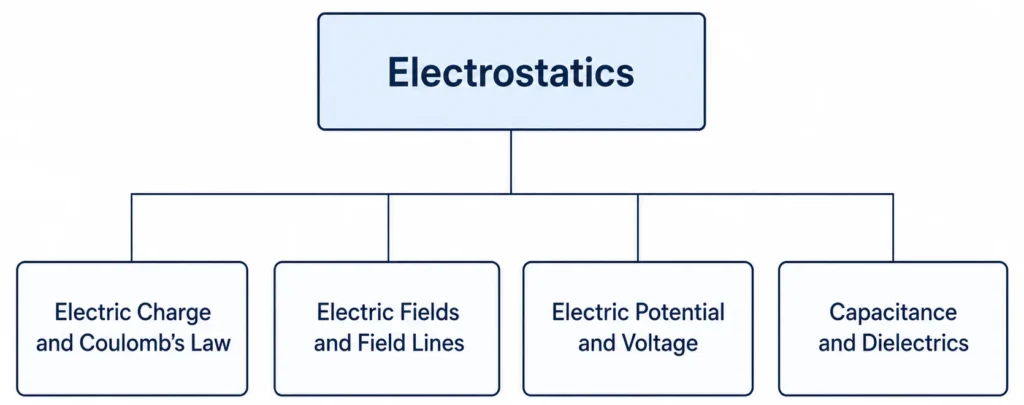
This simple hierarchy chart shows Electrostatics as the parent topic for four connected learning pages: Electric Charge and Coulomb’s Law, Electric Fields and Field Lines, Electric Potential and Voltage, and Capacitance and Dielectrics. The chart helps students see the learning sequence clearly: first understand charge and force, then electric fields, then voltage as energy per charge, and finally capacitance and dielectrics as applications of fields and stored electric energy.
Electrostatics Hub Navigation
Electricity and Magnetism
Provides the wider physics context for charge, electric fields, magnetic fields, circuits, induction, electromagnetic waves, and advanced electromagnetic systems.Electrostatics – Overview
Introduces electric charges at rest and explains how they create forces, fields, potential differences, capacitance, and stored electric energy.Electric Charge and Coulomb’s Law
Begins with electric charge, attraction and repulsion, conservation of charge, and the inverse-square force between point charges.Electric Fields and Field Lines
Shows how charge creates electric influence throughout space and how field lines represent direction and relative field strength.Electric Potential and Voltage
Moves from force to energy by explaining voltage as electric potential difference, or energy change per unit charge.Capacitance and Dielectrics
Applies fields and voltage to charge storage, capacitor energy, dielectric materials, and polarisation inside electric fields.The Mathematical Framework of Electrostatic Fields
Core Physical Primitives at a Glance
| Concept Primitive | Mathematical Foundation | Physical Behavior Matrix |
|---|---|---|
| Electric Charge | Quantized: q = ne | An intrinsic fundamental property of matter; strictly conserved and additive. Explains basic mechanical attraction and repulsion. |
| Coulomb’s Law | Inverse-Square: F ∝ 1/r² | Quantifies the electrostatic force magnitude acting directly along the vector line connecting two localized point charges. |
| Electric Field | Force per Unit Charge: E = F / q | Maps spatial field vectors showing direction and relative force intensity throughout a continuous surrounding space. |
| Electric Potential & Voltage | Work per Unit Charge: V = W / q | Shifts analysis from vector forces to scalar energy configurations; quantifies work independent of path choice. |
| Capacitance & Dielectrics | Charge Storage Ratio: C = Q / V | Measures potential energy storage capacity. Dielectric materials undergo atomic polarization to amplify total system limits. |
| Materials Equilibrium | Boundary Limits: Einside = 0 | Differentiates ideal conductors (instantaneous surface charge migration) from insulators (localized bounded charge states). |
How Electrostatics Connects to Later Physics
Electrical Circuits
Voltage, charge movement, and capacitance become essential when students study current, resistance, energy transfer, and circuit behaviour.Electrodynamics
When charges move or fields change with time, electrostatics develops into electrodynamics, where electric and magnetic effects become linked.Electromagnetic Induction
Understanding electric fields and voltage helps students later understand how changing magnetic fields can produce induced emf and current.Electromagnetic Waves
The field idea introduced in electrostatics eventually becomes part of the wider theory of electromagnetic waves, including light and radio waves.Plasma Physics
In plasmas, charged particles respond strongly to electric fields. Electrostatic ideas help explain particle motion, screening, and collective behaviour.Quantum Electrodynamics QED
At advanced levels, electric interaction becomes part of the quantum theory of electromagnetic forces between charged particles.Applications of Electrostatics
Static Electricity
A charged balloon attracting hair, static cling in clothing, and small sparks on dry days all show how charge separation creates electric forces.Lightning
Large charge separation in storm clouds can create strong electric fields. When air breaks down, a rapid electrical discharge produces lightning.Electronics
Capacitors store and release energy, smooth voltage changes, and help shape signals in electronic circuits.Energy Storage
Capacitance and electric-field energy appear in devices that store, regulate, or release electrical energy.Touchscreens
Capacitive touchscreens detect changes in electric fields when a finger approaches or touches the screen.Printing and Imaging
Photocopiers, laser printers, and inkjet systems can use electrostatic forces to control toner, droplets, or charge patterns.Environmental Engineering
Electrostatic precipitators use electric fields to remove charged particles from exhaust gases and reduce air pollution.Industrial Processes
Electrostatic painting and particle control systems use charged materials to improve coating, reduce waste, and guide fine particles.Common Misconceptions in Electrostatics
Charge vs. Voltage
Misconception: Electric charge is functionally identical to voltage. Reality: Charge is an intrinsic physical property of matter. Voltage represents the scalar energy difference per unit charge between two points. They describe related but distinctly separate mechanical properties.The Nature of Field Lines
Misconception: Electric field lines are physical strings or discrete threads running through space. Reality: Field lines are abstract vector visualization tools. The underlying electric field forms a continuous vector field that exists natively at every coordinate point in the spatial domain.Capacitor Storage Dynamics
Misconception: Capacitors store net charge inside a conductive physical box. Reality: The net charge of an active capacitor remains zero. It functions by holding equal and opposite separated charges on opposite boundary conductors, storing its net potential energy strictly inside the localized electric field established between them.Dielectric Behavior
Misconception: A dielectric acts as a thin microscopic wire allowing current passage. Reality: A dielectric is a pure insulator. It functions by polarizing its internal atomic configurations under external field strains, reducing internal field density to amplify capacitance without letting free charge bypass plate interfaces.Technical Case Studies: Electrostatics in Modern Engineering
Environmental Systems: Electrostatic Precipitators
Industrial manufacturing facilities deploy large-scale electrostatic filters to trap fly ash and microscopic particulates before they leave exhaust stacks. Passing gases are subjected to a high-voltage corona discharge that imbues airborne dust with a net negative charge. These charged particles are then driven by strong electrostatic attraction toward massive, positively grounded collection plates, eliminating up to 99% of particulate air pollution from the emissions stream.Micro-Interface Architecture: Capacitive Touchscreens
Modern mobile displays rely on the manipulation of localized electrostatic fields. A grid of transparent micro-electrodes maintains a continuous, uniform electrostatic field right beneath the glass interface. Because the human finger acts as a natural electrical conductor, touching the screen draws a minute amount of charge to the point of contact. This changes the localized mutual capacitance, letting onboard microcontrollers instantly pinpoint coordinate vectors.Evolution of the Field: History, Engineering Hurdles, and Future Frontiers
Historical Epochs: From Friction to Continuous Field Calculus
Contemporary Challenges: Dielectric Breakdown and Parasitic States
Future Technological Horizons: High-Density Supercapacitors
Electrostatics — FAQ
What is electrostatics?
Electrostatics is the branch of physics that studies electric charges at rest (or moving so slowly that magnetic effects can be neglected) and the forces, fields, and potentials they produce. It examines how stationary charges interact via electric forces and how static electric fields behave in space.
What is electric charge and what are its properties?
Electric charge is a fundamental property of matter that causes it to experience electric force. Charges come in two types — positive and negative — like charges repel each other while opposite charges attract. Charge is conserved: the total charge in an isolated system remains constant.
What is the law governing the force between two static charges?
The force between two static (point) charges is given by Coulomb’s law. It states that the magnitude of the electrostatic force is directly proportional to the product of the magnitudes of the charges and inversely proportional to the square of the distance between them. Like charges repel; unlike charges attract.
What is an electric field and how is it defined?
An electric field is a vector field around a charged object that describes the force per unit charge that a test charge would experience at each point. The field is defined as E = F / q, where F is the Coulomb force on a small test charge q. The field lines emerge from positive charges and end on negative charges.
What is electric potential (voltage) in electrostatics?
Electric potential (also called electrostatic potential or voltage) is a scalar field whose gradient gives the electric field. It represents the potential energy per unit charge at a point in the field, meaning the work needed to bring a unit positive charge from a reference point (often infinity) to that point. Potential helps analyse energy and work in electrostatic configurations.
What is the principle of superposition in electrostatics?
The principle of superposition states that if there are multiple electric charges, the total electric field (or potential) at a point is the vector (or scalar) sum of the fields (or potentials) produced by each charge individually. This allows analysis of complex charge distributions by summing simpler contributions.
What is an electric dipole and what special features does it have?
An electric dipole consists of two equal and opposite charges separated by a small distance. It produces an electric field and potential that decrease faster with distance compared to a single charge, and exhibits characteristic directional dependence. Dipoles are often used to model molecular charge distributions and help understand polarization in dielectrics.
What is electric induction (charging by induction) and when does it occur?
Electrostatic induction (or simply induction) is when a nearby charged object causes redistribution of charges within a conductor, even without direct contact — leading to net charges on different parts and possibly a spark or static discharge if connected. Induction is a key mechanism behind many electrostatic phenomena, such as objects sticking after rubbing (static electricity).
What is capacitance and how is it related to electrostatics?
Capacitance is the ability of a system (like a pair of conductors) to store electric charge and energy in an electric field. In electrostatics, when charges accumulate on conductors, they create an electric field and potential difference. A capacitor stores energy as electrostatic potential energy between its plates. Capacitance depends on the geometry of the conductors and the surrounding medium (permittivity).
Why is electrostatics important in real-world applications and technology?
Electrostatics underlies many everyday and technological phenomena — from static electricity and dust attraction, to the functioning of capacitors, sensors, photocopiers, ink-jet printers, and many electronic devices. Understanding fields, potentials, and charge distributions is crucial for electrical engineering, material science, electronics design, and even in biological systems where charge interactions are key.
Quick Interactive Check
Suggested answer: Electric charge. Electrostatics begins with positive and negative charge and how charges attract or repel.
Suggested answer: Electric force is the force on a particular charge. Electric field describes force per unit positive charge at each point in space.
Suggested answer: Voltage describes electric potential difference, or energy change per unit charge between two points.
Suggested answer: The energy is stored in the electric field between the capacitor plates.
Review Questions and Answers
- What is Coulomb’s Law, and how does it describe the force between two point charges?Answer: Coulomb’s Law states that the electrostatic force F between two point charges is directly proportional to the product of the magnitudes of the charges q1 and q2, and inversely proportional to the square of the distance r between them. Mathematically, it is expressed as:$$F = k_e \frac{|q_1 q_2|}{r^2}$$where ke is Coulomb’s constant (8.99 × 10⁹ N·m2/C2). This law quantifies the magnitude of the force and indicates that like charges repel while opposite charges attract.
- How does the principle of superposition apply to electrostatic forces?Answer: The principle of superposition asserts that when multiple charges are present, the total electrostatic force on a specific charge is the vector sum of the individual forces exerted by each of the other charges independently. Each pairwise interaction contributes to the net force without altering the others, allowing complex force configurations to be calculated by summing simpler interactions.
- What is an electric field, and how is it related to the force experienced by a test charge?Answer: An electric field E is a vector field that represents the force per unit positive test charge at a point in space. It is defined by:$$\mathbf{E} = \frac{\mathbf{F}}{q}$$where F is the force experienced by the test charge q. The direction of the electric field corresponds to the direction of the force on a positive charge, indicating how charges influence the space around them.
- Describe the concept of electric potential energy in the context of electrostatics.Answer: Electric potential energy is the energy stored due to the positions of charges within an electric field. For a pair of point charges, the potential energy U is given by:$$U = k_e \frac{q_1 q_2}{r}$$where q1 and q2 are the charges, r is the separation distance, and ke is Coulomb’s constant. This energy represents the work required to assemble the charge configuration from infinity to the specified arrangement.
- How does a conductor behave when placed in an external electric field, and what is electrostatic shielding?Answer: When a conductor is placed in an external electric field, free electrons within the conductor redistribute themselves to counteract the applied field, resulting in zero electric field inside the conductor in electrostatic equilibrium. This phenomenon is known as electrostatic shielding: the conductor effectively blocks external static electric fields from influencing its interior. This principle is used in designing protective enclosures such as Faraday cages.
- Explain Gauss’s Law and its significance in electrostatics.Answer: Gauss’s Law states that the net electric flux through a closed surface is proportional to the enclosed electric charge. Mathematically, it is expressed as:$$\oint \mathbf{E} \cdot d\mathbf{A} = \frac{Q_{\text{enc}}}{\varepsilon_0}$$where E is the electric field, dA is a differential area vector on the closed surface, Qenc is the total enclosed charge, and ε0 is the permittivity of free space. This law relates electric fields to charge distributions and greatly simplifies field calculations for systems with high symmetry.
- What is the difference between electric potential and electric potential energy?Answer: Electric potential V is the electric potential energy per unit charge at a point in space, representing the work needed to move a positive test charge from infinity to that point without acceleration. It is measured in volts (V). Electric potential energy U, on the other hand, is the total energy a charge possesses due to its position within an electric field, calculated as:$$U = qV$$where q is the charge. Thus, electric potential is a property of the electric field at a point, whereas electric potential energy depends on both the field and the specific charge placed within it.
- How do capacitors function, and what role does dielectric material play in their operation?Answer: Capacitors are devices that store electrical energy by accumulating equal and opposite charges on two conductive plates separated by an insulating material. When a voltage is applied across the plates, an electric field develops and charge accumulates until the voltage across the capacitor equals the applied voltage. Introducing a dielectric material between the plates increases the capacitor’s ability to store charge by reducing the electric field strength for a given charge, thereby increasing the capacitance. The dielectric becomes polarized in the presence of the field, partially canceling the field within the material and allowing more charge to accumulate for the same applied voltage.
- What is electrostatic induction, and how can it be used to charge an object?Answer: Electrostatic induction is the process of redistributing electrical charge in a material due to the influence of nearby charges without direct contact. When a charged object is brought near a neutral conductor, it causes a separation of charges within the conductor: like charges are repelled and opposite charges are attracted. If the conductor is then grounded, allowing charges to enter or leave, and the external charged object is subsequently removed, the conductor retains a net charge opposite to that of the inducing object. This method is used in applications such as electrostatic generators and certain types of sensors.
- How does the concept of electric field lines help in visualizing electric fields, and what are their key properties?Answer: Electric field lines are a visual representation of electric fields, illustrating the direction and relative strength of the field. Key properties include: lines originate from positive charges and terminate on negative charges; the density of lines indicates the field’s magnitude (closer lines represent stronger fields); lines never cross, as this would imply multiple field directions at a single point; and they are perpendicular to the surface of conductors in electrostatic equilibrium. This visualization helps in understanding field interactions and the behavior of charges within the field.
Thought-Provoking Conceptual Challenges
- How does the concept of electrostatic potential help in understanding energy storage in capacitors?Answer: Electrostatic potential, defined as the potential energy per unit charge at a point in an electric field, is a central concept in understanding how capacitors store energy. In capacitors, energy is stored by separating positive and negative charges on two conductive plates, creating an electric field between them. This separation results in a potential difference (voltage) that quantifies the work required to move charges against the electric field, thereby storing energy. The understanding of electrostatic potential allows engineers to calculate the energy stored in a capacitor using the relation:$$U = \frac{1}{2} C V^2$$This concept not only helps in designing capacitors with the required energy storage capacity but also in optimizing performance in circuits, where efficient energy storage and release are critical for filtering, timing, and power management applications.
- What are the limitations of Coulomb’s Law when applied to complex charge distributions, and how can these limitations be addressed?Answer: Coulomb’s Law provides an excellent description of the force between point charges in free space, yet it has limitations when applied to extended or non-uniform charge distributions. For complex charge arrangements, the law’s pairwise approach becomes unwieldy, and the simple inverse-square law does not account for the distribution of charges over a volume or surface. The direct application of Coulomb’s Law to such systems requires integration over the entire charge distribution, which can become mathematically intensive. To address these limitations, physicists employ methods like the principle of superposition and advanced mathematical tools such as Gauss’s Law. By choosing an appropriate Gaussian surface, one can greatly simplify the calculation of the net electric field for symmetric charge distributions. This approach reduces complex integrals into more manageable forms and provides insight into the behavior of electric fields in systems where Coulomb’s Law alone would be cumbersome.
- How does the principle of superposition enhance our understanding of electrostatic interactions in multi-charge systems?Answer: The principle of superposition states that the net electric field created by multiple charges is the vector sum of the fields produced by each individual charge. This concept is fundamental in electrostatics because it allows complex charge configurations to be broken down into simpler, individual interactions that can be analyzed separately. The superposition principle makes it possible to predict the resultant field at any point in space without having to solve an entirely new problem for each configuration. In practical applications, superposition is essential for understanding phenomena such as the interference of electric fields in capacitors and the behavior of charges on conductors. It is also instrumental in computational methods and simulations, where electric fields from multiple sources are calculated and then summed to model real-world scenarios in electronics and material science. This holistic approach to understanding field interactions underscores the elegance and utility of superposition in solving complex problems.
- In what ways do dielectric materials influence the performance of capacitors and other electrostatic systems?Answer: Dielectric materials play a crucial role in capacitors by increasing their capacitance and enhancing energy storage efficiency. When inserted between the plates of a capacitor, a dielectric reduces the electric field for a given charge on the plates by becoming polarized, which in turn increases the capacitor’s ability to store charge at a given voltage. This effect is quantified by the material’s dielectric constant, a measure of its ability to be polarized. Beyond capacitors, dielectric materials are essential in various electrostatic systems such as insulators in high-voltage equipment and printed circuit boards. They prevent unwanted charge flow, thereby enhancing safety and performance. The influence of dielectrics is also seen in devices that rely on precise control of electric fields, including sensors and actuators, making them indispensable in modern electronics and energy storage technologies.
- How can electrostatic shielding be used to protect sensitive electronic equipment from external electric fields, and what are its practical challenges?Answer: Electrostatic shielding involves enclosing sensitive electronic components within a conductive barrier that redistributes charges to cancel external electric fields. This principle is commonly applied in the form of a Faraday cage, which effectively prevents interference from external electrostatic forces, ensuring that the internal environment remains stable. The shield works by directing electric field lines around the interior of the enclosure rather than through it, thereby protecting delicate circuitry from unwanted noise and fluctuations. Despite its effectiveness, practical challenges exist in implementing electrostatic shielding. Factors such as the size, shape, and material of the shield, as well as gaps or seams in the enclosure, can significantly impact its performance. Additionally, for dynamic or high-frequency fields, the design must account for skin effects and resonance phenomena, requiring sophisticated materials and engineering solutions to achieve optimal protection. This makes electrostatic shielding a complex yet vital component in modern electronic design and electromagnetic compatibility (EMC) applications.
- How does the concept of electric flux, as described by Gauss’s Law, provide insights into the behavior of electric fields in symmetric charge distributions?Answer: Electric flux is a measure of the number of electric field lines passing through a given surface, and Gauss’s Law relates this flux to the charge enclosed by that surface. For symmetric charge distributions, such as spherical, cylindrical, or planar geometries, Gauss’s Law simplifies the calculation of electric fields by allowing one to choose a Gaussian surface that exploits the symmetry of the system. This method transforms complex integrals into straightforward algebraic equations, making it much easier to determine the field intensity and distribution. By understanding electric flux, physicists can predict how electric fields behave in various configurations, such as around charged spheres or infinite planes. This understanding is crucial in designing devices like capacitors and in analyzing the behavior of charge distributions in materials. Gauss’s Law not only provides a powerful mathematical tool but also deep conceptual insights into the fundamental nature of electric fields and their relationship with the charges that produce them.
- What role do electrostatic forces play in natural phenomena such as lightning, and how can this understanding improve safety measures?Answer: Electrostatic forces are the driving mechanism behind natural phenomena like lightning, where the separation of electric charges in clouds leads to a massive discharge of energy. As charges accumulate in different regions of a cloud, the electric field between these regions and between the cloud and the ground intensifies until it overcomes the insulating properties of air. This results in a sudden, powerful electrical discharge, or lightning, that neutralizes the charge imbalance. Understanding the electrostatic principles behind lightning can lead to improved safety measures and technology for lightning protection. For instance, lightning rods and grounding systems are designed based on these principles to safely direct the electrical discharge away from buildings and people. Additionally, enhanced weather forecasting and early-warning systems that monitor charge buildup in storm clouds can mitigate risks associated with lightning strikes, thereby protecting lives and infrastructure.
- How can the principles of electrostatics be applied to modern technologies such as touchscreens and air purification systems?Answer: The principles of electrostatics are fundamental in the operation of capacitive touchscreens, where the presence of a conductive object (like a finger) alters the local electric field, allowing the device to detect touch with high precision. In these systems, a network of electrodes generates a uniform electric field that is disrupted upon contact, and the device’s electronics interpret these changes to determine the exact location of the touch. This application has revolutionized user interfaces in smartphones, tablets, and interactive displays. Similarly, electrostatics is used in air purification systems through electrostatic precipitators, which remove particulate matter from industrial emissions. These devices charge particles suspended in the air and then capture them on oppositely charged plates, significantly reducing pollution levels. This application not only improves air quality but also demonstrates the broad utility of electrostatic principles in solving practical, real-world problems, from enhancing personal technology to protecting environmental health.
- In what ways does the redistribution of charges in conductors under external electric fields illustrate the principle of electrostatic induction?Answer: Electrostatic induction is a process where an external electric field causes the redistribution of charges within a conductor without direct contact. When a charged object is brought near a conductor, the free electrons within the conductor either accumulate or are repelled, creating regions of positive and negative charge. This redistribution happens quickly, resulting in an induced charge that mirrors the external field’s influence while the conductor itself remains electrically neutral overall. This phenomenon is critical in many practical applications, such as in the design of sensors and the operation of electrostatic generators. It also provides the basis for methods used to charge objects indirectly, which is essential in processes like photocopying and printing. The understanding of charge redistribution through induction also deepens our insight into the behavior of conductors in varying electric fields, reinforcing the broader principles of electrostatics and its applications in both natural and engineered systems.
- How do environmental factors, such as humidity and temperature, affect electrostatic phenomena, and what implications does this have for industrial applications?Answer: Environmental factors like humidity and temperature significantly influence electrostatic phenomena by altering the insulating properties of air and the behavior of surface charges. High humidity levels, for instance, increase the conductivity of air, allowing charges to dissipate more readily and reducing the likelihood of static buildup. Conversely, in dry conditions, the insulating properties of air are enhanced, which can lead to significant static charge accumulation and an increased risk of electrostatic discharge. These variations have important implications for industrial applications. In manufacturing settings, particularly those involving sensitive electronic components or explosive materials, controlling environmental conditions is critical to prevent unwanted static discharges that could damage equipment or pose safety hazards. Engineers often implement humidity control systems and grounding techniques to mitigate these risks, ensuring that electrostatic phenomena do not adversely affect the quality and safety of industrial processes.
- How does the study of electrostatics contribute to our understanding of molecular interactions and the behavior of biological systems?Answer: Electrostatics plays a pivotal role in molecular interactions by explaining the forces between charged particles within and between molecules. The distribution of electrical charges in molecules determines how they interact through attractive and repulsive forces, influencing molecular bonding, protein folding, and the structure of biological membranes. This understanding is fundamental in fields like biochemistry and pharmacology, where the electrostatic properties of molecules can dictate their reactivity and binding affinity. In biological systems, electrostatic forces are critical in processes such as cell signaling and nerve conduction, where voltage differences across membranes drive the propagation of electrical impulses. These interactions also underpin the stability and functionality of enzymes and receptors, affecting metabolic pathways and overall cellular health. By applying electrostatic principles, researchers can design better drugs, understand disease mechanisms, and develop advanced biomaterials that mimic or enhance natural biological functions.
- What are the potential future developments in electrostatic technology, and how might these innovations impact energy storage and environmental control?Answer: Future developments in electrostatic technology hold promise for significant advancements in energy storage, particularly in the optimization of capacitors and supercapacitors. Emerging materials with high dielectric constants and novel nanostructured designs are expected to increase energy density and improve charge-discharge rates, potentially rivaling traditional battery technologies. Such advancements could lead to more efficient power management in renewable energy systems, electric vehicles, and portable electronics, enabling faster charging and longer lifetimes. Moreover, innovations in electrostatic applications are likely to have a profound impact on environmental control. Enhanced electrostatic precipitators and air filtration systems could further reduce industrial emissions and particulate pollution, contributing to cleaner air and healthier living conditions. Additionally, advances in electrostatic technologies may pave the way for new methods of wireless power transfer and energy harvesting, revolutionizing how we collect and use energy in urban and remote environments. These developments will not only push the boundaries of current scientific understanding but also have wide-reaching societal benefits in sustainability and environmental protection.
Numerical Problems and Solutions
- k = 8.99 × 10⁹ N·m2/C2
- q1 = 5 × 10⁻⁶ C
- q2 = 3 × 10⁻⁶ C
- r = 0.20 m