
Electric charge is a fundamental, non-reducible intrinsic property of matter that dictates how subatomic particles interact through electromagnetic fields. While invisible to the naked eye, this quantized phenomenon governs the stable architecture of atomic configurations, the multi-phase behaviors of chemical materials, the macroscopic flow of current, and the foundational structural forces that prevent solid matter from collapsing under gravitational tension.
Coulomb’s Law provides the first precise, quantitative framework for calculating the mechanical vector forces that arise when static charges interact across a spatial gap. It establishes that the resulting electrostatic force depends on two primary parameters: the scalar product of the interacting charge magnitudes and the inverse-square of their physical separation distance. Mastering this foundational point-source dynamic is a strict prerequisite before exploring advanced field models, continuous charge distributions, vector field lines, and electrodynamic waves.
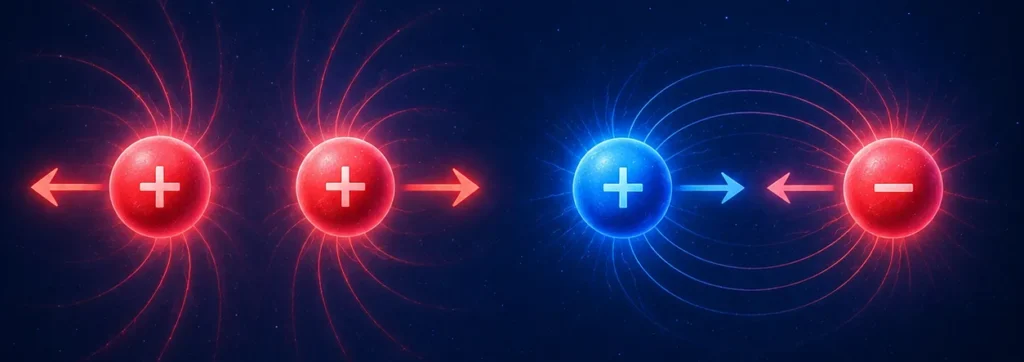
This illustration shows the basic idea behind electric charge and Coulomb’s law. On one side, two like charges push away from each other, showing repulsion. On the other side, unlike charges pull toward each other, showing attraction. The image helps students see that electric force does not require direct contact; charged objects can influence one another through the space between them.
Learning Pathway in Electricity and Magnetism
Electricity and Magnetism
Introduces the overarching academic domain governing electric and magnetic phenomena, spanning static charges, dynamic currents, magnetic induction, and Maxwellian systems.
Electrostatics Parent Hub
Provides the primary conceptual umbrella, focusing on static charge systems in structural equilibrium and their associated field and potential distributions.
Electric Charge and Coulomb’s Law
Establishes the initial quantitative entry point, defining charge quantization, tribal interactions, and the primary inverse-square force equations.
Electric Fields and Field Lines
Advances past dual-source force tracking to map space as a continuous vector field modified by isolated source charges.
Electric Potential and Voltage
Transforms the structural analysis from vector forces to conservative scalar landscapes, defining electrical pressure as potential energy per unit charge.
Capacitance and Dielectrics
Applies field mappings and potential integrations to material polarization boundaries, physical hardware capacitors, and volumetric energy density metrics.
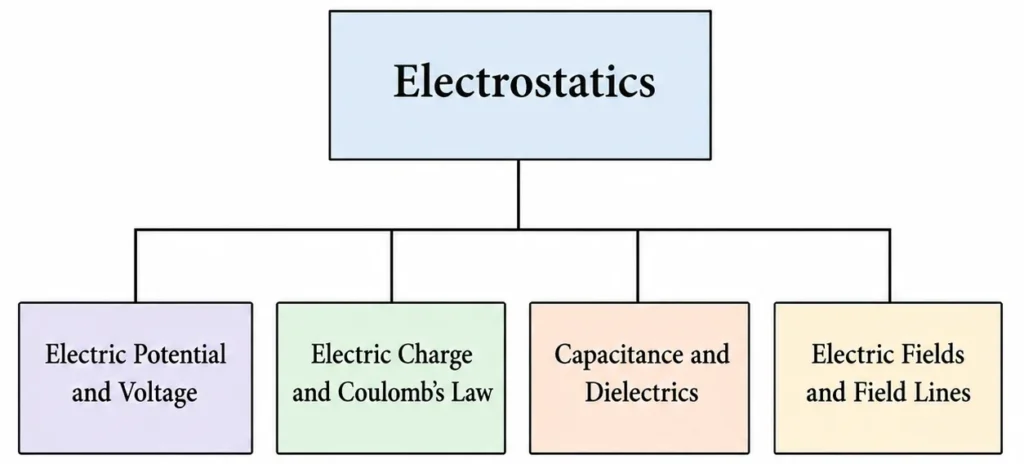
This structure chart shows the main learning pages within the Electrostatics section. It places Electric Charge and Coulomb’s Law alongside Electric Fields and Field Lines, Electric Potential and Voltage, and Capacitance and Dielectrics. The chart helps students see that this topic is the foundation for later ideas such as fields, voltage, and capacitors.
The Core Physical Idea
Distance Scaling Dynamics in Coulombic Interactions
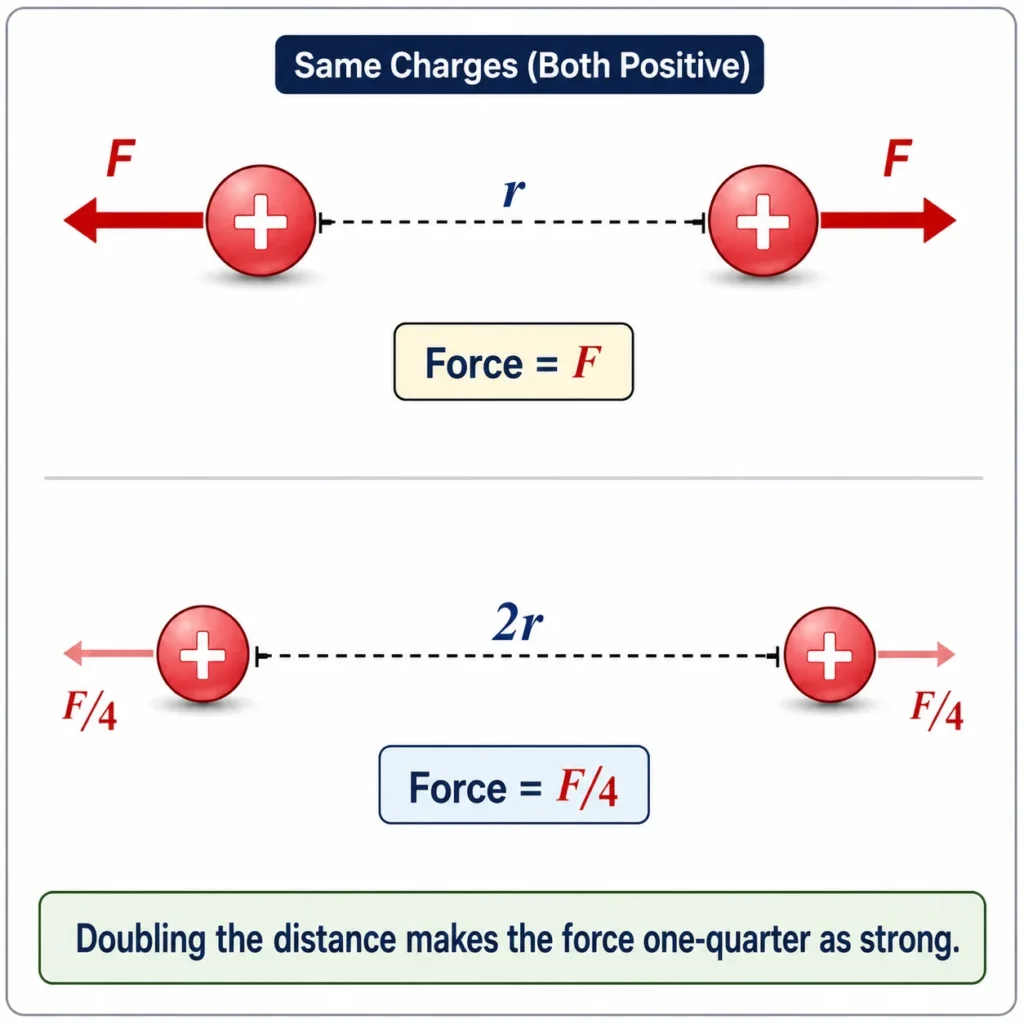
Doubling the distance between two charges reduces the electric force to one-quarter of its original value.
This illustration shows how distance affects electric force in Coulomb’s law. In the upper part, two identical positive charges are separated by a distance r and repel each other with force F. In the lower part, the same charges are separated by twice the distance, 2r, and the force becomes F/4. The image helps students understand that electric force follows an inverse-square relationship: distance does not merely weaken the force slightly; it reduces it very quickly.
The Primary Pillar to Remember
Electric charge gives matter the intrinsic property to attract or repel across empty space, and Coulomb’s Law mathematically calculates the structural force limits of that interaction based on source magnitude and inverse-square separation.
Visualizing the Physical Interaction
Isolate Point Coordinates
Visualize two distinct, idealized point charges suspended in a vacuum volume. They track toward or away from each other entirely along the absolute line vector connecting their centers.
Track Spatial Thinning
Envision the electrical influence radiating spherically outward from the charge center. As the sphere’s surface area expands quadratically, the local intensity thins out following a strict inverse-square dropoff.
Map Directional Signs
The magnitude equation yields a absolute scalar value for force size. You must independently overlay directional vectors by verifying the structural charge parity (like signs push, opposite signs pull).
Key Equations and Physical Interpretations
Physical Meaning of F
F represents the mechanical force magnitude operating between the charges, evaluated in newtons (N). It acts symmetrically on both interacting particles.
The Linear Charge Product
The parameter product |q1q2| establishes that force scales proportionally with charge magnitude. Doubling one charge value will exactly double the resulting force vector.
The Denominator Metric r²
The structural separation distance squared tracks geometric dropoff. Tripling the physical space step cuts the electrical force to exactly one-ninth of the original value.
From Formula to Meaning
Worked Analytical Example
- Charge 1 (q1) = +2.0 × 10⁻⁶ C
- Charge 2 (q2) = -3.0 × 10^{-6 C
- Separation Distance (r) = 0.50 m
- Constant (ke) = 8.99 × 10⁹ N·m2/C2
Common Conceptual Misconceptions
Asymmetric Force Fallacy
Misconception: A massive 10 C charge pulls much harder on a tiny 1 μC charge than the small charge pulls back.
Reality: Both nodes experience the exact same force magnitude. The product q1q2 is commutative, meaning point-source force pairs comply perfectly with Newtonian action-reaction symmetries.
Linear Distance Error
Misconception: Doubling the physical separation cuts the electrostatic force to exactly half.
Reality: The denominator applies a quadratic constraint. Doubling distance cuts the force to one-quarter (25%), while tripling distance drops it to one-ninth (11.1%).
Formulaic Sign Confusion
Misconception: Plugging negative signs directly into the algebraic equation helps track vector directions.
Reality: The standard magnitude formula uses absolute values. Vector mapping must be handled separately by analyzing structural attraction and repulsion rules.
Constant Magnitude Illusion
Misconception: The massive value of ke means everyday objects routinely exert huge electrical forces.
Reality: The standard unit of one coulomb is an exceptionally large charge balance. Everyday static adjustments involve micro-scale or nano-scale coulombs, balancing the equation to normal mechanical values.
Real-World Physics Frameworks
Macroscopic Static Electricity
Frictional contacts—such as rubbing a balloon on fabric—mechanically strip away outer electrons, creating net surface charge imbalances that drive non-contact mechanical movement.
Stable Atomic Geometries
Negatively charged electron orbitals are held in stable configurations around positively charged atomic nuclei by attractive Coulomb forces, forming the physical framework of chemistry.
Material Adhesion Properties
Microscopic surface friction, industrial coating retention, dust collection, and molecular bonds rely directly on electrostatic forces acting across molecular boundaries.
Real-World Structural Demonstration

This illustration shows a simple everyday example of static electricity. After a balloon is rubbed against hair or fabric, electric charge can become separated. The charged balloon then attracts nearby strands of hair, showing that electric force can act without direct contact. This helps students connect Coulomb’s law to a familiar experience: charged objects can influence one another through the space between them.
Bridge to University Thinking
Quick Interactive Check
Show answer
Suggested answer: They repel. Charges with the same sign push away from each other.
Show answer
Suggested answer: The force becomes one-quarter of its original value, because the distance is squared in the denominator.
Show answer
Suggested answer: No. Each charge experiences a force of the same magnitude, but in opposite directions.
Technical Case Studies: Coulombic Forces in Applied Technology
Industrial Filtering: Electrostatic Precipitators
Large manufacturing setups deploy electrostatic filters to trap fly ash and microscopic environmental pollutants before stack gases enter the atmosphere. Exhaust output streams run past high-voltage ionizing wires that apply a net negative charge to passing particles via a localized corona discharge. These charged masses are then exposed to broad, positively grounded collection plates. The resulting strong, attractive Coulomb force vector drives the particles out of the high-velocity gas stream, causing them to deposit on the plates for mechanical removal.
Material Synthesis: Electrostatic Powder Coating
Advanced industrial painting systems rely heavily on inverse-square force vectors to achieve atomized, perfectly uniform surface coatings. The fluid paint powder is forced through a specialized spray nozzle that strips away electrons, leaving the atomized droplets carrying a high positive charge density. The target component is deliberately connected to a negative ground block. As the paint spray approaches the metal surface, attractive Coulomb forces pull the particles uniformly across all geometric boundaries, minimizing overspray waste and ensuring uniform layer thickness.
Evolution of Force Theory: History, Micro-Limits, and Frontiers
Historical Epochs: From Qualitative Friction to Precise Torsion Symmetries
Contemporary Challenges: Managing Coulombic Breakdown in Nanosystems
Future Technological Horizons: Controlled Ion Trapping and Quantum Logic
Advanced Mathematical Rigor: The Vector Superposition of Discrete Charge Systems
Review Questions and Answers
- What is electric charge?Answer: Electric charge is an intrinsic physical property of matter that causes particles to experience vector forces when placed inside electromagnetic fields. Charge can be positive or negative.
- What happens when two like charges are placed near each other?Answer: They repel each other. Two positive charges repel, and two negative charges also experience repulsive force vectors pushing them apart.
- What happens when two unlike charges are placed near each other?Answer: They attract each other. A positive charge and a negative charge generate mutually attractive force vectors pulling them together.
- State Coulomb’s Law in words.Answer: The electrostatic force between two isolated point charges is directly proportional to the product of their charge magnitudes and inversely proportional to the square of the distance separating their centers.
- Why is Coulomb’s Law called an inverse-square law?Answer: Because the resulting force magnitude drops off in inverse proportion to the distance squared (1/r²), matching the spatial expansion properties of a sphere.
- What determines whether the electric force is attractive or repulsive?Answer: The relative signs of the charges. Like signs trigger mechanical repulsion, while opposite signs produce attraction.
- What is the SI unit of electric charge?Answer: The SI unit of electric charge is the coulomb, represented by the uppercase symbol C.
- Why do we use absolute values in Coulomb’s Law?Answer: Absolute values isolate the scalar magnitude of the force. The vector direction is determined separately by evaluating sign parity.
Thought-Provoking Questions and Answers
- If electric force can be much stronger than gravity, why do we not usually feel strong electric forces between ordinary objects?Suggested answer: Most macroscopic objects exist in a state of electrical neutrality, containing nearly identical balances of protons and electrons. This net cancellation masks the intense underlying electrostatic forces, leaving only gravity noticeable at large scales.
- Why is it useful to begin electricity and magnetism with charge rather than circuits?Suggested answer: Circuits are complex networks driven by the localized movement and potential adjustments of charges. Mastering point-source dynamics first allows parameters like current, voltage, and resistance to be understood as continuous physical behaviors rather than abstract circuit rules.
- What does Coulomb’s Law suggest about the way influence spreads through space?Suggested answer: The inverse-square constraint indicates that the electrical influence of a source charge expands uniformly into three-dimensional space, thinning out in direct proportion to the expanding surface area of an imaginary sphere surrounding the charge.
- Why might the same formula feel simple in school physics but become deeper at university?Suggested answer: Introductory courses treat the formula as a basic algebraic lookup tool. University physics frames it as the foundation for complex vector field integrations, differential calculus modeling, and continuous volumetric charge distributions.
Numerical Problems and Solutions
-
Two charges of +1.0 × 10⁻⁶ C and +2.0 × 10⁻⁶ C are separated by 0.30 m. Find the magnitude of the electric force between them.Solution: Deconstruct via the base magnitude formula:$$F = k_e \frac{|q_1 q_2|}{r^2}$$ $$F = (8.99 \times 10^9) \frac{(1.0 \times 10^{-6}\text{ C})(2.0 \times 10^{-6}\text{ C})}{(0.30\text{ m})^2}$$ $$F = (8.99 \times 10^9) \frac{2.0 \times 10^{-12}\text{ C}^2}{0.09\text{ m}^2} \approx 0.20\text{ N}$$Interpretation: Since both source charges carry positive signs, they generate a mutual **repulsive** force of 0.20 N.
-
Two charges exert a force of 0.80 N on each other. If the distance between them is doubled, what is the new force?Solution: Apply the strict scaling constraint of the inverse-square law. Doubling the distance scales the denominator by 2², making the final force magnitude exactly one-quarter of the baseline:$$F_{\text{new}} = \frac{F_{\text{old}}}{2^2} = \frac{0.80\text{ N}}{4} = 0.20\text{ N}$$Interpretation: The force drops significantly due to the quadratic scaling of the spatial separation distance.
-
Two charges of -4.0 × 10⁻⁶ C and +5.0 × 10⁻⁶ C are separated by 0.20 m. Find the magnitude and nature of the force.Solution: Solve using absolute product fields:$$F = (8.99 \times 10^9) \frac{|(-4.0 \times 10^{-6}\text{ C})(5.0 \times 10^{-6}\text{ C})|}{(0.20\text{ m})^2}$$ $$F = (8.99 \times 10^9) \frac{20.0 \times 10^{-12}\text{ C}^2}{0.04\text{ m}^2} \approx 4.50\text{ N}$$Interpretation: The charges maintain opposite signs, giving the 4.50 N force an **attractive** nature.
-
A pair of identical charges separated by 0.10 m repel each other with a force of 9.0 N. Find the magnitude of each charge.Solution: Let the identical charges be represented by the shared variable q:$$F = k_e \frac{q^2}{r^2} \Rightarrow q^2 = \frac{F r^2}{k_e}$$ $$q^2 = \frac{(9.0\text{ N})(0.10\text{ m})^2}{8.99 \times 10^9\text{ N}\cdot\text{m}^2/\text{C}^2}$$ $$q^2 \approx 1.001 \times 10^{-11}\text{ C}^2$$ $$q = \sqrt{1.001 \times 10^{-11}} \approx 3.16 \times 10^{-6}\text{ C}$$Interpretation: Each of the matching charges carries a magnitude of approximately 3.2 μC.
Summary
Glossary
- Electric Charge
- An intrinsic property of subatomic matter that generates electromagnetic vector force interactions.
- Positive Charge
- The specific charge attribute carried natively by protons or deficient electron states.
- Negative Charge
- The specific charge attribute carried natively by free or bounded electron configurations.
- Coulomb
- The standard SI metric unit tracking net electric charge volume, symbolized by C.
- Coulomb’s Law
- The quantitative law defining static force magnitudes between point charges based on inverse-square metrics.
- Point Charge
- An idealized mathematical charge distribution assumed to reside entirely at an isolated coordinate node.
- Inverse-Square Law
- A physical geometric decay pattern where force intensity degrades in proportion to the separation distance squared (1/r²).
- Electrostatic Force
- The mechanical force vector generated between static, non-moving electric charge domains.
- Coulomb’s Constant (ke)
- The baseline scaling factor accounting for vacuum permittivity, equal to approximately 8.99 × 10⁹ N·m2/C2.
- Attraction and Repulsion
- The mechanical vector outcomes of electrostatics: opposing signs pull together (attract), while matching signs push apart (repel).
Frequently Asked Questions
Why do like charges repel?
Like charges repel because the physical interaction of matching electromagnetic field sign states generates force vectors that act symmetrically to push the source nodes apart.
Why do opposite charges attract?
Opposite charges possess complementary field Sign characteristics, causing their mutual field energy states to favor spatial alignment that draws the entities together.
Is Coulomb’s law similar to Newton’s law of gravitation?
Yes, both share an identical inverse-square structural form (1/r²). However, mass-based gravity remains exclusively attractive, whereas charge-based electrostatics can attract or repel.
Why are charges often measured in microcoulombs in school problems?
A full coulomb represents a massive quantity of electric charge. Accumulating one full coulomb on a standard laboratory object would require an extreme, dangerous voltage potential, making microcoulombs (μC) or nanocoulombs (nC) much more practical for standard tracking.
Does Coulomb’s law work for all charged objects?
In its basic algebraic format, the law assumes isolated point charges or spherical configurations where the physical object scale is negligible compared to the separation gap. Continuous or extended charge arrays require complex field integration methods.
Authoritative External References
- OpenStax University Physics Vol 2: Electric Charge — A peer-reviewed source tracking quantized charge fundamentals and basic conservation behaviors.
- OpenStax University Physics Vol 2: Coulomb’s Law — Standardized reference detailing point-source force vectors and inverse-square verification calculations.
- Physics LibreTexts: Coulomb’s Law — An open-access instructional node providing deep derivations and structural practice sets.
- NIST Reference: Elementary Charge Constant — The official scientific consensus values for the quantum charge value e.