Prepare for University Studies & Career Advancement
Work, Energy, and Power
In introductory physics, tracking complex mechanical systems with multiple moving parts, coupling pulleys, and friction using Newton’s Second Law\( \vec{F} = m\vec{a} \)can quickly become highly complex. This approach requires keeping track of complicated vector coordinate directions across multiple geometric dimensions simultaneously.
The Work-Energy framework provides an elegant analytical shortcut. Because energy is a scalar quantity—represented by a simple algebraic value rather than a vector with directional parameters—you can completely bypass tracking the geometric curves an object follows. Instead, you simply evaluate the starting state balances versus the ending available energy balances. Mastering this framework transforms brutal vector problems into straightforward algebraic accounting, making it the foundational tool for studying structural engineering, advanced robotics, and orbital mechanics at the university level.
Educational Pathway Note: This page establishes the scalar conservation principles that bridge foundational kinematics to advanced rigid-body rotation and fluid dynamics.
1. The Core Intuition (Without Calculus)
What is the Mechanical Difference Between Work, Energy, and Power?
Energy represents the absolute capacity to perform physical work, while work is the actual process of transferring that energy across space via force. Power measures the time-based speed of that energy transaction. A low-power system can complete identical total mechanical work as a high-power engine given enough time.
Think of energy as the universal currency of nature, and work as the transaction process. You cannot see, touch, or hold a Joule of energy directly; you only observe what it does when it transfers from one physical account to another. Our fundamental accounting rule for any real-world machine or process is intuitive:
Resulting (Useful) Work = Input Energy − Wasted Energy
If you supply 100 Joules of chemical energy via fuel into a combustion engine, and 70 Joules are lost to the environment as heat and sound (wasted energy), the resulting useful mechanical work pushing the vehicle forward can only be 30 Joules. Energy cannot disappear; it merely changes accounts.
Work (W): The active process of transferring energy. It is the action of a force causing a physical displacement. Pushing a heavy object across a floor transfers energy from your muscles into the object’s kinetic account.
Energy (E): The structural capacity to perform work. Mechanical energy exists in two primary states: Kinetic Energy (energy of active motion) and Potential Energy (stored configuration energy, like a stretched mechanical spring or an object raised in a gravitational field).
Power (P): The temporal speed of the transaction. Carrying a heavy payload up three flights of stairs in 10 seconds requires the exact same total Work as taking 10 minutes—but it demands vastly more Power because the energy transaction occurs at a faster rate.
Quick Check: Energy Accounting & Intuition
Question 1: An electric motor consumes 500 Joules of electrical energy to lift a heavy crate. Due to friction and electrical resistance, 150 Joules of energy is lost as heat to the surroundings. Based on the mechanical accounting rule, how much mechanical work was actually done on the crate?
Conceptual Solution: 350 Joules.
Using the energy accounting formula: Useful Work = 500 J (Input) – 150 J (Wasted) = 350 Joules. This means exactly 350 J went into raising the object’s gravitational potential energy account.
Question 2: A student holds a heavy 25 kg text stack completely still at arm’s length for 60 seconds. Her muscles tremble and she sweats from the exertion. Physically speaking, is she performing mechanical work on the book stack during this time?
Conceptual Solution: No, the mechanical work done on the stack is exactly zero.
While her muscles are burning (doing microscopic biological work internally via muscle fiber contractions), the stack’s macroscopic displacement (d) is zero. Because no energy is transferred into the stack’s mechanical accounts to change its speed or position, no physical work is done on the object.
2. Demystifying the Sign Convention
When is Mechanical Work Positive, Negative, or Zero?
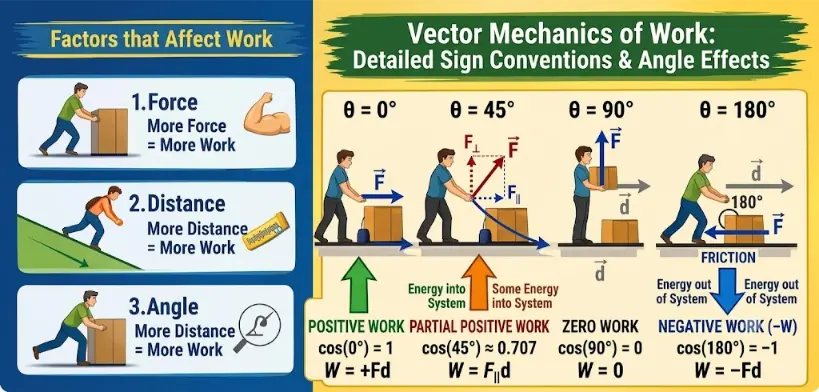
Mechanical work is positive when the applied force vector aligns with displacement, depositing kinetic energy into a system. It evaluates as negative when force opposes displacement, removing system energy. Work scales to zero whenever the net force vector acts perfectly perpendicular to motion.
Mathematical signs (positive versus negative) in physics are not abstract algebraic limits; they reveal the direction of the transaction—who is giving and who is receiving energy. Algebraic physics calculates work using the vector dot product, where \theta represents the angle between the applied force vector and the displacement vector.
Positive Work (+W): Occurs when the applied force and the displacement point in the same general direction (\(0^\circ \le \theta < 90^\circ\)). Pushing a stalled vehicle forward causes it to move forward. You are an energy depositor, adding Joules to the vehicle’s kinetic energy account.
Negative Work (-W): Occurs when the force and displacement point in opposite directions (\(90^\circ < \theta \le 180^\circ\)). When a driver slams on the brakes, the car slides forward while the braking friction force pushes backward. Friction acts as an energy thief, removing kinetic energy from the car and converting it into heat.
Quick Check: The Physics of Signs (+ vs. -)
Question 1: You catch a fast-moving baseball falling straight down. As your hands cushion the impact and bring the ball to a complete stop, are your hands doing positive or negative work on the ball?
Conceptual Solution: Negative work (\(-W\)).
The baseball is moving downward, but your hands must exert an upward force to decelerate it. Because your force vector opposes the displacement vector, you perform negative work, draining the ball’s kinetic energy down to zero.
Question 2: A satellite moves in a perfectly circular orbit around Earth at a constant speed. The massive force of gravity pulls continuously toward the center of the planet. What is the sign of the work done by gravity on the satellite?
Conceptual Solution: The work done is exactly zero (neither positive nor negative).
In a circular orbit, the gravitational force vector is always perfectly perpendicular (at a \(90^\circ\) angle) to the instantaneous displacement vector. Since \(\cos(90^\circ) = 0\), gravity performs zero work. It changes the satellite’s direction, but never adds or removes energy from its speed account.
Complete Vector Mapping of Work Sign Conventions and Energy Transfer.
Core Elements in Vector Mapping:
The Vector Definition of Work: The diagram highlights the dot product equation where the angle between the applied Force vector and the Displacement vector handles the final energy results.
Positive Work (Energy Depositor): Illustrated when the force vector and the displacement vector align in the same directional orientation. Nature adds energy into the system, producing a positive energy deposit.
Zero Work (Energy Neutral): In cases where forces act strictly perpendicular to horizontal motion, the resulting mechanical work evaluates to exactly zero.
Negative Work (Energy Thief): Illustrated by friction or resistance forces. While an object slides forward, the friction vector points straight backward, removing energy from the block and dissipating it as waste heat.
3. The Calculus Bridge (University Level)
How Do You Calculate Mechanical Work Done by a Variable Force?
To calculate the work done by a variable force, you integrate the force function across the spatial path. This calculus framework evaluates continuously changing systems—like mechanical springs or variable gravitational fields—by summing infinitely small dot products along the displacement trajectory.
Standard algebraic expressions assume that the force remains perfectly constant throughout the movement. In real physical systems, forces vary continuously. For example, as you compress a mechanical spring, it fights back harder with every millimeter of compression; the force changes at every point along the path. To analyze this analytically, we break the path down into infinitely small spatial steps (\(d\vec{r}\)) and integrate:
$$
W = \int_{r_1}^{r_2} \vec{F} \cdot d\vec{r}
$$
The Potential Energy Derivative Connection
University-level examinations heavily test the differential relationship between a conservative force system and its potential energy function (U). Mathematically, force is defined as the negative space derivative (gradient) of potential energy:
$$
F(x) = -\frac{dU}{dx}
$$
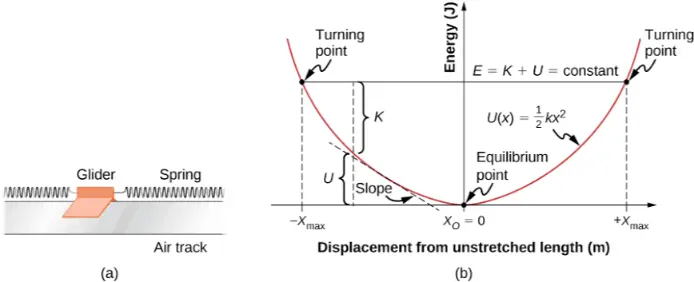
Why the negative sign? Consider an object on an energy landscape. If the potential energy curve slope rises as you move right (a positive slope), nature generates a physical force pulling the object back to the left (a negative force direction). The negative sign enforces a fundamental law: Systems are always pushed mechanically down toward their lowest available potential energy state.
The geometric mapping of a conservative potential energy curve, showing how the slope links visually to restoring force behaviors.
Navigating the Geometric Curve:
The Total Energy Ledger: The total energy boundary remains constant. As an object oscillates, energy continuously cycles between the kinetic account and the potential account, but their absolute sum never changes.
The Slope Tangent Rule: On the left side of a parabolic valley, the spatial curve possesses a negative derivative. Multiplying this by our calculus definition rule yields a positive force vector, pushing the system back right toward equilibrium.
The Equilibrium Hinge: At the absolute base of the curve, the geometric slope lines rest completely flat, meaning the spatial derivative drops to zero. Consequently, the force drops to zero as well, creating a stable physical equilibrium node.
Quick Check: Transitioning to University Calculus
Question 1: A variable force defined by the equation \(F(x) = 4x^3\) (in Newtons) acts on a particle. How do you find the total work performed on the particle as it moves from position \(x = 0\) to \(x = 2\) meters?
Numerical Solution: You must integrate the force function across the spatial limits.
Question 2: A conservative molecular system has a potential energy profile mapped out by the equation \(U(x) = 3x^2 – 5x\). Find the equation for the physical force acting on a particle within this system at any point \(x\).
Numerical Solution: Take the derivative of the potential energy function and multiply by negative one. Using our calculus definition:
First, take the spatial derivative:
$$
\frac{dU}{dx} = 6x – 5
$$
Next, apply the operational negative sign:
$$
F(x) = -(6x – 5) = 5 – 6x
$$
4. Real-World Applications
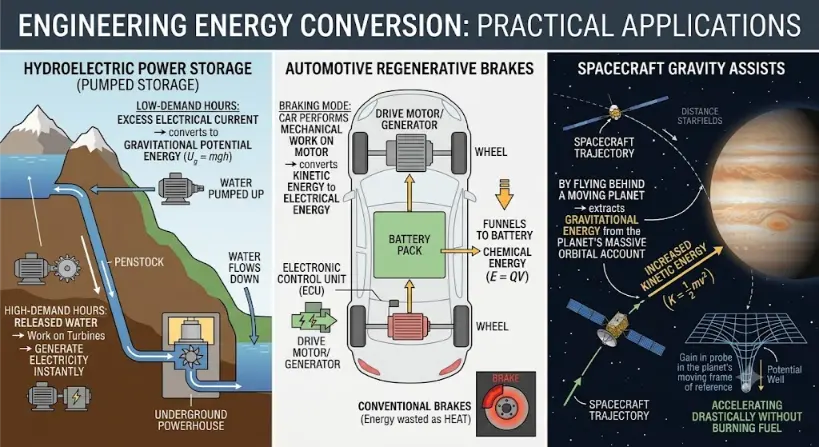
Hydroelectric Power Storage
Pumping Potential Storage
Power grids pump massive fluid structures up into high altitude reservoirs during low-demand off-peak hours, transforming surplus grid electrical energy into gravitational potential energy. When load demands spike, this water is released downward through penstocks, performing structural kinetic work on heavy turbines to generate output power.
Automotive Regenerative Brakes
Kinetic Conservation Loops
Electric consumer vehicles configure their powertrain drives to run in reverse profiles during braking deceleration. Rather than expelling kinetic translational assets into frictional heat trash, vehicle momentum executes negative mechanical work on the motor assembly, translating back into chemical energy fields inside onboard battery arrays.
Spacecraft Gravity Assists
Orbital Slingshot Operations
Interplanetary research probes intercept the massive orbital kinetic reservoirs of moving target planets to execute deep space accelerations. By navigating behind a planet’s moving gravitational field, the probe extracts energy from the planet’s vast orbital momentum, achieving immense boost metrics without burning onboard fuel.
Systems diagram of diverse real-world engineering applications of energy conversion, highlighting efficiency strategies in hydroelectric storage, electric vehicles, and deep space navigation.
Technical Observations in Applied Conversions:
Temporal Storage in Hydro: Visually charts how surplus electric utility assets can transform back and forth across large gravitational potential columns.
EV Efficiency vs. Waste: Traces kinetic feedback loops where capturing translational energy intercepts the system deceleration curve to recharge power reserves.
Orbital Slingshot Mechanics: Maps how a trailing hyperbolic approach vector captures a sliver of planetary orbital kinetic energy to alter a probe’s velocity profile.
5. Common Mechanics Misconceptions
Does Physical Exhaustion Always Mean Mechanical Work is Done?
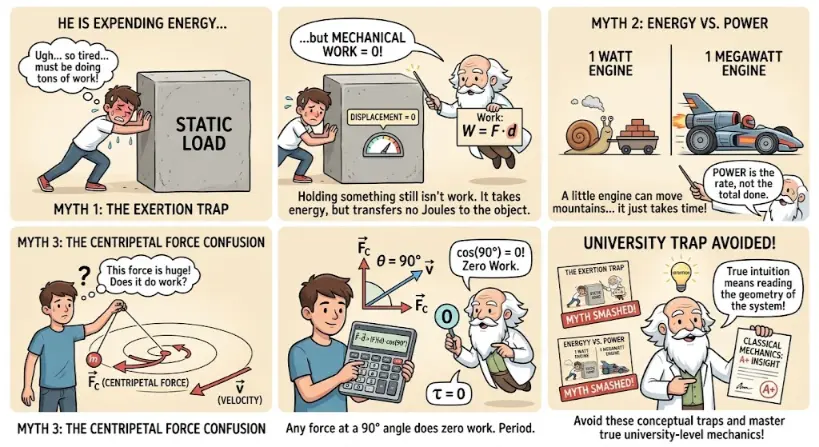
No, physical exhaustion does not mean mechanical work is occurring. Holding an object stationary burns metabolic energy internally through muscle tension, but transfers zero mechanical energy to the object because its spatial displacement vector remains zero.
The Exertion Equals Work Trap: Students often assume that feeling tired or expending physical energy automatically means mechanical work is occurring. Holding an object static requires physiological energy, but transfers zero mechanical energy to the object because there is no displacement.
Confusing Power with Energy: Power is not the total amount of work done; it is strictly the rate of delivery. A low-power engine can lift an incredibly massive object given enough time; a high-power engine simply performs the identical energy transaction in a fraction of the time.
Misinterpreting Centripetal Force: Because centripetal forces (like a string swinging a ball in a circle) can be large, students assume they do work. Any force acting perfectly perpendicular to the instantaneous motion performs absolutely zero work.
A conceptual map for identifying and correcting intuitive traps related to static force, power delivery, and non-parallel vector systems.
Navigating Conceptual Pitfalls:
Exertion vs. Mechanical Transfer: Distinguish chemical metabolic burn (ATP breakdown) from actual mechanical energy injection. If displacement is zero, mechanical work evaluates to zero Joules.
Rate of Flow vs. Total Reservoir: Power is the speedometer of energy delivery, not the odometer of total work accomplished.
Perpendicular Force Neutrality: Centripetal vectors change trajectory direction curves but remain entirely energy neutral because they form a right angle with velocity.
6. Thought-Provoking Conceptual Queries
Question: When a rifle fires a bullet, the expanding combustion gases push backward on the heavy rifle with the exact same force vector that they push forward on the light bullet (following Newton’s Third Law). Why, then, does the bullet fly off with lethal, high-velocity kinetic energy, while the rifle only delivers a manageable recoil kick back into the marksman’s shoulder?
Conceptual Solution: While the forces acting on the rifle and bullet are identical in magnitude, the distances over which those forces act are completely different. The lightweight bullet accelerates across the entire length of the rifle barrel, meaning the force performs massive work across a large distance, packing its kinetic energy account. The heavy rifle has a massive inertia and barely shifts back a fraction of a centimeter before hitting the shooter’s shoulder. Because the force acts across a tiny distance, the mechanical work done on the rifle is minimal.
7. Limits of the Classical Model
In classical mechanics, we assume an object’s mass remains perfectly static regardless of its speed, allowing us to state that kinetic energy can grow infinitely. However, as an object approaches the cosmic speed limit—the speed of light (c)—Einstein’s Special Theory of Relativity reveals that this model breaks down.
At relativistic velocities, adding input work no longer results in a linear speed increase because it requires infinite work to accelerate a massive body up to light speed. Instead, the input energy changes accounts, shifting into relativistic momentum frames. Similarly, at quantum scales, energy cannot always be transferred continuously; it is quantized into discrete packets called quanta, making the classical concept of smooth, continuous integration boundaries invalid.
8. Fermi Estimation Project
The Challenge: Estimate the total kinetic energy contained within all active passenger vehicles driving on the roads of a major global metropolis (like London or New York) at a peak rush-hour moment.
The Back-of-the-Envelope Approach: Assume the city has roughly 10 million residents, and at peak rush hour, about 5% are driving a vehicle simultaneously (500,000 active cars). Let an average passenger car mass be roughly m \approx 1,500\text{ kg}. Assume a standard urban traffic flow velocity of roughly 50\text{ km/h}, which converts smoothly to roughly v \approx 14\text{ m/s}. The kinetic energy account of a single vehicle is:
Developing the cognitive ability to round off complex realities and perform rapid orders-of-magnitude estimations is a hallmark trait tested in top-tier university engineering interviews.
9. Key Terms Glossary
Conservative Force: A force system where the total work done moving an object between two coordinates is completely independent of the path taken (e.g., gravity, spring forces).
Non-Conservative Force: A force system where the work performed depends entirely on the path length, causing mechanical energy to dissipate into heat or sound accounts (e.g., kinetic friction, air resistance).
Joule (J): The standard SI metric unit of work and energy; defined structurally as one Newton-meter (1\text{ N}\cdot\text{m}).
Watt (W): The standard SI metric unit of power; defined as one Joule of energy transferred per second (1\text{ J/s}).
What’s Next? Now that you have mastered scalar energy balances, you are ready to study systems where external forces are zero but internal structural impacts are complex.
Explore the Classical Mechanics Curriculum
This page is part of our comprehensive university preparation track for classical mechanics. Use the map below to navigate between foundational motion laws, structural statics, and advanced analytical frameworks.
Examines translational impulse patterns, conservation rules, and center-of-mass actions under multi-body loads.
Advanced Analytical Blueprint: Synthesizing Work, Energy, and Power
To master university-level classical mechanics, students must move beyond treating work, kinetic energy shifts, and power output delivery as isolated algebraic expressions. In real-world industrial engineering, these metrics function as a single, interconnected dynamic system. Whenever an external force performs continuous mechanical work on an object, it directly updates the system’s kinetic energy reservoir over a specific chronological timeline, dictating the operational wattage baseline of the entire configuration.
Dynamic System Synthesis Matrix
Analytical Step
Core Physics Calculation
Systemic Ledger Impact
1. Force Mapping (Work Input)
W = ∫ F(x) dx
Measures the net energy entering or escaping the mechanical system borders.
2. Velocity Shifting (Kinetic Pool)
W_net = ΔE_k = 1/2 m(v_f^2 – v_i^2)
Translates scalar work values directly into immediate translational speed changes.
3. Time Integration (Power Delivery)
P = dW/dt = F · v
Tracks the time-based transmission rate at which work depletes or fills system reserves.
Case Study: Emergency Braking Analysis of a Rapid Transit Freight Locomotive
Consider an industrial engineering scenario where a fully loaded transit train possessing an integrated system mass parameter m traveling along a horizontal rail structure at an initial velocity v_0 applies its emergency brakes. The automated system applies a constant retarding force vector F_b to systematically strip kinetic energy from the train’s speed accounts until it reaches a safe terminal stop position.
By synthesizing our scalar mechanics toolkits, we map the structural requirements of this deceleration curve through three matching vantage points:
The Work Profile Perspective: The constant braking force performs negative mechanical work against the displacement path vector over a stopping distance d. This negative work acts as an energy drain on the system, reducing the train’s translational kinetic capacity down to zero Joules:
$$ W_{\text{net}} = -F_b \cdot d = 0 – \frac{1}{2}mv_0^2 $$
The Chronological Timeline Perspective: Applying Newton’s Second Law reveals that the uniform retarding force produces a constant negative linear acceleration vector. The time interval t required to bring the system’s velocity safely down to zero is computed directly via momentum boundaries:
$$ t = \frac{m \cdot v_0}{F_b} $$
The Systemic Power Dissipation Perspective: Because the vehicle’s velocity drops linearly from its initial speed down to a dead stop, the rate of energy extraction varies continuously over time. The instantaneous power dissipated by the breaking system drops continuously along the trajectory path, matching a peak initial requirement of:
$$ P_{\text{initial}} = F_b \cdot v_0 $$
By examining this simple mechanical model, students quickly discern that a vehicle traveling at elevated speeds demands a quadratically larger spatial work distance to dissipate its kinetic capacity, yet requires an intensely high-power delivery rating from its component braking systems to force that transaction to occur within tight chronological limits.
Apply your conceptual and analytical mechanics toolkits to these textbook-style challenges. Work through each problem independently before toggling the hidden solutions to audit your methodologies.
Category 1: Analytical & Conceptual Challenges
Problem 1: A particle is subjected to a spatial, one-dimensional conservative force field defined by the equation \(F(x) = -3x^2 + 4x\), where \(x\) is in meters and \(F\) is in Newtons. Derive the corresponding potential energy function \(U(x)\) for this system, assuming the reference potential energy is zero at the origin (\(U(0) = 0\)).
Conceptual Solution: By foundational calculus definition, a conservative force is the negative derivative of its potential energy function:
$$
F(x) = -\frac{dU}{dx}
$$
Rearranging this to solve for potential energy via integration yields:
Applying our boundary condition where the origin acts as our zero-energy baseline (\(U(0) = 0\)), the constant of integration drops away (\(C = 0\)). Therefore, the formal potential energy function is:
$$
U(x) = x^3 – 2x^2
$$
Problem 2: Prove algebraically that the work done by a constant net force vector \(\vec{F}\) acting on a mass \(m\) sliding across a frictionless displacement vector \(\vec{d}\) is exactly equal to the system’s net change in translational kinetic energy (\(\Delta K\)). Start from kinematic fundamentals.
Conceptual Proof: Start with the constant-acceleration 1D kinematic equation:
$$
v_f^2 = v_i^2 + 2ad
$$
Rearrange this equation to isolate the spatial acceleration metric:
$$
ad = \frac{1}{2}(v_f^2 – v_i^2)
$$
Next, bring in Newton’s Second Law to replace our mechanical acceleration variable:
$$
F = ma \Rightarrow a = \frac{F}{m}
$$
Substituting this into our rearranged kinematic framework yields:
Because mechanical work is defined as \(W = Fd\) for a constant parallel force, and translational kinetic energy is defined as \(K = \frac{1}{2}mv^2\), we arrive cleanly at the Work-Energy Theorem:
$$
W = K_f – K_i = \Delta K
$$
Problem 3: A variable force \(F(x) = kx^3\) acts on an object, where \(k\) is a constant. Calculate the total work done by this force as the object moves from an initial position \(x = 0\) to a final position \(x = L\).
Conceptual Solution: Because the force varies continuously across space, we cannot simply multiply force by distance. We must integrate the force function over the given spatial interval:
The total mechanical work performed on the system is:
$$
W = \frac{1}{4}kL^4
$$
Problem 4: State the defining condition for a force to be classified as conservative, and explain how the work done by such a force behaves over a closed loop path.
Conceptual Solution: A force is classified as conservative if the net work it performs on an object depends strictly on the initial and final positions of the trajectory, completely independent of the physical path taken.
A direct mathematical consequence of this path-independence is that the line integral of a conservative force over any completely closed loop path is always identically zero:
$$
\oint \vec{F} \cdot d\vec{r} = 0
$$
This occurs because the starting and ending coordinates of a closed loop are identical, meaning no net spatial displacement or change in the system’s potential energy account has taken place.
Problem 5: Mathematically define mechanical power in both its average scalar format and its instantaneous vector calculus format. What is the operational unit of power expressed entirely in SI base units?
Conceptual Solution: Average power is defined as the total mechanical work performed divided by the total time elapsed:
$$
P_{\text{avg}} = \frac{\Delta W}{\Delta t}
$$
Instantaneous power is the time-derivative of work, which resolves to the dot product of the applied force vector and the instantaneous velocity vector:
$$
P = \frac{dW}{dt} = \vec{F} \cdot \vec{v}
$$
The standard unit of power is the Watt (\(\text{W}\)). Expressed strictly in SI base units:
Problem 6: A block is released from rest at the top of a loop-the-loop track of radius R. Assuming the track is completely frictionless, a naive student states that the minimum release height required to clear the loop without losing contact is exactly 2R, since that matches the peak vertical height of the circle. Explain why this conceptual model fails and identify what mechanical energy accounts are missing from the student’s prediction.
Conceptual Solution: The student’s model fails because it assumes the block can stand completely still at the apex of the loop. To clear the loop without losing contact with the track, the block requires a non-zero minimum velocity to supply the necessary centripetal acceleration to counter gravity. At the absolute ceiling, gravity acts as the centripetal force:
$$
\frac{mv^2}{R} = mg \Rightarrow v^2 = gR
$$
Therefore, the block must possess a kinetic energy account of \(K = \frac{1}{2}mv^2 = \frac{1}{2}mgR\) at the peak. Setting our initial gravitational potential energy account (\(mgh\)) equal to the total mechanical energy balance required at the apex (Potential + Kinetic) reveals:
The student failed to realize that nature forces the system to pay a kinetic energy tax to maintain circular orbital motion, requiring a higher initial drop point (\(2.5R\)).
Problem 7: An ideal massless spring is compressed a distance x and used to launch a heavy block horizontally across a floor with kinetic friction coefficient \mu_k. If you double the initial compression distance to 2x, will the total sliding stopping distance of the block double, triple, or quadruple? Justify your answer using systemic energy tracking instead of kinematics.
Conceptual Solution: The initial energy reservoir stored in the system scales quadratically with compression distance according to the elastic potential energy equation:
$$
U_s = \frac{1}{2}kx^2
$$
Doubling the compression to \(2x\) multiplies the total initial energy ledger by a factor of four:
Once launched, the block must slide forward until the negative mechanical work performed by the force of friction completely depletes this initial energy balance. Since friction on a flat surface is constant, the work done by friction scales linearly with sliding distance. Because the system’s starting energy budget is four times larger, friction must act over four times the distance to drain the ledger back to zero. The stopping distance quadruples.
Problem 8: Consider a satellite orbiting Earth in a perfectly circular trajectory at constant speed. Does the Earth’s gravitational force perform positive, negative, or zero work on the satellite over the course of one full orbit? What if the orbit is highly elliptical?
Conceptual Solution: In a perfectly circular orbit, the gravitational force vector points directly toward the center of the Earth, while the satellite’s instantaneous displacement vector points tangentially along the orbital path. Because these vectors remain perfectly perpendicular at every single coordinate (\(\theta = 90^\circ\)), \(\cos(90^\circ) = 0\). Thus, gravity performs zero mechanical work on a circular orbit, leaving the kinetic energy (and speed) completely unchanged.
In a highly elliptical orbit, the gravity vector is not always perpendicular to motion. When the satellite moves toward the planet, the angle is acute, so gravity does positive work, causing the satellite to accelerate. When moving away, the angle is obtuse, so gravity does negative work, slowing it down. However, over one complete closed orbit, the net work remains precisely zero Joules.
Problem 9: You pull a heavy trunk across a rough floor at a constant velocity by exerting a force at an upward angle of 30° above the horizontal. Since the trunk’s speed is completely constant, its net kinetic energy change is zero. Does this imply that you are performing zero mechanical work on the trunk? Explain the system boundaries.
Conceptual Solution: No, you are absolutely performing non-zero positive work on the trunk. Because your force vector has a horizontal component pointing in the direction of displacement, your individual contribution adds energy into the trunk system.
The reason the net kinetic energy change is zero is due to the Work-Energy Theorem. The rough floor exerts an opposing kinetic friction force that performs an equal magnitude of negative mechanical work. You are depositing Joules into the system, but friction is stealing those Joules at the exact same rate, transforming them entirely into ambient thermal waste.
Problem 10: A heavy swinging pendulum is released from an angle. If air resistance is completely negligible, what can be said about the spatial locations where the system’s kinetic energy is maximized? Where is the magnitude of the restoring force maximized? Do these points coincide?
Conceptual Solution: By conservation of mechanical energy, kinetic energy reaches its absolute maximum when gravitational potential energy drops to its lowest possible point. This occurs at the absolute base of the swing (the equilibrium point).
Conversely, the restoring force acting on the pendulum bob is governed by gravity’s tangential component. This force reaches its maximum magnitude at the highest points of the trajectory. These positions do not coincide; they are perfectly out of phase. The force is zero where kinetic energy peaks, and the force is maxed out where kinetic energy is zero.
Category 3: Numerical Engineering Applications
Problem 11: An electric vehicle cargo hoist with a total operational mass of 1200 kg is tasked with climbing a vertical distance of 45 meters up a structural shaft. If the automated lift assembly’s internal electric motor is rated to continuously draw a maximum mechanical power output of 18 kW, calculate the absolute minimum time required to complete this vertical lift maneuver. (Assume \(g = 9.8\text{ m/s}^2\)).
Numerical Solution: First, calculate the total mechanical work required to lift the hoist. This work equals the net gain in the system’s gravitational potential energy account:
Next, use the fundamental definition of power as the rate of work output delivery. Rearranging this to isolate our temporal target variable yields:
$$
t = \frac{W}{P}
$$
Convert the motor’s power rating from kilowatts to standard operational units (\(18\text{ kW} = 18,000\text{ Watts}\)). Substitute these values back into our equation:
$$
t = \frac{529,200\text{ J}}{18,000\text{ W}} = 29.4\text{ seconds}
$$
The absolute minimum time required to execute the lift is exactly 29.4 seconds.
Problem 12: A 0.5 kg block is pushed against a horizontal spring with a stiffness constant of k = 400\text{ N/m}, compressing it by 0.2 meters. The block is released from rest. If a constant kinetic friction force of 4.0 N acts on the block as it travels across the flat surface, calculate the speed of the block the exact moment it detaches from the spring (at the spring’s uncompressed equilibrium position).
Numerical Solution: We apply the modified conservation of energy ledger accounting for non-conservative work:
$$
U_i + W_{\text{nc}} = K_f
$$
The initial energy is completely stored in the compressed spring matrix:
The speed of the block at detachment is approximately 5.37 m/s.
Problem 13: A sports car engine provides a constant mechanical power output of 60 kW (60,000 W) to its wheels. If the vehicle experiences a continuous, speed-dependent aerodynamic drag force defined by the expression F_{\text{drag}} = 3v^2, calculate the terminal maximum velocity the vehicle can achieve on a flat highway.
Numerical Solution: At terminal maximum velocity, the engine’s power output precisely matches the rate at which aerodynamic drag removes energy from the vehicle. We use the instantaneous power vector dot product equation:
$$
P = F \cdot v
$$
Substitute the speed-dependent drag profile force expression directly into this power function:
$$
P = (3v^2) \cdot v \Rightarrow P = 3v^3
$$
Now, substitute the engine’s fixed operational power rating to isolate the velocity target:
$$
60,000 = 3v^3 \Rightarrow v^3 = 20,000
$$
Taking the cube root of both sides yields:
$$
v = \sqrt[3]{20,000} \approx 27.14\text{ m/s}
$$
The maximum terminal speed is exactly 27.14 m/s.
Problem 14: A physics student uses a rope to drag a 25 kg crate a distance of 12 meters across a level warehouse floor at a constant slow speed. If the rope is held at an angle of 25° above the horizontal floor and the tension in the line is measured at a steady 80 Newtons, calculate the numerical work performed by the student, the work performed by friction, and the net work done on the crate.
Numerical Solution: First, calculate the work done by the student using the standard angular vector dot product:
Because the crate moves at a constant slow speed, its kinetic energy account does not change. According to the Work-Energy Theorem, the sum of all work inputs must balance out completely:
Therefore, the work performed by the surface friction force must be the exact negative counterpart of the input:
$$
W_{\text{friction}} = -870.05\text{ Joules}
$$
The net mechanical work performed on the crate system over the 12 meter track is precisely 0 Joules.
Problem 15: A small roller coaster cart with a mass of 300 kg starts from rest at the top of a peak height H = 40\text{ meters}. It descends down a track and passes through a low valley point at a height of h = 10\text{ meters}. If the cart’s measured speed through that low valley is exactly 22 m/s, calculate the total energy lost to non-conservative thermal friction during the descent.
Numerical Solution: Set up the total mechanical energy conservation ledger to isolate the thermal work loss: