
Prepare for University Studies & Career Advancement

Linear Momentum and Collisions

In introductory mechanics, physical systems are frequently modeled as structureless point-masses tracking along predictable trajectories governed by static Newtonian equations. However, when complex systems undergo macroscopic impacts—such as high-speed automotive collisions, structural fragmentations, or subatomic scattering—the contact forces fluctuate dynamically over millisecond intervals. Attempting to map these transient, time-dependent force vectors explicitly using classical vector mechanics quickly becomes mathematically intractable.
The Linear Momentum framework provides an elegant analytical shortcut by evaluating the system through global conservation principles rather than discrete force tracking. By shifting the frame of reference to the total system ledger, you can completely bypass the highly non-linear internal mechanics of the impact zone and determine the post-collision state with exact algebraic certainty. This comprehensive toolkit serves as the structural foundation for engineering energy-absorbing crumple zones, executing forensic ballistic reconstructions, and calculating high-energy scattering cross-sections within modern particle accelerators.

Educational Pathway Note: This page establishes the vector conservation principles that bridge translational dynamics to continuous systems, rigid-body collisions, and advanced relativistic kinematics.


1. The Core Intuition (Without Calculus)

What is the Fundamental Difference Between Momentum and Kinetic Energy?

Linear momentum is a directional vector quantity tracking the mass-velocity product of a system, rendering its account balance highly sensitive to spatial orientation. Conversely, kinetic energy is a scalar metric mapping work capacity, squaring the velocity variable to completely eliminate directional signs from its accounting ledger.

Think of linear momentum as a physical measure of an object’s resistance to changing its translation state when subjected to an external impulse. It is an intrinsic accounting account that depends fundamentally on mass and instantaneous velocity. For any isolated physical system, our primary conservation rule dictates:

Total Net Momentum Before Impact = Total Net Momentum After Impact

Provided a system remains isolated from non-conservative external boundary forces—such as environmental friction or external drag—the total quantity of linear momentum cannot be created or destroyed. It can only be distributed dynamically among the interacting elements of the system.
  • Linear Momentum (\(\vec{p} = m\vec{v}\)): Tracks the net vector push of a moving mass. Because velocity carries an explicit coordinate direction, a mass moving along the positive horizontal axis adds to the positive ledger, while a mass tracking along the negative axis subtracts from it.
  • Kinetic Energy (\(K = \frac{1}{2}mv^2\)): Tracks the net scalar energy state of the system. Because the velocity term is squared, spatial orientation is entirely removed. The kinetic energy account always maintains a positive value, regardless of the direction of travel.


Quick Check: Momentum vs. Kinetic Energy

Question 1: A lightweight runaway storage cart and a heavy, fully-loaded freight truck travel down an incline, sharing the exact same linear momentum magnitude. If both systems encounter an identical, constant braking force, which vehicle requires a greater stopping distance?


Conceptual Solution: The lighter runaway storage cart will travel a significantly greater distance. While their momentum values (\(p = mv\)) are perfectly matched, their kinetic energy accounts are vastly different. Expressing kinetic energy in terms of momentum reveals the relation \(K = \frac{p^2}{2m}\). Because mass sits in the denominator, the lighter cart must maintain a much higher velocity to match the truck’s momentum, resulting in a substantially larger initial kinetic energy reservoir. By the Work-Energy Theorem (\(W = Fd = \Delta K\)), since the applied braking forces are identical, the cart’s larger kinetic energy balance demands a longer spatial path to safely deplete down to zero.
Question 2: Two identical elastic spheres travel directly toward one another along a frictionless horizontal guide rail at identical speeds, culminating in a perfect head-on impact. What is the total net linear momentum vector of this two-body system?


Conceptual Solution: The total net linear momentum vector of the system is exactly zero. Linear momentum is strictly a vector quantity. If the first sphere moves along the positive axis with a momentum contribution of \(+mv\), the second sphere tracking in direct opposition must contribute an equivalent negative momentum value of \(-mv\). Summing the system components together across the boundary yields a net balance of zero: \((+mv) + (-mv) = 0\).


2. Collision Categories: The Energy Accounting Rules

How Do Kinetic Energy Accounts Behave Across Elastic and Inelastic Collisions?

Total linear momentum is perfectly preserved across all isolated impacts, but internal kinetic energy balances scale based on material elasticity. Elastic collisions conserve kinetic energy completely, inelastic paths degrade a portion into thermal waste, and completely inelastic events maximize energy dissipation as the masses lock together.

While the global linear momentum vector remains invariant under isolated conditions, the system’s kinetic energy ledger transforms according to the mechanical compliance of the colliding bodies. Impacts are split into three structural domains:
  • Perfectly Elastic Collisions: The interacting masses rebound cleanly without generating permanent structural deformation or structural damage. In this ideal scenario, the kinetic energy ledger matches perfectly before and after the interaction: \(\text{Total } K_i = \text{Total } K_f\). No energy is degraded into ambient thermal accounts.
  • Inelastic Collisions: The objects separate post-impact, but the internal structural compression phase permanently degrades mechanical energy. The final energy equation resolves to: \(\text{Resulting } K_f = \text{Input } K_i – W_{\text{thermal}}\), where a portion of the energy account is lost to heat, deformation, and acoustic waves.
  • Completely Inelastic Collisions: The system experiences the absolute maximum theoretical loss of kinetic energy allowed by momentum conservation constraints. The colliding bodies lock together upon impact, moving forward in tandem as a single unified mass matrix.


Quick Check: Energy Alterations in Crashes
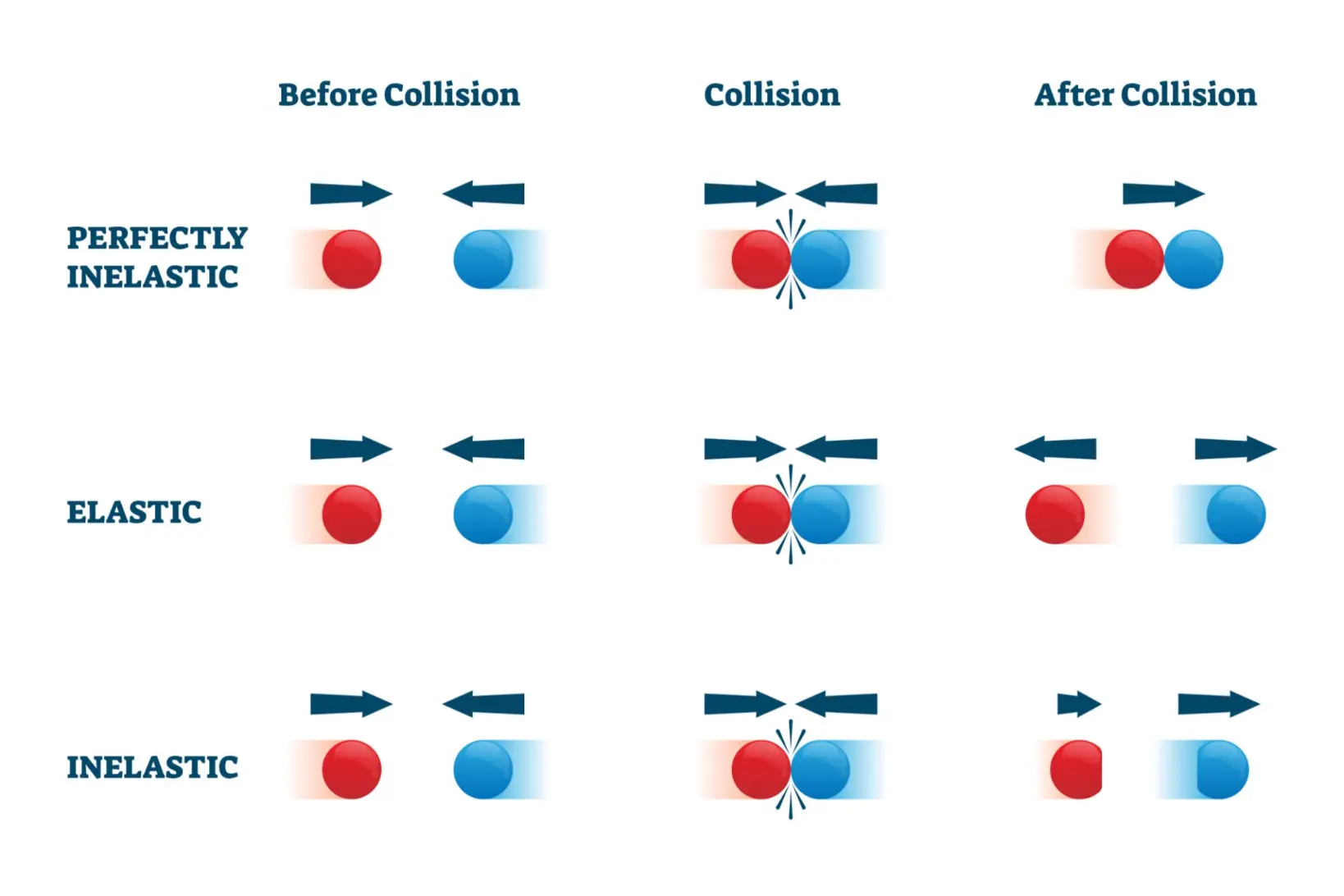
Question 1: During a standardized automotive barrier test, a prototype vehicle impacts a rigid concrete wall. The forward frame deliberately collapses structural members, bringing the car to rest flat against the barrier face. Classify this collision type and map the energy transformation profile.


Conceptual Solution: This event represents a completely inelastic collision because the projectile locked its coordinate matrix directly onto the target rather than rebounding. The original kinetic energy account was not destroyed; it was transformed entirely into non-mechanical work channels: performing plastic structural deformation on the frame members, radiating acoustic energy, and generating localized thermal spikes across the crushed metallic matrix.
A clear physics vector infographic showcasing three types of collisions—perfectly inelastic, elastic, and standard inelastic—split into three distinct visual timeline columns showing states before, during, and after impact.
Mechanics of momentum tracking and object behavior across elastic, inelastic, and perfectly inelastic collision boundaries.

What to Look For in This Illustration:

  • The Perfectly Inelastic Collision (Top Row): Observe how the two independent particles collide and completely lock together. After the impact, they move forward in tandem as a single combined mass matrix with a shared final velocity vector. Kinetic energy loss is at its theoretical maximum here.
  • The Elastic Collision (Middle Row): Watch how the red and blue spheres bounce apart cleanly after impact. The final velocity vectors show the spheres reversing direction completely without any decrease in their speed values. This demonstrates that internal kinetic energy accounts (\(K\)) are 100% preserved.
  • The Standard Inelastic Collision (Bottom Row): Notice the subtle difference in the final stage. The objects still separate and move away independently, but their final vector arrows are dramatically shorter compared to the elastic row. This shorter arrow visualizes the drop in kinetic energy—some of the initial movement budget was lost to thermal deformation during the impact.


3. The Calculus Bridge (University Level)

What is the Exact Calculus Definition of Force in Classical Mechanics?

Force is formally defined as the first time derivative of a system’s linear momentum vector. Rather than an intuitive push or pull, force represents the precise instantaneous rate at which directional linear momentum is transferred across a system boundary per unit time.

In basic physics frameworks, Newton’s Second Law is typically framed as the scalar relationship \(F = ma\). However, acceleration is fundamentally the time derivative of the velocity vector (\(\vec{a} = \frac{d\vec{v}}{dt}\)). By packing the constant mass value directly inside the operator, we reveal a more profound relationship:

$$F = m\frac{dv}{dt} = \frac{d(mv)}{dt}$$

Because linear momentum is explicitly defined as the vector product \(\vec{p} = m\vec{v}\), advanced mechanics establishes force as:

$$F = \frac{dp}{dt}$$

Impulse: Calculating Time-Varying Forces

When analyzing real-world impacts where forces vary continuously across microsecond intervals—such as a structural member buckling or a projectile striking an armor plate—algebraic averages fail. We must integrate the time-dependent force function over the explicit duration of the collision event to determine the net <strong>Impulse</strong>(\(\vec{J}\)), which maps identically to the total momentum update (\(\Delta\vec{p}\)):

$$J = \int_{t_1}^{t_2} F(t) \, dt = \Delta p$$

Geometrically, when plotting the force profile on a time domain graph, the precise area bounded beneath the curve yields the net momentum injected into the system.


Quick Check: Calculus-Based Impulse

Question 1: An analytical model dictates that a volatile localized collision force varies with time according to the expression \(F(t) = 3t^2\). Derive the net momentum change delivered to the target between the interval \(t = 0\) and \(t = 2\) seconds.


Numerical Solution: Because the force function is explicitly time-dependent, we must evaluate the definite integral across the temporal limits:
$$\Delta p = \int_{0}^{2} 3t^2 \, dt = \left[ t^3 \right]_{0}^{2} = (2)^3 – (0)^3 = 8 \text{ kg}\cdot\text{m/s}$$
The system received a net momentum addition of exactly 8 units over the interval.


4. Real-World Applications

Automotive Crumple Zones

Modern vehicles incorporate strategic structural components designed to deform plastically during a crash. By elongating the deceleration time window (\(\Delta t\)), the impulse integral spreads the momentum transfer across a larger timeframe, lowering the peak force vector to protect the cabin occupants.

Aerospace Ion Propulsion

Deep-space spacecraft utilize electromagnetic fields to eject ionized gas particles at ultra-high exhaust velocities. Although the mass flow rate (\(\frac{dm}{dt}\)) is miniscule, the high velocity yields a continuous momentum transfer over extended deployment windows, generating high velocities efficiently.

Ballistic Forensics

Forensic engineers track momentum vectors to reconstruct vehicular accidents and ballistic events. By combining structural mass data with post-impact displacement trajectories and friction metrics, investigators can mathematically backtrack the vectors to determine velocities prior to impact.
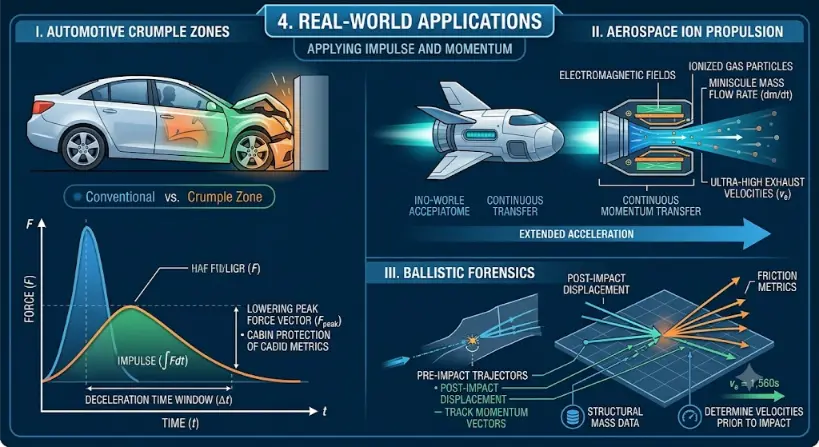

Infographic titled Real-World Applications of Impulse and Momentum divided into three panels: automotive crumple zones with a force-time graph showing lower peak force over a longer time window; aerospace ion propulsion illustrating ionized gas particles ejected via electromagnetic fields; and ballistic forensics showing pre and post-impact trajectory vectors on an isometric grid.
Structural engineering applications of the linear momentum and impulse integrals across automotive, aerospace, and forensic physics domains.

5. Common Misconceptions

Do Elastic Rebounds Generate Less Impact Force Than Dead Stops?

No, a perfectly elastic rebound generates up to double the peak impact force of an inelastic dead stop. Reversing a velocity vector demands a much larger change in momentum (\(\Delta\vec{p} = -2m\vec{v}\)) than simply dropping to zero, requiring a higher net force injection across the interval.

  • The “Elastic Means Less Force” Myth: Students frequently assume that because elastic objects bounce gently, they experience less force than an object hitting a wall and stopping dead. As proven by vector mathematics, an elastic rebound requires a much larger change in momentum (\(\Delta p = -mv – mv = -2mv\)), meaning it experiences up to double the peak force of an inelastic stop.
  • Conservation Under Gravity: Many believe momentum conservation fails if gravity is present. Momentum is always conserved in an isolated system. If gravity acts from outside, it simply means you must expand your system boundaries to include the Earth itself to restore perfect conservation parameters.


Practice Suite: End-of-Chapter Challenges

Apply your conceptual and analytical mechanics toolkits to these textbook-style challenges. Work through each problem independently before toggling the hidden solutions to audit your methodologies.

Category 1: Analytical & Conceptual Challenges

Problem 1: An astronaut floating freely outside a space station discovers her tether has snapped, leaving her static in open space. She happens to be holding a heavy metal multi-tool. How can she utilize this tool to move safely back toward the station door? Unpack the system mechanics.


Conceptual Solution: She must throw the heavy multi-tool directly away from the space station door. Before the throw, the initial momentum account of the isolated system (Astronaut + Tool) is exactly zero. Due to the Conservation of Linear Momentum, the final momentum account must also remain zero. When she exerts a force to push the tool away, the tool gains a momentum vector in that direction. To balance the ledger, the astronaut experiences an equal and opposite momentum vector, causing her to propel backward toward the safety of the station door.

Problem 2: Two objects of unequal mass collide perfectly elastically on a frictionless surface. If they initially approach each other with identical kinetic energies, prove conceptually whether they must rebound with equal velocities.


Conceptual Solution: No, they will not rebound with equal velocities. Because the initial collision preserves both total linear momentum and total mechanical kinetic energy balances perfectly, the velocities are constrained by mass proportions. The lighter object, possessing a lower inertia, will experience a much higher velocity swing to satisfy the dual scalar and vector energy accounts compared to its massive counterpart.

Problem 3: Explain how internal mechanical forces generated during an explosion can accelerate fragments to high speeds without altering the net initial linear momentum vector of the total system.


Conceptual Solution: Internal explosion forces represent standard action-reaction vector pairs according to Newton’s Third Law. While these internal energy releases do massive work accelerating individual structural fragments, their vector forces cancel out completely across the system boundaries. Because no external environmental force vector acts on the architecture, the net system momentum vector remains unchanged throughout the structural breakout.

Problem 4: Define the concept of the Center of Mass velocity (\(\vec{v}_{\text{cm}}\)) of a multi-body collision matrix, and outline why this specific velocity remains perfectly invariant throughout an inelastic collision.


Conceptual Solution: The center of mass velocity tracks the net momentum account of a system divided by its aggregate mass ledger:
$$\vec{v}_{\text{cm}} = \frac{\sum m_i\vec{v}_i}{\sum m_i}$$
Because total linear momentum is perfectly conserved across all impacts regardless of elasticity limits, the numerator remains constant. Since total system mass is also fixed, the center of mass velocity vector remains completely invariant during structural deformations.

Problem 5: Why does a soft canvas safety net protect a falling acrobat from serious injury, whereas hitting a rigid concrete deck from the same height yields catastrophic structural forces?


Conceptual Solution: In both scenarios, the acrobat enters the landing phase with an identical linear momentum change budget (\(\Delta\vec{p}\)), meaning the structural impulse demand (\(\int \vec{F}\,dt\)) is fixed. The soft canvas safety net deforms across a long temporal interval (\(\Delta t\)), distributing the impact matrix across time and lowering the peak force vector to a survivable scale. Concrete offers zero mechanical compliance, compressing the impulse time profile down to milliseconds and generating lethal peak forces.

Category 2: Thought-Provoking Conceptual Challenges

Problem 6: Imagine a heavy rainstorm where massive volumes of water drop vertically down onto a flatbed train moving horizontally along a frictionless track. As water accumulates inside the open train cars, what happens to the horizontal forward speed of the train? Does this violate momentum rules?


Conceptual Solution: The horizontal forward speed of the train will decrease. Because raindrops fall straight down, they contribute zero initial horizontal momentum to the train system. As water gathers in the cars, the net moving mass (\(m\)) of the train increases continuously. Since there are no external horizontal forces acting on the track, the total horizontal linear momentum (\(p = mv\)) must remain perfectly constant. To keep the product of mass and velocity balanced as the mass rises, the forward velocity (\(v\) ) must decrease. This does not violate conservation rules—it is a classic example of an inelastic mass collection event.

Problem 7: A bouncing superball is dropped from rest onto a massive concrete floor. It undergoes a nearly perfect elastic rebound, reversing its velocity vector. A student claims this violates the conservation of momentum because the ball’s momentum vector completely flipped. Audit this claim.


Conceptual Solution: The student’s claim fails because it draws an incomplete system boundary that excludes the planet. When the ball impacts the surface, it transfers linear momentum to the entire Earth. Because the planet’s mass account is practically infinite, its resulting velocity change vector is completely unmeasurable, but mathematically real. Momentum is perfectly conserved across the integrated ball-Earth system boundary.

Problem 8: If two identical gliders collide on a frictionless air track and lock together completely, exactly half of the initial kinetic energy is lost if one was originally stationary. Where does this missing scalar energy account go?


Conceptual Solution: The missing kinetic energy account is not destroyed; it is transformed entirely into non-mechanical structural accounts. The energy performs thermodynamic work to deform the locking mechanism couplings, generates acoustic pressure sound waves that travel outward through the laboratory air matrix, and shifts into molecular thermal kinetic accounts, raising the structural temperature of the gliders.

Problem 9: Can a system possess a non-zero net kinetic energy balance while maintaining a total linear momentum vector of exactly zero? Justify your position with a structural system example.


Conceptual Solution: Yes, absolutely. Consider two identical point masses moving directly toward each other at identical speeds. Because linear momentum is a vector quantity, their opposing directions cancel out entirely, making the net system momentum zero (\((+mv) + (-mv) = 0\)). However, because kinetic energy is a scalar quantity that squares velocity, both individual accounts contribute positive values:
$$K_{\text{net}} = \frac{1}{2}mv^2 + \frac{1}{2}mv^2 = mv^2 > 0$$

Problem 10: A heavy box container falls vertically off a warehouse shelf directly onto a conveyor belt that is actively rolling horizontally at constant speed. Outline the vector momentum updates that occur across this collision sequence.


Conceptual Solution: Upon hitting the moving belt, kinetic friction acts horizontally on the bottom surface of the box, accelerating it forward until its horizontal speed matches the conveyor system. Concurrently, the box exerts an equal negative friction force vector on the belt. To maintain constant speed, the conveyor’s electric motor must draw extra electrical current to balance this negative horizontal momentum injection.

Category 3: Numerical Engineering Applications

Problem 11: A spacecraft module holding a total mass of \(3M\) is drifting across deep space at a constant velocity \(v_0\) along the positive x-axis. Internal charges detonate, splitting the module cleanly into two fragments. Fragment A, with a mass of \(M\), shoots backward along the negative x-axis at a speed of \(2v_0\). Calculate the final velocity vector of Fragment B.


Numerical Solution: Set up the Conservation of Linear Momentum equation: \(p_{\text{initial}} = p_{\text{final}}\). Calculate the initial system momentum account before the explosion:
$$p_{\text{initial}} = (3M)(v_0) = 3Mv_0$$
Define the final fragments’ masses and vectors. Fragment A has mass \(M\) and velocity \(-2v_0\) (negative because it travels backward). Fragment B has a remaining mass of \(3M – M = 2M\), and an unknown velocity \(v_B\):
$$p_{\text{final}} = (M)(-2v_0) + (2M)(v_B) = -2Mv_0 + 2Mv_B$$
Equate the initial and final ledger values together:
$$3Mv_0 = -2Mv_0 + 2Mv_B$$
Add \(2Mv_0\) to both sides to isolate the unknown term, then cancel mass \(M\):
$$5Mv_0 = 2Mv_B \Rightarrow v_B = \frac{5}{2}v_0 = 2.5v_0$$
Fragment B will surge forward along the positive x-axis at exactly <strong>2.5 times the initial speed</strong>.

Problem 12: A particle experiences a highly volatile, time-dependent force inside an accelerator laboratory mapped by the function \(F(t) = 6t – 4\) (Newtons). Calculate the total change in momentum vector experienced by the particle over the time interval from \(t = 1\) second to \(t = 3\) seconds.


Numerical Solution: Because the force vector shifts continuously with time, you must integrate the force function to calculate Impulse:
$$\Delta p = \int_{1}^{3} (6t – 4) \, dt$$
Compute the antiderivative of the function values:
$$\int (6t – 4) \, dt = \left[ 3t^2 – 4t \right]_{1}^{3}$$
Evaluate the definite limits step-by-step:
$$\text{Upper Limit (t = 3): } 3(3)^2 – 4(3) = 27 – 12 = 15$$
$$\text{Lower Limit (t = 1): } 3(1)^2 – 4(1) = 3 – 4 = -1$$
Subtract the lower boundary calculation from the upper boundary calculation:
$$\Delta p = 15 – (-1) = 15 + 1 = 16 \text{ kg}\cdot\text{m/s}$$
The total momentum account of the particle increased by exactly <strong>16 units</strong>.

Problem 13: A \(1500\text{ kg}\) vehicle traveling horizontally east at \(20\text{ m/s}\) enters an intersection and crashes into a \(2500\text{ kg}\) industrial truck traveling straight north at \(12\text{ m/s}\). If the vehicles frame-lock together instantly upon impact, calculate the composite velocity vector magnitude immediately following the crash.


Numerical Solution: Because this is a two-dimensional completely inelastic collision, we set up independent momentum tracking arrays for the x (east) and y (north) coordinate planes.
$$p_x = m_1 v_{1x} = (1500\text{ kg})(20\text{ m/s}) = 30,000\text{ kg}\cdot\text{m/s}$$
$$p_y = m_2 v_{2y} = (2500\text{ kg})(12\text{ m/s}) = 30,000\text{ kg}\cdot\text{m/s}$$
The total aggregate mass of the locked wreckage framework is \(M = 1500 + 2500 = 4000\text{ kg}\). Isolate the post-impact velocity vector components:
$$v_{fx} = \frac{30,000}{4000} = 7.5\text{ m/s}, \quad v_{fy} = \frac{30,000}{4000} = 7.5\text{ m/s}$$
Apply the Pythagorean theorem to evaluate the absolute composite velocity magnitude:
$$v_f = \sqrt{(7.5)^2 + (7.5)^2} = \sqrt{112.5} \approx 10.61\text{ m/s}$$
The composite velocity vector magnitude immediately following the crash is *<strong>10.61 m/s</strong>.

Problem 14: A ballistic pendulum assembly features a \(5.0\text{ kg}\) solid wooden block suspended from ideal massless cords. A \(10\text{ gram}\) (\(0.01\text{ kg}\)) rifle bullet is fired horizontally into the block, embedding itself completely. If the collision forces the block to swing upward to a maximum vertical height of \(0.2\text{ meters}\), calculate the initial velocity of the bullet.


Numerical Solution: Work backward from the maximum swing height using conservation of mechanical energy to find the velocity of the combined assembly immediately after impact:
$$(m+M)gh = \frac{1}{2}(m+M)v_f^2 \Rightarrow v_f = \sqrt{2gh} = \sqrt{2(9.8)(0.2)} = \sqrt{3.92} \approx 1.98\text{ m/s}$$
Now, apply the conservation of linear momentum parameter to link the post-impact speed back to the bullet’s entry velocity:
$$m v_i = (m + M) v_f \Rightarrow (0.01\text{ kg})v_i = (0.01 + 5.0)(1.98\text{ m/s})$$
$$0.01 v_i = 5.01 \cdot 1.98 \Rightarrow 0.01 v_i = 9.9198 \Rightarrow v_i \approx 991.98\text{ m/s}$$
The initial velocity of the bullet is exactly <strong>991.98 m/s</strong>.

Problem 15: A continuous stream of high-pressure cleaning water shoots horizontally from a stationary nozzle at a rate of \(\frac{dm}{dt} = 8.0\text{ kg/s}\) with a fixed velocity of \(25\text{ m/s}\). The jet streams flat against a vertical security wall, dropping vertically down to the ground with zero horizontal rebound. Calculate the continuous force vector exerted by the water stream on the wall surface.


Numerical Solution: Access the calculus-driven definition of force as a momentum transfer gradient:
$$F = \frac{dp}{dt} = \frac{d(mv)}{dt}$$
Because the velocity vector drops uniformly from its forward track down to zero horizontal speed upon hitting the barrier (\(\Delta v = 25\text{ m/s}\)), we evaluate the product:
$$F = v \frac{dm}{dt}$$
Substitute the fixed mass delivery metrics directly into this operational equation:
$$F = (25\text{ m/s}) \cdot (8.0\text{ kg/s}) = 200\text{ Newtons}$$
The continuous force vector exerted by the water stream on the wall surface is exactly <strong>200 Newtons</strong>.


7. Limits of the Classical Model

In classical physics, an object’s mass is treated as a solid, permanent number regardless of how fast it moves. However, as velocities approach the cosmic speed limit—the speed of light (\(c\))—Einstein’s Special Theory of Relativity demonstrates that classical linear momentum calculations break down completely. To calculate correct momentum parameters at relativistic speeds, engineers must introduce the Lorentz factor:

$$p = \frac{mv}{\sqrt{1 – (v^2/c^2)}}$$

At subatomic scales, the wave-particle nature of matter also introduces Heisenberg’s Uncertainty Principle, which states that measuring a particle’s position with infinite precision creates an infinitely large uncertainty in its momentum vector, forcing university physics to drop fixed classical lines in favor of quantum probability functions.


8. Momentum Terms Glossary

  • Linear Momentum (\(p\)): A vector property of a moving body equal to the product of its macroscopic mass and instantaneous velocity vector.
  • Impulse (\(J\)): The total integration of an applied force vector across a specific time duration; corresponds directly to a change in system momentum.
  • Completely Inelastic Collision: An impact event where the maximum possible amount of mechanical kinetic energy is lost, forcing the objects to stick together as one mass.


The Classical Mechanics Matrix

Deepen your understanding of advanced physical systems by exploring how different branches of classical mechanics connect vector preservation laws to continuous macroscopic matter.

Conserved Quantities & Rotation

Analyze vector-based impact interactions via Linear Momentum and Collisions (Current Page), explore rotational conservation laws in Torque and Angular Momentum, or study systemic scalar balance in Work, Energy, and Power.

Newtonian Foundations

Trace the historical roots of force dynamics via the First Law, the foundational Second Law, and action-reaction structures in the Third Law of Motion, all anchored by spatial tracking in Kinematics.

Rigid & Equilibrium States

Unpack complex rotational systems in Rigid-Body Dynamics, track temporal changes using Dynamics, and study non-accelerating structural frames within Statics.

Theoretical & Extended Mechanics

Advance to higher-level domains including the calculus of variations in Analytical Mechanics, bulk matter properties in Continuum Mechanics, liquid/gas physics in Fluid Mechanics, and high-speed transformations via Relativistic Mechanics.

Return to the high-level pillar hub: Classical Mechanics Core Guide.
Last updated: 09 Jul 2026