
What Photons and Quantum States of Light Really Mean
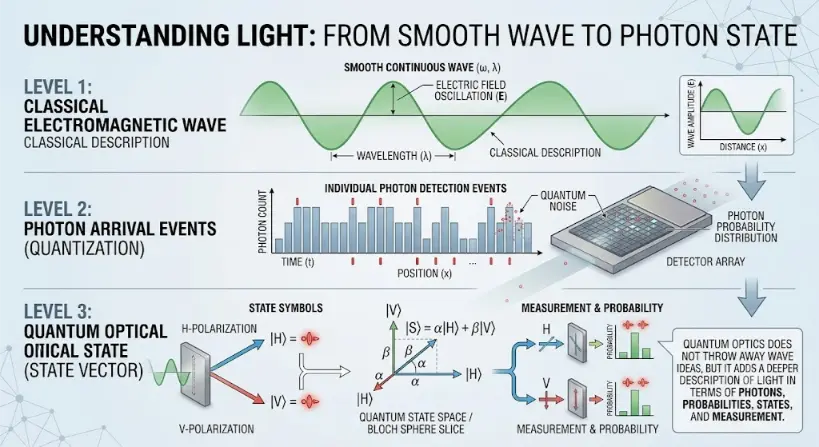
The infographic is organized into three distinct horizontal sections stacked vertically on a clean, light blue technical background accented with subtle geometric network traces.
- Level 1 (Top) — Classical Electromagnetic Wave: This section represents the classical physics perspective. It features a prominent, smooth green sine wave labeled “SMOOTH CONTINUOUS WAVE” propagating along a distance axis. Annotations clearly define the “ELECTRIC FIELD OSCILLATION (E)” and the “WAVELENGTH (lambda)”, framing light as a purely continuous wave phenomenon.
- Level 2 (Middle) — Photon Arrival Events (Quantization): This section introduces the concept of quantization. It features a 3D graphic of a rectangular “DETECTOR ARRAY” catching a light beam. To the left of the array, a blue bar graph maps “INDIVIDUAL PHOTON DETECTION EVENTS” over “TIME (t)” and “POSITION (x)”. Tiny red dots overlaying the bars represent individual photon impacts, illustrating quantum noise and the transition from a smooth wave to discrete particle-like events.
- Level 3 (Bottom) — Quantum Optical State (State Vector): The final section provides the quantum mechanical description using polarization states. On the left, an incoming wave passes through a polarizing beam splitter, dividing into horizontal and vertical components labeled with state symbols for H-Polarization and V-Polarization. The center features a 2D geometric vector graph (“Bloch Sphere Slice”) showing a diagonal superposition state vector (State S equals alpha H plus beta V), with alpha and beta marking the horizontal and vertical probability amplitudes. The right side outlines the measurement process, depicting how the superposition state collapses into definite horizontal or vertical outcomes alongside corresponding probability histograms.
A prominent text box in the lower right summarizes the core educational takeaway: “Quantum optics does not throw away wave ideas, but it adds a deeper description of light in terms of photons, probabilities, states, and measurement.”
The Evolutionary Path: History, Microscopic Collapses, and Next-Gen Paradigms
The Historical Journey
Contemporary Technological Challenges
Future Horizons: Squeezed Light Nodes and On-Chip Vector Engineering
- Quadrature-Squeezed Light Fields: By using specialized non-linear parametric loops, hardware engineers can compress quantum state fluctuations in one field variable (like phase tracking) below the standard vacuum uncertainty limit. This selective noise squeezing allows ultra-precise tracking systems to perform measurement tasks far past the standard diffraction boundaries.
- Monolithic Lithium Niobate Vector Cavities: Industrial chip facilities are transitioning away from bulky bulk optical setups by pattern-etching single-photon emitters directly onto active micro-scale substrates. These compact circuits route localized polarization qubits through integrated Mach-Zehnder channels, allowing developers to execute complex parallel data routing scripts across compact processing matrices.
Photon Energy
| Light Region | Relative Wavelength | Relative Photon Energy | Student-Friendly Meaning |
|---|---|---|---|
| Infrared | Longer than visible light | Lower than visible light | Important in fibre communication, thermal imaging, sensors, and remote controls. |
| Visible red | Longer visible wavelength | Lower visible photon energy | Seen by the eye as red light; common in lasers and indicators. |
| Visible blue | Shorter visible wavelength | Higher visible photon energy | Higher energy per photon than red light. |
| Ultraviolet | Shorter than visible light | Higher than visible light | Can produce stronger interactions with many materials and biological systems. |
Why Photon Energy Is Not the Same as Brightness
Classical Light Versus Quantum Light
| Classical Description | Quantum Description |
|---|---|
| Light is described mainly as an electromagnetic wave. | Light is described using quantum states of the electromagnetic field. |
| Useful for rays, waves, interference, diffraction, and imaging. | Useful for photons, detection events, quantum states, entanglement, and measurement. |
| Intensity can vary smoothly. | Energy exchange can occur in photon-sized packets. |
| Measurement can often be treated as passive observation. | Measurement is part of the physical description and affects what can be known. |
| Good for many everyday optical systems. | Essential for single-photon experiments and quantum technologies. |
What Is a Quantum State?
Polarisation States of a Photon
- \(|H\rangle\) for horizontal polarisation
- \(|V\rangle\) for vertical polarisation
Superposition: More Than Ordinary Mixing
Photon Number States
| State Idea | Meaning | Why It Matters |
|---|---|---|
| Vacuum state | No photons are present in a mode. | Even “empty” quantum fields matter in advanced quantum optics. |
| Single-photon state | One photon is present in a mode. | Central to single-photon experiments and quantum communication. |
| Two-photon state | Two photons are present in a mode or system. | Important in photon-pair experiments and entanglement studies. |
| Many-photon state | Many photons are present. | Can often behave more like classical light, depending on the state. |
Coherent States and Laser Light
Modes of Light
Photon Detection and Measurement
Probability in Quantum Light
Entangled Photon States
Quantum States and Information
Common Quantum States of Light
| State Type | Simple Meaning | Where Students Meet It |
|---|---|---|
| Single-photon state | A state with one photon in a defined mode or set of possible modes. | Single-photon interference, quantum communication, photon counting. |
| Polarisation state | A state describing the photon’s polarisation possibilities. | Polariser experiments, qubits, entangled photon pairs. |
| Path state | A state describing which path or combination of paths a photon can take. | Interferometers and single-photon experiments. |
| Coherent state | A quantum state that closely resembles a classical wave-like field. | Idealised laser light and classical-to-quantum comparisons. |
| Number state | A state with a definite number of photons. | Photon counting and quantum optics theory. |
| Entangled state | A joint state of two or more systems that cannot be described independently. | Bell tests, quantum communication, quantum information science. |
Case Studies: Quantum States of Light in Action
Case Study 1: Single-Photon Interference
Case Study 2: Polarisation Qubits
Case Study 3: Entangled Photon Pairs
Case Study 4: Photon Counting
Connections with Wider Physics and Technology
Light and Optics
Quantum optics grows from the wider study of light, including rays, waves, interference, diffraction, polarisation, and optical instruments.
Wave Optics
Wave optics explains interference, diffraction, phase, coherence, and polarisation, which remain important in quantum light experiments.
Photonics
Photonics uses light in devices and systems, while quantum optics explains the deeper photon-level behaviour behind advanced technologies.
Laser Optics
Laser light often behaves classically at large scales, but it is also described by quantum states of the electromagnetic field.
Modern Physics
Modern relativity and localized state properties explain why light energy is exchanged in discrete packets and why photons rule particle interactions.
Electromagnetic Waves
Photons are quanta of electromagnetic radiation, linking quantum optics with the classical wave picture of electric and magnetic fields.
Learning Pathway Within Quantum Optics
Photons and Quantum States of Light
Current page. Understand photons, photon energy, polarisation states, superposition, number states, coherent states, modes, and measurement outcomes.
Single-Photon Experiments
Explore how single photons reveal wave-particle duality, interference, probability, and the limits of classical thinking.
Quantum Entanglement with Photons
Learn how photon pairs can share quantum states and why entanglement challenges ordinary ideas about separateness.
Quantum Communication
See how quantum states of photons can support secure communication ideas and future quantum networks.
Quantum Measurement and Light
Understand why measurement matters in quantum optics and how detection affects what can be known about light.
Quick Check: Photons and Quantum States of Light
Quick Check: Quantum Light
Common Misunderstandings About Photons and Quantum States
Misunderstanding 1: A Photon Is Just a Tiny Speck of Light
Misunderstanding 2: Superposition Means the Photon Is Just Hidden in One Ordinary State
Misunderstanding 3: Quantum Light Is Always Dim
Misunderstanding 4: Measurement Only Reveals What Was Already There
Misunderstanding 5: Quantum States Are Only Mathematical Tricks
Key Terms
- Coherent state
- A quantum state of light that closely resembles a classical wave-like field, often used to describe idealised laser light.
- Entanglement
- A quantum relationship in which two or more systems share a joint state that cannot be described as independent parts.
- Mode
- A possible field pattern of light, described by properties such as frequency, direction, polarisation, or spatial shape.
- Photon
- A quantum packet of electromagnetic radiation associated with light and other electromagnetic waves.
- Photon counting
- The detection of individual photon events using sensitive detectors.
- Photon number state
- A quantum state with a definite number of photons in a mode.
- Photon energy
- The energy carried by one photon, given by \(E = hf\) or \(E = \frac{hc}{\lambda}\).
- Polarisation state
- A quantum state describing the polarisation possibilities of a photon.
- Probability amplitude
- A quantity used in quantum theory to calculate the probability of a measurement outcome.
- Quantum measurement
- The process by which a quantum system is tested and a specific outcome is obtained.
- Quantum state
- A description of a quantum system that determines possible measurement outcomes and their probabilities.
- Superposition
- A quantum combination of possible states that can produce interference effects.
Review Questions
- What is a photon?Answer: A photon is a quantum packet of electromagnetic radiation. It is associated with light and carries energy determined by its frequency.
- What equation relates photon energy to frequency?Answer: The equation is \(E = hf\), where \(E\) is photon energy, \(h\) is Planck’s constant, and \(f\) is frequency.
- Why does shorter wavelength mean higher photon energy?Answer: Since \(E = \frac{hc}{\lambda}\), photon energy is inversely related to wavelength. A shorter wavelength gives a larger value of \(E\).
- What is a quantum state of light?Answer: A quantum state of light describes what can be predicted about light, including possible measurement outcomes and their probabilities.
- What is a polarisation state?Answer: A polarisation state describes the polarisation possibilities of a photon, such as horizontal, vertical, or a superposition of both.
- What is superposition?Answer: Superposition is a quantum combination of possible states. It can produce interference effects that are not explained by ordinary classical uncertainty.
- Why is photon detection important in quantum optics?Answer: Photon detection reveals individual quantum events and allows experiments to test predictions about quantum states, probabilities, and measurement outcomes.
- How is entanglement related to photon states?Answer: Entanglement occurs when two or more photons share a joint quantum state that cannot be described as separate independent states.
Thought-Provoking Questions
- Why is it useful to describe light as both a wave and as photons?Answer: The wave description explains interference, diffraction, phase, and polarisation. The photon description explains discrete energy exchange, detection events, and quantum states. Quantum optics often needs both perspectives.
- Why does superposition challenge everyday thinking?Answer: Everyday objects usually seem to have definite properties before we look at them. Quantum systems can be described by superpositions of possible outcomes, and measurement plays a role in what is observed.
- Why does a single-photon experiment reveal something deep about nature?Answer: A single photon is detected as one event, yet many single-photon events can build an interference pattern. This shows that quantum behaviour cannot be reduced to ordinary particles alone.
- Why might photons be useful for quantum communication?Answer: Photons can travel through fibres or free space, carry quantum states, and be measured using optical detectors. Their quantum behaviour can be used in secure communication ideas and quantum networks.
- Why should students avoid saying quantum optics is simply “weird”?Answer: Quantum optics may feel unusual, but it is not vague or magical. It is a precise experimental science with mathematical rules and measurable predictions.
Comprehensive Numerical Problems with Solutions
- A photon has frequency 5.0 × 10¹⁴ Hz. Find its energy using the fundamental frequency relation expression, where h = 6.63 × 10⁻³⁴ J s.Solution:Apply the base field equation directly:$$E = hf$$Substitute values:$$E = (6.63 \times 10^{-34}\text{ J}\cdot\text{s}) \times (5.0 \times 10^{14}\text{ Hz}) = 3.315 \times 10^{-19}\text{ J}$$Answer: The isolated photon packet energy is exactly 3.315 × 10⁻¹⁹ J.
- A photon has a vacuum wavelength of 500 nm. Estimate its energy in electron volts using the standard metric conversion constant shortcut.Solution:Apply the electron-volt conversion ratio shortcut formula:$$E(\mathrm{eV}) \approx \frac{1240}{\lambda(\mathrm{nm})}$$Substitute the wavelength parameter directly into the quotient ($\lambda$ = 500 nm):$$E \approx \frac{1240}{500} = 2.48\text{ eV}$$Answer: The photon energy evaluates to exactly 2.48 eV.
- A red light photon has a wavelength of 650 nm, and a violet photon has a wavelength of 400 nm. Determine which spectral packet holds greater total structural energy.Solution:The reciprocal wavelength energy relationship determines:$$E = \frac{hc}{\lambda}$$This demonstrates that photon energy values scale inversely relative to wavelength footprint variables. Because the violet photon presents a shorter wavelength than the red photon (400 nm is less than 650 nm), its calculation yields a higher energy value.Answer: The violet photon possesses greater structural energy.
- A weak particle tracking detector receives a flux of 2.0 × 10⁶ photons per second. If each single photon holds an energy value of 3.0 × 10⁻¹⁹ J, estimate the aggregate optical power reaching the active matrix.Solution:Total continuous power scales as the product of tracking frequency and individual packet packets:$$P = N \cdot E$$Substitute values:$$P = (2.0 \times 10^6\text{ s}^{-1}) \times (3.0 \times 10^{-19}\text{ J}) = 6.0 \times 10^{-13}\text{ W}$$Answer: The absolute optical power reaching the detector is exactly 6.0 × 10⁻¹³ W.
- A quantum channel photon carries a discrete energy metric of 1.55 eV. Estimate its operating wavelength tracking coordinate using the structural inverse quotient rule.Solution:Transpose variables within the conversion constant relationship to isolate the wavelength:$$\lambda(\mathrm{nm}) \approx \frac{1240}{E(\mathrm{eV})}$$Substitute values:$$\lambda \approx \frac{1240}{1.55\text{ eV}} = 800\text{ nm}$$Answer: The target light wavelength coordinate is exactly 800 nm.
External References for Further Reading
- OpenStax University Physics: Wave-Particle Duality — A student-level introduction to the wave and particle behaviour of light and matter.
- OpenStax University Physics: Photon Energy Equations — A useful source for equations such as \(E = hf\).
- NIST: Speed of Light in Vacuum — A reference for the exact value of the speed of light in vacuum.
- The Nobel Prize in Physics 2022: Entangled Photons and Quantum Information — A readable overview of why experiments with entangled photons matter in modern physics.