
What Single-Photon Experiments Really Are
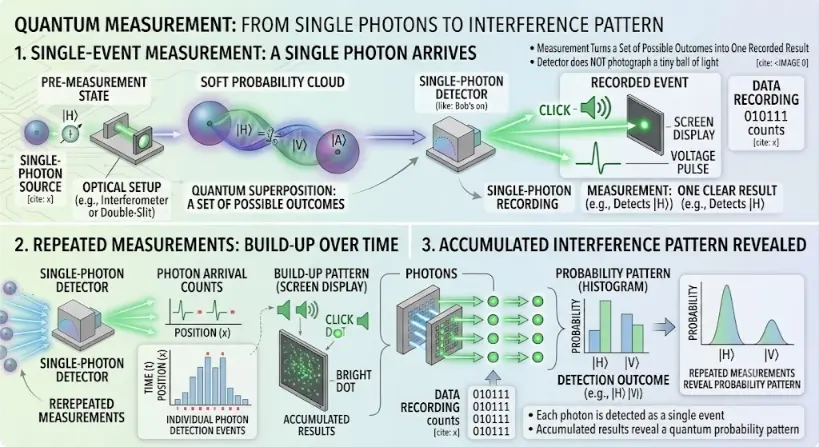
Part 1: SINGLE-EVENT MEASUREMENT: A SINGLE PHOTON ARRIVES
The top panel establishes the behavior of an isolated particle system moving through space:- Source to Setup: On the far left, a “SINGLE-PHOTON SOURCE” releases one light particle into a “PRE-MEASUREMENT STATE”. It passes through an “OPTICAL SETUP (e.g., Interferometer or Double-Slit)”.
- Superposition Wave Packet: While traveling, the photon is visualized as a “SOFT PROBABILITY CLOUD”—a multi-layered wave packet glowing in purple and green containing symbols for ket H, ket V, and ket A, labeled “QUANTUM SUPERPOSITION: A SET OF POSSIBLE OUTCOMES”.
- Isolated Collapse: Upon hitting the “SINGLE-PHOTON DETECTOR”, the probability cloud vanishes and resolves into a single, localized “RECORDED EVENT”. This event is represented by three simultaneous readouts: an audio “CLICK” icon, a sharp green spot on a “SCREEN DISPLAY”, and a discrete “VOLTAGE PULSE” timeline trace. A sidebar explicitly reminds students: “Measurement turns a set of possible outcomes into one recorded result” and “Detector does NOT photograph a tiny ball of light.”
Part 2: REPEATED MEASUREMENTS: BUILD-UP OVER TIME
The lower-left panel explores what happens when the exact same experiment is repeated sequentially over an extended timeline:- Accumulating Dots: Multiple individual photons are sent sequentially through the setup. A timeline graph titled “INDIVIDUAL PHOTON DETECTION EVENTS” tracks arrival coordinates on axes for Position (x) and Time (t).
- The Sensor Matrix: Nearby, a small display labeled “ACCUMULATED RESULTS” shows individual green impact dots scattering randomly across a black screen matrix, proving that individual impact points cannot be predicted with absolute certainty.
Part 3: ACCUMULATED INTERFERENCE PATTERN REVEALED
The final, lower-right panel shows the grand statistical conclusion of quantum mechanics:- Emergent Ordering: As thousands of photons accumulate through a large “DETECTOR ARRAY”, the seemingly random dots form distinct, parallel vertical bands.
- Mathematical Distribution: This physical pattern is verified by a “PROBABILITY PATTERN (HISTOGRAM)” bar graph and a final smooth, fluctuating wave plot labeled “REPEATED MEASUREMENTS REVEAL PROBABILITY PATTERN” showing high-probability peaks (constructive interference) and low-probability troughs (destructive interference).
- Takeaway Summary: A summary box in the bottom right wraps up the core lesson with two final points:
- Each photon is detected as a single event.
- Accumulated results reveal a quantum probability pattern.
The Evolutionary Path: History, Particle Hurdles, and Foundry Foundations
The Historical Journey
Contemporary Scientific Challenges
Future Horizons: Quantum Dots and Integrated Nanophotonics
- On-Demand Semiconductor Quantum Dots: To replace random down-conversion crystals, industrial foundries are fabricating single indium-arsenide quantum dots inside microscopic optical cavities. When triggered by a fast electrical pulse, these artificial atoms release a single photon with near 100% purity and high indistinguishability, providing a scalable source for hardware processors.
- Lithium Niobate Nanophotonic Matrices: Bypassing bulky free-space alignment benches, modern laboratories are pattern-etching waveguides, micro-ring resonators, and superconducting nanowire detectors directly onto single lithium niobate wafers. These integrated chips guide, modulate, and count single photons inside a tiny footprint, establishing the structural foundation for quantum key distribution.
Why Single Photons Matter
Weak Light Is Not Always the Same as Single-Photon Light
Basic Parts of a Single-Photon Experiment
| Part of Experiment | Main Role | Student-Friendly Meaning |
|---|---|---|
| Photon source | Produces very weak light, heralded photons, or controlled single photons | The beginning of the quantum light signal |
| Optical elements | Guide, split, reflect, filter, or polarise the photon state | The path and test setup for the photon |
| Interferometer or slit system | Allows different paths or alternatives to combine | The place where wave-like probability effects appear |
| Single-photon detector | Registers individual photon events | The device that produces “clicks” |
| Timing electronics | Records when events occur | The clock and counting system |
| Data analysis | Builds patterns from many events | The step that reveals the probability distribution |
Photon Sources
Single-Photon Detectors
The Single-Photon Double-Slit Experiment
Interference One Photon at a Time
Which-Path Information
Mach-Zehnder Interferometer Experiments
Beam Splitters and Probability
Photon Antibunching
Quantum Eraser Ideas
What Single-Photon Experiments Teach
Detection Is Discrete
A photon is detected as a single event, not as a small continuous smear of energy across the detector.
Patterns Are Probabilistic
Individual detection events may not be predictable, but many repeated events can form a precise probability pattern.
Interference Can Survive One Photon at a Time
Interference does not require many photons meeting each other. It can arise from the quantum amplitudes of one photon’s alternatives.
Measurement Matters
The experimental arrangement determines which properties can be observed and whether interference conditions are preserved.
Classical Pictures Have Limits
Neither the simple particle picture nor the simple classical wave picture fully captures single-photon behaviour.
Quantum Technology Depends on Control
Quantum communication, entanglement experiments, and quantum networks require reliable sources, detectors, and optical control.
Experimental Challenges
| Challenge | Why It Matters | Student-Friendly Meaning |
|---|---|---|
| Background light | Unwanted photons may imitate or obscure real events | The experiment must be kept optically clean |
| Detector efficiency | Some photons may not be detected | A missing click does not always mean no photon arrived |
| Dark counts | Detectors may sometimes click without an intended photon | The detector has its own noise |
| Timing jitter | Detection time has uncertainty | The clock is not infinitely precise |
| Alignment | Small optical errors can destroy the expected pattern | Quantum optics needs careful geometry |
| Statistical repetition | Many events are needed to see probability patterns | One photon is not enough to reveal the full pattern |
Case Studies: Single-Photon Experiments in Action
Case Study 1: Single-Photon Double-Slit Pattern
Case Study 2: Mach-Zehnder Interferometer
Case Study 3: Testing a Single-Photon Source
Case Study 4: Single Photons in Quantum Communication
Connections with Wider Physics and Technology
Light and Optics
Single-photon experiments grow from the wider study of light, including reflection, interference, diffraction, polarisation, and optical instruments.
Wave Optics
Interference, phase, diffraction, coherence, and superposition of wave patterns help students understand the experimental background.
Photonics
Photonics provides the devices and systems used to generate, guide, modulate, and detect light in practical experiments.
Laser Optics
Lasers and optical components often support the preparation, alignment, and control of experimental light fields.
Modern Physics
The mathematical language of operators, wavefunctions, and matrix math rules how single light packets evolve across a target coordinate track.
Electromagnetic Waves
Photons are quanta of electromagnetic radiation, linking quantum events with the classical field description of light.
Learning Pathway Within Quantum Optics
Photons and Quantum States of Light
Understand photons, photon energy, polarisation states, superposition, number states, coherent states, modes, and measurement outcomes.
Single-Photon Experiments
Current page. Explore how one-photon-at-a-time experiments reveal interference, probability, which-path information, and the limits of classical pictures.
Quantum Entanglement with Photons
Learn how photon pairs can share quantum states and why entanglement challenges ordinary ideas about separateness and independence.
Quantum Communication
See how quantum states of photons can support secure communication ideas and future quantum networks.
Quantum Measurement and Light
Understand why measurement matters in quantum optics and how detection affects what can be known about light.
Quick Check: Single-Photon Experiments
Quick Check: One Photon at a Time
Common Misunderstandings About Single-Photon Experiments
Misunderstanding 1: A Photon Is Just a Tiny Ball Passing Through One Slit
Misunderstanding 2: Interference Requires Many Photons to Meet Each Other
Misunderstanding 3: Weak Light Automatically Means Single Photons
Misunderstanding 4: Measurement Means a Human Must Look
Misunderstanding 5: Quantum Eraser Experiments Send Messages Backward in Time
Key Terms
- Antibunching
- A non-classical photon-arrival pattern in which simultaneous photon detections are reduced.
- Beam splitter
- An optical component that creates different possible output paths for light.
- Coincidence counting
- A method of identifying related photon events by comparing detections within a chosen time window.
- Dark count
- A detector count that occurs even without an intended incoming photon due to random thermal noise inside the tracking substrate.
- Detection event
- A recorded click, pulse, dot, or signal caused by a photon being detected.
- Heralded photon
- A photon whose presence is inferred from the detection of a partner photon produced in the same event.
- Interference
- The strengthening or weakening of probability patterns due to the combination of quantum amplitudes.
- Mach-Zehnder interferometer
- An optical setup using beam splitters and mirrors to create and recombine two path alternatives.
- Photon source
- A device or process used to produce photons for an experiment.
- Probability amplitude
- A quantum quantity whose magnitude and phase help determine measurement probabilities.
- Quantum eraser
- An experiment showing how interference depends on whether path information remains distinguishable in the final measurement arrangement.
- Single-photon detector
- A detector capable of registering individual photon events.
- Single-photon experiment
- An experiment designed to study light at the level of individual photon events.
- Timing jitter
- The internal temporal uncertainty that limits the exact time recorded for a single particle click.
- Which-path information
- Information that allows the path or alternative taken by a photon to be distinguished.
Review Questions
- What is a single-photon experiment?Answer: It is an experiment designed to study light at the level of individual photon events rather than as a continuous classical beam.
- Why is a weak light beam not always the same as a single-photon source?Answer: A weak beam may have a low average photon number, but it can still sometimes contain zero, one, or more than one photon in a short time interval.
- What does the single-photon double-slit experiment show?Answer: It shows that photons are detected as individual events, yet many events can build an interference pattern that reveals wave-like quantum probability behaviour.
- What is which-path information?Answer: Which-path information is information that makes it possible to distinguish which path or alternative a photon took in an experiment.
- What happens to interference when path alternatives become distinguishable?Answer: The interference pattern can disappear because the alternatives no longer combine in the same way.
- What role does a beam splitter play in a single-photon experiment?Answer: It creates different possible output paths for the photon’s quantum state. It does not divide the photon into two smaller pieces.
- Why are single-photon detectors imperfect?Answer: Real detectors may miss photons, produce dark counts, have timing uncertainty, and require careful calibration and shielding.
- Why are single-photon experiments important for quantum communication?Answer: Quantum communication often depends on encoding and detecting quantum states of individual photons or very weak optical signals.
Thought-Provoking Questions
- Why does a single-photon interference pattern challenge the idea that a photon is just a tiny particle?Answer: A tiny classical particle would be expected to pass through one path and build a simple particle distribution. Single-photon interference shows that quantum probability amplitudes associated with alternatives can shape the final pattern.
- Why does measurement matter in quantum optics?Answer: The measurement arrangement determines which information becomes available. If the setup reveals path information, it can change whether interference is observed.
- Why is it not enough to perform a single trial in a quantum experiment?Answer: One detection event does not reveal the full probability pattern. Quantum predictions are usually tested by repeating the experiment many times and comparing the statistical distribution with theory.
- Why should students avoid sensational explanations of quantum eraser experiments?Answer: Quantum eraser experiments are subtle, but they do not allow time travel or mind-controlled reality. They show how distinguishability, measurement, and correlations affect observed statistical patterns.
- How do single-photon experiments show the partnership between theory and instrumentation?Answer: Quantum theory predicts probability patterns, but experiments require sources, detectors, timing electronics, alignment, shielding, and data analysis to reveal those patterns.
Comprehensive Numerical Problems with Solutions
- A high-speed single-photon detector records 2.0 × 10⁵ photon counts over an active measurement timeline of 10 s. Calculate the average count rate.Solution:Use the standard particle registration rate expression:$$\text{Count Rate} = \frac{\text{Total Counts}}{\text{Time}}$$Substitute values straight into the equation:$$\text{Count Rate} = \frac{2.0 \times 10^5}{10\text{ s}} = 2.0 \times 10^4\text{ s}^{-1}$$Answer: The average particle count rate balances at exactly 2.0 × 10⁴ counts s−1.
- A light packet propagates with an operating wavelength tracker value of 700 nm. Estimate its localized energy in electron volts using the standard energy quotient shortcut.Solution:Apply the electron-volt shortcut index formula:$$E(\mathrm{eV}) \approx \frac{1240}{\lambda(\mathrm{nm})}$$Substitute the tracking wavelength ($\lambda$ = 700 nm):$$E \approx \frac{1240}{700} \approx 1.7714\text{ eV}$$Answer: The calculated single photon packet energy evaluates to approximately 1.77 eV.
- A single-photon avalanche detector presents an operational efficiency rating of 60%. If exactly 1000 single photons strike the active array area, calculate how many detections are expected on average.Solution:The expected total counts represent the product of total incident particles and collection efficiency fractions:$$\text{Expected Detections} = \text{Efficiency} \times \text{Incident Photons}$$$$\text{Expected Detections} = 0.60 \times 1000 = 600$$Answer: Exactly 600 single particle counts are expected to accumulate on average.
- A photon sensor yields a background dark count rate of 50 counts s−1. How many fake clicks are expected to stack up during a 20 s testing block?Solution:Cumulative noise clicks equal the product of the background dark click frequency and total timeframe parameters:$$\text{Dark Counts} = \text{Rate} \times \text{Time}$$$$\text{Dark Counts} = 50\text{ s}^{-1} \times 20\text{ s} = 1000$$Answer: Exactly 1000 noise dark counts are expected to build up across the logger.
- A balanced 50:50 beam splitter routes a single photon to detector A with a probability of 0.5 and detector B with a probability of 0.5. If this single particle experiment run is repeated 2000 times sequentially, how many counts are expected at detector A on average?Solution:Multiply the specific channel route probability index by the total number of experimental repetitions:$$\text{Expected Counts}_A = \text{Probability} \times \text{Total Trials}$$$$\text{Expected Counts}_A = 0.5 \times 2000 = 1000$$Answer: Exactly 1000 particle counts are expected to trigger at detector A.
- An optical nanophotonic track monitor captures 4800 raw signals alongside 300 background noise events. Estimate the true corrected signal count.Solution:Isolate the true signal metrics by subtracting the structural background noise block from raw parameters:$$\text{Corrected Signal} = \text{Raw Signals} – \text{Background Events}$$$$\text{Corrected Signal} = 4800 – 300 = 4500$$Answer: The true corrected data signal count scales to precisely 4500.
External References for Further Reading
- OpenStax University Physics: Wave-Particle Duality — A student-level introduction to the wave and particle behaviour of light and matter.
- OpenStax College Physics: The Particle-Wave Duality — A useful explanation of quantum interference and particle-wave behaviour.
- NIST: Single Photonics and Quantum Information — A standards-focused overview of single-photon technologies and quantum information research.
- NIST: Single-Photon Detectors — A reference on detector performance, efficiency, timing, and applications in quantum networks.