
Quantum measurement is one of the most important ideas in quantum optics because light is often known through what detectors record. A photon may be prepared in a quantum state, pass through optical components, and finally produce a click, a current pulse, a spot on a sensor, or a recorded timing event. The measurement is not just a passive act of looking. It helps define what question is being asked of the quantum system.
This page introduces Quantum Measurement and Light in a student-friendly way. It belongs to the wider Quantum Optics cluster, which functions as a structural core inside the broader field of physical science.
The goal is not to make quantum measurement sound mysterious for its own sake. The goal is to help students understand why measurement, probability, detection, disturbance, and experimental arrangement are central to the way quantum light behaves.
What Quantum Measurement and Light Really Means
In everyday life, measurement often seems simple. If we measure the length of a table, we assume the table already had that length before we measured it. The measuring tool merely reveals a property that was already there.
Quantum measurement is more subtle. In quantum optics, a measurement does not always reveal a simple pre-existing classical value. Instead, the measurement setup determines which property is being tested, and the result is one outcome from a set of possible outcomes predicted by the quantum state.
For light, this may involve measuring polarisation, photon number, path, arrival time, energy, phase-related behaviour, or correlations between photons. The way the experiment is arranged affects what can be observed.
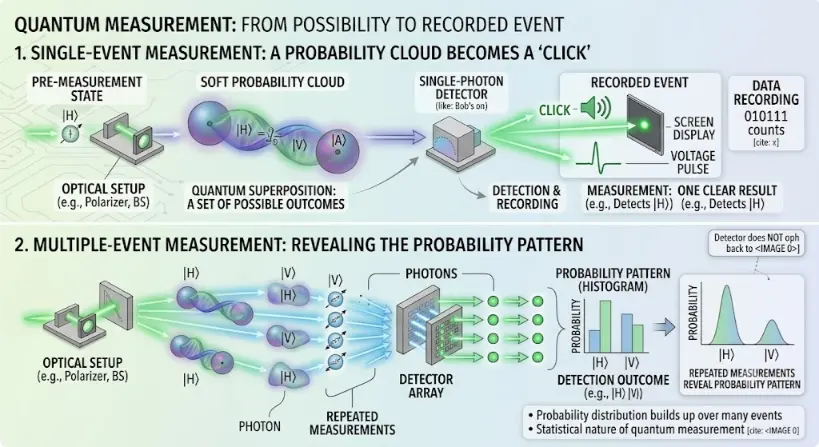
The image is a comprehensive multi-panel scientific infographic titled “QUANTUM MEASUREMENT: FROM POSSIBILITY TO RECORDED EVENT”. The visualization uses detailed schematic diagrams, soft glow effects, and clear sans-serif fonts against a patterned technological background. The illustration is structured into two primary vertical sections, contrasting single-event measurement with the results of repeated measurements.
Part 1: SINGLE-EVENT MEASUREMENT: A PROBABILITY CLOUD BECOMES A ‘CLICK’
This upper panel details the transition of a single photon from a quantum state to a discrete measurement result:- Pre-Measurement State: On the upper left, a single photon travels from a ‘Pre-Measurement State’ labeled |H⟩, through an ‘OPTICAL SETUP (e.g., Polarizer, BS)’. Crucially, before measurement, the photon is visualized as a soft probability cloud—a translucent, multi-layered indigo and green glow containing embedded superposition symbols like ket H and ket V, explicitly labeled ‘QUANTUM SUPERPOSITION: A SET OF POSSIBLE OUTCOMES’.
- Measurement and Recording: Arrows trace its path to a ‘SINGLE-PHOTON DETECTOR’ labeled as ‘Detection & Recording’. At the detector interface, the visualization changes abruptly. From the detector, a single, sharp green ‘RECORDED EVENT’ is emitted, featuring three grouped icons labeled ‘MEASUREMENT: ONE CLEAR RESULT (e.g., Detects |H⟩)’:
- A green ‘CLICK’ sound wave icon.
- A single green bright dot on a small ‘SCREEN DISPLAY’.
- A single ‘VOLTAGE PULSE’ waveform.
- Data Logging: Adjacent data recording blocks show binary data logs (e.g., ‘010111 counts’) and text explicitly states: ‘Measurement Turns a Set of Possible Outcomes into One Recorded Result’ and ‘Detector does NOT photograph a tiny ball of light’.
Part 2: MULTIPLE-EVENT MEASUREMENT: REVEALING THE PROBABILITY PATTERN
This lower panel illustrates how repeated measurements build a statistical description of the system:- Repeated Process: Labeled ‘REPEATED MEASUREMENTS’, this section shows an identical ‘OPTICAL SETUP’. Many individual photons, each visualized as a pre-measurement probability cloud, are sent through the setup toward a ‘DETECTOR ARRAY’.
- Statistical Building: The detectors record many individual clicks, dots, and pulses. These events build up statistically. Callout plots visualize this with two distinct graphs:
- ‘PROBABILITY PATTERN (HISTOGRAM)’: A bar chart showing ‘PROBABILITY’ over ‘DETECTION OUTCOME (e.g., |H⟩, |V⟩)’, with labels indicating H vs. V results.
- A smooth, continuous ‘PROBABILITY’ curve plot labeled ‘REPEATED MEASUREMENTS REVEAL PROBABILITY PATTERN’.
- Key Conclusions: Bullet points in the lower right conclude: ‘Probability distribution builds up over many events’ and ‘Statistical nature of quantum measurement’. The entire image has a clean, diagrammatic quality.
The Evolutionary Path: History, System Disturbance, and Foundry Paradigms
The shift from standard intensity detection to quantum state reconstruction required re-engineering measurement boundaries from passive checking loops into active field projections.
The Historical Journey
The basic logic governing optical state collapse was mapped out during the 1920s through the statistical formulations of Max Born and the uncertainty relationships developed by Werner Heisenberg. However, modern quantum optical measurement transitioned into an experimental technology platform during the 1980s. Key milestones emerged when material foundries developed the first high-efficiency silicon single-photon avalanche diodes (SPADs) and ultra-low-noise balanced homodyne detection loops. These developments allowed physicists to move beyond reading average beam powers to tracking individual photon collision footprints, leading directly to the mid-1990s development of optical quantum tomography—the mathematical reconstruction of an unmeasured light field’s complete density matrix.
Contemporary Technical Hurdles
The absolute engineering challenge in managing single-photon tracking systems is minimizing **backaction and detector noise parameters**. Every physical interaction with an incoming photon causes system disturbance. In standard semiconductor single-photon tracking, an incoming packet collapses into an avalanche of current that destroys the photon entirely. Furthermore, random thermal fluctuations within the receiver substrate trigger fake current pulses known as **dark counts**. This noise hides fragile quantum data fields, requiring engineers to house high-precision tracking setups inside heavy cryostats cooled near absolute zero to minimize thermal dark clicks.
Future Paradigms: Quantum Non-Demolition and Superconducting Arrays
Next-generation hardware configurations bypass classical collection boundaries by constructing non-destructive optical cavities and high-density material tracks:
- Quantum Non-Demolition (QND) Tracking Loops: To track a photon packet without absorbing or destroying its structural state, researchers are developing QND interfaces. By passing a flying photon near an ultra-high-finesse cavity containing a trapped atom, the photon’s field shifts the atomic phase parameter without losing energy, letting developers check quantum bits multiple times along a shared data rail.
- Superconducting Nanowire Single-Photon Arrays: Foundries are scaling processing rates past old silicon dead-time boundaries by pattern-etching ultra-thin circuits out of superconducting materials like niobium nitride. When a single photon hits the chilled wire, it creates a localized hot spot that temporarily breaks superconductivity, generating an instant voltage tracking spike with sub-nanosecond recovery windows.
Why Measurement Matters in Quantum Optics
Quantum optics studies light at a level where individual photons, quantum states, and measurement outcomes matter. At this level, a detector is not just an accessory. It is part of the experiment’s meaning.
A polarisation analyser asks a polarisation question. A path detector asks which route the photon took. A photon counter asks how many photons arrived. A timing detector asks when a photon arrived. Each measurement arrangement selects a particular kind of information.
| Measurement Question | Possible Device or Setup | What It Tests |
|---|---|---|
| What is the photon’s polarisation? | Polariser and detector | Polarisation state relative to a chosen basis |
| Which path was taken? | Path detector or marked optical route | Distinguishability of alternatives |
| How many photons arrived? | Photon counter or photon-number-resolving detector | Photon number information |
| When did the photon arrive? | Timing electronics and single-photon detector | Arrival time and coincidence timing |
| Are two photons correlated? | Two detectors and coincidence counting | Joint measurement statistics |
| Is interference visible? | Interferometer and detector pattern | Phase-related probability amplitudes |
The Quantum State Before Measurement
A quantum state describes what can be predicted about a system before measurement. It does not always tell us one definite classical story. Instead, it gives rules for calculating possible outcomes and their probabilities.
For example, a photon’s polarisation state may be written as:
$$|\psi\rangle = a|H\rangle + b|V\rangle$$
Here, \(|H\rangle\) represents horizontal polarisation, \(|V\rangle\) represents vertical polarisation, and a and b are probability amplitudes. If the photon is measured in the horizontal-vertical basis, the probabilities are related to \(|a|^2\) and \(|b|^2\).
For a properly normalised state:
$$|a|^2 + |b|^2 = 1$$
This means the total probability of all possible outcomes must add to 1.
The Born Rule: From Amplitudes to Probabilities
The Born rule is one of the central rules of quantum mechanics. It tells us how to turn probability amplitudes into measurement probabilities.
If a photon state is written as:
$$|\psi\rangle = a|H\rangle + b|V\rangle$$
then the probability of measuring horizontal polarisation is:
$$P(H) = |a|^2$$
and the probability of measuring vertical polarisation is:
$$P(V) = |b|^2$$
This is one reason quantum physics is both strange and precise. It may not predict the exact result of one individual measurement in every case, but it predicts the statistical pattern of many repeated measurements with great accuracy.
Individual Outcomes and Statistical Patterns
A single measurement gives one result. A detector clicks here, not there. A photon is recorded in one output channel, not another. One polarisation result is obtained, not all possible results at once.
However, one result is not enough to reveal the full quantum pattern. To test the quantum state, the experiment must often be repeated many times under the same preparation conditions. The collection of outcomes then reveals the probability distribution predicted by the state.
This is why quantum optics often looks like careful counting. Researchers may count detections, coincidences, error rates, arrival times, or correlations. The meaning appears in the pattern of many events.
Measurement Basis
A measurement basis is the set of alternatives used in a measurement. For polarisation, one basis may be horizontal and vertical. Another basis may be diagonal and anti-diagonal. A photon that has a definite-looking state in one basis may be a superposition in another basis.
| Measurement Basis | Possible Outcomes | Student-Friendly Meaning |
|---|---|---|
| Horizontal-vertical basis | \(|H\rangle\) or \(|V\rangle\) | Ask whether the photon is horizontal or vertical |
| Diagonal basis | \(|D\rangle\) or \(|A\rangle\) | Ask whether the photon matches one diagonal direction or the other |
| Path basis | Path 1 or Path 2 | Ask which route the photon is detected in |
| Time-bin basis | Early or late | Ask which timing alternative is recorded |
The choice of basis matters because quantum states are not just lists of fixed answers for every possible question. The question asked by the measurement changes the kind of answer that can be obtained.
Polarisation Measurement Example
Suppose a photon is prepared in diagonal polarisation and then measured using a horizontal-vertical polariser. The result may be horizontal or vertical, with probabilities determined by the quantum state.
If many identically prepared photons are measured, the detector counts may show an approximately balanced pattern. This does not mean each photon was secretly half horizontal and half vertical. It means the measurement basis and the prepared state together determine the probabilities of the outcomes.
This example is useful because it shows how quantum measurement differs from ordinary classification. The result depends not only on the photon, but also on how the measurement is set up.
Measurement and Disturbance
Measuring a quantum system can change what can be known about it afterward. In quantum optics, a photon measurement may absorb the photon, redirect it, project it into a particular state, or destroy the interference conditions that existed before the measurement.
This does not mean every measurement is violent or dramatic. It means measurement is a physical interaction, not an abstract act of awareness. A detector, polariser, beam splitter, or optical component changes the experimental situation.
This idea is especially important in quantum communication. If an unknown quantum state is measured in the wrong basis, the measurement may introduce errors that can later be detected statistically.
Which-Path Measurement and Interference
One of the clearest examples of measurement changing what is observed is the relationship between which-path information and interference.
In a single-photon double-slit or interferometer experiment, interference can appear when the alternatives remain indistinguishable. If the setup records which path the photon took, the interference pattern can disappear.
This does not require a person to consciously watch the photon. The key issue is whether the physical arrangement preserves or destroys the distinguishability of the alternatives. If path information exists in the system, the interference conditions are changed.
Complementarity
Complementarity is the idea that certain kinds of information cannot be fully revealed at the same time in the same experimental arrangement. For example, an experiment may reveal interference behaviour or which-path information, but not both in a complete classical way.
This is not simply a limitation of poor instruments. It reflects the structure of quantum measurement. The experimental arrangement determines what kind of property can be meaningfully tested.
For students, complementarity is a reminder that quantum systems are not ordinary objects with all classical properties waiting to be read at once.
Detection Events
In many quantum optics experiments, the measurement result is a detection event. A single-photon detector may produce an electrical pulse. A camera sensor may record a spot. A timing system may record the arrival time of a photon.
A detection event is local and definite. However, the probability of where and when events appear is shaped by the quantum state and the experimental arrangement. This is why a single-photon interference experiment can produce individual dots that slowly build into a wave-like pattern.
The detector records the event. The full experiment explains the pattern.
Single-Photon Detectors and Their Limits
Single-photon detectors are essential tools in quantum optics. They are designed to register extremely weak light signals, sometimes at the level of individual photons.
Real detectors are not perfect. They may miss some photons. They may produce dark counts. They may have timing uncertainty. They may respond differently at different wavelengths. They may also saturate if too much light arrives.
| Detector Feature | Meaning | Why It Matters |
|---|---|---|
| Detection efficiency | Fraction of arriving photons that are recorded | Higher efficiency gives more reliable counting |
| Dark count rate | Counts recorded without intended photons | Noise can imitate real events |
| Timing jitter | Uncertainty in recorded arrival time | Important for coincidence measurements |
| Wavelength range | Range of light the detector responds to | The detector must match the photons being measured |
| Dead time | Recovery time after a detection event | Can limit how quickly events can be counted |
| Saturation | Detector overwhelmed by too many photons | A detector designed for single photons may not measure bright beams well |
Projective Measurement
A projective measurement is a common idealised model of quantum measurement. In this picture, measuring a quantum system gives one of the allowed outcomes and leaves the system in the state associated with that outcome, if the system remains available after measurement.
For example, if a photon is measured and found to be horizontally polarised, a later measurement in the same basis would be expected to give the same result, provided the photon has not been absorbed or otherwise changed.
This ideal model is useful for learning, but real optical measurements may involve loss, imperfect detectors, noise, partial measurement, or more complex device behaviour.
Weak Measurement
Weak measurement is an advanced idea in quantum measurement. It refers to measurements that extract only a small amount of information from a quantum system while disturbing it less strongly than an ordinary projective measurement.
Weak measurements require careful interpretation. They do not allow students to bypass quantum rules, and they do not reveal all hidden classical properties. They are specialised tools used in advanced experiments to study subtle aspects of quantum systems.
At this level, students only need the broad idea: not all measurements are equally strong, and the amount of information gained is linked with how the quantum system is affected.
Decoherence
Decoherence occurs when a quantum system becomes entangled with its environment in a way that makes quantum interference difficult or impossible to observe locally. In practical terms, the system begins to behave more classically because phase relationships become inaccessible.
For light, decoherence can arise when unwanted interactions reveal path information, polarisation information, timing information, or environmental correlations. It is one reason quantum experiments require careful isolation and control.
Decoherence helps explain why quantum effects are often delicate. The quantum state must remain coherent enough for interference, entanglement, or superposition effects to be observed.
Quantum Measurement and Entanglement
Entangled photons make measurement especially interesting. Two photons may share a joint quantum state. When each photon is measured, the separate outcomes may look individually random, but the correlations between the outcomes can match quantum predictions.
This does not mean one detector sends a usable signal to the other detector faster than light. The correlations become visible only after the results are compared through ordinary communication.
This is why entanglement experiments require coincidence counting, timing systems, basis choices, and statistical analysis. The meaning lies not in one detection event, but in the pattern across many paired events.
Quantum Measurement in Communication
In quantum communication, measurement is part of the security and information process. A receiver may measure photon states in selected bases. The sender and receiver may later compare basis choices, estimate error rates, and decide whether the channel appears disturbed.
If an eavesdropper measures unknown quantum states, the act of measurement can introduce errors in suitable protocols. This makes measurement disturbance a useful physical idea in quantum key distribution.
However, real security still depends on implementation. Devices, software, authentication, detector behaviour, side channels, and user practice must all be designed carefully.
What Quantum Measurement Teaches
Quantum measurement teaches students that information in physics is not only about what exists, but also about how something is tested. The experiment does not merely collect answers. It defines the question.
Measurement Selects a Question
A polarisation measurement, path measurement, photon-counting measurement, and timing measurement ask different questions about light.Outcomes Can Be Probabilistic
The quantum state may predict probabilities rather than one guaranteed result for every individual measurement.Many Events Reveal the Pattern
A single detection event gives one result, while many repeated measurements reveal the statistical structure of the quantum state.Distinguishability Affects Interference
If the experiment reveals which alternative occurred, interference can disappear.Detectors Are Part of the Physics
Detector efficiency, dark counts, timing uncertainty, and wavelength response affect what is actually measured.Quantum Information Is Physical
Measurement, disturbance, no-cloning, and detection show that information is constrained by physical law.Case Studies: Quantum Measurement and Light in Action
Case Study 1: Polarisation Measurement
A photon is prepared in one polarisation state and then measured with a polariser set to a chosen angle. The detector records whether the photon passes or is blocked, or which output channel receives it.
This case study shows that the measurement basis matters. A photon prepared in one basis may give probabilistic results when measured in another basis.
Case Study 2: Single-Photon Interference
A single photon passes through an interferometer. If the path alternatives remain indistinguishable, the detection probabilities can show interference. If path information is recorded, the interference can disappear.
This case study shows how measurement and distinguishability affect the pattern of outcomes.
Case Study 3: Photon Counting
A detector records individual photon arrivals over time. The experiment may measure count rate, dark counts, timing, or photon-number statistics.
This case study shows that quantum optics often depends on careful counting and statistical interpretation rather than on watching a photon follow a visible path.
Case Study 4: Entangled Photon Correlations
Two entangled photons travel to separate detectors. Each detector records local outcomes. The individual results may appear random, but when the data sets are compared, strong correlations can appear.
This case study shows why quantum measurement is central to entanglement. The joint pattern reveals the quantum state more clearly than any single result.
Case Study 5: Quantum Key Distribution
In a quantum key distribution system, the receiver measures photon states and later compares selected information with the sender. If the error rate is too high, the system may have been disturbed or may be too noisy for reliable key generation.
This case study shows how measurement becomes part of a communication protocol, not merely a laboratory observation.
Connections with Wider Physics and Technology
Quantum measurement and light connects the conceptual foundations of quantum theory with real optical devices, detectors, communication systems, and experiments.
Light and Optics
Quantum measurement builds on the wider study of light, including polarisation, interference, diffraction, lenses, mirrors, and optical instruments.Wave Optics
Interference, phase, coherence, and polarisation provide the wave background needed to understand many measurement experiments.Photonics
Photonics supplies the sources, waveguides, detectors, modulators, and integrated devices used in quantum optical measurements.Modern Physics
Quantum mechanics establishes the complete math language of state projections, normalization limits, matrix operations, and trace probabilities.Electricity and Magnetism
A deep knowledge of electric and magnetic fields explains the foundational behavior of electromagnetic radiation across space links.Data Science and Analytics
Quantum optical experiments often depend on analysing large sets of detection events, correlations, error rates, and statistical patterns.Learning Pathway Within Quantum Optics
This page completes the introductory Quantum Optics cluster by focusing on measurement, the idea that connects photons, experiments, entanglement, and communication.
Photons and Quantum States of Light
Understand photons, photon energy, polarisation states, superposition, number states, coherent states, modes, and measurement outcomes.Single-Photon Experiments
Explore how one-photon-at-a-time experiments reveal interference, probability, which-path information, and the limits of classical pictures.Quantum Entanglement with Photons
Learn how photon pairs can share quantum states and why entanglement challenges ordinary ideas about separateness and independence.Quantum Communication
See how quantum states of photons can support secure key distribution ideas, teleportation protocols, and future quantum networks.Quantum Measurement and Light
Current page. Understand why measurement matters in quantum optics and how detection affects what can be known about light.Quick Check: Quantum Measurement and Light
Quick Check: Measurement in Quantum Optics
Q1. Is quantum measurement simply looking at a property that was always classically definite?
Not always. Quantum measurement gives one outcome from possibilities described by the quantum state, and the measurement setup determines what property is being tested.
Q2. Why does the measurement basis matter?
Different bases ask different questions. A photon that has a definite outcome in one basis may give probabilistic outcomes in another basis.
Q3. What happens when which-path information is available?
When path alternatives become distinguishable, interference can disappear because the conditions for probability-amplitude interference have changed.
Q4. Why are many repeated measurements needed?
One measurement gives one outcome. Many repeated measurements reveal the probability pattern predicted by the quantum state.
Common Misunderstandings About Quantum Measurement and Light
Misunderstanding 1: Measurement Requires a Human Observer
Quantum measurement does not require human consciousness. What matters is the physical interaction that records, distinguishes, or irreversibly correlates an outcome with a detector, environment, or measuring system.
Misunderstanding 2: A Detector Simply Shows the Photon’s Hidden Classical Path
A detector records an outcome, but the result is not always best understood as revealing a hidden classical path that existed in the ordinary sense before measurement. In many experiments, the quantum state and measurement setup together determine the probabilities.
Misunderstanding 3: If Results Are Probabilistic, Quantum Physics Is Vague
Quantum physics is probabilistic, but not vague. It gives precise predictions for the statistical pattern of many repeated measurements.
Misunderstanding 4: Measurement Always Destroys the Photon
Some photon detections absorb the photon, but not all optical measurements should be imagined in exactly the same way. Different measurement methods affect the system differently.
Misunderstanding 5: Quantum Measurement Allows Faster-Than-Light Communication
Measurement of entangled photons can reveal correlations after data comparison, but it does not allow controlled faster-than-light messaging.
Misunderstanding 6: Detector Details Are Only Engineering Details
Detector efficiency, dark counts, timing uncertainty, wavelength response, and saturation affect the physical interpretation of real quantum optics experiments.
Key Terms
- Born rule
- The rule that connects quantum amplitudes with measurement probabilities.
- Coincidence counting
- A method of identifying related photon events by comparing detections within a chosen time window.
- Complementarity
- The idea that some types of information, such as full interference and full which-path knowledge, cannot be obtained together in the same experimental arrangement.
- Dark count
- A detector count that occurs even without an intended incoming photon due to thermal leakage cycles inside the active tracking substrate.
- Decoherence
- The loss of observable quantum interference due to interaction with the environment or unwanted distinguishing information.
- Detection event
- A recorded click, pulse, spot, count, or signal corresponding to a measurement outcome.
- Measurement basis
- The set of possible outcomes defined by a particular measurement arrangement.
- Probability amplitude
- A quantum quantity whose squared magnitude gives a measurement probability.
- Projective measurement
- An idealised measurement that gives one allowed outcome and projects the system into the corresponding state.
- Quantum measurement
- The process by which a quantum system is tested and a specific outcome is obtained.
- Quantum state
- A description that predicts possible measurement outcomes and their probabilities.
- Single-photon detector
- A detector designed to register individual photon events.
- Timing jitter
- The internal temporal uncertainty and phase noise that limits the accuracy of a recorded photon arrival time.
- Weak measurement
- A measurement that extracts limited information while disturbing the quantum system less strongly than a standard projective measurement.
- Which-path information
- Information that makes it possible to distinguish which path or alternative occurred.
Review Questions
- What is quantum measurement?Answer: Quantum measurement is the process by which a quantum system is tested and a specific outcome is obtained from possible outcomes predicted by the quantum state.
- Why is measurement important in quantum optics?Answer: Quantum optics often studies individual photons and quantum states, so detectors and measurement arrangements determine what information can be observed.
- What is a measurement basis?Answer: A measurement basis is the set of possible outcomes defined by how a quantum system is measured, such as horizontal-vertical or diagonal polarisation.
- What does the Born rule connect?Answer: The Born rule connects probability amplitudes with measurement probabilities.
- Why can which-path information remove interference?Answer: Interference requires indistinguishable alternatives. If the setup records which path occurred, the alternatives become distinguishable and the interference conditions are changed.
- What is a detection event?Answer: A detection event is a recorded outcome such as a detector click, pulse, dot, count, or timing signal.
- Why are real single-photon detectors imperfect?Answer: Real detectors may miss photons, produce dark counts, have timing uncertainty, respond differently at different wavelengths, or saturate under too much light.
- Does quantum measurement require human consciousness?Answer: No. Quantum measurement depends on physical interactions and records, not on human consciousness.
Thought-Provoking Questions
- Why does quantum measurement challenge the idea that experiments merely reveal pre-existing classical properties?Answer: In quantum experiments, the measurement setup helps define which property is tested, and the result may be one outcome from possibilities described by the quantum state rather than a simple pre-existing classical value.
- Why is probability not a weakness of quantum physics?Answer: Quantum theory gives precise probability predictions. Although one event may not be predictable with certainty, many repeated events reveal a reliable statistical pattern.
- Why might detector imperfections affect the interpretation of a quantum optics experiment?Answer: Missed photons, dark counts, timing jitter, and limited efficiency can change the recorded data, so experimenters must account for detector behaviour before drawing conclusions.
- Why does measurement disturbance matter in quantum communication?Answer: Measuring unknown quantum states can introduce errors. In suitable protocols, those errors can help users detect disturbance in the channel.
- How does quantum measurement show the partnership between physics and information?Answer: Quantum measurement shows that information is not separate from physical law. What can be known, copied, disturbed, or communicated depends on how the quantum system is physically measured.
Numerical Problems with Solutions
- A photon state vector is written as: $$|\psi\rangle = \sqrt{0.70}|H\rangle + \sqrt{0.30}|V\rangle$$ Calculate the probability of resolving a horizontal polarization outcome.Solution:The Born rule states that the probability of an outcome equals the squared magnitude of its probability amplitude:$$P(H) = \left|\sqrt{0.70}\right|^2 = 0.70$$Convert the raw decimal fraction into a standard percentage:$$\text{Percentage} = 0.70 \times 100\% = 70\%$$Answer: The probability of recording a horizontal polarization event is exactly 70%.
- A single-photon detector receives a stream of 5000 incoming photons. If its active detection efficiency is exactly 60%, calculate how many counts are expected to be recorded.Solution:The expected count parameter represents the product of incoming light quanta and detector collection efficiency:$$\text{Expected Detections} = 0.60 \times 5000 = 3000$$Answer: Exactly 3000 photons are expected to be recorded.
- A non-cryogenic photon sensor exhibits a dark count rate of 25 counts s−1. Determine the total number of fake counts expected across a continuous 40 s measurement window.Solution:The cumulative noise clicks scale as the product of dark count rates and total integration duration:$$\text{Dark Counts} = \text{Rate} \times \text{Time}$$$$\text{Dark Counts} = 25\text{ s}^{-1} \times 40\text{ s} = 1000$$Answer: Exactly 1000 dark counts are expected to accumulate across the data log.
- A high-resolution photon array registers 12,000 total raw counts. If post-processing calibrations estimate that 1500 of those counts are background noise events, calculate the corrected signal count.Solution:Subtract the background noise parameter from the total raw uncorrected counts:$$\text{Corrected Signal} = \text{Total Counts} – \text{Background Counts}$$$$\text{Corrected Signal} = 12000 – 1500 = 10500$$Answer: The corrected signal count equals exactly 10,500.
- In a repeated polarization measurement run, an observer records 680 horizontal polarization outcomes and 320 vertical polarization outcomes. Calculate the fraction of outcomes that are horizontal.Solution:1. First, sum the separate results to establish the cumulative measurement baseline:$$\text{Total Outcomes} = 680 + 320 = 1000$$2. Compute the horizontal event ratio over the total baseline:$$\text{Horizontal Fraction} = \frac{680}{1000} = 0.68$$Answer: The horizontal outcome fraction is 0.68 (or 68%).
- A high-speed coincidence gate timing window parameter is configured to exactly 5 ns. Express this time interval configuration directly in base seconds.Solution:Convert nanoseconds using the standard scientific metric conversion constant, where 1 ns = 10−9 s:$$\text{Time} = 5 \times 10^{-9}\text{ s}$$Answer: The coincidence window interval parameter equals exactly 5 × 10⁻⁹ s.
- A quantum network loop compares 20,000 received raw data bits and isolates 600 mismatches. Calculate the net communication channel error rate.Solution:The error rate represents the quotient of data mismatches over total sampled tracking coordinates:$$\text{Error Rate} = \frac{\text{Mismatches}}{\text{Tested Bits}}$$$$\text{Error Rate} = \frac{600}{20000} = 0.03$$Convert the raw decimal fraction into a standard percentage value:$$\text{Percentage} = 0.03 \times 100\% = 3\%$$Answer: The net channel data error rate is exactly 3%.
External References for Further Reading
The following references provide helpful background for students who want to read beyond this introductory page.
- OpenStax University Physics: Wave Functions — A student-level reference on quantum states, probability, and measurement-related ideas.
- OpenStax University Physics: The Heisenberg Uncertainty Principle — A useful background reference on measurement limits and uncertainty in quantum physics.
- NIST: Single Photonics and Quantum Information — A reference on single-photon technologies, non-classical states of light, and detection of single photons.
- NIST: Single-Photon Detectors — A practical reference on single-photon detector technologies and performance considerations.
- The Nobel Prize in Physics 2022: Entangled Photons and Quantum Information — A readable overview of entangled states, Bell experiments, and quantum information science.
Why This Topic Matters
Quantum measurement and light matter because they reveal how quantum physics becomes experimental reality. Photons are not understood only through abstract equations. They are understood through detections, correlations, probability patterns, and measurement choices.
For students, this topic brings together the whole Quantum Optics cluster. Photon states describe what is possible. Single-photon experiments reveal event-by-event behaviour. Entanglement shows joint quantum states. Quantum communication uses measurement and disturbance as part of information protocols.
The deeper lesson is that quantum physics is not only about what light is. It is also about what can be known, how it can be known, and what changes when we try to know it.
Summary
Quantum measurement is the process by which a quantum system is tested and a definite outcome is recorded. In quantum optics, measurements may involve polarisation, path, photon number, arrival time, energy, phase-related behaviour, or correlations between photons.
The measurement basis determines the kind of question being asked. The quantum state predicts possible outcomes and their probabilities. Many repeated measurements reveal the statistical pattern predicted by the theory.
Quantum measurement is central to single-photon experiments, entangled photon tests, quantum communication, detector technology, and the wider understanding of how light behaves at the quantum level.
Reflection Question
If a quantum measurement does not merely reveal a simple pre-existing classical fact, what does this suggest about the relationship between reality, information, and the questions we ask nature?