
Understanding Cloud Computing as a System
Cloud computing can be understood as a structured system where ideas are transformed into working solutions. Rather than viewing cloud services as isolated tools, this perspective highlights how different elements interact to produce scalable and reliable outcomes.
How does cloud computing transform ideas into real-world systems?
Answer: Cloud computing integrates inputs, constraints, tools, and processes to transform conceptual requirements into scalable, operational systems.
At the input level, learners and practitioners bring foundational computing knowledge, real-world scenarios, and system requirements. These inputs are shaped by controls such as security principles, governance policies, cost constraints, and performance objectives, ensuring that solutions are not only functional but also responsible and sustainable.
The mechanisms—cloud platforms, development tools, sandbox environments, and collaborative workflows—provide the infrastructure through which systems are built, tested, and deployed. These enable the transition from conceptual understanding to practical implementation.
The outputs of this process are real capabilities: designing cloud architectures, deploying scalable services, managing identity and access, monitoring performance, and evaluating trade-offs between cost, reliability, and risk.
Viewed in this way, cloud computing is not just a collection of services, but a system of transformation—where ideas evolve into operational systems that can be scaled, evaluated, and continuously improved in real-world environments.
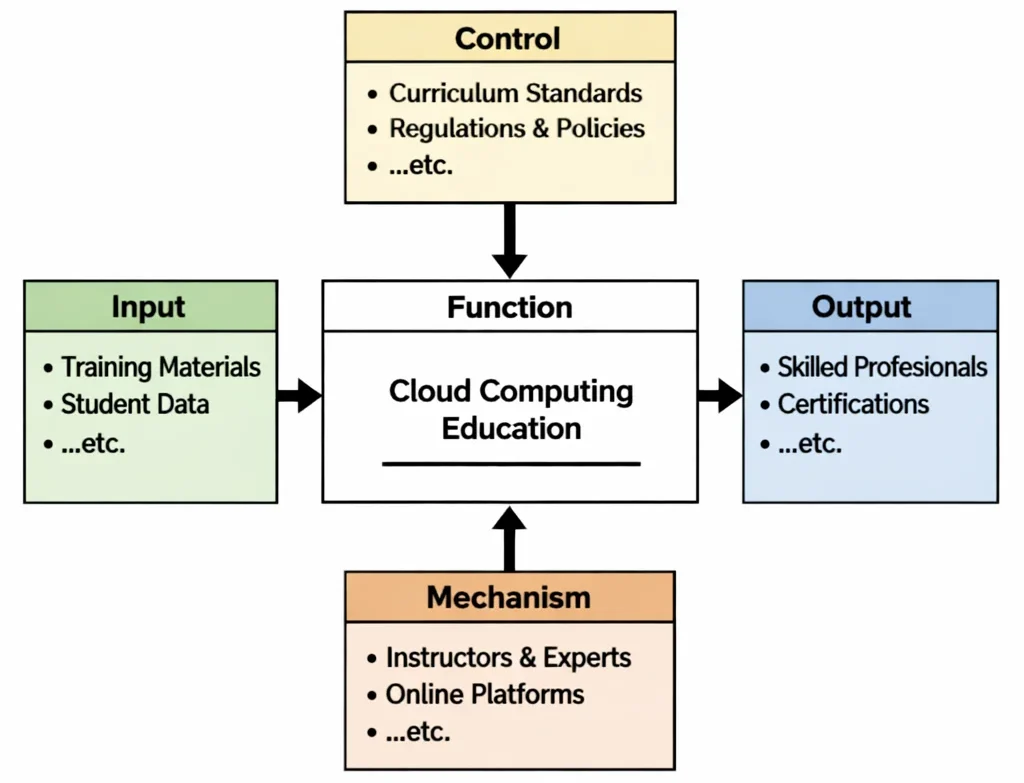
This IDEF0 (Input–Control–Output–Mechanism) diagram presents cloud computing as a structured system. Inputs represent foundational knowledge and requirements, controls define constraints such as security and cost, mechanisms provide the tools for implementation, and outputs represent deployable systems and practical capabilities.

Cloud computing enables scalable and flexible digital systems, forming the backbone of modern applications, storage, and distributed computing.
Building Cloud Systems: Infrastructure and Scale
Cloud computing is a coordinated system of infrastructure, automation, and distributed services. Each card below highlights a fundamental architectural pillar required to deliver resilient, scalable, and globally accessible cloud solutions.
Cloud Systems Overview
Presents the overarching macro-architecture of distributed cloud platforms, detailing how virtualized hardware pools, global edge networks, and shared responsibility models combine to orchestrate digital workloads.
Layers of Cloud Services
Examines how Infrastructure as a Service (IaaS), Platform as a Service (PaaS), and Software as a Service (SaaS) divide operational control, stack management, and maintenance responsibilities between consumer and cloud vendor.
Deployment Strategies
Explores public, private, community, and hybrid cloud topologies, evaluating how data residency laws, latency constraints, and operational governance dictate workload distribution.
Data in Distributed Systems
Details block, file, and object storage architectures, focusing on distributed data replication, eventual consistency models, lifecycle policies, and durability guarantees across multiple availability zones.
Resource Abstraction
Covers hypervisors (Type-1 and Type-2), kernel-level container isolation (Docker), and orchestration engines (Kubernetes) that maximize bare-metal server hardware utilization.
Automated Delivery Systems
Connects software development with infrastructure operations through continuous integration/continuous deployment (CI/CD) pipelines and declarative Infrastructure as Code (IaC) tooling like Terraform.
Cloud Connectivity
Focuses on Virtual Private Clouds (VPCs), subnets, routing tables, network address translation (NAT), peering connections, and VPN/Direct Connect conduits for secure data transport.
Scaling & Reliability
Analyzes horizontal and vertical auto-scaling, load balancer target groups, health probes, fault tolerance, and multi-region active-active failover mechanisms to handle traffic spikes.
Trust & Governance
Enforces zero-trust access policies through Identity and Access Management (IAM), envelope key encryption, automated compliance auditing, and security baseline controls.
Serverless Execution
Details Function-as-a-Service (FaaS) event-driven micro-runtimes that execute code on demand without requiring persistent server provisioning or manual OS patching.
Edge & Distributed Futures
Extends compute runtimes to point-of-presence (PoP) edge nodes and IoT gateways, drastically reducing latency for real-time telemetry, video streaming, and mobile processing.
Cloud Computing in the IT Ecosystem
Cloud computing provides the infrastructure foundation that enables other domains of information technology to operate at scale. The connections below show how cloud systems support, extend, and interact with key areas across the digital landscape.
Distributed Communication Systems
Enable global connectivity between cloud resources, ensuring data flows reliably across regions and services.
Data-Driven Systems
Provide scalable storage and computation needed to process large datasets and support analytics workflows.
Intelligent Systems at Scale
Support model training, deployment, and real-time inference through elastic computing resources.
Cloud-Native Application Design
Enable modern software architectures built on distributed services, automation, and continuous delivery.
Security in Distributed Environments
Protect systems through identity control, encryption, and monitoring across interconnected infrastructure.
These domains do not operate independently. In modern systems, cloud infrastructure underpins data processing, communication, intelligence, and application delivery—forming the backbone of today’s digital ecosystem.
Why Study Cloud Computing
Cloud computing is the infrastructure behind modern digital systems. It enables applications, data platforms, and intelligent services to operate at scale, supporting everything from web platforms and enterprise systems to artificial intelligence and real-time analytics.
- Understanding How Modern Systems Operate: Studying cloud computing reveals how digital services are built and delivered. It explains how storage, processing, and networking are distributed across systems, allowing applications to remain available, scalable, and responsive under real-world conditions.
- Designing Systems Through Trade-offs: Cloud systems are shaped by decisions—how much control to retain, how much to automate, and how to balance cost, performance, and security. Understanding service and deployment models helps students see how these trade-offs define system behavior.
- Developing Practical System Capabilities: Cloud computing introduces the processes used to deploy and manage applications across distributed environments. This includes working with virtual resources, managing data, and ensuring systems remain stable under varying conditions.
- Supporting Data and Intelligent Systems: Modern analytics and machine learning depend on scalable infrastructure. Cloud computing enables large-scale data processing, model deployment, and real-time system interaction across distributed platforms.
- Preparing for Evolving Technical Roles: A foundation in cloud computing supports further study in software engineering, data systems, cybersecurity, and artificial intelligence. More importantly, it develops the ability to understand and design systems that operate in complex, real-world environments.
Key Capabilities in Cloud Computing Systems
Modern cloud systems rely on a set of interconnected capabilities that allow applications to operate reliably, securely, and at scale. These capabilities work together to support real-world systems across industries:
- Networking and Connectivity: Cloud networks connect services, data, and users with predictable performance and security. Concepts such as virtual networks, routing, and gateways determine how data flows, while load balancing and content delivery systems extend reach and reliability.
- Resource Abstraction: Cloud platforms use abstraction to run applications efficiently. Virtual machines and containers package workloads for portability and scalability, while orchestration systems coordinate deployment across environments.
- Security and Governance: Security is embedded into cloud systems. Identity control, encryption, monitoring, and policy enforcement ensure that systems remain protected while meeting compliance requirements.
- Scalability and Performance: Cloud systems adapt dynamically to changing demand. Scaling strategies and distributed architectures allow services to maintain responsiveness under varying workloads.
- Cost and Resource Management: Efficient operation requires balancing performance with cost. Resource allocation, optimization strategies, and usage awareness ensure systems remain sustainable and efficient.
- Integration with Intelligent Systems: Cloud infrastructure supports technologies such as artificial intelligence, real-time analytics, and connected devices. It enables systems to process data and deliver intelligent services at scale.
- Industry and Professional Relevance: These capabilities translate into real-world roles such as cloud architect, DevOps engineer, and site reliability engineer. Understanding them prepares students to design and manage systems in modern technology environments.
Advanced Areas in Cloud Computing
Beyond foundational capabilities, cloud computing extends into advanced practices that ensure systems remain reliable, efficient, and adaptable in real-world environments. These areas reflect how large-scale systems are operated, maintained, and continuously improved:
- Reliability and Resilience: Modern systems are designed to handle failure as a normal condition. Redundancy, load distribution, and controlled deployment approaches ensure that services continue operating even when individual components fail.
- Backup and Recovery Strategies: Cloud systems must recover quickly from disruptions. This involves defining recovery objectives, maintaining backup systems, and designing architectures that minimize downtime and data loss.
- System Observability: Understanding system behavior requires visibility into performance and operations. Metrics, logs, and tracing allow engineers to monitor activity, detect anomalies, and respond to issues effectively.
- Cost-Aware Operation: Cloud flexibility introduces the need for disciplined resource management. Efficient usage, scaling strategies, and architectural choices help balance performance with cost.
- Data and Analytics Integration: Cloud platforms support large-scale data pipelines and analytics systems. These enable organizations to process, analyze, and act on data in real time.
- Machine Learning Operations (MLOps): Deploying intelligent systems requires structured workflows for managing models, monitoring performance, and adapting to changing data. These processes ensure that machine learning systems remain effective over time.
Engineering FAQs: Cloud Systems & Distributed Infrastructure
What is cloud computing?
Cloud computing provides on-demand access to computing resources such as servers, storage, and applications over the internet. It allows systems to scale dynamically without relying on fixed physical infrastructure.
How is cloud computing different from traditional IT systems?
Traditional systems rely on owned hardware with fixed capacity, while cloud systems use shared, distributed infrastructure. This enables faster scaling, greater flexibility, and more efficient resource usage.
What are the main cloud service models?
Cloud services are delivered at different levels. Infrastructure provides basic resources, platforms support development, and software delivers complete applications. Each level defines how responsibility is shared between provider and user.
Why is cloud computing important for modern applications?
Cloud computing enables applications to operate at scale, remain available under changing demand, and serve users globally. It forms the foundation for web systems, data platforms, and intelligent services.
What challenges are associated with cloud computing?
Key challenges include managing security, controlling costs, ensuring compliance, and avoiding dependence on a single provider. These require careful system design and monitoring.
What careers are related to cloud computing?
Cloud computing supports roles such as cloud engineer, architect, DevOps engineer, and site reliability engineer. Many modern IT roles now require understanding of distributed systems and cloud platforms.
Cloud Computing Glossary
- Cloud computing
- Delivery of computing resources such as servers, storage, and software over the internet on demand, allowing systems to scale without owning physical infrastructure.
- Infrastructure as a Service (IaaS)
- A cloud service model that provides virtual machines, storage, and networking, giving users control over system configuration and deployment.
- Platform as a Service (PaaS)
- A managed environment for building and deploying applications without handling underlying infrastructure.
- Software as a Service (SaaS)
- Applications delivered over the web, where users access software without managing infrastructure or platforms.
- Virtualization
- Technology that allows multiple virtual machines to run on a single physical server, improving resource efficiency and flexibility.
- Containers
- Lightweight units that package applications and dependencies together, enabling consistent deployment across different environments.
- Auto-scaling
- The automatic adjustment of computing resources based on demand to maintain performance while controlling cost.
- Load balancing
- Distribution of incoming traffic across multiple servers to improve system performance and reliability.
- Content Delivery Network (CDN)
- A network of distributed servers that deliver content to users from locations closer to them, reducing latency and improving speed.
- Latency
- The delay between a user request and system response, often influenced by network distance and system performance.
- Multi-region deployment
- Running systems across multiple geographic regions to improve availability and reduce the impact of failures.
- Identity and Access Management (IAM)
- Systems that control who can access cloud resources and what actions they are allowed to perform.
- Encryption
- The process of securing data by converting it into a coded form that can only be accessed with the correct key.
- Serverless computing (FaaS)
- A cloud model where applications run as functions without managing servers, scaling automatically based on events.
- DevOps
- A set of practices that combine development and operations to automate and improve the deployment and management of applications.
- Infrastructure as Code (IaC)
- The practice of managing infrastructure through code, allowing systems to be deployed and updated automatically and consistently.
- Vendor lock-in
- Dependence on a specific cloud provider’s services, making it difficult to switch to another platform.
- Hybrid cloud
- A deployment model that combines private and public cloud environments to balance control, security, and scalability.
Cloud Computing — Application and Reflection
These questions help reinforce key ideas and connect cloud computing concepts to real-world system design. Focus on understanding how decisions affect performance, reliability, and scalability.
Key Conceptual Questions
1. What distinguishes cloud systems from traditional infrastructure?
Answer: Cloud systems use distributed, on-demand resources that scale dynamically, unlike traditional infrastructure which relies on fixed, locally managed hardware with static physical limits.
2. Why is scalability central to cloud computing?
Answer: Scalability allows systems to adjust resources based on incoming demand automatically, ensuring stable user performance while optimizing cost by releasing unneeded compute instances.
3. How do cloud service models shape system design?
Answer: Service models (IaaS, PaaS, SaaS) determine how control and operational maintenance are split between vendor and consumer, directly influencing architectural flexibility, speed of deployment, and administrative overhead.
Applied Real-World Scenarios
1. Scenario: Handling Sudden Demand Spikes
How should a cloud architect design a system to maintain low latency during unpredictable flash sale traffic surges?
How should a cloud architect design a system to maintain low latency during unpredictable flash sale traffic surges?
Answer: Configure horizontal auto-scaling rules combined with Elastic Load Balancing (ELB), object caching (Redis), and CDN edge delivery to distribute traffic and absorb load without over-provisioning baseline resources.
2. Scenario: Balancing Security and Flexibility
How can an enterprise protect sensitive financial data while giving developers cloud flexibility?
How can an enterprise protect sensitive financial data while giving developers cloud flexibility?
Answer: Implement a hybrid cloud architecture. Sensitive records remain secured in private cloud or on-premises environments, while public cloud resources handle elastic customer-facing microservices via encrypted VPC interfaces.
3. Scenario: Maintaining High System Reliability
What design approach prevents single-point-of-failure downtimes during physical data center outages?
What design approach prevents single-point-of-failure downtimes during physical data center outages?
Answer: Deploy multi-region or multi-Availability Zone (AZ) redundant clusters with automated health check routing, distributed database replication, and zero-downtime failover orchestration.
Cloud Computing — Integration & Perspective
Cloud computing is the infrastructure that allows modern digital systems to exist beyond the limits of individual machines. It transforms computing into a shared, distributed capability—where resources can be accessed, scaled, and coordinated across regions and environments.
Rather than focusing on specific tools or services, cloud computing is best understood as a system of orchestration. It connects storage, processing, networking, and security into a unified environment where applications can operate reliably under real-world conditions. Each decision—how systems scale, how data is distributed, how access is controlled—shapes the behavior of the entire system.
As digital systems continue to expand in complexity, cloud platforms provide the structure needed to support global services, data-driven applications, and intelligent systems. They enable organizations to move from isolated solutions to interconnected systems that adapt, respond, and evolve over time.
Understanding cloud computing therefore goes beyond learning technologies. It is about recognizing how infrastructure enables capability—how systems are designed to operate at scale, remain resilient under uncertainty, and support the continuous transformation of ideas into real-world solutions.