
Prepare for University Studies & Career Advancement

Photons and Quantum States of Light

Light is familiar because we see with it every day. Yet in quantum optics, light becomes something deeper and stranger: it can arrive in indivisible packets called photons, occupy quantum states, show superposition, and reveal behaviour that cannot be explained by ordinary classical waves alone.
This page introduces Photons and Quantum States of Light in a student-friendly way. It belongs to the wider Quantum Optics cluster, where students can also explore single-photon experiments, entanglement with photons, quantum communication, and quantum measurement.
The main goal is not to make quantum light mysterious for its own sake. The goal is to show how the familiar idea of light becomes a precise language for modern physics, photonics, communication, sensing, and quantum technology.

What Photons and Quantum States of Light Really Mean
A photon is often described as a packet of light energy. This is a useful starting point, but it is not the whole story. A photon is not a tiny glowing ball travelling through space like a miniature planet. It is a quantum object associated with the electromagnetic field.
A quantum state of light is the mathematical and physical description of what can be predicted about light before measurement. It may describe photon energy, polarisation, direction, phase, number of photons, probability amplitudes, and possible measurement outcomes.
In classical optics, we often describe light using waves: wavelength, frequency, amplitude, phase, and polarisation. In quantum optics, we still care about these ideas, but we also ask new questions: How many photons are present? What state are they in? Are the measurement outcomes certain or probabilistic? Can one photon be in a superposition of possibilities? Can two photons share an entangled state?
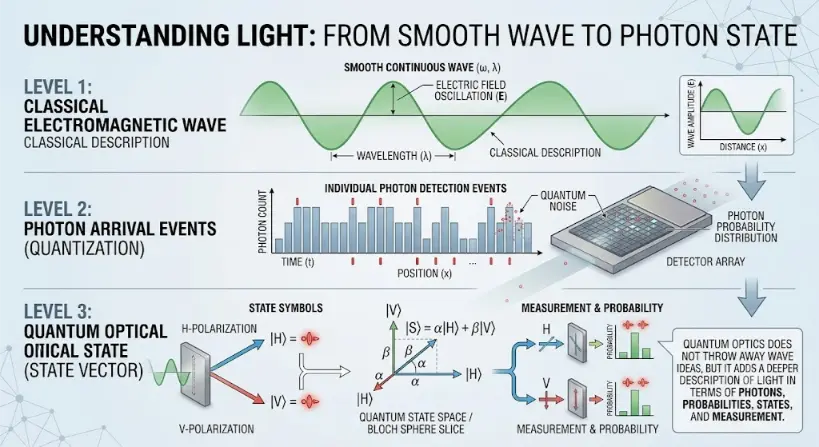
A three-level horizontal scientific infographic titled "UNDERSTANDING LIGHT: FROM SMOOTH WAVE TO PHOTON STATE". The top level depicts a continuous green sine wave representing a classical electromagnetic wave with labeled field oscillations and wavelength. The middle level illustrates quantization through a bar graph of discrete photon arrival counts over time and position alongside a detector array. The bottom level details the quantum optical state vector, showing a mathematical superposition formula, state symbols for horizontal and vertical polarization, and measurement probability diagrams.
The three conceptual levels of describing light in physics. The progression moves from a classical continuous wave model to discrete photon counting events (quantization), and finally to a state-vector representation that details probabilities, superpositions, and measurement outcomes without discarding the underlying wave properties.

The infographic is organized into three distinct horizontal sections stacked vertically on a clean, light blue technical background accented with subtle geometric network traces.

  • Level 1 (Top) — Classical Electromagnetic Wave: This section represents the classical physics perspective. It features a prominent, smooth green sine wave labeled “SMOOTH CONTINUOUS WAVE” propagating along a distance axis. Annotations clearly define the “ELECTRIC FIELD OSCILLATION (E)” and the “WAVELENGTH (lambda)”, framing light as a purely continuous wave phenomenon.
  • Level 2 (Middle) — Photon Arrival Events (Quantization): This section introduces the concept of quantization. It features a 3D graphic of a rectangular “DETECTOR ARRAY” catching a light beam. To the left of the array, a blue bar graph maps “INDIVIDUAL PHOTON DETECTION EVENTS” over “TIME (t)” and “POSITION (x)”. Tiny red dots overlaying the bars represent individual photon impacts, illustrating quantum noise and the transition from a smooth wave to discrete particle-like events.
  • Level 3 (Bottom) — Quantum Optical State (State Vector): The final section provides the quantum mechanical description using polarization states. On the left, an incoming wave passes through a polarizing beam splitter, dividing into horizontal and vertical components labeled with state symbols for H-Polarization and V-Polarization. The center features a 2D geometric vector graph (“Bloch Sphere Slice”) showing a diagonal superposition state vector (State S equals alpha H plus beta V), with alpha and beta marking the horizontal and vertical probability amplitudes. The right side outlines the measurement process, depicting how the superposition state collapses into definite horizontal or vertical outcomes alongside corresponding probability histograms.

A prominent text box in the lower right summarizes the core educational takeaway: “Quantum optics does not throw away wave ideas, but it adds a deeper description of light in terms of photons, probabilities, states, and measurement.”

The Evolutionary Path: History, Microscopic Collapses, and Next-Gen Paradigms

The conceptual transition from deterministic classical waveforms to multi-mode probability matrices required deep mathematical modifications to standard field operators.

The Historical Journey

The transition to single-particle light tracking developed directly from the early twentieth-century blackbody theories of Max Planck and the photo-emission constraints calculated by Albert Einstein. These principles gained rigorous system mathematical formalization in 1963, when physicist Roy Glauber defined the quantum optics framework of optical coherence. By replacing classical electromagnetic wave intensities with normalized photon correlation field statistics, Glauber developed a robust mechanism to map single-photon packets through local matrices, establishing that lasers generate distinct, low-noise non-classical state bounds.

Contemporary Technological Challenges

The key barrier preventing the implementation of single-photon data platforms is the localized phenomenon of **decoherence**. Because macro quantum states are incredibly sensitive to their structural environments, a single photon propagating along a solid channel can be easily absorbed or scattered by tiny grid defects. Since checking or reading a fragile superposition state triggers a sudden **wavefunction collapse**, classical active repeaters cannot clone or refresh an ongoing flight path signal. This issue forces foundries to invent specialized defect-free shielding pipelines to sustain long-distance optical memory arrays.

Future Horizons: Squeezed Light Nodes and On-Chip Vector Engineering

Next-generation computing architectures bypass boundary constraints by modulating light variables below classical measurement thresholds:
  • Quadrature-Squeezed Light Fields: By using specialized non-linear parametric loops, hardware engineers can compress quantum state fluctuations in one field variable (like phase tracking) below the standard vacuum uncertainty limit. This selective noise squeezing allows ultra-precise tracking systems to perform measurement tasks far past the standard diffraction boundaries.
  • Monolithic Lithium Niobate Vector Cavities: Industrial chip facilities are transitioning away from bulky bulk optical setups by pattern-etching single-photon emitters directly onto active micro-scale substrates. These compact circuits route localized polarization qubits through integrated Mach-Zehnder channels, allowing developers to execute complex parallel data routing scripts across compact processing matrices.

Photon Energy

The energy of a photon is related to its frequency:
$$E = hf$$
Here, E is photon energy, h is Planck’s constant, and f is the frequency of the light.
Since light in vacuum also satisfies:
$$c = f\lambda$$
the photon energy can also be written as:
$$E = \frac{hc}{\lambda}$$
This equation is important because it connects the wave description of light with the quantum description. A higher-frequency photon has higher energy. A shorter-wavelength photon also has higher energy.
Light RegionRelative WavelengthRelative Photon EnergyStudent-Friendly Meaning
InfraredLonger than visible lightLower than visible lightImportant in fibre communication, thermal imaging, sensors, and remote controls.
Visible redLonger visible wavelengthLower visible photon energySeen by the eye as red light; common in lasers and indicators.
Visible blueShorter visible wavelengthHigher visible photon energyHigher energy per photon than red light.
UltravioletShorter than visible lightHigher than visible lightCan produce stronger interactions with many materials and biological systems.

Why Photon Energy Is Not the Same as Brightness

Students often confuse photon energy with brightness. They are related, but they are not the same.
Photon energy tells us how much energy each photon carries. Brightness or optical power usually depends on how many photons arrive per second and how much energy each photon carries.
A dim blue light may contain relatively few high-energy photons. A bright red light may contain many lower-energy photons. This distinction becomes important in detectors, laser safety, photochemistry, quantum experiments, and optical communication.

Classical Light Versus Quantum Light

Classical optics treats light as an electromagnetic wave. This works extremely well for many situations, including lenses, mirrors, interference, diffraction, polarisation, and most ordinary imaging systems.
Quantum optics becomes necessary when the energy exchange of light happens in discrete packets, when individual photons are detected, when photon statistics matter, or when superposition and entanglement become important.
Classical DescriptionQuantum Description
Light is described mainly as an electromagnetic wave.Light is described using quantum states of the electromagnetic field.
Useful for rays, waves, interference, diffraction, and imaging.Useful for photons, detection events, quantum states, entanglement, and measurement.
Intensity can vary smoothly.Energy exchange can occur in photon-sized packets.
Measurement can often be treated as passive observation.Measurement is part of the physical description and affects what can be known.
Good for many everyday optical systems.Essential for single-photon experiments and quantum technologies.
Quantum optics does not mean classical optics is wrong. It means classical optics is an approximation that works very well in many situations, while quantum optics gives a deeper description when individual photons and quantum states matter.

What Is a Quantum State?

A quantum state is a description of a physical system that tells us what outcomes are possible and how likely those outcomes are when a measurement is made. In quantum optics, the system is light.
For a photon, a quantum state may describe properties such as polarisation, direction, frequency, energy, arrival time, path, or spatial mode. The state does not always say, “The photon definitely has this one ordinary property before measurement.” Instead, it may describe a set of possible outcomes with probability amplitudes.
This is one reason quantum theory feels unusual. It does not always give a story like classical physics. It gives a precise rule for predicting measurement results.

Polarisation States of a Photon

Polarisation is one of the easiest ways to introduce photon states. In classical optics, polarisation describes the direction of the electric-field oscillation. In quantum optics, a single photon can also have a polarisation state.
For example, we may use:
  • \(|H\rangle\) for horizontal polarisation
  • \(|V\rangle\) for vertical polarisation
A photon may be prepared in a horizontal state, a vertical state, or a superposition of both. A simple superposition can be written as:
$$|\psi\rangle = a|H\rangle + b|V\rangle$$
Here, a and b are probability amplitudes. They help determine the probabilities of different measurement outcomes. This notation is compact, but the idea is profound: before measurement, the photon state may not be simply “horizontal” or simply “vertical.”

Superposition: More Than Ordinary Mixing

A superposition is not just a lack of knowledge. It is not simply saying, “The photon is secretly horizontal or vertical, but we do not know which.” In quantum theory, superposition can produce interference effects that cannot be explained by ordinary classical uncertainty alone.
This is why single-photon experiments are so important. Even when photons are sent one at a time, interference patterns can gradually build up. The behaviour suggests that the quantum state carries information about possible paths or outcomes before measurement.
Students will study this more fully in Single-Photon Experiments.

Photon Number States

Another important way to describe quantum light is by photon number. A light field may be in a state with zero photons, one photon, two photons, or more. These are often called number states or Fock states.
State IdeaMeaningWhy It Matters
Vacuum stateNo photons are present in a mode.Even “empty” quantum fields matter in advanced quantum optics.
Single-photon stateOne photon is present in a mode.Central to single-photon experiments and quantum communication.
Two-photon stateTwo photons are present in a mode or system.Important in photon-pair experiments and entanglement studies.
Many-photon stateMany photons are present.Can often behave more like classical light, depending on the state.
Photon number matters because some experiments and technologies depend on controlling individual photons. A single-photon communication system, for example, behaves very differently from an ordinary bright light beam.

Coherent States and Laser Light

Laser light is often described as coherent. In ordinary terms, this means the light has a well-organised wave character, with a stable phase relationship and narrow wavelength range compared with many other sources.
In quantum optics, a useful description of ideal laser light involves coherent states. A coherent state is not a state with an exact fixed number of photons. Instead, it has photon-number uncertainty while maintaining a well-defined wave-like character.
This is a useful bridge between classical and quantum descriptions. Coherent laser light can look very wave-like, yet it still consists of quantum light described by a quantum state.
Students can connect this idea with Laser Optics and LEDs, Lasers, and Photodetectors.

Modes of Light

A photon is always associated with a mode of the electromagnetic field. A mode can be thought of as a possible pattern in which light can exist. It may involve direction, frequency, polarisation, spatial shape, or confinement in a cavity or waveguide.
This matters because saying “one photon” is incomplete unless we also understand the mode. A photon in one polarisation mode is different from a photon in another polarisation mode. A photon in one path of an interferometer is different from a photon in another path.
Modes connect quantum optics with wave optics. The wave pattern tells us what kind of optical mode exists; the quantum state tells us how that mode is occupied and measured.

Photon Detection and Measurement

Photons are usually known through detection events. A detector may click, create a current pulse, record a photon arrival time, or register a photon at a particular pixel. These events are not merely technical details; they are part of how quantum light is observed.
In quantum optics, measurement is not always a passive act of looking. The measurement setup influences what property can be observed. A polarisation measurement reveals information about polarisation. A path measurement reveals information about path. An energy measurement reveals information about frequency or wavelength.
This topic is developed more deeply in Quantum Measurement and Light.

Probability in Quantum Light

Quantum states often predict probabilities rather than certain outcomes for individual events. This does not mean quantum physics is vague. It means the theory gives very precise predictions for probability patterns over many repeated measurements.
For example, if identical photons are prepared in the same polarisation superposition and then measured, individual outcomes may vary. Yet after many measurements, the pattern of results can match the probabilities predicted by the quantum state.
This is one of the most important habits students must develop: quantum mechanics often predicts the pattern, even when it does not predict each individual outcome with certainty.

Entangled Photon States

Two photons can sometimes share a joint quantum state that cannot be separated into two independent descriptions. This is called entanglement. Entanglement is one of the most important and surprising features of quantum physics.
For example, two photons may be created so that their polarisation measurements are strongly correlated. Measuring one photon gives information about the other, even when the photons are far apart. This does not mean students should imagine a simple hidden signal travelling between them. The correct explanation belongs to quantum theory.
Entangled photons are important in tests of quantum mechanics, quantum communication, quantum cryptography, and future quantum networks. Students can explore this topic in Quantum Entanglement with Photons.

Quantum States and Information

Quantum states can carry information in ways that differ from ordinary classical bits. A classical bit is usually 0 or 1. A quantum bit, or qubit, can be represented by a quantum state that allows superposition. Photons can be used as qubits through polarisation, path, time-bin, frequency, or other degrees of freedom.
This does not mean quantum information is magic. It is governed by strict physical rules. Quantum states cannot simply be copied perfectly, and measurement changes what can be known. These restrictions are part of what makes quantum communication both powerful and delicate.
Students can connect this idea with Quantum Communication.

Common Quantum States of Light

Students do not need to master every mathematical detail at first, but it is helpful to recognise several common state ideas in quantum optics.
State TypeSimple MeaningWhere Students Meet It
Single-photon stateA state with one photon in a defined mode or set of possible modes.Single-photon interference, quantum communication, photon counting.
Polarisation stateA state describing the photon’s polarisation possibilities.Polariser experiments, qubits, entangled photon pairs.
Path stateA state describing which path or combination of paths a photon can take.Interferometers and single-photon experiments.
Coherent stateA quantum state that closely resembles a classical wave-like field.Idealised laser light and classical-to-quantum comparisons.
Number stateA state with a definite number of photons.Photon counting and quantum optics theory.
Entangled stateA joint state of two or more systems that cannot be described independently.Bell tests, quantum communication, quantum information science.

Case Studies: Quantum States of Light in Action

Case Study 1: Single-Photon Interference

In a single-photon interference experiment, photons are sent one at a time through an arrangement such as an interferometer or double-slit setup. Each photon is detected as a single event, but many events gradually build a pattern that shows wave-like interference.
This case study shows why photons cannot be understood as ordinary classical particles. The detection event is particle-like, but the probability pattern is wave-like.

Case Study 2: Polarisation Qubits

A photon’s polarisation can be used to represent a quantum bit. Horizontal and vertical polarisation may serve as two basis states, while diagonal or circular polarisations can be represented as superpositions.
This case study shows why polarisation is so useful in teaching quantum optics. It gives students a visual and experimental way to understand quantum states.

Case Study 3: Entangled Photon Pairs

In some experiments, a source creates pairs of photons whose measurement results are linked by a shared quantum state. The photons may travel to different detectors, yet their results show correlations that cannot be explained by simple independent properties.
This case study prepares students for entanglement, Bell tests, and quantum communication.

Case Study 4: Photon Counting

Photon-counting detectors can register individual photon events. Instead of measuring only a smooth light intensity, the experiment records clicks, arrival times, or counts. This allows researchers to study weak light, quantum statistics, and single-photon behaviour.
This case study shows that quantum optics depends not only on sources of light, but also on detectors capable of revealing the discrete nature of light.

Connections with Wider Physics and Technology

Photons and quantum states of light connect many areas of physics and modern technology. These related pages help students see the wider learning map.

Light and Optics

Quantum optics grows from the wider study of light, including rays, waves, interference, diffraction, polarisation, and optical instruments.

Wave Optics

Wave optics explains interference, diffraction, phase, coherence, and polarisation, which remain important in quantum light experiments.

Photonics

Photonics uses light in devices and systems, while quantum optics explains the deeper photon-level behaviour behind advanced technologies.

Laser Optics

Laser light often behaves classically at large scales, but it is also described by quantum states of the electromagnetic field.

Modern Physics

Modern relativity and localized state properties explain why light energy is exchanged in discrete packets and why photons rule particle interactions.

Electromagnetic Waves

Photons are quanta of electromagnetic radiation, linking quantum optics with the classical wave picture of electric and magnetic fields.

Learning Pathway Within Quantum Optics

This page is the starting point for the Quantum Optics cluster. It gives students the language of photons and quantum states before they move into experiments, entanglement, communication, and measurement.

Photons and Quantum States of Light

Current page. Understand photons, photon energy, polarisation states, superposition, number states, coherent states, modes, and measurement outcomes.

Single-Photon Experiments

Explore how single photons reveal wave-particle duality, interference, probability, and the limits of classical thinking.

Quantum Communication

See how quantum states of photons can support secure communication ideas and future quantum networks.

Quick Check: Photons and Quantum States of Light

Quick Check: Quantum Light

Q1. Is a photon simply a tiny classical ball of light?
No. A photon is a quantum object associated with the electromagnetic field. It can produce particle-like detection events, but it is not an ordinary tiny ball.
Q2. What does a quantum state describe?
A quantum state describes what can be predicted about a system, including possible measurement outcomes and their probabilities.
Q3. Why is photon energy related to wavelength?
Photon energy is \(E = hf\), and frequency is related to wavelength by \(c = f\lambda\). Therefore, \(E = \frac{hc}{\lambda}\), so shorter wavelength means higher photon energy.
Q4. What is a superposition state?
A superposition state is a quantum state that combines different possible measurement outcomes. It is not merely ordinary uncertainty; it can produce quantum interference effects.

Common Misunderstandings About Photons and Quantum States

Misunderstanding 1: A Photon Is Just a Tiny Speck of Light

A photon is not a tiny classical speck. It is a quantum excitation of the electromagnetic field. It may be detected as a local event, but its state can involve wave-like probability patterns.

Misunderstanding 2: Superposition Means the Photon Is Just Hidden in One Ordinary State

Superposition is not the same as ordinary ignorance. A photon in a superposition can produce interference effects that would not appear if it merely had a hidden classical property.

Misunderstanding 3: Quantum Light Is Always Dim

Single-photon experiments often use very weak light, but quantum optics also describes strong light fields. Even intense laser light has a quantum description, although it may behave very much like a classical wave in many situations.

Misunderstanding 4: Measurement Only Reveals What Was Already There

In quantum mechanics, measurement is more subtle. The measurement setup helps determine which property is tested, and the result may not be explainable as simply revealing a pre-existing classical value.

Misunderstanding 5: Quantum States Are Only Mathematical Tricks

Quantum states are mathematical descriptions, but they make testable predictions about real experiments. Single-photon interference, polarisation measurements, photon counting, and entanglement tests all rely on quantum-state predictions.

Key Terms

Coherent state
A quantum state of light that closely resembles a classical wave-like field, often used to describe idealised laser light.
Entanglement
A quantum relationship in which two or more systems share a joint state that cannot be described as independent parts.
Mode
A possible field pattern of light, described by properties such as frequency, direction, polarisation, or spatial shape.
Photon
A quantum packet of electromagnetic radiation associated with light and other electromagnetic waves.
Photon counting
The detection of individual photon events using sensitive detectors.
Photon number state
A quantum state with a definite number of photons in a mode.
Photon energy
The energy carried by one photon, given by \(E = hf\) or \(E = \frac{hc}{\lambda}\).
Polarisation state
A quantum state describing the polarisation possibilities of a photon.
Probability amplitude
A quantity used in quantum theory to calculate the probability of a measurement outcome.
Quantum measurement
The process by which a quantum system is tested and a specific outcome is obtained.
Quantum state
A description of a quantum system that determines possible measurement outcomes and their probabilities.
Superposition
A quantum combination of possible states that can produce interference effects.

Review Questions

  1. What is a photon?
    Answer: A photon is a quantum packet of electromagnetic radiation. It is associated with light and carries energy determined by its frequency.
  2. What equation relates photon energy to frequency?
    Answer: The equation is \(E = hf\), where \(E\) is photon energy, \(h\) is Planck’s constant, and \(f\) is frequency.
  3. Why does shorter wavelength mean higher photon energy?
    Answer: Since \(E = \frac{hc}{\lambda}\), photon energy is inversely related to wavelength. A shorter wavelength gives a larger value of \(E\).
  4. What is a quantum state of light?
    Answer: A quantum state of light describes what can be predicted about light, including possible measurement outcomes and their probabilities.
  5. What is a polarisation state?
    Answer: A polarisation state describes the polarisation possibilities of a photon, such as horizontal, vertical, or a superposition of both.
  6. What is superposition?
    Answer: Superposition is a quantum combination of possible states. It can produce interference effects that are not explained by ordinary classical uncertainty.
  7. Why is photon detection important in quantum optics?
    Answer: Photon detection reveals individual quantum events and allows experiments to test predictions about quantum states, probabilities, and measurement outcomes.
  8. How is entanglement related to photon states?
    Answer: Entanglement occurs when two or more photons share a joint quantum state that cannot be described as separate independent states.

Thought-Provoking Questions

  1. Why is it useful to describe light as both a wave and as photons?
    Answer: The wave description explains interference, diffraction, phase, and polarisation. The photon description explains discrete energy exchange, detection events, and quantum states. Quantum optics often needs both perspectives.
  2. Why does superposition challenge everyday thinking?
    Answer: Everyday objects usually seem to have definite properties before we look at them. Quantum systems can be described by superpositions of possible outcomes, and measurement plays a role in what is observed.
  3. Why does a single-photon experiment reveal something deep about nature?
    Answer: A single photon is detected as one event, yet many single-photon events can build an interference pattern. This shows that quantum behaviour cannot be reduced to ordinary particles alone.
  4. Why might photons be useful for quantum communication?
    Answer: Photons can travel through fibres or free space, carry quantum states, and be measured using optical detectors. Their quantum behaviour can be used in secure communication ideas and quantum networks.
  5. Why should students avoid saying quantum optics is simply “weird”?
    Answer: Quantum optics may feel unusual, but it is not vague or magical. It is a precise experimental science with mathematical rules and measurable predictions.

Comprehensive Numerical Problems with Solutions

  1. A photon has frequency 5.0 × 10¹⁴ Hz. Find its energy using the fundamental frequency relation expression, where h = 6.63 × 10⁻³⁴ J s.
    Solution:
    Apply the base field equation directly:
    $$E = hf$$
    Substitute values:
    $$E = (6.63 \times 10^{-34}\text{ J}\cdot\text{s}) \times (5.0 \times 10^{14}\text{ Hz}) = 3.315 \times 10^{-19}\text{ J}$$
    Answer: The isolated photon packet energy is exactly 3.315 × 10⁻¹⁹ J.
  2. A photon has a vacuum wavelength of 500 nm. Estimate its energy in electron volts using the standard metric conversion constant shortcut.
    Solution:
    Apply the electron-volt conversion ratio shortcut formula:
    $$E(\mathrm{eV}) \approx \frac{1240}{\lambda(\mathrm{nm})}$$
    Substitute the wavelength parameter directly into the quotient ($\lambda$ = 500 nm):
    $$E \approx \frac{1240}{500} = 2.48\text{ eV}$$
    Answer: The photon energy evaluates to exactly 2.48 eV.
  3. A red light photon has a wavelength of 650 nm, and a violet photon has a wavelength of 400 nm. Determine which spectral packet holds greater total structural energy.
    Solution:
    The reciprocal wavelength energy relationship determines:
    $$E = \frac{hc}{\lambda}$$
    This demonstrates that photon energy values scale inversely relative to wavelength footprint variables. Because the violet photon presents a shorter wavelength than the red photon (400 nm is less than 650 nm), its calculation yields a higher energy value.
    Answer: The violet photon possesses greater structural energy.
  4. A weak particle tracking detector receives a flux of 2.0 × 10⁶ photons per second. If each single photon holds an energy value of 3.0 × 10⁻¹⁹ J, estimate the aggregate optical power reaching the active matrix.
    Solution:
    Total continuous power scales as the product of tracking frequency and individual packet packets:
    $$P = N \cdot E$$
    Substitute values:
    $$P = (2.0 \times 10^6\text{ s}^{-1}) \times (3.0 \times 10^{-19}\text{ J}) = 6.0 \times 10^{-13}\text{ W}$$
    Answer: The absolute optical power reaching the detector is exactly 6.0 × 10⁻¹³ W.
  5. A quantum channel photon carries a discrete energy metric of 1.55 eV. Estimate its operating wavelength tracking coordinate using the structural inverse quotient rule.
    Solution:
    Transpose variables within the conversion constant relationship to isolate the wavelength:
    $$\lambda(\mathrm{nm}) \approx \frac{1240}{E(\mathrm{eV})}$$
    Substitute values:
    $$\lambda \approx \frac{1240}{1.55\text{ eV}} = 800\text{ nm}$$
    Answer: The target light wavelength coordinate is exactly 800 nm.

External References for Further Reading

The following references provide helpful background for students who want to read beyond this introductory page.
  1. OpenStax University Physics: Wave-Particle Duality — A student-level introduction to the wave and particle behaviour of light and matter.
  2. OpenStax University Physics: Photon Energy Equations — A useful source for equations such as \(E = hf\).
  3. NIST: Speed of Light in Vacuum — A reference for the exact value of the speed of light in vacuum.
  4. The Nobel Prize in Physics 2022: Entangled Photons and Quantum Information — A readable overview of why experiments with entangled photons matter in modern physics.

Why This Topic Matters

Photons and quantum states of light matter because they form the language of quantum optics. Without this language, single-photon experiments, entanglement, quantum communication, quantum measurement, and many future quantum technologies cannot be understood clearly.
For students, this topic also builds a bridge between familiar light and modern physics. It shows how the same light that forms images and travels through lenses can also reveal probability, superposition, measurement, and the quantum structure of nature.
The deeper lesson is that light is not only something we see with. It is something we can use to test reality, carry information, and build new technologies.

Summary

A photon is a quantum object associated with electromagnetic radiation. Its energy is given by \(E = hf\) or \(E = \frac{hc}{\lambda}\). Higher frequency means higher photon energy, while shorter wavelength also means higher photon energy.
A quantum state of light describes possible measurement outcomes and their probabilities. Photon states may involve polarisation, path, frequency, number, mode, superposition, or entanglement.
Students who understand photons and quantum states of light are ready to study single-photon experiments, quantum entanglement with photons, quantum communication, and quantum measurement.

Reflection Question

If light can behave like a wave, arrive as individual photons, and exist in quantum states before measurement, what does this suggest about the difference between the world we see and the deeper rules that govern it?
Last updated: 14 Jul 2026