
Quantum entanglement with photons is one of the most remarkable ideas in modern physics. It shows that two photons can share a single quantum state, even when they travel in different directions and are measured far apart. Their measurement results can be linked in ways that cannot be explained by ordinary classical independence.
This page introduces Quantum Entanglement with Photons in a student-friendly way. It belongs to the wider Quantum Optics cluster, where students can also study Photons and Quantum States of Light, Single-Photon Experiments, Quantum Communication, and Quantum Measurement and Light.
The goal is not to make entanglement sound magical. The goal is to explain it carefully: entanglement is a real, testable quantum relationship between measurement outcomes. It challenges classical intuition, but it does not allow faster-than-light messaging or simple science-fiction shortcuts.
What Quantum Entanglement with Photons Really Means
In ordinary thinking, if two objects are separated, we expect each object to have its own independent properties. If we measure one object, we may learn something about it, but we do not usually expect that measurement to be part of a single shared description with another distant object.
Entanglement changes this picture. When two photons are entangled, the correct quantum description belongs to the pair as a whole. The two photons cannot always be described as having separate, independent quantum states of their own. Instead, they share a joint state.
This shared state can produce strong correlations between measurement results. For example, two entangled photons may be sent to two distant detectors. When each photon is measured, the results may be linked in a way that agrees with quantum theory but conflicts with simple classical hidden-property explanations.
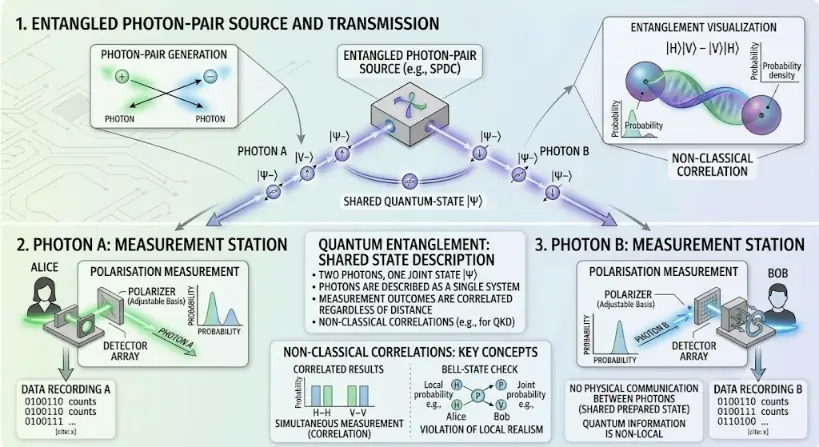
The image is a comprehensive three-part scientific infographic set against a clean, light blue technical background, detailing the generation, transmission, and measurement of entangled photon pairs.
- Panel 1: Entangled Photon-Pair Source and Transmission: A hardware component labeled “ENTANGLED PHOTON-PAIR SOURCE (e.g., SPDC)” sits in the middle, splitting an incoming energy source into two separate paths labeled “PHOTON A” and “PHOTON B”. The two diverging blue light pathways are connected by a curved glowing arc labeled “SHARED QUANTUM-STATE |Ψ⟩”, emphasizing that the two particles are governed by a single, non-local joint system. Spherical photon markers along the tracks are tagged with state vectors like |Ψ−⟩, |V−⟩, and |D−⟩. Two explanatory diagrams flank the main track: Photon-Pair Generation displays cross-arrows indicating the conversion of a single pump photon into two down-converted photons, and Entanglement Visualization features a double-helix wave diagram plotting probability density, explicitly stating the anti-correlated state formula (|H⟩|V⟩ − |V⟩|H⟩) to show “Non-Classical Correlation”.
- Panels 2 & 3: Alice and Bob Measurement Stations: The bottom left and bottom right sections portray identical, independent verification setups used by two observers. A user avatar labeled “Alice” monitors a “POLARISATION MEASUREMENT” array on the left where Photon A passes through an adjustable-basis optical polarizer and strikes a detector array, feeding into a “DATA RECORDING A” module tracking simultaneous counts. On the right, a matching avatar labeled “Bob” monitors an identical “POLARISATION MEASUREMENT” station for Photon B, tracking the light through a separate adjustable polarizer and detector array, sending results to “DATA RECORDING B”.
- Central Core Concepts: Positioned directly between the measurement stations are two summary panels outlining the underlying physics. A bulleted description clarifies that the two photons represent a single joint state system, meaning measurement outcomes remain perfectly correlated regardless of the spatial distance separating Alice and Bob. A “Non-Classical Correlations Box” displays a “Simultaneous Measurement” probability chart contrasting H-H and V-V outcomes. A “Bell-State Check” diagram explicitly demonstrates how local probabilities combine to prove a “Violation of Local Realism,” with adjacent bold text emphasizing that there is no physical communication between photons because the quantum information is completely non-local.
The Evolutionary Path: History, Hidden Variables, and Foundry Paradigms
The verification of photon-pair entanglement transformed physics from a philosophical debate on local realism into a foundational roadmap for industrial quantum optics.
The Historical Journey
The discussion surrounding non-local states began in 1935 when Albert Einstein, Boris Podolsky, and Nathan Rosen introduced the EPR paradox, claiming that instant correlation tracking violated the localized limits of special relativity. They proposed that quantum mechanics was incomplete and that photons must carry hidden local variable configurations initialized at the source. This paradigm changed in 1964 when theorist John Stewart Bell developed Bell’s Theorem, demonstrating mathematically that no local hidden-variable model could replicate the high-precision statistical correlations predicted by pure quantum fields. Early cascade experiments in the 1970s and 1980s by John Clauser and Alain Aspect, followed by Anton Zeilinger’s pioneering multi-photon parametric down-conversion setups, successfully verified these violations, culminating in the 2022 Nobel Prize in Physics.
Contemporary Technical Hurdles
The core technical barrier to distributing entangled photon pairs over real network infrastructures is environmental **decoherence**. Because multi-particle superposition states are exceptionally sensitive to external physical disturbances, minor thermal gradients or localized polarization mode dispersion inside silica fiber lines alter the optical modes. Since measuring or amplifying an unseparated quantum state triggers an immediate **wavefunction collapse**, classical signal repeaters cannot be used to refresh the data stream. This constraint requires developers to engineer low-noise material tracks and cryogenically cooled atomic crystals to capture and preserve flying qubits without dephasing.
Future Horizons: Quantum Dot Arrays and Spatial Routing
Modern quantum engineering focuses on replacing bulky laboratory benches with micro-scale platforms capable of scaling multi-channel quantum networks:
- Deterministic Quantum Dot Emitters: To replace old non-linear crystals that split photons randomly, foundries are pattern-etching single indium-arsenide quantum dots inside semiconductor micro-cavities. These microchips emit high-purity, entangled photon streams on-demand when triggered electrically, paving the way for scalable quantum processors.
- Space-Assisted Entanglement Routing Constellations: Because outer space is a vacuum free from the optical attenuation and dephasing limits of long fiber lines, aerospace networks are mounting entangled photon sources onto satellite payloads. These constellations beam correlated photon pairs over thousands of kilometers to separated ground routing nodes, establishing the core framework for a secure quantum internet.
A Simple Classical Comparison
To see why entanglement is unusual, begin with a classical comparison. Suppose a box contains one red card and one blue card. You shuffle the cards, put one into each envelope, and send the envelopes to two students. If one student opens an envelope and finds a red card, the other student must have the blue card.
This classical situation shows correlation, but it is not quantum entanglement. The colours were fixed before the envelopes were opened. Measurement simply revealed a pre-existing property.
Entangled photons are different. Their correlations cannot always be explained as if each photon carried a hidden list of fixed answers for every possible measurement setting. This difference is tested through Bell-type experiments.
Photon Polarisation as an Entanglement Example
Photon polarisation is one of the clearest ways to introduce entanglement. A single photon can have horizontal polarisation, vertical polarisation, diagonal polarisation, circular polarisation, or a superposition state.
For two photons, we can describe a joint state. A simplified entangled polarisation state may be written as:
$$|\psi\rangle = \frac{1}{\sqrt{2}}(|H\rangle_A|V\rangle_B + |V\rangle_A|H\rangle_B)$$
Here, \(|H\rangle\) represents horizontal polarisation, \(|V\rangle\) represents vertical polarisation, and the labels A and B refer to the two photons travelling toward two different measurement stations.
This expression does not mean that photon A secretly has one definite polarisation and photon B secretly has the opposite one in an ordinary classical way. It means the pair is described by a joint quantum state whose measurement outcomes are correlated.
Why Entanglement Is Not Ordinary Correlation
Correlation means that two results are related. Entanglement is a special kind of quantum correlation. All entangled systems show correlation in suitable measurements, but not all correlated systems are entangled.
| Classical Correlation | Quantum Entanglement |
|---|---|
| Objects may carry pre-existing matching or opposite properties. | The pair may require one joint quantum state rather than two separate independent states. |
| Measurement often reveals what was already fixed. | Measurement outcomes follow quantum probability rules and may violate classical hidden-variable expectations. |
| Examples include shuffled cards, paired gloves, or matched labels. | Examples include entangled photon polarisation states tested with different polariser settings. |
| Classical probability is usually enough. | Quantum amplitudes, measurement settings, and joint states are needed. |
The difference is subtle but important. Entanglement is not merely “two things are connected.” It is a precise quantum relationship between possible measurement outcomes.
How Entangled Photon Pairs Are Produced
Entangled photons can be produced in several ways. One common method in quantum optics is spontaneous parametric down-conversion. In this process, a photon from a pump laser enters a nonlinear crystal and may produce two lower-energy photons whose properties are linked by conservation rules and quantum-state preparation.
The two output photons may become entangled in polarisation, path, energy-time, or other degrees of freedom depending on the design of the source. The details can become advanced, but the student-level idea is straightforward: a carefully designed source can create photon pairs described by a shared quantum state.
Entangled photon sources are important in Bell tests, quantum communication experiments, quantum cryptography, quantum teleportation demonstrations, and quantum network research.
Degrees of Freedom Used in Photon Entanglement
Photons can be entangled in different physical properties. These properties are often called degrees of freedom.
| Degree of Freedom | What Is Entangled? | Student-Friendly Meaning |
|---|---|---|
| Polarisation | Measurement outcomes related to polarisation directions | The photons share linked polarisation behaviour |
| Path | Possible paths through an optical system | The photons share linked route possibilities |
| Time-bin | Early and late arrival-time possibilities | The photons share linked timing alternatives |
| Energy-time | Energy and timing relationships | The photons share correlations in frequency and emission time |
| Orbital angular momentum | Spatial twist or mode structure of light | The photons share linked spatial-mode properties |
Polarisation entanglement is often easiest for beginners, but modern quantum optics can use many different photon properties to encode and study quantum information.
Bell’s Theorem and Why It Matters
Bell’s theorem gives a way to test whether the world can be explained by a broad class of local hidden-variable theories. In simple terms, it asks whether measurement results could be explained by hidden instructions carried by each particle, combined with the rule that distant measurement choices do not instantly influence local results.
Bell-type experiments with entangled photons compare measurement correlations at different detector settings. Quantum theory predicts certain correlations that can violate Bell inequalities. Experiments have repeatedly supported the quantum predictions.
This is why entangled photons are so important. They do not merely illustrate a strange idea. They allow precise experimental tests of the foundations of physics.
What Bell Tests Do Not Mean
Bell-test results are often misrepresented. They do not mean that information can be sent faster than light. They do not mean that any two things can be magically controlled at a distance. They do not mean that ordinary cause and effect has disappeared from everyday life.
A careful statement is better: entangled quantum systems can show correlations that cannot be explained by simple local hidden-variable models. However, usable communication still requires ordinary classical information exchange, which cannot exceed the speed of light.
This careful distinction protects students from common internet myths about entanglement.
The No-Signalling Principle
Entanglement produces strong correlations, but it does not allow one person to control the result seen by another person far away. Each local measurement result appears individually random. Only when the two sets of results are later compared do the correlations become visible.
This is the no-signalling principle. It means entanglement cannot be used as a faster-than-light messaging system. Quantum physics may challenge classical intuition, but it still respects the rule that usable information cannot be transmitted instantaneously between distant observers.
This idea is especially important before students move into Quantum Communication.
Entanglement and Quantum Measurement
Entanglement forces students to think carefully about measurement. Before measurement, the pair is described by a joint quantum state. When measurements are performed, specific outcomes are obtained at each detector.
The measurement settings matter. If two observers choose different polariser angles, the pattern of correlations can change. Quantum theory predicts these patterns using the shared state and the measurement choices.
This does not mean a detector simply reads a classical label hidden inside the photon. The result belongs to the quantum measurement process. Students can explore this more deeply in Quantum Measurement and Light.
Entanglement Versus Superposition
Superposition and entanglement are related, but they are not the same thing. A single photon can be in a superposition of polarisation states or path states. Entanglement involves a shared quantum state of two or more systems.
| Idea | Simple Meaning | Example |
|---|---|---|
| Superposition | One quantum system is described by a combination of possible states | A photon in a combination of \(|H\rangle\) and \(|V\rangle\) |
| Entanglement | Two or more systems share a joint quantum state that cannot be separated into independent states | Two photons with linked polarisation outcomes |
A helpful memory aid is this: superposition concerns alternatives within a quantum state; entanglement concerns how two or more quantum systems share one combined state.
Entanglement Swapping
Entanglement swapping is an advanced but important idea. It allows two photons that have never directly interacted to become entangled through a suitable joint measurement on their partners.
A simple outline is this: first, create two entangled photon pairs. Then perform a special measurement on one photon from each pair. This measurement can project the remaining two photons into an entangled state, even though those remaining photons did not interact directly.
This idea is important for future quantum networks because long-distance quantum communication may require entanglement to be extended across multiple links.
Quantum Teleportation with Photons
Quantum teleportation is another idea that is often misunderstood. It does not mean moving a person, object, or photon through space like science fiction. In quantum information, teleportation means transferring an unknown quantum state from one system to another using shared entanglement and classical communication.
Photons are useful in teleportation experiments because they can carry quantum states and travel through optical systems. However, teleportation still requires classical communication between the parties. This means it cannot be used for faster-than-light messaging.
Students should treat quantum teleportation as a precise information protocol, not as a fantasy transport device.
Entanglement in Quantum Communication
Entangled photons are useful in quantum communication because they can support shared correlations, security checks, and future quantum network protocols. Some quantum key distribution approaches use entanglement to help two parties test whether their shared data has been disturbed.
In a future quantum network, entanglement may help connect distant quantum devices. However, building such systems requires much more than the idea of entanglement itself. It also requires photon sources, low-loss optical paths, detectors, synchronisation, error handling, quantum memories, and careful engineering.
This shows the difference between a beautiful physical principle and a working technology.
Experimental Challenges
Experiments with entangled photons are delicate. The source must produce suitable photon pairs. The optical paths must preserve the relevant quantum state. Detectors must record events reliably. Background noise and photon loss must be controlled. Timing systems must identify which detection events belong together.
| Challenge | Why It Matters | Student-Friendly Meaning |
|---|---|---|
| Photon loss | Some photons may never reach the detector | The shared pattern becomes harder to measure |
| Detector efficiency | Detectors may miss some photons | A missing click does not always mean no photon was produced |
| Background counts | Unwanted light or detector noise can mimic events | The experiment needs careful filtering and shielding |
| Timing coincidence | Researchers must identify paired detection events | The system must know which clicks belong together |
| State purity | The generated state may not be perfectly entangled | Real experiments are never perfectly ideal |
| Alignment and stability | Optical paths and polarisers must stay controlled | Small changes can affect the measured correlations |
What Entangled Photon Experiments Teach
Entangled photon experiments are valuable because they reveal how quantum theory differs from ordinary classical thinking.
Quantum States Can Be Shared
Two photons can be described by one joint quantum state rather than two separate independent states.Correlations Can Be Non-Classical
The measurement results can show patterns stronger than those allowed by simple local hidden-variable explanations.Measurement Settings Matter
Changing the polariser angle or measurement basis changes the pattern of observed correlations.No Faster-Than-Light Messaging
Entanglement creates correlations, but it does not let one observer send controlled messages instantly to another.Technology Needs Engineering
Quantum communication requires sources, detectors, fibres, timing systems, error handling, and reliable optical platforms.Foundations Become Applications
Ideas once debated as philosophy now support research in quantum communication, networks, cryptography, and sensing.Case Studies: Entangled Photons in Action
Case Study 1: Polarisation-Entangled Photon Pairs
A source creates two photons whose polarisation measurements are linked by a shared quantum state. The photons travel to two separate measurement stations. Each station chooses a polariser setting and records detection outcomes.
After many trials, the results are compared. The correlation pattern can agree with quantum theory and differ from simple classical expectations. This case study is a standard entry point into Bell-test experiments.
Case Study 2: Bell-Test Experiments
Bell-test experiments use different measurement settings to test whether the observed correlations can be explained by local hidden-variable models. Entangled photon experiments have played a major role in this area.
This case study shows that entanglement is not only a theoretical concept. It has been tested experimentally with carefully designed optical systems and statistical analysis.
Case Study 3: Entanglement-Based Quantum Key Distribution
In some quantum key distribution schemes, two users receive entangled photons and measure them. The shared correlations can help them generate related data and test whether the system has been disturbed.
This case study prepares students for quantum communication. The important idea is not that information is hidden by ordinary secrecy, but that quantum measurement and correlation can become part of a security test.
Case Study 4: Entanglement Swapping for Quantum Networks
Entanglement swapping can extend entanglement across links. By performing a joint measurement on photons from two different entangled pairs, distant photons can become entangled even if they did not directly interact.
This case study shows why entanglement is important for future quantum networks. The challenge is not only creating entanglement, but distributing and preserving it across complex systems.
Connections with Wider Physics and Technology
Quantum entanglement with photons connects quantum optics with wave optics, quantum physics, photonics, communication, measurement, and information science.
Light and Optics
Entangled photon experiments use optical components such as lenses, mirrors, beam splitters, polarisers, filters, and detectors.Wave Optics
Phase, polarisation, interference, coherence, and optical modes remain important in experiments with entangled photons.Photonics
Photonics provides the practical tools for generating, guiding, filtering, modulating, and detecting photons in quantum systems.Modern Physics
Entanglement is one of the defining ideas of quantum physics, linking mathematical state representations, non-local probability matrices, and observer dependencies.Cloud Computing
Entangled channels form the physical security parameters required to coordinate blinding matrices safely across server networks.Electromagnetic Waves
Photons serve as localized quanta of oscillating high-frequency fields, enabling quantum optics to dictate macroscopic behavior via individual particle correlations.Learning Pathway Within Quantum Optics
This page builds on photons, quantum states, and single-photon experiments. It prepares students for quantum communication and the deeper question of measurement.
Photons and Quantum States of Light
Understand photons, photon energy, polarisation states, superposition, number states, coherent states, modes, and measurement outcomes.Single-Photon Experiments
Explore how one-photon-at-a-time experiments reveal interference, probability, which-path information, and the limits of classical pictures.Quantum Entanglement with Photons
Current page. Learn how photon pairs can share quantum states and why entanglement challenges ordinary ideas about separateness and independence.Quantum Communication
See how quantum states and entangled photons can support secure communication ideas and future quantum networks.Quantum Measurement and Light
Understand why measurement matters in quantum optics and how detection affects what can be known about light.Quick Check: Quantum Entanglement with Photons
Quick Check: Entangled Photons
Q1. What does it mean for two photons to be entangled?
It means the two photons are described by a shared quantum state, so their measurement outcomes can be correlated in ways that cannot always be explained by separate independent states.
Q2. Is entanglement the same as ordinary classical correlation?
No. Ordinary correlation may come from pre-existing matching properties. Entanglement involves a joint quantum state and can produce correlations that violate classical hidden-variable expectations.
Q3. Can entanglement be used to send messages faster than light?
No. Entanglement produces correlations, but each local result is not controllable as a message. Usable communication still requires ordinary classical information exchange.
Q4. Why are entangled photons useful in quantum communication?
Entangled photons can provide shared quantum correlations that help support security checks, quantum key distribution ideas, teleportation protocols, and future quantum network research.
Common Misunderstandings About Entangled Photons
Misunderstanding 1: Entanglement Means Instant Messaging
Entanglement does not allow faster-than-light messaging. It produces correlations between measurement results, but one observer cannot choose a local outcome in order to send a controlled message instantly to another observer.
Misunderstanding 2: Entangled Photons Are Connected by a Hidden Wire
Entangled photons are not connected by a physical thread, beam, or ordinary signal after separation. The correct description is a shared quantum state prepared by the source and tested through measurement correlations.
Misunderstanding 3: Entanglement Is Just Two Matching Objects
Two matching classical objects can be correlated, but entangled photons can show measurement correlations that cannot be explained by simple pre-existing labels or hidden instruction lists.
Misunderstanding 4: Entanglement Is Only Philosophy
Entanglement raises deep conceptual questions, but it is also an experimental and technological subject. It is tested in laboratories and used in quantum communication, quantum cryptography research, and quantum network development.
Misunderstanding 5: Quantum Teleportation Moves Matter Like Science Fiction
Quantum teleportation transfers a quantum state using entanglement and classical communication. It does not transport a person, object, or photon as imagined in science fiction.
Key Terms
- Bell inequality
- A mathematical limit satisfied by certain local hidden-variable theories but violated by quantum predictions and experiments in suitable cases.
- Coincidence counting
- A method of identifying paired photon events by looking for detections that occur within a suitable time window.
- Entangled photons
- Photon pairs or groups whose quantum states are linked so that measurement outcomes show non-classical correlations.
- Entanglement swapping
- A protocol in which entanglement can be created between two systems that did not directly interact, using a suitable joint measurement on partner systems.
- Joint quantum state
- A quantum state describing a combined system rather than each part independently.
- Local hidden-variable theory
- A class of theories in which measurement results are assumed to be determined by hidden properties carried locally by each system.
- No-signalling principle
- The principle that entanglement cannot be used to send usable information faster than light.
- Polarisation entanglement
- Entanglement involving the polarisation states of photons.
- Quantum entanglement
- A quantum relationship in which two or more systems share a joint state that cannot be described as independent separate states.
- Quantum key distribution
- A communication method that uses quantum states to help generate and test shared key material.
- Quantum network
- A network designed to distribute quantum states, entanglement, or quantum information between different nodes.
- Quantum teleportation
- A protocol for transferring an unknown quantum state using shared entanglement and classical communication.
- Spontaneous parametric down-conversion
- A nonlinear optical process often used to generate correlated or entangled photon pairs.
Review Questions
- What is quantum entanglement?Answer: Quantum entanglement is a relationship in which two or more systems share a joint quantum state that cannot be described as separate independent states.
- Why are photons useful for studying entanglement?Answer: Photons can travel through optical systems, carry polarisation or path states, be detected individually, and be used in experiments that test quantum correlations.
- How is entanglement different from ordinary classical correlation?Answer: Classical correlation can often be explained by pre-existing properties. Entanglement involves a joint quantum state and can produce correlations that violate classical hidden-variable expectations.
- What is a Bell inequality?Answer: A Bell inequality is a mathematical limit that must be satisfied by certain local hidden-variable theories. Quantum mechanics predicts violations in suitable entangled systems.
- Can entanglement be used for faster-than-light messaging?Answer: No. Entanglement produces correlations, but local outcomes cannot be controlled to send usable messages instantly. Classical communication is still required.
- What is spontaneous parametric down-conversion used for?Answer: It is often used to generate correlated or entangled photon pairs in quantum optics experiments.
- What is entanglement swapping?Answer: Entanglement swapping is a protocol that can create entanglement between systems that did not directly interact, using a suitable joint measurement on partner systems.
- Why is entanglement important for quantum communication?Answer: Entanglement can support shared quantum correlations, security checks, quantum teleportation protocols, and future quantum network designs.
Thought-Provoking Questions
- Why does entanglement challenge the idea that distant objects must always have completely separate descriptions?Answer: Entangled systems are described by a joint quantum state. Their measurement results can be linked in ways that cannot be explained by assigning each object a fully independent set of pre-existing properties.
- Why is it important to distinguish entanglement from faster-than-light communication?Answer: Without this distinction, students may misunderstand entanglement as a messaging tool. Entanglement creates correlations, but it does not allow controlled instant communication.
- Why did entanglement move from a philosophical puzzle to a practical research field?Answer: Improvements in photon sources, detectors, optical control, and statistical testing made it possible to perform precise experiments and develop applications in quantum information, communication, and sensing.
- Why are repeated measurements necessary in entanglement experiments?Answer: One pair of measurements gives only one result. Entanglement is tested through statistical patterns across many pairs and many measurement settings.
- How does entanglement show the partnership between deep physics and engineering?Answer: The physics explains joint quantum states and non-classical correlations. Engineering provides the lasers, crystals, fibres, detectors, timing electronics, stabilisation, and data analysis needed to observe and use them.
Numerical Problems with Solutions
- An experiment produces 10,000 entangled photon pairs. If both photons are successfully detected in 35% of the trials, how many coincidence detections are expected?Solution:The expected coincidences evaluate as the product of total trials and successful joint probability thresholds:$$\text{Coincidence Detections} = 0.35 \times 10000 = 3500$$Answer: Exactly 3500 coincidence detections are expected.
- A source emits 2.0 × 10⁶ photon pairs per second. If 0.10% of pairs are successfully recorded as coincidences, what is the coincidence rate?Solution:1. Convert the percentage threshold parameter into fraction index coordinates:$$0.10\% = \frac{0.10}{100} = 0.0010$$2. Multiply total pair emission rates by the extraction scaling metric:$$\text{Coincidence Rate} = 0.0010 \times (2.0 \times 10^6\text{ s}^{-1}) = 2000\text{ s}^{-1}$$Scale using standard prefix notations:$$\text{Coincidence Rate} = 2.0 \times 10^3\text{ counts s}^{-1}$$Answer: The continuous coincidence rate equals exactly 2.0 × 10³ counts s−1.
- In a simplified polarisation-correlation test, 720 matching outcomes and 280 non-matching outcomes are recorded. What fraction of outcomes are matching?Solution:1. Find the total sum baseline of all recorded test metrics:$$\text{Total Outcomes} = 720 + 280 = 1000$$2. Extract the matching quotient over the cumulative data baseline:$$\text{Matching Fraction} = \frac{720}{1000} = 0.72$$Answer: The matching fraction is 0.72 (or 72%).
- Two independent detectors have isolated efficiencies of 60% and 50% respectively. If an entangled photon pair reaches the arrays simultaneously, find the probability that both are detected.Solution:Assuming completely independent detector array response states, multiply the discrete probabilities:$$\text{Joint Probability} = 0.60 \times 0.50 = 0.30$$Answer: The probability that both photons trigger a recorded hit is exactly 0.30 (or 30%).
- An electronic coincidence circuit window is set precisely at 2 ns. Express this timing configuration interval parameter in base seconds units.Solution:Convert using the baseline scientific conversion constant, where 1 ns = 10−9 s:$$\text{Time} = 2 \times 10^{-9}\text{ s}$$Answer: The operational window interval evaluates to exactly 2 × 10⁻⁹ s.
- A quantum network communication experiment routes entangled states down a fiber link. If 40% of the initial photon pairs scatter or are lost, calculate what percentage remains viable for tracking.Solution:Subtract the line attenuation quotient from the complete initial launch baseline:$$\text{Percentage Remaining} = 100\% – 40\% = 60\%$$Answer: Exactly 60% of the photon pairs remain available for detection.
External References for Further Reading
The following references provide helpful background for students who want to read beyond this introductory page.
- The Nobel Prize in Physics 2022: Entangled Photons and Quantum Information — A readable overview of major experiments with entangled quantum states and their importance for quantum information.
- OpenStax University Physics: Introduction to Quantum Mechanics — A student-level introduction to the quantum framework needed for understanding states, measurement, and probability.
- NIST: Quantum Communications and Networks — A reference on research into quantum devices, communications, and network applications.
- NIST: Entanglement Routing in Quantum Networks — A reference detailing contemporary routing architectures for distributed quantum networks.
Why This Topic Matters
Quantum entanglement with photons matters because it reveals one of the deepest differences between classical and quantum physics. It shows that the quantum world cannot always be understood as separate objects carrying fixed hidden properties.
For students, this topic is also important because it connects fundamental physics with modern technology. Entangled photons are used in experiments that test quantum theory and in research toward quantum communication, quantum cryptography, quantum networks, and quantum information systems.
The deeper lesson is that light does not only help us see the world. Under the right conditions, light helps us test the hidden structure of reality itself.
Summary
Quantum entanglement occurs when two or more systems share a joint quantum state that cannot be described as separate independent states. Entangled photons can show strong measurement correlations, especially in polarisation, path, time-bin, energy-time, or spatial-mode experiments.
Bell-type experiments show that entangled photon correlations cannot be explained by simple local hidden-variable models. However, entanglement does not allow faster-than-light communication. Usable information still requires classical communication.
Students who understand entangled photons are ready to study quantum communication, quantum teleportation protocols, quantum networks, and the deeper role of measurement in quantum optics.
Reflection Question
If two photons can share one quantum state even when they are far apart, what does this suggest about the difference between physical separation and quantum separability?