
Heat transfer is the study of how thermal energy moves because of temperature differences. It explains why a metal spoon becomes hot in soup, why warm air rises, why sunlight can heat the Earth across space, why buildings need insulation, why engines need cooling, and why electronic chips must be carefully designed to remove heat.
This page is a sub-hub within Thermodynamics. While thermodynamics tells us whether energy is conserved and what direction natural processes tend to follow, heat transfer asks a more practical question: how fast does thermal energy move, by what path, and through which material, fluid, or surface?
Heat transfer connects directly with Classical Thermodynamics, Engineering Thermodynamics, Thermodynamic Cycles, and Non-Equilibrium Thermodynamics. It also reaches far beyond traditional thermal science into buildings, electronics, climate systems, renewable energy, spacecraft, medical devices, manufacturing, and everyday comfort.
This sub-hub introduces the three main modes of heat transfer: conduction, convection, and radiation. It also guides students into thermal resistance, heat exchangers, and combined heat transfer, where real systems are analysed as networks of heat-flow paths rather than isolated textbook examples.
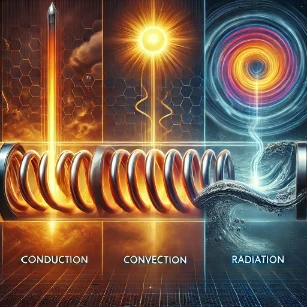
Heat transfer has three main modes: conduction through materials, convection by moving fluids, and radiation by electromagnetic waves.
This illustration summarises the three fundamental modes of heat transfer. On the left, conduction is shown through a heated solid rod, where thermal energy moves through the material. In the centre, convection is represented by swirling fluid currents and rising warm regions, showing heat carried by moving liquid or gas. On the right, radiation is shown as wave-like energy emitted from a hot object, reminding students that heat can also travel by electromagnetic waves, even across empty space.
What Heat Transfer Really Is
Heat transfer is not simply “heat moving around.” It is the study of energy movement caused by temperature difference. Heat always has a direction: from a hotter region toward a colder region, unless external work or a device forces energy to move against that natural direction.
This makes heat transfer one of the most practical parts of physics. It turns abstract ideas such as energy, temperature, entropy, and equilibrium into real design questions: How thick should insulation be? How large should a heat sink be? How fast should coolant flow? How much heat can a wall, pipe, battery, or heat exchanger safely carry?
| Heat-Transfer Question | Why It Matters | Example |
|---|---|---|
| How does heat move? | Identifies the mode of transfer | Conduction, convection, or radiation |
| How fast does heat move? | Determines heating or cooling rate | Chip cooling, cooking, battery safety |
| What blocks or allows heat flow? | Guides material and geometry choices | Insulation, heat sinks, thermal barriers |
| Which path dominates? | Reveals the thermal bottleneck | Contact resistance in electronics |
| How can heat be recovered? | Improves energy efficiency | Heat exchangers and waste heat recovery |
Learning Pathway: Heat Transfer
This Heat Transfer sub-hub is organised as a six-page learning pathway. Students should begin with the three physical modes, then move into modelling tools and practical systems.
Heat Conduction
Learn how heat moves through materials because of temperature gradients, particle interactions, lattice vibrations, and electron motion in metals.Heat Convection
Study how liquids and gases carry heat through natural buoyancy, forced flow, boundary layers, and mixing.Thermal Radiation
Explore how heat travels by electromagnetic waves, why infrared radiation matters, and why radiation can occur through vacuum.Thermal Resistance
See how heat-flow paths can be modelled like resistance networks, making walls, insulation, pipes, and heat sinks easier to analyse.Heat Exchangers
Understand how devices transfer heat between fluids in engines, power plants, HVAC systems, refrigeration, vehicles, and industrial processes.Combined Heat Transfer
Bring conduction, convection, radiation, thermal resistance, and heat exchangers together to analyse realistic thermal systems.The Three Main Modes of Heat Transfer
Heat transfer is commonly divided into three main modes: conduction, convection, and radiation. Each mode has its own physical mechanism, but real systems often use more than one mode at the same time.
| Mode | How Heat Moves | Needs Matter? | Common Example |
|---|---|---|---|
| Conduction | Through microscopic interactions inside matter | Yes | Heat moving through a metal rod |
| Convection | By moving fluid carrying thermal energy | Yes, a fluid | Warm air rising from a heater |
| Radiation | By electromagnetic waves | No | Sunlight warming the Earth |
Heat Conduction: Heat Through Materials
Heat Conduction is heat transfer through a material or between objects in direct contact. It occurs because energetic particles, atoms, molecules, and electrons transfer energy to neighbouring regions.
Conduction is especially important in solids because particles are closely packed. Metals usually conduct heat well because free electrons help carry thermal energy. Insulators such as foam, wool, wood, and glass fibre slow heat flow because they have low thermal conductivity and often trap air.
For steady one-dimensional conduction through a flat layer, a common equation is:
Q˙ = kA (Thot − Tcold)⁄L
| Factor | Effect on Conduction | Example |
|---|---|---|
| Thermal conductivity k | Higher k increases heat flow | Copper conducts better than plastic |
| Area A | Larger area increases heat flow | A large wall loses more heat than a small panel |
| Temperature difference | Larger difference increases heat flow | A hotter stove heats a pan faster |
| Thickness L | Greater thickness reduces heat flow | Thicker insulation reduces heat loss |
Heat Convection: Heat Carried by Moving Fluids
Heat Convection occurs when a moving fluid carries thermal energy from one place to another. A fluid may be a liquid or a gas, so convection appears in air currents, boiling water, ocean circulation, radiator cooling, HVAC systems, cooling fans, and weather systems.
Convection may be natural or forced. Natural convection is driven by buoyancy: warmer fluid often becomes less dense and rises, while cooler fluid sinks. Forced convection is driven by fans, pumps, blowers, or compressors.
A common model for convection between a surface and a fluid is Newton’s law of cooling:
Q˙ = hA(Ts − T∞)
| Type of Convection | What Drives It? | Example |
|---|---|---|
| Natural convection | Buoyancy from density differences | Warm air rising from a heater |
| Forced convection | Fan, pump, blower, or external flow | Water pump moving coolant through a radiator |
| Mixed convection | Both buoyancy and forced flow | Air movement around warm equipment in a room |
Thermal Radiation: Heat by Electromagnetic Waves
Thermal Radiation is heat transfer by electromagnetic waves, especially infrared radiation at ordinary temperatures. It does not require a material medium, which is why solar radiation can travel through space.
All objects above absolute zero emit thermal radiation. At room temperature, most of this radiation is invisible infrared. At high temperatures, objects may glow visibly red, orange, yellow, or white.
For an ideal blackbody, the Stefan-Boltzmann law is:
Q˙ = σAT4
For a real surface, emissivity ϵ is included:
Q˙ = ϵσAT4
| Radiation Idea | Meaning | Example |
|---|---|---|
| Emissivity | How effectively a surface emits radiation | Matte black surfaces often emit strongly |
| Reflectivity | How much radiation is reflected | Shiny foil reflects radiant heat |
| Absorptivity | How much radiation is absorbed | Dark surfaces absorb sunlight strongly |
| Temperature effect | Radiation increases strongly with T4 | Furnaces and fires radiate intensely |
Thermal Resistance: A Practical Modelling Tool
Thermal Resistance helps students analyse heat flow through layers, surfaces, interfaces, insulation, and cooling paths. It turns heat-transfer problems into a circuit-like model.
The basic thermal-resistance relationship is:
Q˙ = ΔT⁄Rth
For conduction through a flat layer:
Rcond = L⁄kA
For convection between a surface and a fluid:
Rconv = 1⁄hA
| Thermal Resistance Idea | Why It Helps | Example |
|---|---|---|
| Series resistance | Layers can be added step by step | Wall with plaster, insulation, and brick |
| Parallel resistance | Heat can split between paths | Wall with studs and insulation |
| Contact resistance | Interfaces may block heat flow | Processor touching a heat sink |
| Overall U-value | Combines several resistances | Building envelope or heat exchanger |
Heat Exchangers: Controlled Heat Movement Between Fluids
Heat Exchangers are devices designed to transfer heat between fluids, usually without mixing them. They are used in car radiators, refrigerators, air-conditioners, power plants, industrial processes, data centres, and renewable energy systems.
A heat exchanger often combines convection from the hot fluid to a wall, conduction through the wall, and convection from the wall to the cold fluid. This makes heat exchangers one of the best practical examples of combined heat transfer.
| Heat Exchanger Type | Main Feature | Typical Use |
|---|---|---|
| Shell-and-tube | Many tubes inside a shell | Power plants and chemical processing |
| Plate heat exchanger | Thin plates create compact flow channels | HVAC, food processing, heat recovery |
| Finned-tube exchanger | Fins increase air-side area | Radiators and air-conditioner coils |
| Microchannel exchanger | Small channels increase compact heat transfer | Electronics, vehicles, compact cooling |
Combined Heat Transfer: The Real-World Condition
Combined Heat Transfer occurs when conduction, convection, and radiation act together. In real systems, this is the normal situation rather than the exception.
A hot pipe conducts heat through its wall, convects heat to surrounding air, and radiates infrared energy to nearby surfaces. A building roof absorbs solar radiation, conducts heat through layers, convects with outdoor air, and emits infrared radiation to the sky. An oven cooks food by radiation from hot surfaces, convection from hot air, and conduction inside the food.
| System | Conduction | Convection | Radiation |
|---|---|---|---|
| Hot pipe | Through wall and insulation | Outer surface to air | Outer surface to surroundings |
| Building roof | Through roof layers | Air over roof surface | Solar gain and infrared emission |
| Electronic heat sink | Through chip, base, and fins | Air or liquid cooling | Surface radiation |
| Oven | Into tray and food | Hot air circulation | Hot walls and heating elements |
Thermal Properties of Materials
Heat transfer depends strongly on material properties. Some materials allow heat to move quickly. Others resist heat flow. Some store large amounts of thermal energy, while others change temperature quickly.
| Property | Meaning | Why It Matters |
|---|---|---|
| Thermal conductivity k | How easily heat conducts through a material | Important for insulation, cookware, walls, and heat sinks |
| Specific heat capacity cp | Energy needed to raise temperature per unit mass | Important for thermal storage and fluid heating |
| Density ρ | Mass per unit volume | Affects thermal storage per volume |
| Thermal diffusivity α | How quickly temperature changes spread | Important in transient heating and cooling |
| Emissivity ϵ | How effectively a surface emits radiation | Important in radiation, spacecraft, buildings, and thermal cameras |
Thermal diffusivity is commonly written as:
α = k⁄ρcp
A material with high thermal diffusivity responds quickly to temperature changes. A material with low thermal diffusivity warms or cools more slowly.
Heat Transfer in Engineering Applications
Heat transfer becomes especially important when thermal energy must be controlled for safety, efficiency, comfort, or performance. Engineers rarely ask only whether heat can move. They ask whether it moves too fast, too slowly, in the wrong direction, or through the wrong path.
Power Plants
Boilers, turbines, condensers, cooling towers, nuclear systems, and waste-heat recovery units all depend on controlled heat transfer.Automotive Engineering
Engines, exhaust systems, radiators, batteries, motors, inverters, and passenger cabins all require thermal management.Electronics Cooling
Microprocessors, power electronics, servers, phones, and sensors need heat sinks, fans, liquid cooling, and thermal interface materials.Refrigeration and Air Conditioning
Refrigerators, air-conditioners, chillers, and heat pumps move heat using refrigerants, compressors, evaporators, condensers, and heat exchangers.Renewable Energy Systems
Solar thermal systems, geothermal plants, biomass systems, thermal storage, and heat pumps all depend on efficient heat-transfer design.Buildings and Insulation
Walls, roofs, windows, air gaps, reflective barriers, shading, ventilation, and thermal bridges determine heating and cooling demand.Spacecraft and Satellites
In space, radiation and conduction dominate external thermal control because there is little or no air for ordinary convection.Food, Medicine, and Biology
Cooking, sterilisation, cryotherapy, fever management, tissue heating, and medical devices all involve controlled heat transfer.Thermal Insulation and Heat Control
Thermal insulation is used to slow unwanted heat transfer. It does not stop heat completely, but it increases resistance to heat flow. This is essential in buildings, industrial equipment, refrigeration, clothing, spacecraft, furnaces, and cryogenic storage.
| Insulation Type | Main Heat-Transfer Control | Example Use |
|---|---|---|
| Fibreglass and mineral wool | Traps air and slows conduction and convection | Building walls and roofs |
| Foam insulation | Low conductivity and trapped gas pockets | Refrigerators, panels, packaging |
| Reflective insulation | Reduces radiation exchange | Radiant barriers and spacecraft blankets |
| Vacuum insulation | Reduces conduction and convection | Thermos flasks and cryogenic tanks |
| Thermal barrier coatings | Protects surfaces from high temperature | Turbines, engines, furnaces |
Advanced Topics in Heat Transfer
After students understand conduction, convection, radiation, resistance models, and heat exchangers, they can begin exploring more advanced topics. These topics are important in university engineering, research, and modern technology.
Phase-Change Heat Transfer
Boiling, condensation, evaporation, melting, and freezing involve latent heat and often produce very strong heat-transfer effects.Heat Transfer Enhancement
Fins, surface roughness, turbulence promoters, extended surfaces, microchannels, and special fluids can increase heat-transfer rates.Transient Heat Transfer
Many systems change temperature with time, such as batteries during charging, buildings during the day, and food in an oven.Microscale and Nanoscale Heat Transfer
At very small scales, heat transfer may be influenced by molecular, quantum, interface, and size effects not visible in ordinary systems.Computational Heat Transfer
Simulation tools such as CFD and finite element analysis help predict temperature fields, flow patterns, and thermal stresses.Thermal Management of Energy Systems
Batteries, hydrogen systems, heat pumps, solar thermal receivers, and data centres require carefully integrated thermal design.Connections with Wider Thermodynamics
Heat transfer is closely connected with other parts of thermodynamics. It provides the practical pathway through which energy crosses system boundaries.
Laws of Thermodynamics
The laws explain conservation, direction, entropy, and limits; heat transfer explains the rate and mechanism of energy movement.Thermodynamic Cycles
Engines, refrigerators, turbines, and heat pumps depend on heat added, heat rejected, and work produced through cycles.Phase Equilibria and Phase Transitions
Boiling, condensation, freezing, melting, and sublimation involve heat transfer and latent heat.Statistical Thermodynamics
Microscopic particle motion and energy distribution help explain macroscopic thermal behaviour.Computational Thermodynamics
Modelling and simulation help predict heat flow, material behaviour, phase stability, and thermal performance in complex systems.Renewable and Sustainable Energy Thermodynamics
Thermal efficiency, waste heat recovery, solar heating, geothermal energy, and heat pumps all require heat-transfer understanding.Connections with Wider Physics and Science
Heat transfer also reaches beyond thermodynamics. Radiation links it with electromagnetic waves and optics. Convection links it with fluid mechanics and climate. Conduction links it with materials science and solid-state physics.
Physics
Heat transfer connects energy, temperature, matter, waves, fluids, and microscopic motion.Science
Thermal energy movement appears in Earth systems, biology, chemistry, astronomy, and environmental science.Physical Chemistry
Reaction rates, calorimetry, phase change, enthalpy, entropy, and free energy all involve thermal energy exchange.Electromagnetic Waves
Thermal radiation is electromagnetic radiation emitted because of temperature.Plasma Physics
High-temperature plasmas involve radiation, conduction, convection-like transport, and energy balance.Nuclear Fusion
Fusion systems require extreme thermal control, plasma heating, radiation management, and heat removal from reactor components.Why Study Heat Transfer?
Heat transfer helps students see how physics becomes design. It explains not only why temperature changes, but also how quickly changes occur and what can be done to control them.
It Explains Everyday Experience
Metal feels colder than wood, hot soup cools faster when stirred, sunlight warms skin, and blankets reduce heat loss because of heat-transfer principles.It Builds Engineering Judgement
Students learn when to use insulation, when to increase surface area, when to improve airflow, and when to reduce contact resistance.It Supports Energy Efficiency
Buildings, engines, industrial plants, refrigeration systems, and heat pumps all depend on controlling heat loss and heat recovery.It Protects Safety and Reliability
Overheating can damage engines, batteries, electronics, medical devices, aircraft, spacecraft, and industrial equipment.It Connects Physics with Technology
Thermal design appears in vehicles, data centres, power systems, manufacturing, climate control, and renewable energy.It Prepares Students for University
Heat transfer is essential for mechanical engineering, chemical engineering, materials science, aerospace, environmental engineering, and applied physics.Common Misunderstandings About Heat Transfer
Misunderstanding 1: Cold Flows from Cold Objects
Cold is not a substance that flows. Heat transfers from hotter regions to colder regions because of temperature difference.
Misunderstanding 2: Temperature and Heat Are the Same Thing
Temperature describes thermal state, while heat describes energy transferred because of temperature difference.
Misunderstanding 3: Insulation Stops Heat Completely
Insulation slows heat transfer. If a temperature difference remains, some heat transfer usually continues.
Misunderstanding 4: Radiation Happens Only When Objects Glow
Objects do not need to glow visibly to emit thermal radiation. Ordinary warm objects emit mostly invisible infrared radiation.
Misunderstanding 5: One Heat-Transfer Mode Acts Alone
Real systems often combine conduction, convection, and radiation. A single-mode model is often only a first approximation.
Key Terms
- Heat transfer
- The movement of thermal energy because of temperature difference.
- Conduction
- Heat transfer through matter by microscopic interactions such as particle collisions, lattice vibrations, and electron motion.
- Convection
- Heat transfer involving fluid motion.
- Radiation
- Heat transfer by electromagnetic waves.
- Thermal conductivity
- A material property that describes how easily heat conducts through a material.
- Convection coefficient
- A coefficient that describes how effectively heat transfers between a surface and a fluid.
- Emissivity
- A measure of how effectively a surface emits thermal radiation compared with an ideal blackbody.
- Thermal resistance
- A measure of how strongly a layer, surface, interface, or system resists heat flow.
- Heat exchanger
- A device that transfers heat between fluids, usually while keeping them separated.
- Combined heat transfer
- Heat transfer involving two or more modes acting together in the same system.
Frequently Asked Questions: Heat Transfer
What is heat transfer in physics?
Heat transfer is the movement of thermal energy from one region, body, or system to another because of a temperature difference.
What are the three main modes of heat transfer?
The three main modes are conduction, convection, and radiation. Conduction transfers heat through matter, convection transfers heat by fluid motion, and radiation transfers heat by electromagnetic waves.
What is heat conduction?
Heat conduction is heat transfer through a material or between materials in contact. It is especially important in solids such as metals, walls, cookware, and electronic components.
What is heat convection?
Heat convection is heat transfer by the motion of a fluid, such as air, water, oil, steam, or refrigerant.
What is thermal radiation?
Thermal radiation is heat transfer by electromagnetic waves. It does not require a material medium and can occur through vacuum.
What is thermal resistance?
Thermal resistance measures how strongly a material, layer, surface, or system resists heat flow.
What is a heat exchanger?
A heat exchanger is a device that transfers heat between fluids, usually without allowing them to mix.
What is combined heat transfer?
Combined heat transfer occurs when two or more modes, such as conduction, convection, and radiation, act together in the same system.
Why is heat transfer important in engineering?
Engineers use heat transfer to design engines, buildings, heat exchangers, electronics cooling systems, batteries, power plants, HVAC systems, and thermal protection systems.
How is heat transfer related to thermodynamics?
Thermodynamics explains energy, equilibrium, entropy, and limits. Heat transfer explains how thermal energy actually moves across materials, fluids, and surfaces.
Why is heat transfer important for sustainability?
Heat transfer affects energy efficiency, waste heat recovery, renewable energy systems, building performance, refrigeration, heat pumps, and industrial energy use.
Why should students study heat transfer before university?
Heat transfer prepares students for engineering, physics, materials science, environmental science, chemistry, energy systems, and many real-world design problems.
Review Questions and Answers
- What is heat transfer?Answer: Heat transfer is the movement of thermal energy from one region or object to another because of a temperature difference.
- What are the three main mechanisms of heat transfer?Answer: The three main mechanisms are conduction, convection, and radiation.
- How does conduction occur in solids?Answer: Conduction occurs when thermal energy is transferred through particle interactions, lattice vibrations, and, in metals, free electron motion.
- How does convection differ from conduction?Answer: Conduction transfers heat through microscopic interactions in matter, while convection transfers heat through the bulk motion of a fluid.
- How does radiation transfer energy?Answer: Radiation transfers energy by electromagnetic waves and does not require a material medium.
- Why does metal feel colder than wood at the same room temperature?Answer: Metal conducts heat away from the skin faster than wood, so it feels colder even when both materials have the same temperature.
- Why do fins improve heat dissipation?Answer: Fins increase surface area, allowing more heat to transfer to the surrounding fluid by convection and sometimes radiation.
- Why is vacuum a good insulator against conduction and convection?Answer: Vacuum has very few particles, so conduction and convection are greatly reduced. Radiation can still occur through vacuum.
Thought-Provoking Questions and Answers
- Why is heat transfer more than a set of formulas?Answer: Heat transfer requires judgement about materials, geometry, surfaces, fluids, time, safety, and the dominant heat-flow path. The formula is only useful after the physical situation is understood.
- Why does heat transfer matter for renewable energy?Answer: Solar thermal systems, geothermal systems, heat pumps, thermal storage, and waste heat recovery all depend on capturing, moving, storing, or rejecting heat efficiently.
- How can better heat transfer improve urban infrastructure?Answer: Efficient building envelopes, district heating, heat recovery, reflective surfaces, ventilation design, and heat-pump systems can reduce energy demand and improve comfort.
- Why is thermal management difficult in microelectronics?Answer: Microelectronic devices generate heat in very small volumes, creating high heat flux and hot spots that require careful conduction, convection, and interface design.
- Why does spacecraft thermal control rely strongly on radiation?Answer: In space there is little or no air for ordinary convection, so spacecraft must control temperature using radiation, conduction paths, insulation, coatings, and heaters.
- How can heat transfer research support environmental sustainability?Answer: Better heat-transfer design can reduce waste heat, improve industrial efficiency, support low-energy buildings, enable better heat pumps, and reduce the energy needed for cooling and heating.
Numerical Problems and Solutions
- A wall is 0.20 m thick, has thermal conductivity 1.5 W/(m·K), area 10 m2, and temperature difference 50 K. Calculate the heat conduction rate.Solution:
- Use Q˙ = kA ΔT⁄L.
- Q˙ = (1.5)(10) 50⁄0.20.
- Q˙ = 15 × 250 = 3750 W.
Answer: The heat conduction rate is 3750 W. - A surface at 80°C loses heat to air at 20°C with convection coefficient h = 25 W/(m2·K). Calculate the heat transfer per unit area.Solution:
- Use q″ = h(Ts − T∞).
- q″ = 25(80 − 20).
- q″ = 25 × 60 = 1500 W/m2.
Answer: The heat transfer per unit area is 1500 W/m2. - A black surface at 500 K radiates to surroundings at 300 K. Estimate the radiative heat flux using σ = 5.67 × 10⁻⁸ W/(m2·K4).Solution:
- Use q″ = σ(T14 − T24).
- 5004 = 6.25 × 10¹⁰ and 3004 = 8.10 × 10⁹.
- Difference = 5.44 × 10¹⁰.
- q″ ≈ (5.67 × 10⁻⁸)(5.44 × 10¹⁰).
- q″ ≈ 3085 W/m2.
Answer: The radiative heat flux is approximately 3085 W/m2. - A composite wall has two layers: 0.10 m brick with k = 0.70 W/(m·K), and 0.05 m insulation with k = 0.04 W/(m·K). Calculate the total thermal resistance per unit area.Solution:
- Use R′ = L1⁄k1 + L2⁄k2.
- R′ = 0.10⁄0.70 + 0.05⁄0.04.
- R′ = 0.143 + 1.25 = 1.393 m2·K/W.
Answer: The total thermal resistance per unit area is 1.393 m2·K/W. - A heat exchanger transfers 10 kW across an area of 5 m2 with effective temperature difference 20 K. Find the overall heat-transfer coefficient U.Solution:
- Use Q˙ = UAΔT.
- Rearrange: U = Q˙⁄AΔT.
- Convert 10 kW = 10000 W.
- U = 10000⁄(5)(20) = 100 W/(m2·K).
Answer: The overall heat-transfer coefficient is 100 W/(m2·K). - Water removes 20 kW of heat in a pipe. If mass flow rate is 0.50 kg/s and cp = 4180 J/(kg·K), find the temperature rise.Solution:
- Use Q˙ = m˙cpΔT.
- Rearrange: ΔT = Q˙⁄m˙cp.
- ΔT = 20000⁄(0.50)(4180).
- ΔT ≈ 9.57 K.
Answer: The water temperature rises by approximately 9.57 K.
Summary
Heat transfer explains how thermal energy moves because of temperature difference. It has three main modes: conduction through matter, convection by moving fluids, and radiation by electromagnetic waves.
This sub-hub introduces six important parts of the Heat Transfer cluster: Heat Conduction, Heat Convection, Thermal Radiation, Thermal Resistance, Heat Exchangers, and Combined Heat Transfer. Together, these pages help students move from basic heat-flow ideas to realistic thermal systems.
Heat transfer is essential in physics, engineering, chemistry, materials science, environmental design, energy technology, vehicles, buildings, electronics, spacecraft, and human comfort. It is one of the clearest examples of how scientific principles become practical design decisions.
Reflection Question
If almost every useful technology must either move heat, block heat, store heat, or reject heat, how should future engineers design thermal systems that are efficient, safe, sustainable, and comfortable for human life?