
Combined heat transfer describes real thermal systems in which conduction, convection, and radiation occur together. In textbooks, these three modes are often introduced separately. In real life, however, heat rarely chooses only one path. A hot pipe conducts heat through its wall, loses heat to surrounding air by convection, and emits infrared radiation to nearby surfaces at the same time.
This page belongs to the Heat Transfer cluster within Thermodynamics. It brings together ideas from Heat Conduction, Heat Convection, Thermal Radiation, Thermal Resistance, and Heat Exchangers.
The central idea is that heat-transfer modes often act as a network. Heat may conduct through a solid, convect into a moving fluid, radiate to nearby surfaces, and then conduct again through another layer. Combined heat transfer teaches students how to identify these linked steps, decide which ones are important, and build a practical thermal model.
This topic is important in buildings, engines, ovens, furnaces, electronics, batteries, spacecraft, heat exchangers, human thermal comfort, climate systems, fire safety, and energy-efficient design. It is where heat-transfer theory becomes realistic.
What Combined Heat Transfer Really Means
Combined heat transfer means that two or more heat-transfer modes occur in the same system. A single physical object may involve conduction inside solids, convection at fluid surfaces, and radiation between exposed surfaces.
| Mode | How Heat Moves | Where It Often Appears in Combined Systems |
|---|---|---|
| Conduction | Through matter by microscopic energy transfer | Walls, pipes, fins, insulation, circuit boards, machine parts |
| Convection | Between a surface and a moving fluid | Air cooling, water cooling, ventilation, coolant loops, heat exchangers |
| Radiation | By electromagnetic waves | Hot surfaces, furnaces, sunlight, spacecraft, fire, radiant barriers |
A combined heat-transfer problem is not solved by naming the modes only. The important task is to ask how the heat flows, what resistance each step provides, and which mode controls the overall rate.
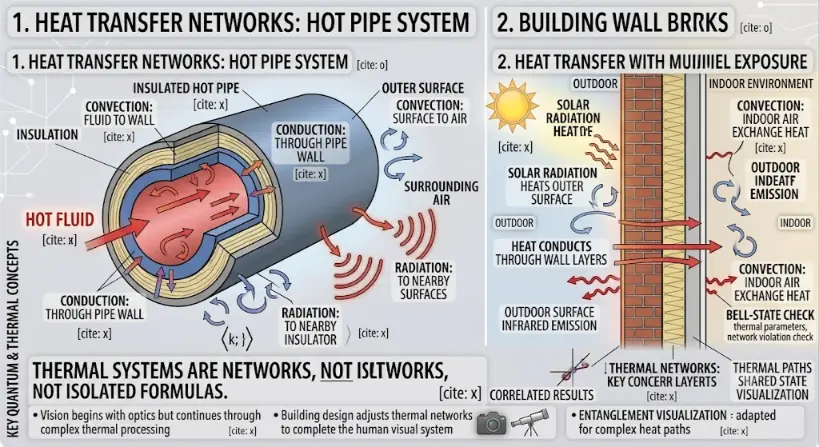
A visual mapping of multiple heat-transfer modes within typical engineering and architectural systems, illustrating how conduction, convection, and radiation act as a thermal network.
The image is a comprehensive multi-panel scientific infographic titled “KEY QUANTUM & THERMAL CONCEPTS.” It uses clean, diagrammatic illustrations and charts against a light gray background with subtle network and circuit patterns. It is organized into two primary vertical panels, linked by a large central conceptual statement.
Part 1: Heat Transfer Networks: Hot Pipe System
This panel provides a complete visual description of how heat moves across the materials of an active hot fluid transport system:
- Cross-Section View: A dynamic 3D diagram shows an “INSULATED HOT PIPE.” A large red arrow labeled “HOT FLUID” enters the pipe from the left, representing fluid flow.
- Heat Flow Layers and Methods: Arrows and labels explicitly trace four modes of heat transfer:
- Swirling arrows from the hot fluid to the internal surface are labeled “CONVECTION: FLUID TO WALL”.
- Arrows moving directly through the thick blue-gray inner pipe wall are labeled “CONDUCTION: THROUGH PIPE WALL”.
- Arrows continuing through the subsequent yellow insulation layer are labeled “CONDUCTION: THROUGH INSULATION”.
- Swirling arrows from the exterior insulation surface into the “SURROUNDING AIR” are labeled “CONVECTION: SURFACE TO AIR”.
- Surface Radiation: Multiple large, curved wave arrows emanate outward from the outer insulation surface and are labeled “RADIATION: TO NEARBY SURFACES” and “RADIATION: TO NEARBY INSULATOR”.
Part 2: Building Wall with Multiple Exposure
This panel uses a multi-layer wall diagram to illustrate complex, environmentally exposed thermal systems, showing them as a network rather than isolated formulas:
- Brick Wall Cross-Section: A detailed schematic shows a “BUILDING WALL WITH MULTIPLE LAYERS,” including brick, insulation, and interior paneling. It is split vertically into “OUTDOOR ENVIRONMENT” and “INDOOR ENVIRONMENT.”
- Integrated Transfer Mapping: Multiple heat flow diagrams are visual metaphors:
- A sun icon with a spectrum bar emits “SOLAR RADIATION” which “HEATS OUTER SURFACE”. Swirling blue-gray arrows from the outdoor air are labeled “CONVECTION: OUTDOOR AIR”. Red wave arrows from the outdoor surface indicate “OUTDOOR SURFACE INFRARED EMISSION”. Arrows labeled “HEAT CONDUCTS THROUGH WALL LAYERS” track conduction.
- In the indoor section, swirling blue-gray arrows show “CONVECTION: INDOOR AIR EXCHANGE HEAT”. Red wave arrows indicate “INDOOR SURFACE INFRARED EMISSION”.
Why Real Systems Usually Combine Heat-Transfer Modes
Real objects have surfaces, thickness, surroundings, and temperature differences. Because of this, heat often needs to cross several physical regions before reaching its final destination.
| System | Conduction | Convection | Radiation |
|---|---|---|---|
| Hot pipe in air | Through pipe wall and insulation | Outer surface to air | Outer surface to nearby walls |
| Building wall | Through plaster, insulation, brick, and concrete | Indoor and outdoor air films | Solar gain and infrared emission |
| Electronic heat sink | From chip through base and fins | Air moving between fins | Small radiation from exposed surfaces |
| Oven | Through tray and food | Hot air around food | Radiation from heating elements and walls |
| Human body | Through skin and clothing layers | Air movement around the body | Infrared exchange with surroundings |
| Spacecraft | Through panels and structures | Almost none outside spacecraft | Solar absorption and infrared emission to space |
This table shows why combined heat transfer is not an advanced exception. It is the normal condition for many practical systems.
The Thermal-Resistance View
One of the clearest ways to analyse combined heat transfer is to use thermal resistance. Heat flow is driven by temperature difference and limited by the resistances along the path.
The basic relationship is:
Q˙ = ΔT⁄Rtotal
Here, Q˙ is the heat-transfer rate, ΔT is the temperature difference, and Rtotal is the total thermal resistance of the path.
For a simple combined path, the total resistance may include convection, conduction, and another convection step:
Rtotal = Rconv,1 + Rcond + Rconv,2
| Resistance | Common Expression | Meaning |
|---|---|---|
| Conduction resistance | Rcond = L⁄kA | Resistance through a flat solid layer |
| Convection resistance | Rconv = 1⁄hA | Resistance between a surface and a fluid |
| Radiation resistance | Rrad = 1⁄hradA | Approximate resistance for linearised radiation exchange |
| Contact resistance | Often measured or estimated | Resistance caused by imperfect surface contact |
Combined Conduction and Convection
Many systems combine conduction through a solid with convection at one or both surfaces. A wall separating warm indoor air from cold outdoor air is a common example.
A simple wall with convection on both sides can be represented as:
Rtotal = 1⁄hiA + L⁄kA + 1⁄hoA
The heat-transfer rate is then:
Q˙ = (Ti − To)⁄Rtotal
| Term | Physical Meaning |
|---|---|
| 1⁄hiA | Indoor convection resistance |
| L⁄kA | Conduction resistance through the wall |
| 1⁄hoA | Outdoor convection resistance |
| Ti − To | Temperature difference between indoor and outdoor air |
This model helps students see why both material choice and surface air movement matter. A wall with good insulation may still lose heat through poor surface conditions, thermal bridges, or air leakage around the edges.
Combined Convection and Radiation from a Surface
A hot surface exposed to air usually loses heat by both convection and radiation. Convection carries heat into the surrounding fluid, while radiation sends electromagnetic energy to nearby surfaces.
The total heat loss may be approximated as:
Q˙total = Q˙conv + Q˙rad
Using common surface models:
Q˙conv = hA(Ts − T∞)
Q˙rad = ϵσA(Ts4 − Tsur4)
| Quantity | Meaning |
|---|---|
| Ts | Surface temperature |
| T∞ | Bulk fluid temperature |
| Tsur | Surrounding surface or radiation temperature |
| h | Convection heat-transfer coefficient |
| ϵ | Surface emissivity |
| σ | Stefan-Boltzmann constant |
At modest temperatures, convection may dominate. At high temperatures, radiation can become very strong because of the fourth-power temperature dependence.
Linearised Radiation and Effective Heat-Transfer Coefficient
Radiation equations contain fourth powers of absolute temperature, so they are not naturally linear. For some engineering calculations, radiation can be approximated using an effective radiation coefficient hrad:
Q˙rad ≈ hradA(Ts − Tsur)
Then convection and radiation from the same surface can be combined:
Q˙total ≈ (hconv + hrad)A(Ts − Tenv)
This approximation is useful when the radiation surroundings and fluid temperature are similar, or when a simplified first estimate is enough.
| Approach | Usefulness | Limitation |
|---|---|---|
| Exact radiation expression | More accurate for large temperature differences | Nonlinear and more complex |
| Linearised radiation coefficient | Easier to combine with convection | Approximate over a limited temperature range |
| Combined coefficient hconv + hrad | Useful for surface heat-loss estimates | Can hide differences between fluid and radiation surroundings |
Overall Heat-Transfer Coefficient
When several heat-transfer steps act together, engineers often combine them into an overall heat-transfer coefficient U.
The common form is:
Q˙ = UAΔT
For heat exchangers, walls, pipe insulation, and equipment surfaces, U represents the combined effect of many resistances.
In resistance form:
1⁄UA = Rtotal
| Situation | What U Combines |
|---|---|
| Building wall | Indoor convection, wall conduction, outdoor convection, sometimes radiation |
| Heat exchanger | Hot-side convection, wall conduction, fouling, cold-side convection |
| Insulated pipe | Internal convection, pipe conduction, insulation conduction, outer convection and radiation |
| Electronic cooling path | Chip conduction, contact resistance, heat spreader, heat sink, air convection, surface radiation |
The value of U is useful because it converts a complex heat-transfer path into one practical coefficient. However, students should remember that U is not a pure material property. It depends on geometry, surfaces, fluids, flow conditions, fouling, and temperature range.
Example System: A Hot Pipe Losing Heat
A hot pipe in air is a classic combined heat-transfer system. Hot fluid inside the pipe transfers heat to the pipe wall by convection. Heat conducts through the pipe wall and any insulation. The outer surface then loses heat by convection to air and radiation to surrounding surfaces.
| Step | Mode | Physical Location |
|---|---|---|
| Fluid to inner pipe wall | Convection | Inside pipe |
| Through pipe wall | Conduction | Pipe material |
| Through insulation | Conduction | Insulation layer |
| Outer surface to air | Convection | External air |
| Outer surface to surrounding surfaces | Radiation | Radiation exchange |
This example shows why pipe insulation is not only about the insulation material. Surface temperature, air movement, emissivity, pipe size, and surrounding temperature also matter.
Example System: Electronics Cooling
Electronics cooling is another important combined heat-transfer problem. A chip produces heat internally. Heat conducts through the chip package, thermal interface material, heat spreader, and heat sink. Then air or liquid removes heat by convection. Some heat may also be lost by radiation from exposed surfaces.
| Cooling Path Part | Main Heat-Transfer Issue |
|---|---|
| Chip material | Internal conduction and heat spreading |
| Thermal interface material | Contact resistance and surface gaps |
| Heat sink base | Conduction from base to fins |
| Fins | Conduction along fins and convection to air |
| Fan or liquid flow | Forced convection and pressure drop |
| Outer surfaces | Radiation, usually secondary at moderate temperatures |
This is why one poor interface can make an otherwise good cooling design fail. Heat-transfer design must consider the entire pathway, not only the heat sink or fan.
Example System: Building Heat Gain and Heat Loss
A building envelope combines all three heat-transfer modes. Solar radiation heats roofs, walls, and windows. Heat conducts through walls, windows, and insulation. Air movement creates convection at indoor and outdoor surfaces. Surfaces also exchange infrared radiation with the sky, ground, neighbouring buildings, and indoor objects.
| Building Component | Combined Heat-Transfer Behaviour |
|---|---|
| Roof | Absorbs solar radiation, emits infrared radiation, conducts heat inward, convects with outdoor air |
| Wall | Conducts through layers and exchanges heat with air on both sides |
| Window | Transmits solar radiation, conducts through glass, convects at surfaces, radiates to surroundings |
| Insulation | Reduces conduction and convection within trapped air spaces |
| Ventilation | Moves heat by air exchange and forced convection |
Good building design therefore uses combined thinking: insulation, reflective surfaces, shading, air sealing, ventilation, window coatings, thermal mass, and indoor comfort all interact.
Example System: Cooking and Ovens
Cooking is a familiar example of combined heat transfer. In an oven, hot air transfers heat to food by convection. Heating elements and hot oven walls radiate energy toward the food. Heat then conducts inward through the food.
| Cooking Situation | Dominant Combined Modes |
|---|---|
| Oven baking | Convection from hot air, radiation from walls, conduction inside food |
| Frying pan | Conduction from pan to food, convection within oil or moisture |
| Grilling | Strong radiation from hot surfaces, convection from hot gases, conduction inside food |
| Boiling | Convection in water, conduction into food, phase-change heat transfer |
The same meal can cook differently depending on which heat-transfer mode dominates. This is why baking, grilling, boiling, steaming, and frying produce different textures and temperature patterns.
Example System: Human Thermal Comfort
Human thermal comfort depends on combined heat transfer between the body, clothing, air, surrounding surfaces, moisture, and metabolism.
| Heat-Transfer Route | Human Comfort Meaning |
|---|---|
| Conduction | Heat transfer through clothing, shoes, seats, floors, and bedding |
| Convection | Air movement removes or supplies heat at the skin and clothing surface |
| Radiation | The body exchanges infrared radiation with walls, windows, sky, and nearby surfaces |
| Evaporation | Sweat evaporation removes heat through phase change |
| Metabolism | The body generates internal heat through biological processes |
This explains why a room can feel uncomfortable even when air temperature looks acceptable. Cold windows, hot walls, strong drafts, humidity, clothing, and radiant temperature all affect comfort.
Deciding Which Mode Dominates
In combined heat-transfer analysis, students should not assume all modes are equally important. The first task is often to estimate which mode controls the heat-transfer rate.
| Clue | Likely Important Mode | Example |
|---|---|---|
| Large solid thickness or insulation | Conduction resistance | Heat loss through a thick wall |
| Moving air or water | Convection | Fan-cooled heat sink or coolant loop |
| Very hot surfaces | Radiation | Furnace, flame, red-hot metal |
| Shiny or reflective surfaces | Radiation surface effects | Radiant barrier or polished metal shield |
| Small contact area between solids | Contact resistance | Chip-to-heat-sink interface |
| Large exposed surface area | Convection and radiation | Heat sink fins or radiator panels |
A useful habit is to ask: where is the biggest temperature drop? The largest temperature drop often occurs across the largest thermal resistance, which may be the bottleneck in the system.
Thermal Circuits with Parallel Heat Paths
Combined heat transfer may involve both series and parallel paths. For example, a hot surface may lose heat to air by convection and to surrounding walls by radiation at the same time. These are parallel paths because both occur from the same surface to the environment.
For parallel paths:
Q˙total = Q˙1 + Q˙2 + Q˙3 + &cdots;
If the paths can be represented by resistances with the same temperature difference:
1⁄Req = 1⁄R1 + 1⁄R2 + 1⁄R3 + &cdots;
| Parallel Heat-Transfer Situation | Meaning |
|---|---|
| Convection and radiation from one surface | Heat leaves by two paths at the same time |
| Wall with studs and insulation | Heat passes through different materials side by side |
| Multiple fins on a heat sink | Heat leaves through many extended surfaces |
| Battery pack with several cooling paths | Heat may split through casing, coolant plate, and neighbouring cells |
Thermal Bridges in Combined Heat Transfer
A thermal bridge is a lower-resistance path that allows heat to bypass insulation or the intended thermal pathway. In combined heat-transfer problems, thermal bridges can strongly change real performance.
| Thermal Bridge | Combined Heat-Transfer Effect |
|---|---|
| Metal stud in insulated wall | Conduction through metal increases heat loss despite insulation |
| Window frame | Conduction, convection, and radiation near frame affect comfort and condensation |
| Bolts through insulation | Heat bypasses insulation through metal fasteners |
| Battery module casing | Heat may concentrate through unintended conductive paths |
Thermal bridges show why real systems cannot always be understood from material R-values alone. Geometry, joints, fasteners, and interfaces matter.
Transient Combined Heat Transfer
Many combined heat-transfer systems are not steady. Their temperatures change with time. A phone heats up during use, a house warms in the afternoon sun, a battery pack heats during fast charging, and food gradually cooks from outside to inside.
| Transient System | What Changes with Time? |
|---|---|
| Electronic device | Chip, casing, heat sink, and surrounding air temperatures rise during operation |
| Building wall | Solar radiation, outdoor temperature, and indoor response vary throughout the day |
| Food in an oven | Surface temperature rises first, then heat conducts inward |
| Battery during charging | Internal heat generation, conduction, and coolant removal vary over time |
| Spacecraft surface | Solar exposure and radiation to space change with orbit and orientation |
Transient combined heat transfer may require thermal capacitance, heat generation, time-dependent boundary conditions, and numerical simulation. Even then, the same basic modes remain: conduction, convection, and radiation.
Combined Heat Transfer in High-Temperature Systems
At high temperatures, radiation often becomes much more important. Furnaces, combustion chambers, kilns, engines, turbines, and fire environments may involve strong radiation from flames, gases, walls, and hot surfaces.
| High-Temperature System | Combined Heat-Transfer Features |
|---|---|
| Industrial furnace | Radiation from hot walls and flames, convection from hot gases, conduction into materials |
| Gas turbine blade | Hot-gas convection, internal cooling, conduction through blade, radiation at high temperature |
| Fire exposure | Radiation from flames, convection from hot gases, conduction into structures |
| Re-entry heat shield | Convection and radiation from high-temperature flow, conduction through protective layers |
In such systems, ignoring radiation can lead to serious underestimation of heat load, material temperature, and safety risk.
Combined Heat Transfer in Low-Temperature and Space Systems
In low-temperature systems and space systems, radiation and conduction paths must be controlled carefully. Cryogenic tanks, satellites, telescopes, and vacuum systems may have little or no convection, so radiation and conduction through supports become dominant.
| System | Important Combined Effects |
|---|---|
| Cryogenic storage tank | Radiation shielding, vacuum insulation, conduction through supports |
| Satellite | Solar absorption, infrared emission, conduction through structure |
| Space telescope | Radiation cooling, sun shields, conduction isolation, low-temperature detectors |
| Vacuum chamber | No ordinary convection, so radiation and support conduction matter strongly |
These examples show that combined heat transfer is not only about ordinary air and walls. It also matters in extreme environments where one mode may disappear and another becomes dominant.
Everyday Examples of Combined Heat Transfer
Hot Coffee Cooling
Heat leaves the cup by convection to air, radiation to surroundings, conduction through the cup, and evaporation from the surface.House Heating and Cooling
Walls, windows, roofs, air movement, sunlight, and infrared radiation all shape indoor temperature.Cooking in an Oven
Radiation from hot surfaces, convection from air, and conduction inside food act together.Computer Cooling
Heat conducts through chips and heat sinks, convects to air, and radiates slightly from surfaces.Car Radiator
Hot coolant convects heat to tubes, heat conducts through metal, and air removes heat by forced convection.Warm Clothing
Clothing reduces conduction and convection, while the body also exchanges infrared radiation with surroundings.Applications of Combined Heat Transfer
Combined heat transfer appears whenever heat moves through real objects, surfaces, fluids, and surroundings. It is especially important in design problems where simplified single-mode analysis is not enough.
Building Energy Design
Combined analysis helps design insulation, windows, roofs, shading, ventilation, and radiant barriers for comfort and efficiency.Electronics and Data Centres
Cooling systems must manage conduction through components, convection to air or liquid, and sometimes radiation inside enclosures.Electric Vehicles and Batteries
Battery packs combine internal heat generation, conduction between cells, convection to coolant, and thermal runaway protection.Industrial Furnaces
High-temperature processes involve strong radiation, gas convection, and conduction into materials and furnace walls.Heat Exchangers
Heat exchangers combine convection on both fluid sides with conduction through walls and fouling resistance.Spacecraft Thermal Control
Spacecraft use conduction pathways, radiation surfaces, insulation blankets, and solar control coatings.Human Comfort and Safety
Thermal comfort, protective clothing, fire exposure, and medical heating or cooling all involve multiple heat-transfer modes.Renewable Energy Systems
Solar thermal collectors, geothermal systems, heat pumps, and thermal storage all require combined heat-transfer design.Challenges and Practical Limitations
Combined heat transfer is realistic, but it is also more difficult than studying each mode separately. The main challenge is not writing more equations, but deciding which effects matter most and how they interact.
| Challenge | Why It Matters | Example |
|---|---|---|
| Multiple modes act together | Ignoring one mode may give a poor prediction | Radiation in a hot furnace |
| Nonlinear radiation | Radiation depends on T4 | High-temperature surfaces |
| Unknown convection coefficient | h depends on flow, geometry, and fluid properties | Air cooling around complex equipment |
| Contact resistance | Interfaces can dominate heat flow | Processor and heat sink connection |
| Thermal bridges | Heat may bypass intended insulation | Metal framing in buildings |
| Transient behaviour | Temperatures change with time | Battery pack heating during fast charging |
| Material property changes | Conductivity, emissivity, and heat capacity may vary with temperature | Fire protection and high-temperature insulation |
| Geometry complexity | Heat may flow in two or three dimensions | Electronics packages and building corners |
The practical lesson is that combined heat-transfer models should be built carefully. Start simple, identify the dominant heat paths, then add complexity only where it improves understanding or design accuracy.
Future Directions and Emerging Trends
Combined heat transfer is becoming more important because modern systems are compact, power-dense, energy-conscious, and often exposed to demanding environments.
Multiphysics Simulation
Advanced software combines conduction, convection, radiation, fluid flow, heat generation, and structural effects in one model.Battery Thermal Safety
Electric vehicles require combined models of heat generation, conduction, coolant flow, radiation, and failure propagation.Passive Building Cooling
Designers combine reflective roofs, insulation, natural ventilation, shading, and radiative cooling surfaces.Advanced Electronics Cooling
High-performance chips require careful control of interface resistance, heat spreading, liquid convection, and enclosure heat rejection.Space Thermal Engineering
Spacecraft rely on radiation control, conduction isolation, multilayer insulation, and temperature-dependent surface coatings.High-Temperature Materials
Turbines, furnaces, reactors, and heat shields require combined analysis of gas convection, radiation, and conduction through protective layers.AI-Assisted Thermal Optimisation
Machine learning and optimisation can help identify better heat paths, insulation layouts, cooling designs, and surface coatings.Thermal Metamaterials
Engineered structures may guide heat flow in designed directions, controlling conduction and radiation in unusual ways.Connections with Wider Physics and Technology
Combined heat transfer connects all major heat-transfer modes with real engineering systems, environmental design, energy technology, and thermal safety.
Thermodynamics
Combined heat transfer applies thermodynamic energy ideas to systems where heat moves through matter, fluids, and radiation fields.Heat Transfer
This page brings together the three major heat-transfer modes into realistic system analysis.Heat Conduction
Conduction moves heat through solid layers, fins, walls, pipe materials, food, bodies, and electronic components.Heat Convection
Convection transfers heat between surfaces and fluids in fans, pumps, ventilation, cooling loops, and natural circulation.Thermal Radiation
Radiation transfers heat by electromagnetic waves and becomes especially important in sunlight, space, fire, and high-temperature systems.Thermal Resistance
Thermal resistance provides the circuit-like language needed to combine heat-transfer paths.Heat Exchangers
Heat exchangers are practical combined systems involving convection, conduction, fouling resistance, and sometimes radiation.Engineering Thermodynamics
Engines, power systems, HVAC, refrigeration, turbines, and energy systems require combined heat-transfer thinking.Learning Pathway Within Heat Transfer
Combined Heat Transfer is the final page in this Heat Transfer pathway. It helps students bring together the individual modes into practical models of real systems.
Heat Conduction
Learn how heat moves through materials by molecular interactions, electron motion, and temperature gradients.Heat Convection
Study how fluids transfer heat through natural motion, forced flow, boundary layers, and mixing.Thermal Radiation
Explore how heat travels by electromagnetic waves, even through empty space.Thermal Resistance
Learn how resistance models help analyse heat flow through layers, walls, insulation, interfaces, and cooling paths.Heat Exchangers
See how devices transfer heat between fluids in engines, power plants, HVAC systems, refrigeration, and industry.Combined Heat Transfer
Current page. Understand how conduction, convection, and radiation work together in real thermal systems.Quick Check: Combined Heat Transfer
Quick Check: Multiple Heat-Transfer Modes
Q1. Why is combined heat transfer more realistic than studying conduction, convection, and radiation separately?
Most real systems contain solids, fluids, surfaces, and surroundings, so heat often conducts, convects, and radiates at the same time.
Q2. In a hot pipe exposed to air, which heat-transfer modes are usually involved?
Heat may convect from the hot fluid to the pipe wall, conduct through the pipe and insulation, convect from the outer surface to air, and radiate to nearby surfaces.
Q3. Why is thermal resistance useful in combined heat-transfer problems?
Thermal resistance lets different heat-transfer steps be combined into a circuit-like model, making it easier to find the main bottleneck.
Q4. Why can radiation become important at high temperature?
Radiation depends strongly on absolute temperature through a fourth-power relationship, so it can become very large in furnaces, fires, and high-temperature equipment.
Common Misunderstandings About Combined Heat Transfer
Misunderstanding 1: A System Has Only One Heat-Transfer Mode
Most real systems involve more than one mode. A wall, oven, pipe, heat sink, or human body may involve conduction, convection, radiation, and sometimes evaporation or heat generation.
Misunderstanding 2: The Strongest-Looking Mode Always Dominates
The visually obvious mode is not always the limiting factor. A large temperature drop across a hidden interface or insulation layer may control the heat-transfer rate.
Misunderstanding 3: Radiation Can Always Be Ignored at Room Temperature
Radiation may be smaller than convection in many room-temperature systems, but it can still affect comfort, surface temperature, night-sky cooling, low-emissivity windows, and thermal imaging.
Misunderstanding 4: Better Insulation Solves Every Heat-Transfer Problem
Insulation reduces conduction, but heat may still enter through air leakage, radiation, thermal bridges, windows, or poor surface design.
Misunderstanding 5: More Cooling Always Means Better Design
Stronger cooling may require larger fans, higher pump power, more materials, more noise, or higher cost. Good design balances thermal performance with overall system efficiency.
Key Terms
- Combined heat transfer
- Heat transfer involving two or more modes, such as conduction, convection, and radiation, acting together in one system.
- Thermal pathway
- The route through which heat moves from one region to another.
- Thermal resistance network
- A circuit-like model that represents heat-flow paths using thermal resistances.
- Series resistance
- Thermal resistances arranged one after another along the same heat-flow path.
- Parallel resistance
- Thermal resistances arranged so heat can split among multiple paths.
- Overall heat-transfer coefficient
- A coefficient U that represents the combined effect of multiple heat-transfer resistances.
- Thermal bridge
- A low-resistance path that allows heat to bypass insulation or the intended thermal barrier.
- Linearised radiation coefficient
- An approximate coefficient used to express radiation heat transfer in a form similar to convection.
- Transient heat transfer
- Heat transfer in which temperatures change with time.
- Thermal bottleneck
- The part of a heat-transfer path that provides the largest resistance or controls the overall heat-transfer rate.
- Multiphysics simulation
- A simulation that combines heat transfer with other physical effects such as fluid flow, electricity, structures, or radiation.
- Surface boundary condition
- A mathematical description of how a surface exchanges heat with its surroundings by convection, radiation, prescribed temperature, or heat flux.
Frequently Asked Questions: Combined Heat Transfer
What is combined heat transfer?
Combined heat transfer occurs when two or more heat-transfer modes, such as conduction, convection, and radiation, act together in the same system.
Why is combined heat transfer important?
It is important because most real thermal systems do not involve only one heat-transfer mode. Buildings, engines, ovens, heat exchangers, electronics, and spacecraft all involve combined effects.
What is a simple example of combined heat transfer?
A hot pipe in air is a simple example. Heat conducts through the pipe wall, convects to air, and radiates to nearby surfaces.
How does thermal resistance help in combined heat-transfer problems?
Thermal resistance helps represent conduction, convection, contact resistance, and sometimes radiation as a circuit-like network, making heat-flow paths easier to analyse.
Can convection and radiation happen at the same surface?
Yes. A surface exposed to air can lose heat by convection to the air and by radiation to surrounding surfaces at the same time.
When does radiation become especially important?
Radiation becomes especially important at high temperatures, in space, in solar heating, in fire exposure, and where surfaces have strong emissivity effects.
What is an overall heat-transfer coefficient?
The overall heat-transfer coefficient U represents the combined effect of multiple resistances in a heat-transfer path.
What is a thermal bridge?
A thermal bridge is a low-resistance path that allows heat to bypass insulation or an intended thermal barrier.
Why is combined heat transfer important in buildings?
Buildings exchange heat through conduction in walls, convection with air, solar radiation, infrared radiation, windows, ventilation, and thermal bridges.
Why is combined heat transfer important in electronics?
Electronics cooling involves conduction through chips and interfaces, convection to air or liquid, and sometimes radiation from surfaces.
Is combined heat transfer always steady?
No. Many systems are transient, meaning temperatures change with time, such as batteries, buildings, food, and electronic devices.
Why should students learn combined heat transfer?
It helps students move from separate textbook modes to realistic thermal analysis in buildings, machines, energy systems, electronics, and environmental design.
Review Questions and Answers
- What does combined heat transfer mean?Answer: It means two or more heat-transfer modes act together in one system, such as conduction through a solid and convection from its surface.
- What three major heat-transfer modes are usually combined in real systems?Answer: The three major modes are conduction, convection, and radiation.
- How does heat leave a hot surface exposed to air and surroundings?Answer: It can leave by convection to the air and by radiation to surrounding surfaces.
- What is the basic thermal-resistance equation for heat flow?Answer: Q˙ = ΔT⁄Rtotal.
- Why is a hot pipe an example of combined heat transfer?Answer: It involves convection inside the pipe, conduction through the pipe wall and insulation, convection to outside air, and radiation to surroundings.
- What is a thermal bottleneck?Answer: It is the part of a heat-transfer pathway that provides the largest resistance or most strongly limits the overall heat-transfer rate.
- Why is radiation often important at high temperature?Answer: Radiation depends strongly on absolute temperature, so its contribution grows rapidly as temperature increases.
- Why can building heat transfer be difficult to predict?Answer: Buildings involve conduction through layers, convection with air, solar radiation, infrared radiation, air leakage, windows, and thermal bridges.
Thought-Provoking Questions and Answers
- Why is it risky to analyse a real thermal system using only one heat-transfer mode?Answer: A neglected mode may carry a significant part of the heat or control surface temperature. For example, radiation may be minor at room temperature but dominant in a furnace.
- Why is the largest thermal resistance often more important than the largest material layer?Answer: Heat-transfer rate is controlled by resistance, not visual size. A thin interface or air gap can sometimes resist heat more than a thick metal part.
- Why does combined heat transfer matter for sustainability?Answer: Energy-efficient buildings, waste-heat recovery, heat pumps, solar systems, and cooling technologies all depend on managing multiple heat-transfer paths intelligently.
- Why can thermal comfort differ from air temperature?Answer: Comfort depends not only on air temperature, but also on radiation from surrounding surfaces, air movement, humidity, clothing, and conduction through contact surfaces.
- Why is combined heat transfer important in spacecraft?Answer: Spacecraft cannot rely on external air convection, so radiation and conduction pathways must be carefully designed to control temperature.
- What does combined heat transfer teach about engineering judgement?Answer: It teaches that good engineering is not just applying formulas. It requires identifying the real heat paths, dominant resistances, boundary conditions, and design trade-offs.
Numerical Problems and Solutions
- A wall has indoor convection resistance 0.020 K/W, conduction resistance 0.300 K/W, and outdoor convection resistance 0.030 K/W. Find the total resistance and heat-transfer rate for ΔT = 35 K.Solution:
- For series resistances, add them: Rtotal = 0.020 + 0.300 + 0.030.
- Rtotal = 0.350 K/W.
- Use Q˙ = ΔT⁄Rtotal.
- Q˙ = 35⁄0.350 = 100 W.
Answer: The total resistance is 0.350 K/W, and the heat-transfer rate is 100 W. - A hot surface loses 120 W by convection and 45 W by radiation. Find the total heat loss.Solution:
- For parallel heat-loss paths, add the heat rates.
- Q˙total = Q˙conv + Q˙rad.
- Q˙total = 120 + 45 = 165 W.
Answer: The total heat loss is 165 W. - A surface has hconv = 12 W/(m2·K), hrad = 5 W/(m2·K), area A = 2.0 m2, and temperature difference 30 K. Estimate total heat loss using a combined coefficient.Solution:
- Combined coefficient: htotal = hconv + hrad = 12 + 5 = 17 W/(m2·K).
- Use Q˙ = htotalAΔT.
- Q˙ = (17)(2.0)(30).
- Q˙ = 1020 W.
Answer: The estimated total heat loss is 1020 W. - A wall has U = 0.40 W/(m2·K), area A = 25 m2, and indoor-outdoor temperature difference 18 K. Find the heat-transfer rate.Solution:
- Use Q˙ = UAΔT.
- Q˙ = (0.40)(25)(18).
- Q˙ = 180 W.
Answer: The heat-transfer rate is 180 W. - A heat path has two parallel resistances: R1 = 0.50 K/W and R2 = 1.00 K/W. Find the equivalent resistance.Solution:
- Use 1⁄Req = 1⁄R1 + 1⁄R2.
- 1⁄Req = 1⁄0.50 + 1⁄1.00.
- 1⁄Req = 2.0 + 1.0 = 3.0.
- Req = 1⁄3.0 = 0.333 K/W.
Answer: The equivalent resistance is approximately 0.333 K/W. - A device produces 75 W of heat. The total thermal resistance from the device to the surroundings is 0.60 K/W. If the surrounding temperature is 25°C, estimate the device temperature.Solution:
- Use ΔT = Q˙Rtotal.
- ΔT = (75)(0.60) = 45 K.
- Device temperature = 25°C + 45°C.
- Device temperature = 70°C.
Answer: The estimated device temperature is 70°C. - A food item receives 300 W by convection and 200 W by radiation in an oven. If 70% of this heat is effectively used to raise the food temperature, what useful heating rate is available?Solution:
- Total incoming heat rate = 300 + 200 = 500 W.
- Useful heating rate = 0.70 × 500.
- Useful heating rate = 350 W.
Answer: The useful heating rate is 350 W. - A hot surface at 400 K radiates to surroundings at 300 K. If the exact radiation heat loss is 180 W and the surface area is 2.0 m2, estimate the effective radiation coefficient using Q˙rad = hradA(Ts − Tsur).Solution:
- Use hrad = Q˙rad⁄A(Ts − Tsur).
- Temperature difference = 400 − 300 = 100 K.
- hrad = 180⁄(2.0)(100).
- hrad = 0.90 W/(m2·K).
Answer: The effective radiation coefficient is 0.90 W/(m2·K).
External References for Further Reading
The following references provide useful background on heat-transfer mechanisms, thermal resistance, radiation, convection, and combined heat-transfer analysis.
- OpenStax University Physics: Mechanisms of Heat Transfer — A clear overview of conduction, convection, and radiation.
- OpenStax College Physics: Conduction — A student-friendly explanation of conductive heat transfer.
- OpenStax College Physics: Convection — A useful explanation of convection and heat transfer by fluid motion.
- OpenStax College Physics: Radiation — A clear discussion of radiation heat transfer and the Stefan-Boltzmann law.
- NASA Glenn Research Center: Heat Transfer — A concise engineering-oriented introduction to heat-transfer mechanisms.
- Engineering ToolBox: Overall Heat Transfer Coefficient — A practical reference on combined resistance and overall heat-transfer coefficients.
Why This Topic Matters
Combined heat transfer matters because real systems do not behave like isolated textbook examples. A building does not lose heat by conduction alone. A heat exchanger does not work by convection alone. An oven does not cook by radiation alone. A spacecraft does not survive by one heat-transfer mode alone.
For students, combined heat transfer is the bridge from learning separate mechanisms to analysing real systems. It teaches how to identify heat paths, combine resistances, recognise dominant modes, and understand design trade-offs.
For modern technology, combined heat transfer is essential in energy-efficient buildings, batteries, electric vehicles, data centres, spacecraft, heat pumps, high-temperature systems, food processing, medical devices, and sustainable engineering design.
Summary
Combined heat transfer occurs when conduction, convection, radiation, and sometimes contact resistance, evaporation, or heat generation act together in one system.
A useful starting point is the thermal-resistance form:
Q˙ = ΔT⁄Rtotal
For a surface losing heat by both convection and radiation:
Q˙total = Q˙conv + Q˙rad
For many practical systems, the overall heat-transfer form is used:
Q˙ = UAΔT
Combined heat transfer is important because it reflects real thermal behaviour. It helps students and engineers understand buildings, electronics, ovens, engines, heat exchangers, human comfort, spacecraft, furnaces, and renewable energy systems more accurately.
Reflection Question
If real systems usually lose or gain heat through several paths at once, how should engineers decide whether to improve insulation, increase airflow, change surface coating, reduce contact resistance, or redesign the whole thermal pathway?