
Virtual Reality (VR) and Augmented Reality (AR) Education is, at its core, the art of teaching people to design presence—that peculiar feeling that a digital experience is not merely viewed, but inhabited. The diagram helps clarify what must come together for that to happen. Students arrive with different goals: some want to build simulations for engineering or healthcare, some want interactive storytelling, some are drawn to training, therapy, or industrial design. At the same time, the field moves quickly, and today’s headsets, interaction patterns, and deployment platforms rarely stand still for long. These inputs keep the learning grounded in both human motivation and technical reality.
Controls matter because immersive technology has consequences. Curriculum standards and academic policies do more than organise lessons; they set boundaries for quality and responsibility—comfort, accessibility, safety, ethics, user privacy, and the discipline of evaluation. In VR/AR, a design that looks brilliant on paper can fail in minutes if users feel disoriented, overwhelmed, or excluded. The controls ensure that students learn to measure experience, not just to produce visuals.
Mechanisms then supply the “workbench”: hardware, software, development environments, asset pipelines, testing methods, and carefully chosen learning resources. With these in place, students can prototype rapidly, observe how real users respond, and refine interaction until it feels natural. When the function succeeds, the outputs are unmistakable—practitioners who understand both the technical stack and the psychology of immersion, and projects that demonstrate usable, meaningful experiences rather than mere novelty.
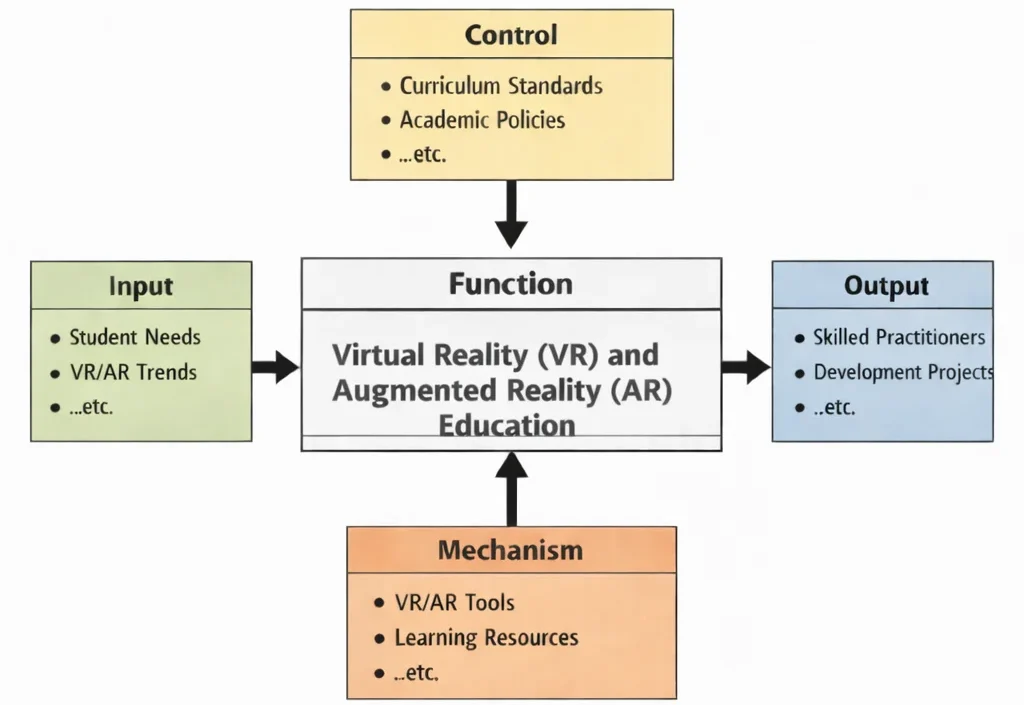
This IDEF0 diagram models “Virtual Reality (VR) and Augmented Reality (AR) Education” as an organized transformation process. Inputs such as student needs and VR/AR trends enter from the left, while controls—curriculum standards and academic policies—shape objectives, safety considerations, assessment, and scope from above. The central function produces outputs on the right, including skilled practitioners and completed development projects. Supporting mechanisms from below—VR/AR tools and learning resources—provide the practical foundation for building immersive experiences, testing interactions, refining usability, and learning through iterative prototyping.
Interactive Check: Intro & System Concepts
Verify your understanding of how immersive presence, safety controls, and spatial computing environments function:
Introductory Concept Verification
1. Why is virtual reality education described as teaching people to design “presence” rather than merely producing visuals?
Answer: Presence is the psychological sensation of inhabiting a digital environment. Designing presence requires harmonizing 3D rendering framerates, spatial tracking latencies, haptic feedback, and ergonomic UX design to prevent disorientation.
2. What role do safety considerations and accessibility standards serve as “Controls” in VR/AR education?
Answer: Controls establish non-negotiable boundaries preventing motion sickness, sensory overload, and exclusion—ensuring that immersive simulations are physically safe, accessible, and ethically responsible for all users.
Virtual Reality (VR) and Augmented Reality (AR) have redefined the boundaries of digital interaction, transforming how users perceive, engage with, and respond to digital environments. While game development remains one of the most exciting applications of VR and AR, their influence now extends into fields like education, healthcare, architecture, and cybersecurity. Developers working in this space require a deep understanding of 3D modeling, sensory feedback, real-time rendering, and the immersive integration of narratives and mechanics.
One of the foundations of immersive design lies in narrative design, where AR/VR environments are crafted to respond dynamically to user decisions. Coupling that with artificial intelligence in games creates responsive virtual characters and environments that adapt in real time. This is particularly potent when layered with procedural storytelling systems within game engine development.
In these immersive contexts, data collection and storage becomes vital. From tracking user gaze and gesture to logging real-time biometric data, AR/VR applications must analyze complex sensory inputs. Insights are drawn using data analysis, supported by data cleaning and preprocessing routines to ensure accuracy. These datasets fuel improvements in design, usability, and personalized experience.
The technical underpinnings of AR/VR are closely tied to tools and technologies in data science, enabling simulation of physics, real-time feedback systems, and adaptive scene rendering. Visualization plays a central role, with data visualization helping developers interpret user interaction patterns and optimize the spatial layout and object responsiveness.
In safety-critical applications, immersive systems must incorporate protocols from network security and endpoint security to prevent breaches. Protection of user data, especially in sensitive AR environments like remote surgery or military simulations, demands robust systems for cybersecurity policy, identity and access management, and cryptography.
Immersive simulations also benefit from integration with big data analytics and domain-specific analytics, especially when deployed at scale. Whether in training modules, virtual classrooms, or collaborative workspaces, these tools help tailor content to individual preferences and performance metrics. Such insights also contribute to the ethical and social aspects of immersive technology design.
As VR/AR hardware becomes more integrated into public and private sectors, new challenges emerge in emerging areas in cybersecurity such as deepfakes, spoofing of sensor input, and virtual surveillance. Tools from incident response and forensics are crucial for diagnosing vulnerabilities, while ethical hacking allows developers to test and improve security through simulated attacks.
Moreover, projects that integrate real-world operations with mixed-reality environments—such as in smart factories or infrastructure monitoring—must comply with protocols found in CPS security and operational technology (OT) security. Monitoring and modeling such environments with threat intelligence tools ensures a secure and resilient infrastructure.
As this field grows, VR and AR will continue to depend on cross-disciplinary knowledge, blending security protocols, data pipelines, narrative craft, and game mechanics. Students and professionals entering this space are encouraged to explore data science and analytics holistically and pursue ethical, user-centered, and innovative applications of these transformative technologies.
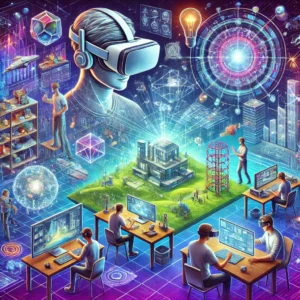
This artwork portrays Virtual Reality and Augmented Reality as a blend of human experience, 3D computing, and collaborative engineering. A prominent VR headset figure symbolizes full immersion—stepping into a simulated environment where perception is shaped by software and sensors. Below, multiple creators sit at workstations, suggesting the teamwork behind immersive systems: designers, programmers, and 3D artists building scenes, interactions, and user interfaces. At the center, a miniature city-like model and scaffolding hint at spatial computing—constructing digital objects that can be navigated, manipulated, and scaled like real structures. Surrounding icons, glowing geometric shapes, and interface overlays represent tracking, rendering pipelines, depth mapping, and real-time feedback. The overall composition captures the core idea: VR creates an entirely digital world you enter, while AR layers digital content onto the physical world, turning spaces into interactive environments for learning, design, training, and entertainment.
Building Cyber Resilience: VR & AR Navigation
Discover how Virtual Reality and Augmented Reality build immersive 3D environments, spatial tracking systems, and mixed-reality overlays across the Game Development cluster. Each card details hardware integration, SLAM tracking, UX design, and spatial computing.
Game Development Overview
Presents the overarching game production framework, mapping how XR spatial interactions integrate with standard game logic.
Game Engine Development
Examines low-level stereo rendering pipelines, low-latency display synchronization, and 6-DOF controller tracking systems.
Artificial Intelligence in Games
Explores spatial AI perception cones, auditory localization, and responsive virtual characters within virtual spaces.
Narrative Design
Covers spatial storytelling, diegetic world UI triggers, gaze-based interaction, and embodied player presence in XR.
Virtual & Augmented Reality
Focuses on hardware integration (HMDs, ARKit/ARCore), 3D environment optimization, SLAM mapping, gaze-based UX, and mixed-reality environments.
Definition of Virtual Reality and Augmented Reality
Virtual Reality (VR):
A fully immersive digital environment that isolates users from the real world, allowing them to interact with virtual objects and scenarios through devices like headsets and motion controllers.
Augmented Reality (AR):
A technology that overlays digital elements, such as images, sounds, and data, onto the real world using devices like smartphones, AR glasses, or headsets.
Core Objectives of VR/AR Development
Immersion:
Create realistic and engaging experiences that captivate users.
Interactivity:
Enable intuitive and meaningful interactions with digital content.
Accessibility:
Optimize performance across diverse devices and platforms.
Innovation:
Continuously push the technological limits to enhance user experiences.
Key Components of VR/AR Development
Hardware Integration
- Definition: Ensuring seamless compatibility between the application and VR/AR hardware.
- Key Devices:
- VR Headsets: Oculus Quest, HTC Vive, PlayStation VR.
- AR Platforms: Microsoft HoloLens, Magic Leap, ARKit (Apple), and ARCore (Google).
- Input Devices: Motion controllers, hand-tracking systems, and haptic feedback devices.
- Applications:
- Providing real-time feedback to enhance immersion.
- Utilizing sensors for accurate spatial tracking.
3D Modeling and Environment Design
- Definition: Creating detailed, interactive, and realistic virtual environments for VR and AR.
- Key Techniques:
- Low-Poly Optimization: Balancing detail with performance for real-time rendering.
- Texturing and Lighting: Adding realism through advanced shaders and dynamic lighting.
- 360-Degree Spaces: Designing environments that fully surround the user.
- Applications:
- Crafting lifelike worlds for VR games.
- Designing AR overlays for interior design or architecture.
Spatial Computing and Tracking
- Definition: Utilizing spatial awareness to map and interact with real-world or virtual environments.
- Key Features:
- SLAM (Simultaneous Localization and Mapping): Mapping physical spaces for AR interactions.
- Positional Tracking: Enabling movement within a VR environment.
- Object Recognition: Identifying and interacting with real-world objects in AR.
- Applications:
- AR apps for furniture placement, like IKEA Place.
- Room-scale VR experiences in games like Beat Saber.
User Experience (UX) and Interface Design
- Definition: Designing intuitive and engaging interfaces that align with VR/AR interactivity.
- Key Techniques:
- Gaze-Based Navigation: Allowing users to control menus by looking at options.
- Gesture Controls: Leveraging hand tracking for interaction.
- Minimizing Motion Sickness: Ensuring smooth transitions and reducing disorientation.
- Applications:
- Creating interfaces for VR training simulations.
- Developing AR HUDs (Heads-Up Displays) for smart glasses.
Performance Optimization
- Definition: Ensuring smooth performance and responsiveness across VR/AR devices.
- Key Strategies:
- Frame Rate Optimization: Maintaining a stable frame rate (e.g., 90 FPS for VR) to prevent lag.
- Efficient Rendering: Using techniques like culling and level-of-detail (LOD) adjustments.
- Battery Management: Optimizing AR apps for mobile devices.
- Applications:
- Delivering seamless gameplay in VR titles.
- Extending the usability of AR apps on smartphones.
Applications of VR/AR Development
Gaming and Entertainment
- VR: Immersive games like Half-Life: Alyx or The Walking Dead: Saints & Sinners.
- AR: Mobile games like Pokémon GO and interactive museum exhibits.
Education and Training
- VR: Simulated environments for training pilots, surgeons, or engineers.
- AR: Augmented anatomy lessons or historical site visualizations for students.
Healthcare and Therapy
- VR: Pain management through distraction-based therapy or phobia exposure treatments.
- AR: Real-time assistance for surgeons using augmented overlays during operations.
Retail and E-Commerce
- VR: Virtual shopping experiences where users explore stores digitally.
- AR: Try-before-you-buy experiences, like virtual fitting rooms for clothing or makeup.
Architecture and Real Estate
- VR: Virtual walkthroughs of unbuilt properties or designs.
- AR: Overlaying furniture and decor in real-world spaces.
History and Evolution of Immersive Computing
Virtual and Augmented Reality trace their roots back to early stereoscopic viewppers and Ivan Sutherland’s 1968 “Sword of Damocles” head-mounted display. The 1990s saw an initial commercial wave (such as Nintendo’s Virtual Boy and arcade VR units), which largely stalled due to high costs, latency, and inadequate pixel density. A modern renaissance began in the early 2010s with smartphone-powered AR and Kickstarter-backed VR headsets (Oculus Rift), leading to widespread consumer adoption of standalone inside-out tracked headsets like the Meta Quest and spatial computing headsets like Apple Vision Pro.
Challenges in VR/AR Development
Hardware Limitations
- VR requires high-performance devices, which can be cost-prohibitive.
- AR faces constraints like limited field-of-view in headsets and mobile battery life.
Motion Sickness
- Poor frame rates or lag can cause discomfort in VR users.
- Developers must design motion systems that minimize nausea.
Content Accessibility
- Ensuring experiences are inclusive and accessible to users with disabilities.
Cross-Platform Development
- Creating applications compatible with diverse devices and ecosystems.
High Development Costs
- Developing VR/AR experiences demands skilled professionals and cutting-edge tools, increasing production costs.
Emerging Trends in VR/AR Development
Mixed Reality (MR):
- Combining VR and AR for seamless transitions between virtual and physical worlds.
- Examples: Microsoft HoloLens projects blending real and digital environments.
AI-Driven Enhancements:
- Integrating AI for adaptive environments, real-time translation, and procedural content generation.
- Examples: Virtual tutors in VR educational platforms.
Tactile Feedback and Haptics:
- Enhancing immersion through gloves, suits, and other devices that simulate touch.
- Examples: Haptic feedback in gloves for realistic object interactions.
Social VR/AR Experiences:
- Creating collaborative spaces for socializing, gaming, or working.
- Examples: VR meeting platforms like AltspaceVR and Horizon Workrooms.
5G Integration:
- Leveraging 5G networks for real-time streaming and enhanced AR/VR performance.
Why Study Virtual Reality and Augmented Reality
Immersive Technology for Real-World Applications
Studying Virtual Reality (VR) and Augmented Reality (AR) enables students to design fully immersive environments or overlay digital information onto the real world. These technologies are widely used in fields like healthcare (surgical training), architecture (virtual walkthroughs), education (interactive simulations), and entertainment.
Interdisciplinary Skill Development
VR and AR development combines computer graphics, 3D modeling, spatial computing, user interface design, and human perception. Students learn to create experiences that are not only technically sound but also psychologically engaging.
Future-Ready Career Paths
As demand for immersive content rises, skills in VR/AR design are crucial for careers in game development, remote training, product design, and virtual collaboration tools.
Interactive Quick Review: Spatial Computing Architecture
Reinforce key concepts regarding SLAM mapping, motion-to-photon latency, and vergence-accommodation conflict before reviewing the FAQ:
Quick Review Verification
1. What is SLAM (Simultaneous Localization and Mapping) and why is it critical for AR?
Answer: SLAM algorithms allow an AR device to map an unknown physical room in real time while simultaneously tracking its own precise position and orientation within that space, enabling virtual objects to anchor stably onto physical surfaces.
2. How does Motion-to-Photon Latency impact VR user comfort and immersion?
Answer: Motion-to-photon latency measures the total time elapsed from when a user moves their head to when the corresponding updated pixel is displayed on screen. High latency breaks visual-vestibular synchronization, directly triggering motion sickness and breaking presence.
Frequently Asked Questions about Virtual Reality and Augmented Reality
What is virtual reality (VR) in game development and how does it enhance gameplay?
VR creates a fully isolated digital environment using stereoscopic head-mounted displays and 6-DOF tracking, replacing physical reality to produce deep psychological presence and visceral interactivity.
What is augmented reality (AR) and how is it used in interactive game experiences?
AR overlays digital graphics, audio, and holograms onto the physical world via smart glasses or mobile cameras, creating hybrid real-world gameplay environments like Pokémon GO.
How do VR and AR technologies differ in terms of immersion and user interaction?
VR completely substitutes the physical environment for digital immersion, whereas AR augments and coexists with the physical world by anchoring virtual objects to real surfaces.
What are the key hardware components required for effective VR game development?
High-refresh-rate OLED/LCD display panels, inertial measurement units (IMUs), optical tracking cameras, high-performance GPUs, and 6-DOF motion controllers.
How does motion tracking technology contribute to VR gaming experiences?
Precise positional tracking allows users to lean, duck, walk, and manipulate objects naturally, translating physical kinematics directly into digital simulation loops.
What challenges do developers face when integrating VR and AR into game development?
Maintaining high stable framerates (90+ FPS), eliminating motion-to-photon latency, overcoming hardware battery/thermal limits, and mitigating cybersickness.
How do VR and AR enhance narrative design and storytelling in games?
By surrounding the player with spatialized audio, diegetic world cues, and character eye contact, shifting storytelling from observed cinema to embodied personal participation.
What role do specialized software tools play in developing VR and AR games?
Game engines (Unity/Unreal) and XR developer kits (OpenXR, ARKit, ARCore) provide pre-built spatial tracking wrappers, render stereo camera projections, and manage controller bindings.
Virtual Reality and Augmented Reality: Conclusion
Virtual Reality and Augmented Reality are revolutionizing how we perceive and interact with the world. By merging cutting-edge technology with creativity, VR/AR developers are crafting immersive experiences that transcend traditional boundaries of storytelling, education, and innovation. While challenges like hardware constraints and motion sickness remain, the industry’s rapid advancements signal a transformative future where virtual and augmented realities become integral to human life.
End-of-Page Exercises: Review, Reflections & Analytics
Review Questions and Answers
1. What is virtual reality (VR) in game development and how does it enhance gameplay?
Answer: VR isolates the user in a digital simulation, replacing physical sight and sound to deliver deep psychological presence and intuitive 1:1 physical interaction.
2. What is augmented reality (AR) and how is it used in interactive game experiences?
Answer: AR overlays digital assets onto physical rooms using camera feeds and SLAM spatial mapping, allowing virtual characters to interact directly with real furniture and surfaces.
3. How do VR and AR technologies differ in terms of immersion and user interaction?
Answer: VR replaces reality for total digital immersion; AR augments physical reality by superimposing digital objects while keeping the user aware of their real surroundings.
4. What are the key hardware components required for effective VR game development?
Answer: High-resolution dual displays, optical/inertial tracking sensors, 6-DOF controllers, and high-performance GPUs capable of rendering stereoscopic frames at 90+ FPS.
5. How does motion tracking technology contribute to VR gaming experiences?
Answer: Translates physical body movements (head rotation, ducking, hand gestures) into real-time simulation updates, anchoring the player inside the virtual world.
6. What challenges do developers face when integrating VR and AR into game development?
Answer: High frame-rate overhead demands, hardware battery and thermal throttling on mobile chips, motion sickness mitigation, and cross-device fragmentation.
7. How do VR and AR enhance narrative design and storytelling in games?
Answer: By placing the player directly inside the scene as an active participant, utilizing spatial audio and gaze interaction to deliver emotional story beats organically.
8. What role do specialized software tools play in developing VR and AR games?
Answer: Game engines and XR SDKs handle sensor stream parsing, distortion correction, stereo rendering, and spatial anchor persistence out of the box.
9. How can game developers optimize performance for VR and AR applications?
Answer: Using foveated rendering, multi-view rendering, aggressive draw-call culling, low-poly geometry assets, and texture compression to maintain locked 90 FPS.
10. What future trends in VR and AR are expected to shape the evolution of game development?
Answer: Waveguide AR glasses, lightweight form factors, AI-driven foveated neural rendering, and wrist-based EMG muscle tracking.
Thought-Provoking Architectural Questions
1. How will the integration of advanced AI techniques further transform VR and AR game experiences?
Answer: AI will generate adaptive AR holograms that react intelligently to physical home furniture layouts and enable natural spoken conversations with virtual characters in VR.
2. What ethical considerations arise from the use of VR and AR technologies in game development?
Answer: Biometric gaze tracking, room environmental scans, and facial expressions harvest highly sensitive personal telemetry, raising severe privacy and surveillance risks.
3. In what ways can narrative design be enhanced through the use of VR and AR technologies?
Answer: By evoking visceral empathy and personal agency—characters look directly into the player’s eyes, and story events unfold in personal physical proximity.
4. How might future hardware advancements impact the development of VR and AR game engines?
Answer: Silicon advancements with integrated neural processing units (NPUs) will shift rendering graphs toward real-time neural radiance fields and generative ray tracing.
5. What strategies can be used to balance immersion and user comfort in VR and AR games?
Answer: Implementing comfort vignettes, teleportation locomotion modes, stable artificial horizons, and locked 90+ FPS frame rendering.
6. How can game developers leverage cross-platform development to maximize reach?
Answer: Utilizing unified XR abstraction layers (like OpenXR) to compile single codebases across Meta Quest, PCVR, Apple Vision Pro, and PlayStation VR2.
7. What role does user experience (UX) design play in the success of VR and AR game development?
Answer: UX determines spatial ergonomics—ensuring menu HUDs float naturally in 3D space, preventing arm fatigue from gestural inputs and eliminating simulator sickness.
8. How can the integration of real-time data analytics enhance immersive experiences?
Answer: Telemetry heatmaps tracking head rotation and controller focal points reveal player attention distributions, guiding developers in balancing virtual environments.
9. How might future advancements in haptic technology influence VR and AR gameplay?
Answer: Advanced pneumatics and resistive exoskeleton gloves will allow players to feel physical weight, textures, and solid impacts from virtual objects.
10. What potential benefits and challenges arise from using VR and AR for training?
Answer: Benefits include zero-risk simulation of dangerous scenarios (surgery, aerospace repairs); challenges include hardware acquisition costs and software validation hurdles.
11. How can user-generated content in VR/AR games influence narrative design?
Answer: Players create custom rooms, avatar skins, and interactive puzzle maps that other users explore, turning the community into co-authors of the virtual ecosystem.
12. What strategies ensure VR/AR technologies remain accessible and inclusive?
Answer: Providing seated play modes, single-controller interaction options, adjustable text scaling, and audio-described spatial cues for users with limited mobility or vision.
Numerical Engineering Problems & Solutions
Problem 1: VR Interaction Telemetry Dataset Volume
A VR game collects 5,000,000 interaction data points per month. If 3% (0.03) of these data points are analyzed for behavioral modeling, calculate monthly data points used, annual volume (12 months), and confirm average monthly usage.
Solution:
- Monthly data points used = 5,000,000 × 0.03 = 150,000 points/month
- Annual data points volume = 150,000 × 12 = 1,800,000 points/year
- Average monthly usage = 1,800,000 ÷ 12 = 150,000 points/month
Problem 2: Stereoscopic Headset Display Pixel Count
A VR headset has a native panel resolution of 2,160 × 1,200 pixels per eye. Calculate total pixels per eye, total pixels for both eyes combined, and total pixel count expressed in millions.
Solution:
- Pixels per eye = 2,160 × 1,200 = 2,592,000 pixels
- Total pixels for both eyes = 2,592,000 × 2 = 5,184,000 pixels
- Total pixels in millions = 5,184,000 ÷ 1,000,000 ≈ 5.18 million pixels
Problem 3: VR Frame Rendering Accumulation Metrics
A VR application runs at a locked rate of 90 frames per second. Calculate total frames rendered in 10 minutes, total frames rendered in a 24-hour period, and average frames rendered per hour.
Solution:
- Frames per minute = 90 frames/sec × 60 seconds = 5,400 frames/min
- Frames rendered in 10 minutes = 5,400 × 10 = 54,000 frames
- Frames rendered in 24 hours = 90 frames/sec × 86,400 seconds/day = 7,776,000 frames/day
- Average frames per hour = 7,776,000 ÷ 24 = 324,000 frames/hour
Problem 4: VR Frame Processing Time & Optimization Savings
A game engine takes 0.01 seconds per frame at 90 FPS. Calculate total processing time per minute and per hour. If optimization reduces processing time by 20% (0.20), calculate time saved per minute.
Solution:
- Frames per minute = 90 × 60 = 5,400 frames/min
- Total processing time per minute = 5,400 × 0.01 seconds = 54.0 seconds/min
- Total processing time per hour = 54.0 × 60 = 3,240 seconds/hour
- Optimized frame time = 0.01 × (1 – 0.20) = 0.008 seconds
- Optimized processing time per minute = 5,400 × 0.008 = 43.2 seconds/min
- Time saved per minute = 54.0 – 43.2 = 10.8 seconds saved/min
Problem 5: VR Security Telemetry Anomaly Logging
A VR session logs 800,000 events daily. Telemetry specifies that 0.25% (0.0025) represent security anomalies. Calculate daily critical events, weekly critical events (7 days), and monthly critical events (30 days).
Solution:
- Critical events per day = 800,000 × 0.0025 = 2,000 events/day
- Critical events per week = 2,000 × 7 = 14,000 events/week
- Critical events per month = 2,000 × 30 = 60,000 events/month
Problem 6: Asset Streaming Load Time Reduction
A VR project reduces loading time from 1.2 seconds down to 0.9 seconds per 3D asset. For a world loading 3,000 assets, calculate time saved per asset, total time saved in seconds, and convert to minutes and hours.
Solution:
- Time saved per asset = 1.2 – 0.9 = 0.3 seconds saved/asset
- Total time saved in seconds = 3,000 × 0.3 = 900 seconds
- Convert to minutes = 900 ÷ 60 = 15.0 minutes
- Convert to hours = 15 ÷ 60 = 0.25 hours
Problem 7: Neural Network Parameter Distribution
A neural network in an XR engine uses 128 hidden units where total parameters equal 1282. Calculate total parameters. If distributed evenly across 5 processing layers, calculate parameters per layer.
Solution:
- Total parameters = 128 × 128 = 16,384 parameters
- Parameters per layer across 5 layers = 16,384 ÷ 5 = 3,276.8 parameters/layer
- Rounded to nearest integer = 3,277 parameters/layer
Problem 8: Headset Battery Life Extension Metrics
A standalone VR headset battery lasts 3.0 hours on a full charge. A hardware power-draw optimization increases battery life by 30% (0.30). Calculate new battery life, additional time gained in hours, and convert time gained to minutes.
Solution:
- New battery life = 3.0 × 1.30 = 3.9 hours
- Additional time gained = 3.9 – 3.0 = 0.9 hours
- Convert to minutes = 0.9 × 60 = 54.0 minutes
Problem 9: Motion Tracking Sensor Sampling Frequency
A spatial motion tracking sensor samples spatial orientation at 200 Hz (200 samples per second). Calculate samples collected per minute, per hour, and per day (24 hours).
Solution:
- Samples per minute = 200 samples/sec × 60 seconds = 12,000 samples/min
- Samples per hour = 12,000 × 60 minutes = 720,000 samples/hour
- Samples per day = 720,000 × 24 hours = 17,280,000 samples/day
Problem 10: Development Tool Cost Saving & Budget Impact
A studio invests $50,000 in a VR development tool that improves production productivity by 20% (0.20). If the initial project budget was $250,000, calculate adjusted project cost, direct cost saving, and percentage reduction in cost.
Solution:
- Adjusted project cost = $250,000 × (1 – 0.20) = $250,000 × 0.80 = $200,000
- Direct cost saving = $250,000 – $200,000 = $50,000
- Percentage reduction in project cost = 20.0%
Problem 11: Narrative Script Word Count & Expansion Volume
A VR game narrative script consists of 15 chapters with an average of 3,000 words per chapter. Calculate original total word count. If each chapter expands by 10% (0.10), calculate new total script words.
Solution:
- Original total word count = 15 chapters × 3,000 words = 45,000 words
- Revised average per chapter = 3,000 × 1.10 = 3,300 words/chapter
- Revised total script word count = 3,300 × 15 = 49,500 words
Problem 12: Engine Development Schedule Optimization
A VR engine development project requires 600 baseline hours to complete. Process improvements reduce development schedule duration by 25% (0.25). Calculate new development time in hours, hours saved, and percentage reduction.
Solution:
- New development schedule = 600 × (1 – 0.25) = 600 × 0.75 = 450 hours
- Hours saved = 600 – 450 = 150 hours saved
- Percentage reduction = (150 ÷ 600) × 100 = 25.0%
Virtual Reality and Augmented Reality — Summary & Wrap-Up
Virtual Reality and Augmented Reality redefine human-computer interaction by substituting or overlaying physical reality with responsive, spatial 3D simulations. By mastering hardware sensor integration, SLAM tracking algorithms, stereoscopic performance optimization, and ergonomic spatial UX design, XR developers craft immersive worlds that transform entertainment, training, healthcare, and collaboration.