
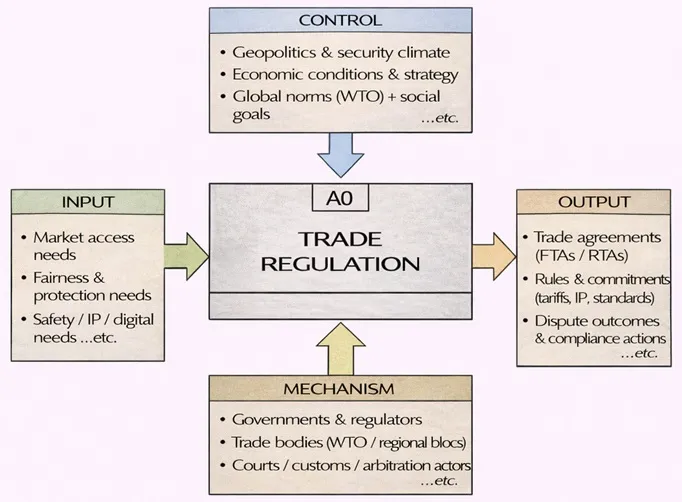

Legal Frameworks Governing International Trade and Economic Exchange
Definition of Trade Regulations
Key Objectives of Trade Regulations:
- Facilitate Trade: Reducing barriers and promoting free-flowing commerce.
- Ensure Fairness: Preventing practices like dumping, subsidies, and intellectual property violations.
- Resolve Disputes: Providing mechanisms for addressing conflicts between trading partners.
- Support Development: Encouraging trade practices that contribute to economic growth and sustainability.
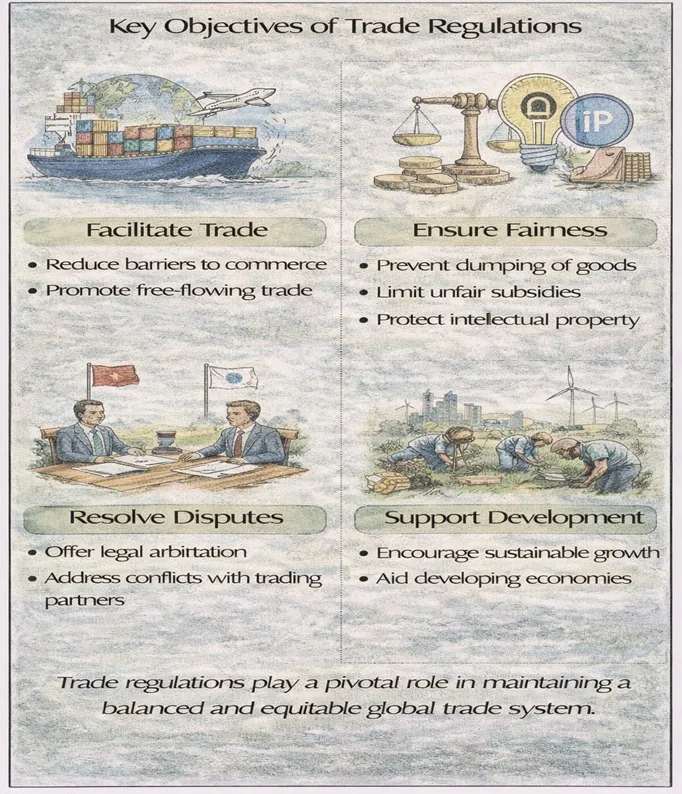
This IDEF-style diagram presents four linked aims: (1) Facilitate trade by reducing barriers and encouraging smoother cross-border commerce; (2) Ensure fairness by discouraging dumping and unfair subsidies while protecting intellectual property; (3) Resolve disputes by providing structured legal pathways such as arbitration or dispute panels; and (4) Support development by promoting growth that benefits developing economies and aligns with sustainability goals. The diagram ends with the idea that these objectives together help maintain a balanced and equitable global trade framework.
Key Elements of Trade Regulations
World Trade Organization (WTO): Setting Global Trade Rules and Facilitating Negotiations
- Definition: The WTO is an international organization that establishes rules for global trade, resolves disputes, and facilitates negotiations among member countries.
- Key Features:
- Trade Liberalization: Advocating for reduced trade barriers through multilateral agreements.
- Dispute Resolution Mechanism: Providing a structured process for addressing trade conflicts.
- Monitoring Compliance: Ensuring member nations adhere to agreed trade rules.
- Applications:
- Facilitating trade negotiations to update global trade rules.
- Monitoring tariff reductions and trade liberalization commitments.
- Examples:
- WTO rulings on U.S.-China tariff disputes.
- Mediating conflicts over agricultural subsidies among member nations.
Trade Agreements: Bilateral and Multilateral Agreements Like USMCA and the EU Single Market
- Definition: Trade agreements are formal pacts between nations or groups of nations to establish rules and standards for trade relationships.
- Key Types:
- Bilateral Agreements: Between two countries (e.g., U.S.-South Korea Free Trade Agreement).
- Multilateral Agreements: Among multiple countries (e.g., Comprehensive and Progressive Agreement for Trans-Pacific Partnership, CPTPP).
- Regional Agreements: Focused on specific geographic areas (e.g., European Union Single Market).
- Applications:
- Enhancing market access and reducing trade barriers.
- Standardizing rules on labor, environment, and intellectual property.
- Examples:
- NAFTA, now USMCA, regulating trade among the U.S., Canada, and Mexico.
- EU Single Market agreements facilitating free movement of goods, services, and capital.
Dispute Resolution: Mechanisms to Address Trade Barriers and Unfair Practices
- Definition: Dispute resolution mechanisms are processes established to address and resolve conflicts arising from trade practices that violate agreements or rules.
- Key Features:
- Arbitration Panels: Neutral bodies that adjudicate disputes between nations.
- Sanctions and Remedies: Imposing penalties for non-compliance or unfair practices.
- Retaliatory Measures: Allowing nations to respond proportionately to trade violations.
- Applications:
- Resolving disputes over anti-dumping measures and intellectual property rights.
- Addressing conflicts related to tariffs, quotas, or subsidies.
- Examples:
- WTO arbitration on steel tariffs imposed by the U.S.
- Dispute resolution between India and the EU over agricultural subsidies.
Applications of Trade Regulations
Regulating Tariffs, Quotas, and Intellectual Property Rights
- Overview: Trade regulations ensure that tariffs, quotas, and intellectual property (IP) rights are applied fairly and transparently.
- Applications:
- Standardizing tariffs to prevent discriminatory practices.
- Regulating quotas to manage import and export volumes.
- Enforcing IP protections to prevent counterfeiting and piracy.
- Examples:
- Imposing anti-dumping tariffs on imported goods sold below market value.
- Protecting pharmaceutical patents under the WTO’s Trade-Related Aspects of Intellectual Property Rights (TRIPS) agreement.
Ensuring Compliance with Rules on Subsidies and Anti-Dumping Measures
- Overview: Subsidy regulations prevent unfair advantages, while anti-dumping measures protect domestic industries from predatory pricing by foreign competitors.
- Applications:
- Investigating and penalizing countries that subsidize industries unfairly.
- Imposing duties on dumped products to level the playing field.
- Examples:
- WTO cases against illegal agricultural subsidies by developed nations.
- Anti-dumping tariffs on Chinese solar panels in the European Union.
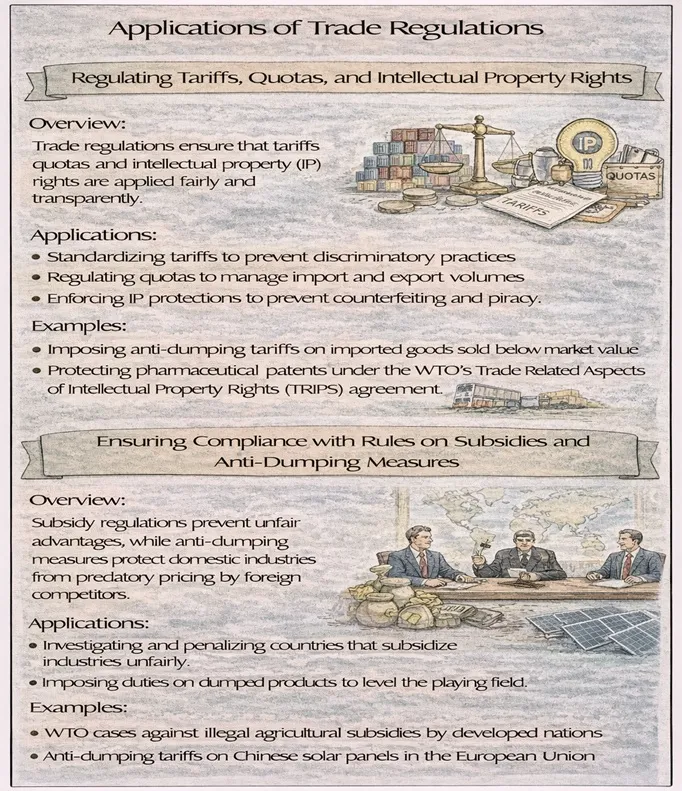
A two-part IDEF-style diagram titled “Applications of Trade Regulations.” The upper panel summarizes how trade rules standardize tariffs, manage quotas, and protect intellectual property to reduce discrimination and counterfeiting, with examples such as anti-dumping tariffs and pharmaceutical patent protection under TRIPS. The lower panel shows how regulations address unfair subsidies and predatory pricing through investigations and duties, illustrating outcomes via WTO subsidy disputes and anti-dumping measures such as EU tariffs on Chinese solar panels.
Examples of Trade Regulations in Action
Mediating Trade Disputes Between the U.S. and China Over Tariffs
- Scenario: The U.S. and China impose tariffs on each other’s goods, leading to a protracted trade conflict.
- Outcome: WTO mechanisms mediate the dispute, resulting in negotiations to reduce tariffs and enhance compliance with global trade rules.
Negotiating Agreements Like the Comprehensive and Progressive Agreement for Trans-Pacific Partnership (CPTPP)
- Scenario: Pacific Rim countries negotiate a multilateral trade agreement to promote economic integration and reduce trade barriers.
- Outcome: The CPTPP establishes standards on labor rights, environmental protection, and market access, benefiting member nations through increased trade opportunities.
Emerging Trends in Trade Regulations
- Digital Trade and E-Commerce Regulations
- Addressing challenges in cross-border digital services, data localization, and cybersecurity.
- Examples: WTO discussions on e-commerce frameworks and digital taxation policies.
- Sustainability and Green Trade Practices
- Incorporating environmental standards into trade agreements to combat climate change.
- Examples: Carbon border taxes and trade incentives for renewable energy technologies.
- Regionalization of Trade Agreements
- Increasing focus on regional trade blocs to address geopolitical shifts and supply chain resilience.
- Examples: African Continental Free Trade Area (AfCFTA) promoting intra-African trade.
- Geopolitical Influences on Trade Policies
- Balancing national security concerns with economic interests in trade decisions.
- Examples: Restrictions on technology exports to rival nations due to cybersecurity concerns.
- Labor and Human Rights in Trade
- Strengthening labor protections and ethical sourcing requirements in trade agreements.
- Examples: Provisions in USMCA addressing minimum wage and workplace conditions.
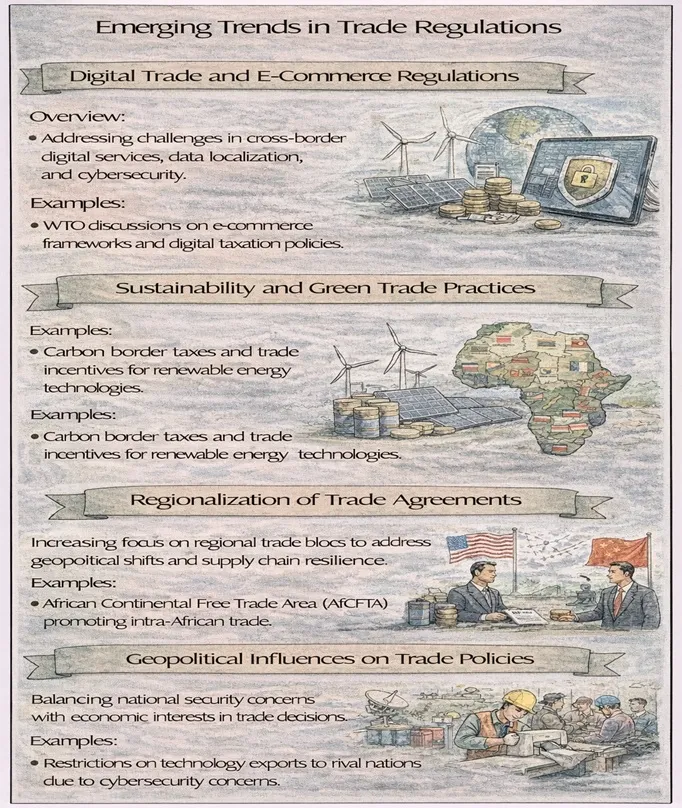
This IDEF-style infographic presents five current directions shaping trade regulation. It highlights (1) digital trade and e-commerce rules addressing cross-border services, data localization, and cybersecurity; (2) sustainability and green trade practices such as carbon border measures and incentives for renewable technologies; (3) regionalization through trade blocs that strengthen supply-chain resilience (e.g., AfCFTA); (4) geopolitical influences that add national-security constraints on sensitive technology trade; and (5) labor and human-rights clauses that promote ethical sourcing and stronger workplace protections (e.g., provisions seen in USMCA).
Challenges in Trade Regulations
- Complexity of Multilateral Negotiations
- Balancing diverse interests and priorities among nations with varying economic power.
- Non-Tariff Barriers
- Addressing challenges like technical standards, licensing requirements, and regulatory divergence.
- Dispute Resolution Delays
- Managing lengthy and complex arbitration processes that impact trade flows.
- Protectionism and Trade Wars
- Navigating policies aimed at shielding domestic industries at the expense of global cooperation.
- Compliance Costs for Small Businesses
- Ensuring that smaller enterprises can navigate complex trade regulations without undue burden.
Why Study Trade Regulations
Understanding the Rules That Shape Global Commerce
Exploring the Balance Between Free Trade and Protectionism
Connecting Law, Economics, and International Relations
Applying Concepts to Real-World Trade Disputes and Agreements
Preparing for Careers in Law, Policy, and International Business
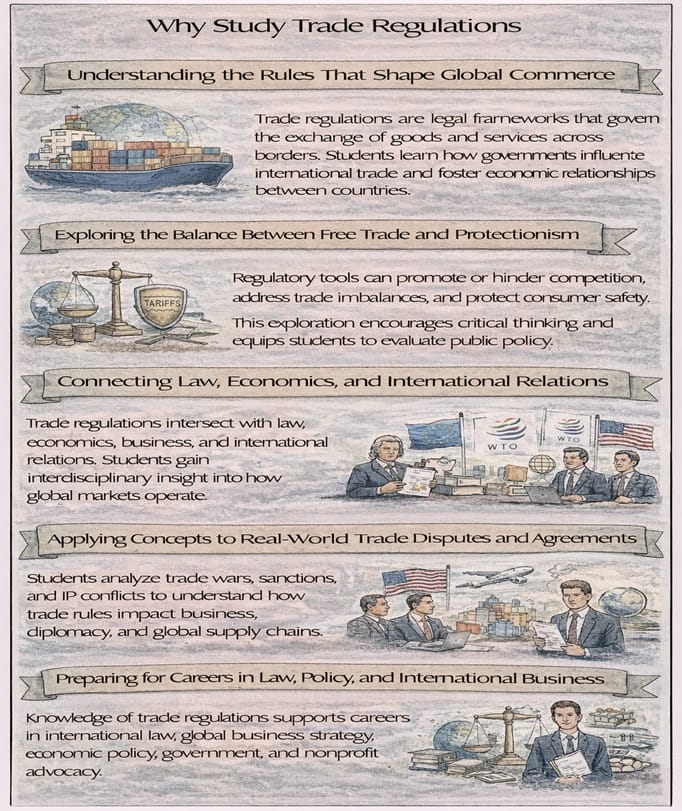
A vertically stacked infographic titled “Why Study Trade Regulations,” organized into five short sections, each paired with a small illustration. The panels explain: (1) trade regulations as legal frameworks for cross-border exchange; (2) the tension between free trade and protectionism using tools like tariffs; (3) the interdisciplinary link between law, economics, business, and international relations (with a WTO-style meeting scene); (4) applying concepts to trade disputes and agreements affecting supply chains and diplomacy; and (5) career relevance in law, policy, and international business. All text is presented in black on a light textured background for readability.
Trade Regulations: Conclusion
Frequently Asked Questions – Trade Regulations in International Law
What are trade regulations in international law?
Trade regulations in international law are rules and agreements that govern how goods and services move across borders. They define what tariffs, quotas, standards, and procedures countries can use, and aim to make trade more predictable, fair, and transparent while allowing governments to pursue legitimate policy goals such as health, safety, and environmental protection.
Why do countries need international trade rules instead of acting alone?
If each country acted entirely alone, trade could be disrupted by sudden tariffs, bans, or discrimination, creating uncertainty for businesses and consumers. International trade rules provide a shared framework so countries can open markets in a balanced way, manage conflicts, and avoid trade wars, while still retaining space to protect public interests and vulnerable sectors.
What are tariffs and non-tariff barriers in trade regulations?
Tariffs are taxes imposed on imported goods, which make those goods more expensive and can protect domestic industries. Non-tariff barriers are other measures that affect trade, such as quotas, import licenses, product standards, customs procedures, or subsidies. Trade regulations often seek to reduce tariffs and ensure that non-tariff measures are fair, transparent, and not unnecessarily trade-restrictive.
How do international trade agreements work?
International trade agreements are treaties in which countries agree to reduce trade barriers, follow common rules, and provide each other with certain guarantees such as non-discrimination and transparency. They can be global, regional, or bilateral. Once ratified, these agreements shape national trade laws and policies and provide mechanisms for resolving disputes between member states.
What is the role of international trade institutions in regulating trade?
International trade institutions help manage and oversee trade agreements, provide forums for negotiation, and offer systems for resolving disputes. They collect and share data, monitor how members implement their commitments, and sometimes provide technical assistance to help developing countries participate more effectively in global trade.
How do trade regulations address unfair trade practices such as dumping and subsidies?
Trade regulations allow countries to respond to unfair practices like dumping—selling goods abroad at very low prices—or certain harmful subsidies that distort competition. Tools such as anti-dumping duties and countervailing duties can be used, but they must follow agreed legal procedures and standards of proof to avoid becoming disguised protectionism.
How do trade regulations relate to development and inequality?
Trade regulations influence development and inequality by affecting which countries can access markets, move up value chains, and attract investment. Many trade agreements include special and differential treatment for developing countries, longer transition periods, and capacity-building support. Debates continue about how to design trade rules that promote inclusive and sustainable development rather than deepening inequalities.
How do trade rules interact with environmental and labour standards?
Trade rules increasingly interact with environmental and labour standards. Some agreements include chapters on sustainable development, labour rights, and environmental protection. A key challenge is to ensure that countries can adopt strong standards to protect workers and the environment without those standards being misused as disguised trade barriers or excuses for protectionism.
Which school subjects provide a good foundation for studying international trade regulations?
Useful subjects include economics, business studies, geography, history, mathematics, and global or social studies, along with any introductory law or civics courses. Economics helps you understand trade models and policy choices, while humanities and social sciences build skills in reading, writing, argumentation, and understanding how institutions and power shape global trade.
What skills are important for students interested in trade law and regulation?
Important skills include analytical thinking, clear writing, comfort with data, and the ability to follow complex legal and economic arguments. Curiosity about global business, politics, and development is vital. Over time, students also learn to interpret treaty provisions, compare national trade policies, and think strategically about negotiation and dispute settlement in trade contexts.
What careers can knowledge of international trade regulations lead to?
Knowledge of international trade regulations is valuable for careers as trade lawyers, policy advisers, diplomats, trade negotiators, officials in international or regional organisations, economists, compliance officers in multinational companies, and consultants. Many roles in supply chain management, logistics, manufacturing, and development agencies also benefit from understanding how trade rules work in practice.
How does the Trade Regulations page on Prep4Uni.online support my learning and study choices?
The Trade Regulations page on Prep4Uni.online introduces key ideas such as tariffs, non-tariff barriers, trade agreements, dispute resolution, and links with development and sustainability in a student-friendly way. It helps you see how law, economics, and politics come together in global trade, supporting your exploration of degree options in law, economics, business, and international relations.
Interactive Simulator: International Tariff & Carbon Border Adjustment (CBAM) Modeler
Simulate the economic impact of custom tariffs, anti-dumping duties, and Carbon Border Adjustment Mechanisms (CBAM) on cross-border trade shipments.
Interactive Review Questions (Click to Reveal Answers)
Click on any question below to expand the collapsible toggle and reveal the detailed answer explanation.
What are international trade regulations?
How do trade regulations promote fair competition?
What role do tariffs play in international trade policy?
How does the World Trade Organization (WTO) influence trade regulations?
What is the significance of non-tariff barriers in trade regulations?
How do free trade agreements (FTAs) affect international trade regulations?
What challenges do governments face in enforcing international trade regulations?
How can trade regulations influence economic growth in developing countries?
What mechanisms exist for resolving disputes over international trade regulations?
How do environmental and labor standards intersect with international trade regulations?
Comprehensive Practice & Assessment Module
Section 1: Fundamental Trade Law Principles & Regulatory Institutions
-
Define the Most-Favoured-Nation (MFN) principle under GATT Article I.
Answer: The MFN principle mandates that any advantage, favor, privilege, or immunity granted by a WTO member state to any product originating in or destined for any other country must be accorded immediately and unconditionally to the like product originating in or destined for the territories of all other WTO member states. -
What is the function of the National Treatment obligation under GATT Article III?
Answer: National Treatment prohibits member states from treating imported foreign products less favorably than like domestic products once they have cleared customs, specifically barring discriminatory internal taxes, regulations, or sales restrictions. -
Distinguish between an anti-dumping duty and a countervailing duty (CVD).
Answer: An anti-dumping duty is imposed on foreign imports sold below normal market value (home market price). A countervailing duty is imposed on foreign imports that benefit from illegal financial subsidies granted by the exporting state government, offsetting the artificial price advantage. -
Explain the function of the WTO Dispute Settlement Body (DSB) Appellate Body.
Answer: The DSB Appellate Body hears legal appeals from panel reports in trade disputes between member states, issuing binding interpretations of WTO treaty law (though its operation has faced impasse due to appointment blocks). -
What is the function of the TRIPS Agreement in global intellectual property protection?
Answer: The Trade-Related Aspects of Intellectual Property Rights (TRIPS) Agreement establishes comprehensive minimum standards of protection across patents, copyrights, trademarks, and trade secrets that all WTO member states must enforce domestically. -
Describe the purpose of Rules of Origin in regional trade agreements (RTAs).
Answer: Rules of Origin determine the national source of a product to decide whether it qualifies for preferential zero-tariff treatment under an RTA, preventing third-party countries from re-routing goods through low-tariff bloc members (“transshipment”). -
What are Sanitary and Phytosanitary (SPS) measures under WTO rules?
Answer: SPS measures are regulations applied by governments to protect human, animal, or plant life from food safety risks, pests, or diseases. Under the SPS Agreement, such rules must be based on scientific evidence and risk assessment rather than serving as disguised trade protectionism. -
Explain the mechanism of a Carbon Border Adjustment Mechanism (CBAM).
Answer: CBAM is an environmental trade levy that imposes a carbon tax on imported carbon-intensive goods (like steel, cement, and fertilizer) equivalent to the carbon price paid by domestic producers, preventing “carbon leakage” to countries with lax climate laws.
Section 2: Advanced Case Analysis & Global Trade Policy Scenarios
-
Scenario: Country A imposes a 25% tariff on imported foreign steel, citing GATT Article XXI “Security Exceptions” due to geopolitical tensions. Foreign steel exporters from Country B challenge the tariff at the WTO. Analyze the legal defense under Article XXI.
Answer: Country A will argue Article XXI is self-judging, granting states sole discretion to determine their essential security interests during emergencies in international relations. Country B will argue under the Russia – Traffic in Transit precedent that WTO panels have objective jurisdiction to review whether security claims are made in good faith or represent disguised economic protectionism. -
Evaluate the legal validity of compulsory licensing of pharmaceutical patents under the TRIPS Doha Declaration.
Answer: Under the 2001 TRIPS Doha Declaration on Public Health, member states have the legal right to grant compulsory licenses authorizing domestic generic drug production without patent holder consent during national health emergencies (e.g., epidemics), balancing IP protection with public health access. -
Analyze how Technical Barriers to Trade (TBT) agreements evaluate regulatory divergence between nations.
Answer: The TBT Agreement ensures technical regulations, product standards, and testing procedures do not create unnecessary obstacles to international trade. States are encouraged to adopt international standards (such as ISO) unless those standards are ineffective or inappropriate for fulfilling legitimate policy objectives. -
Explain the function of the “General Exceptions” clause under GATT Article XX.
Answer: Article XX allows WTO members to enact trade-restrictive measures otherwise violating GATT rules if necessary to protect public morals (XX(a)), human/animal/plant life (XX(b)), or exhaustible natural resources (XX(g)), provided the measures are not applied arbitrarily or as disguised trade restrictions (the Chapeau test). -
Scenario: An agricultural firm in Country X receives direct state cash grants covering 30% of export production costs, allowing it to undercut prices in Country Y. Identify the type of subsidy and remedies under the WTO SCM Agreement.
Answer: Direct cash grants tied to export performance constitute a “prohibited export subsidy” under Article 3 of the Agreement on Subsidies and Countervailing Measures (SCM). Country Y can initiate WTO dispute proceedings for immediate withdrawal or conduct domestic investigations to impose Countervailing Duties (CVD) to offset the 30% subsidy margin. -
Discuss the economic and legal implications of “Nearshoring” and “Friendshoring” on multilateral trade frameworks.
Answer: Nearshoring and friendshoring restructure global supply chains toward geographically proximate or geopolitically aligned partners. While enhancing supply chain resilience, this trend risks fragmenting the global multilateral trading system into closed regional blocs, weakening WTO MFN non-discrimination rules. -
Explain the function of “Investor-State Dispute Settlement” (ISDS) in international investment agreements.
Answer: ISDS allows foreign corporate investors to submit arbitration claims directly against host state governments before international tribunals (e.g., ICSID) for regulatory measures that allegedly breach fair treatment, expropriate assets, or violate legitimate investment expectations.
Section 3: Mathematical, Tariff & Applied Trade Economic Models
-
WTO Anti-Dumping Duty Calculation: An exporter in Country A sells industrial machinery in its domestic market at $800,000 per unit (Normal Value, Vn). It exports the identical machinery to Country B at an export price (Pe) of $550,000 per unit.
Problem: Calculate the Dumping Margin Percentage (Md) allowed under WTO Article VI rules:Md = [(Vn − Pe) / Pe] × 100
Solution:
1. Compute dumping amount: $800,000 − $550,000 = $250,000.
2. Calculate margin ratio relative to export price: $250,000 / $550,000 = 0.4545.
3. Convert to percentage: 0.4545 × 100 = 45.45%.
Country B can lawfully impose an anti-dumping duty of up to 45.45% ($250,000/unit) on imports. -
Ad Valorem Tariff & Government Customs Revenue Model: Country Y imports $2,500,000,000 worth of foreign automotive vehicles annually. Country Y raises its MFN tariff rate from 5% to 12%.
Problem: Calculate the total custom revenue collected under the new 12% rate and the net increase in customs tax revenue collected (assuming import volume remains constant).
Solution:
1. Total revenue at 12%: $2,500,000,000 × 0.12 = $300,000,000.
2. Original revenue at 5%: $2,500,000,000 × 0.05 = $125,000,000.
3. Net revenue increase: $300,000,000 − $125,000,000 = $175,000,000.
Total customs revenue collected is $300,000,000, yielding a net revenue increase of $175,000,000. -
Carbon Border Adjustment Mechanism (CBAM) Levy Calculation: An importer in Country C imports 10,000 metric tons of steel from Country D. The embedded carbon intensity is 2.2 tons of CO2 per ton of steel. Country C’s carbon price is $80/ton CO2, while Country D already paid an explicit domestic carbon price of $30/ton CO2.
Problem: Compute the net CBAM equalization levy owed at customs:CBAM Levy = Total CO2 Tonnage × (Country C Price − Country D Price)
Solution:
1. Calculate total embedded carbon: 10,000 tons steel × 2.2 = 22,000 tons CO2.
2. Calculate carbon price differential: $80 − $30 = $50/ton.
3. Compute total CBAM duty: 22,000 × $50 = $1,100,000.
The net CBAM levy owed at Country C customs is $1,100,000. -
Compound Custom Duty Model (Ad Valorem + Specific Duty): A shipment of 5,000 liters of imported specialty wine has an invoice value (CIF) of $100,000. Customs law applies a compound duty consisting of a 10% ad valorem duty PLUS a specific duty of $2.50 per liter.
Problem: Calculate the Total Compound Customs Duty owed.
Solution:
1. Ad valorem component: $100,000 × 0.10 = $10,000.
2. Specific duty component: 5,000 liters × $2.50 = $12,500.
3. Total compound duty: $10,000 + $12,500 = $22,500.
The total compound customs duty is $22,500. -
Rules of Origin Regional Value Content (RVC) Calculation: Under USMCA rules, a motor vehicle component must achieve a Regional Value Content (RVC) of at least 65% under the Transaction Value Method to qualify for zero-tariff entry. The total vehicle price (V) is $35,000, and the value of non-originating foreign parts (VNM) is $10,500.
Problem: Calculate RVC percentage using the formula:RVC = [(V − VNM) / V] × 100
Solution:
1. Calculate domestic regional value: $35,000 − $10,500 = $24,500.
2. Divide by total price: $24,500 / $35,000 = 0.70.
3. Convert to percentage: 0.70 × 100 = 70.0%.
The RVC is 70.0%, exceeding the 65% threshold and qualifying the vehicle for preferential tariff treatment. -
Retaliatory Trade Sanctions Tariff Impact Model: In response to illegal subsidies, the WTO authorizes State A to impose 25% retaliatory tariffs on $400,000,000 worth of agricultural imports from State B.
Problem: Compute total annual duty revenues collected from retaliatory tariffs.
Solution:
1. Multiply import value by tariff rate: $400,000,000 × 0.25 = $100,000,000.
State A collects $100,000,000 in annual retaliatory tariff duties. -
Import Tariff Deadweight Loss (DWL) Economic Model: A small nation applies a tariff that reduces import volume by 20,000 units (ΔQ = 20,000) and increases domestic market price by $15 per unit (ΔP = $15).
Problem: Compute economic Deadweight Loss (DWL) of the tariff using the welfare triangle formula:DWL = 0.5 × ΔP × ΔQ
Solution:
1. Multiply terms: 0.5 × $15 × 20,000 = $150,000.
The deadweight loss to societal economic welfare is $150,000. -
TRIPS Patent Term Expiration Timeline Analysis: A pharmaceutical company files a global patent application under TRIPS Article 33 on June 1, 2010.
Problem: Determine the mandatory minimum patent expiration date under international law (20-year rule).
Solution:
1. Add 20 years to filing date: June 1, 2010 + 20 years = June 1, 2030.
The patent protection expires on June 1, 2030, after which generic manufacturers may freely produce the drug.