
Cybersecurity Policy Education is where security becomes sayable—not just technically possible. The diagram shows that policy work begins with inputs such as examples, scenarios, and a basic understanding of systems, but it is shaped by controls that come from the outside world: laws, regulations, governance requirements, and the need for accountability. With mechanisms like guided instruction, case studies, and drafting exercises, learners practice the delicate conversion that policy demands: turning vague intentions (“be secure”) into precise expectations (“who must do what, by when, using which approved methods, with which evidence”). The output is practical policy literacy—people who can read a policy without guessing, write rules that teams can actually follow, and design exceptions that are documented rather than improvised. In short, the function captured here is the transformation of security from a technical specialty into an organization-wide agreement that can be taught, enforced, and improved.
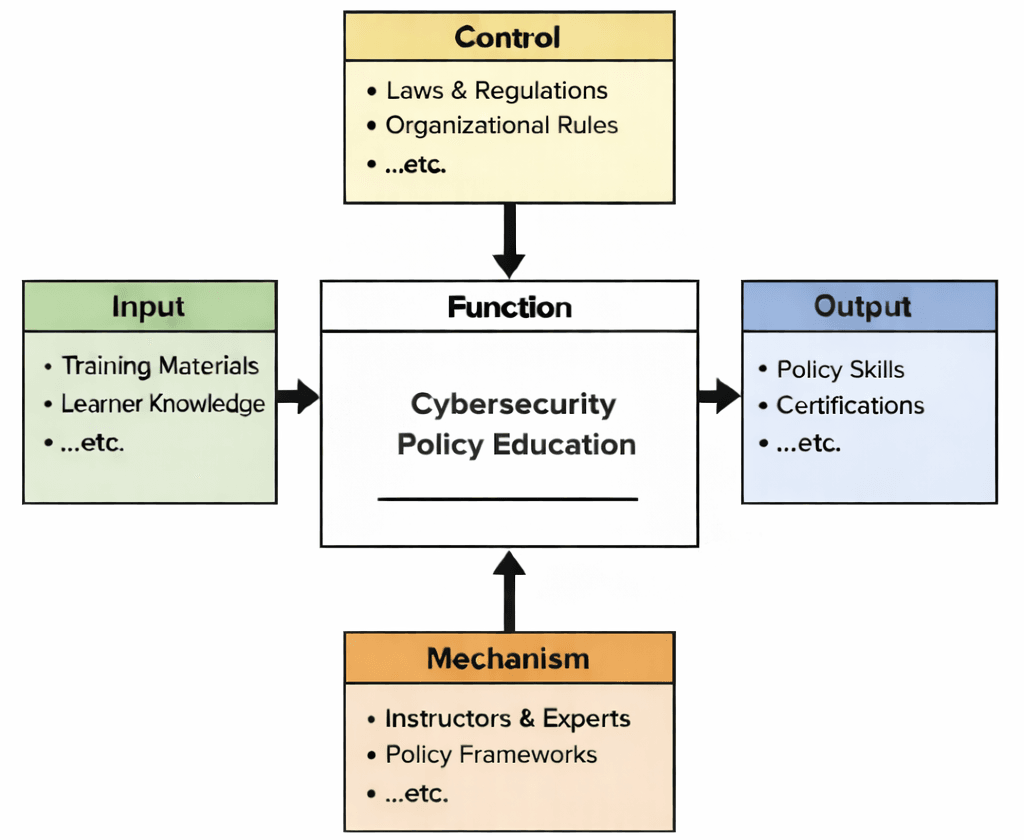
This IDEF0 (Input–Control–Output–Mechanism) diagram summarizes Cybersecurity Policy Education as a structured transformation. Inputs include training materials, real policy examples, and baseline learner knowledge about digital systems and risk. Controls include legal and regulatory requirements, organizational governance, security frameworks, and curriculum outcomes that define what policy must achieve and how it is evaluated. Mechanisms include instructors, policy workshops, case studies, risk assessment tools, and review processes that help learners practice drafting, interpreting, and refining policy. Outputs include learners who can translate security goals into workable rules, align policies with compliance needs, design responsibilities and exceptions clearly, and produce policy artifacts that can be communicated, implemented, and audited.
Interactive Check: Intro & System Concepts
Verify your understanding of how governance frameworks convert technical goals into organizational rules:
Introductory Concept Verification
1. Why must cybersecurity policy translate vague technical intentions into explicit operational expectations?
Answer: Technical capabilities alone do not guarantee compliance or consistent behavior across an organization. A policy transforms technical goals into clear, accountable rules (“who must do what, by when, using which approved tools, backed by what audit evidence”), making security enforceable, measurable, and auditable.
2. What constitutes the primary operational output of Cybersecurity Policy Education?
Answer: Practical policy literacy: the capability to draft unambiguous security rules, align organizational practices with regulatory mandates (e.g., GDPR, HIPAA, ISO 27001), manage documented exception workflows, and establish clear governance accountabilities.
Cybersecurity awareness has become an essential pillar of digital defense strategies in today’s hyper-connected world. Whether securing enterprise data in virtualized environments or safeguarding individual access points, awareness empowers users to act as the first line of defense. As the boundaries between cloud, personal, and industrial systems blur, building a culture of vigilance is just as critical as deploying advanced cybersecurity technologies.
Promoting cybersecurity awareness begins with understanding how technologies like serverless computing and edge computing introduce new attack surfaces. As digital infrastructure expands, so do the methods adversaries use to exploit human error—often through social engineering, poor password practices, or misuse of applications lacking proper application security.
Fostering awareness also involves recognizing that secure configurations must extend into areas like cloud networking, identity management, and data lifecycle governance. Modern infrastructure powered by DevOps and Infrastructure as Code can enforce secure defaults and limit privileges, but without user understanding and compliance, even the most robust systems are vulnerable.
Raising awareness across technical and non-technical teams ensures proactive defense against threats that can exploit weak endpoints or lax email hygiene. Teams must also recognize how cryptographic tools protect data both in transit and at rest. This knowledge helps prevent accidental breaches and supports compliance with policy frameworks developed through informed cybersecurity policies.
Awareness education benefits from real-world case studies, where breaches were either mitigated or exacerbated by user behavior. In such scenarios, the role of timely incident response and forensics becomes evident. Knowledge of attack vectors, such as phishing, and strategies like ethical hacking, reinforces the importance of continuous learning in defense postures.
With the rise of AI-powered attacks, it is crucial for end-users to stay informed through initiatives that incorporate insights from AI and ML in cybersecurity. Training should also address emerging concerns such as OT security and interconnected critical systems that now rely on industrial IoT. These overlaps are becoming more visible through cyber-physical systems and demand holistic understanding beyond just software-based attacks.
Awareness is further strengthened when it is data-informed. Leveraging insights from data science and analytics—and more specifically, tools from big data analytics—can help organizations tailor education campaigns and monitor risky behaviors. Meanwhile, defenders use threat intelligence to track evolving tactics, techniques, and procedures (TTPs), bridging the gap between technical operations and everyday awareness.
Building a secure digital culture cannot be the sole responsibility of technical staff. Everyone, from administrators managing cloud performance tuning to those securing network infrastructure, must understand their role in the broader cybersecurity ecosystem. Ultimately, awareness becomes the foundation for resilience, aligning technology with informed human action.

This illustration portrays cybersecurity policy and compliance as the bridge between technical protection and formal responsibility. At the center, a glowing checklist and prominent green check mark symbolize documented controls, audits, and proof that required safeguards are in place. Around it, legal imagery—scales of justice, official documents, and a courthouse—signals governance, regulations, and organizational obligations. Security shields and warning icons represent risk management, while servers and data stacks suggest the systems and records that must be protected and monitored. Overall, the scene emphasizes that strong cybersecurity is not only about tools, but also about policies, standards, training, and ongoing verification that an organization is meeting its legal and ethical duties.
Building Cyber Resilience: Cybersecurity Policy Navigation
Discover how Cybersecurity Policy and Governance establishes regulatory boundaries, organizational accountability, and compliance verification across the Cybersecurity cluster. Each card details data privacy laws (GDPR/CCPA), security frameworks (NIST/ISO 27001), risk management, and formal audit logging.
Cybersecurity Overview
Presents the macro governance model, detailing how enterprise policy and legal compliance direct technical, operational, and physical security controls.
Network Security
Examines codifying network access control policies, acceptable perimeter firewall configurations, and mandatory network traffic logging standards.
Application Security
Focuses on mandating secure coding benchmarks (OWASP ASVS), vulnerability patching SLAs, Software Bill of Materials (SBOM) tracking, and CI/CD gate policies.
Cloud Security
Details multi-cloud compliance governance, enforcing public bucket restrictions, cloud data residency mandates, and automated CSPM policy checks.
Endpoint Security
Covers acceptable use policies (AUP) for corporate laptops, Bring Your Own Device (BYOD) security policies, and mandatory full-disk encryption mandates.
Identity & Access Management
Governs access control policies, least-privilege role definitions, mandatory Multi-Factor Authentication (MFA) rules, and quarterly privilege access reviews.
Cryptography
Establishes cryptographic standards, mandating minimum key lengths (AES-256, RSA-2048+), key rotation cadences, and approved cipher suite lists.
Incident Response & Forensics
Codifies formal Incident Response Policies, mandatory breach notification timelines, evidence chain-of-custody rules, and legal disclosure protocols.
Threat Intelligence
Integrates threat intelligence feeds into formal risk management frameworks, updating organizational risk appetite models based on emerging adversary TTPs.
Ethical Hacking & Pen Testing
Defines rules of engagement policies for red-teaming, rules for bug bounty programs, and authorization scope limits for penetration testing.
Cybersecurity Awareness
Mandates employee security awareness training requirements, anti-phishing evaluation metrics, and social engineering compliance tracking.
Cybersecurity Policy
Focuses on regulatory compliance (GDPR, HIPAA, PCI DSS), NIST/ISO 27001 frameworks, risk assessment methodologies, audit logging, and security governance.
CPS Security
Enforces critical infrastructure safety and security policies, mandating compliance with real-time safety standards and cyber-physical interlock audits.
OT Security
Establishes industrial control security policies (IEC 62443, NERC CIP), air-gap requirements, and vendor remote access controls on plant floors.
AI & ML in Security
Drafts AI safety governance policies, model risk management guidelines, automated compliance monitoring standards, and training data privacy protections.
Emerging Areas
Investigates policy frameworks for Post-Quantum Cryptography transition, sovereign cloud data boundaries, and international digital privacy treaties.
Key Topics in Cybersecurity Policy and Compliance
Cybersecurity policy connects regulatory mandates with internal operational controls:
Data Protection Laws
- Purpose: Safeguarding personal data privacy and establishing legally binding requirements for processing, storage, and cross-border transfers.
- Major Regulations:
- GDPR (European Union): Mandates explicit consent, data encryption, data residency, and user rights (such as the “Right to be Forgotten”).
- CCPA (California): Grants consumers transparency rights over personal data collection and opt-out controls.
- HIPAA (US Healthcare): Mandates strict privacy and access controls over Protected Health Information (PHI).
- PCI DSS (Payment Cards): Enforces technical security controls for processing credit card numbers.
Security Frameworks
- ISO/IEC 27001: International standard defining requirements for an Information Security Management System (ISMS).
- NIST Cybersecurity Framework (CSF): Organized around five core functions: Identify, Protect, Detect, Respond, and Recover.
- CIS Controls: Prioritized technical safeguards mitigating common cyberattack vectors.
Risk Management and Governance
- Risk Management: Evaluating asset criticality, threat likelihood, and potential impact to prioritize technical controls.
- Governance: Establishing organizational roles, responsibilities, policies, and steering committees to align security with business goals.
Applications of Cybersecurity Policy and Compliance
Operational execution of policy frameworks across enterprise environments:
Auditing for Compliance with Industry Standards
- Audit Workflows: Conducting internal assessments and third-party external audits to verify encryption, access controls, and logging.
- Compliance Tools: Utilizing automated monitoring engines (Drata, Vanta, Qualys, Splunk) to generate real-time compliance evidence.
Developing Organizational Security Policies
- Acceptable Use Policy (AUP): Rules governing employee usage of company devices, email, and networks.
- Incident Response Policy: Outlining mandatory containment steps, escalation chains, and regulatory reporting requirements.
- Access Control Policy: Establishing rules for granting, reviewing, and revoking system access rights.
- Data Classification Policy: Categorizing data (Public, Internal, Confidential, Restricted) and dictating encryption handling.
Emerging Trends in Cybersecurity Policy and Governance
Next-generation governance models adapting to modern technology stacks:
Zero Trust Security Policies
- Codifying “never trust, always verify” policies requiring continuous authentication and micro-segmentation.
AI-Powered Policy Enforcement & Supply Chain Risk
- Utilizing machine learning to automate policy drift detection and enforcing strict vendor risk assessments across software supply chains.
Data Sovereignty & Localization
- Managing compliance with national laws restricting sensitive citizen data from leaving geographical borders.
Why Study Cybersecurity Policy
Understanding cybersecurity policy connects technical domain knowledge with organizational leadership:
- Bridging Technology, Law, and Governance: Connects technical security controls with legal mandates, risk management, and business objectives.
- Understanding Global Frameworks: Prepares learners to navigate complex, overlapping regulatory landscapes (GDPR, NIST, ISO 27001).
- Shaping Institutional Security Practices: Equips professionals to draft enforceable rules, manage risk exception registers, and pass compliance audits.
Interactive Quick Review: Policy & Governance Controls
Reinforce key concepts regarding policy hierarchies, audit trails, and risk management before reading the FAQ:
Quick Review Verification
1. What is the fundamental distinction between a security policy and a security standard?
Answer: A security policy is a high-level executive document defining what must be protected and overall security goals. A security standard defines specific, mandatory technical parameters (e.g., minimum AES-256 encryption, password length, or patch SLA timelines) required to achieve those policy goals.
2. How do compliance automation platforms reduce the administrative burden of audit logging?
Answer: Compliance automation tools continuously pull live configuration telemetry from cloud APIs, version control systems, and identity providers, continuously gathering verifiable evidence for SOC 2 or ISO 27001 audits without manual screenshot gathering.
Cybersecurity Policy – Frequently Asked Questions
What is a cybersecurity policy, and why is it important?
A cybersecurity policy is a formal document defining how an organization protects digital assets, systems, and data. It establishes clear behavioral rules, accountabilities, and technical baselines to mitigate risk and ensure legal compliance.
What are the key components of an effective cybersecurity policy?
Scope, roles and responsibilities, access control rules, acceptable asset use guidelines, data classification levels, incident response protocols, and references to governing regulatory standards.
How do policies support risk management and legal compliance?
They translate high-level regulations (GDPR, HIPAA) and risk assessments into daily operational rules, generating verifiable audit logs that prove due diligence during legal reviews or security audits.
What is the difference between a policy, standard, procedure, and guideline?
Policies set overall direction (“what”); Standards specify mandatory technical parameters; Procedures detail step-by-step instructions (“how”); Guidelines offer advisory best practices.
How often should cybersecurity policies be updated?
Policies should be formally reviewed at least annually, and immediately updated following major infrastructure changes, new privacy laws, or significant security incidents.
How do organizations handle policy non-compliance?
Through a combination of technical enforcement controls (automated access block), retraining, and formal disciplinary procedures detailed within the organization’s governance framework.
Cybersecurity Policy and Compliance: Conclusion
Cybersecurity policy and compliance provide a structured approach to managing security risks while meeting legal and ethical obligations. By adopting best practices, organizations can protect their data, ensure regulatory adherence, and foster a culture of accountability.
- Documented Accountabilities: Replace informal practices with clear, enforceable rules and roles.
- Continuous Posture Verification: Utilize automated compliance scanning to verify policy adherence in real time.
- Regular Audits & Revisions: Review and update policies annually to keep pace with emerging regulations and technical architectures.
End-of-Page Exercises: Review, Reflections & Analytics
Review Questions and Answers
1. What is a cybersecurity policy and why is it important for organizations?
Answer: A cybersecurity policy is a formal document establishing guidelines and standards to protect digital assets. It serves as a roadmap for risk management, regulatory compliance, and guiding employee security behavior.
2. What are the key components of an effective cybersecurity policy?
Answer: Components include access controls, data classification, acceptable use rules, incident response procedures, user responsibilities, and auditing standards.
3. How does a cybersecurity policy contribute to risk management within an organization?
Answer: It systematically identifies critical assets, assesses vulnerabilities, mandates technical mitigations, and sets incident containment protocols, lowering overall organizational risk profiles.
4. In what ways do compliance requirements influence the development of cybersecurity policies?
Answer: Laws like GDPR or HIPAA mandate specific controls (encryption, access logs, breach notification windows), forcing policies to incorporate mandatory technical safeguards to avoid legal penalties.
5. How does employee training factor into the successful enforcement of cybersecurity policies?
Answer: Training ensures staff understand expectations, recognize social engineering, and follow password and data handling rules, reducing accidental policy non-compliance.
6. What challenges might organizations face when implementing cybersecurity policies?
Answer: Employee resistance to friction, legacy technology incompatibilities, resource constraints, and keeping rules current against fast-evolving cyber threats.
7. How can organizations ensure that their cybersecurity policies remain effective over time?
Answer: By establishing annual policy review cycles, conducting regular compliance audits, incorporating lessons from post-incident reviews, and updating rules for emerging technology stacks.
8. What role does incident response play in a cybersecurity policy?
Answer: It provides a structured operational playbook for detecting, containing, eradicating, and recovering from security breaches, establishing clear escalation roles and reporting timelines.
9. How do cybersecurity policies support regulatory and legal compliance?
Answer: Policies document mandatory technical controls and auditing workflows required by law, supplying external auditors with evidence of organizational compliance.
10. What best practices should organizations follow when developing a cybersecurity policy?
Answer: Engage cross-departmental stakeholders, align rules with NIST/ISO frameworks, conduct risk assessments, maintain clear concise language, and enforce automated technical guardrails.
Thought-Provoking Architectural Questions
1. How can organizations ensure that their cybersecurity policies remain effective in a rapidly evolving threat landscape?
Answer: By establishing continuous automated Policy-as-Code checks, integrating real-time threat intelligence feeds, and utilizing modular policy structures that allow technical standards to be updated without rewriting high-level policy frameworks.
2. What are the potential long-term impacts of poorly implemented cybersecurity policies on an organization?
Answer: Chronic security breaches, crippling regulatory fines, severe reputational erosion, employee policy fatigue leading to bypass workarounds, and prolonged recovery operational downtime.
3. How might emerging technologies such as AI and blockchain transform policy development and enforcement?
Answer: AI will dynamically detect policy compliance drift in cloud configurations, while blockchain immutable ledgers will supply tamper-proof, verifiable audit logs for regulatory reporting.
4. In what ways can international collaboration influence the formulation of cybersecurity policies globally?
Answer: Cross-border threat sharing harmonizes data protection laws, enabling standardized global breach notification mandates and joint law enforcement actions against ransomware cartels.
5. What strategies balance strict cybersecurity policies with operational business flexibility?
Answer: Adopt risk-based access controls, automated Just-In-Time (JIT) access approvals, and frictionless single sign-on (SSO) with risk-based adaptive multi-factor authentication.
6. How do cultural differences impact policy enforcement in multinational organizations?
Answer: Regional privacy expectations and legal frameworks (e.g., EU GDPR vs US state laws) require localized policy addendums while maintaining global core security baselines.
7. What role do government regulations play in shaping corporate cybersecurity policies?
Answer: Regulations set legal minimums for data handling, incident disclosure windows, and executive liability, elevating cybersecurity from an IT issue to a board-level governance duty.
8. How can organizations measure policy effectiveness in reducing risk and ensuring compliance?
Answer: Tracking metrics like policy exception ticket volumes, audit finding remediation times, phishing simulation click rates, and incident frequency.
9. What potential challenges arise when integrating new policies into an existing IT infrastructure?
Answer: Legacy systems lacking modern logging or MFA capabilities, developer pushback against CI/CD security gates, and technical debt.
10. How might the evolution of remote/hybrid work influence future policy requirements?
Answer: Shifts policies from perimeter firewall protection toward Zero Trust endpoint controls, mandatory VPN/ZTNA, BYOD security rules, and cloud data loss prevention (DLP).
11. What innovative approaches encourage employee policy adherence in large organizations?
Answer: Gamified awareness simulations, Security Champions networks inside product teams, and positive recognition for reporting security vulnerabilities.
12. How can public-private partnerships contribute to robust cybersecurity policies?
Answer: By facilitating threat intelligence sharing between intelligence agencies and industry operators, ensuring policies reflect real-world technical realities.
Numerical Engineering Problems & Solutions
Problem 1: Calculating Policy Compliance Increase and Percentage Improvement
An organization with 300 employees records an initial security policy compliance rate of 85% (255 compliant staff). Implementing a mandatory policy training session increases compliance by 10 percentage points up to 95% (285 compliant staff). Calculate initial compliant staff, new compliant staff, and percentage increase in compliant employees.
Solution:
- Initial compliant employees = 300 × 0.85 = 255 employees
- New compliance rate = 85% + 10% = 95%
- New compliant employees = 300 × 0.95 = 285 employees
- Net increase in compliant employees = 285 – 255 = 30 employees
- Percentage increase in compliant staff = (30 / 255) × 100 ≈ 11.76%
Problem 2: Policy Review Payback Period & Revised Annual Savings
A formal policy review costs $50,000 and yields an average breach loss reduction of $200,000 per year. Calculate initial payback period in years. If further policy automation reduces breach losses by an additional 25% ($50,000 extra savings), calculate new total annual savings and revised payback period.
Solution:
- Initial payback period = $50,000 / $200,000 = 0.25 years (3 months)
- Additional savings = $200,000 × 0.25 = $50,000/year
- New total annual savings = $200,000 + $50,000 = $250,000/year
- Revised payback period = $50,000 / $250,000 = 0.20 years (2.4 months)
Problem 3: Calculating Endpoint Security Policy Compliance Rate
A company policy mandates that 90% of all 500 company endpoints be secured. Calculate required secured endpoints. An audit reveals that 15 endpoints are insecure. Calculate current compliance rate and determine if additional securing is required.
Solution:
- Mandated secured endpoints = 500 × 0.90 = 450 endpoints
- Actual secured endpoints = 500 total – 15 insecure = 485 endpoints
- Current compliance rate = (485 / 500) × 100 = 97.0%
Problem 4: Calculating Expected Annual Loss Reduction from Policy Hardening
A risk assessment notes a breach probability of 5% (0.05) per year with an average cost of $100,000 per breach. Updated security policies reduce breach probability by 60%. Calculate initial expected annual loss, new breach probability, new expected loss, and annual loss reduction.
Solution:
- Initial expected annual loss = 0.05 × $100,000 = $5,000/year
- New breach probability = 5% × (1 – 0.60) = 2.0% (0.02)
- New expected annual loss = 0.02 × $100,000 = $2,000/year
- Annual loss reduction = $5,000 – $2,000 = $3,000/year
Problem 5: Calculating Non-Compliance Incident Reduction
An audit reveals that 40% of 25 annual security incidents resulted from employee policy non-compliance. A new policy enforcement tool reduces non-compliance incidents by 50%. Calculate non-compliance incident counts before and after enforcement.
Solution:
- Original non-compliance incidents = 25 × 0.40 = 10 incidents
- Incidents reduced (50% drop) = 10 × 0.50 = 5 incidents eliminated
- New expected non-compliance incidents = 10 – 5 = 5 incidents
Problem 6: Calculating Total Additional Policy Training Hours
A policy update increases annual mandatory training hours from 4 to 8 hours per employee across a workforce of 200 employees. Calculate total initial training hours, new total training hours, additional hours required, and percentage increase.
Solution:
- Initial total training hours = 200 × 4 hours = 800 hours/year
- New total training hours = 200 × 8 hours = 1,600 hours/year
- Additional training hours = 1,600 – 800 = 800 hours
- Percentage increase = (800 / 800) × 100 = 100.0%
Problem 7: Calculating Return on Investment (ROI) for Policy Implementation
Implementing a new data governance policy costs $100,000 and generates $250,000 in expected breach loss prevention savings. Calculate net savings and Return on Investment (ROI) percentage.
Solution:
- Net financial savings = $250,000 (savings) – $100,000 (cost) = $150,000
- ROI percentage = ($150,000 / $100,000) × 100 = 150.0%
Problem 8: Calculating Average Annual Review Cost and Net Benefit
A formal policy review occurs every 2 years at a cost of $20,000 per review. Over a 10-year period, calculate total review cost and average annual review expense. If policy improvements save $50,000 per year, calculate net annual financial benefit.
Solution:
- Number of reviews in 10 years = 10 / 2 = 5 reviews
- Total review cost over 10 years = 5 × $20,000 = $100,000
- Average annual review cost = $100,000 / 10 = $10,000/year
- Net annual benefit = $50,000 (annual savings) – $10,000 (annual review cost) = $40,000/year
Problem 9: Calculating Incident Reduction & Cost Savings from Policy Enforcement
A firm spends $75,000 annually on policy enforcement, achieving a 70% reduction in incident frequency from a baseline of 20 breaches per year. If each breach costs $10,000, calculate post-enforcement incidents and net financial breach cost savings.
Solution:
- Incidents eliminated = 20 × 0.70 = 14 breaches saved
- Expected post-enforcement breaches = 20 – 14 = 6 breaches/year
- Gross breach cost savings = 14 breaches × $10,000 = $140,000/year
- Net savings after enforcement expense = $140,000 – $75,000 = $65,000/year
Problem 10: Calculating Annual Backup Compliance Expense
A new data retention policy mandates automated database backups every 24 hours (365 backups per year). Each cloud backup execution costs $5. Calculate total annual backup executions required and total annual backup cost.
Solution:
- Total annual backups required = 365 backups/year
- Annual backup expense = 365 × $5 = $1,825/year
Problem 11: Calculating Target Risk Score Reduction
An enterprise risk audit assigns an initial risk score of 80 points. A governance initiative aims to reduce the organizational risk score by 30%. Calculate numerical point reduction and target risk score.
Solution:
- Numerical risk point reduction = 80 points × 0.30 = 24 points reduction
- Target risk score = 80 – 24 = 56 points
Problem 12: Calculating Annual Savings from Reduced Breach Probability
A system valued at $500,000 exhibits an 8% (0.08) annual breach probability. A new cybersecurity policy lowers annual breach probability to 3% (0.03). Calculate expected annual loss before and after policy implementation, and net annual savings.
Solution:
- Pre-policy expected annual loss = 0.08 × $500,000 = $40,000/year
- Post-policy expected annual loss = 0.03 × $500,000 = $15,000/year
- Net annual savings = $40,000 – $15,000 = $25,000/year
Cybersecurity Policy and Governance — Summary & Wrap-Up
Cybersecurity policy and compliance provide a structured framework for managing security risks, meeting legal mandates, and establishing organizational accountability. By combining risk-based policies, automated compliance verification, and clear administrative guidelines, organizations establish a dependable governance foundation that turns security theory into reliable operational practice.