
Cryptography Education is the study of trust under pressure: how to keep meaning intact when messages travel through untrusted space. The diagram shows how that understanding is built. Learners begin with inputs—concepts, examples, and the essential foundations—yet cryptography cannot be learned as “clever tricks.” It is shaped by controls: standards that define safe parameters, protocol rules that prevent subtle failures, and security requirements that demand precision rather than intuition. With mechanisms such as guided instruction, practice labs, and carefully chosen tools, students move from symbols on a page to disciplined habits: choosing the right primitive for the job, handling keys with respect, verifying rather than assuming, and recognizing that a strong algorithm can still be defeated by a weak implementation or sloppy usage. The output is a learner who can speak about secrecy and authenticity in concrete terms—and who can apply cryptography as reliable engineering, not as mystique.
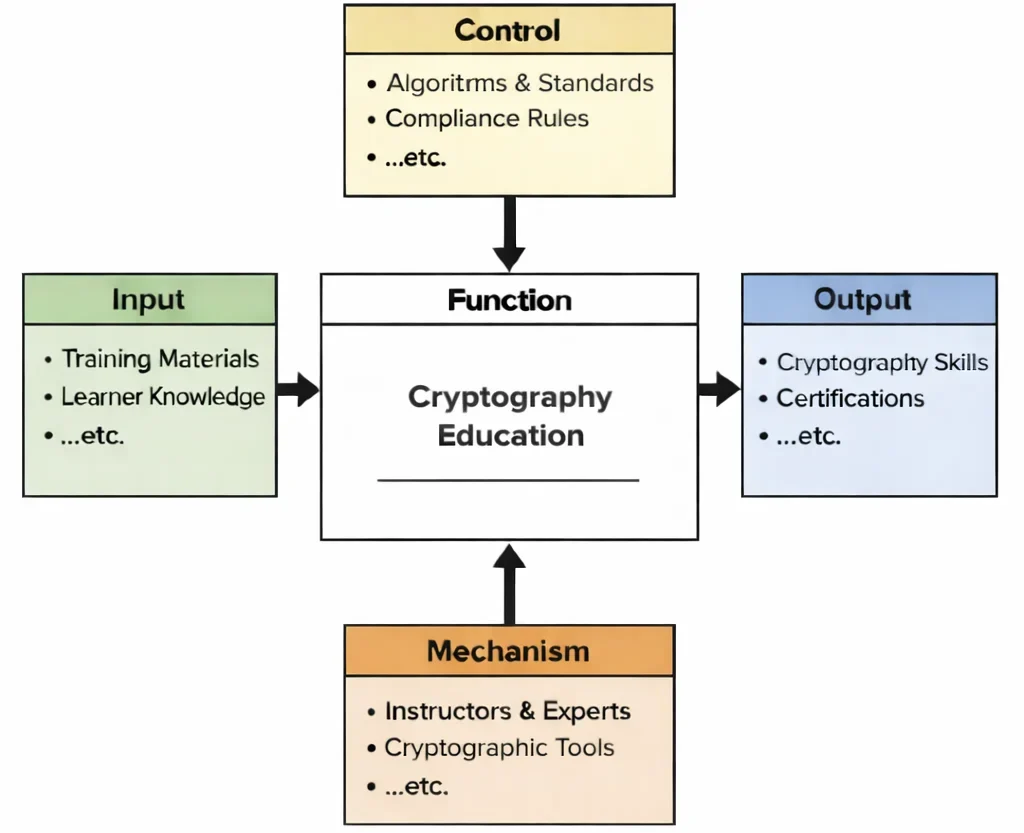
This IDEF0 (Input–Control–Output–Mechanism) diagram summarizes Cryptography Education as a structured transformation process. Inputs include learning materials and foundational learner knowledge (basic math, computing concepts, and security context). Controls include cryptographic standards, security requirements, protocol constraints, and curriculum outcomes that define what is correct, safe, and interoperable. Mechanisms include instructors, worked examples, lab environments, and cryptography tools for practicing hashing, encryption, signatures, key management, and secure protocol usage. Outputs include learners who can explain core cryptographic ideas, apply modern primitives appropriately, avoid common misuse patterns, and reason clearly about confidentiality, integrity, authentication, and trust.
Interactive Check: Intro & System Concepts
Verify your understanding of how cryptographic primitives and standardized protocols establish trust across untrusted networks:
Introductory Concept Verification
1. Why is cryptography described as “trust under pressure” rather than just a set of clever mathematical tricks?
Answer: Cryptography maintains data confidentiality and authenticity when messages travel through hostile, untrusted networks. It requires strict adherence to standardized parameters and protocol rules because a mathematically sound algorithm can still fail catastrophically if implemented or configured sloppily.
2. What is the primary output expected from Cryptography Education?
Answer: Practical engineering capability: learners who can choose the correct cryptographic primitive for a given architecture, handle keys securely, verify rather than assume, and apply encryption as reliable engineering rather than mystic lore.
Cryptography forms the backbone of secure digital communication, enabling confidentiality, authentication, and data integrity across systems. From personal messaging to enterprise-grade cloud networking, cryptographic principles ensure that sensitive data remains shielded from unauthorized access. Its integration with broader cybersecurity strategies is essential for protecting critical systems, particularly in sectors involving operational technologies and infrastructure.
As threats evolve, cryptographic techniques must also keep pace. Innovations in edge computing and serverless architectures have introduced new environments where encryption and key management are crucial. Likewise, cryptography supports the confidentiality and integrity of data in distributed systems reliant on availability and performance tuning to deliver reliable services.
In the era of smart applications and microservices, the integration of cryptographic methods into DevOps pipelines and containerized environments helps maintain end-to-end security. These developments support the secure delivery of software, while safeguarding APIs and user data within cloud-native frameworks. Furthermore, secure application design incorporates principles from application security to reduce vulnerabilities exploitable via weak encryption.
With the proliferation of connected devices, sectors such as CPS security and endpoint security demand cryptographic robustness. Whether in medical equipment, autonomous vehicles, or industrial control systems, cryptographic algorithms secure the data streams and control commands that underpin their functionality. These layers complement network security measures to form a multi-tiered defense system.
As adversaries adopt advanced methods, including AI-driven attacks, fields such as AI and ML in cybersecurity are being harnessed to identify cryptographic weaknesses and improve defensive capabilities. These techniques, often supported by data science and big data analytics, facilitate real-time threat detection, anomaly prediction, and key management optimization.
Cryptography also plays a pivotal role in governance and awareness. Secure authentication and access control rely heavily on identity and access management, while adherence to compliance frameworks is reinforced through encryption standards. Developing a strong culture of cybersecurity awareness and policy implementation ensures that cryptographic measures are applied consistently and effectively across all levels of an organization.
To anticipate future threats, professionals explore emerging areas in cybersecurity and enhance system resilience through simulation and testing, such as ethical hacking and red teaming. These practices complement incident response and forensics processes that uncover breaches and inform remediation. Finally, actionable insights are drawn from threat intelligence, completing the loop from encryption to detection and recovery.

This image represents cryptography as the foundation of digital trust. A bright padlock sits at the center of a microchip-like ring, suggesting that encryption is built into modern computing systems rather than added as an afterthought. Floating key symbols and streams of binary code hint at the core idea of cryptography: information is transformed into ciphertext using mathematical algorithms and can only be unlocked with the correct key. The surrounding security icons and glowing network nodes evoke secure communication—protecting messages, identities, payments, and stored data from eavesdropping or tampering. As an introductory visual, it conveys both confidentiality (keeping data secret) and integrity/authentication (ensuring data is genuine and unchanged).
Building Cyber Resilience: Cryptography Navigation
Discover how Cryptography establishes data confidentiality, message authentication, and PKI trust chains across the Cybersecurity cluster. Each card details AES symmetric ciphers, RSA/ECC public-key encryption, SHA-256 hashing, and digital certificate verification.
Cybersecurity Overview
Presents the overarching macro-architecture, mapping how cryptographic primitives secure data at rest, in transit, and in use across enterprise systems.
Network Security
Examines TLS/SSL cryptographic handshakes, secure VPN tunneling, IPsec packet encryption, and cipher suite negotiation.
Application Security
Focuses on secure password hashing (Argon2/bcrypt), JSON Web Token (JWT) signature verification, and field-level database payload encryption.
Cloud Security
Details Cloud Key Management Services (KMS), envelope encryption, HSM master keys, and customer-managed encryption keys (CMK).
Endpoint Security
Covers full-disk encryption (BitLocker/FileVault), trusted platform modules (TPM), and secure boot cryptographic validation.
Identity & Access Management
Governs digital identity verification, FIDO2/WebAuthn public-key challenge-response authentication, and OAuth token signatures.
Cryptography
Focuses on symmetric ciphers (AES), asymmetric key pairs (RSA/ECC), digital signatures, X.509 PKI certificates, SHA-256 hashing, and post-quantum algorithms.
Incident Response & Forensics
Analyzes cryptographic hash verification for forensic disk images (SHA-256/MD5 checksums) and investigates compromised private key revocation events.
Threat Intelligence
Tracks cryptographic vulnerabilities, compromised Certificate Authorities (CAs), and quantum computing advancements threatening legacy algorithms.
Ethical Hacking & Pen Testing
Executes side-channel timing attacks, weak random number generator analyses, and certificate validation bypass testing.
Cybersecurity Awareness
Educates users on the importance of end-to-end encrypted messaging, avoiding phishing sites lacking valid TLS certificates, and credential protection.
Policy & Governance
Enforces organizational cryptographic standards, key rotation schedules (≤90 days), FIPS 140-2/3 compliance, and approved cipher suite lists.
CPS Security
Applies lightweight cryptography for resource-constrained IoT sensors, encrypted CAN bus messaging in vehicles, and signed firmware updates.
OT Security
Secures industrial control communications, protecting SCADA telemetry packets and controller command integrity against interception.
AI & ML in Security
Leverages machine learning to analyze cryptographic side-channel radiation, detect weak key generation entropy, and optimize key distribution.
Emerging Areas
Investigates Post-Quantum Cryptography (PQC), Fully Homomorphic Encryption (FHE) for secure cloud analytics, and Zero-Knowledge Proofs (ZKPs).
Key Topics in Cryptography
Cryptographic systems rely on fundamental mathematical primitives that deliver confidentiality, integrity, authenticity, and non-repudiation:
Symmetric and Asymmetric Encryption
- Symmetric Encryption: Employs a single secret key for both encryption and decryption. Highly efficient for bulk data encryption (e.g., AES-128 / AES-256).
- Asymmetric Encryption: Utilizes a mathematically linked key pair—a public key for encryption/verification and a private key for decryption/signing (e.g., RSA, ECC).
Digital Signatures and Certificates
- Digital Signatures: Cryptographic proofs created using a private key that verify message integrity and sender authenticity.
- Digital Certificates (X.509): Issued by trusted Certificate Authorities (CAs) to bind public keys to organizational identities in TLS/HTTPS.
Blockchain and Cryptographic Hashing
- Cryptographic Hashing: One-way mathematical functions (SHA-256) producing fixed-length digests that uniquely fingerprint input data.
- Blockchain Technology: Decentralized ledgers combining cryptographic hashes and consensus mechanisms to ensure tamper-proof records.
Applications of Cryptography
Real-world deployments of cryptographic protocols across digital infrastructures:
Secure Web Communication (HTTPS)
- SSL/TLS Protocols: Encrypt web browser and server communication, protecting online banking and e-commerce transactions from eavesdroppers.
Data Storage Security
- Full-Disk & Database Encryption: Encrypting stored files and database volumes using AES to protect data at rest against physical disk theft.
Secure Email & Messaging
- PGP / S/MIME & E2EE: End-to-end encryption securing email and chat messages so only intended recipients can read ciphertext.
Emerging Trends in Cryptography
Next-generation cryptographic paradigms addressing quantum threats and data privacy:
Post-Quantum Cryptography (PQC)
- Developing lattice-based and hash-based algorithms resistant to quantum computing cryptanalysis (Shor’s algorithm).
Homomorphic Encryption & Zero-Knowledge Proofs (ZKPs)
- Homomorphic Encryption: Permitting computations on encrypted data without decrypting it first, enabling secure cloud analytics.
- Zero-Knowledge Proofs: Proving statement validity without revealing underlying data secrets.
Why Study Cryptography
Mastering cryptography equips security engineers to construct un-bypassable mathematical trust boundaries:
- Securing Digital Communication: Provides the theoretical foundation for secure web browsing, financial transactions, and private messaging.
- Mastering Mathematical Primitives: Teaches symmetric ciphers, asymmetric key pairs, hash functions, and digital signatures.
- Applied Implementation Challenges: Exposes real-world pitfalls such as side-channel attacks, improper IV reuse, and weak key management.
Interactive Quick Review: Cryptographic Primitives
Reinforce key concepts regarding symmetric ciphers, asymmetric key pairs, and hashing before reading the FAQ:
Quick Review Verification
1. What is the operational difference between symmetric encryption and asymmetric encryption?
Answer: Symmetric encryption uses a single shared secret key for both encryption and decryption, making it extremely fast for bulk data. Asymmetric encryption uses a public/private key pair; data encrypted with a public key can only be decrypted by the corresponding private key, solving the secure key distribution problem.
2. Why must cryptographic hash functions be collision-resistant?
Answer: Collision resistance ensures it is computationally infeasible for an attacker to find two distinct plaintext inputs that produce the identical hash digest, protecting digital signatures and software integrity verifications from forgery.
Cryptography – Frequently Asked Questions
What is cryptography, and why is it important in cybersecurity?
Cryptography secures information so only authorized parties can read or modify it. It underpins confidentiality, integrity, and authentication, protecting web browsing, banking, and critical infrastructure from eavesdropping and tampering.
What is the difference between symmetric and asymmetric encryption?
Symmetric encryption uses one secret key for both encryption and decryption (fast, bulk data). Asymmetric encryption uses a public/private key pair (secure key exchange and digital signatures).
What are cryptographic hash functions, and how are they used?
Hash functions (like SHA-256) convert arbitrary input into a fixed-length digest. They are collision-resistant and irreversible, used for password storage, file integrity checks, and digital signatures.
What is Public-Key Infrastructure (PKI)?
PKI is the framework of policies, hardware, and Certificate Authorities (CAs) managing digital certificates that bind public keys to identities, heavily used in HTTPS web browsing.
How does cryptography protect data in transit and at rest?
Data in transit is secured via TLS protocols using symmetric/asymmetric ciphers. Data at rest is protected via full-disk and database encryption (AES-256).
Why is Key Management critical in cryptographic systems?
Even strong algorithms fail if keys are hardcoded or mismanaged. Secure key management (KMS/HSM) governs key generation, rotation, and revocation over their entire lifecycle.
Cryptography: Conclusion
Cryptography is the backbone of modern cybersecurity, enabling secure communication, protecting data, and establishing trust in digital systems. With advancements in technology and the emergence of new threats, cryptography continues to evolve, ensuring the security of our increasingly interconnected world.
- Use Standard Primitives: Rely on proven algorithms like AES-256, RSA-2048+, ECC, and SHA-256.
- Protect the Keys: Never hardcode secrets; manage keys securely via KMS/HSM with scheduled rotation.
- Prepare for Quantum Threats: Monitor NIST Post-Quantum Cryptography standards to future-proof systems.
End-of-Page Exercises: Review, Reflections & Analytics
Review Questions and Answers
1. What is cryptography and why is it important in IT security?
Answer: Cryptography is the science of encoding and decoding information to protect it from unauthorized access, ensuring confidentiality, authenticity, and integrity across digital systems.
2. How do symmetric and asymmetric encryption differ in their approaches?
Answer: Symmetric encryption uses one shared secret key for encryption and decryption (fast for bulk data). Asymmetric encryption uses a public/private key pair (secure key distribution and signing).
3. What are the primary components of a cryptographic system?
Answer: Cryptographic algorithms (mathematical ciphers), cryptographic keys (secret/public values), and protocols (rules governing key exchange and message formatting).
4. How do encryption algorithms ensure the confidentiality of transmitted data?
Answer: By transforming plaintext into incomprehensible ciphertext using complex mathematical functions that cannot be reversed without the correct decryption key.
5. What role do digital signatures play in maintaining data integrity and authenticity?
Answer: Digital signatures use private keys to sign data hashes, allowing recipients to verify sender identity and confirm that message payloads have not been altered in transit.
6. How does key management contribute to the overall security of cryptographic systems?
Answer: Proper key management ensures keys are generated securely, distributed safely, stored in HSMs, rotated on schedule, and revoked immediately if compromised.
7. What are some common cryptographic protocols used in secure communications?
Answer: TLS (Transport Layer Security) for HTTPS web traffic, IPsec for VPN tunneling, and PGP/S/MIME for secure email encryption.
8. How does a cryptographic hash function work and why is it essential for data verification?
Answer: Hash functions map arbitrary data inputs to fixed-size unique digests deterministically. Any tiny input alteration completely changes the output hash, making tampering instantly detectable.
9. What challenges are associated with implementing cryptography in modern IT systems?
Answer: Implementation errors (side-channel leaks, poor random number generators), complex key management overhead, performance latency, and future quantum computing threats.
10. How does the evolution of cryptography impact overall cybersecurity measures?
Answer: It drives continuous adaptation, replacing broken ciphers (MD5/SHA-1) with secure standards (SHA-256, AES) and preparing infrastructures for post-quantum algorithms.
Thought-Provoking Architectural Questions
1. How will quantum computing affect modern cryptography protocols?
Answer: Shor’s algorithm running on quantum computers will efficiently factor large prime numbers, breaking asymmetric algorithms like RSA and ECC, forcing global migration to post-quantum cryptography.
2. What are the ethical implications of widespread cryptography in balancing privacy and national security?
Answer: Strong end-to-end encryption protects citizen privacy and financial data from cyber criminals, but also creates “going dark” challenges for law enforcement investigating criminal conspiracies.
3. How can blockchain technology revolutionize digital signatures and secure transactions?
Answer: By recording cryptographically signed transactions across decentralized, immutable ledgers, blockchain eliminates single points of failure and establishes trust without central authorities.
4. In what ways does the concept of perfect secrecy challenge current encryption standards?
Answer: The One-Time Pad achieves mathematically unbreakable “perfect secrecy,” but requires a random key as long as the message and used only once—making it impractical for bulk internet traffic.
5. What role might artificial intelligence play in both enhancing and breaking cryptographic systems?
Answer: AI optimizes key distribution and detects side-channel timing anomalies. Conversely, ML models can assist cryptanalysts in automating pattern recognition against flawed cipher implementations.
6. How do evolving cryptographic standards influence global cybersecurity practices?
Answer: NIST and ISO standards set mandatory compliance baselines, compelling organizations worldwide to retire deprecated algorithms and adopt approved cryptographic frameworks.
7. Can post-quantum cryptography truly safeguard data in a future dominated by quantum computing?
Answer: Yes, lattice-based and hash-based post-quantum algorithms rely on mathematical problems believed to be equally hard for both classical and quantum computers to solve.
8. What is the impact of cryptography on digital rights and personal privacy in the modern era?
Answer: Cryptography is the technical bedrock of personal privacy, ensuring that individuals retain control over their communications, health records, and financial transactions against corporate or state surveillance.
9. How can decentralized cryptographic systems change the landscape of data security?
Answer: By removing centralized honey-pot servers, decentralized cryptographic systems prevent single-point-of-failure data breaches, distributing trust across independent nodes.
10. What challenges exist in implementing cryptographic solutions in resource-constrained environments?
Answer: IoT microcontrollers have limited battery, RAM, and CPU cycles, making heavy RSA or AES operations impractical without lightweight cryptography alternatives (e.g., PRESENT, SIMON).
11. How might advancements in cryptanalysis influence the future design of encryption algorithms?
Answer: Successful cryptanalytic attacks expose structural weaknesses, driving cryptographers to design ciphers with higher diffusion, larger key sizes, and greater mathematical complexity.
12. How does the interplay between cryptography and cyberlaw shape the global digital landscape?
Answer: Export control laws govern cryptographic software distribution, while data protection regulations (GDPR) legally mandate encryption as a mandatory technical safeguard against breaches.
Numerical Engineering Problems & Solutions
Problem 1: Calculating Brute-Force Feasibility for a Symmetric 128-Bit Key
A symmetric encryption algorithm uses a 128-bit key (total space of 2^128 possible keys). A hardware cracking rig tests 10^9 keys per second. Calculate total possible keys and estimate brute-force time in years (using 3.15 × 10^7 seconds per year).
A symmetric encryption algorithm uses a 128-bit key (total space of 2^128 possible keys). A hardware cracking rig tests 10^9 keys per second. Calculate total possible keys and estimate brute-force time in years (using 3.15 × 10^7 seconds per year).
Solution:
- Total key space = 2^128 ≈ 3.4028 × 10^38 possible keys
- Brute-force duration in seconds = (3.4028 × 10^38) / 10^9 = 3.4028 × 10^29 seconds
- Convert seconds to years: (3.4028 × 10^29) / (3.15 × 10^7) ≈ 1.08 × 10^22 years
Problem 2: Estimating Quantum Brute-Force Time for a 256-Bit Key
A cryptographic algorithm uses a 256-bit key (2^256 key space). Grover’s quantum algorithm effectively reduces symmetric key search complexity to the square root of the key space (2^128 operations). A quantum computer tests 10^12 keys per second. Calculate quantum search operations and estimate time in years.
A cryptographic algorithm uses a 256-bit key (2^256 key space). Grover’s quantum algorithm effectively reduces symmetric key search complexity to the square root of the key space (2^128 operations). A quantum computer tests 10^12 keys per second. Calculate quantum search operations and estimate time in years.
Solution:
- Grover’s reduced search space = √(2^256) = 2^128 operations
- Total operations = 2^128 ≈ 3.4028 × 10^38 operations
- Duration in seconds = (3.4028 × 10^38) / 10^12 = 3.4028 × 10^26 seconds
- Convert seconds to years: (3.4028 × 10^26) / (3.15 × 10^7) ≈ 1.08 × 10^19 years
Problem 3: Calculating Hash Collision Probability via Birthday Paradox
A cryptographic hash function produces a 256-bit output. Calculate the approximate collision probability when n = 2^64 distinct hash outputs are generated using the birthday paradox approximation: P ≈ n^2 / (2 × 2^256).
A cryptographic hash function produces a 256-bit output. Calculate the approximate collision probability when n = 2^64 distinct hash outputs are generated using the birthday paradox approximation: P ≈ n^2 / (2 × 2^256).
Solution:
- Square of distinct outputs (n^2) = (2^64)^2 = 2^128
- Denominator = 2 × 2^256 = 2^257
- Collision probability = 2^128 / 2^257 = 1 / 2^129
Problem 4: Estimating Available Prime Numbers for 1024-Bit RSA Keys
An RSA key generation routine selects a prime number of approximately 1024 bits. Using the Prime Number Theorem density estimation, density in that range is approximately 1 / ln(2^1024). Calculate ln(2^1024) and estimate prime availability.
An RSA key generation routine selects a prime number of approximately 1024 bits. Using the Prime Number Theorem density estimation, density in that range is approximately 1 / ln(2^1024). Calculate ln(2^1024) and estimate prime availability.
Solution:
- Calculate ln(2^1024) = 1024 × ln(2) = 1024 × 0.693147 ≈ 709.78
- Prime density reciprocal = 1 / 709.78
- Total numbers in range ≈ 2^1024
- Estimated available primes = (2^1024) / 709.78 ≈ 2^1024 / 709.78
Problem 5: Nonce Collision Probability in a Challenge-Response Protocol
A secure protocol generates a random 128-bit nonce. Calculate the approximate collision probability if n = 1,000,000 (10^6) nonces are generated, using the birthday paradox formula P ≈ n^2 / (2 × 2^128).
A secure protocol generates a random 128-bit nonce. Calculate the approximate collision probability if n = 1,000,000 (10^6) nonces are generated, using the birthday paradox formula P ≈ n^2 / (2 × 2^128).
Solution:
- Square of nonces (n^2) = (10^6)^2 = 10^12 = 2^39.86
- Total nonce space denominator = 2 × 2^128 = 2^129
- Collision probability = 10^12 / (2 × 3.4028 × 10^38) ≈ 1.47 × 10^-27
Problem 6: Calculating Brute-Force Duration for an 80-Bit Cipher
A legacy encryption algorithm has a security margin of 2^80 operations. A supercomputer performs 10^12 operations per second. Calculate total time required to break the cipher in seconds, minutes, and years.
A legacy encryption algorithm has a security margin of 2^80 operations. A supercomputer performs 10^12 operations per second. Calculate total time required to break the cipher in seconds, minutes, and years.
Solution:
- Total operations = 2^80 ≈ 1.2089 × 10^24 operations
- Duration in seconds = (1.2089 × 10^24) / 10^12 = 1.2089 × 10^12 seconds
- Convert seconds to minutes: (1.2089 × 10^12) / 60 ≈ 2.015 × 10^10 minutes
- Convert seconds to years: (1.2089 × 10^12) / (3.15 × 10^7) ≈ 38,377 years
Problem 7: Estimating Blockchain Proof-of-Work Mining Duration
A blockchain mining target requires an average of 2^80 hash computations to find a valid block. A mining rig computes 10^10 hashes per second. Calculate average mining time in seconds, hours, and days.
A blockchain mining target requires an average of 2^80 hash computations to find a valid block. A mining rig computes 10^10 hashes per second. Calculate average mining time in seconds, hours, and days.
Solution:
- Total hash computations = 2^80 ≈ 1.2089 × 10^24 hashes
- Mining time in seconds = (1.2089 × 10^24) / 10^10 = 1.2089 × 10^14 seconds
- Convert seconds to hours: (1.2089 × 10^14) / 3,600 ≈ 3.358 × 10^10 hours
- Convert hours to days: (3.358 × 10^10) / 24 ≈ 1.399 × 10^9 days (approx. 3.83 million years)
Problem 8: Calculating Modular Exponentiation Execution Time
An RSA modular exponentiation operation uses a 256-bit exponent requiring approximately 256 modular multiplications. If each modular multiplication takes 10^-6 seconds (1 microsecond), calculate total execution time in seconds and milliseconds.
An RSA modular exponentiation operation uses a 256-bit exponent requiring approximately 256 modular multiplications. If each modular multiplication takes 10^-6 seconds (1 microsecond), calculate total execution time in seconds and milliseconds.
Solution:
- Multiplications required = 256 operations
- Time per multiplication = 10^-6 seconds
- Total execution time in seconds = 256 × 10^-6 = 0.000256 seconds
- Convert to milliseconds: 0.000256 × 1,000 = 0.256 milliseconds
Problem 9: Miller-Rabin Primality Test False Positive Probability
A Miller-Rabin primality test has a 1/4 (0.25) probability of incorrectly identifying a composite number as prime in a single iteration. If k = 20 independent iterations are executed, calculate the probability that a composite number mistakenly passes all 20 iterations.
A Miller-Rabin primality test has a 1/4 (0.25) probability of incorrectly identifying a composite number as prime in a single iteration. If k = 20 independent iterations are executed, calculate the probability that a composite number mistakenly passes all 20 iterations.
Solution:
- Single-iteration error probability = 1/4
- Probability of passing k iterations = (1/4)^20 = 4^-20 ≈ 9.09 × 10^-13
Problem 10: Guess Probability for a Rotating Session Key
A secure channel uses a 128-bit session key rotated every 30 minutes. An active attacker attempts 10^9 key guesses per second. Calculate total guesses attempted during one 30-minute window and probability of guessing the correct key.
A secure channel uses a 128-bit session key rotated every 30 minutes. An active attacker attempts 10^9 key guesses per second. Calculate total guesses attempted during one 30-minute window and probability of guessing the correct key.
Solution:
- Window duration in seconds = 30 minutes × 60 seconds = 1,800 seconds
- Total key guesses in 30 minutes = 10^9 guesses/sec × 1,800 seconds = 1.8 × 10^12 guesses
- Total 128-bit key space = 2^128 ≈ 3.4028 × 10^38 keys
- Probability of success = (1.8 × 10^12) / (3.4028 × 10^38) ≈ 5.29 × 10^-27
Problem 11: Calculating Effective Key Space Reduction from a Vulnerability
An encryption algorithm originally has a key space of 2^256. A side-channel vulnerability leaks partial key bits, reducing the effective key space by a factor of 2. Calculate the new effective key space and absolute percentage reduction.
An encryption algorithm originally has a key space of 2^256. A side-channel vulnerability leaks partial key bits, reducing the effective key space by a factor of 2. Calculate the new effective key space and absolute percentage reduction.
Solution:
- Original key space = 2^256
- Reduced effective key space = (2^256) / 2 = 2^255
- Keys lost = 2^256 – 2^255 = 2^255 keys
- Percentage reduction = (2^255 / 2^256) × 100 = 50.0%
Problem 12: Daily Digital Certificate Verification Throughput
A PKI trust validator verifies 10,000 digital certificates daily. Each certificate verification requires 5 modular exponentiations, with each exponentiation taking 0.005 seconds. Calculate total daily verification time in seconds, minutes, and hours.
A PKI trust validator verifies 10,000 digital certificates daily. Each certificate verification requires 5 modular exponentiations, with each exponentiation taking 0.005 seconds. Calculate total daily verification time in seconds, minutes, and hours.
Solution:
- Time per individual certificate = 5 exponentiations × 0.005 seconds = 0.025 seconds/cert
- Total daily verification time in seconds = 0.025 seconds × 10,000 certs = 250 seconds
- Convert seconds to minutes: 250 / 60 ≈ 4.17 minutes
- Convert minutes to hours: 4.17 / 60 ≈ 0.069 hours (approx. 4 minutes and 10 seconds)
Cryptography — Summary & Wrap-Up
Cryptography is the backbone of modern cybersecurity, enabling secure communication, protecting data, and establishing trust in digital systems. With advancements in technology and the emergence of new threats, cryptography continues to evolve, ensuring the security of our increasingly interconnected world. By mastering symmetric and asymmetric ciphers, public-key infrastructure, cryptographic hashing, and modern key management, engineers build reliable and resilient digital trust frameworks.