
Cloud Security Education teaches a kind of clarity that modern systems demand: you may not own the cloud’s hardware, but you still own the consequences of how you configure it. The diagram lays out that transformation. Learners arrive with inputs—concepts, examples, and a foundation in IT—but their learning is shaped by controls: policies, governance requirements, and compliance rules that force security to be more than good intentions. With mechanisms such as guided labs and real security tools, students practice the actions that actually protect systems: setting least-privilege access, securing identities, encrypting data, monitoring logs and alerts, and designing for resilience when something goes wrong. The output is practical capability—learners who can build and operate cloud resources in a way that is auditable, explainable, and responsibly defended, rather than merely “working.”
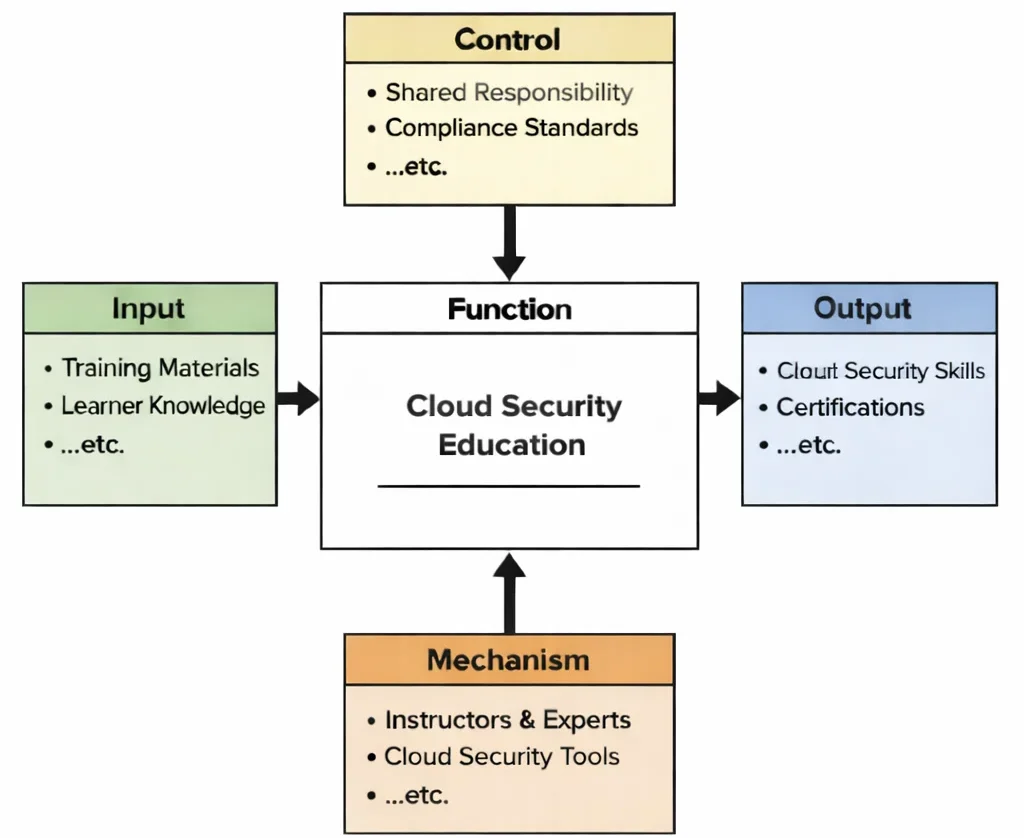
This IDEF0 (Input–Control–Output–Mechanism) diagram summarizes Cloud Security Education as a structured transformation. Inputs include training resources and learner baseline knowledge. Controls include security policies, governance rules, compliance expectations, and curriculum outcomes that define what “secure cloud” means in practice. Mechanisms such as instructors, experts, security tooling, and lab environments enable hands-on learning with identity, access control, monitoring, encryption, and incident response basics. Outputs include learners who can apply cloud security principles, configure protective controls, interpret security signals, and make defensible trade-offs between risk, usability, and cost.
Interactive Check: Intro & System Concepts
Verify your understanding of how governance controls and hands-on mechanisms transform cloud infrastructure configurations:
Introductory Concept Verification
1. Why is configuration management the primary ownership burden for cloud consumers?
Answer: Under the Shared Responsibility Model, cloud providers secure the physical data center and hypervisor infrastructure, but consumers retain 100% responsibility for configuring IAM permissions, network firewall rules, object storage privacy, and database encryption. Misconfigurations represent the single largest cause of cloud data breaches.
2. What is the main operational output expected from Cloud Security Education?
Answer: Practical engineering capability: the ability to configure least-privilege IAM roles, automate continuous posture management (CSPM), enforce data-at-rest encryption, and respond to control-plane audit alerts in an auditable and defensible manner.
Cloud security is now a core part of modern cybersecurity. Moving from on-prem to the cloud creates new risks—shared infrastructure, multi-tenant data, and fast-changing services. To manage them, combine security, compliance, and identity management with the fundamentals of cybersecurity and cryptography.
Cloud-native tech such as serverless and containers improves speed and scale, but it also demands tighter controls. Keep configurations reliable by baking checks into DevOps and Infrastructure as Code, and validate choices with sensible performance tuning.
Strong identity and access management is non-negotiable: least privilege, MFA, and short-lived credentials. Pair that with threat intelligence and behavior analytics to spot misuse quickly and prevent credential-based attacks.
AI and ML help detect anomalies in real time and predict risk. When issues do occur, well-rehearsed incident response and forensics turn alerts into fast, compliant action.
New patterns—like edge computing and richer cloud networking—boost performance but also widen the attack surface. Secure them with the same rigor you apply to core cloud services.
Protecting cloud apps means aligning with application security and understanding nearby systems such as cyber-physical and OT. Don’t forget the basics in hybrid setups: endpoint and network security.
People and process matter. Build security awareness, enforce clear policies, and use ethical hacking to test defenses before attackers do.
Stay ahead by tracking emerging areas and applying insights from data science and big-data analytics. Aim for automated, scalable defenses that match the speed and change of the cloud.

This image visualizes cloud security as a protected “core” inside a busy data-center environment. A luminous cloud symbol with a padlock hovers in the middle, implying encrypted storage and controlled access to cloud resources. On both sides, tall server racks suggest large-scale infrastructure, while floating shield icons and authentication-style symbols represent key defenses such as identity and access management, encryption, secure configuration, and continuous threat detection. The radiating lines and digital glow convey always-on vigilance—systems that watch, verify, and respond in real time to keep cloud platforms trustworthy for users and organizations.
Building Cyber Resilience: Cloud Security Navigation
Discover how Cloud Security establishes identity boundaries, automated posture governance, and runtime workload protection across the Cybersecurity cluster. Each card details CSPM misconfiguration scanning, KMS key rotation, zero-trust network segmentation, and cloud logging.
Cybersecurity Overview
Presents the overarching macro-view, mapping how cloud security boundaries integrate with on-premises network defenses, identity providers, and incident response teams.
Network Security
Examines Virtual Private Cloud (VPC) subnets, stateful Security Groups, stateless NACLs, Web Application Firewalls (WAF), and encrypted IPSec/DirectConnect transit.
Application Security
Focuses on securing cloud-hosted web APIs, SAST/DAST pipeline integration, serverless function security, and mitigating OWASP Top 10 vulnerabilities in production.
Endpoint Security
Covers host-level EDR agent deployment across cloud VMs, container host OS hardening, disk volume encryption, and patch management across cloud compute clusters.
Cloud Security
Focuses on the Shared Responsibility Model, CSPM misconfiguration auditing, CWPP runtime workload protection, KMS envelope encryption, and CNAPP posture management.
Identity & Access Management
Governs cloud IAM roles, multi-factor authentication (MFA), Single Sign-On (SSO), short-lived STS tokens, and least-privilege policy enforcement across cloud accounts.
Cryptography
Applies cloud Key Management Services (KMS), hardware security modules (HSM), AES-256 server-side storage encryption, and TLS 1.3 transit encryption.
Incident Response & Forensics
Orchestrates cloud control-plane log audits (CloudTrail/Azure Monitor), automated token revocation playbooks, memory snapshot extraction, and cloud breach containment.
Threat Intelligence
Feeds real-time threat intelligence feeds into cloud threat engines (GuardDuty/Sentinel) to detect compromised API access keys and malicious IP traffic automatically.
Ethical Hacking & Pen Testing
Executes controlled cloud infrastructure penetration tests, simulating privilege escalation, S3 bucket exfiltration, and IAM policy bypasses inside sandbox accounts.
Cybersecurity Awareness
Trains cloud developers and administrators in secure cloud configuration hygiene, credential handling best practices, and avoiding hardcoded API keys in Git.
Policy & Governance
Enforces cloud compliance frameworks (SOC 2, ISO 27017, CIS Benchmarks, GDPR), automated policy-as-code checks (OPA/AWS Config), and mandatory audit trails.
CPS Security
Protects cloud-connected cyber-physical systems, ensuring secure MQTT IoT gateways, encrypted device telemetry, and isolated cloud command backends.
OT Security
Safeguards hybrid cloud links to industrial OT networks, enforcing strict unidirectional security gateways to protect SCADA assets from cloud-origin threats.
AI & ML in Security
Leverages AI for real-time cloud log anomaly detection, automated user behavior analytics (UEBA), and predictive threat scoring across multi-cloud environments.
Emerging Areas
Investigates confidential cloud computing (hardware-enclave execution), sovereign cloud boundaries, post-quantum cloud key exchange, and zero-trust cloud mesh networks.
Cloud Account Hardening: 12-Step Quickstart
Follow these fundamental architectural steps to establish an auditable, secure cloud account baseline:
- Secure the root/org account – Enable MFA for root, restrict root API keys, and use break-glass access procedures only.
- Centralize identity – Connect SSO; use roles over long-lived users; rotate credentials automatically.
- Least-privilege IAM – Start from deny-by-default; grant time-bound roles; review access monthly.
- Default encryption – Turn on at-rest encryption for storage, DBs, and backups; enforce TLS in transit.
- Key & secret management – Managed KMS for keys; managed vault for app secrets; never store in code.
- Network segmentation – Private subnets/endpoints; WAF on public apps; minimal inbound rules.
- Logging & audit – Enable control-plane and data-plane logs; keep immutable copies in a central account.
- Secure CI/CD – Scan dependencies, images, and IaC; sign artifacts; generate SBOM; policy gates pre-deploy.
- Harden workloads – Minimal base images; patch regularly; runtime sensors/EDR for VMs & containers.
- Detection & alerts – Watch for role changes, key use, public buckets, anomalous network paths.
- Backups & DR – Encrypted, tested restores; cross-region copies for critical data/services.
- Continuous posture – Run CSPM/CNAPP; fix critical misconfigs fast; report time-to-remediate.
Top Cloud Misconfigurations & Remediation Matrix
Common cloud infrastructure misconfigurations and their fast, production-grade remediation steps:
| Misconfiguration | Why It’s Risky | Fast Remediation |
|---|---|---|
| Public Object Storage | Data exposure and ransomware staging | Block public access at account level; use bucket policies with allow-lists only. |
| Over-Privileged Roles | Lateral movement, data exfiltration | Replace wildcards (`*`); split duties; add time-bound elevation with approvals. |
| Long-Lived Access Keys | Credential theft & resale | Rotate to short-lived, role-based access (OIDC); monitor key creation/use events. |
| Unencrypted DB / Snapshots | Data theft from backups | Enable default KMS encryption; re-encrypt old snapshots; restrict snapshot sharing. |
| Flat VPC / VNet Topology | Large blast radius | Segment by environment & tier; private endpoints; deny-by-default SG/NSG rules. |
| Open Admin Ports (22/3389) | Brute force & exploits | Close ports to internet; require VPN/SSM Bastion; JIT access with approvals. |
| Secrets in Code / Images | Instant compromise if leaked | Scan repos & images; move to Secrets Manager/Vault; rotate exposed secrets. |
| No Log Retention | No forensics or detection | Centralize CloudTrail/Audit logs, set immutable retention, alert on logging gaps. |
Interactive Quick Review: Cloud Security Controls
Reinforce key concepts regarding posture management, shared responsibility, and account hardening before reading the FAQ:
Quick Review Verification
1. What is the core functional difference between CSPM and CWPP in cloud security?
Answer: CSPM (Cloud Security Posture Management) scans control-plane configurations for compliance flaws (unencrypted buckets, open firewalls, wildcards). CWPP (Cloud Workload Protection Platform) monitors live compute runtimes (VMs, containers, serverless) for active malware, memory tampering, and process anomalies.
2. How does OIDC Workload Identity Federation eliminate hardcoded cloud credentials in CI/CD pipelines?
Answer: Instead of storing long-lived AWS/Azure secret keys inside GitHub Secrets, OIDC allows GitHub Actions to exchange a short-lived cryptographically signed token for a temporary, short-lived cloud IAM role token, eliminating static key leak risks entirely.
Cloud Security — Frequently Asked Questions
What is the Shared Responsibility Model?
Cloud providers secure the cloud (physical facilities, host hardware, and managed service runtimes). You secure what you configure and run: user identities, data encryption, virtual network firewalls, workload patching, and application code.
What are the first controls to put in place for a new cloud account?
Least-privilege IAM with mandatory MFA, short-lived credentials via SSO, default AES-256 encryption for storage and databases, centralized CloudTrail/audit logging, and deny-by-default network Security Groups.
How do we secure CI/CD pipelines and the cloud supply chain?
Scan code dependencies (SCA), container images, and IaC templates; sign build artifacts (Cosign); generate Software Bill of Materials (SBOM); enforce pre-deployment policy gates; and inject runtime secrets via OIDC workload identity federation.
Do containers and serverless change cloud security practices?
Yes—shift focus to container image vulnerability scanning, Kubernetes admission/Pod Security Policies, runtime behavioral monitoring (Falco), least-privilege per-function IAM execution roles, and scoped API Gateway authorizations.
What critical events should be monitored in a cloud environment?
Control-plane API calls (IAM policy/role edits, access key creation), public exposure of storage buckets/snapshots, unexpected cross-region network egress, failed MFA spikes, and runtime process anomalies on VM instances.
Cloud Security: Conclusion
Cloud security is a critical aspect of modern cybersecurity strategies. As organizations increasingly rely on cloud environments, implementing robust security measures ensures data protection, compliance, and resilience against evolving threats.
- Continuous Configuration Posture: Automate CSPM scanning to catch misconfigurations before they reach production.
- Identity as the Perimeter: Enforce mandatory MFA, least-privilege IAM policies, and short-lived session tokens.
- Defense in Depth: Combine KMS envelope encryption, zero-trust network subnets, and runtime workload protection (CWPP).
- Audit & Incident Readiness: Centralize immutable audit trails and automate alert playbooks for rapid threat containment.
End-of-Page Exercises: Review, Reflections & Analytics
Review Questions and Answers
1. What is cloud security and why is it critical in modern IT environments?
Answer: Cloud security refers to the technologies, policies, and controls protecting cloud data, applications, and infrastructure. It is critical because cloud environments operate on shared, public infrastructure where misconfigurations can expose sensitive data globally in seconds.
2. What are the key components of an effective cloud security strategy?
Answer: Key components include Least-Privilege IAM, default AES-256 data encryption, continuous CSPM configuration auditing, zero-trust network micro-segmentation, centralized immutable logging, and automated incident response playbooks.
3. How does encryption contribute to cloud security?
Answer: Encryption renders data unreadable without valid cryptographic keys. Applied at rest (KMS envelope encryption) and in transit (TLS 1.3), it protects data privacy even if storage buckets or network paths are compromised.
4. What role does identity management play in ensuring secure cloud access?
Answer: Identity is the modern cloud perimeter. IAM authenticates actors (MFA/SSO) and evaluates granular permissions (RBAC/ABAC), ensuring users and service accounts access only authorized cloud API resources.
5. How do compliance requirements influence cloud security practices?
Answer: Regulations (GDPR, HIPAA, PCI DSS, SOC 2) force cloud architects to implement verifiable technical controls: data residency pinning, customer-managed key rotation, immutable audit trail logging, and continuous vulnerability reporting.
6. What common cyber threats target cloud environments and how can they be mitigated?
Answer: Threats include public S3 bucket exposure, leaked API keys, compromised IAM roles, and ransomware. Mitigate using account-level public block rules, secret scanning in CI/CD, short-lived OIDC tokens, and immutable snapshots.
7. How does continuous monitoring improve the security of cloud systems?
Answer: Tools like GuardDuty and Security Hub analyze API logs in real time using machine learning, instantly alerting on unauthorized administrative role creation, abnormal data downloads, or compromised compute nodes.
8. What are the challenges of securing cloud infrastructures, and how can organizations overcome them?
Answer: Challenges include rapid resource churn, multi-cloud complexity, and configuration drift. Overcome by embedding security into Infrastructure as Code (Terraform/Checkov), using centralized CNAPP tools, and enforcing policy-as-code gates.
9. How can application security be integrated into cloud security strategies?
Answer: By deploying Web Application Firewalls (WAF) in front of cloud APIs, scanning container images in CI/CD pipelines, scoping least-privilege IAM execution roles per microservice, and running RASP runtime protection.
10. What future trends are expected to shape cloud security?
Answer: Trends include AI-driven self-healing security posture engines, confidential cloud computing (hardware enclave execution), zero-trust service mesh networking, and post-quantum KMS encryption algorithms.
Thought-Provoking Architectural Questions
1. How might the integration of AI and machine learning revolutionize cloud security strategies in the future?
Answer: AI will automate predictive posture management, continuously simulating multi-hop exploit paths inside cloud accounts and auto-remediating over-permissioned IAM roles or open firewall ports before adversaries exploit them.
2. What are the potential benefits and drawbacks of implementing a Zero-Trust model in cloud security?
Answer: Benefits include complete elimination of implicit internal trust, preventing lateral breach movement. Drawbacks include increased initial architecture complexity, performance latency overhead from continuous token verification, and potential developer friction.
3. How can organizations ensure robust data protection in cloud environments while maintaining user accessibility?
Answer: By deploying Risk-Based Adaptive Authentication paired with KMS envelope encryption. Users authenticate seamlessly via Single Sign-On (SSO), while high-risk API requests dynamically trigger secondary MFA verification.
4. What strategies can be employed to mitigate insider threats in cloud security?
Answer: Enforce Just-In-Time (JIT) access elevation requiring peer approval, block long-lived access keys, deploy User and Entity Behavior Analytics (UEBA) to detect massive S3 data downloads, and maintain immutable CloudTrail log buckets.
5. How might advancements in quantum computing impact current encryption methods used in cloud security?
Answer: Quantum algorithms will compromise classical RSA/ECC asymmetric keys used in TLS handshakes. Cloud providers must transition KMS key vaults to Post-Quantum Cryptography (PQC) lattice-based algorithms (ML-KEM/ML-DSA).
6. What role does continuous monitoring play in maintaining cloud security, and how can it be optimized using AI?
Answer: Continuous monitoring captures control-plane and data-plane telemetry. AI optimizes this by filtering false-positive noise, correlating disparate alerts across multi-cloud regions, and executing automated quarantine playbooks instantly.
7. How can organizations leverage threat intelligence to create a proactive cybersecurity posture in cloud environments?
Answer: By feeding global threat feeds (CISA KEV, dark web key dumps) into cloud WAFs and CSPM engines, automatically blocking malicious IP ranges and revoking leaked credentials before threat actors exploit them.
8. What challenges might organizations face when integrating cloud security solutions with legacy systems?
Answer: Legacy systems lack cloud-native identity APIs and automated logging endpoints. Overcome using hybrid identity proxies (Azure AD Connect), log shippers, and placing legacy servers behind encrypted zero-trust gateways.
9. How can regulatory compliance shape the future of cloud security?
Answer: Mandates force organizations to adopt sovereign cloud regions, enforce customer-managed KMS keys, restrict cross-border network data flows, and automate real-time compliance audit reporting.
10. How might the evolution of threat landscapes impact the development of cloud security technologies?
Answer: As adversaries use AI to automate credential stuffing and cloud API scanning, cloud security will shift from human-driven SOC workflows to fully autonomous, machine-speed defense and self-healing infrastructure.
11. What potential benefits and drawbacks could arise from the widespread adoption of Zero-Trust models?
Answer: Benefits include reduced blast radiuses and complete lateral threat containment. Drawbacks include significant engineering overhead in managing fine-grained mTLS certificates, token lifetimes, and micro-segmentation policies.
12. How can the integration of continuous monitoring and automated response transform cloud security operations?
Answer: Cuts Mean Time to Respond (MTTR) from days to milliseconds, automatically revoking compromised credentials, blocking malicious IPs, and isolating compromised container pods instantly upon detection.
Numerical Engineering Problems & Solutions
Problem 1: Calculating Annual Financial Savings from Reduced Data Breach Costs
An enterprise experiences an average cloud data breach cost of $1,000,000 per incident. Implementing automated CSPM scanning and default KMS encryption reduces breach frequency by 2 incidents per year. Calculate total annual financial savings.
An enterprise experiences an average cloud data breach cost of $1,000,000 per incident. Implementing automated CSPM scanning and default KMS encryption reduces breach frequency by 2 incidents per year. Calculate total annual financial savings.
Solution:
- Cost per individual breach avoided = $1,000,000
- Breaches prevented per year = 2 incidents
- Total annual savings = 2 × $1,000,000 = $2,000,000/year
Problem 2: Estimating ROI for an AI-Driven Cloud Security Solution
Deploying a Cloud Native Application Protection Platform (CNAPP) costs $400,000 in software setup fees. The system saves $120,000 per year in reduced breach exposure and automated operational labor. Calculate payback period in years and 5-year Return on Investment (ROI) percentage.
Deploying a Cloud Native Application Protection Platform (CNAPP) costs $400,000 in software setup fees. The system saves $120,000 per year in reduced breach exposure and automated operational labor. Calculate payback period in years and 5-year Return on Investment (ROI) percentage.
Solution:
- Payback period = Initial Investment / Annual Savings = $400,000 / $120,000 ≈ 3.33 years (3 years and 4 months)
- Total 5-year gross savings = $120,000 × 5 years = $600,000
- Net financial gain = $600,000 – $400,000 = $200,000
- 5-Year ROI = ($200,000 / $400,000) × 100 = 50.0%
Problem 3: Calculating Reduction in Cloud Incident Response Time
A manual cloud incident response process takes an average of 50 minutes to isolate a compromised virtual instance. Integrating automated SOAR playbooks cuts mean containment time to 30 minutes. Calculate time saved per incident in minutes and percentage response time improvement.
A manual cloud incident response process takes an average of 50 minutes to isolate a compromised virtual instance. Integrating automated SOAR playbooks cuts mean containment time to 30 minutes. Calculate time saved per incident in minutes and percentage response time improvement.
Solution:
- Time saved per incident = 50 minutes – 30 minutes = 20 minutes saved
- Percentage response time improvement = (20 / 50) × 100 = 40.0%
Problem 4: Estimating Cost Savings from Improved Security Awareness Training
A cloud security awareness training program costs $25,000 per year and prevents an estimated 3 security incidents per year, with each incident costing $150,000 in remediation labor. Calculate annual gross incident loss reduction and net annual program savings.
A cloud security awareness training program costs $25,000 per year and prevents an estimated 3 security incidents per year, with each incident costing $150,000 in remediation labor. Calculate annual gross incident loss reduction and net annual program savings.
Solution:
- Gross incident loss reduction = 3 incidents × $150,000 = $450,000/year
- Net annual savings = $450,000 (losses avoided) – $25,000 (program cost) = $425,000/year
Problem 5: Calculating Average Cost Reduction per User for Enhanced Access Control
Implementing Zero-Trust single sign-on (SSO) and MFA across 10,000 cloud users reduces annual credential breach exposure by $800,000. Calculate average annual security risk cost reduction per individual user account.
Implementing Zero-Trust single sign-on (SSO) and MFA across 10,000 cloud users reduces annual credential breach exposure by $800,000. Calculate average annual security risk cost reduction per individual user account.
Solution:
- Risk reduction per user = Total Annual Risk Reduction / Total User Count = $800,000 / 10,000 users = $80 per user per year
Problem 6: Determining Reduction in False Positive Alert Rates
A legacy cloud monitoring system exhibits a 30% false positive alert rate across 1,000 daily security notifications (300 false alerts). Fine-tuning machine learning threat models reduces false positives down to 10% (100 false alerts). Calculate net false alerts eliminated and relative percentage noise reduction.
A legacy cloud monitoring system exhibits a 30% false positive alert rate across 1,000 daily security notifications (300 false alerts). Fine-tuning machine learning threat models reduces false positives down to 10% (100 false alerts). Calculate net false alerts eliminated and relative percentage noise reduction.
Solution:
- Absolute percentage point drop = 30% – 10% = 20 percentage points
- False alerts eliminated daily = 300 – 100 = 200 false alerts saved
- Relative percentage reduction = (20 / 30) × 100 ≈ 66.67%
Problem 7: Calculating Financial Savings from Automated Monitoring
Manual cloud security log inspection costs an organization $60,000 per year. Implementing automated CloudTrail log aggregation and SIEM analysis cuts manual auditing costs by 70%. Calculate annual financial savings and new annual monitoring cost.
Manual cloud security log inspection costs an organization $60,000 per year. Implementing automated CloudTrail log aggregation and SIEM analysis cuts manual auditing costs by 70%. Calculate annual financial savings and new annual monitoring cost.
Solution:
- Annual cost savings = $60,000 × 0.70 = $42,000/year
- New annual monitoring cost = $60,000 – $42,000 = $18,000/year
Problem 8: Estimating Annual Downtime Cost Reduction from Cloud Resilience
Unplanned cloud outages cost an e-commerce platform $200,000 per hour. Deploying multi-region active-active failover and DDoS protection reduces annual outage downtime by 15 hours. Calculate total annual financial downtime savings.
Unplanned cloud outages cost an e-commerce platform $200,000 per hour. Deploying multi-region active-active failover and DDoS protection reduces annual outage downtime by 15 hours. Calculate total annual financial downtime savings.
Solution:
- Downtime hours saved = 15 hours
- Cost per downtime hour = $200,000
- Total annual savings = 15 hours × $200,000 = $3,000,000/year
Problem 9: Calculating Cost Efficiency & ROI of an MFA Implementation
Enforcing Multi-Factor Authentication (MFA) across all employee cloud roles costs $50,000 per year in licensing and administration. The system prevents credential theft, saving an estimated $250,000 per year in breach recovery expenses. Calculate net annual savings and Return on Investment (ROI) percentage.
Enforcing Multi-Factor Authentication (MFA) across all employee cloud roles costs $50,000 per year in licensing and administration. The system prevents credential theft, saving an estimated $250,000 per year in breach recovery expenses. Calculate net annual savings and Return on Investment (ROI) percentage.
Solution:
- Net annual savings = $250,000 (losses avoided) – $50,000 (MFA cost) = $200,000/year
- ROI percentage = ($200,000 / $50,000) × 100 = 400.0%
Problem 10: Determining Average Annual Cost of a Data Breach
An enterprise records $3,000,000 in total annual losses across 6 independent cloud security breach incidents. Calculate average financial loss per individual breach incident.
An enterprise records $3,000,000 in total annual losses across 6 independent cloud security breach incidents. Calculate average financial loss per individual breach incident.
Solution:
- Average cost per breach = Total Annual Loss / Incident Count = $3,000,000 / 6 = $500,000 per incident
Problem 11: Calculating Percentage Decrease in Security Incident Frequency
An enterprise recorded 40 cloud security incidents last year. Deploying automated CSPM configuration gates reduces annual security incidents by 25%. Calculate number of incidents prevented, remaining incident count, and percentage decrease.
An enterprise recorded 40 cloud security incidents last year. Deploying automated CSPM configuration gates reduces annual security incidents by 25%. Calculate number of incidents prevented, remaining incident count, and percentage decrease.
Solution:
- Incidents prevented = 40 × 0.25 = 10 incidents saved
- New annual incident count = 40 – 10 = 30 incidents
- Percentage decrease = (10 / 40) × 100 = 25.0%
Problem 12: Break-Even Analysis for a Cloud Security Infrastructure Upgrade
Upgrading a cloud enterprise infrastructure to an automated zero-trust security suite requires $500,000 in initial setup costs. The platform generates $45,000 per month in operational labor and breach mitigation savings. Calculate break-even payback period in months and total net operational savings over 5 years (60 months).
Upgrading a cloud enterprise infrastructure to an automated zero-trust security suite requires $500,000 in initial setup costs. The platform generates $45,000 per month in operational labor and breach mitigation savings. Calculate break-even payback period in months and total net operational savings over 5 years (60 months).
Solution:
- Payback break-even period = $500,000 / $45,000 ≈ 11.11 months (rounded to 12th month)
- Total 60-month gross savings = 60 months × $45,000 = $2,700,000
- Net financial savings = $2,700,000 – $500,000 = $2,200,000