
Kirchhoff’s laws help students analyse circuits that are too complex for simple series and parallel rules alone. Once a circuit has more than one loop, more than one branch, or several sources and resistors, students need a systematic method for finding unknown currents and voltages.
Kirchhoff’s laws are built on two deep conservation ideas. Kirchhoff’s current law is based on conservation of charge: charge cannot pile up indefinitely at a junction, so the total current entering a junction must equal the total current leaving it. Kirchhoff’s voltage law is based on conservation of energy: around a closed loop, the total potential rise and total potential drop must balance.
This page helps students move from recognising circuit patterns to analysing circuit networks. The aim is not only to write equations, but to understand why those equations make physical sense.
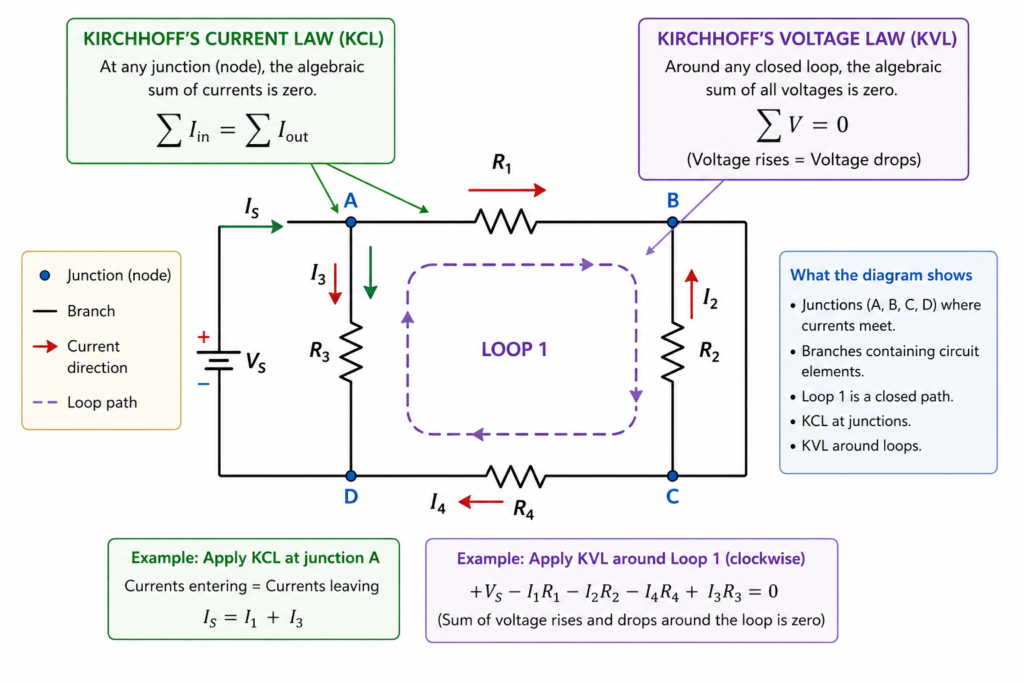
This infographic shows how Kirchhoff’s laws are applied to a circuit with junctions, branches, resistors, a voltage source, and a closed loop. Kirchhoff’s current law is illustrated at a node, where the total current entering must equal the total current leaving. Kirchhoff’s voltage law is illustrated around a loop, where voltage rises and voltage drops must balance. The diagram helps students see that circuit analysis is not based on arbitrary rules, but on the conservation of charge at junctions and the conservation of energy around loops.
Electrical Circuits Learning Pathway
This page follows from current, resistance, Ohm’s law, and series-parallel circuits. It extends those ideas into more general circuit analysis, where currents and voltages must be found by writing equations from junctions and loops.
Electricity and Magnetism
Provides the wider physics context for charge, electric fields, voltage, circuits, magnetism, induction, and electromagnetic waves.Electrical Circuits
Introduces how moving charge transfers energy through wires, components, sources, resistors, capacitors, and alternating-current systems.Current, Resistance, and Ohm’s Law
Builds the foundation for circuit thinking by connecting charge flow, voltage, resistance, and energy transfer through Ohm’s law.Series and Parallel Circuits
Explains how current, voltage, and resistance behave when components are connected along one path or across multiple branches.Kirchhoff’s Laws and Circuit Analysis
Extends circuit reasoning to junctions and loops using conservation of charge and conservation of energy.RC Circuits and Time Constants
Connects resistance with capacitance to explain charging, discharging, exponential change, and time delay in circuits.AC Circuits and Impedance
Moves from direct current to alternating current, reactance, impedance, phase difference, and frequency-dependent circuit behaviour.The Core Physical Idea
The core physical idea is that every circuit must obey conservation principles. Charge is conserved at junctions, so current cannot simply disappear or appear at a node. Energy is conserved around closed loops, so the sum of voltage rises and voltage drops around a loop must balance.
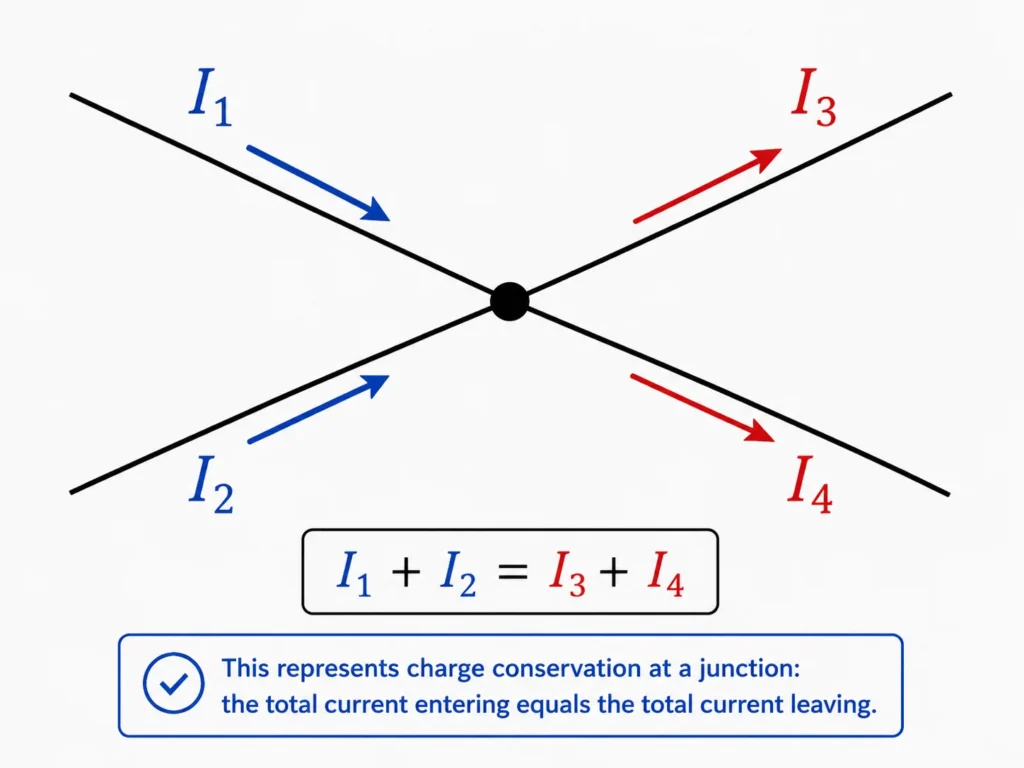
Kirchhoff’s current law is usually applied at junctions. If current flows into a junction, the same total amount of current must flow out, unless charge is accumulating there. In ordinary steady circuits, no long-term charge buildup occurs at a junction.
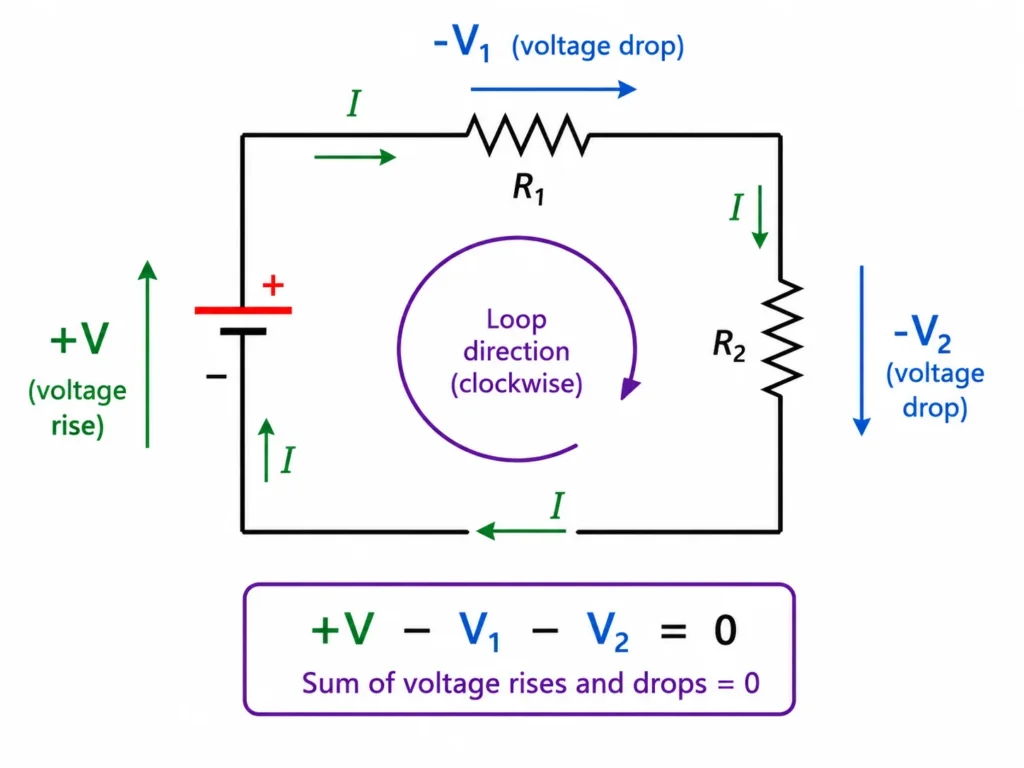
Kirchhoff’s voltage law is applied around closed loops. As a charge moves around a complete loop, it may gain energy from a battery and lose energy through resistors or other components. When the charge returns to the starting point, the net change in electric potential around the loop is zero.
Pictorial Illustration 1: Kirchhoff’s Current Law at a Junction
Pictorial Illustration 2: Kirchhoff’s Voltage Law Around a Loop
Pictorial Illustration 3: Setting Up Circuit Equations
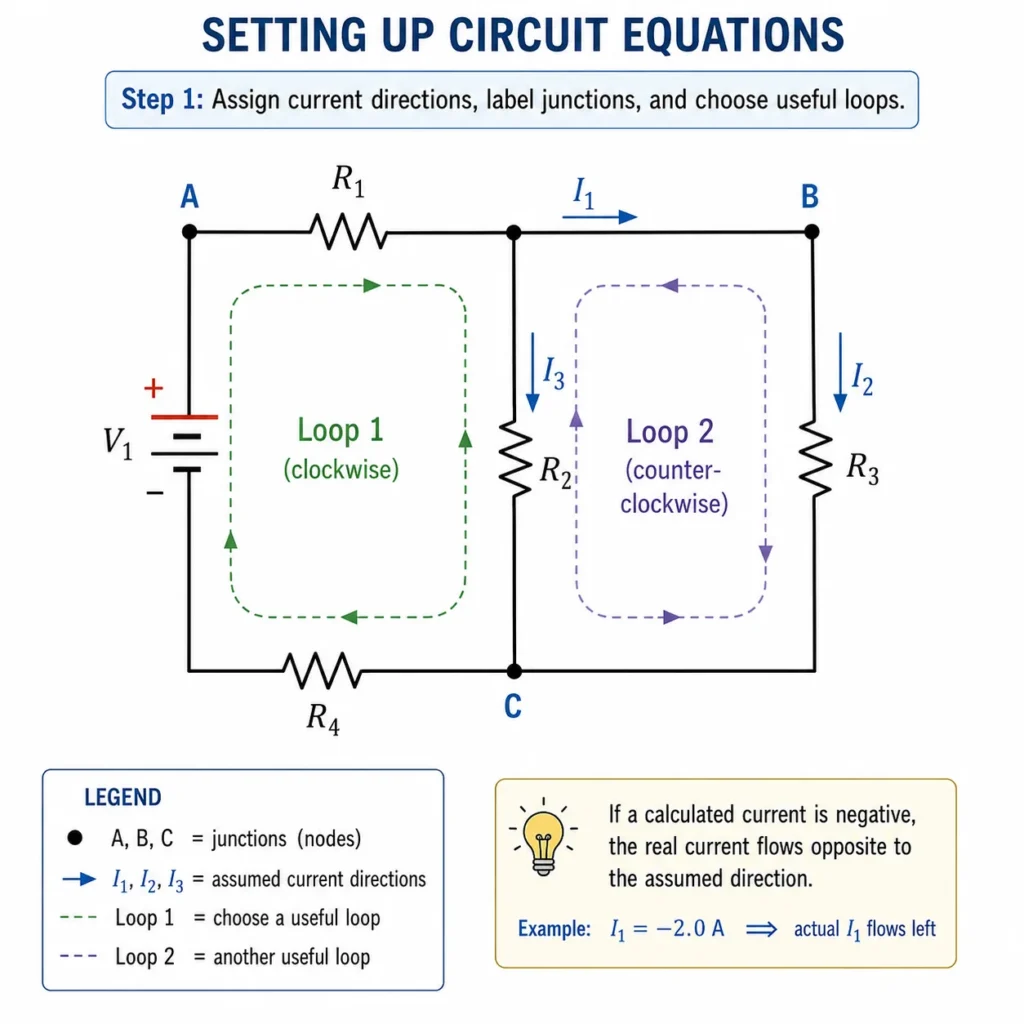
This illustration shows a multi-loop circuit used to begin Kirchhoff circuit analysis. The diagram labels key junctions, marks assumed current directions, and highlights selected loops for writing equations. It helps students see that circuit analysis is a methodical process: choose current directions first, identify important nodes and loops, and then apply Kirchhoff’s current and voltage laws. If a calculated current turns out to be negative, that simply means the real current flows opposite to the assumed direction.
The One Idea to Remember
Kirchhoff’s laws are conservation laws written in circuit language.
At junctions, charge is conserved. Around loops, energy is conserved. This is why Kirchhoff’s laws work even when a circuit is more complicated than a simple series or parallel arrangement.
How to Visualise the Idea
A useful way to visualise Kirchhoff’s laws is to imagine following charge through a circuit. At a junction, charge may split into different branches, but the total flow must be accounted for. Around a loop, the charge may gain energy from sources and lose energy in components, but after one complete circuit it returns to the same electric potential.
Junctions Are Accounting Points
At each junction, current entering and current leaving must balance. This is charge accounting.Loops Are Energy Paths
A closed loop lets students track voltage rises and voltage drops until the path returns to its starting point.Current Directions Are Assumptions
You may choose a current direction before solving. A negative answer means the real direction is opposite.Signs Must Be Consistent
The hardest part is often not the physics but keeping a consistent sign convention while moving around a loop.Key Equations and What They Mean
Kirchhoff’s current law can be written as:
\( \sum I_{\text{in}} = \sum I_{\text{out}} \)
This means the total current entering a junction equals the total current leaving the junction.
It can also be written using signs as:
\( \sum I = 0 \)
where currents entering and leaving are assigned opposite signs.
Kirchhoff’s voltage law can be written as:
\( \sum \Delta V = 0 \)
This means the algebraic sum of potential changes around any closed loop is zero.
For a resistor, Ohm’s law still applies:
\( V_R = IR \)
A common loop equation may look like:
\( +\mathcal{E} – I R_1 – I R_2 = 0 \)
where \( \mathcal{E} \) is the emf or voltage rise provided by the source, and \( IR_1 \) and \( IR_2 \) are voltage drops across resistors.
What \( \sum I_{\text{in}} = \sum I_{\text{out}} \) Means
Current is charge flow. In steady circuits, charge does not accumulate at a junction, so inflow and outflow must balance.What \( \sum \Delta V = 0 \) Means
After moving around a closed loop and returning to the starting point, the net change in electric potential is zero.What \( V_R = IR \) Means
A resistor produces a voltage drop related to the current through it and the resistance value.What \( \mathcal{E} \) Represents
The symbol \( \mathcal{E} \) often represents the emf or voltage rise supplied by a battery or source.From Formula to Meaning
The equation \( \sum I_{\text{in}} = \sum I_{\text{out}} \) is not just a rule for drawing arrows. It says that charge is conserved. If \( 4 \ \text{A} \) enters a junction, then \( 4 \ \text{A} \) must leave through one or more branches in a steady circuit.
The equation \( \sum \Delta V = 0 \) says that electric potential behaves like height in a closed walking path. You may go uphill and downhill, but if you return to the starting point, your total change in height is zero. In a circuit, batteries are like potential rises, while resistors are often potential drops.
The equation \( V_R = IR \) allows Kirchhoff’s voltage law to become a solvable circuit equation. Each resistor’s voltage drop can be expressed in terms of current and resistance, so unknown currents can be found using simultaneous equations.
Worked Example
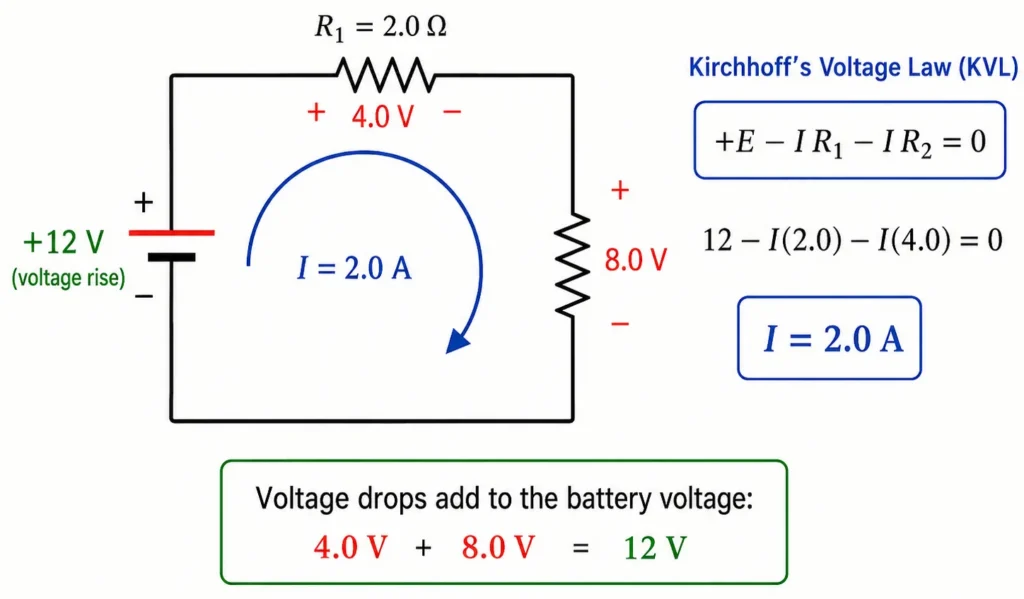
Problem: A single-loop circuit contains a \( 12 \ \text{V} \) battery and two resistors, \( R_1 = 2.0 \ \Omega \) and \( R_2 = 4.0 \ \Omega \), connected in series. Use Kirchhoff’s voltage law to find the current.
Given: \( \mathcal{E} = 12 \ \text{V} \), \( R_1 = 2.0 \ \Omega \), \( R_2 = 4.0 \ \Omega \).
Method: Choose a loop direction. Treat the battery as a voltage rise and each resistor as a voltage drop.
Solution:
Write Kirchhoff’s voltage law:
\( +\mathcal{E} – I R_1 – I R_2 = 0 \)
Substitute values:
\( 12 – I(2.0) – I(4.0) = 0 \)
Combine terms:
\( 12 – 6.0I = 0 \)
Solve:
\( 6.0I = 12 \)
\( I = 2.0 \ \text{A} \)
Interpretation: The current in the loop is \( 2.0 \ \text{A} \). The voltage drops are \( 4.0 \ \text{V} \) across \( R_1 \) and \( 8.0 \ \text{V} \) across \( R_2 \), adding to the \( 12 \ \text{V} \) supplied by the battery.
What Students Usually Get Wrong
Kirchhoff’s laws are not conceptually mysterious, but they require careful bookkeeping. Most errors come from inconsistent signs, unclear current directions, or writing too many dependent equations.
Changing Sign Rules Halfway
Students often begin with one sign convention and accidentally change it while moving around a loop. Consistency is more important than the particular convention chosen.Thinking Negative Current Means Failure
A negative current does not mean the solution is wrong. It means the actual current flows opposite to the direction first assumed.Writing Too Many Equations
Not every loop equation is independent. Students should choose enough independent equations to solve for the unknowns.Forgetting That Junction Rules Are About Charge
The junction rule is not a memorised arrow trick. It comes from conservation of charge.Forgetting That Loop Rules Are About Energy
The loop rule is not only about adding voltages. It comes from conservation of energy around a closed path.Where This Appears in Real Life
Kirchhoff’s laws are used whenever circuits contain multiple branches, loops, sources, or loads. They are part of the basic language of electrical engineering, electronics, instrumentation, power systems, and troubleshooting.
Electronic Circuit Boards
Circuit boards often contain many branches and components. Kirchhoff’s laws help engineers predict current and voltage throughout the board.Power Distribution
Electrical networks must account for how current divides among branches and how voltage changes across loads and cables.Sensor Circuits
Many sensors are placed in bridge or divider networks. Kirchhoff-style reasoning helps translate resistance or voltage changes into measurable signals.Battery and Source Networks
Circuits with more than one battery or power supply often require loop analysis to determine how sources and loads interact.Fault Diagnosis
Technicians use current and voltage measurements, guided by Kirchhoff’s laws, to locate broken connections, short circuits, and failing components.Real-World Illustration
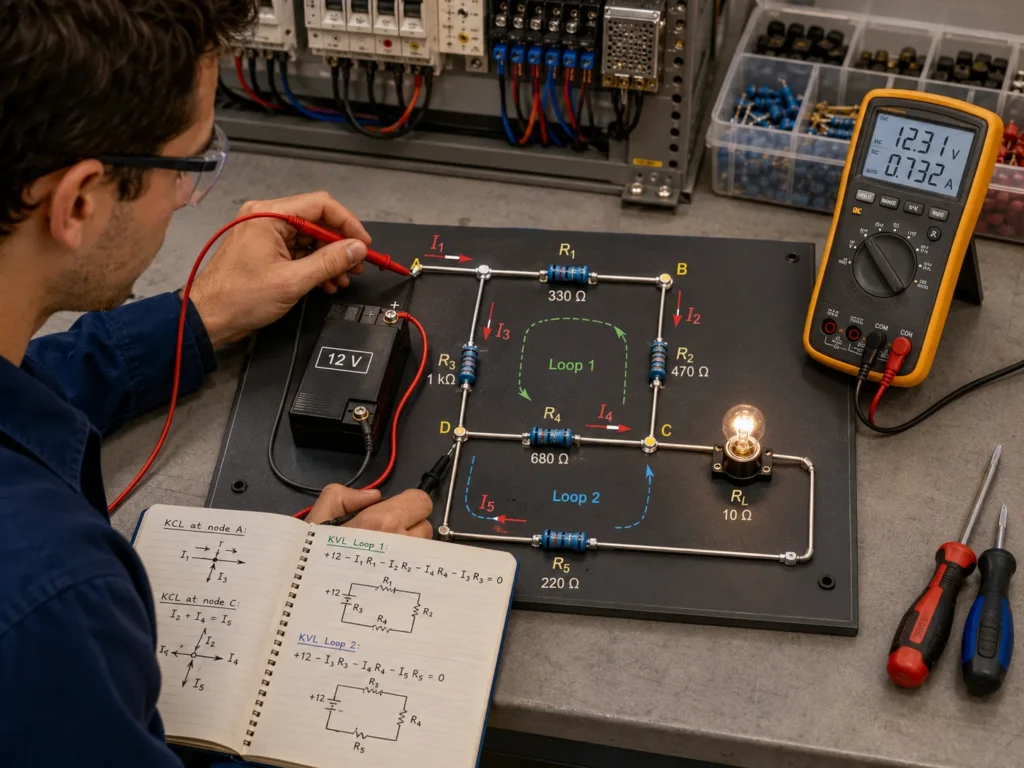
Kirchhoff’s laws help analyse real circuits with branches, loops, sources, and loads.This illustration shows a technician testing a practical circuit in an electronics lab. The circuit board includes branches, loops, resistors, a power source, and a load, while a multimeter is used to measure electrical quantities. Current directions and loop paths are marked to show how Kirchhoff’s current law and Kirchhoff’s voltage law help engineers and students analyse real circuits. The picture helps students see that Kirchhoff’s laws are not only classroom procedures, but practical tools for designing, checking, and troubleshooting real electrical systems.
Bridge to University Thinking
At school level, Kirchhoff’s laws are often used to solve small resistor circuits. At university level, they become the foundation for network analysis, nodal analysis, mesh analysis, circuit simulation, electronics, signal processing, power systems, and control systems.
This topic prepares students to move beyond simple equivalent-resistance problems. Instead of hoping a circuit can be reduced easily, students learn a general method: identify unknowns, write junction and loop equations, solve the system, and interpret the signs physically.
Quick Interactive Check
Check Your Understanding of Kirchhoff’s Laws
Use these short questions to test whether you understand Kirchhoff’s laws as conservation principles, not just equation recipes.
What conservation principle is behind Kirchhoff’s current law?
Your thinking prompt: At a junction, what physical quantity cannot simply disappear?
Suggested answer: Conservation of charge. The total current entering a junction must equal the total current leaving it.
What conservation principle is behind Kirchhoff’s voltage law?
Your thinking prompt: Around a closed loop, what must happen to total energy change per unit charge?
Suggested answer: Conservation of energy. The algebraic sum of potential changes around a closed loop is zero.
If \( 5 \ \text{A} \) enters a junction and \( 2 \ \text{A} \) leaves through one branch, how much current leaves through the other branch?
Your thinking prompt: Use current in equals current out.
Suggested answer: \( 3 \ \text{A} \) must leave through the other branch, because \( 5 = 2 + 3 \).
If a calculated current is negative, what does that usually mean?
Your thinking prompt: Think about the direction you assumed at the beginning.
Suggested answer: It usually means the actual current flows opposite to the direction you assumed.
Why is Kirchhoff analysis useful when a circuit is not purely series or purely parallel?
Your thinking prompt: Think about circuits with multiple branches and loops.
Suggested answer: Kirchhoff analysis provides a general method for writing equations from junctions and loops, even when the circuit cannot be simplified by series-parallel rules alone.
Key takeaway: Kirchhoff’s current law conserves charge at junctions, while Kirchhoff’s voltage law conserves energy around loops.
Review Questions and Answers
- What is Kirchhoff’s current law?Answer: Kirchhoff’s current law states that the total current entering a junction equals the total current leaving the junction.
- What is Kirchhoff’s voltage law?Answer: Kirchhoff’s voltage law states that the algebraic sum of potential changes around any closed loop is zero.
- What physical principle supports Kirchhoff’s current law?Answer: Conservation of charge.
- What physical principle supports Kirchhoff’s voltage law?Answer: Conservation of energy.
- What is a junction in a circuit?Answer: A junction is a point where three or more conducting paths meet and current can split or combine.
- What is a loop in a circuit?Answer: A loop is a closed path through a circuit that starts and ends at the same point.
- What does a negative current mean in circuit analysis?Answer: It means the actual current flows opposite to the direction initially assumed.
- Why are Kirchhoff’s laws useful?Answer: They provide a general method for analysing circuits with multiple branches, loops, and sources.
Thought-Provoking Questions and Answers
- Why are Kirchhoff’s laws more general than simple series and parallel rules?Suggested answer: Series and parallel rules apply to simple connection patterns. Kirchhoff’s laws apply to any circuit network because they are based on conservation of charge and energy.
- Why is it acceptable to assume a current direction before knowing the real direction?Suggested answer: The chosen direction is only a reference for writing equations. If the solution gives a negative value, the real current flows the other way.
- Why does the voltage around a closed loop add to zero?Suggested answer: Electric potential is a state quantity. If a charge returns to its starting point, the net change in potential must be zero, even if there were rises and drops along the way.
- Why can circuit analysis be thought of as “electrical accounting”?Suggested answer: At junctions, current must be accounted for. Around loops, voltage changes must be accounted for. Kirchhoff’s laws make sure charge and energy are not lost in the calculation.
- Why is sign convention so important in Kirchhoff analysis?Suggested answer: The equations depend on whether a component is treated as a voltage rise or drop. A consistent sign convention prevents contradictions and makes the final signs meaningful.
Numerical Problems and Solutions
- At a junction, \( 6.0 \ \text{A} \) enters from one wire. Two currents leave: \( 2.5 \ \text{A} \) through one branch and \( I \) through another. Find \( I \).Solution:Using Kirchhoff’s current law:\( I_{\text{in}} = I_{\text{out}} \)\( 6.0 = 2.5 + I \)\( I = 3.5 \ \text{A} \)Interpretation: The second branch carries \( 3.5 \ \text{A} \).
- A loop contains a \( 9.0 \ \text{V} \) battery and two series resistors of \( 3.0 \ \Omega \) and \( 6.0 \ \Omega \). Use Kirchhoff’s voltage law to find the current.Solution:\( +9.0 – I(3.0) – I(6.0) = 0 \)\( 9.0 – 9.0I = 0 \)\( I = 1.0 \ \text{A} \)Interpretation: The loop current is \( 1.0 \ \text{A} \).
- A loop has a \( 12 \ \text{V} \) source and a \( 4.0 \ \Omega \) resistor carrying \( 2.0 \ \text{A} \). What voltage drop occurs across the resistor, and how much voltage remains for other components?Solution:\( V_R = IR \)\( V_R = (2.0)(4.0) = 8.0 \ \text{V} \)Remaining voltage:\( 12 – 8.0 = 4.0 \ \text{V} \)Interpretation: The resistor drops \( 8.0 \ \text{V} \), leaving \( 4.0 \ \text{V} \) for other components in the loop.
- At a junction, \( I_1 = 4.0 \ \text{A} \) enters and \( I_2 = 1.5 \ \text{A} \) leaves. A second current \( I_3 \) also enters. If \( 5.0 \ \text{A} \) leaves through another branch, find \( I_3 \).Solution:Total current in equals total current out:\( 4.0 + I_3 = 1.5 + 5.0 \)\( 4.0 + I_3 = 6.5 \)\( I_3 = 2.5 \ \text{A} \)Interpretation: The second entering current is \( 2.5 \ \text{A} \).
- A loop equation gives \( -6.0 + 3.0I = 0 \). Find \( I \) and interpret the sign if the assumed direction was clockwise.Solution:\( 3.0I = 6.0 \)\( I = 2.0 \ \text{A} \)Interpretation: The current is \( 2.0 \ \text{A} \) in the assumed clockwise direction. If the result had been negative, the actual direction would be counterclockwise.
Advanced Network Frameworks: Nodal and Mesh Matrix Equations
When a circuit network scales up to include dozens of independent loops, active junctions, and crossed-wire intersections, applying Kirchhoff’s rules manually becomes prone to systematic ledger bookkeeping errors. To handle this complexity, university-level electrical engineering standardizes Kirchhoff’s constraints into structured algebraic frameworks known as Nodal Analysis (built on KCL) and Mesh Analysis (built on KVL). These methods gather isolated equations into single, clean matrix structures:
$$ \mathbf{G}\mathbf{V} = \mathbf{I} \quad \text{and} \quad \mathbf{R}\mathbf{I} = \mathbf{V} $$Where \(\mathbf{G}\) represents a system conductance matrix, \(\mathbf{R}\) is a systemic loop resistance matrix, and the vector arrays track your unknown node potentials (\(\mathbf{V}\)) or independent mesh branch currents (\(\mathbf{I}\)). By converting circuit physical pathways into linear algebra formats, massive networks can be solved instantly through computer simulation algorithms or inverse matrix operations.
Deep Insight: Graph Theory and Topological Independent Loops
The Mathematical Limits of Network Bookkeeping
A classic trap for students is writing down too many loop equations, accidentally creating redundant, dependent relationships that fail to solve. To prevent this, university-level analysis applies Network Graph Theory to the schematic layout. By treating the circuit as a collection of geometric branches (B) and junction nodes (N), we can apply strict topological invariants to calculate the exact number of independent equations required to solve the system:
- The exact number of unique, independent Kirchhoff Current Law node equations is precisely: $$ \text{Unique KCL Nodes} = N – 1 $$
- The exact number of unique, independent Kirchhoff Voltage Law loop equations is precisely: $$ \text{Unique KVL Loops} = B – (N – 1) $$
By verifying your equation count against these topological limits before starting line substitution steps, you eliminate the risk of hitting mathematical dead ends.
The Limits of Conservative Fields
It is critical to note that Kirchhoff’s Voltage Law assumes the electric field inside the circuit is completely conservative (\(\oint \mathbf{E} \cdot d\mathbf{l} = 0\)). This assumption holds true for steady direct current and low-frequency networks.
However, if the circuit is exposed to a rapidly changing high-frequency external magnetic field, Faraday’s Law of Induction dictates that the loop integral no longer equals zero. Instead, the changing magnetic flux induces an electromotive force directly inside the connecting wires themselves (\(\oint \mathbf{E} \cdot d\mathbf{l} = -d\Phi_B/dt\)). Under these high-frequency conditions, KVL fails because electric potential changes become path-dependent, requiring engineers to transition to full Maxwell field equation analysis.
Summary
Kirchhoff’s laws provide a general method for analysing circuits with junctions and loops. Kirchhoff’s current law says that current entering a junction must equal current leaving the junction. Kirchhoff’s voltage law says that voltage rises and drops around a closed loop must add to zero.
These laws are not merely calculation tricks. They express conservation of charge and conservation of energy in circuit form. By assigning current directions, writing junction equations, writing loop equations, and solving systematically, students can analyse circuits that go beyond simple series and parallel patterns.
Final takeaway: Kirchhoff’s laws turn complex circuits into solvable systems by applying conservation of charge at junctions and conservation of energy around loops.
Glossary
- Kirchhoff’s Current Law
- The rule that the total current entering a junction equals the total current leaving the junction.
- Kirchhoff’s Voltage Law
- The rule that the algebraic sum of potential changes around a closed loop is zero.
- Junction
- A point in a circuit where three or more conducting paths meet.
- Loop
- A closed path in a circuit that starts and ends at the same point.
- Branch
- A separate conducting path in a circuit between two junctions or nodes.
- Node
- A connection point in a circuit where components or wires meet.
- Voltage Rise
- An increase in electric potential, often produced when moving through a source from negative to positive terminal.
- Voltage Drop
- A decrease in electric potential, often occurring across a resistor in the direction of current.
- Emf
- The energy supplied per unit charge by a source, often represented by \( \mathcal{E} \).
- Sign Convention
- A consistent rule for assigning positive and negative signs to currents and voltage changes during circuit analysis.
Frequently Asked Questions
What is the difference between Kirchhoff’s current law and voltage law?
Kirchhoff’s current law applies at junctions and is based on conservation of charge. Kirchhoff’s voltage law applies around closed loops and is based on conservation of energy.
Why does current entering a junction equal current leaving it?
In a steady circuit, charge does not build up indefinitely at a junction. Therefore, the total rate of charge flow entering must equal the total rate leaving.
Why does the voltage around a closed loop add to zero?
After moving around a closed loop, a charge returns to its starting point. Since electric potential at the starting and ending point is the same, the net potential change is zero.
What does a negative current mean?
A negative current usually means the actual current direction is opposite to the direction assumed when setting up the equations.
Do Kirchhoff’s laws replace Ohm’s law?
No. Kirchhoff’s laws help write current and voltage equations for circuits. Ohm’s law is still used to relate voltage, current, and resistance for ohmic resistors.
Why are Kirchhoff’s laws useful for circuit analysis?
They provide a general method for analysing circuits with multiple branches, loops, sources, and components, even when simple series and parallel simplification is not enough.
External References
- OpenStax University Physics: Kirchhoff’s Rules — A university-level explanation of junction and loop rules with worked circuit examples.
- OpenStax College Physics: Kirchhoff’s Rules — A student-friendly reference on current conservation, voltage loops, and circuit-solving steps.