
What the Carnot Cycle Really Is
| Feature | Carnot Cycle Meaning | Why It Matters |
|---|---|---|
| Ideal heat engine | Converts part of absorbed heat into work | Defines the best possible performance limit |
| Reversible cycle | Every process can be reversed without net change to the universe | Produces maximum possible efficiency |
| Two reservoirs | Heat is absorbed at TH and rejected at TC | Efficiency depends only on reservoir temperatures |
| Second Law limit | No real engine can exceed Carnot efficiency | Shows the unavoidable limit of heat-to-work conversion |
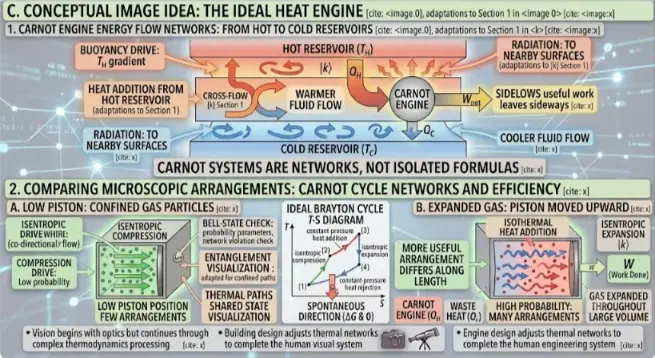
Comprehensive conceptual visualization of the ideal Carnot heat engine. The top panel illustrates a natural, multi-mode energy flow path loop driven by temperature-gradient and work input. The lower panels track useful work and cycle spontaneity, demonstrating that real thermal systems with widespread possibilities move from low-probability to high-probability states, but also generate waste heat, driving changes in a thermodynamic network. A central graph connects the energy flow and operating arrangements.
Part 1: Carnot Engine Energy Flow Networks: From Hot to Cold Reservoirs
This upper panel provides a visual model of natural Carnot engine energy flow networks and macroscopic energy input, demonstrating it as a multi-mode loop within a thermodynamic network:- Thermal Crossed Flow: A detailed schematic shows a large ‘HOT RESERVOIR (TH)’ emitting thermal radiation and fluid flow toward a central ‘CARNOT ENGINE’. Heat input QH enters from the hot reservoir, useful work output Wnet is extracted sideways, and waste heat QC is rejected downward into a ‘COLD RESERVOIR (TC)’.
Part 2: Comparing Microscopic Arrangements: Carnot Cycle Networks and Efficiency
This lower panel visualizes and compares operating arrangements to track cycle efficiency and statistical microstates:- Sub-Diagram A: Low Piston (Confined Gas Particles): Shows a magnified view of confined gas particles corresponding to ‘ISENTROPIC COMPRESSION’ at low piston volume with fewer spatial microstates.
- Sub-Diagram B: Expanded Gas (Piston Moved Upward): Depicts gas spread throughout a larger volume during ‘ISOTHERMAL HEAT ADDITION’ and ‘ISENTROPIC EXPANSION’, representing high probability and greater available microstates while driving useful work extraction.
The Four Processes of the Carnot Cycle
| Stage | Process | Main Event | Heat Transfer |
|---|---|---|---|
| 1 → 2 | Reversible isothermal expansion at TH | Gas expands while absorbing heat from the hot reservoir | Heat added: QH |
| 2 → 3 | Reversible adiabatic expansion | Gas continues expanding without heat transfer, and temperature falls from TH to TC | Q = 0 |
| 3 → 4 | Reversible isothermal compression at TC | Gas is compressed while rejecting heat to the cold reservoir | Heat rejected: QC |
| 4 → 1 | Reversible adiabatic compression | Gas is compressed without heat transfer, and temperature rises from TC to TH | Q = 0 |
Process 1 → 2: Isothermal Expansion at the Hot Temperature
Process 2 → 3: Adiabatic Expansion
Process 3 → 4: Isothermal Compression at the Cold Temperature
Process 4 → 1: Adiabatic Compression
The Carnot Cycle on a Pressure-Volume Diagram
| Curve | Appearance on P–V Diagram | Physical Meaning |
|---|---|---|
| Isothermal expansion | Smooth expansion curve at higher temperature | Heat is absorbed while gas does work |
| Adiabatic expansion | Steeper expansion curve | Gas cools without heat transfer |
| Isothermal compression | Smooth compression curve at lower temperature | Heat is rejected while gas is compressed |
| Adiabatic compression | Steeper compression curve | Gas warms without heat transfer |
The Carnot Cycle on a Temperature-Entropy Diagram
| Process | Path on T–S Diagram | Heat Transfer Meaning |
|---|---|---|
| Isothermal heat addition | Horizontal line at TH | QH = THΔS |
| Isentropic expansion | Vertical line downward | No heat transfer |
| Isothermal heat rejection | Horizontal line at TC | QC = TCΔS |
| Isentropic compression | Vertical line upward | No heat transfer |
Carnot Efficiency
| Change | Effect on Carnot Efficiency | Physical Meaning |
|---|---|---|
| Increase TH | Efficiency increases | A hotter heat source can provide higher possible efficiency |
| Decrease TC | Efficiency increases | A colder sink allows more heat-to-work conversion |
| TC approaches TH | Efficiency approaches zero | No useful temperature difference exists |
| TC approaches 0 K | Efficiency approaches one in theory | Not physically reachable in practice |
Why the Carnot Cycle Is the Maximum Efficiency Limit
| Engine Type | Efficiency Compared with Carnot | Reason |
|---|---|---|
| Reversible Carnot engine | Maximum possible | No entropy generation |
| Any real engine | Lower than Carnot | Irreversibilities and losses are unavoidable |
| Hypothetical engine exceeding Carnot | Impossible | Would violate the Second Law |
Reversibility: The Ideal That Real Machines Cannot Reach
| Reversible Ideal | Real Machine Problem |
|---|---|
| No friction | Bearings, pistons, seals, and moving parts produce friction |
| No finite temperature difference during heat transfer | Real heat transfer needs a temperature difference to occur at useful rates |
| No turbulence or pressure loss | Real fluid flow produces losses in pipes, valves, ducts, and passages |
| Infinitely slow processes | Real engines must produce power at a useful rate |
| No entropy generation | All real processes generate entropy |
What the Carnot Cycle Teaches About Real Engines
It Sets an Upper Limit
No real engine operating between the same two temperatures can exceed the Carnot efficiency.
It Explains Waste Heat
Heat rejection is not merely poor design; it is required for a cyclic heat engine.
It Shows Why Temperature Matters
Higher source temperature and lower sink temperature increase the maximum possible efficiency.
It Clarifies the Role of Entropy
Real engines generate entropy, and that entropy generation reduces useful work output.
It Guides Better Engineering
Engineers improve performance by reducing irreversibilities, improving heat transfer, lowering friction, and recovering waste heat.
It Prevents Impossible Claims
Any claim of an engine exceeding Carnot efficiency signals an error or a violation of thermodynamic law.
Carnot Cycle Compared with Other Thermodynamic Cycles
| Cycle | Main Application | How It Relates to Carnot |
|---|---|---|
| Carnot Cycle | Ideal heat-engine limit | Sets maximum possible efficiency between two temperatures |
| Otto Cycle | Spark-ignition petrol engines | More realistic for internal combustion engines with constant-volume heat addition |
| Diesel Cycle | Compression-ignition engines | Models heat addition during part of the expansion process |
| Rankine Cycle | Steam power plants | More practical for phase-change systems using boilers and condensers |
| Brayton Cycle | Gas turbines and jet engines | Models continuous-flow compression, combustion, and expansion |
| Refrigeration and Heat Pump Cycles | Cooling and heating systems | Use work input to move heat from colder to warmer regions |
Carnot Engine Versus Carnot Refrigerator
| Device | Direction of Operation | Main Purpose |
|---|---|---|
| Carnot heat engine | Clockwise on a P–V diagram | Convert part of heat input into work |
| Carnot refrigerator | Reverse cycle | Use work input to remove heat from a cold region |
| Carnot heat pump | Reverse cycle | Use work input to deliver heat to a warm region |
Entropy View of the Carnot Cycle
Applications and Importance of the Carnot Cycle
Heat Engine Benchmarking
Carnot efficiency gives the theoretical ceiling for engines, turbines, and power plants operating between two temperature limits.
Power Plant Analysis
Steam and gas power cycles can be judged against the ideal limit set by reservoir temperatures.
Engine Development
Petrol, diesel, and gas turbine engines improve by reducing irreversibilities, but they cannot exceed Carnot limits.
Refrigeration and Heat Pumps
The reversed Carnot Cycle sets ideal performance limits for cooling and heating devices.
Waste Heat Recovery
Carnot reasoning shows why low-temperature waste heat is harder to convert into useful work than high-temperature heat.
Energy Policy and Sustainability
Thermodynamic limits help explain why efficiency gains have physical ceilings and why waste heat management matters.
Engineering Education
The Carnot Cycle teaches students the difference between poor design, good design, and physical impossibility.
Second Law Understanding
The cycle gives a clear model for entropy, reversibility, heat rejection, and maximum efficiency.
Why Real Engines Cannot Be Carnot Engines
| Real-World Factor | Why It Prevents Carnot Perfection |
|---|---|
| Finite heat transfer | Useful heat-transfer rates require finite temperature differences |
| Friction | Mechanical parts dissipate energy as heat |
| Fluid turbulence | Flow losses generate entropy |
| Pressure drops | Pipes, valves, passages, and heat exchangers reduce useful pressure energy |
| Material limits | Very high temperatures damage materials or require expensive protection |
| Combustion irreversibility | Real combustion is not a reversible heat-addition process |
| Power requirement | Engines must operate at useful speed, not infinitely slowly |
Common Misunderstandings About the Carnot Cycle
Misunderstanding 1: Carnot Efficiency Is the Efficiency of Real Engines
Misunderstanding 2: A Perfect Engine Converts All Heat into Work
Misunderstanding 3: Carnot Efficiency Can Be Calculated Using Celsius
Misunderstanding 4: The Carnot Cycle Is Mainly About Engine Construction
Misunderstanding 5: Higher Temperature Always Solves Efficiency Problems
Challenges and Practical Limitations
| Challenge | Why It Matters | Practical Consequence |
|---|---|---|
| Reversible heat transfer requires infinitesimal temperature difference | Heat transfer would be extremely slow | Real engines need finite temperature differences |
| Isothermal expansion and compression are hard to maintain | Temperature must remain constant during volume change | Real engines use more practical heat-addition and heat-rejection processes |
| Adiabatic reversibility is idealised | Real insulation is imperfect and real flows have losses | Actual processes generate entropy |
| Useful power requires finite speed | Finite speed introduces friction, turbulence, and pressure loss | Efficiency falls below Carnot value |
| Materials limit TH | High temperatures cause creep, melting, oxidation, or thermal stress | Engine design must balance efficiency against durability |
| Cold reservoir temperature is not freely chosen | Environment, cooling water, and ambient air impose limits | Waste heat rejection remains necessary |
Future Directions and Engineering Relevance
High-Temperature Materials
Better ceramics, alloys, and coatings allow engines and turbines to operate at higher temperatures, moving closer to ideal efficiency limits.
Waste Heat Recovery
Carnot reasoning helps identify which waste heat streams are useful and which are too low in temperature to recover efficiently.
Advanced Heat Pumps
Reversed-cycle thinking supports more efficient heating systems for buildings and industry.
Low-Carbon Power Systems
Thermodynamic limits shape nuclear, solar thermal, geothermal, biomass, and fossil-fuel systems with carbon capture.
Thermal Energy Storage
Storage temperature affects how much useful work or heating value can later be extracted.
Data Centre and Electronics Cooling
Carnot thinking helps explain the energy cost of removing heat from warm electronics to warmer surroundings.
Industrial Decarbonisation
Factories can reduce energy use by matching heat sources and sinks more intelligently.
Engineering Education
The Carnot Cycle will remain a foundational model because it reveals the structure of the Second Law more clearly than almost any other cycle.
Connections with Wider Thermodynamics
Thermodynamics
The Carnot Cycle is one of the clearest demonstrations of how thermodynamic laws limit energy conversion.
Laws of Thermodynamics
The First Law gives the energy balance, while the Second Law explains why Carnot efficiency is a maximum limit.
Entropy in Thermodynamics
The reversible Carnot Cycle has no entropy generation, making it the ideal benchmark for real processes.
Heat Transfer
Real engines fall below Carnot efficiency partly because real heat transfer requires finite temperature differences.
Engineering Thermodynamics
Carnot efficiency provides a theoretical ceiling for practical engines, turbines, power cycles, refrigerators, and heat pumps.
Renewable and Sustainable Energy Thermodynamics
The quality of heat, source temperature, and sink temperature all affect how much useful work can be obtained from thermal energy.
Learning Pathway Within Thermodynamic Cycles
Carnot Cycle
Current page. Learn how the ideal reversible heat-engine cycle sets the maximum possible efficiency between two temperatures.
Otto Cycle
Study the idealised cycle for spark-ignition petrol engines, including compression, heat addition, expansion, and heat rejection.
Diesel Cycle
Explore the idealised compression-ignition engine cycle and how it differs from the Otto Cycle.
Rankine Cycle
Learn how steam power plants use boilers, turbines, condensers, pumps, and phase change to produce work.
Brayton Cycle
Understand the gas turbine and jet engine cycle involving compression, combustion, expansion, and exhaust.
Refrigeration and Heat Pump Cycles
See how reversed cycles use work input to move heat from colder regions to warmer regions.
Interactive Learning Tool: Carnot Cycle Pressure-Volume Simulator
Carnot Cycle P–V Diagram & State Simulator
Quick Check: Carnot Cycle
Quick Check: Ideal Efficiency and Reversibility
Key Terms
- Carnot Cycle
- An ideal reversible heat-engine cycle operating between two temperature reservoirs.
- Hot reservoir
- The high-temperature source from which the engine absorbs heat.
- Cold reservoir
- The low-temperature sink to which the engine rejects heat.
- Carnot efficiency
- The maximum possible efficiency of a heat engine operating between two reservoir temperatures.
- Reversible process
- An ideal process that can be reversed without leaving any net change in the system and surroundings.
- Isothermal process
- A process that occurs at constant temperature.
- Adiabatic process
- A process with no heat transfer across the system boundary.
- Isentropic process
- A reversible adiabatic process with constant entropy.
- Thermal efficiency
- The fraction of heat input converted into useful net work output.
- Entropy generation
- Entropy produced by irreversibilities such as friction, finite-temperature heat transfer, turbulence, and mixing.
- Heat engine
- A device that operates in a cycle, absorbs heat from a hot source, produces work, and rejects heat to a colder sink.
- Second Law of Thermodynamics
- The thermodynamic law that explains direction, irreversibility, entropy generation, and limits on heat-engine efficiency.
Frequently Asked Questions: Carnot Cycle
What is the Carnot Cycle?
What are the four processes in the Carnot Cycle?
What is Carnot efficiency?
Why must Carnot temperatures be in kelvins?
Can a real engine reach Carnot efficiency?
Can any engine exceed Carnot efficiency?
Why does a heat engine reject heat?
Why is the Carnot Cycle reversible?
What does the Carnot Cycle teach engineers?
How is the Carnot Cycle related to refrigerators and heat pumps?
Why is Carnot efficiency higher when TH is higher?
Why is the Carnot Cycle important if it cannot be built exactly?
Review Questions and Answers
- What is the Carnot Cycle?Answer: The Carnot Cycle is an ideal reversible heat-engine cycle that operates between two temperature reservoirs and gives the maximum possible efficiency.
- What are the two reservoir temperatures in the Carnot Cycle?Answer: The hot reservoir temperature is TH, and the cold reservoir temperature is TC. Both must be measured in kelvins.
- What is the formula for Carnot efficiency?Answer: ηCarnot = 1 − (TC / TH).
- Why does the Carnot Cycle include two isothermal processes?Answer: Heat is absorbed reversibly at the hot temperature during isothermal expansion and rejected reversibly at the cold temperature during isothermal compression.
- Why does the Carnot Cycle include two adiabatic processes?Answer: The adiabatic processes change the working substance temperature between TH and TC without heat transfer.
- Why is the Carnot Cycle called reversible?Answer: It is reversible because every process is idealised to occur without entropy generation, friction, turbulence, or finite-temperature heat-transfer losses.
- Why can real engines not reach Carnot efficiency?Answer: Real engines contain irreversibilities such as friction, finite heat-transfer rates, turbulence, pressure losses, and non-ideal combustion.
- What does the area inside the Carnot Cycle on a P-V diagram represent?Answer: The area inside the loop represents the net work output per cycle.
- What happens to Carnot efficiency when TC increases while TH remains fixed?Answer: Carnot efficiency decreases because TC / TH becomes larger.
- What is the main lesson of the Carnot Cycle?Answer: The main lesson is that heat-engine efficiency has an unavoidable upper limit determined only by the hot and cold reservoir temperatures.
Thought-Provoking Questions and Answers
- Why is the Carnot Cycle more useful as a limit than as a machine design?Answer: Its assumptions are too ideal for practical construction, but its efficiency limit is extremely useful for judging how close real engines come to the best possible performance.
- Why does the need to reject heat reveal a deep limitation of energy conversion?Answer: It shows that heat is not fully convertible into work in a cyclic engine. Some energy must be rejected, so energy quality matters as much as energy quantity.
- Why does increasing TH often improve ideal efficiency but create practical problems?Answer: Higher TH improves the Carnot limit, but real materials may suffer from melting, creep, oxidation, thermal stress, or safety risks at very high temperatures.
- Why is low-temperature waste heat difficult to convert into useful work?Answer: If the heat source temperature is only slightly above the environment, the Carnot efficiency is low, so only a small fraction can ideally become work.
- Why does reversibility require slow processes, and why is that a problem for engines?Answer: Reversibility requires processes to remain extremely close to equilibrium, which makes them very slow. Practical engines must operate at useful power, requiring finite rates that introduce irreversibilities.
- How does the Carnot Cycle help students avoid impossible engineering claims?Answer: It provides a clear thermodynamic ceiling. If a proposed heat engine exceeds Carnot efficiency between the same temperatures, the claim must be wrong.
- Why is the Carnot Cycle closely connected to sustainability?Answer: It explains why efficiency improvements have physical limits and why waste heat recovery depends strongly on temperature level.
- What does the Carnot Cycle teach about the difference between energy and useful energy?Answer: It shows that not all heat energy has the same ability to produce work. Heat at higher temperature has greater work potential than heat near environmental temperature.
Numerical Problems and Solutions
- A Carnot engine operates between TH = 600 K and TC = 300 K. Find its efficiency.Solution:
- Use ηCarnot = 1 − (TC / TH).
- ηCarnot = 1 − (300 / 600).
- ηCarnot = 1 − 0.5 = 0.5.
Answer: The efficiency is 0.5, or 50%. - A Carnot engine operates between TH = 800 K and TC = 320 K. If it absorbs 2000 J of heat per cycle, find the work output.Solution:
- ηCarnot = 1 − (320 / 800) = 1 − 0.4 = 0.6.
- Use Wnet = η QH.
- Wnet = (0.6)(2000) = 1200 J.
Answer: The work output is 1200 J per cycle. - A Carnot engine absorbs 5000 J of heat and has efficiency 40%. Find the work output and heat rejected.Solution:
- Efficiency 40% = 0.40.
- Wnet = η QH = (0.40)(5000) = 2000 J.
- Use Wnet = QH − QC.
- QC = QH − Wnet = 5000 − 2000 = 3000 J.
Answer: The work output is 2000 J, and the heat rejected is 3000 J. - A Carnot engine has TH = 900 K and efficiency 55%. Find the cold reservoir temperature.Solution:
- Use η = 1 − (TC / TH).
- 0.55 = 1 − (TC / 900).
- TC / 900 = 0.45.
- TC = (0.45)(900) = 405 K.
Answer: The cold reservoir temperature is 405 K. - A Carnot engine rejects 1200 J of heat to a cold reservoir at 300 K. The hot reservoir is at 600 K. Find the heat absorbed and work output per cycle.Solution:
- For a Carnot engine, QC / QH = TC / TH.
- 1200 / QH = 300 / 600 = 0.5.
- QH = 1200 / 0.5 = 2400 J.
- Wnet = QH − QC = 2400 − 1200 = 1200 J.
Answer: The heat absorbed is 2400 J, and the work output is 1200 J. - A proposed engine operates between TH = 700 K and TC = 350 K. It claims an efficiency of 60%. Is this possible?Solution:
- Calculate the Carnot efficiency: ηCarnot = 1 − (350 / 700).
- ηCarnot = 1 − 0.5 = 0.5, or 50%.
- The proposed engine claims 60%, which is greater than the Carnot limit.
Answer: No. The claim is impossible because it exceeds the Carnot efficiency of 50%. - A Carnot engine operates between 500 °C and 30 °C. Find its efficiency. Use kelvins.Solution:
- Convert temperatures: TH = 500 + 273 = 773 K.
- TC = 30 + 273 = 303 K.
- ηCarnot = 1 − (303 / 773).
- ηCarnot ≈ 1 − 0.392 = 0.608.
Answer: The efficiency is approximately 60.8%. - A Carnot engine has QH = 1000 J, TH = 500 K, and TC = 250 K. Find QC, Wnet, and efficiency.Solution:
- Use QC / QH = TC / TH.
- QC = QH(TC / TH) = 1000(250 / 500) = 500 J.
- Wnet = QH − QC = 1000 − 500 = 500 J.
- η = Wnet / QH = 500 / 1000 = 0.5.
Answer: QC = 500 J, Wnet = 500 J, and efficiency is 50%.