
The Rankine Cycle is the ideal thermodynamic cycle used to understand steam power plants and many vapour power systems. It explains how water is pumped to high pressure, heated into steam, expanded through a turbine to produce work, and condensed back into liquid so the cycle can repeat.
This page belongs to the Thermodynamic Cycles cluster within Thermodynamics. It follows heat-engine cycles such as the Carnot Cycle, Otto Cycle, and Diesel Cycle. It also prepares students to compare steam power systems with gas turbine systems such as the Brayton Cycle and reversed cycles such as Refrigeration and Heat Pump Cycles.
The central idea of the Rankine Cycle is phase change. Unlike the Otto and Diesel cycles, which are usually introduced using gas-only air-standard models, the Rankine Cycle uses a working fluid that changes between liquid and vapour. In many power plants, that working fluid is water. Water is pressurised as a liquid, boiled into steam, expanded through a turbine, and condensed back into liquid.
The Rankine Cycle is one of the most important cycles in energy engineering because it underlies coal-fired power plants, nuclear power plants, biomass plants, some solar thermal power systems, geothermal plants, and many waste-heat recovery systems. It shows how heat can be converted into mechanical work through a practical vapour cycle.
Interactive Rankine Cycle Calculator & Simulator
Explore how boiler pressure (Phigh), condenser pressure (Plow), and turbine inlet temperature (T3) impact thermal efficiency, turbine work output, pump work, and steam quality at the turbine exit. Adjust the parameters below to dynamically update the ideal cycle calculations and visual T–s diagram relative to the saturation dome.
THERMAL EFFICIENCY (η)
35.2%
TURBINE WORK (wturb)
1080 kJ/kg
PUMP WORK (wpump)
5.0 kJ/kg
EST. STEAM QUALITY (x4)
0.86
What the Rankine Cycle Really Is
The Rankine Cycle is an ideal vapour power cycle. It is designed around a working fluid that can be pumped as a liquid, heated into vapour, expanded through a turbine, and then condensed back into liquid.
In a typical steam Rankine Cycle, water leaves the condenser as a low-pressure liquid. A pump raises its pressure. A boiler adds heat and turns it into high-pressure steam. A turbine expands the steam and produces work. A condenser removes heat and converts the exhaust steam back into liquid water.
| Feature | Rankine Cycle Meaning | Real Power Plant Connection |
|---|---|---|
| Vapour power cycle | The working fluid changes phase between liquid and vapour | Water becomes steam and later condenses back into water |
| Pump work | Liquid is raised to high pressure | Pump work is usually small compared with turbine work |
| Boiler heat addition | Heat turns high-pressure liquid into steam | Heat may come from fuel, nuclear fission, solar heat, biomass, or geothermal energy |
| Turbine expansion | High-pressure steam expands and produces shaft work | Turbines drive electric generators in power stations |
| Condenser heat rejection | Low-pressure steam becomes liquid again | Cooling water, air cooling, or cooling towers remove waste heat |
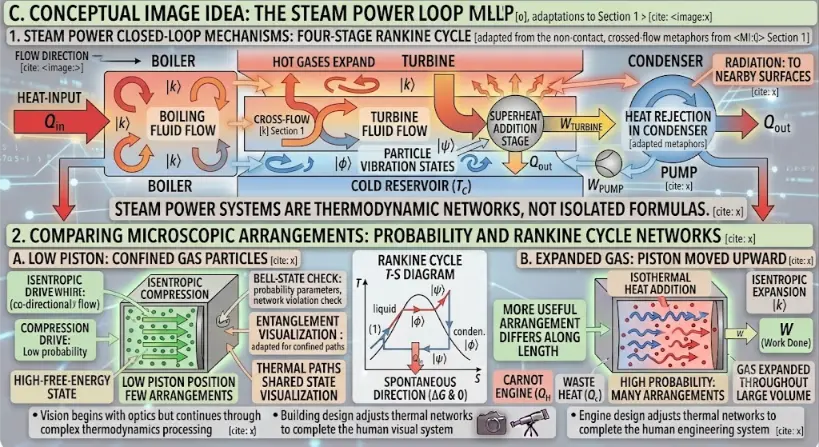
Conceptual visual map of a closed-loop steam power plant and its corresponding ideal Rankine cycle. The top diagram illustrates energy flows through macroscopic machinery components, while the bottom panel maps operations directly onto a temperature-entropy (T–s) graph relative to the saturation dome.
The Four Ideal Processes of the Rankine Cycle
The ideal Rankine Cycle has four main processes. These processes are often numbered from state 1 to state 4.
| Stage | Component | Ideal Process | Main Event |
|---|---|---|---|
| 1 → 2 | Pump | Isentropic compression of liquid | Low-pressure liquid is pumped to high pressure |
| 2 → 3 | Boiler | Constant-pressure heat addition | High-pressure liquid becomes steam |
| 3 → 4 | Turbine | Isentropic expansion of steam | Steam expands and produces work |
| 4 → 1 | Condenser | Constant-pressure heat rejection | Low-pressure steam condenses into liquid |
Process 1 → 2: Pump Compression
The working fluid leaves the condenser as a low-pressure liquid. The pump raises its pressure so it can enter the boiler at high pressure.
Because liquids have small specific volume, the work needed to pump the liquid is usually much smaller than the work produced by the turbine. This is one reason the Rankine Cycle is more practical than a cycle that compresses vapour instead of liquid.
For an ideal pump, the process is often treated as isentropic:
s2 = s1
For an incompressible liquid, the pump work per unit mass may be approximated by:
wpump ≈ v1 (P2 − P1)
Process 2 → 3: Heat Addition in the Boiler
The high-pressure liquid enters the boiler. Heat is added at approximately constant pressure. The water may first warm as compressed liquid, then boil into saturated vapour, and may finally become superheated steam.
The heat added per unit mass is:
qin = h3 − h2
Here, h2 is the specific enthalpy at the boiler inlet, and h3 is the specific enthalpy at the boiler outlet.
Process 3 → 4: Turbine Expansion
High-pressure steam enters the turbine and expands to lower pressure. As the steam expands, it does work on turbine blades. The turbine shaft then drives a generator or another mechanical load.
For an ideal turbine, the expansion is isentropic:
s4 = s3
The turbine work output per unit mass is:
wturbine = h3 − h4
Process 4 → 1: Heat Rejection in the Condenser
The low-pressure exhaust steam enters the condenser. Heat is rejected to cooling water, air, or another sink. The steam condenses into liquid, allowing the pump to handle liquid water again.
The heat rejected per unit mass is:
qout = h4 − h1
Condensation is essential. It closes the cycle and keeps pump work low because the pump handles liquid rather than vapour.
Energy Balance of the Rankine Cycle
The Rankine Cycle is a heat-engine cycle. It absorbs heat in the boiler, produces work in the turbine, uses some work in the pump, and rejects heat in the condenser.
The net work output per unit mass is:
wnet = wturbine − wpump
Using enthalpies:
wnet = (h3 − h4) − (h2 − h1)
The thermal efficiency is:
ηRankine = wnet / qin
Therefore:
ηRankine = [ (h3 − h4) − (h2 − h1) ] / (h3 − h2)
| Quantity | Expression | Meaning |
|---|---|---|
| Pump work input | wpump = h2 − h1 | Work needed to raise liquid pressure |
| Boiler heat input | qin = h3 − h2 | Heat added to produce steam |
| Turbine work output | wturbine = h3 − h4 | Useful work from steam expansion |
| Condenser heat rejection | qout = h4 − h1 | Heat removed to condense steam |
| Net work output | wnet = wturbine − wpump | Useful work after pump input is subtracted |
The Rankine Cycle on a Temperature-Entropy Diagram
The temperature-entropy diagram is one of the most useful ways to visualise the Rankine Cycle. It usually includes the saturation dome, which separates compressed liquid, saturated mixture, and superheated vapour regions.
| Process | Appearance on T–S Diagram | Physical Meaning |
|---|---|---|
| 1 → 2 | Nearly vertical line upward | Liquid is compressed by the pump |
| 2 → 3 | Heat-addition path across or beyond the saturation dome | Water heats, boils, and may become superheated steam |
| 3 → 4 | Nearly vertical line downward | Steam expands through the turbine |
| 4 → 1 | Heat-rejection path inside the saturation dome | Steam condenses back into liquid |
On a T–S diagram, heat transfer in internally reversible processes is related to area under the curve. The area associated with boiler heat addition is larger than the area associated with condenser heat rejection. The difference corresponds to net work output.
The Rankine Cycle on a Pressure-Volume Diagram
A pressure-volume diagram can also show the Rankine Cycle, but it is often less visually convenient than the temperature-entropy diagram because liquid volumes are very small compared with vapour volumes.
| Process | Appearance on P–V Diagram | Meaning |
|---|---|---|
| 1 → 2 | Small volume change at high pressure rise | Liquid pumping requires little volume change |
| 2 → 3 | Constant-pressure heating and vapourisation | Volume increases greatly as water becomes steam |
| 3 → 4 | Expansion path to lower pressure | Steam expands and produces work |
| 4 → 1 | Constant-pressure condensation | Volume decreases as vapour becomes liquid |
Why the Rankine Cycle Uses Liquid Pumping
A major advantage of the Rankine Cycle is that the pump compresses liquid water rather than steam. Compressing a liquid requires much less work than compressing a gas or vapour because liquid specific volume is small.
This is one reason the Rankine Cycle became practical for large-scale power generation. The turbine can produce a large amount of work from steam expansion, while the pump consumes only a small fraction of that work.
| Compression Situation | Specific Volume | Work Requirement |
|---|---|---|
| Compressing liquid water | Small | Relatively low pump work |
| Compressing steam | Large | Much higher compressor work |
| Rankine Cycle choice | Liquid is compressed before heating | Practical and efficient for vapour power plants |
Boiler, Turbine, Condenser, and Pump
The Rankine Cycle is usually taught using four major components. Each component has a clear energy role.
Pump
Raises the pressure of liquid water from condenser pressure to boiler pressure. It requires work input but usually much less than the turbine produces.Boiler
Adds heat at high pressure. Water becomes steam, and in many systems the steam is superheated before entering the turbine.Turbine
Expands high-pressure steam to lower pressure and converts thermal energy into mechanical shaft work.Condenser
Rejects heat and condenses exhaust steam back into liquid water so the cycle can repeat.Thermal Efficiency of the Rankine Cycle
The thermal efficiency of the Rankine Cycle depends on how much net work is obtained from the heat added in the boiler.
The basic form is:
ηRankine = wnet / qin
The efficiency can be improved by increasing the average temperature at which heat is added, decreasing the temperature at which heat is rejected, reducing turbine and pump losses, and using improved cycle arrangements such as superheating, reheating, and regeneration.
| Efficiency Strategy | How It Helps | Practical Limit |
|---|---|---|
| Increase boiler pressure | Raises average heat-addition temperature | Materials, safety, and moisture concerns |
| Superheat steam | Raises turbine inlet temperature and reduces turbine moisture | High-temperature material limits |
| Lower condenser pressure | Increases turbine expansion range | Cooling water temperature and condenser size |
| Use reheat | Reduces turbine moisture and increases work output | More equipment and cost |
| Use regeneration | Raises feedwater temperature before boiler entry | More complex plant layout |
Superheated Rankine Cycle
In a simple saturated Rankine Cycle, steam may enter the turbine as saturated vapour. In many real power plants, steam is superheated before entering the turbine. Superheating means heating the steam beyond the saturated vapour state at the boiler pressure.
Superheating has two major benefits. It can increase turbine work output, and it can reduce the moisture content at the turbine exit. Excess moisture in turbine blades can cause erosion, vibration, and efficiency loss.
| Superheating Effect | Benefit | Engineering Concern |
|---|---|---|
| Higher turbine inlet temperature | More possible work output | Requires high-temperature materials |
| Drier turbine exhaust | Less blade erosion | Still must control final steam quality |
| Higher average heat-addition temperature | Better cycle efficiency | Boiler and superheater design becomes more demanding |
Reheat Rankine Cycle
In a reheat Rankine Cycle, steam expands partly in a high-pressure turbine, returns to the boiler or reheater for additional heating, and then expands further in a low-pressure turbine.
Reheat helps reduce moisture at the final turbine exit and can increase the average temperature of heat addition. It is common in large steam power plants.
| Reheat Step | Purpose | Result |
|---|---|---|
| First turbine expansion | Extract work from high-pressure steam | Steam pressure and temperature fall |
| Reheating | Add heat again before further expansion | Steam temperature rises |
| Second turbine expansion | Extract more work at lower pressure | More total turbine work and less moisture risk |
Regenerative Rankine Cycle
In a regenerative Rankine Cycle, some steam is extracted from the turbine and used to preheat feedwater before it enters the boiler. This reduces the amount of heat that must be supplied in the boiler at low temperature.
Regeneration improves efficiency by increasing the average temperature at which external heat is added to the cycle.
| Regenerative Feature | Function | Benefit |
|---|---|---|
| Steam extraction | Removes some steam from intermediate turbine stages | Provides heat for feedwater heating |
| Feedwater heater | Warms water before boiler entry | Reduces boiler heat input requirement |
| Higher average heat-addition temperature | Improves thermodynamic efficiency | Reduces fuel use for a given output |
Back Work Ratio
The back work ratio is the fraction of turbine work used to drive the pump:
BWR = wpump / wturbine
In the Rankine Cycle, the back work ratio is usually small because the pump compresses liquid. This is very different from gas turbine cycles, where compressor work can be a large fraction of turbine work.
| Cycle Type | Compression Medium | Back Work Ratio Tendency |
|---|---|---|
| Rankine Cycle | Liquid water | Usually small |
| Brayton Cycle | Gas or air | Often much larger |
Rankine Cycle Compared with Carnot Cycle
The Carnot Cycle gives the maximum possible efficiency between two temperatures, but it is not convenient for practical steam power plants. The Rankine Cycle is more practical because it avoids compressing a wet mixture and instead condenses the working fluid fully before pumping it as liquid.
| Feature | Carnot Cycle | Rankine Cycle |
|---|---|---|
| Main role | Ideal efficiency limit | Practical vapour power model |
| Working fluid behaviour | Ideal reversible heat-engine model | Liquid-vapour phase change cycle |
| Compression step | May involve difficult two-phase compression in a vapour system | Pumps liquid water after condensation |
| Practicality | Theoretical benchmark | Foundation of steam power plants |
| Main lesson | Maximum possible efficiency depends on reservoir temperatures | Steam cycles can convert heat to work using practical components |
Rankine Cycle Compared with Brayton Cycle
The Rankine and Brayton cycles are both major power cycles, but they use different working-fluid behaviour. The Rankine Cycle is a vapour power cycle with phase change. The Brayton Cycle is a gas power cycle without condensation in its basic form.
| Feature | Rankine Cycle | Brayton Cycle |
|---|---|---|
| Typical working fluid | Water and steam | Air or combustion gas |
| Phase change | Yes | No in the simple ideal cycle |
| Main compression device | Pump | Compressor |
| Compression work | Small because liquid is pumped | Large because gas is compressed |
| Main application | Steam power plants | Gas turbines and jet engines |
| Common combination | Bottoming cycle in combined-cycle plants | Topping cycle in combined-cycle plants |
Applications of the Rankine Cycle
The Rankine Cycle is one of the most widely used thermal power cycles because it can convert heat from many sources into mechanical and electrical power.
Steam Power Plants
Coal, biomass, and many thermal power plants use Rankine-cycle principles to convert heat into electricity.Nuclear Power Plants
Nuclear reactors produce heat that generates steam for turbines in Rankine-like power cycles.Concentrated Solar Power
Solar thermal systems can use mirrors to heat a working fluid and drive a steam or vapour power cycle.Geothermal Power
Geothermal heat can be used directly or through secondary working fluids to produce power.Waste Heat Recovery
Industrial exhaust, engine waste heat, and process heat can sometimes drive Rankine or organic Rankine cycles.Marine Propulsion
Steam cycles have historically powered ships and remain important in some specialised marine and naval systems.Combined-Cycle Power Plants
Waste heat from a Brayton-cycle gas turbine can generate steam for a Rankine bottoming cycle.Organic Rankine Cycles
Organic fluids can be used instead of water for lower-temperature heat sources such as geothermal, biomass, or waste heat.Organic Rankine Cycle
The Organic Rankine Cycle, often called ORC, is a variation of the Rankine Cycle that uses an organic working fluid instead of water. Organic fluids can boil at lower temperatures, making them useful for low-grade heat sources.
| Feature | Steam Rankine Cycle | Organic Rankine Cycle |
|---|---|---|
| Common working fluid | Water and steam | Organic fluids such as refrigerants or hydrocarbons |
| Best suited heat source | Medium to high temperature | Low to medium temperature |
| Common applications | Power stations and steam plants | Waste heat, geothermal, biomass, and small-scale power recovery |
| Main design issue | Steam conditions, moisture, pressure, materials | Fluid selection, environmental impact, safety, and temperature match |
Organic Rankine systems show that the Rankine idea is not limited to large steam plants. The same basic cycle can be adapted for smaller and lower-temperature energy resources.
Why Real Rankine Cycles Differ from the Ideal Cycle
Real Rankine cycles contain irreversibilities and practical limits. Pumps and turbines are not perfectly isentropic. Boilers and condensers have pressure drops. Heat transfer requires finite temperature differences. Materials limit temperature and pressure.
| Ideal Assumption | Real Behaviour | Effect |
|---|---|---|
| Isentropic pump | Pump friction and fluid losses occur | More pump work is required |
| Constant-pressure boiler | Pressure drops occur through tubes and fittings | Actual heat addition is not perfectly constant pressure |
| Isentropic turbine | Turbine friction, leakage, and flow losses occur | Less turbine work is produced |
| Constant-pressure condenser | Pressure drops and finite heat-transfer differences exist | Condenser performance affects turbine exhaust pressure |
| No heat loss to surroundings | Pipes, valves, and equipment lose heat | Less useful energy remains in the working fluid |
| Pure equilibrium states | Real transients, controls, and off-design operation occur | Plant performance changes with load and environment |
Moisture in Steam Turbines
One practical concern in Rankine cycles is moisture at the turbine exit. If steam expands too far into the wet region, liquid droplets can form. These droplets may erode turbine blades and reduce efficiency.
Engineers control turbine moisture by using superheating, reheating, appropriate condenser pressure, and careful turbine design.
| Moisture Problem | Why It Matters | Engineering Response |
|---|---|---|
| Droplet erosion | Liquid droplets can damage turbine blades | Use superheat and reheat to keep steam drier |
| Reduced efficiency | Wet steam does not expand as ideally | Improve turbine staging and steam conditions |
| Mechanical stress | Uneven droplet impact and vibration can occur | Use suitable materials and blade geometry |
| Maintenance burden | Blade wear increases inspection and repair needs | Control steam quality and operating conditions |
Cooling and Condenser Limitations
The condenser is essential because it creates the low-pressure sink needed for turbine expansion and turns exhaust steam back into liquid. However, condenser performance depends strongly on the available cooling source.
| Cooling Issue | Effect on Rankine Cycle | Example |
|---|---|---|
| Warm cooling water | Raises condenser temperature and pressure | Lower efficiency in hot weather |
| Limited water supply | Restricts condenser heat rejection | Dry cooling or hybrid cooling may be needed |
| Cooling tower losses | Water and energy are used in cooling | Large plants require careful water management |
| Air-cooled condensers | Can reduce water use but may raise condensing temperature | Useful in dry regions but may reduce efficiency |
This shows why the Rankine Cycle is not only about the boiler and turbine. The cold sink is just as important as the heat source.
Challenges and Practical Limitations
The Rankine Cycle is powerful and practical, but real systems must deal with pressure, temperature, materials, cooling, water quality, emissions, maintenance, and cost.
| Challenge | Why It Matters | Practical Consequence |
|---|---|---|
| High boiler pressure and temperature | Improves efficiency but stresses materials | Requires strong alloys, inspection, and safety systems |
| Turbine moisture | Can damage blades and reduce efficiency | Requires superheat, reheat, and steam-quality control |
| Condenser cooling limits | Cold sink temperature affects efficiency | Plant output may vary with climate and water availability |
| Pressure drops | Reduce useful pressure and efficiency | Careful piping, boiler, valve, and heat exchanger design is needed |
| Water treatment | Impurities cause scaling, corrosion, and deposits | Chemical control and maintenance are essential |
| Start-up and load changes | Thermal stress can occur during transients | Controlled heating, monitoring, and operational procedures are needed |
| Environmental impact | Fuel use, water use, waste heat, and emissions matter | Efficiency improvement and cleaner heat sources are important |
Future Directions and Engineering Relevance
The Rankine Cycle remains important in a changing energy world. Even as renewable electricity grows, vapour power cycles still matter for nuclear energy, biomass, geothermal energy, solar thermal systems, waste heat recovery, and combined-cycle power plants.
Advanced Steam Conditions
Higher-pressure and higher-temperature steam can improve efficiency, but require stronger materials and careful safety design.Combined-Cycle Plants
Gas turbines can provide high-temperature exhaust heat that drives a Rankine bottoming cycle for higher overall efficiency.Small Modular Nuclear Systems
Future nuclear systems may use Rankine-like steam cycles or other thermal cycles to convert reactor heat into electricity.Concentrated Solar Thermal Power
Stored solar heat can drive vapour cycles and provide dispatchable renewable electricity.Organic Rankine Cycle Recovery
ORC systems can convert lower-temperature waste heat into useful power in industrial and distributed energy settings.Digital Plant Monitoring
Sensors and digital twins can track turbine performance, condenser pressure, heat rate, pump operation, and maintenance needs.Low-Carbon Industrial Heat
Rankine-based systems can support heat recovery and power generation from biomass, waste heat, geothermal resources, and thermal storage.Water-Smart Cooling
Improved cooling systems can reduce water use while maintaining acceptable plant performance.Connections with Wider Thermodynamics
The Rankine Cycle connects thermodynamics, heat transfer, phase change, fluid mechanics, materials, sustainability, and power generation. It is a practical expression of how heat becomes work through a controlled cycle.
Thermodynamics
The Rankine Cycle applies energy balances, entropy, phase change, and thermal efficiency to vapour power systems.Laws of Thermodynamics
The First Law gives the cycle energy balance, while the Second Law explains efficiency limits and irreversibility.Heat Transfer
Boilers, condensers, superheaters, reheaters, and feedwater heaters depend on heat-transfer design.Phase Equilibria and Phase Transitions
Boiling and condensation are central to how the Rankine Cycle works.Engineering Thermodynamics
Steam power plants, turbines, boilers, condensers, and cycle efficiency are core engineering thermodynamics topics.Thermodynamics and Heat Transfer in Mechanical Engineering
The Rankine Cycle shows how mechanical engineers turn thermal energy into useful power through practical machines.Learning Pathway Within Thermodynamic Cycles
The Rankine Cycle is the fourth page in this Thermodynamic Cycles pathway. After studying ideal heat-engine limits and internal combustion engine cycles, students now examine the vapour power cycle behind many steam power plants.
Carnot Cycle
Learn how the ideal reversible heat-engine cycle sets the maximum possible efficiency between two temperatures.Otto Cycle
Understand how the ideal spark-ignition engine cycle links compression ratio, constant-volume heat addition, expansion, and efficiency.Diesel Cycle
Explore compression ignition, constant-pressure heat addition, cut-off ratio, and ideal diesel engine efficiency.Rankine Cycle
Current page. Learn how steam power plants use pumps, boilers, turbines, condensers, phase change, and heat-to-work conversion.Brayton Cycle
Understand the gas turbine and jet engine cycle involving compression, combustion, expansion, and exhaust.Refrigeration and Heat Pump Cycles
See how reversed cycles use work input to move heat from colder regions to warmer regions.Quick Check: Rankine Cycle
Quick Check: Steam, Phase Change, and Power
Q1. What type of power system does the Rankine Cycle mainly model?
The Rankine Cycle mainly models steam power plants and vapour power systems.
Q2. Why is pump work usually small in the Rankine Cycle?
The pump compresses liquid water, which has a small specific volume. This requires much less work than compressing vapour.
Q3. What happens in the boiler?
Heat is added at high pressure, turning water into steam and sometimes superheating the steam before turbine entry.
Q4. Why is the condenser necessary?
The condenser rejects heat and turns exhaust steam back into liquid water, allowing the pump to operate with low work input.
Key Terms
- Rankine Cycle
- An ideal vapour power cycle used to model steam power plants and related systems.
- Boiler
- A device that adds heat to water at high pressure, producing steam.
- Turbine
- A machine that expands steam and converts thermal energy into mechanical shaft work.
- Condenser
- A heat exchanger that rejects heat and condenses exhaust steam into liquid water.
- Pump
- A device that raises the pressure of liquid water before it enters the boiler.
- Superheated steam
- Steam heated beyond the saturated vapour state at a given pressure.
- Saturated liquid
- Liquid at the point where boiling would begin if heat were added at constant pressure.
- Saturated vapour
- Vapour at the point where condensation would begin if heat were removed at constant pressure.
- Steam quality
- The mass fraction of vapour in a saturated liquid-vapour mixture.
- Back work ratio
- The ratio of pump work input to turbine work output.
- Reheat
- A cycle improvement in which steam is reheated between turbine expansion stages.
- Regeneration
- A cycle improvement in which extracted steam preheats feedwater before boiler entry.
Frequently Asked Questions: Rankine Cycle
What is the Rankine Cycle?
The Rankine Cycle is an ideal vapour power cycle used to model steam power plants and other systems that convert heat into work using phase change.
What are the four main components of a Rankine Cycle?
The four main components are the pump, boiler, turbine, and condenser.
What are the four ideal processes in the Rankine Cycle?
The four ideal processes are isentropic pumping, constant-pressure heat addition, isentropic turbine expansion, and constant-pressure heat rejection.
Why does the Rankine Cycle use water and steam?
Water is widely used because it is abundant, inexpensive, thermally useful, and can change phase between liquid and steam in a practical temperature range.
Why is the pump work small in the Rankine Cycle?
Pump work is small because the pump compresses liquid water, which has much smaller specific volume than steam.
What happens in the turbine?
High-pressure steam expands through the turbine and produces shaft work that can drive an electric generator.
What happens in the condenser?
The condenser rejects heat from the exhaust steam and turns it back into liquid water.
What is Rankine Cycle efficiency?
Rankine Cycle efficiency is the ratio of net work output to heat input: ηRankine = wnet / qin.
Why is superheating used?
Superheating raises turbine inlet temperature, can increase work output, and helps reduce moisture at the turbine exit.
What is reheat in a Rankine Cycle?
Reheat sends partially expanded steam back for additional heating before further turbine expansion, reducing moisture and improving performance.
What is regeneration in a Rankine Cycle?
Regeneration uses extracted steam to preheat feedwater before it enters the boiler, improving efficiency.
Why should students learn the Rankine Cycle?
The Rankine Cycle helps students understand steam power plants, phase change, turbines, boilers, condensers, power generation, waste heat recovery, and thermal efficiency.
Review Questions and Answers
- What is the Rankine Cycle?Answer: The Rankine Cycle is an ideal vapour power cycle used to model steam power plants and related heat-to-work systems.
- What are the four main components of a simple Rankine Cycle?Answer: The four main components are the pump, boiler, turbine, and condenser.
- What does the pump do in the Rankine Cycle?Answer: The pump raises the pressure of liquid water before it enters the boiler.
- What does the boiler do?Answer: The boiler adds heat at high pressure, turning water into steam and sometimes superheating it.
- What does the turbine do?Answer: The turbine expands high-pressure steam and converts part of its energy into mechanical work.
- What does the condenser do?Answer: The condenser rejects heat and changes exhaust steam back into liquid water.
- Why is the Rankine Cycle practical for steam power plants?Answer: It compresses liquid water rather than steam, so pump work is small compared with turbine work.
- What is the basic efficiency expression for the Rankine Cycle?Answer: ηRankine = wnet / qin.
- Why is turbine moisture a problem?Answer: Liquid droplets in wet steam can erode turbine blades and reduce efficiency.
- How can the Rankine Cycle be improved?Answer: It can be improved using superheating, reheating, regeneration, higher boiler pressure, lower condenser pressure, and better turbine and pump efficiency.
Thought-Provoking Questions and Answers
- Why is the Rankine Cycle more practical than a Carnot-like vapour cycle for steam power plants?Answer: The Rankine Cycle condenses the working fluid fully and pumps it as liquid. This avoids difficult compression of a wet vapour mixture and keeps compression work small.
- Why does the condenser matter if it only rejects heat?Answer: The condenser creates a low-pressure sink for turbine expansion and restores liquid water for pumping. Its temperature strongly affects efficiency.
- Why can superheating protect turbine blades?Answer: Superheating makes steam drier during expansion, reducing the chance of liquid droplets forming and eroding turbine blades.
- Why does water availability affect Rankine power plants?Answer: Many condensers require cooling water or cooling towers. Limited water supply can restrict heat rejection and reduce plant performance.
- Why is waste heat recovery often connected with Rankine cycles?Answer: Rankine and organic Rankine cycles can convert some waste heat into useful power when the heat source temperature is suitable.
- Why does increasing boiler temperature usually improve efficiency?Answer: It raises the average temperature at which heat is added, allowing a greater fraction of heat input to become useful work.
- Why is the Rankine Cycle still important in a renewable energy future?Answer: Biomass, geothermal, concentrated solar thermal, waste heat, and nuclear systems may still use vapour power cycles to produce electricity.
- What does the Rankine Cycle teach about engineering trade-offs?Answer: It shows that efficiency, pressure, temperature, moisture, materials, water use, cost, safety, and environmental impact must be balanced together.
Numerical Problems and Solutions
- A simple Rankine Cycle has h1 = 200 kJ/kg, h2 = 210 kJ/kg, h3 = 3200 kJ/kg, and h4 = 2300 kJ/kg. Find pump work, turbine work, net work, heat input, and efficiency.Solution:
- Pump work: wpump = h2 − h1 = 210 − 200 = 10 kJ/kg.
- Turbine work: wturbine = h3 − h4 = 3200 − 2300 = 900 kJ/kg.
- Net work: wnet = 900 − 10 = 890 kJ/kg.
- Heat input: qin = h3 − h2 = 3200 − 210 = 2990 kJ/kg.
- Efficiency: η = 890 / 2990 ≈ 0.298.
Answer: wpump = 10 kJ/kg, wturbine = 900 kJ/kg, wnet = 890 kJ/kg, qin = 2990 kJ/kg, and efficiency is approximately 29.8%. - A pump raises water pressure from 10 kPa to 5 MPa. If v1 = 0.001 m3/kg, estimate the pump work per kilogram.Solution:
- Use wpump ≈ v1 (P2 − P1).
- Convert pressure difference: P2 − P1 = 5000 kPa − 10 kPa = 4990 kPa.
- Since 1 kPa·m3/kg = 1 kJ/kg, wpump = 0.001 × 4990.
- wpump = 4.99 kJ/kg.
Answer: The pump work is approximately 4.99 kJ/kg. - A turbine receives steam with h3 = 3400 kJ/kg and exhausts it at h4 = 2400 kJ/kg. If the mass flow rate is 12 kg/s, find the turbine power output.Solution:
- Turbine work per kilogram: wturbine = h3 − h4 = 3400 − 2400 = 1000 kJ/kg.
- Power: Wturbine = m × wturbine.
- Wturbine = 12 × 1000 = 12000 kJ/s.
- Since 1 kJ/s = 1 kW, Wturbine = 12000 kW.
Answer: The turbine power output is 12 MW. - A boiler heats water from h2 = 300 kJ/kg to h3 = 3300 kJ/kg. If the mass flow rate is 8 kg/s, find the heat input rate.Solution:
- Heat input per kilogram: qin = h3 − h2 = 3300 − 300 = 3000 kJ/kg.
- Qin = m × qin = 8 × 3000.
- Qin = 24000 kJ/s = 24000 kW.
Answer: The boiler heat input rate is 24 MW. - A Rankine Cycle rejects heat in the condenser from h4 = 2300 kJ/kg to h1 = 190 kJ/kg. Find the heat rejected per kilogram.Solution:
- Use qout = h4 − h1.
- qout = 2300 − 190 = 2110 kJ/kg.
Answer: The heat rejected is 2110 kJ/kg. - A Rankine plant produces net work of 950 kJ/kg and receives boiler heat input of 2800 kJ/kg. Find its thermal efficiency.Solution:
- Use η = wnet / qin.
- η = 950 / 2800 ≈ 0.339.
Answer: The thermal efficiency is approximately 33.9%. - A Rankine Cycle has turbine work 1100 kJ/kg and pump work 12 kJ/kg. Find the back work ratio.Solution:
- Use BWR = wpump / wturbine.
- BWR = 12 / 1100 ≈ 0.0109.
Answer: The back work ratio is approximately 0.0109, or 1.09%. - A steam plant has net power output 50 MW. If the net work output is 1000 kJ/kg, find the required steam mass flow rate.Solution:
- Convert 50 MW to 50000 kJ/s.
- Use Wnet = m × wnet.
- m = Wnet / wnet = 50000 / 1000.
- m = 50 kg/s.
Answer: The required steam mass flow rate is 50 kg/s.
Why This Topic Matters
The Rankine Cycle matters because it is one of the main ways human societies have converted heat into electricity. Whenever heat is used to boil a working fluid and drive a turbine, Rankine-cycle thinking is close by.
For engineers, the Rankine Cycle teaches why boilers, turbines, condensers, pumps, cooling systems, phase change, and material limits all matter together. It also shows why waste heat rejection is unavoidable and why the cold sink can strongly affect efficiency.
For students, the Rankine Cycle is a bridge between simple heat-engine theory and real power plants. It shows how thermodynamics becomes machinery, and how a cycle diagram becomes a power station with pipes, turbines, pumps, valves, water treatment, safety systems, and environmental consequences.
Summary
The Rankine Cycle is an ideal vapour power cycle used to model steam power plants and related systems. It consists of liquid compression in a pump, constant-pressure heat addition in a boiler, steam expansion in a turbine, and constant-pressure heat rejection in a condenser.
The main energy relationships are:
wnet = (h3 − h4) − (h2 − h1)
qin = h3 − h2
ηRankine = wnet / qin
Real Rankine cycles improve performance through superheating, reheating, regeneration, higher boiler pressure, lower condenser pressure, and better component efficiency. They are widely used in steam power plants, nuclear power, biomass systems, geothermal energy, concentrated solar power, waste heat recovery, and organic Rankine systems.
Reflection Question
If the Rankine Cycle can convert many heat sources into electricity but must still reject waste heat, how should future engineers balance efficiency, water use, fuel choice, cooling limits, materials, and environmental responsibility in power plant design?