
Entropy in thermodynamics helps explain why natural processes have a direction, why heat flows from hot to cold, why engines cannot be perfectly efficient, and why energy can become less available for useful work even though it is still conserved.
This page belongs to the Laws of Thermodynamics cluster within Thermodynamics. It builds on the Zeroth Law of Thermodynamics, First Law of Thermodynamics, Second Law of Thermodynamics, and Third Law of Thermodynamics. It also prepares students for Free Energy in Thermodynamics.
Entropy is often introduced as “disorder,” but that word is only a rough starting point. A more useful idea is that entropy describes how energy is spread among microscopic possibilities. When energy becomes more widely distributed and more microscopic arrangements become possible, entropy usually increases.
This makes entropy one of the deepest ideas in physics. It connects heat, probability, microscopic motion, irreversibility, information, engines, phase changes, chemical reactions, biological systems, climate processes, and the arrow of time.
What Entropy Really Means
Entropy is a thermodynamic state function usually represented by the symbol S. It helps measure how energy is distributed within a system and how many microscopic arrangements can produce the same macroscopic condition.
In classical thermodynamics, entropy change is defined using reversible heat transfer:
dS = δQrev ⁄ T
For a finite reversible heat transfer at constant temperature:
ΔS = Qrev ⁄ T
Here, ΔS is entropy change, Qrev is heat transferred reversibly, and T is absolute temperature in kelvins.
| Symbol | Meaning | Important Note |
|---|---|---|
| S | Entropy | A state function |
| ΔS | Change in entropy | Depends only on initial and final equilibrium states |
| Qrev | Reversible heat transfer | Used to calculate entropy change |
| T | Absolute temperature | Must be measured in kelvins |
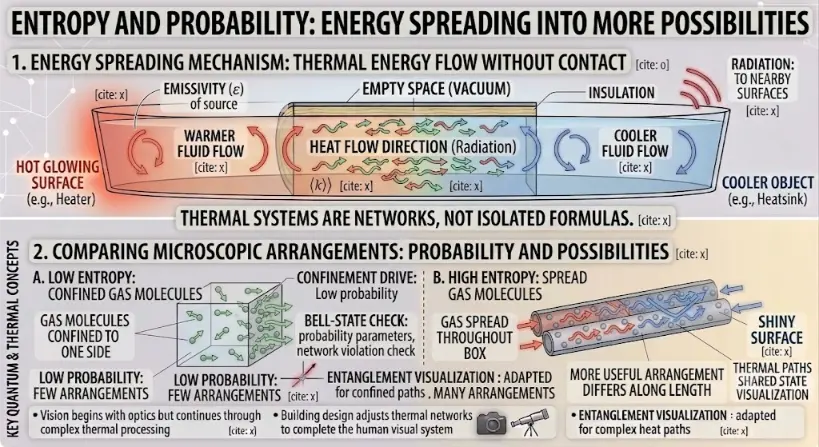
Conceptual visualization of entropy and probability in energy spreading. The top panel uses non-contact thermal radiation through a vacuum to illustrate how energy spreads into countless possible wave paths, connecting with microscopic possibilities. The lower panels directly compare microscopic arrangements, demonstrating that a confined low-entropy gas has few possible arrangements (low probability), while a spread-out high-entropy gas can adopt many more possible arrangements (high probability), thereby connecting entropy to probability rather than just visual messiness.
The image is a comprehensive conceptual infographic titled “ENTROPY AND PROBABILITY: ENERGY SPREADING INTO MORE POSSIBILITIES,” set against a clean white background with subtle diagrammatic traces. The illustration is organized into two primary vertical panels, connected by a large horizontal conceptual title banner: “THERMAL SYSTEMS ARE NETWORKS, NOT ISOLATED FORMULAS”. It adopts a precise diagrammatic and educational style, featuring soft glowing accents and prominent text callouts, inspired by the structure of image_51.png.
Part 1: Energy Spreading Mechanism: Thermal Energy Flow Without Contact
This upper panel provides a visual model of heat transfer through empty space (vacuum) to illustrate energy spreading into more possibilities. The diagram adapts the visual structure of Section 1 in image_51.png. On the far left, a detailed “HOT GLOWING SURFACE (e.g., Heater)” emits a strong red-orange glow. Its internal structure reveals swirling red and orange arrows, labeled “WARMER FLUID FLOW,” similar to the concepts from Section 1 in image_51.png. This hot surface approaches, without contacting, a “COOLER OBJECT (e.g., Heatsink)” on the right, which contains blue swirling arrows labeled “COOLER FLUID FLOW”. The central space is labeled “EMPTY SPACE (VACUUM)”. Countless small, curved red and blue wave arrows, adapted from the flow and radiation visual metaphors of image_51.png, travel from the hot surface to the cooler object, labeled “HEAT FLOW DIRECTION (Radiation)”. The diagram illustrates how energy initially concentrated spreads through countless possible wave paths, connecting with microscopic possibilities. Labeled callouts detail: “EMISSIVITY (ϵ) of source”, “INSULATION”, and “RADIATION: TO NEARBY SURFACES”. Integrated quantum concepts kets like |k⟩ and citation brackets suggest connections with microscopic probability states.Part 2: Comparing Microscopic Arrangements: Probability and Possibilities
This lower panel uses direct comparisons between two microscopic systems to link entropy with probability and possibilities. It is split vertically to show two sub-diagrams, Arranged in stacked formations adapted from Section 2 in image_51.png:- Section A: Low Entropy: Confined Gas Molecules: On the left, this section shows a magnified view of a gas box similar in layout to Section 2A in image_51.png. Gas molecules, indicated by small, co-directional green flow arrows from the Section 2A metaphors, are confined to one side of the box, labeled “GAS MOLECULES CONFINED TO ONE SIDE” and “LOW PROBABILITY: FEW ARRANGEMENTS”. Callouts include: “CONFINEMENT DRIVE: Low probability”, “BELL-STATE CHECK: probability parameters, network violation check”, and adapted entanglement and shared state visualizations for confined paths, connecting with quantum probability states.
- Section B: High Entropy: Spread Gas Molecules: On the right, this section shows a magnified view of two parallel gas boxes where gas has spread. Gas molecules, indicated by blue and red wave arrows from the Section 2B metaphors, are spread throughout the whole box, labeled “GAS SPREAD THROUGHOUT BOX” and “HIGH PROBABILITY: MANY ARRANGEMENTS”. The diagram illustrates that the second arrangement allows for many more possible microscopic arrangements. Blue and red wave arrows indicate efficient energy transfer and widespread possibilities. A prominent label states: “MORE USEFUL ARRANGEMENT DIFFERS ALONG LENGTH”, emphasizing how the second case allows for more complex, diverse arrangements. Callouts repeat quantum concepts and summaries.
Entropy as a State Function
Entropy is a state function. This means that the entropy change between two equilibrium states depends only on the initial and final states, not on the actual path taken.
This is important because entropy changes for irreversible processes are often calculated by imagining a reversible path between the same initial and final states. The real process may be messy, fast, frictional, or irreversible, but the entropy change of the system can still be calculated from a convenient reversible path.
| Quantity | State Function? | Reason |
|---|---|---|
| Entropy S | Yes | Depends on the state of the system |
| Internal energy U | Yes | Depends on the thermodynamic state |
| Temperature T | Yes | Describes the state of the system |
| Heat Q | No | Depends on the transfer path |
| Work W | No | Depends on how the process occurs |
Entropy and the Second Law
The Second Law of Thermodynamics is often expressed using entropy:
ΔStotal ≥ 0
For an isolated system, the total entropy can increase or remain constant, but it cannot decrease.
| Situation | Total Entropy Change | Meaning |
|---|---|---|
| Ideal reversible process | ΔStotal = 0 | No net entropy is produced |
| Real irreversible process | ΔStotal > 0 | Entropy is generated |
| Impossible natural process in an isolated system | ΔStotal < 0 | Would violate the Second Law |
The word “total” is essential. Entropy can decrease in one part of a system, but only if entropy increases elsewhere by at least as much.
Entropy Is Not Simply Disorder
Saying “entropy is disorder” can be helpful at first, but it can also mislead students. Entropy is better understood as a measure related to energy spreading, microscopic possibilities, and the probability of macroscopic states.
| Common Phrase | Problem | Better Interpretation |
|---|---|---|
| Entropy means disorder | Too visual and sometimes vague | Entropy relates to energy spreading and microstates |
| Entropy always increases everywhere | Ignores local decreases | Total entropy of an isolated system does not decrease |
| Entropy means energy is destroyed | Contradicts the First Law | Energy is conserved, but its usefulness may decrease |
| Low entropy always means neat appearance | Microscopic arrangements may not be visible | Entropy depends on accessible microstates, not only appearance |
A clean crystal may look ordered, but entropy still depends on its thermal vibrations, defects, quantum states, and possible microscopic arrangements. A messy-looking object is not automatically a high-entropy thermodynamic system unless its physical states and energy distribution are considered.
Microscopic View: Microstates and Macrostates
A macrostate describes a system using large-scale quantities such as temperature, pressure, volume, and energy. A microstate describes one detailed microscopic arrangement of particles and their energies that corresponds to that macrostate.
A macrostate with many possible microstates has high entropy. A macrostate with fewer possible microstates has lower entropy.
| Term | Meaning | Example |
|---|---|---|
| Macrostate | Large-scale description | A gas has pressure P, volume V, and temperature T |
| Microstate | Detailed microscopic arrangement | Exact positions and motions of all molecules |
| Multiplicity | Number of microstates for a macrostate | More ways for gas molecules to be spread throughout a box |
This microscopic viewpoint explains why some processes are overwhelmingly likely. A gas spreads into a room because there are vastly more microscopic arrangements corresponding to “spread out” than to “all molecules gathered in one corner.”
Boltzmann’s Entropy Formula
The statistical meaning of entropy is captured by Boltzmann’s famous formula:
S = kB ln Ω
Here, S is entropy, kB is Boltzmann’s constant, and Ω is the number of accessible microstates.
| Symbol | Meaning |
|---|---|
| S | Entropy |
| kB | Boltzmann’s constant |
| Ω | Number of accessible microstates |
| ln | Natural logarithm |
This equation gives entropy a deep probabilistic meaning. A state with more accessible microstates has greater entropy because there are more ways for the system to be arranged while appearing the same macroscopically.
Why Entropy Uses a Logarithm
The logarithm in Boltzmann’s formula is not accidental. When two independent systems are combined, their numbers of microstates multiply:
Ωtotal = Ω1Ω2
But entropy should add:
Stotal = S1 + S2
The natural logarithm converts multiplication into addition:
ln(Ω1Ω2) = ln Ω1 + ln Ω2
This is why entropy can be an additive thermodynamic quantity while still being connected to the number of microscopic possibilities.
Entropy Change During Heat Transfer
When heat Q is transferred reversibly at temperature T, the entropy change is:
ΔS = Qrev ⁄ T
For the same amount of heat, entropy change is larger at lower temperature because the same energy transfer has a greater relative effect on a colder system.
| Heat Transfer | Entropy Change | Meaning |
|---|---|---|
| Heat enters a system | ΔS > 0 | The system’s entropy increases |
| Heat leaves a system | ΔS < 0 | The system’s entropy decreases |
| Same Q at lower T | Larger |ΔS| | Entropy change is more significant at lower temperature |
| Same Q at higher T | Smaller |ΔS| | Entropy change is less significant at higher temperature |
Entropy Change of the System and Surroundings
To decide whether a process is consistent with the Second Law, we often need to consider both the system and the surroundings:
ΔStotal = ΔSsystem + ΔSsurroundings
A process can have:
ΔSsystem < 0
and still be possible if:
ΔSsurroundings > |ΔSsystem|
This is how local order can form without violating the Second Law. Freezing water, crystal growth, and biological organisation can reduce entropy locally while increasing entropy elsewhere.
Entropy and Heat Flow from Hot to Cold
Consider heat Q flowing from a hot reservoir at temperature Th to a cold reservoir at temperature Tc. The hot reservoir loses entropy:
ΔSh = –Q ⁄ Th
The cold reservoir gains entropy:
ΔSc = Q ⁄ Tc
Since Tc < Th, the cold reservoir gains more entropy than the hot reservoir loses. Therefore:
ΔStotal > 0
This explains why heat naturally flows from hot to cold. The reverse process would reduce total entropy and would not occur spontaneously.
Reversible and Irreversible Processes
A reversible process is an ideal process that can be undone without leaving any net change in the system and surroundings. Real processes are usually irreversible because they involve finite temperature differences, friction, turbulence, mixing, electrical resistance, viscosity, or rapid expansion.
| Process Type | Entropy Behaviour | Example |
|---|---|---|
| Reversible process | No total entropy production | Ideal slow heat transfer through infinitesimal temperature difference |
| Irreversible process | Total entropy increases | Friction, mixing, sudden expansion, real heat transfer |
| Adiabatic reversible process | Entropy remains constant | Ideal isentropic compression or expansion |
| Adiabatic irreversible process | Entropy increases | Free expansion of gas into a vacuum |
Real systems generate entropy. Reversible processes are ideal limits that help define maximum possible performance.
Entropy Generation
Entropy generation describes the entropy produced inside a system because of irreversibilities. A general way to express entropy balance is:
ΔSsystem = Sin – Sout + Sgen
Here, Sgen represents entropy generated by irreversible effects. For real processes:
Sgen ≥ 0
| Source of Entropy Generation | Example |
|---|---|
| Friction | Moving parts in an engine or machine |
| Heat transfer across finite temperature difference | Hot wall heating colder fluid |
| Mixing | Two gases mixing spontaneously |
| Electrical resistance | Current heating a wire |
| Viscous flow | Fluid energy dissipated in pipes |
| Chemical reaction away from equilibrium | Combustion or rapid reaction |
Isentropic Processes
An isentropic process is a process in which entropy remains constant:
ΔS = 0
In many introductory thermodynamics courses, an isentropic process is treated as both adiabatic and reversible. This is an idealisation, but it is useful for analysing turbines, compressors, nozzles, and ideal gas processes.
| Condition | Does It Guarantee Isentropic Behaviour? | Explanation |
|---|---|---|
| Adiabatic only | No | Entropy can still be generated by irreversibility |
| Reversible only | No | Entropy can change if reversible heat transfer occurs |
| Adiabatic and reversible | Yes | No heat transfer and no entropy generation |
Entropy and Energy Quality
Entropy helps explain why energy quality matters. The First Law of Thermodynamics says energy is conserved. The Second Law says that energy can become more spread out and less available for useful work.
For example, the thermal energy in a warm ocean is enormous, but it is not easily converted into useful work unless there is a temperature difference. Entropy helps explain this difference between total energy and usable energy.
| Energy Form or Situation | Usefulness for Work | Entropy Connection |
|---|---|---|
| High-temperature heat source | More useful | Can drive engines if a colder sink exists |
| Uniform room-temperature heat | Less useful | Energy is widely spread with little temperature difference |
| Organised mechanical motion | Highly useful | Can be converted into work more directly |
| Frictional heat | Less useful | Organised motion has been dissipated into random thermal motion |
Entropy and Heat Engines
Heat engines convert part of the heat absorbed from a hot reservoir into useful work and reject the remaining heat to a cold reservoir. Entropy explains why this rejected heat is unavoidable.
For a reversible heat engine operating between two reservoirs:
Qh ⁄ Th = Qc ⁄ Tc
This leads to the Carnot efficiency:
ηC = 1 – Tc ⁄ Th
The entropy viewpoint shows why no engine can convert all absorbed heat into work while operating in a cycle. Some heat must be rejected so entropy balance can be maintained.
Entropy and Phase Changes
Phase changes often involve significant entropy changes because the microscopic arrangements and energy distribution of the substance change.
For a reversible phase transition at temperature Ttrans:
ΔStrans = ΔHtrans ⁄ Ttrans
| Phase Change | Typical Entropy Change of Substance | Reason |
|---|---|---|
| Melting | Increases | Particles gain more freedom of arrangement |
| Boiling | Increases strongly | Gas molecules occupy many more positions and motions |
| Freezing | Decreases | Particles become more constrained in a solid structure |
| Condensation | Decreases | Gas molecules become more constrained in liquid form |
Even when the entropy of a substance decreases during freezing, the surroundings usually gain entropy because heat is released. The total entropy change determines whether the process is natural under the conditions.
Entropy Change of an Ideal Gas
For an ideal gas, entropy change can depend on temperature and volume. One common expression is:
ΔS = nCV ln(T2 ⁄ T1) + nR ln(V2 ⁄ V1)
Here, n is the number of moles, CV is molar heat capacity at constant volume, R is the gas constant, T is absolute temperature, and V is volume.
This equation shows that entropy can increase when temperature rises, when volume increases, or both.
Entropy and Mixing
Mixing is a classic entropy-increasing process. When two gases mix, each gas gains access to more volume and more possible molecular arrangements.
For ideal gases, mixing different gases at the same temperature and pressure usually increases entropy. This helps explain why gases mix spontaneously but do not naturally separate into pure regions without external work.
| Before Mixing | After Mixing | Entropy Effect |
|---|---|---|
| Gases separated by a partition | Gases spread through available volume | Entropy increases |
| Fewer accessible arrangements | More accessible arrangements | Mixed state is more probable |
| Artificial separation maintained | Natural mixing after barrier removal | Process has a direction |
Entropy and Information
Entropy also has connections with information. In thermodynamics, entropy is linked to missing microscopic information: many different microstates can correspond to the same observed macrostate.
In information theory, entropy measures uncertainty in possible messages or states. The two ideas are not identical in every context, but they are deeply related. Both involve the number of possibilities compatible with what is known.
This connection appears in topics such as Maxwell’s demon, data erasure, computation, and the thermodynamics of information. It shows that entropy is not only about heat engines; it also touches the physics of knowledge, measurement, and computation.
Entropy and the Arrow of Time
Entropy helps explain why everyday time seems to have a direction. A glass can shatter, but scattered pieces do not spontaneously leap back into a glass. Cream mixes into coffee, but mixed coffee does not naturally separate into cream and black coffee.
At the microscopic level, many laws of physics are nearly reversible. At the macroscopic level, entropy makes some directions overwhelmingly more probable than their reverse.
This is why entropy is often connected to the arrow of time. The future is the direction in which total entropy tends to increase for natural macroscopic processes.
Local Order and Living Systems
Living organisms are highly organised, but they do not violate the Second Law. They maintain local order by taking in energy and matter, using free energy to build and repair structures, and releasing heat and waste to the surroundings.
The entropy of the organism may decrease locally in certain processes, but the entropy of the surroundings increases by a larger amount. Life is possible because it is not an isolated system.
| Living System Process | Entropy Perspective |
|---|---|
| Building proteins | Local order increases, but energy is consumed and heat is released |
| Maintaining body temperature | Metabolism releases heat to surroundings |
| Active transport | Free energy is used to create local concentration gradients |
| Growth and repair | Organisation is maintained by energy input and waste output |
Applications of Entropy
Entropy appears in many scientific and engineering fields because it describes direction, irreversibility, energy quality, microscopic possibilities, and equilibrium.
Heat Engines
Entropy explains why engines must reject heat and why no real engine can be perfectly efficient.Refrigerators and Heat Pumps
Moving heat from cold to hot requires work input because it goes against the natural entropy-increasing direction.Power Plants
Entropy generation helps identify energy losses in turbines, boilers, condensers, and heat exchangers.Phase Transitions
Melting, boiling, condensation, freezing, and crystallisation involve entropy changes that affect stability.Chemical Reactions
Entropy contributes to Gibbs free energy and helps determine whether reactions are thermodynamically favourable.Biological Systems
Cells use free energy to maintain local order while increasing entropy in their surroundings.Climate and Earth Systems
Atmospheric mixing, radiation balance, heat flow, evaporation, condensation, and ocean circulation involve entropy production.Information and Computing
Entropy connects thermodynamics with data erasure, uncertainty, information processing, and physical limits of computation.Challenges and Practical Limitations
Entropy is powerful, but students often find it difficult because it is abstract. It cannot usually be seen directly, and it is easy to confuse entropy with heat, disorder, randomness, or energy loss.
| Challenge | Why It Matters | Example |
|---|---|---|
| Entropy is abstract | Students cannot see entropy directly | It must be inferred through heat, temperature, probability, or state changes |
| Disorder analogy can mislead | Visual messiness is not the full thermodynamic concept | A crystal can have entropy through vibrations and defects |
| System boundary matters | Entropy changes must include system and surroundings | Freezing water lowers water entropy but raises surroundings entropy |
| Irreversible processes are hard to calculate directly | Entropy formula uses reversible heat transfer | Use a reversible path between the same states |
| Non-equilibrium systems are complex | A single entropy value may not describe rapidly changing systems easily | Plasmas, explosions, living cells, and turbulent flows |
| Microscopic counting is difficult | Real systems have enormous numbers of microstates | Statistical mechanics uses models and approximations |
| Entropy and information overlap but differ by context | Students may merge concepts too quickly | Thermodynamic entropy and information entropy require careful interpretation |
The practical lesson is that entropy should be learned through several connected lenses: heat transfer, energy spreading, microstates, irreversibility, free energy, and useful work.
Future Directions and Emerging Trends
Entropy remains important in modern science because future technologies increasingly operate near limits of efficiency, information, heat dissipation, and microscopic control.
Low-Power Computing
The thermodynamics of information helps researchers understand heat generation and energy limits in computing.Battery and Energy Storage
Entropy changes influence heat generation, voltage behaviour, safety, and degradation in batteries.Quantum Thermodynamics
Researchers study entropy, heat, and work in quantum systems where fluctuations and measurement matter.Nanoscale Heat Engines
Tiny thermodynamic machines test how entropy and fluctuations behave at small scales.Climate Modelling
Entropy production and energy flow can help analyse atmospheric, oceanic, and planetary processes.Biophysical Thermodynamics
Entropy helps explain protein folding, molecular machines, membranes, metabolism, and cellular organisation.Materials Discovery
Entropy can stabilise phases, influence alloys, shape defects, and guide high-entropy material design.AI-Assisted Thermodynamic Modelling
Machine learning can help estimate entropy-related properties in complex materials, reactions, and energy systems.These trends show that entropy is not an old classroom abstraction. It remains central to energy technology, computation, quantum science, biology, climate systems, and materials design.
Connections with Wider Physics and Technology
Entropy connects the laws of thermodynamics with statistical mechanics, free energy, heat engines, materials, biology, chemistry, climate science, and information theory.
Thermodynamics
Entropy is one of the central ideas of thermodynamics because it explains direction, irreversibility, and energy quality.Laws of Thermodynamics
Entropy gives the Second Law its most powerful form and connects the Third Law to absolute entropy.Second Law of Thermodynamics
The Second Law states that the total entropy of an isolated system does not decrease.Third Law of Thermodynamics
The Third Law gives entropy an absolute reference point near 0 K for perfect crystals.Free Energy in Thermodynamics
Free energy combines energy and entropy to predict spontaneity, useful work, and equilibrium.Heat Transfer
Heat transfer across temperature differences produces entropy and limits thermal system performance.Non-Equilibrium Thermodynamics
Real systems with gradients, flows, and finite rates require entropy production analysis.Modern Physics
Statistical mechanics gives entropy a microscopic meaning through probability and microstates.Learning Pathway Within the Laws of Thermodynamics
Entropy in Thermodynamics is the fifth page in the Laws of Thermodynamics pathway. It deepens the Second Law and prepares students to understand free energy.
Zeroth Law of Thermodynamics
Learn how thermal equilibrium defines temperature and why thermometers work.First Law of Thermodynamics
Understand how energy is conserved as heat, work, and internal energy change in thermal systems.Second Law of Thermodynamics
Explore why heat flows naturally from hot to cold, why engines cannot be perfectly efficient, and how entropy gives processes direction.Third Law of Thermodynamics
Study what happens to entropy and material behaviour as temperature approaches absolute zero.Entropy in Thermodynamics
Current page. Learn how entropy connects energy spreading, probability, irreversibility, and natural change.Free Energy in Thermodynamics
See how Gibbs and Helmholtz free energy predict useful work, spontaneity, phase stability, and equilibrium.Quick Check: Entropy in Thermodynamics
Quick Check: Entropy, Direction, and Microstates
Q1. Is entropy simply the same as disorder?
No. Disorder is only a rough analogy. Entropy is better understood through energy spreading, microscopic possibilities, and thermodynamic state.
Q2. What does ΔStotal ≥ 0 mean?
It means the total entropy of an isolated system cannot decrease. It remains constant for ideal reversible processes and increases for real irreversible processes.
Q3. What does S = kB ln Ω connect entropy to?
It connects entropy to the number of accessible microstates Ω. More microstates mean higher entropy.
Q4. Can entropy decrease locally?
Yes. Entropy can decrease locally if entropy increases elsewhere by a larger amount, so the total entropy of the isolated combined system does not decrease.
Common Misunderstandings About Entropy
Misunderstanding 1: Entropy Means Everything Always Becomes Messy
Entropy is not merely visible messiness. It is related to energy distribution and microscopic possibilities. A system may look neat while still having significant entropy.
Misunderstanding 2: Entropy Destroys Energy
Entropy does not destroy energy. Energy is conserved by the First Law. Entropy explains why energy can become less available for useful work.
Misunderstanding 3: Entropy Cannot Decrease Anywhere
Entropy can decrease in a local system if the surroundings gain enough entropy. Refrigerators, living organisms, crystal growth, and freezing all involve local entropy changes that must be considered with surroundings.
Misunderstanding 4: The Entropy Formula Works Only for Reversible Processes
The direct formula ΔS = Qrev ⁄ T uses reversible heat transfer, but entropy change between two equilibrium states can still be calculated for an irreversible process by choosing a reversible path between the same states.
Misunderstanding 5: Entropy Explains Speed
Entropy helps determine thermodynamic direction, but it does not by itself tell how fast a process occurs. Speed depends on kinetics, barriers, transport rates, and mechanisms.
Key Terms
- Entropy
- A thermodynamic state function related to energy spreading, microscopic possibilities, irreversibility, and the direction of natural processes.
- Microstate
- A specific microscopic arrangement of particles and energies compatible with a given macrostate.
- Macrostate
- A large-scale description of a system using quantities such as temperature, pressure, volume, and energy.
- Multiplicity
- The number of accessible microstates corresponding to a macrostate.
- Boltzmann’s formula
- The equation S = kB ln Ω, which connects entropy to the number of accessible microstates.
- Reversible process
- An ideal process that can be reversed without producing net change in the system and surroundings.
- Irreversible process
- A real process that produces entropy and cannot be perfectly reversed without leaving a net change.
- Entropy generation
- Entropy produced by irreversible effects such as friction, mixing, resistance, or heat transfer across finite temperature differences.
- Isentropic process
- A process in which entropy remains constant, often idealised as adiabatic and reversible.
- Arrow of time
- The observed direction of macroscopic processes, associated with increasing total entropy.
- Energy quality
- The usefulness of energy for doing work, which tends to decrease when entropy increases.
- Thermodynamic probability
- The likelihood of a macrostate based on how many microstates correspond to it.
Frequently Asked Questions: Entropy in Thermodynamics
What is entropy in thermodynamics?
Entropy is a thermodynamic state function related to energy spreading, microscopic possibilities, irreversibility, and the direction of natural processes.
Is entropy the same as disorder?
Not exactly. Disorder is a rough analogy. Entropy is better understood through energy distribution, accessible microstates, and thermodynamic probability.
What is the entropy statement of the Second Law?
The total entropy of an isolated system never decreases. It remains constant for ideal reversible processes and increases for real irreversible processes.
What does S = kB ln Ω mean?
It means entropy increases with the number of accessible microstates. A macrostate with more microscopic arrangements has greater entropy.
Can entropy decrease?
Entropy can decrease locally, but only if entropy increases elsewhere by at least as much. The total entropy of an isolated system cannot decrease.
Why does heat flow from hot to cold?
Heat flowing from hot to cold increases total entropy. The reverse flow would reduce total entropy unless work or another compensating process is involved.
What is entropy generation?
Entropy generation is entropy produced by irreversible effects such as friction, mixing, resistance, turbulence, and heat transfer across finite temperature differences.
What is an isentropic process?
An isentropic process is one in which entropy remains constant. In ideal thermodynamics, this often means a process is both adiabatic and reversible.
How does entropy relate to free energy?
Free energy includes entropy through terms such as TS. Entropy helps determine how much energy is available for useful work.
Does life violate the Second Law?
No. Living systems maintain local order by taking in energy and releasing heat and waste, increasing entropy in the surroundings.
Why is entropy important in engineering?
Entropy helps engineers identify irreversibility, efficiency limits, heat losses, waste heat, and opportunities for better energy design.
Why should students learn entropy?
Entropy connects thermodynamics, probability, heat engines, free energy, phase changes, biology, computation, climate systems, and the arrow of time.
Review Questions and Answers
- What is entropy?Answer: Entropy is a thermodynamic state function related to energy spreading, microscopic possibilities, and irreversibility.
- What is the entropy statement of the Second Law?Answer: The total entropy of an isolated system never decreases.
- What does ΔS = Qrev ⁄ T describe?Answer: It describes the entropy change for reversible heat transfer at absolute temperature T.
- Why must temperature be in kelvins in entropy equations?Answer: Entropy equations use absolute temperature, so kelvins must be used.
- What is a microstate?Answer: A microstate is one detailed microscopic arrangement of particles and energies compatible with a macrostate.
- What does Boltzmann’s formula S = kB ln Ω mean?Answer: It means entropy increases with the number of accessible microstates.
- Why can entropy decrease locally without violating the Second Law?Answer: Because the surroundings can gain more entropy than the local system loses, so total entropy still increases.
- What is entropy generation?Answer: Entropy generation is entropy produced by irreversible processes such as friction, mixing, resistance, and heat transfer across finite temperature differences.
Thought-Provoking Questions and Answers
- Why is entropy harder to understand than energy?Answer: Energy has many familiar forms, while entropy is about distribution, probability, and irreversibility. It often requires thinking about both macroscopic behaviour and microscopic possibilities.
- Why does entropy make time feel directional?Answer: Natural macroscopic processes tend toward states with higher total entropy, making the future different from the past in everyday experience.
- Why is energy conservation not enough to explain real processes?Answer: Energy conservation allows many processes that do not happen naturally. Entropy explains why some energy transformations are naturally favoured and others are not.
- How can entropy help explain the limits of technology?Answer: Entropy generation reduces the useful work available from energy. It helps explain why engines, refrigerators, computers, and power plants face efficiency limits.
- Why is the “disorder” explanation of entropy incomplete?Answer: Disorder focuses on appearance, while entropy depends on energy distribution and microscopic arrangements that may not be visually obvious.
- What does entropy teach us about life and organisation?Answer: It shows that local organisation is possible when energy flows through a system and entropy increases in the surroundings.
Numerical Problems and Solutions
- 600 J of heat is added reversibly to a system at 300 K. Find the entropy change.Solution:
- Use ΔS = Qrev ⁄ T.
- ΔS = 600 ⁄ 300.
- ΔS = 2.0 J/K.
Answer: The entropy change is 2.0 J/K. - 500 J of heat leaves a system at 250 K. Find the entropy change of the system.Solution:
- Heat leaves the system, so Qrev = -500 J.
- Use ΔS = Qrev ⁄ T.
- ΔS = -500 ⁄ 250.
- ΔS = -2.0 J/K.
Answer: The system’s entropy decreases by 2.0 J/K. - 900 J of heat flows from a reservoir at 600 K to a reservoir at 300 K. Find the total entropy change.Solution:
- Hot reservoir: ΔSh = –900 ⁄ 600 = -1.5 J/K.
- Cold reservoir: ΔSc = 900 ⁄ 300 = 3.0 J/K.
- Total: ΔStotal = -1.5 + 3.0 = 1.5 J/K.
Answer: The total entropy change is 1.5 J/K, so the process is consistent with the Second Law. - A system has Ω = 1.0 × 10¹⁰ accessible microstates. Find its entropy in terms of kB.Solution:
- Use S = kB ln Ω.
- S = kB ln(1.0 × 10¹⁰).
- ln(1.0 × 10¹⁰) = 10 ln 10 ≈ 23.03.
- So S ≈ 23.03kB.
Answer: S ≈ 23.03kB. - A substance melts reversibly at 350 K with enthalpy of fusion 7000 J/mol. Find the entropy change of fusion.Solution:
- Use ΔSfus = ΔHfus ⁄ Tfus.
- ΔSfus = 7000 ⁄ 350.
- ΔSfus = 20 J/(mol·K).
Answer: The entropy change of fusion is 20 J/(mol·K). - An ideal gas expands isothermally from 2.0 L to 8.0 L. For n = 1.0 mol, find ΔS = nR ln(V2 ⁄ V1), using R = 8.31 J/(mol·K).Solution:
- Use ΔS = nR ln(V2 ⁄ V1).
- ΔS = (1.0)(8.31) ln(8.0 ⁄ 2.0).
- ΔS = 8.31 ln 4.
- ln 4 ≈ 1.386.
- ΔS ≈ 11.5 J/K.
Answer: The entropy change is approximately 11.5 J/K. - A reversible engine absorbs 1000 J from a hot reservoir at 500 K. If it rejects heat to a cold reservoir at 250 K, find the rejected heat using entropy balance.Solution:
- For a reversible engine, Qh ⁄ Th = Qc ⁄ Tc.
- 1000 ⁄ 500 = Qc ⁄ 250.
- 2.0 = Qc ⁄ 250.
- Qc = 500 J.
Answer: The engine must reject 500 J of heat to the cold reservoir. - A process has ΔSsystem = -30 J/K and ΔSsurroundings = 45 J/K. Is the total process allowed by the Second Law?Solution:
- Use ΔStotal = ΔSsystem + ΔSsurroundings.
- ΔStotal = -30 + 45.
- ΔStotal = 15 J/K.
- Since ΔStotal > 0, the process is allowed by the Second Law.
Answer: Yes. The total entropy increases by 15 J/K.
External References for Further Reading
The following references provide useful background on entropy, the Second Law, microscopic entropy, and statistical interpretations.
- OpenStax University Physics: Entropy — A clear explanation of entropy as a thermodynamic state function.
- OpenStax University Physics: Entropy on a Microscopic Scale — A useful introduction to microscopic entropy and the Second Law.
- OpenStax Physics: Second Law of Thermodynamics and Entropy — A student-friendly discussion of entropy, heat transfer, and the direction of natural processes.
- NASA Glenn Research Center: Second Law of Thermodynamics — A concise engineering-oriented explanation of entropy and irreversible processes.
- Chemistry LibreTexts: Boltzmann Distribution and the Statistical Definition of Entropy — A deeper explanation of S = kB ln W and microstates.
- Chemistry LibreTexts: The Famous Equation of Statistical Thermodynamics — A focused discussion of the Boltzmann entropy equation.
Why This Topic Matters
Entropy matters because it explains the direction of natural processes. It tells us why heat flows from hot to cold, why friction produces thermal energy, why gases mix, why engines have efficiency limits, and why useful energy can become less available.
For students, entropy is the bridge between the macroscopic world of heat engines and the microscopic world of molecules and probability. It also prepares students for free energy, phase equilibria, statistical mechanics, materials science, chemistry, biology, climate science, and information theory.
For modern technology, entropy is essential for understanding power plants, batteries, heat pumps, refrigerators, data centres, biological systems, climate processes, low-power computing, and sustainable energy design.
Summary
Entropy is a thermodynamic state function related to energy spreading, microscopic possibilities, irreversibility, and the direction of natural processes.
For reversible heat transfer, entropy change is given by:
ΔS = Qrev ⁄ T
At the microscopic level, entropy is connected to the number of accessible microstates:
S = kB ln Ω
The Second Law states that the total entropy of an isolated system does not decrease. This explains why real processes have a direction, why engines cannot be perfectly efficient, and why energy quality matters as much as energy quantity.
Reflection Question
If entropy tells us that energy naturally spreads into more possible arrangements, how should scientists, engineers, and students think differently about efficiency, waste heat, information, life, and the direction of time?