
Refrigeration and heat pump cycles are thermodynamic cycles that use work input to move heat from a colder region to a warmer region. This may seem to go against the natural direction of heat flow, but it does not violate thermodynamics because external work is supplied to drive the process.
This page belongs to the Thermodynamic Cycles cluster within Thermodynamics. It completes the pathway after heat-engine cycles such as the Carnot Cycle, Otto Cycle, Diesel Cycle, Rankine Cycle, and Brayton Cycle.
The central idea is simple but powerful. A refrigerator removes heat from a cold space and rejects it to warmer surroundings. A heat pump takes heat from a cooler source and delivers it to a warmer space for heating. The same basic cycle can therefore be used for cooling, heating, food preservation, air conditioning, industrial temperature control, and low-carbon building systems.
These cycles show students that thermodynamics is not only about engines producing work. Sometimes the goal is the opposite: to spend work wisely so that heat can be moved in a useful direction.
Interactive Vapour-Compression Simulator & COP Calculator
Explore how evaporator temperature (TL), condenser temperature (TH), compressor work, and throttling impact cooling capacity, heating capacity, and Coefficients of Performance (COPR and COPHP). Adjust the parameters below to dynamically update the state calculations and visual P–h diagram relative to the saturation dome.
REFRIGERATOR COP (COPR)
4.14
HEAT PUMP COP (COPHP)
5.14
COOLING EFFECT (qL)
145 kJ/kg
HEATING EFFECT (qH)
180 kJ/kg
What Refrigeration and Heat Pump Cycles Really Are
Refrigeration and heat pump cycles are reversed heat-engine cycles. A heat engine receives heat from a hot source, produces work, and rejects heat to a cold sink. A refrigerator or heat pump uses work input to move heat from a low-temperature region to a high-temperature region.
| Device | Main Purpose | Useful Heat Transfer | Work Direction |
|---|---|---|---|
| Heat engine | Produce work | Heat naturally flows from hot to cold | Work output |
| Refrigerator | Remove heat from a cold space | Useful effect is QL, heat removed from the cold region | Work input |
| Heat pump | Deliver heat to a warm space | Useful effect is QH, heat delivered to the warm region | Work input |
| Air conditioner | Cool an indoor space | Useful effect is heat removed from indoors | Work input |
The same physical machine may act as a refrigerator, air conditioner, or heat pump depending on which heat transfer is considered useful. In cooling mode, the useful effect is removing heat from a cold space. In heating mode, the useful effect is delivering heat to a warm space.
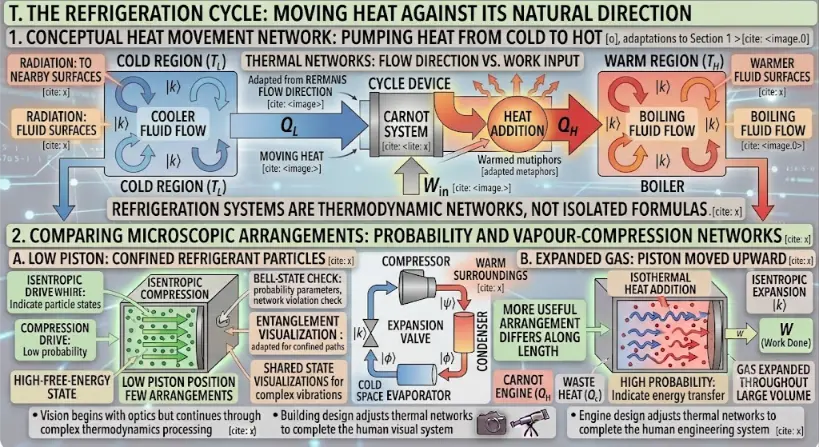
Concept map and comparative microscopic diagrams visualizing the refrigeration cycle and entropy. The top panel illustrates a natural multi-mode flow path loop driven by temperature-gradient and work input, while lower panels track useful work, cycle spontaneity, and microscopic particle states.
The Basic Energy Balance
A refrigerator or heat pump receives work input and moves heat from a colder region to a warmer region. For one complete cycle, the energy balance is:
QH = QL + Win
Here, QL is the heat removed from the low-temperature region, QH is the heat rejected or delivered to the high-temperature region, and Win is the required work input.
Rearranging gives:
Win = QH − QL
| Quantity | Meaning | Refrigerator View | Heat Pump View |
|---|---|---|---|
| QL | Heat absorbed from the low-temperature region | Useful cooling effect | Heat taken from outdoor air, ground, water, or another source |
| QH | Heat rejected to the high-temperature region | Waste heat rejected to room air or outdoors | Useful heating delivered indoors |
| Win | Work input required to run the cycle | Electricity to run compressor | Electricity to run compressor |
The important point is that QH is larger than QL, because the work input also becomes part of the heat delivered to the high-temperature side.
Coefficient of Performance
Refrigerators and heat pumps are not usually described by thermal efficiency because their purpose is not to produce work. Instead, they are described by coefficient of performance, often written as COP.
Coefficient of Performance for a Refrigerator
For a refrigerator, the useful effect is heat removed from the cold region:
COPR = QL / Win
A higher COPR means more cooling is produced for each unit of work input.
Coefficient of Performance for a Heat Pump
For a heat pump, the useful effect is heat delivered to the warm region:
COPHP = QH / Win
Since QH = QL + Win, the heat-pump COP is related to the refrigerator COP:
COPHP = COPR + 1
| Device | Useful Output | COP Formula | Meaning |
|---|---|---|---|
| Refrigerator | Cooling effect | COPR = QL / Win | Heat removed per unit work input |
| Heat pump | Heating effect | COPHP = QH / Win | Heat delivered per unit work input |
| Same cycle | Different useful side | COPHP = COPR + 1 | Heat-pump COP is higher because delivered heat includes work input |
Why COP Can Be Greater Than One
Students sometimes think a COP greater than one violates energy conservation. It does not. A heat pump with COP of 4 does not create four units of energy from one unit of electricity. It uses one unit of work to move several units of heat from a source to a warmer space.
For example, if a heat pump uses 1 kWh of electrical work and delivers 4 kWh of heat indoors, then about 3 kWh of heat has been taken from the outdoor air, ground, or another heat source.
| Misleading Interpretation | Correct Interpretation |
|---|---|
| The device creates more energy than it uses | The device moves existing heat and adds work input |
| COP is the same as efficiency | COP measures useful heat moved or delivered per unit work input |
| A high COP breaks thermodynamics | A high COP is possible because the device transfers heat rather than converting work into heat only |
The Reversed Carnot Cycle
The ideal upper limit for refrigeration and heat pump performance is given by the reversed Carnot Cycle. It is a perfectly reversible cycle operating between a low temperature TL and a high temperature TH, both measured in kelvins.
For a Carnot refrigerator:
COPR,Carnot = TL / (TH − TL)
For a Carnot heat pump:
COPHP,Carnot = TH / (TH − TL)
These formulas reveal a key lesson: refrigeration and heat pumping become harder as the temperature lift increases. The temperature lift is TH − TL.
| Temperature Situation | Effect on Ideal COP | Physical Meaning |
|---|---|---|
| Small temperature difference | High COP possible | Heat is moved only a short thermal distance |
| Large temperature difference | COP decreases | More work is needed to lift heat from cold to warm |
| Lower evaporator temperature | COP decreases | Deep freezing requires more work |
| Higher condenser temperature | COP decreases | Rejecting heat to hotter surroundings is harder |
The Vapour-Compression Refrigeration Cycle
The most common practical refrigeration and heat pump cycle is the vapour-compression cycle. It uses a refrigerant that evaporates at low pressure and condenses at high pressure.
The four main components are the compressor, condenser, expansion valve, and evaporator.
| Stage | Component | Main Process | Thermal Meaning |
|---|---|---|---|
| 1 → 2 | Compressor | Vapour compression | Low-pressure refrigerant vapour becomes high-pressure, high-temperature vapour |
| 2 → 3 | Condenser | Heat rejection and condensation | Refrigerant rejects heat and becomes liquid |
| 3 → 4 | Expansion valve | Throttling | Pressure drops suddenly and some liquid flashes into vapour |
| 4 → 1 | Evaporator | Heat absorption and evaporation | Refrigerant absorbs heat from the cold space and becomes vapour |
Process 1 → 2: Compression
The compressor receives low-pressure refrigerant vapour from the evaporator and compresses it to a higher pressure. The temperature also rises, so the refrigerant can reject heat to the warmer surroundings in the condenser.
The compressor work input per unit mass is:
wcompressor = h2 − h1
Here, h1 and h2 are the refrigerant enthalpies at compressor inlet and outlet.
Process 2 → 3: Condensation
The high-pressure hot refrigerant enters the condenser. It rejects heat to outdoor air, cooling water, or indoor air in heating mode. As it loses heat, it condenses from vapour to liquid.
The heat rejected per unit mass is:
qH = h2 − h3
For an air conditioner or refrigerator, this heat is usually rejected to the surroundings. For a heat pump, this heat is the useful heating output.
Process 3 → 4: Throttling Through the Expansion Valve
The high-pressure liquid refrigerant passes through an expansion valve or capillary tube. Its pressure drops suddenly. This throttling process is highly irreversible, but it is simple, reliable, and widely used.
For an ideal throttling valve, the enthalpy remains approximately constant:
h4 = h3
After throttling, the refrigerant is a cold low-pressure mixture of liquid and vapour, ready to absorb heat in the evaporator.
Process 4 → 1: Evaporation
The cold low-pressure refrigerant enters the evaporator. It absorbs heat from the refrigerated space, indoor air, water loop, or another cold source. As it absorbs heat, the refrigerant evaporates into vapour.
The heat absorbed per unit mass is:
qL = h1 − h4
For a refrigerator or air conditioner, this is the useful cooling effect. For a heat pump, this is the heat extracted from the colder source before being upgraded and delivered at a higher temperature.
Energy Relations for the Vapour-Compression Cycle
Using refrigerant enthalpies, the main performance quantities for the vapour-compression cycle are:
| Quantity | Expression | Meaning |
|---|---|---|
| Compressor work input | win = h2 − h1 | Work needed to compress refrigerant vapour |
| Cooling effect | qL = h1 − h4 | Heat absorbed in the evaporator |
| Heating effect | qH = h2 − h3 | Heat rejected in the condenser |
| Refrigerator COP | COPR = (h1 − h4) / (h2 − h1) | Cooling per unit compressor work |
| Heat pump COP | COPHP = (h2 − h3) / (h2 − h1) | Heating per unit compressor work |
These equations are widely used in engineering analysis because refrigerant property tables and pressure-enthalpy diagrams often give enthalpy values directly.
The Cycle on a Pressure-Enthalpy Diagram
The pressure-enthalpy diagram is one of the most common diagrams for refrigeration and heat pump analysis. It is especially useful because heat and work quantities are often enthalpy differences.
| Process | Appearance on P–h Diagram | Physical Meaning |
|---|---|---|
| 1 → 2 | Compression from low pressure to high pressure | Enthalpy and pressure increase |
| 2 → 3 | High-pressure heat rejection | Refrigerant condenses and enthalpy decreases |
| 3 → 4 | Nearly vertical throttling line | Pressure decreases while enthalpy remains nearly constant |
| 4 → 1 | Low-pressure heat absorption | Refrigerant evaporates and enthalpy increases |
A pressure-enthalpy diagram helps students see why the expansion valve does not produce useful work. The pressure drops, but the process is throttling, not turbine expansion.
The Cycle on a Temperature-Entropy Diagram
A temperature-entropy diagram helps students understand heat transfer and irreversibility in refrigeration and heat pump cycles.
| Process | Path on T–S Diagram | Meaning |
|---|---|---|
| Compression | Rises to higher pressure and temperature | Work input raises refrigerant energy |
| Condensation | Heat rejection at high temperature | Refrigerant changes from vapour to liquid |
| Throttling | Irreversible pressure drop | Entropy increases and useful work potential is lost |
| Evaporation | Heat absorption at low temperature | Refrigerant absorbs heat from the cold region |
Compared with the reversed Carnot Cycle, the practical vapour-compression cycle has irreversibilities, especially during throttling and real compression. These reduce the COP below the ideal limit.
Refrigerator, Air Conditioner, and Heat Pump: Same Cycle, Different Purpose
Refrigerators, air conditioners, and heat pumps often use the same vapour-compression principle. What changes is the useful side of the heat transfer.
| Device | Cold Side | Warm Side | Main Goal |
|---|---|---|---|
| Refrigerator | Food compartment | Kitchen air | Keep food cold |
| Air conditioner | Indoor room air | Outdoor air | Cool indoor space |
| Heat pump in heating mode | Outdoor air, ground, or water source | Indoor space | Heat indoor space |
| Reversible heat pump | Can switch depending on mode | Can switch depending on mode | Provide both heating and cooling |
This is why many modern air-conditioning systems can also heat. By reversing the refrigerant flow using a reversing valve, the indoor and outdoor coils can swap roles.
Main Components of a Vapour-Compression System
Compressor
Raises refrigerant pressure and temperature. It supplies the work input that allows heat to move from cold to warm.Condenser
Rejects heat at high pressure. The refrigerant changes from vapour to liquid while giving heat to the warm side.Expansion Valve
Drops the refrigerant pressure through throttling. This creates a cold low-pressure mixture before the evaporator.Evaporator
Absorbs heat at low pressure. The refrigerant evaporates while cooling the desired space or heat source.Reversing Valve
Used in reversible heat pumps to switch between heating and cooling modes.Fans and Pumps
Move air or water across coils so heat can be absorbed or rejected effectively.Refrigerant
The working fluid that evaporates and condenses at useful temperatures and pressures.Controls and Sensors
Regulate temperature, pressure, compressor speed, defrost cycles, safety limits, and energy performance.Why Phase Change Is So Useful
The vapour-compression cycle is powerful because the refrigerant changes phase. During evaporation, the refrigerant can absorb a large amount of heat at nearly constant temperature. During condensation, it can reject a large amount of heat at another nearly constant temperature.
| Phase-Change Process | Why It Helps | Example |
|---|---|---|
| Evaporation | Absorbs large latent heat from the cold region | Cooling air inside a refrigerator or room |
| Condensation | Rejects large latent heat to the warm region | Heating indoor air or rejecting heat outdoors |
| Low-pressure boiling | Allows refrigerant to evaporate at low temperature | Freezers and air conditioners |
| High-pressure condensation | Allows refrigerant to reject heat at higher temperature | Heat pump heating and condenser coils |
Without phase change, much larger fluid flow rates or temperature differences might be needed to move the same amount of heat.
Temperature Lift and System Performance
Temperature lift is the difference between the temperature at which heat is delivered and the temperature at which heat is absorbed. A larger temperature lift usually lowers COP.
For example, a heat pump works more easily when taking heat from mild outdoor air and delivering it to a moderately warm indoor space. It works harder when outdoor air is very cold and indoor heating temperature must be high.
| Condition | Effect on COP | Reason |
|---|---|---|
| Cold source temperature rises | COP improves | Heat is easier to extract from a warmer source |
| Warm delivery temperature falls | COP improves | Heat does not need to be lifted as far |
| Freezer temperature is very low | COP decreases | Deep cooling requires larger temperature lift |
| Outdoor air is very cold | Heat pump COP decreases | Less heat is available at useful temperature |
| Condenser is dirty or poorly cooled | COP decreases | System must reject heat at higher temperature and pressure |
Air-Source, Ground-Source, and Water-Source Heat Pumps
Heat pumps can take heat from different sources. The source affects COP, installation cost, reliability, and suitability for different climates.
| Heat Pump Type | Heat Source | Advantages | Challenges |
|---|---|---|---|
| Air-source heat pump | Outdoor air | Common, easier to install, widely used | Performance falls in very cold weather and defrost may be needed |
| Ground-source heat pump | Ground or buried loop | More stable source temperature and often high COP | Higher installation cost and site requirements |
| Water-source heat pump | Lake, river, well, or water loop | Can be efficient when water source is suitable | Requires water access, regulation, and fouling control |
| Exhaust-air heat pump | Ventilation exhaust air | Recovers heat that would otherwise be lost | Limited by available exhaust airflow and temperature |
Refrigerants and Environmental Responsibility
The refrigerant is central to refrigeration and heat pump cycles. It must evaporate and condense at useful temperatures and pressures, carry heat effectively, remain stable, and be safe enough for practical use.
Modern refrigerant selection also considers environmental impact. Older refrigerants caused ozone depletion or had high global warming potential. Newer choices aim to reduce environmental harm while maintaining safety, efficiency, and reliability.
| Refrigerant Property | Why It Matters | Design Concern |
|---|---|---|
| Boiling temperature | Determines operating pressure and useful temperature range | Must match cooling or heating application |
| Latent heat | Affects heat moved per kilogram of refrigerant | Higher latent heat can reduce required mass flow |
| Pressure level | Affects compressor and piping design | Too high or too low pressure can create engineering challenges |
| Toxicity | Affects safety in occupied spaces | Requires suitable containment and ventilation |
| Flammability | Affects installation and safety rules | Requires charge limits and safety precautions |
| Global warming potential | Affects climate impact if refrigerant leaks | Low-impact refrigerants are increasingly important |
| Ozone depletion potential | Affects stratospheric ozone layer | Ozone-depleting refrigerants have been phased out in many systems |
Refrigeration Cycle Compared with Heat Engine Cycles
Refrigeration and heat pump cycles are related to heat-engine cycles, but the direction of operation is different. Heat engines produce work from heat flow. Refrigeration and heat pump cycles use work to control heat flow.
| Cycle Type | Energy Goal | Work Role | Example |
|---|---|---|---|
| Carnot Cycle | Ideal heat-to-work conversion or reversed heat movement | Work output as engine, work input when reversed | Ideal engine, refrigerator, or heat pump limit |
| Rankine Cycle | Produce power from vapour expansion | Net work output | Steam power plant |
| Brayton Cycle | Produce power from gas expansion | Net work output | Gas turbine or jet engine |
| Refrigeration and Heat Pump Cycles | Move heat from cold to warm | Work input | Refrigerator, air conditioner, heat pump |
Reversed Carnot Cycle Versus Vapour-Compression Cycle
The reversed Carnot Cycle gives the ideal COP limit, but the vapour-compression cycle is much more practical. A perfect reversed Carnot cycle would require ideal reversible heat transfer and ideal expansion, which are difficult to achieve in real equipment.
| Feature | Reversed Carnot Cycle | Vapour-Compression Cycle |
|---|---|---|
| Main role | Ideal performance benchmark | Practical refrigeration and heat pump model |
| Compression | Ideal reversible compression | Real compressor with losses |
| Expansion | Ideal expansion with possible work recovery | Throttling valve, simple but irreversible |
| Heat transfer | Reversible heat transfer at ideal temperatures | Finite temperature differences in heat exchangers |
| Practicality | Difficult to realise | Widely used in refrigerators, air conditioners, and heat pumps |
Applications of Refrigeration and Heat Pump Cycles
Domestic Refrigerators
Keep food cold by removing heat from an insulated compartment and rejecting it to the surrounding room.Air Conditioning
Remove heat and moisture from indoor air to improve comfort in homes, schools, offices, vehicles, and public buildings.Heat Pump Heating
Use work input to deliver heat indoors from outdoor air, ground, water, or waste heat sources.Cold Storage and Food Supply
Preserve food, medicine, and biological materials by maintaining controlled low temperatures.Industrial Refrigeration
Support chemical processing, food production, ice making, gas liquefaction, and temperature-sensitive manufacturing.Data Centre Cooling
Remove heat from servers and power electronics to maintain reliability and reduce downtime.Electric Vehicle Thermal Management
Control battery, motor, inverter, and cabin temperatures using heat pump and refrigeration principles.Low-Carbon Buildings
Heat pumps can reduce dependence on direct fossil-fuel heating when powered by low-carbon electricity.Why Real Systems Differ from Ideal Cycles
Real refrigeration and heat pump systems differ from ideal models because components have losses, heat exchangers need finite temperature differences, refrigerants experience pressure drops, and compressors are not perfectly isentropic.
| Ideal Assumption | Real Behaviour | Effect on Performance |
|---|---|---|
| Isentropic compression | Compressor friction, motor losses, heating, and leakage occur | More work input is required |
| Perfect heat exchangers | Finite temperature differences are needed for heat flow | COP decreases |
| No pressure drops | Pipes, coils, filters, and valves cause pressure losses | Compressor must work harder |
| Ideal expansion | Most systems use irreversible throttling | Useful work potential is lost |
| Pure steady operation | Systems start, stop, defrost, cycle, and operate at part load | Seasonal performance differs from ideal COP |
| No refrigerant leakage | Leaks can occur over equipment lifetime | Performance and environmental impact worsen |
Common Performance Improvements
Engineers improve refrigeration and heat pump systems by reducing temperature lift, improving compressor performance, improving heat exchangers, selecting suitable refrigerants, and using smarter controls.
Variable-Speed Compressors
Adjust compressor speed to match demand, improving part-load efficiency and comfort control.Better Heat Exchangers
Larger or more effective coils reduce temperature differences and improve COP.Electronic Expansion Valves
Control refrigerant flow more accurately than simple fixed restrictions in many systems.Improved Insulation
Reduces unwanted heat gain into cold spaces or heat loss from warm spaces.Heat Recovery
Waste heat from cooling systems can sometimes be used for water heating or space heating.Low-Impact Refrigerants
Reduce environmental harm while maintaining suitable safety and performance.Defrost Control
Improves air-source heat pump performance in cold and humid conditions.Smart Controls
Use sensors, weather data, occupancy patterns, and variable operation to improve seasonal performance.Challenges and Practical Limitations
Refrigeration and heat pump cycles are useful and efficient, but they still face practical challenges involving climate, cost, refrigerants, installation quality, maintenance, and operating conditions.
| Challenge | Why It Matters | Engineering Response |
|---|---|---|
| Large temperature lift | Reduces COP and increases compressor work | Improve building insulation, lower heating supply temperature, and use suitable heat sources |
| Cold-weather operation | Air-source heat pumps may lose capacity and need defrosting | Use improved compressors, controls, backup heat, or ground-source systems where suitable |
| Refrigerant environmental impact | Leaks can contribute to climate or ozone problems depending on refrigerant | Use low-impact refrigerants, leak prevention, and proper recovery |
| Installation quality | Poor sizing, airflow, charging, or duct design can reduce performance | Use proper design, commissioning, and maintenance |
| Compressor reliability | The compressor is a major cost and energy consumer | Use good lubrication, controls, protection, and appropriate operating limits |
| Frost formation | Outdoor coils can collect frost in heating mode | Use defrost cycles and coil design to manage frost |
| Noise and comfort | Fans, compressors, and cycling affect user experience | Use quiet design, variable-speed operation, and good placement |
Future Directions and Engineering Relevance
Refrigeration and heat pump cycles are becoming more important as societies seek lower-energy cooling, cleaner heating, safer cold chains, and better temperature control in buildings, vehicles, industry, and data systems.
Building Electrification
Heat pumps can replace many direct fossil-fuel heating systems when electricity is increasingly low-carbon.Natural Refrigerants
Carbon dioxide, ammonia, hydrocarbons, and other lower-impact refrigerants are important in future system design.High-Temperature Heat Pumps
Industrial heat pumps may provide useful heat for processes that previously depended on fuel combustion.Thermal Energy Storage
Cold or hot storage can shift energy use away from peak demand periods and support renewable electricity grids.Data Centre Thermal Management
More efficient cooling systems are essential as computing power and AI infrastructure grow.Electric Vehicle Heat Pumps
Efficient cabin and battery temperature control can improve range, charging performance, and comfort.Smart Grid Integration
Heat pumps and refrigeration systems can respond to electricity prices, grid signals, and renewable energy availability.Advanced Cycle Designs
Ejector cycles, transcritical cycles, cascade systems, magnetic refrigeration, and absorption cycles may expand future options.Connections with Wider Thermodynamics
Refrigeration and heat pump cycles connect thermodynamic laws, heat transfer, phase change, fluid flow, materials, energy efficiency, and environmental responsibility.
Thermodynamics
These cycles show how work input can move heat against its natural direction while still obeying the First and Second Laws.Laws of Thermodynamics
The Second Law explains why work input is needed to move heat from cold to warm.Heat Transfer
Evaporators and condensers depend on conduction, convection, phase change, and sometimes radiation.Phase Equilibria and Phase Transitions
Evaporation and condensation are central to vapour-compression refrigeration and heat pump operation.Engineering Thermodynamics
Refrigerators, heat pumps, compressors, expansion valves, and refrigerants are core engineering thermodynamics topics.Thermodynamics and Heat Transfer in Mechanical Engineering
These cycles show how mechanical engineers design cooling, heating, thermal comfort, and industrial temperature-control systems.Learning Pathway Within Thermodynamic Cycles
Refrigeration and Heat Pump Cycles complete this Thermodynamic Cycles pathway by reversing the usual heat-engine direction. Instead of producing work from heat flow, these cycles use work input to control heat flow.
Carnot Cycle
Learn how the ideal reversible heat-engine cycle sets the maximum possible efficiency between two temperatures.Otto Cycle
Understand how the ideal spark-ignition engine cycle links compression ratio, constant-volume heat addition, expansion, and efficiency.Diesel Cycle
Explore compression ignition, constant-pressure heat addition, cut-off ratio, and ideal diesel engine efficiency.Rankine Cycle
Learn how steam power plants use pumps, boilers, turbines, condensers, phase change, and heat-to-work conversion.Brayton Cycle
Understand gas turbines, jet engines, compressors, combustors, turbines, pressure ratio, and continuous-flow power.Refrigeration and Heat Pump Cycles
Current page. See how reversed cycles use work input to move heat from colder regions to warmer regions.Quick Check: Refrigeration and Heat Pump Cycles
Quick Check: Moving Heat from Cold to Warm
Q1. Why does a refrigerator need work input?
A refrigerator moves heat from a colder region to a warmer region, which is opposite to natural heat flow. Work input is required to drive this process.
Q2. What is the useful effect of a refrigerator?
The useful effect of a refrigerator is QL, the heat removed from the cold space.
Q3. What is the useful effect of a heat pump?
The useful effect of a heat pump is QH, the heat delivered to the warm space.
Q4. Why does COP decrease when temperature lift increases?
A larger temperature lift means heat must be moved across a larger temperature difference, so more work input is required for each unit of heat moved.
Key Terms
- Refrigeration cycle
- A thermodynamic cycle that uses work input to remove heat from a low-temperature region.
- Heat pump cycle
- A thermodynamic cycle that uses work input to deliver heat to a high-temperature region.
- Coefficient of performance
- A performance measure showing useful cooling or heating divided by work input.
- Evaporator
- A heat exchanger where refrigerant absorbs heat and evaporates at low pressure.
- Condenser
- A heat exchanger where refrigerant rejects heat and condenses at high pressure.
- Compressor
- A device that raises refrigerant vapour pressure and temperature using work input.
- Expansion valve
- A device that lowers refrigerant pressure through throttling.
- Throttling
- An irreversible pressure-drop process with approximately constant enthalpy.
- Refrigerant
- The working fluid that evaporates and condenses to move heat in a refrigeration or heat pump cycle.
- Temperature lift
- The temperature difference between the heat delivery side and the heat absorption side.
- Vapour-compression cycle
- The most common practical cycle used in refrigerators, air conditioners, and heat pumps.
- Reversed Carnot Cycle
- An ideal reversible cycle that gives the maximum possible COP between two temperatures.
Frequently Asked Questions: Refrigeration and Heat Pump Cycles
What is a refrigeration cycle?
A refrigeration cycle uses work input to remove heat from a low-temperature space and reject it to a higher-temperature region.
What is a heat pump cycle?
A heat pump cycle uses work input to take heat from a cooler source and deliver it to a warmer space for heating.
How are refrigerators and heat pumps related?
They use the same basic thermodynamic principle. A refrigerator focuses on the cooling side, while a heat pump focuses on the heating side.
What are the four main components of a vapour-compression cycle?
The four main components are the compressor, condenser, expansion valve, and evaporator.
What does the compressor do?
The compressor raises the pressure and temperature of refrigerant vapour so it can reject heat at a higher temperature.
What does the evaporator do?
The evaporator absorbs heat from the cold region, causing low-pressure refrigerant to evaporate.
What does the condenser do?
The condenser rejects heat to the warm region, causing high-pressure refrigerant vapour to condense into liquid.
What does the expansion valve do?
The expansion valve reduces refrigerant pressure through throttling, producing a cold low-pressure mixture before the evaporator.
What is COP?
COP, or coefficient of performance, is the useful cooling or heating effect divided by the work input.
Why can a heat pump COP be greater than one?
A heat pump does not simply convert electricity into heat. It uses work input to move additional heat from a source to the heated space.
Why does COP fall in very cold weather?
The heat pump must move heat across a larger temperature difference, and the outdoor source contains less easily extractable heat at low temperature.
Why should students learn refrigeration and heat pump cycles?
These cycles explain refrigerators, air conditioners, heat pumps, cold storage, building heating, vehicle thermal management, and many low-carbon energy systems.
Review Questions and Answers
- What is the main purpose of a refrigeration cycle?Answer: Its main purpose is to remove heat from a low-temperature region and reject it to a higher-temperature region using work input.
- What is the main purpose of a heat pump cycle?Answer: Its main purpose is to deliver heat to a warm space by taking heat from a cooler source and adding work input.
- What is the basic energy balance for a refrigerator or heat pump?Answer: The basic balance is QH = QL + Win.
- What is the COP of a refrigerator?Answer: COPR = QL / Win.
- What is the COP of a heat pump?Answer: COPHP = QH / Win.
- Why is COPHP = COPR + 1 for the same cycle?Answer: Because QH = QL + Win, so the useful heating output includes both the heat taken from the cold side and the work input.
- What are the four main components of a vapour-compression cycle?Answer: The four main components are compressor, condenser, expansion valve, and evaporator.
- Why is throttling used even though it is irreversible?Answer: Throttling is simple, reliable, inexpensive, and effective for reducing refrigerant pressure before the evaporator.
- Why does a larger temperature lift reduce COP?Answer: More work is required to move heat from a colder source to a much warmer destination.
- Why are refrigerants important?Answer: Refrigerants determine operating pressures, heat-transfer performance, safety, environmental impact, and temperature range.
Thought-Provoking Questions and Answers
- Why is a refrigerator not violating the natural direction of heat flow?Answer: Heat naturally flows from hot to cold by itself. A refrigerator moves heat from cold to warm only because external work is supplied. The total process still obeys the Second Law.
- Why can heat pumps support low-carbon heating?Answer: Heat pumps move heat rather than generating all heat directly from fuel combustion. When powered by low-carbon electricity, they can reduce emissions from building heating.
- Why is the outdoor temperature so important for an air-source heat pump?Answer: Outdoor temperature affects evaporator temperature and temperature lift. Very cold outdoor air reduces heating capacity and COP.
- Why might better insulation improve heat pump performance?Answer: Better insulation reduces heating demand and may allow lower supply temperatures, reducing temperature lift and improving COP.
- Why are refrigerants both useful and environmentally sensitive?Answer: Refrigerants make efficient phase-change heat transfer possible, but leaks can harm the environment if the refrigerant has high global warming potential or ozone depletion potential.
- Why is COP a better performance measure than efficiency for refrigerators and heat pumps?Answer: These devices are not trying to convert heat into work. They are using work to move heat, so useful heat moved or delivered per unit work input is the more meaningful measure.
- Why does the expansion valve reduce performance compared with an ideal expansion device?Answer: Throttling wastes useful pressure energy and increases entropy. It is used because it is simple and reliable, but it is not thermodynamically ideal.
- What does refrigeration teach about engineering trade-offs?Answer: It shows that performance, cost, safety, refrigerant choice, climate impact, reliability, temperature range, and user comfort must be balanced together.
Numerical Problems and Solutions
- A refrigerator removes 600 J of heat from a cold space and requires 200 J of work input per cycle. Find its COP and heat rejected.Solution:
- Use COPR = QL / Win.
- COPR = 600 / 200 = 3.0.
- Use QH = QL + Win.
- QH = 600 + 200 = 800 J.
Answer: The refrigerator COP is 3.0, and the heat rejected is 800 J. - A heat pump delivers 5000 W of heat to a room while using 1250 W of electrical power. Find its COP and the heat extracted from the cold source.Solution:
- COPHP = QH / Win = 5000 / 1250 = 4.0.
- Use QH = QL + Win.
- QL = QH − Win = 5000 − 1250 = 3750 W.
Answer: The heat pump COP is 4.0, and it extracts 3750 W from the cold source. - A Carnot refrigerator operates between TL = 260 K and TH = 310 K. Find its ideal COP.Solution:
- Use COPR,Carnot = TL / (TH − TL).
- COPR,Carnot = 260 / (310 − 260).
- COPR,Carnot = 260 / 50 = 5.2.
Answer: The ideal refrigerator COP is 5.2. - A Carnot heat pump operates between TL = 275 K and TH = 315 K. Find its ideal COP.Solution:
- Use COPHP,Carnot = TH / (TH − TL).
- COPHP,Carnot = 315 / (315 − 275).
- COPHP,Carnot = 315 / 40 = 7.875.
Answer: The ideal heat pump COP is approximately 7.88. - A vapour-compression refrigerator has h1 = 395 kJ/kg, h2 = 430 kJ/kg, h3 = 250 kJ/kg, and h4 = 250 kJ/kg. Find the cooling effect, compressor work, and refrigerator COP.Solution:
- Cooling effect: qL = h1 − h4 = 395 − 250 = 145 kJ/kg.
- Compressor work: win = h2 − h1 = 430 − 395 = 35 kJ/kg.
- COPR = qL / win = 145 / 35 ≈ 4.14.
Answer: The cooling effect is 145 kJ/kg, compressor work is 35 kJ/kg, and refrigerator COP is approximately 4.14. - Using the same enthalpy values h1 = 395 kJ/kg, h2 = 430 kJ/kg, h3 = 250 kJ/kg, and h4 = 250 kJ/kg, find the heat pump COP.Solution:
- Heating effect: qH = h2 − h3 = 430 − 250 = 180 kJ/kg.
- Compressor work: win = h2 − h1 = 430 − 395 = 35 kJ/kg.
- COPHP = qH / win = 180 / 35 ≈ 5.14.
Answer: The heat pump COP is approximately 5.14. - A refrigerator has COP 3.5 and removes 700 W from a cold space. Find the required work input and heat rejected.Solution:
- Use COPR = QL / Win.
- Win = QL / COPR = 700 / 3.5 = 200 W.
- QH = QL + Win = 700 + 200 = 900 W.
Answer: The work input is 200 W, and the heat rejected is 900 W. - A heat pump has COP 4.5 and uses 2.0 kW of electrical power. Find the heating output and heat extracted from the cold source.Solution:
- Use QH = COPHP × Win.
- QH = 4.5 × 2.0 = 9.0 kW.
- Use QH = QL + Win.
- QL = 9.0 − 2.0 = 7.0 kW.
Answer: The heating output is 9.0 kW, and the heat extracted from the cold source is 7.0 kW.
Why This Topic Matters
Refrigeration and heat pump cycles matter because modern life depends on controlled temperature. Food supply chains, medicine storage, indoor comfort, data centres, electric vehicles, industrial processes, and clean heating all rely on moving heat effectively.
For engineers, these cycles show how thermodynamics, heat transfer, phase change, compressors, refrigerants, controls, and environmental responsibility come together in real systems. A good system is not only cold or warm enough. It must also be efficient, safe, reliable, affordable, quiet, maintainable, and environmentally responsible.
For students, refrigeration and heat pump cycles provide a powerful lesson in reversed thermodynamic thinking. Instead of asking how heat can produce work, they ask how work can move heat in a useful direction.
Summary
Refrigeration and heat pump cycles use work input to move heat from a low-temperature region to a high-temperature region. The basic energy balance is:
QH = QL + Win
For a refrigerator:
COPR = QL / Win
For a heat pump:
COPHP = QH / Win
The most common practical system is the vapour-compression cycle, using a compressor, condenser, expansion valve, and evaporator. It is used in refrigerators, air conditioners, heat pumps, cold storage, electric vehicles, industrial cooling, and building systems.
The performance of these cycles depends on temperature lift, refrigerant choice, compressor efficiency, heat exchanger design, installation quality, controls, and environmental impact. As societies seek efficient cooling and low-carbon heating, refrigeration and heat pump cycles will become even more important.
Reflection Question
If heat pumps and refrigeration systems can reduce energy waste but also depend on refrigerants, electricity, installation quality, and climate conditions, how should future engineers design cooling and heating systems that are efficient, safe, affordable, and environmentally responsible?